Blog

  • Rupert Murdoch’s News Corp to buy ESPN’s 50% stake in ESPN STAR Sports

    By A Correspondent


    Rupert Murdoch’s News Corp has agreed to acquire the 50 per cent it does not own in its Asian sports TV joint venture, ESPN STAR Sports, bringing to an end a 16-year-old relationship which, among other things, dominates cricket broadcast in the sub-continent.


    A unit of News Corporation will buy ESPN’s 50 per cent equity interest, a statement from the two partners said.  The transaction, which is subject to customary regulatory approvals, will allow News Corporation unit to own and operate all ESS businesses, including STAR Sports, ESPN and STAR Cricket.


    ESPN STAR Sports, which generates about Rs2,500 crore in revenues, also owns television broadcast rights for the ICC World Cup Cricket and T20 Champions League.


    No financial terms were disclosed but people close to the transaction said that it could have cash and non-cash components.


    While the cash component would not be very substantial, the non-cash portion could involve handing over the non-India distribution rights of possibly the T20 Championship League rights to ESPN.


    “News Corporation’s acquisition of the interest of ESS that we did not already own continues the programme of simplifying our operating model, consolidating our affiliate ownership structures, and furthers our commitment to delivering incredible sports programming to consumers across the globe, and particularly enhancing our position in sports programming in emerging markets,” said James Murdoch, deputy chief operating officer and chairman & CEO International, News Corporation.


    Wednesday’s announcement comes just weeks after STAR broke up with long-time Indian partner, the Kolkata-based ABP Group and sold its stake in Hindi news and regional language channels.


    “After 16 years jointly managing ESS, we have decided to independently pursue future opportunities in Asia,” said John Skipper, president of ESPN and co-chairman, Disney Media Networks.


    The partners also announced that Manu Sawhney, managing director of ESS, who has led ESS in the past 16 years, will hand over charge to Peter Hutton, SVP of sports for Fox International Channels (FIC).

    Mr Hutton will report to the ESS Board. Mr Sawhney will be staying with the company until August 31 to work with Hutton on a smooth transition.


    STAR’s ambitions in the sports broadcasting space were evident when it acquired the rights to Indian cricket from the Board of Control for Cricket in India, beating rival Sony and paying Rs4,000 crore.


    Speakingfrom the US, STAR India CEO Uday Shankar said: “Till the regulatory framework is done, it will be business as usual. As for the money we spent on acquiring the Indian cricket rights, it is money which will be paid over several years, (six) and I am confident of a broadcast transformation and a bigger market. A lot of distortion in this space will also have sorted out.”


    Mr Shankar also clarified that all the ESPN employees would continue not only as of now, but post the regulatory framework. “It’s not as if STAR has a ready-made sports setup all ready,” he added. As for competition and raising prices for acquisitions, he said, there are four active players and all will compete very vigorously.


    Source: The Economic Times
    Copyright © 2012, Bennett, Coleman & Co. Ltd. All Rights Reserved

  • Newspapers must make sense of TV news

    Ranjona Banerji

    By Ranjona Banerji


    Something has to be done about newspapers being so serious and stick-in-the-mud. Look at yesterday on television. There was so much excitement over two loos at the Planning Commission’s offices – spending Rs 35 lakh to do potty comfortably while millions of Indians were consigned to surviving happily on Rs 32 a day (am being generous here). To rub salt in the wound, Rs5 lakh was spent on a security system to keep the janata-public out. Everyone was spitting fire, from the opposition to activists to ordinary people. Montek Singh Ahluwalia, deputy chairman of the Planning Commission also had a wee tantrum – at the media and also RTI, which opened the bathroom doors as it were.


    Then Thursday morning comes and you open the newspaper. Hmmm. Does anyone oblige you by putting the story upfront with lots of diagrams and graphic details? Of course not – there’s just news on display like the economy and monsoon and a murder here and there. You have to trawl through the newspaper – page 12 or 15 or something to get a small little story about this toilet transgression. Even that CWG man who said that Indians have different cleanliness standards – anyone remember him – because of dirty bathrooms at CWG homes got more purchase on the press. Of course, I don’t remember his name but that may be because my brain has very strict hygiene protocols.


    If this example of newspaper perfidy is not bad enough, how about the other big story of the day? Some folliclely challenged man in Indonesia had something to do with Jharkhand politician and former chief minister Madhu Koda’s ill-gotten crores of rupees. The part of the day that wasn’t about Montek’s potty was about Koda’s friend. Some squeaky tapes played on and on as the anchors’ voices tried to match them for squeakiness and outdid them in decibel levels. Don’t ask me what the whole thing was about because I never figured it out. I must also clarify that I have nothing against men or women who don’t have a lot of hair on their heads but I have no other way of identifying this man who has something to do with Indonesia.


    Is one to find a code in the morning’s newspapers? Nyet, nada and all the rest of it. The monsoon and its arrival got more play in the newspapers than Koda’s not too hairy on the head friend and all that money. There will be at least one grateful person.


    It’s been said before, but it has to be said again. Newspapers must dedicate at least half a page a day making sense of TV news stories for hapless viewers.


  • Global ad biggies like Omnicom, Publicis & Dentsu in hectic parleys to buy Taproot

    By Neha Dewan & Ravi Balakrishnan


    In 2011, when Taproot snatched two big-ticket assignments, PepsiCo and Airtel – both JWT clients – the joke was that JWTstood for Just Went to Taproot.


    Now JWT may just have to be shuffled around to become TJW – or Taproot Just Went – now that a clutch of global ad networks are in hectic parleys with the founders of the five-year-old independent Indian agency. Those in the fray, said a person familiar with the negotiations, include the Omnicom group, Publicis and Dentsu.


    Agnello Dias, chairman and co-founder, Taproot India, said: “There are three or four groups talking to us and Dentsu is one of them. It doesn’t have any head start and we are no closer to signing a dotted line (with Dentsu than with any other network).”


    A Dentsu spokesperson was unavailable for comment. Nakul Chopra, CEO, Publicis South Asia, said: “We don’t comment on acquisitions of any nature.”


    Taproot’s co-founders Dias and Santosh Padhi are clearly testing the market and checking out valuations, said an agency insider. But this may not tantamount to an immediate sale.


    “The global groups are speaking not just to Taproot but also to other independent agencies like Creativeland Asia. We are open to talking to anybody but at the end of the day it may not be Dentsu, Omnicom or anybody. We would just like to get an idea of how much we are worth and valued at,” is how the insider who requested anonymity put it.


    The agency, which had a slow beginning in 2007, eventually moved on to big clients. Campaigns such as ‘Har Ek Friend Zaroori Hota Hai’ (HFZ) and ‘Change the Game’ for Pepsi got popular acclaim as well as industry  accolades with HFZ winning seven medals at Goafest this year.


    At Goafest, considered the premier local ad festival in India, Taproot was runner-up to Ogilvy India, clinching 34 metals and beating top agencies such as Leo Burnett, DDB Mudra, Grey and JWT. Besides this, the agency had won the Grand Effie award last year for the ‘Change the Game’ campaign.


    In its fifth year, the agency runs a tight ship with 35 people on board. A senior official at a leading ad agency says that Taproot has had to turn down a lot of projects in the past year.


    “Funding via a sale of equity will help them increase their capabilities,” he said. For now though, a more interesting game is afoot with Dias and Padhi playing their cards very close to their chest.


    Source: The Economic Times
    Copyright © 2012, Bennett, Coleman & Co. Ltd. All Rights Reserved


  • How ‘Fake Jhunjhunwala’ writer Aditya Magal impressed the ‘real’ Jhunjhunwala

    By Sruthijith KK


    On Tuesday, 26-year-old Aditya Magal nervously walked into the Nariman Point offices of billionaire investor Rakesh Jhunjhunwala. Most people who looked up from their terminals didn’t glance a second time, possibly concluding that the boy-faced youngster must be an internship-seeker at Rare Enterprises. But Jhunjhunwala himself took a keen interest in Magal, seating him in his private office, enquiring about his background, his family, his stylish haircut and his girlfriends.


    As word about the young visitor spread, Jhunjhunwala’s colleagues – hardnosed traders and analysts – streamed into his office to meet Magal. They shook hands with him. Everyone smiled. Some said they were fans. Magal’s stock was on the rise. The encounter, facilitated by ET, saw uproarious moments.


    For four-and-a-half years, unknown to everyone, Magal has been Fake Jhunjhunwala, the anonymous writer behind ‘The Secret Journal of Rakesh Jhunjhunwala’, a popular parody blog that tore into people in the news – politicians, actors, journalists, other stock market players, anyone – with biting sarcasm.


    He caricatured the identity of Jhunjhunwala, an opinionated ace stock picker with interesting quirks, into a loud, wildly entertaining character who spared none. His blog gets 30,000 unique visitors a month.


    Magal’s Twitter account is followed by more than 45,000. Even his online fan club has 2,500 followers on Twitter. Well-known people on Twitter, such as Gul Panag and Pritish Nandy, are amused by his writing.


    Not everyone’s amused though. Like some journalists, who were mercilessly taken down by the Fake Jhunjhunwala, who then called the real Jhunjhunwala to complain. “I told them I don’t write it,” the real Jhunjhunwala said. “Then they wanted to know who wrote it. Arrey, how do I know?”


    Kingfisher boss Vijay Mallya once told Jhunjhunwala that he liked to start his day by reading his tweets. “The first time I didn’t say anything. Then, another time he again said, ‘Rakeshbhai, you are very funny, what all you keep tweeting?’ Then I told him I don’t write it,” Jhunjhunwala said.


    In his column in The Indian Express, editor-in-chief Shekhar Gupta mistakenly attributed Fake Jhunjhunwala’s tweet to the real Jhunjhunwala, to illustrate the prejudices and dominance of the “upper caste, creamy layer of our society”. The newspaper later apologised.


    Magal carries clear disclaimers on both his Twitter bio and his blog. And as long as he does that, Jhunjhunwala says, he has no problems with what he writes. “Who am I? You have a right to express yourself. And you are saying you are not me. Then what is the problem?” In a country where people compete to take offence, Magal picked the right man to parody.


    As it happened, Magal didn’t pick Jhunjhunwala. The blog was started in 2008 by Mark Fidelman, an American who then worked in Indian real estate. Inspired by the success of the Fake Steve Jobs blog, Fidelman created the blog as a platform to vent his frustrations with India after his business here suffered. After three months, Fidelman told Magal, who he knew through a business association, about the blog, and asked him to take over. Magal says he started laughing.


    “I have been following Rakesh sir since the time I was 20 or so. I was following a number of investors and gradually, what Rakesh sir said started making the most sense for me.” Magal dabbled in the stock markets and like countless retail investors before him, was taken in by Jhunjhunwala’s knowledge and his uncanny ability to make the right bets.


    If he was a follower before, writing the blog for four years turned Magal into something of a devotee. He has read and watched nearly every interview the investor has given. He knows everything there is to know about Jhunjhunwala, from the year his sister got married to the architect of his Lonavala home. From the brands of cigarettes and whiskeys he prefers to the Mercedes S Class he drives. “Why, I also have a Bentley,” Jhunjhunwala helped along, amused by Magal’s grasp of J-trivia. But Magal knows not just trivia about Jhunjhunwala. He also knows his investment portfolio closely.


    But Magal’s natural funny side is more often on display. At lunch with this correspondent, he recited a poem: “Jhunjhunwala goes to Lonavala to live in a house by Killawala.” Nitin Killawala is the architect. In Jhunjhunwala’s office, as his colleagues gathered around to meet the famous blogger, Magal parodied Jhunjhunwala’s TV appearances. His habit of talking up the India story, the peculiar way in which he says ‘humongous’. Everyone laughed.


    When Jhunjhunwala lit another cigarette, Magal told him that he should cut down on his smoking. “What is this sir? Earlier in interviews you used to say you smoked 10-15 cigarettes. Now you say 20-25. And you have stopped doing yoga.” Jhunjhunwala demonstrated some yoga-style breathing for him.


    The atmosphere was warm and convivial. When Magal sought permission to click some pictures of his office, Jhunjhunwala readily agreed. “Please, please, do. Click whatever you want Aditya, we are simple people.”


    Jhunjhunwala found Magal so funny that he saved his number as ‘Aditya Joker’ on his phone. “You are a natural joker. You have a talent for humour,” he said.


    Niraj Dalal, who works with Jhunjhunwala, said he was relieved to meet Magal. “People used to suspect it’s me!” Jhunjhunwala said he also thought the writer was someone who knew him closely or worked with him. “There were things only seven or eight of us would know and that would be on the blog. That used to unnerve us,” Dalal said.


    Jhunjhunwala asked Magal what he wanted to do in life. “Write books and help people. The moment I have a plot ready in my head, I’ll drop everything and write a book,” he said.


    Jhunjhunwala wished him the best. Magal invited Jhunjhunwala to visit his Bangalore home sometime. “Surely. Will you invite me for your wedding?” Certainly, Magal said. “Will you come in a helicopter, sir?”


    Magal told Jhunjhunwala that he would love to write his autobiography if he ever considered writing one. The investor was hesitant. “Why should we self-glorify? Let’s see when it comes to that.”


    Magal gifted him two Ganesha idols, which Jhunjhunwala is known to collect. He asked a colleague to place the brass idol alongside dozens of idols on a shelf in his office. The other one, a sandalwood idol, he placed right in front of him, along the five monitors on his desk that he uses to watch the movements of his empire of wealth.


    Before Magal left, Jhunjhunwala asked him if there was anything he could do to help. “I’d be foolish not to ask you for investment advice. But then I’m not a pretty girl and you are not tipsy,” Magal said, referring to a wisecrack Jhunjhunwala made during an interview regarding his rule about stock tips. Jhunjhunwala made an exception, and gave him a stock tip. “Buy.”


    As he rode the elevator down and got into the waiting cab, Magal was overjoyed. When he walked in, he didn’t know what to expect. “I can now cross off one item on my bucket list,” he said.


    Source: The Economic Times
    Copyright © 2012, Bennett, Coleman & Co. Ltd. All Rights Reserved

     

  • Aaj Tak Care Awards are good news for society: Aroon Purie

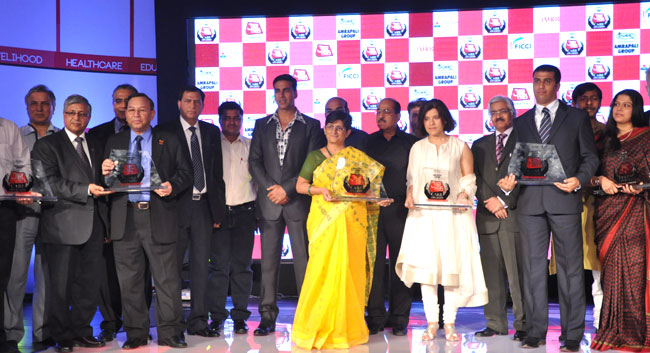
    Bollywood Star Akshay Kumar & Aroon Purie, Chairman & Editor-n-Chief, India Today Group with winners of Aaj Tak Care Awards


    By Shruti Pushkarna


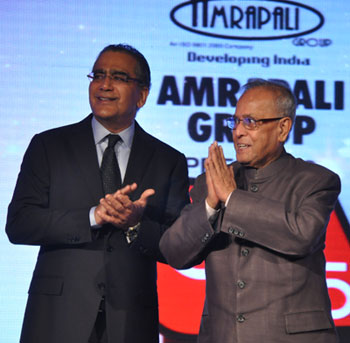
    Mr.Aroon Purie, Editor-in-Chief, India Today Group with Finance Minister Pranab Mukherjee at the Aaj Tak Care Awards

    TV Today Network’s Hindi news channel Aaj Tak hosted the first edition of Aaj Tak Care Awards on June 6 at the Taj Palace Hotel inNew Delhi. The awards seek to honour corporate entities who have contributed towards inclusive and sustainable development keeping in mind the society as the focal point.


    Finance Minister Pranab Mukherjee graced the event as the chief guest and felicitated the winners at the awards ceremony. Bollywood actor Akshay Kumar, who launched the Aaj Tak Care awards anthem, was also present at the awards ceremony.


    Inaugurating the awards ceremony, Aroon Purie, Chairman & Editor-in-Chief, India Today Group said: “The industry realises it must make more than just profit; that it must give back to the society. TV News channels have been accused of concentrating only on what’s wrong with the society, so these awards are ‘good news’.”


    Speaking at the event, Mr Pranab Mukherjee urged the corporate sector to build CSR in a big way into their business: “You need to give back to the society. We need more Nandan Nilekanis to join the cause. CorporateIndiahas to help with new ideas to deal with some of the prevailing socio-economic issues. We need to work together towards a better future.”


    Aaj Tak Care Awards were given away in five different categories, Education, Empowerment, Environment, Healthcare and Livelihood. Leading research agency, IMRB International filtered entries for participation in these awards based on parameters like replicability, sustainability, people participation and innovativeness. In the second phase, Federation of Indian Chambers of Commerce (FICCI), with their expertise in various sectors, partnered to further shortlist the companies. They compared and evaluated the CSR initiatives of all entries and nominated the final 40 companies for the second phase. The third and last phase of the Aaj Tak Care Awards was the selection process by the jury where eminent personalities debated and arrived at a list of final 12 winners.


    The Jury was chaired by Mr Gurcharan Das, Chairman, author & management consultant. Other jury members included, Prof Dipankar Gupta, noted sociologist; Mr Arun Kapur, Executive Director, Learn Today; Mr Sandeep Pandey, social activist; Mr Rajender Singh, environmentalist & chairman, Tarun Bhagat Sangh; Dr Ashok Seth, Chairman of Fortis Group of Hospitals (Cardiovascular Sciences & Cardiology Council); Mr Sandeep Chachra, Executive Director, Action Aid India.


    Commenting on the awards, Joy Chakraborthy, CEO, TV Today Network said: “The Aaj Tak Care Awards is an endeavour by the TV Today network to recognize and honour the real champions of corporateIndiawho have positively impacted the society. We looked at companies who have gone beyond their corporate objectives of growth and profitability, and laid an emphasis on the improvement of the society as their larger objective.”


    List of winners in all five categories:

    Education

    Amway India Enterprises Pvt. Ltd

    PVR Limited


    Environment

    Suzlon Energy Limited

    ONGC

    Dabur India Ltd


    Healthcare

    Eli Lilly & Company

    JK Lakshmi Cement Ltd

    Standard Chartered


    Empowerment

    Gitanjali Gems

    Microsoft Corporation


    Livelihood

    Bharat Petroleum Corporation Limited (BPCL)

    First Source Solutions Ltd


  • The Anchor: Upen Rai on 5 reasons why online videos are important for marketers

    By Upen Rai


    1. Video gets undivided attention

    Web pages are full of hyperlinks, images, advertisements, and so on which distract the user. When a video plays, the user is fixated on the audio and video with undivided attention. What better medium to get your message across to the user?


    2. Video is ubiquitous 

    The web is full of conflicting standards and making things work across device form factors and browser quirks can be frustrating. Video playback is ubiquitous and works equally well on all device form factors – so it is easy for online marketers to ensure that their message gets conveyed like it was meant to be!


    3. Video increases engagement

    Ever since web analytics were measured, website owners have struggled to keep bounce rates low and engage the user with interesting content. Video automatically increases engagement by keeping the user busy, while advertising and other messaging can be shown non-intrusive to the user experience.


    4. Video enables a higher call to action

    With the right mix of audio and compelling visuals, it is easier for brands to create a call to action and on the online medium, even lead a user into then completing a task. Video raises emotional connect with the brand and eases the user into completing actions like supporting a cause, liking a brand’s social media page, sharing the message with more users, and so on.


    5. Anybody can make online videos

    Whether it is a large corporate or a small group of non-profit volunteers, a compelling brand message is easy to create, produce and distribute in the online space. It is the best way for viral marketing and to gather more eyeballs.


    Upen Rai is Director, Times Internet Ltd


  • Debrief | Fox Movies: Brilliant!

    By Anil Thakraney


    Haha. Real cool ad. Will keep you in splits and very entertained because it’s delightfully salacious. FOX Movies decided to offer cinema dubbed in regional languages for the Thai market, and their ad agency turned it into an idea for subtitles-free communication.


    The fun commercial features a young male exec whose eyes are shamelessly trained on his pretty lady boss’s breasts. And the dude gets a couple of tight slaps as his just reward. Poor chap, not his fault. He’s used to reading subtitles in the foreign language movies he watches. And is unable to kick the ‘bad’ habit.


    Yup, it’s super stuff. The TVC packs in all the ingredients of a good ad film. It is entertaining, surprising, engaging and single-minded. And there’s cool lateral thinking at play to highlight what is otherwise a very uninteresting product promise. Full marks!


    As a naughty aside, this particular treatment will not work in the Indian market. Only because the average Indian male’s eyes are fixated ‘out there’ in any case, and it has nothing to do with watching foreign films that carry subtitles. 🙂


    Rating: (On a scale of 1 to 5): 5. Fabulous advertising


  • We want to be in the forefront when new media merges with traditional: Anuj Gandhi


    The writing was on the wall the day Anuj Gandhi joined Network 18 in March this year to oversee the group’s distribution and new business development. And the reason for this was the all-new relationship between Network 18-TV 18 and Reliance Industries forged a few months before his joining.


    Other than the providing of the much-needed funds and the consequent stake in one of India’s largest (and more powerful) media conglomerates, Reliance was also looking at making full use of the content produced and owned by the various Network18 and Television18 arms, especially for the Reliance 4G services.


    Also, in the post-digitization era, distribution becomes a key driver in the revenues of a broadcaster, especially for niche channels. And with various mobile devices becoming popular and wireless technology progressing rapidly from 2G to 4G even in India, the monetization potential for multimedia content leapfrogs.


    Enter IndiaCast, a joint venture of TV18 and Viacom18 to create India’s first multi-platform ‘Content Asset Monetization’ entity.


    IndiaCast Group CEO Anuj Gandhi is a veteran in the distribution and the affiliate sales front. An MBA from the SP Jain Insitute of Management, he has worked with Discovery Communications as Director – Affiliate Sales (1997-2002),  as President of SET Discovery (2002-07) and CEO of DEN Networks (2007-2010) and worked as an independent consultant for a little over a year. He has also worked with IndusInd Media in distribution (way back in 1994) and prior to that with Ranbaxy. Clearly, being an early leader in every aspect of the distribution business, Mr Gandhi is well-poised to monetize the wide variety of content that IndiaCast has in its basket.


    Hours after announcing IndiaCast, Anuj Gandhi spoke with MxMIndia, his first and until the time of publishing only detailed interview on the shape of things to come.


    So we see the the birth of a laaarge distribution company…

    IndiaCast is much larger than other traditional distribution companies because it entails monetizing content assets of all the groups – right now TV18 and Viacom18, and post-acquisition of Eenadu, but for all rights. It’s effectively all non ad-sales kind of monetization businesses. It will be online, traditional brick-and-mortar distribution businesses at a global level. So it is pretty huge.


    It’s just the beginning. My sense is that most people will do it because the lines are diffusing between various rights that people use in the market. It has already happened in the international market where a DTH guy blocks Over The Top (OTT) or IPTV rights from you and vice versa. So you will have technologies where OTT rights will sit on a box so the cable guy will come and tell you that I not only want to do cable rights but I also want OTT rights. Thus, with the passage of time, new media will get merged with traditional media and we want to be at the forefront of the revolution which will happen in the next few months/years.


    Any international tie-ups in the offing?

    We already have international updations in the US, UK and Dubai. Colors is being distributed there and going forward, we want to expand our portfolio. We plan to distribute more and more channels internationally. So it’s work-in-progress on that front.


    So what happens to Sun18 now that IndiaCast has been formed?

    Sun18 was an alliance that worked very well and will continue to do well. The deal at Sun18 was that we will distribute Sun and Disney channels in Hindi-Speaking Markets  (HSM) and they will distribute us in the South. So, the only change in the whole alliance is that instead of distributing in the whole of South, they will only do Tamil Nadu now. Otherwise everything stays the same, we still distribute them in the North and also Disney which is part of their network. With this, Sun18 North has kind of folded into IndiaCast.


    Is it a coincidence that IndiaCast happened days before the scheduled digitization in the metros or was it on the cards for a while?

    No it was in the pipeline and we were talking about it for a while now and we knew that we needed to get all our pieces in order.


    Any major challenges you see coming up in the future?

    I think the major challenge would be to get the deal right for digitization. Whether it happens in 25 or 90 days (as digitization in the four metros is likely to get delayed by a few months), this is a chance where the industry needs to correct itself; we all need to work in getting the ARPU situation right in this country. So the challenges are basically at the industry level. Also, on the global front, the challenge is to be able to do more channel launches in international markets and be seen as a serious player. Also, one more challenge will be about how new media unfolds in the country.


    With viewers being able to subscribe to channels a la carte, do you anticipate reach/visibility of channels to take a beating… for instance, what if a person just takes one or two channels a la carte?

    While there will be some percentage of the market that will opt for it because by law you have to offer it. Like when CAS started, everyone talked about a la carte and people taking only one or two channels, but it just doesn’t happen. It doesn’t happen anywhere in the world and it won’t happen inIndiatoo. There may be a few people who would want that but that would be a single-digit percentage for me. So I am not too worried about it. But what will happen is, as they say, the time spent on niche channels will go up with digitization as everybody will be getting the same quality of channels. But if you start picking and chasing packages, some channels will start suffering. Not everybody is going to take all Hindi news channels, for example. So if they are in the same package, then people may pick them but if they are placed differently then it may not be the case. So some impact will happen, but not in the short term.


    We see that IndiaCast will also represent Sun and Disney in HSMs. Any others on the anvil? Since UTV channels are now part of Disney, will they move too?

    Nothing right now, I think we already have too much on our table right now. If something happens tomorrow, we do not know but we are not looking at adding anything new as yet.


    As part of Network 18/Television 18 agreement with the Reliance Industries Ltd’s Independent Media Trust stake, there was also a plan of all Network 18/Television 18 content being syndicated to Reliance 4G? Will it be done via IndiaCast?

    I won’t be able to comment on this but as is known, all content monetization businesses lies with IndiaCast so the same businesses will be done with any 4G networks whether it is from Reliance or any other telco from the business.


    So going back to the earlier discussion, the arrangement with Sun18 stays…

    Yes, we have just changed the definition in terms of the three states in the south. Otherwise it remains where it was. So Sun18 continues to exist and holds up in IndiaCast. It won’t be called Sun18 anymore. There is no shareholding changing – Sun18 North is just folding up into IndiaCast.


    Do you see consolidation gaining prominence as we move ahead?

    I think it will happen for some time. What way and form – will now change as technology is becoming a critical part of our business. The traditional mergers may not happen as much but there has been a lot of M&A happening on the platform side which will also have an impact on broadcasting.


    With digitization happening, do you anticipate the revenue from non-advertising sources will actually be more than what comes from advertising?

    I cannot generalise it and will depend on channel to channel. But will certainly grow; I feel that it could be 50-50 at the network level. So niche channels will benefit more from subscription than ad sales but mass channels will still earn revenues from ad sales.


    So just as it holds true for the sales folk these days, do you see the distribution team also have much say in content in the future?

    I wish my bosses here say that distribution guy must have a say in content (laughs). But it’s not that now. Until now the interaction with the consumer was through various means and the stakeholders were too many in the value chain. Going forward, because it will be a box and be kind of a direct deal – so if I am going to an MSO, he can probably tell me area specific complaints – it will reach back to the content owners much faster and in much clearer terms than what is happening today. That is what is happening in international markets and it will start happening inIndiatoo. But we are a couple of years away from that.


    So we’ll soon have distribution heads becoming CEOs of networks…

    Touche.


  • Charlotte Chunawala named CEO of Cohn & Wolfe India

    By A Correspondent


    Cohn & Wolfe have announced that Charlotte Chunawala has joined as CEO, Cohn & Wolfe India, effective immediately. Ms Chunawala will be responsible for all operations in India, providing strategic client counsel, leading new business efforts and ensuring integration with the agency’s offices across the Asia-Pacific region and around the world. Ms Chunawala will report to Donna Imperato, CEO of Cohn & Wolfe, and be supported by Dolly Tayal and Piyal Banerjee, heading Mumbai and Delhi offices respectively.


    Ms Chunawala’s global experience includes over 15 years of agency and consultant work in the UK, Europe and South Asia where she managed high-profile client programs across key verticals including consumer, corporate and financial communications as well as public affairs.


    With offices in Mumbai and Delhi, Cohn & Wolfe India will be supported by former Unilever India communications head Irfan Khan, who will serve as chairman of the board, and Prema Sagar, the pre-eminent PR thought leader inIndia, who will serve in a mentoring role as the agency continues its expansion.


    The opening of Cohn & Wolfe India is the latest of several endeavours by Cohn & Wolfe to build its presence in Asia, including last year’s acquisitions of impactasia and XPR in Chinaand Southeast Asia, respectively. The agency now has eight offices in the Asia-Pacific region.


    “These are dynamic times for development in Indiaand there is tremendous potential for growth in the region,” said Ms Imperato. “I am very grateful to have a partner in Charlottewho brings a deep understanding of these market dynamics, and whose experience will greatly enhance our ability to serve clients who are looking for communications support in one of the fastest growing economies in the world.”


    “I am excited to be heading Cohn and Wolfe’s entry into the Indian market,” said Ms Chunawala. “With clients constantly demanding better brand understanding and brand definition; who better to work with than Cohn and Wolfe, which is recognized internationally as a leader in brand strategy.”


  • DDB Mudra wins The Economist’s Battle of Wits quiz

    By A Correspondent


    The DDB Mudra Mumbai comprised Anwesh Bose, Manasa Nayak, Siddharth Srivastava team won The Economist’s Battle of Wits quiz held at Garden of Five Senses in Delhi last Friday.


    The NTPC team comprising Sujit Varkey, KM Prashanth and Chandan Shahi came in second and Zenith Optimedia team, comprising Sudipto B, Ashima Thapliyal and Vikrant Dhawan came in third.


    The quiz was conducted by Firstpost senior editor Anant Rangaswami.


    17 teams from various clients and media organizations participated in the quiz.


    Mahesh Nambiar, ad sales director, The Economist,India, said: “We are delighted at the turnout for the event. We were worried that the searing heat may act as a deterrent but 65 of our friends from media and client organizations turned up.”


  • Make way for the men. Basics Life goes National

    By A Correspondent


    After having enjoyed great success in the men’s fashion segment inSouth Indiawith over 90 stores, Hasbro Clothing has decided to launch its Basics Life brand in a nationwide campaign to promote their newly launched online shopping portal, Basicslife.com.


    Hasbro Clothing was founded by brothers, Hanif and Suhail Sattar in 1992. Their rebranded retail experience store, Basics Life, was launched in 2008 and in 4 years, it has spread across 90 exclusive outlets and has presence in over 600 multi-brand outlets across Indiaand the world, apart from being available on the lifestyle and fashion portals like myntra, Jabong and others. The brand houses clothing, footwear and accessories from their three private labels Basics 029, Genesis and Probase.


    After their e-commerce store, www.basicslife.com opened, they feel the time is right to push for a national presence. “Our dream of being the one of a kind lifestyle retail fashion destination for men is finally showing signs of coming of age, the range in the store, and the store itself, was testimony to that fact, now the communication and the reach with this new creative will put us on the map,” said Hanif Sattar.


    The campaign, ‘Shop like a Man’, speaks to and for the men, and has been conceived and created by Happy, Bangalore. The agency has been handling the account from 2008, right from creation of the Basics Life brand.


    “The central idea was to promote shopping for men like never before. We latched onto the idea ‘Shop like a man’ (working out of the insight that online shopping could only have been invented by man),” said Kartik Iyer, Chief Executive Officer and creative lead on the project.


    The campaign starts off with ‘The ‘Man’tra”, a signature anthem created specifically to celebrate all the basic things that make men, men. Kartik Iyer had himself penned the song in collaboration with Mikey McCleary. In addition to the TVCs, The ‘Man’tra will also be released as a standalone 3minute song supported by a 2 minute video on YouTube.


    “The project has been brewing for a while now. So when we decided to create a song, the order of process was all very different. Not to mention loads of fun. But I must confess being true to mankind was truly a pleasure,” said Mr Iyer.


    In addition, the campaign also comprises of spots, activation, digital/social and viral engagement programmes.


    Campaign Credits

    Brand: Basics Life

    Client: Hanif Sattar, Suhail Sattar

    Agency: Happy,Bangalore

    CEO & ECD: Kartik Iyer

    CCO: Praveen Das

    Lyricis: Kartik Iyer / Mikey Mccleary

    Copywriter – Athul C

    Art Director – Viduthlai Raj M

    Account Management:  Neelima K, Ajaykumar


    Production House: Hello Robot

    Producer: Kitisha Gaglani

    Director: Barney Howells

    Director of Photography: Edward Goldner

    Music Director: Mikey McCleary

    Art Director: Sid


  • Ram Kapoor continues to be favourite Hindi GEC character : Ormax Media

    By A Correspondent


    According to the eleventh edition of Ormax Media’s quarterly study Characters India Loves (CIL), Ram Kapoor (Bade Achhe Lagte Hain) continues to be the favourite character among Hindi GEC viewers.


    Bade Achhe Lagte Hain launched on May 30, 2011 and Ram Kapoor entered the CIL July-Aug 2011 track (Edition Eight) at No. 5. His co-star Priya entered at the No. 10 rank. From CIL 9 onwards, Ram Kapoor continues to hold the first position. He is more popular than Priya who is at rank No. 4 in this track.


    The favourite non-fiction show characters are Kapil Sharma (Comedy Circus), Raghu & Rannvijay (MTV Roadies) at No. 1, 2 & 3 respectively.


    This track of CIL was conducted among 3000+ respondents in six cities – Mumbai, Delhi, Ahmedabad, Lucknow, Indore & Jalandhar, in the 15-44 years age group.