Blog

  • Nanhi Kali: Story of the triumph of communication

    By Tuhina Anand


    Project Nanhi Kali along with StrawberryFrog has set a fine example of what an evocative communication can do for a cause. When KC Mahindra Education Trust, a registered public charitable trust in India and Mahindra Foundation USA, both not-for-profit arms of the Mahindra Group commissioned StrawberryFrog NYC (known for being the world’s first cultural movement agency), it had an inkling of the path ahead. The task for the agency was to help create awareness and support for its Project Nanhi Kali globally, especially through digital and new media campaigns.


    For decades, Project Nanhi Kali relied on paid advertising to generate awareness and support. Seeing the immense potential of the world wide web and the recent social media boom, the management decided to focus all its resources towards the cause and completely reinvent its marketing strategy to harness the potential of the digital media and online space.


    The collaboration between Project Nanhi Kali & StrawberryFrog has witnessed the design and launch of some unique and successful digital campaigns like the ‘A Girl Story’ (http://www.agirlstory.org/), ‘Girl Store’ (http://www.the-girl-store.org/) and the more recent ‘Girl Epidemic’ (http://thegirlepidemic.com/).


    Through these innovative campaigns Nanhi Kali has not only been able to successfully create mass awareness globally and raise sponsorships amounting to $44,218 for the project as well as drive traffic to the official Nanhi Kali website and generate a buzz on online communities such as Facebook and Twitter.


    The StrawberryFrog-Project Nanhi Kali collaboration has witnessed the launch of some innovative and hard-hitting campaigns that have created a buzz online. StrawberryFrog has purposefully designed these campaigns to be provocative to create an initial shock and awe response to the campaigns, and thereby create awareness and break through the wall of indifference.


    The websites individually and collectively not only put the issue of uneducated girls being most vulnerable to exploitation upfront, but also provides the viewer with a solution to join the fight against it by sponsoring the education of young girls. The idea is to bring about a shift in the “culture of silence” in our societies and bring critical issues to the forefront and seek global support to bring about effective change.


    Sheetal Mehta, Executive Director Project Nanhi Kali, on the Girl Epidemic (the recently launched campaign) said: “The Girl Epidemic must be seen and shared, there’s never been anything like it.”


    She added, “The work for Nanhi Kali could convert those who think that creativity in advertising is on the wane. The sheer volume of first-rate award winning work being produced is impressive. From the simple brilliance of “A Girl Story” which is the world’s first donation-based online film series to another standout – The Girl Store an opportunity to bring e-commerce and creativity together in an innovative campaign and where you can buy a girl her life back before someone else takes it.


    The creative excellence, strategic smarts and work ethic of StrawberryFrog working on Nanhi Kali has helped spark something special for brand Nanhi Kali. Further, StrawberryFrog has always understood that a nonprofit has limited resources, and therefore the message being sent needs to be strong and powerful enough to start a movement. The momentum, being slowly built over the past four years, has created a body of work that is outstanding. We are seeing Nanhi Kali at its best.”


    Scott Goodson, Chairman of StrawberryFrog said: “Our goal with this work is to generate more money to educate girl children through Project Nanhi Kali. Period! And we wanted to do this with the greatest weapon we have at our disposal: creativity and innovation.”


    Here’s a look at what StrawberryFrog has created for Nanhi Kali Project


    The Girl Epidemic

    StrawberryFrog & Nanhi Kali recently launched the Girl Epidemic. It shows how girls in some parts of the world are treated as an infectious disease. It highlights the centuries-old absurdity that would value the life and potential of a young girl less than a boy, the result of which is the disappearance of girls, the selling of young girls as young as 8-years-old into sex slavery or marriage. The extremely powerful campaign brings home the message that this is wrong, that it must stop, and that education is the cure. In fact, it is the cure to solving the most important challenge we face as human beings. If you educate a girl, you educate a family, and as a result you reduce overpopulation, environmental impact, hunger, disease and a host of other world problems. The Girl Epidemic shows how educating a girl can save the world.


    The multiplatform Girl Epidemic campaign features an innovative e-commerce site. The main spark to ignite the Girl Epidemic is a major film production for YouTube and the Girl Epidemic ecommerce site where you can make donations. It is a unique trailer-style film that dramatizes an already disturbing societal norm. Young girls are often sold into sex slavery, child labor, and are frequently killed at birth because they are not of the desirable sex: male.


    The cure for The Girl Epidemic is education. Donating to www.TheGirlEpidemic.org can help change deep-seated social norms by allowing girls to receive an education, therefore transforming young girls to become valuable members of society – making them indispensable.


    The Girl Store

    In 2010 KCMET & StrawberryFrog together launched www.the-girl-store.org. ‘The Girl Store’ is an innovative website which allows the viewer to sponsor the supplies that allow an underprivileged girl in India to go to school and get an education. The Girl Store operates like an e-commerce site. The site asks visitors to a buy a girl her life back by donating school materials to underprivileged girls in India. Visitors can buy specific items, such as a backpack, workbooks, or school shoes for a girl pictured on the site.


    The core idea reiterated throughout the site is that the life of an underprivileged girl is not a condemned fait accompli. It is up to the viewers to change her destiny by ‘buying’ her life back – empowering her through education.  Funds raised through the site are used to provide holistic educational support (not only academic support through classes, but also material support in the form of a comprehensive material kit) to underprivileged girls in India. This website has raised $40,000 through online donations on the store, from 1115 donors globally till date providing educational support to 500 underprivileged girls in India.


    The site has received over 3 million hits till date, raising enough funds to send hundreds of girls to school, and has also received global media coverage. The ‘Girl Store’ has earned critical acclaim to its credit, including the ‘Bronze Pencil’ at the prestigious One Club Annual at One Show Awards held in New Yorkin 2011. It also received a ‘Bronze Cyber Lion’ at the Cannes Lions International Advertising Festival 2011.


    A Girl Story

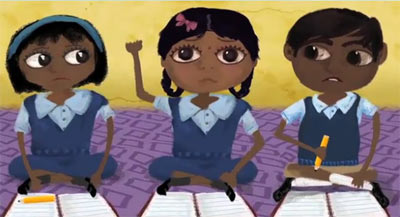
    Launched in 2010, A Girl Story is a unique, donation-based film series that combines technology, film, and storytelling to shed light on the global challenge of educating young girls. The animated, emotional story follows the path of a young Indian girl named Tarla who wants to go to school to better her life. Whether she succeeds, however, is completely up to you, because Tarla’s story progresses only by audience donations that unlock new chapters within the film series. This website raised approximately $4,000 from 182 donors globally.

     

  • Paritosh Joshi: Ratings & readerships must come with a Statutory Warning

    By Paritosh Joshi


    If you are reading this column with any professional interest, it is safe to assume you have done or been closely involved with one or more of the following things within the last year:

    • Sold media inventory
    • Bought media inventory
    • Planned a media schedule


    In any of these situations you would have to:

    • Define the target audience
    • Use widely used market research to assess and compare impact of the medium or media in consideration
    • Price the medium or media as a buyer or seller or assess its or their value for money for the advertiser’s planned media expenditure


    Inevitably, you would have to deal with television rating points, publication readerships, radio listenerships and the like. That’s where the fun begins.


    With the target audience.


    “Housewives SEC A and B, 5 lakh+ towns, UP,Bihar, Jharkhand”, one might say. “Men and Women, SEC A1, Top 6 metros” another might demand. Or even, “Women, SEC A1+, Mumbai and Delhi”. I have to add I am not inventing these, having heard them as specific asks or offers in situations I have been in close proximity to. To be sure, you could probably assign brands or media to all of them with not much effort. So far so good. It’s what happens next that makes no sense.


    Someone with access to the right research will actually produce numbers purportedly accurate to within a decimal point to size said target audience and the extent to which a medium or combination of media will reach it.


    This is bovine excrement, euphemistically speaking. Why, you ask?


    Because all media research is based on statistical sampling, not a person-by-person census of every reader, viewer or listener of show or medium. Statistical numbers are estimates. They work on the twin ideas that all large populations are distributed according to the Standard Normal Distribution, the good old Bell Curve that we are all familiar with. Put simply, the notion that in any large enough group, there are a few thin people, a few fat people and a lot of people of intermediate weight (thereby making you wonder what happened to all of us in the Media and Entertainment fraternity, or whether there’s also an ABnormal Distribution to explain it). And that if you were to draw an adequately large random sample from this normally distributed population, the sample would retain all the statistical characteristics of the population such as Mean and Standard Distribution.


    It can be shown that the minimum sample size required to ensure that the sample follows the behaviour of the parent population is 30. Samples of smaller size will exhibit asymmetries and other oddities of shape (things statisticians call measures of Skewness but never mind), that make them useless for drawing reasonable conclusions about their parent populations. As the sample available to extrapolate from becomes smaller, the error in extrapolation becomes larger, exponentially larger.


    Thereby bringing us back to the issue of ratings and readerships and such. Take readership and the Indian Readership Survey for a moment. About 67 per cent of India’s population of 1.2 billion, ~160 million households are represented by just over 2.5 lakh respondents. Put another way, every respondent represents nearly 1000 households. Things get even more interesting when you look at television metering.India’s 130 million (your guess is as good as mine on what the actual number is) are represented by ~8,000 meters.  Of course, TAM makes no claim to represent all India, so even if these 8,000 only represented the top 100 cities that have a 2011 population of 128 million or a population above the age of 4 of ~115 million people in over 20 million homes, there would still be only 1 meter in every 2,500 homes. We will get more generous and allow for the fact that TV penetration across the top 100 cities is 70 per cent. In other words out of 20 million total households, there are only 14 million TV homes. Even in this situation there is just 1 metered home in 2,000 TV owning homes.


    You see where this is going?


    As users slice and chop large aggregate populations and search for meaning in the samples that supposedly represent the segments thus generated, the available sample used to do the statistical prediction shrinks to a point where there is no predictive integrity within it. And yet, statistically naive people in every corner of our industry routinely use these frail foundations to build imposing edifices of brand and media transactions and planning.


    Then again, even the Taj Mahal is built on flimsy marshland that may eventually cause it to sink out of sight.


    So here’s the suggested Statutory Warning: “Irresponsible use of audience measurement may lead to impaired business diagnosis”.


    Paritosh Joshi was until recently CEO, Star CJ. He has been a marketer, a mediaperson and a key officebearer on industry bodies. He can reached via the comments board below or his Twitter handle @paritoshZero.


  • Vizeum bags media duties of Veev

    By A Correspondent


    Veev, the premium leather goods brand which is promoted by Chennai based Srivathsa Industries, announced the appointment of Aegis Media’s Vizeum India as its media AOR.


    The company has plans to ramp up its retail presence in the country substantially and the appointment of Vizeum is in line with this strategy.


    Confirming the same, Prakash Venkatesan, CEO, Veev said: “We are delighted to partner with Vizeum as we focus on building our retail presence. We had strong referrals of Vizeum. Once we met them, we realized why they enjoyed such equity. We look forward to working with them and wish them the very best.”


    Commenting on the win,S Yesudas, Managing Director – Indian Subcontinent, Vizeum said: “We are humbled at the faith bestowed upon us by our clients and other business partners. I take this opportunity to welcome Veev into the Vizeum family. We are thankful to Prakash and team for considering us worthy. This business will be handled out of our Chennai Office.”


    Vizeum successfully operates in 55 countries with a philosophy of in-depth understanding of the co existence of lives, brands and media in the actual world.


  • The Anchor: Mahrukh Inayet on 5 reasons why anchoring is more about substance than style

    By Mahrukh Inayet


    1. News always comes first

    Viewers want the news first. Rest, very little matters. Your style has little bearing on the viewer nor does it alter the impact of news on the viewer. Facts are sacrosanct. Information rules. It needs no garnishing.


    2. The new age viewer

    Today’s viewer is a global citizen. Aware, informed, educated and opinionated. More importantly, s/he is consistently running against time. They get their news and boom – they are out. Your personality might make them stop, but it is the news that will make them stay.


    3. Credibility

    News anchoring is all about credibility. The more you establish your substance, the more the viewer will notice your style. But remember, substance comes first. Think about it – most well known TV faces have been around for years. In theUS, the average age for prime time anchors is 60. Larry King, Peter Jennings, Dan Rather – the list is endless.


    4. Journalism v/s Style

    News does not come in fancy packages. It’s hard hitting and raw. Floods, drought, bomb blasts, terror strike, petrol prices – can you even imagine viewers bothering with anything but the information.


    5. News, not the newsreader

    In broadcast journalism school you are taught to conduct yourself in a manner that takes attention away from you and highlights what you are presenting. News anchors only disseminate the news – they are the medium, not the message


    Mahrukh Inayet is Former Senior Editor, Times Now


  • JWT acquires 51% stake in Hungama Digital

    From the MxM Infodesk


    Leading advertising agency JWT has acquired a majority stake in Hungama Digital Services, the digital and promotions marketing division of Hungama Digital Media Entertainment. Although the joint communique issued does not state it, MxMIndia learns that the JWT stake in Hungama Digital will be 51 percent.



     

    The new entity which will be called Hungama Digital Services Pvt. Ltd.will be a full-service digital agency specializing in digital marketing and social media solutions. As part of the acquisition, Hungama’s activations arm, Hungama Promo Marketing will become a part of Hungama Digital Services Pvt. Ltd. and provide an engagement platform linked to online and offline deliveries.


    Neeraj Roy

    Said Neeraj Roy, MD and CEO, Hungama Digital Media Entertainment, “With JWT, we are now part of the largest advertising network in the world. Hungama Digital Services is the coming together of two exceptional teams in a globally relevant market.” He added, “India is at the cusp of a digital revolution with the advent of 500+ million consumers getting online in the next 3-4 years. From augmented reality to developing applications for connected devices, Hungama Digital Services has been at the forefront of digital technology. With this partnership\ with JWT we hope to offer integrated digital and experiential services to our clients and prepare brands to connect, interact and now transact with their customers.”


    Hungama Digital Services has been a dominant player in the digital space for 13 years and is spread across six cities in India. The existing team of 120 people, who will join Hungama Digital Services, will continue to drive the agency, including servicing old and new clients and offer creative and promo marketing services, viral marketing campaigns, social media marketing and mobile marketing, applications, managing websites and video services.


    Colvyn Harris

    “Digital is our next new frontier.The idea of the partnership is to build a digital offering for our clients so we can live up to being a ‘single source’ partner across all their ‘marketing solutions’ needs. What will be most effective in the future is a new set of talented, digital high end specialists who will add new skills and capabilities to what JWT already offers to its clients. We want all our clients to be leaders in their respective categories.” said Colvyn Harris, CEO of JWT India.


    With this acquisition, Hungama Digital Services along with JWT Digital capabilities will be a digital thought-leader with delivery capability in digital ideation, production, and social media.By our association with many of India’s largest clients, Hungama Digital Services will be able to create the right traction and critical mass within the digital and business community in India.


    “We have greatly expanded our digital capability across the region, and we are not standing still. JWT will continue to hire new digital experts and explore possible acquisitions across the region this year,” said Michael Maedel, President, JWT Asia Pacific.


  • Ranjona Banerji: Getting a bum deal from Yahoo India

    Ranjona Banerji

    By Ranjona Banerji


    Last month, I dumped my Reliance internet connection (dip in connectivity and more importantly, rude service) and opted for Tata Photon. But my grouse is not with either of them. It is with Yahoo India. The Tata Photon opens with a Yahoo India page (I can’t shut it down too quickly because then Mozilla Firefox won’t reload and I can’t go back to Google Chrome because it slows down my machine and particularly did not like this website… so who said the internet was all plain sailing!).


    The page is dominated by Bollywood nonsense (celebrities who married young, star break ups that hurt us more than it hurt them) and then a sprinkling of political news in the next segment and only cricket news in the next.


    I am now inured to the stranglehold which Bollywood has on our lives. But I still question a news source which can look no further than the lowest common denominator. I also don’t quite know if the average internet user in India wants only Bollywood and cricket and nothing else. Has Tata Photon done any such research about its average user?


    Out of curiosity and since the damn page was open, on Tuesday evening I ventured further into the Yahoo India page and decided to see how it treated other news. In the sports category, there were only cricket, tennis and football, in that order. I went to tennis since that’s my area of interest. There was a story about Maria Sharapova, nothing at all about Rafael Nadal and Novak Djokovic’s French Open battle and Nadal’s historic seventh French Open title.


    Instead I see a story about how reality TV star, Kim Kardashian, “flashed her bums” during some family tennis match. I went no further into the story, credited to ANI, but it is wrong on so many levels. For one, the English. It is not “flashed her bums”. Bums when it applies to the buttocks is a singular entity, like bottom. Unless Kardashian has cultivated a collection of homeless drunks which she brought along to a family tennis match.


    But more than the grammar, it is the intent which is offensive. I understand that sex is a human impulse which beats all others (well…). But why should this daft little story find itself in a sports section of a well-known website? Is there any connection with tennis at all? If I wanted to fulfil my baser instincts on the internet there are enough explicit sites for my guilty pleasures. Yahoo India is not the preferred choice for anyone, unless that it is intention? The Yahoo.com website has an excellent, up to the minute and comprehensive sports section. Is Yahoo India so far away from there?


  • Modi Omega Pharma awards PR mandate to GreenThumb

    By A Correspondent


    Modi Omega Pharma India Pvt. Ltd. has appointed GreenThumb as its communications partner following a multi-agency pitch. As part of the mandate, GreenThumb will be responsible for the development and implementation of an effective media strategy to generate awareness across all metros and mini metros about the various brands in the company’s portfolio.


    Modi Omega Pharma is an OTC division of the Umesh Modi Group of Companies, which has over 17 companies in its portfolio and an annual turnover of Rs2,000 crore. Modi Omega Pharma was formed in 2010 as a 50:50 joint venture between Modi-Mundipharma and Omega Pharma Limited, a Belgium-based pharma OTC company with operations in over 35 countries.


    On the engagement with GreenThumb, Ms Himani Modi, Director, Modi Omega, said: “In the last few years, Modi Omega Pharma has endeavoured to bring internationally renowned OTC products to meet the changing needs of Indian consumers. Since 2010, we have launched an anti-snoring throat spray ‘Silence’, an anti-head lice lotion ‘Jungle Formula’ and anti-acne products under the brand ‘Bodysol’. We are in an expansion mode and recently launched a premium baby skin care brand ‘Galenco’. Therefore, it was imperative that proper measures should be taken to reach out to the target audience and create mass awareness about our products. We invited a multi-agency pitch and were keen to partner with a PR agency that would have a clear understanding of our requirements. We liked the fresh and innovative ideas that were presented by the GreenThumb team and decided to give the mandate to them.”


    Commenting on this partnership, GreenThumb’s CEO Arjun Banerjee said: “With only a handful of brands available in the anti-lice, anti-snoring and premium baby skin care segments, there is definitely a massive demand in the market for technologically advanced and high quality products in these categories. So, we are extremely happy to partner with Modi Omega for promoting their internationally renowned brands across India. The challenge would be to position Modi Omega’s brands as the most sought after in their respective categories and our PR Campaign over the next year will focus on addressing this issue.”


  • Bheem, Katrina Kaif and Sachin Tendulkar are kids’ favorites, says Ormax Media

    By A Correspondent


    As per the sixth edition of Ormax Media’s kids’ favourite character ranking study, Small Wonders, Bheem is the favourite television character among kids, followed by Doraemon at No. 2.


    The study also tracks the favourites of kids across nine other parameters. The table below lists the favourites across five parameters:

    Parameter No. 1 Favorite
    Favourite Film Star – Male Salman Khan
    Favourite Film Star – Female Katrina Kaif
    Favourite Cricketer Sachin Tendulkar
    Favourite Sportsperon (Non-cricket) Sania Mirza
    Favourite Hindi GEC Character Anandi (Balika Vadhu)


    The other three parameters measured by Small Wonders among kids are their Favourite Sports, Favourite Play Items and Favourite Places to Eat Outside.


    The study was conducted among 6-14 year old kids, SEC ABC, in eight cities – Mumbai, Delhi, Kolkata, Ahmedabad, Hyderabad, Lucknow, Jalandhar and Chennai.


    The study report gives details on all parameters across age, gender and markets.


  • Spark Punjabi launches new shows

    By A Correspondent


    Spark Punjabi, the international Punjabi channel which is a joint venture between Reliance Broadcast Network and CBS Studios International, is adding a new spark to its programming. True to its promise to deliver variety entertainment relevant to different target groups, beginning June 11, Spark Punjabi will feature special shows.


    Comedy seems to resonate very well with the viewers, even in the PHCHP region, and hence Spark Punjabi will be launching 2 new shows – Naadaniyaan, a situational comedy, and Bulbulay, a story of four lunatic characters, in the prime time slots.


    The new shows are being promoted through an aggressive multi media campaign, featuring TV, Radio, OOH, Print, Digital, Cable, Cinema across the PHCHP region to ensure that audiences quickly sample these new offerings.


    The channel launched these shows in sync with its recent campaign called ‘Choose Your Set-Top-Box Wisely’, designed to increase awareness and empower consumers with adequate information to make the right choice while choosing their set top boxes, while also enabling operators to build their brand equity.


  • Eros International launches online music channel

    From the MxM Infodesk


    Movie-makers Eros International Media Ltd has announced the launch of a dedicated online music service on YouTube titled ‘Eros Now Music’ (youtube.com/erosnowmusic).


    The channel will serve as a platform for emerging and established artists and will showcase original music content and leverage from the global reputation of Eros as a premium content provider.


    Speaking on the launch, Ricky Ghai, CEO, Eros Digital, said: “As part of our digital transformation, the launch of Eros Now Music is a step forward in providing rich and original music exclusively on the digital platform. This is part of Eros’s global vision to raise the stake and appreciate the raw and diverse talent of South Asian Music and promote it on the world platform.”


    Eros Now Music will feature established as well as emerging talent including Shaan, DJ Sheizwood, UK-based pop artist Kimeli, Shweta Yogendra, Farhan Saeed, Gajendra, Simmy and Tippy, Rahul/Shah Rule among others. The content on the newly launched channel will include music videos and behind-the-scenes footage.


  • Online ad platform Komli Media raises $39 million

    By Radhika P Nair


    Komli Media, India’s biggest online media technology platform for advertising, has raised $39 million, or Rs214 crore, in the biggest round of fundraising by an internet company in the country this year.


    Norwest Venture Partners led the latest round with participation from existing investors- Nexus Venture Partners, Helion Venture Partners and Draper Fisher Jurvetson- along with one new investor, Western Technology Investment.


    Komli’s CEO Prashant Mehta declined to disclose the valuation of the Mumbai-based company in a deal which takes the total private equity capital raised by it to $62 million. Industry experts said that internet companies in India are typically valued at up to five times their revenue. Komli, which is targetting revenue of $100 million in 2013, can therefore be inferred to have a value of up to $500 million.


    “Considering that advertising spends are the first to get affected in a downturn, this investment has greater significance than just the amount invested,” said Mayank Rastogi, a partner who specialises in private equity at consultancy Ernst & Young.


    The month of May saw the lowest amount of private equity investment in the past year, with just $385 million in funding for 32 deals. In contrast, in May 2011, there were 44 deals, in which close to $1.3 billion was invested. Mr Mehta, whose company counts Facebook as an exclusive partner in India and expects a Nasdaq listing within 18 months, was of the opinion that even though the overall environment is gloomy, it is not so for the digital media industry.


    “We are at a tipping point. Komli thinks the digital medium is far more accountable and provides greater return on investment,” he said The online advertising market in India is estimated to be worth Rs1,850 crore, which is just 7 per cent of the overall advertising pie, according to an Avendus Report. However, the sector is expected to grow rapidly to Rs7,000 crore by 2015. Google and Facebook collectively account for about 29 per cent of direct advertising spends.”


    Founded in 2006 by Amar Goel, who is also the chairman, Komli has been aggressively buying companies overseas to speed up growth. In February, it made its sixth acquisition in two years, buying Singapore-based online advertising network Admax.


    Last year, Komli took over the India business of video advertising venture Jivox and in July 2011, it acquired mobile advertising and publishing network Zestadz. The Zestadz acquisition marked Komli’s entry into the fast-growing mobile advertising segment.


    “It is in the mobile advertising space that Komli competes directly with Google’s AdMob, which is the market leader globally and in India, and with InMobi,” said Srinivas Chari, cofounder and chief marketing officer of Xerago, a digital and interactive marketing company.


    Source: The Economic Times
    Copyright © 2012, Bennett, Coleman & Co. Ltd. All Rights Reserved


  • End of Digital Beginning for M&E: PwC


    From the MxM Infodesk


    Digital migration is increasingly playing out differently across the various segments and geographies of the entertainment and media industry, says leading consulting firm Pricewaterhouse Coopers’s Global Entertainment and Media Outlook 2012-2016. Despite ongoing economic uncertainty, the past year has seen global sales of tablets and smart devices reach record levels once again, underlining the growing revenue opportunities from digital delivery of media and entertainment (M&E) content and advertising to increasingly connected, and particularly mobile, consumers.


    According to PwC’s annual Global Entertainment and Media Outlook 2012-2016, released yesterday (June 12), digital opportunities are now well understood by media companies, advertising agencies and advertisers themselves: the industry is approaching the ‘end of the digital beginning’ as rising comfort levels with digital mean that it is becoming business-as-usual. Although the ‘fog’ experienced in the past few years around strategic options is lifting, there is more to be done: today’s challenge is in the implementation of those digital strategies.


    A world of difference

    PwC believes that though the focus may still be on digital migration, challenges for M&E companies differ according to diverging market pictures across segments and geographies. Tipping points and contrasting market development rates highlighted by this year’s Outlook data and analysis show:


    • Global media and entertainment spending on digital advertising and consumer formats increased by 17.6 percent in 2011 compared with only a 0.6 percent rise in non-digital spending. Digital’s share of total spend will grow from 28 percent in 2011 to 37.5 percent in 2016, and digital spending will account for 67 percent of total M&E spending growth to 2016.
    • Digital maturity varies widely at a segment level. For example, global spending on digital recorded music formats will overtake physical distribution in 2015, reaching 55 percent of total revenues in 2016. And global spending on online and wireless video games will overtake console and PC games revenues in 2013. By contrast, the digital component of consumer magazines will account for only 10.4 percent of spending by 2016, up from 3.1 percent in 2011.
    • Global spending on music rose 1.3 percent in 2011, the first gain in many years, thanks to growth in the concert and music festival market and a slower decline in recorded music. Rises in digital music spending mean that overall, global spending on recorded music will finally begin to increase in 2013.
    • Mobile internet access subscriber numbers, a key driver of digital spending, will more than double during the next five years to 2.9 billion by 2016, of which almost 1 billion will be in China. In India, mobile internet subscribers will increase from a low base at a compound annual rate of 50.8 percent to 2016, making it the fastest growth market for mobile internet in the world.
    • By 2016, global mobile internet advertising revenues of $24.5 billion will grow at 36.5 percent compounded annually, to almost match the size of the classified internet advertising market. However, paid search at $78.1 billion and banner/display at $46.6 billion will retain the lion’s share of the market in 2016. China’s mobile internet advertising market will grow at a compound rate of 68.4 percent to reach $6.2 billion in 2016, making it the second largest market in the world behind the United States at $9.4 billion.
    • The newspaper publishing segment illustrates diverging trends across mature and growth economies. There will be ongoing declines in some territories such as the United States (declining 1.4 percent compounded annually to 2016, and expected to be worth 43.8 percent less in 2016 than 2007), but strong growth in countries where the digital infrastructure is less mature, such as Argentina (11.9 percent growth compounded annually to 2016), Indonesia (11.2 percent), and India (9.6 percent).
    • France passed the United Kingdom and Germany in 2011 to become the second largest TV subscriptions market in the world behind the United States, driven by a 76 percent rise in IPTV households. In the TV advertising segment, spending in Russia surged by 20.2 percent in 2011; by 2016, Russia will overtake the UK, Germany, Italy, and France to become the largest TV advertising market in EMEA (Europe, Middle East and Africa).
    • In the worldwide filmed entertainment market, over-the-top/streaming services will grow at a 21.0 percent CAGR to $11 billion in 2016, and will overtake spending through TV subscription providers in 2012.


    Said Marcel Fenez, Global Leader, Entertainment & Media, PwC: “The various segments of the M&E sector are at different stages of digital development, but they are all embracing digital to meet the ever-changing demands of consumers effectively and profitably. Media and entertainment companies have reached what we’re calling the ‘end of the digital beginning’: they’ve made the commitment to a digital future, and are now striving to make the necessary changes to their products, distribution and organisations.”


    Reshaping and retooling for life in the digital new normal

    According to the Outlook, the challenge now for M&E companies in a world where digital is established as ‘business as usual’ – and in those markets where the infrastructure is suitably developed to support digital distribution and consumption – is to focus on planning out and executing their digital strategies. Uncertainty in past years triggered by digital migration is giving way to a sharper focus on identifying, choosing and executing the business models, organizational structures and skill sets to harness new consumer behaviours and deliver rising future value.


    • A finger on the consumer’s pulse
      M&E companies need more than ever to understand consumer behaviours and motivations in order to engage with and immerse consumers in their connected, multi-screen environment. Data analytics tools are required to mine the mass of customer data, however the development of such tools may be triggering consumer fears over risks to their privacy. PwC believes that avoiding this will require a shift of industry mindset from ‘customer ownership’, towards facilitating a position where the customer is ‘in control’.Companies will find that giving consumers more control over how their personal data is used may deliver higher benefits back to consumers, encouraging them to volunteer even more information, as well as providing better value for advertisers and higher rewards for media owners. Businesses need to aim for a win-win model in which the medium, the advertiser and the consumer all collaborate and benefit. Ultimately, the only person who ‘owns’ the customer – and the customer’s data – is the customer him or herself.


    • New roles emerge across the M&E value chain
      M&E companies need to identify the role or roles they will occupy as new structures emerge across the digital value chain, and work collaboratively with other providers with complementary capabilities.


    According to the Outlook, these roles could include:

    • acting as the online destination or physical auditorium that hosts the customer experience (the ‘venue’)
    • aggregating and filtering consumers’ content requirements (the ‘community curator’)
    • providing exclusive content (the ‘content monopoliser’)
    • being the ‘device developer’
    • acting as the consumer’s trusted content companion across devices (the ‘digital services champion’)
    • being the third-party specialist supporting experimentation, innovation and execution (the ‘ideas generator’)


    For creative and media agencies, the rise of unpaid or earned media reflects an innovative new fusion of advertising, content and analytics, and presents an opportunity for sweeping change in their roles and business models. Advancing socialization is feeding into the widely-accepted concept among agencies and advertisers of “bought, owned and earned” advertising. A fourth category is emerging — “managed” advertising, (the orchestrated use of social media, such as engagement via bloggers). Everything that agencies do for their clients now has an embedded digital component and agencies are directing clients’ attention toward output measures such as earned/unpaid media reach, and purchasing intentions.


    There are therefore opportunities for agencies to act as digital marketing and brand consultants, guiding their clients with insights into opportunities around the aggregation of data, socialization and content – particularly as the historical distinction between traditional and digital disappears.


    • Benefits of reorganizing around digital
      To date, many M&E businesses have developed digital as an adjacent operating group, with separate infrastructure, solutions and staff. But in the ‘new normal’, PwC believes that companies need to move away from this siloed approach, instead embedding and integrating their digital operations into the main enterprise, and driving improvements in three key areas: profitability, by reducing operational costs through common platforms and integrated business processes; scalability, gaining greater agility to grow and flex the business; and innovation, through integration, automation and talent.To realise these benefits, companies will have to tackle challenges around rights, royalties and piracy – areas where many M&E companies are often burdened by rigid, complex, bespoke legacy systems There are additional issues in leading and marshalling the talent and culture of innovation, needed to make digital implementation a reality, particularly in meeting the distinctive employment needs and expectations of the Millennial generation.

      Added Mr Fenez: In the face of sweeping change and uncertainty, the M&E industry has spent the past few years seeking effective business and operating models for the new world, through a cycle of constant experimentation, ongoing innovation and targeted analysis of the results. This will continue. But with digital now at the core of business-as- usual, PwC believes that experimentation and execution are no longer sequential but will proceed in parallel, enabling M&E companies to press ahead into the ‘new normal’ with confidence.”

      “We’ve reached the point at which talking specifically about ‘digital’ increasingly misses the point. As digital becomes the standard, its rising penetration ceases to be a topic for discussion in itself. What matters now is how companies capitalise on it and operate within it,” he said


    The Pricewaterhouse Coopers Outlook for Entertainment and Media 2012-2016 can be purchased at www.pwc.com/outlook.