Blog

  • Mediaah! Pathetic performance at Cannes + Twitter stats + Medianama turns 4

    By Pradyuman Maheshwari


    The Cannes Lions is no Olympics, so if India returned home with no Grand Prix and just three Golds, there is no reason to despair.  Yes, there’s a jury out there, and there are many people comprising each of them, so it’s not easy to please all or most of them. Hence those who have come home with the honours deserve a huge pat on their back since they’ve managed to impress some of the best brains in the business from across the world.


    Sad, because India is big news internationally. This is because of our bigness. People know that the real consumers exist in China and India. The one billion-plus population ensures that. The world recognises that being a democracy means that a lot of commerce-friendly measures are tough to implement. So there is much action in China and hence sexier work in advertising. That last bit also translates to more awards in the tally and more attention to that country.


    This year’s Cannes Lions has seen a Abby-like controversy. I’m sure the folks at the Advertising Club Bombay will say “See, it happens there too”. While the Cannes Lions organisers aren’t at fault for what could’ve happened, but I guess there’s got to be some action else the festival will not see the 11000+ delegates who turned up for one or more days.


    #CannesLions Stats

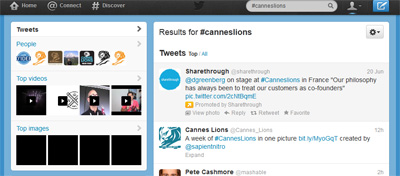
    I was unable to get to Cannes as there was more pressing work here, but the best way to keep track was decidedly #CannesLions. In fact, as someone said, even if you were physically present at Cannes, it was a great way to get the buzz.


    Here are some stats courtesy the Twitter Advertising blog (http://advertising.twitter.com/2012/06/twitter-celebrates-users-and-brands.html):

    • There were 103,389 mentions of #CannesLions on Twitter during the six days of the festival – a substantial increase from the 20,000 in 2011. Over 5,000 pictures were tweeted.
    • That’s 17,232 Tweets a day and 718 Tweets an hour with a peak of 3,000 Tweets an hour during key seminars – up from 40 per hour on average in 2011.
    • The total #CannesLions earned media on Twitter has been calculated at over 61 million impressions.


    Often, the 3k tweets an hour looked a hundred thousand. They just didn’t stop coming! And even after the last day, there were several tweets on celebrations, discussions and there’s one exceedingly painful on a book written on the future of advertising. Tweets are fun, informative but can also be a pain!


    Nikhil Pahwa’s Medianama is 4

    My hearty congratulations to Medianama and Nikhil Pahwa on the popular tech-telecom-media site’s fourth anniversary.


    I know there are some who think Nikhil is brash, but that’s only because a lot of people in important offices are used to puffs and plugs from journos and trade sites. Although it may be styled as a blog, I am aware that he follows the same rigour as any journalist ought to.


    Medianama went live on June 27, 2008. It’s got a small team and has advertisers on board. So revenues are happening. When I asked Nikhil about revenues, he replied (rather tweeted back): “Healthy. We’re slowly learning to grow. Is tricky, but learning.” Guess I know what he means.


    Buzz me if you have a story to tell. Confidentiality assured. There are various ways you can reach me: pradyumanm[at]mxmindia.com, Gtalk pradyumanm@gmail.com, Twitter @pmahesh and of course the mobile: 98338 76278.  The views expressed here are my own


  • Karan Darda to head Lokmat ops, COO Jwalant Swaroop takes on advisory role

    By A Correspondent


    Jwalant Swaroop
    Karan Darda

    The winds of change are blowing at Marathi daily, Lokmat. Senior mediaperson and a veteran newspaper business professional Jwalant Swaroop, who was the Chief Operating Officer of Lokmat Media since June last year, will now take on an advisory role. Meanwhile, executive director Karan Darda, who was being groomed to take full charge of the business operations, is likely to assume the role of the COO.


    As Executive Director, Mr Darda has been involved in the operations and circulation areas of the group and has been working towards conceptualizing and implementing marketing programmes. He has been on the board of the Company since April 2009 and is credited with conceptualizing and successfully implementing Aurangabad Premier League for cricket and Kolhapur Premier League for football, thereby creating new opportunities for the group in sports.


    Mr Swaroop has been with the Lokmat group since 1992 and was instrumental in the group’s wide acceptance in Delhi amongst marketers and media agency professionals. Mr Swaroop has also worked with the Northern Indian Patrika for a bit and spent around six years in ad agency, Advertising & Integrated Marketing (AIM).


  • UTV Indiagames launches official mobile game for ‘Brave’

    By A Correspondent


    The gaming company, UTV Indiagames, has launched the official java mobile game for Disney Pixar’s ‘Brave’.


    This game captures the vivid and beautiful Scottish Highlands. Based on the protagonist of the movie -Merida, the user has to use his/her archery skills to unfold the mystery and save her family.


    “Disney Pixar’s Brave has an excellent storyline which has all the elements – adventure, mystery, action – that lend itself into an engaging game, deepening the fantastical movie experience. With this Java game we want to reach out to 60 per cent of India’s mobile phone population,” said Samir Bangara, Managing Director – Digital, Disney UTV.


  • RK Swamy BBDO relaunches Parryware with unique insight

    By A Correspondent


    [youtube width=”400″ height=”225″]http://www.youtube.com/watch?v=IYefcFAeuXc[/youtube]

    As part of its brand relaunch mandate, RK Swamy BBDO has created a refreshingly new campaign for sanitary brand Parryware.


    RK Swamy BBDO, known for its insightful work, calls the bathroom “Apna sa Kona” (your very own space) in this new campaign. This insight is based on special moments which one spends in a bathroom.


    Sunil Kukreti, Senior Partner, RK Swamy BBDO, New Delhi, said: “The insight of the campaign is that the bathroom is one place in the house where you can be yourself. You might cry, dance or just ponder in this one space, which is truly yours. The ‘Apna sa Kona’ campaign is created around this.”


    The current campaign comprises of Print and TV.


    Parryware with a brand heritage of nearly 60 years is now part of the Spanish Roca Group.


  • Big Magic ups ante by getting Amar Upadhyay as host

    Amar Upadhyay

    By A Correspondent


    Amar Upadhyay, last seen on Big Boss season 5, is all set to hit the small screen again with BIG Magic’s Police Files.


    The channel aims to feature local-relevant entertainment through the core Hindi heartland – UP, MP, Biharand Jharkhand. With the Hindi heartland known for crimes like drug trafficking, extortion, murder for hire, crime against women, homicide, burglary, theft, land mafia and more, the actor will be seen highlighting cases that the local populace can relate to.


    Anand Chakravarthy

    “Amar is a household name and rose to fame through a fiction show and then again through a reality show. He connects excellently with audiences and has a huge fan following in the heartland. His ability to connect with audiences is unique and a show like Police Files requires someone who is one amongst them, understands the true issues of the heartland and offers them solutions on dealing with situations, should they ever be in one. Amar does this beautifully as he discusses cases and helps audiences look out for possible signs through discussions with psychologists, real cops and more…” said Anand Chakravarthy, Executive Vice President, Marketing, RBNL and Business Head, BIG Magic.


    Speaking on hosting the show, Amar Upadhyay said: “BIG Magic is the newest entertainment channel that has swept the Heartland. With its specially created localized shows, the channel has been able to fulfill a huge entertainment lacuna in the region. I liked the concept of Police Files and its ability to help audiences deal with the growing crime rate in the region. I look forward to making this iconic show an ideal platform to fight crime and create awareness amongst public.”


    The show hopes to empower viewers to be better equipped to deal with criminal situations. As part of the show, Mr Upadhyay will be seen engaged in discussions with psychiatrists, real lawyers and the real police, who discuss the reason, rationale, signs to look out for and more, when it comes to dealing with crime in the region.


  • HUL, LG etc look beyond regular advtg

    By Bhanu Pande & Ratna Bhushan


    PepsiCo is organising seven-a-side soccer tournaments in neighbourhoods, LG is showcasing its durables in residential complexes, Cadbury is standing outside super markets with its cookies, Hindustan Unilever is standing with a shampoo to assess the state of your scalp… These are some of the biggest companies, with hefty advertising budgets. Yet, to market their wares, they are increasingly looking beyond conventional, passive advertising and spending more on marketing activities where the connect with the target consumer is active and direct.


    In marketing lingo, such on-the-ground events and promotions are called ‘brand activation’, and they generally form the largest chunk of a company’s non-advertising activities. Spurred by brand activation spends, such non-advertising spends, called below-the-line (BTL), are gaining share over advertising spends at several leading consumer companies.


    According to LK Gupta of LG Electronics, 60 per cent of the company’s marketing

    budget is going towards BTL activities, against 35-40 per cent three years ago. “With increasing choices, the consumer has become more discerning,” said Mr Gupta, vice president-marketing. “Therefore, ground activations are gaining traction due to the added impact they give beyond the media clutter.”


    Elsewhere, Homi Battiwalla, category director, PepsiCo India, labels the increase in his company’s BTL spends as “significant”. “Today, consumers have started saying, ‘show me something real’,” he added. In April, in its advertising, PepsiCo India switched from cricket to soccer, and launched a campaign, ‘change the game’.


    Alongside, it hit neighbourhoods with ‘T-20 Football’ – a seven-a-side, 20-minute soccer tourney. “We realised plain advertising wasn’t enough,” said Mr Battiwalla. “We wanted to build the idea, and create an experiential engagement that is grassroots with our target audience.”


    All this is translating into more business for firms like New Delhi-based Candid Marketing, which helps companies with their brand-activation strategies. Its managing director Atul S Nath says its business is growing 25 per cent a year. “Clients are questioning the delivery from plain advertising,” he said. “Delivery from brand activation is almost immediate, though the latter has its limitations.”


    Mr Nath predicts that, in the next five years, the split between BTL and ATL (above-the-line, or advertising) spends will be equal. Currently, companies spend more on mass-media advertising than on events and promotions. He, however, feels, advertising budgets will not fall in absolute terms, but more of the incremental allocation will be to BTL activities. “Overall spends on BTL will significantly rise as people begin to see its impact,” he said.


    Mr Gupta of LG agrees, and attributes it partly to the rise of online marketing and social media, which conveys details of a product quicker than conventional advertising. “The influencing touch points are shifting,” he said. “The customer comes armed with his own research. So, conversion with demo and explanation has become an area of great focus.”


    It’s also the current tight business environment, said brand consultant Harish Bijoor, who sees advertising symbolising ‘theme’ and BTL representing ‘sales’. In a tough market, cash flows are an imperative. “So, they are putting their big bucks on BTL, and money is certainly moving from theme to scheme,” he said.


    Mayank Shah of Parle Products says the idea is to engage with the consumer despite the higher costs. “In case of traditional advertising on television or print, cost per contact is very low,” said Mr Shah, group product manager. “BTL activation is costlier, but it’s the quality of engagement with the consumer that makes a lot of sense. He feels, it is very important to generate trials in food products, which is the company’s main product category. “Sometimes it’s necessary to make consumer sample your products,” said Mr Shah. “And where there’s a big rural and semi-urban opportunity, we need to go BTL.


    Dabur India too has been relying heavily on BTL activities in tier-II and tier-III towns. “With rural consumers increasingly moving towards branded products, just leveraging mainstream media is not enough to connect with them,” said George Angelo, executive director-sales, Dabur.


    The company has the Dabur Amla ‘banke dikhao rani pratiyogita’, a rural beauty and talent hunt where rural women are groomed by trained beauticians. Another of its recent BTL activity was the Dabur Gulabari Miss Rose glow contest – a regional model hunt from state capitals, with the eventual winner receiving a wildcard to the Femina Miss India contest. “A BTL initiative involving Vanya Mishra (a wildcard who was one of the winners at the Miss India contest) resulted in Dabur Gulabari reporting its highest ever monthly sales in April,” said Mr Angelo.


    Source: The Economic Times

    Copyright © 2012, Bennett, Coleman & Co. Ltd. All Rights Reserved


  • Road to CL2013: The way to win at Cannes is by not aiming for a metal

    The Cannes metal wins for India has been disappointing. There could be various reasons for it and the metal tally definitely doesn’t point that the work coming out of India is of inferior category. However, it does point that there is something more required from India n agencies to gain attention of the international jury. Who better that people on the Cannes jury this year to show us some light on where the agencies could improve and what really went behind the judging. We spoke to a few on the jury this year to understand where India went wrong and what can be done to reclaim some of the lost ground this year.


    Rahul Jauhari, National Creative Director, Everest Brand Solutions

    Rahul Jauhari

    I don’t think you can aim at Cannes by doing something that can win at Cannes . Most winning entries at Cannes are brilliant solutions to one business issue or another. “Let’s do something like that one” ­ is not going to get you anywhere. The point is to solve the business issue facing your brand with a wonderful idea and execution. If it is that wonderful, it will win.


    And yes, the glorious part is in doing it in a way that is relevant to the India n audience. The jury are not fools. They can see through scams, in most cases. They ask relevant questions and give a lot of importance to the logic of the communication. They reward ingenuity, but not at the cost of authenticity.Brazilwins a lot of awards at Cannes . But their work is unmistakably Brazilian. The same goes for other countries. So, the language of your entry is not a minus point, as long as you send in a good explanation.


    The jury at Cannes is now well represented by different countries. And that shows in the selection of work. “Let’s do something that integrates social media” is not the answer either. More Facebook likes is not equal to higher chances at a Cannes metal. If the idea is loved, people will spread it on social media. A print ad can lead to online furore or fan-following. The same goes for a TV ad or a radio spot. The consumer builds in social media integration without asking you. So there.


    Simply put, the way to win at Cannes is not by aiming for a metal at Cannes . Aim for a brilliant solution or idea. Execute it brilliantly. Even the simplest of ideas can win. There is that little bit about the packaging, though. When a jury member has to sift through a thousand plus entries, he or she will not suffer a poorly packaged entry. Keep it simple, keep it to the point. Sure make it enjoyable. But remember, the jury wants to know how you did it, why you did it and what it achieved. Inform them, but don’t bore them to death. And don’t try to con them. Most are highly experienced and can tell a fake from a real. Instantly.


    Sunil Gautam, Founder, HanmerMSL

    This is the fourth year for Cannes PR Lions which saw 1,130 entries from 61 countries, the highest number of entries received by Cannes Lions in this category ever. 134 entries were short listed. India had 19 entries, 1 was short-listed.


    The composition of jury was very good and it represented the cross-section from the world over. There was a lot of interaction and discussion before finalising the winners. According to me, it was very professional judging and the experience was awesome.


    India had 19 entries in this category, and many of them came up for lively discussion. Of these, one entry was short listed. Unfortunately, this entry didn’t get any metal. But the overall effort by the India n agencies was excellent. All the campaigns that were reviewed were very imaginative, with good strategy, execution and measurable impact and results.


    My advice to the India n public relations industry is to focus on innovative strategies, immaculate execution and measurable results in such a way that the campaigns that they implement for a client are a huge success. And not to plan campaigns from the short sighted of just winning awards. Good campaigns are appreciated everywhere and they may end up with the awards. The client comes first and they will get awarded if they deserve.


    Vikram S Gaikwad, Partner & Executive Creative Director, Creativeland Asia

    Vikram S Gaikwad

    I think there are three simple yet significant aspects to any entry. The idea, its execution and the category in which it is entered. A brilliant idea can miss out simply because it is not entered in the right category.

    With the number of entries running in thousands even in each category, each panel has a unique criteria while judging entries. So, the chances are that a great entry submitted in a wrong category might fail to even get a shortlist.

    Also, we should look at the new categories introduced at Cannes every year.I was disappointed to see little or no work in categories like Mobile, PR and Brand Entertainment & Content categories. With the size of the Indian
    market, number of brands, consumption etc, we are very much capable of capitalising on various opportunities and entering more quality work in the future.

    This year the number of metals that India won has gone significantly low. This definitely is disappointing. So, I am hoping we will make up for it
    next year.

  • Case Study: Honda Brio: Love Ka Connection

    By A Correspondent


    Campaign: Honda Brio: Love Ka Connection


    Aim and Objectives:

    The core objective of the communication was divided into two levels. The first one was to inspire more and more people to test drive Honda Brio and feel the experience of being loved back and, second, that the dealers of Honda feel excited about the whole campaign and are inspired to sell more.


    The Background:

    According to Honda Brio’s current brand positioning – there’s no happier feeling than being loved back and that’s what you get every time you drive Honda Brio. It always goes the extra mile every time to make sure the love story never ends.” Keeping this promise and idea intact, BIG FM came up with the concept to give an experience of loving and getting love back.


    Timelines:

    The campaign was spread across 30 cities and executed within 21 days, Touch basing more than 40 dealer outlets. Apart from the 23 92.7 BIG stations, the activity was also done on 7 non-BIG FM stations which was co-ordinated by BIG FM.


    How the strategy was implemented:

    The core idea was to promote the voice of Honda Brio where consumers test drive Honda Brio. RJ called up the customers who have taken a test drive and asked them to share their experience. The customer who shared the best experience was called on a show every Friday to co-host a show with the RJ. Also every weekend, RJs went to Honda Showrooms and promote the activity at the dealers shop through games and music.


    In addition to the Voice of Honda Contest, Dealer Delight was also taken into consideration as one of the main objective was to uplift dealers moral as well as making them feel good by sending them to the corresponding radio station and meet the RJ and thus get an opportunity go come on – air.


    The activity was executed in four phases with each one having its own level of communication. In the first phase, a 7 day on-air promotion was done with the help of On Air Promos and RJs informing listeners about the activity and the dealer. In the second and thirds phase the activity went on-ground at dealers shops where games were played for the contest ” Voice of Honda Brio.” In the last phase, the dealers were called to the radio station and did a one to one interaction with RJs on-air.


    Expectations v/s Outcome:

    Honda had two core expectations from the campaign- one, delighting the dealers about the campaign and the other, to increase the test drives of Honda Brio. 92.7 BIG FM met the expectations by delivering more than what was expected from the campaign which resulted in 24 per cent increase in footfalls at the dealer shop and an astounding 34 per cent increase in test drives. The Honda dealers were highly satisfied with the activity and were kicked out about the brand.


    Constraints and challenges in implementation:

    The biggest challenge of the activity was co-ordinating 30 stations and communicating the same thought in 9 different languages. Also that the whole activity was in 23 BIG FM stations and 7 non-BIG FM stations required a smooth running of the activity at Honda dealerships and engaging both consumers and dealers.


    Since the activity was planned for a time span of 21 days in 30 cities, the execution needed to be perfect in every way possible. Regional language creative needed to be updated frequently as per dealers requirement as well as taste.


    Challenges/Difficulties in Execution:

    As the creative were in 9 different languages, the same communication was scripted in different languages. With addition of dealer’s feedback, each creative was given a regional flavour, keeping in line the communication. RJs doing the activation at the dealers store were also aligned to the campaign and the core thought across 30 cities. Also daily consumer bytes from the activity were aired on a day to day basis.


    Take-homes:

    • Radio can be effectively used to support on-ground activation
    • Non-Metros have a higher inclination towards Radio


    Credits, Strategy & Execution:

    The Team: Praveen Pahuja, Neha Goel, Kinney Mishra (National and Local Programming team)


  • Vizeum bags media duties for Dalmia Bharat

    By A Correspondent


    Dalmia Bharat Group have announced the empanelment of Aegis Media’s Vizeum India as its media AoR.


    Dalmia Bharat Group – a diversified business group – has further extended its current scope of partnership with Vizeum India. For records, Vizeum is already the media AoR for Dalmia Cement in Chennai. It is believed that the client satisfaction in the cement business led to Vizeum being enrolled for the Group assignment.


    Confirming the same, BK Singh, Executive Director, Group Marketing and Corporate Communications, Dalmia Bharat, said: “It was a natural choice given our satisfactory partnership in cement business that we didn’t need to look beyond Vizeum for the media duties of the group.  They have a proven track record with Dalmia Cement. The team is proactive, extremely passionate and provides a good balance of thinking and doing.  We look forward to working with them.”


    Commenting on the win, S Yesudas, Managing Director – Indian Subcontinent, Vizeum said: “We are truly humbled beyond words in expressing our delight for the faith our clients are placing on us. I take this opportunity to welcome Dalmia Bharat Group into the Vizeum family. We are thankful to BK and his team for considering us worthy. This assignment will be handled out of our Delhi and Chennai Offices.”


  • Anil Thakraney: Zero in digital work

    By Anil Thakraney


    So, once again we did miserably in the Cannes cyber awards category. Here’s mxmindia’s story on this subject, and I must say it is pretty depressing.


    http://www.mxmindia.com/2012/06/are-we-duhs-in-digital/


    I suspect the main reason we continue to languish in this field is the apathetic creative directors. Most large agency creative directors don’t get this new medium, and it appears to me they don’t even WANT to get it. Because we are a third world nation, for lakhs of people the television set is still an aspirational purchase. And, therefore, it is widely believed that it will take many years before the digital medium becomes truly relevant in India. This might be true, but that still doesn’t change the fact that the digital world is already at our door step… rather, it has walked right in… and many brands can benefit from it. And the winners will be those who move early.


    Another thing: If the traditional ad agencies continue to ignore this space and treat it as a ‘supplementary’ medium, they run the risk of losing this business to specialized tech solutions shops. Such boutique digital agencies are already sprouting, and before the sluggish large agencies get their act together, this part of the business will be lost to them. Perhaps forever. All the more reason the ad agencies need to act before it’s too late.


    It is also true that most of the senior ad agency leaders are old worlders and they are finding it difficult to connect with this medium. Their lives begin and end with the 30 second TVC. That’s all right, and they can continue to focus on TV commercials. But as long as they make sure their creative departments are packed with young ‘techno-creatives’, and these blokes are on the job from the very first client briefing. This would naturally lead to upping the staff budget, but this is an investment that will pay off in the long run. Just as when television started booming in India, ad agencies were compelled to start out a specialized films department, exactly that’s what needs to be done now.


    Net net: It’s the traditional mind set that needs to change. A tall ask in an industry where some senior leaders pride themselves in not even trying to figure out how a basic internet tool like the social media works. Check for yourself how many of them are on Twitter and Facebook and you’ll know what I mean.


    * * *


    PS: Must watch: Repellent Radio. Brilliant stuff. This is a good example of Brazil’s super advertising talent. And also why that nation always does marvelously at Cannes.


    Link: http://www.canneslions.com/work/2012/radio/


  • The Anchor: Prathap Suthan on 7 reasons why mango is the Emperor of Fruitland

    By Prathap Suthan


    Honestly, I am yet to stumble on to someone who doesn’t rage after this fruit. In fact, if I do meet him or her, it just might be a fickle pretense.


    Take lush mango away from the menu of pleasures, and you’d dread the emptiness that stares at you from the fruit bowl.


    I mean everything that’s left inside, including moldy grapes, obese melons, and squishy jackfruit, is one mediocre disappointment after another.


    You’d be truly blessed if you ever had an orgasmic experience with a guava. One errant seed raking up screaming havoc in an old dental cavity notwithstanding.


    In all my years as a devoted single fruit pilgrim, no one really asked me if any other fruit deserved the altar. But now that I have to defend my icon, allow me 2 non-noodle minutes.


    Thankfully, I didn’t have to invent any of the reasons why Mango will reign undisputed. They have always existed. I just had to put them in no particular order.


    1. Mango, the great Equalizer

    No matter who you are, where you live, or what you like, you are a subject of this awesome fruit of plenty. If you aren’t an eternal slave of its yumminess to the nth degree, dude you have no clue what you are missing. Regardless of our faiths, beliefs, geographies, physical differences, skin colours, hairstyles, fashion skews, cultural peccadilloes, bank balances, and even sexual orientation, the mango is not mere king.


    It’s a great leveler. We are all equal victims. Unless some of us are lashed by daily nightmares of man-eating mangoes, snorting rhinos can’t wrench most of us away from slobbering over its spell. It’s worthy of leading a new age religion. Or at least a dozen political parties aligned along gourmet tastebuds.


    2. Mango, the winning Politician

    I am often pushed into vague corners by sour men and women who poke holes at India Shining. But then, little do they consider the mango side of it. If it wasn’t for that campaign, aam aadmi as an expression wouldn’t have been brought to the fore. The ordinary men and women of our country wouldn’t have found such a powerful public idiom. Come to think of it, there nothing else unites us so tastefully across all socio-economic definitions. Considering that we grew up in a country where every neighbourhood has at least one mango tree, and every one us would have either plucked or thrown down a mango. Centuries from now, mango people will be linked to the history of the 2004 elections. As the little big people who torpedoed a government’s feel good carrier.


    3. Mango, the giver of Words

    I am yet to lick an apple, salivate over a plump orange, drool at a spiky pineapple, or go anywhere oral near a banana. Yuck. On the other sticky hand, I can’t wait to get cozy with a juicy mango, unpeel its skin, and allow my tongue to plunder its curves. Every word that’s been designed to bring out osculatory pleasure makes ample sense and effective relevance. Go on, close your eyes. You can bite a mango, you can slurp a mango, you can nibble a mango, you can kiss a mango, you can moan a mango, and oh yes, you can suck a mango. I doubt if there’s a wildest word you cannot do to a mango.


    4. Mango, the Cultural Fountain

    Undoubtedly, inspiration isn’t just limited to pushing and expanding the frontiers of vocal expression. The mango has undoubtedly aided the growth and profusion of our aesthetics. If it hasn’t stimulated us enough, I think we have been fools to overlook the cornucopia it unleashes. From paisley that makes huge contributions to the clothes of men and women – neckties to sarees, I am sure mango has pandered itself to aspiring writers of novels and poetry. There’s much hidden in the gush of its juices, the allure of its nectar, the softness of its body, and the blush of its colours. I certainly cannot see glorious muskmelon or splendid kiwi goading me to spill my ink. I might suffer from permanent drought. If I am not entirely mistaken, the fertile mango has already spawned fashion, books, taxis, beverages, radio stations etc. There’s so much more possible.


    5. Mango, the natural Aphrodisiac

    Here’s a quickie. Whenever you two decide to bathe each other’s teeth, grab a nice handful of Alphonso. Or any common mango from the fridge. With so much of passion held inside its ripe and near gossamer thin skin, it does give human chemistry a bit of a goosebumpy spur. Add a little dose of imagination, and the humble mango could be quite an experimental grenade while rolling in the hay. While there could be unexplored magic potion and endless ginseng within pears, peaches, and pomegranates, I’d still bet that they offer precious zilch to help you better Vatsya’s magnum opus. The mango is the undoubted king and queen in bed – as much as it’s on the dining table, in the living room, under a moonlight night, in the bathroom, under the staircase, and just about everywhere both of you want to come and go.


    6. Mango, the sensitive humanist

    Mango may have a large nut. But maybe there’s a thumping heart inside. Perhaps that’s the way one should read that.Look at it this way. Why do you think mangoes come in all sorts of shapes? And sizes. And colours. And even price ranges? They mirror us. They do their best to become like us. They understand us better than most other fruit. Unlike plebian chikoo, jamun, plums, and even rambutan which have negligible variety. Almost one size fits all. On the other hand, consider the benevolence of the Gods. The great mango has just as many rich variations as us – tall, short, squat, stocky, beautiful, small, lean, thin, overweight and so on. Long mangoes. Short mangoes. Big mangoes. Small mangoes. Pointy mangoes. Round mangoes. Fat mangoes. Thin mangoes. Green mangoes. Red mangoes. Blue mangoes. White mangoes. Sweet mangoes. Sour mangoes.

    For every distinct physical and even mental trait, there are mangoes that have evolved to characterize people. Just how more awesome can this true monarch be?


    7. Mango, the incredible Indian

    With so many different varieties that you might know, here are a few you wouldn’t have heard of. All harvested across the corners of our country. Kishenbhog, Jamadar, Fazli, Gulabkhas, Badami, Raspuri, Zardalu, Pairi, Malkurad, Beneshan, Bangalora, Jehangir, Suvarnarekha, Mulgoa, Himayuddin and Samar Behest Chausa. Ignore them if you like to lead a poor life. While all of them represent the mosaic India is, with the hottest summers giving you the sweetest mangoes, the mango is no longer a seasonal protege. With the koel as its raucous herald. Today, science and ingenuity has helped mango mutate into anything you think of. And most of them brim with the essence of its inherent mischief. You can have them as shakes, aam ras, aam panna, sherbet, squashes, nectar, juices, drinks, candy, jams, jellies, preserves, chutneys, curries and achaar. Until civilization declares similar lust for any other fruit from the planet’s orchards, the mango will remain raja. And me and you its besotted praja.
     

  • Ketchum appoints Rob Flaherty CEO, Ray Kotcher becomes Chairman

    By A Correspondent


    Ketchum has announced that Rob Flaherty, senior partner and president, will also assume the role of chief executive officer, effective July 1. Raymond L Kotcher, senior partner and CEO, will become the chairman. This shift follows a multi-year plan designed to ensure a seamless management transition at the highly successful agency, which PRWeek recently named as its 2012 agency of the year.


    Mr Flaherty joined Ketchum in 1989 and was named president in 2008. He will continue to report to Mr Kotcher. Over the course of his tenure Mr Flaherty has been involved in all aspects of the firm including having successfully led its largest office (New York), one of its global practices (Corporate) and several of its largest client engagements. He has counseled client organizations and brands including IBM, FedEx, Philips and Pfizer.


    According to Dale Adams, President and CEO of Omnicom’s Diversified Agency Services group (DAS): “As CEO, Ray developed the Ketchum brand into one of the most successful in the DAS group of companies and in the public relations sector. I have great respect for Ray’s leadership and many accomplishments and am pleased to have his continued commitment and involvement as chairman. His ability to lead and plan with this group will ensure the transition to Rob will be seamless.”


    Mr Kotcher, started at Ketchum in 1983, was appointed president of the agency in 1992, and in June 2000 was named CEO. As CEO, he transformed and grew the firm. In 2009 Kotcher led one of the public relations industry’s largest-ever mergers when Ketchum and Pleon combined operations to create the leading communications consultancy in Europe.


    Under his leadership, Ketchum’s geographic client-service footprint also grew in developing markets through acquisitions in China, India and Russia and a joint venture in the Middle East. As CEO, Kotcher also led the development of a range of offerings in areas such as change management, sports and entertainment, and word-of-mouth marketing.


    “I am privileged to have served as Ketchum’s CEO through more than a decade of extraordinary change and opportunity in the communications industry,” said Mr Kotcher.


    “The appointment of Rob to CEO has been long planned for and he is distinctly qualified for this role,” he continued.


    As chief executive, Mr Flaherty will work with Mr Kotcher and other leaders of the firm to guide agency strategy. He also will remain focused on providing clients with breakthrough ideas and the agency’s talent with clear opportunities for growth.


    “Having called Ketchum my home for 23 years, I am deeply honored to assume the role of CEO from Ray. Ray has been an outstanding leader, mentor and friend. I tremendously value our partnership and am looking forward to it continuing,” said Mr Flaherty.