Blog

  • Aamir reaches out to BIG 92.7 listeners in 45 cities

    By A Correspondent


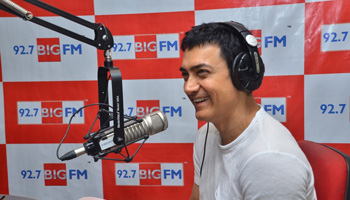
    92.7 BIG FM listeners had a special treat when Aamir Khan dropped by at the Mumbai station to interact with them on air.


    Engaging in conversations with listeners from across Tier II and III cities resulted in some interesting revelations, as they shared their feedback, the difference it has made to their lives and to the society at large and also proactive recommendations of subjects that could be taken up on the show. “People around watch the show and expect change from their society, change will happen only when one personally changes,” he said.


    Speaking on the occasion, Mr Khan said: “I am very happy to have got this opportunity on 92.7 BIG FM to connect with my audiences. With Satyamev Jayate, our endeavor has been to address key issues plaguing the nation, the show today has gone a long way in helping us get a first hand feedback about the show, how it has impacted us and how the show can play a catalyst in bringing about the much required change in our society.”


    Commenting on Mr Khan’s visit to the studio, a company spokesperson said: “We, at 92.7 BIG FM, were happy to have Aamir Khan choose our network to reach out to people across India, while offering our listeners the opportunity to speak with someone, who is working towards creating a positive change in society.”


  • Happy bags Ola Cabs and Eros Now

    By A Correspondent


    Happy Creative Services, which recently launched its Mumbai operations, has been appointed the creative agency for two new accounts based out of the city.


    The first one being Ola Cabs, a technology-based cab service that allows people to book a cab directly through an app on their smart phone along with the option to book via telephone and the web. The service is currently available in Mumbai, Delhi and Bangalore currently and shall soon roll out to 8 cities within the year.


    “It is about time we had a proper organized cab service in our country. I am sure everyone is sick and tired of being put to the mercy of unorganized cab services and unprofessional cab drivers. We’re really excited to be working with Ola Cabs to launch their brand across the country. That fact that it is a technology-based service makes it all the more exciting. We are grateful to the team at Ola for placing their faith in us”, said Kartik Iyer, CEO, Happy Creative Services.


    On appointing Happy as the creative agency Bhavish Aggarwal, CEO, Ola Cabs said: “I was impressed with the simplicity and broad appeal of Happy’s past work and that’s exactly what we wanted at Ola. The team at Happy has put in a lot of time with us to understand what our product and brand is and how to communicate with our consumers. I’m really excited about bringing them on board!”


    Happy also bagged the Erosnow.com account, the digital arm of Eros International – the producers behind many of some famous Bollywood movies. Erosnow.com is a subscription based website where people can watch their favourite Bollywood movies on demand, from anywhere in the world. The site shall also feature Tamil and Telugu movies and will proceed to offer more languages in the future. Erosnow.com shall also offer music and humor content alongside the movie offering.


    “It is an opportunity to take Bollywood to the world. And we can’t think Eros enough for choosing us to do the job. We have a lot of exciting things planned for the global audience. It is all about the movies, and that can only be fun and entertaining,” said Pallavi Nayak, GM Mumbai, Happy Creative Services.


    “Getting Ola Cabs and Erosnow.com on board at Happy Mumbai is very much in sync with our overall growth strategy,” said Siddhartha Roy, COO, Happy Creative Services. “We are very confident that our work on these businesses will certainly help increase our penetration in Mumbai” he added.


    Both accounts are headquartered in Mumbai and shall be serviced by Happy’s Mumbai branch.


    Since its inception the Mumbai branch has also been working with MTV on certain special projects surrounding their ACT initiative.


  • Shapoor Mistry seen within the Shapoorji Pallonji Group as a ‘big picture strategist’

    Shapoor Mistry

    By Kala Vijayraghavan


    Reclusive Indian-born Irish tycoon Pallonji Mistry, 82, officially bequeathed the chairman’s role of the $2.5-billion Shapoorji Pallonji Group (SPG) to eldest son, Shapoor Mistry, 47, in early June.


    The change of guard was in keeping with the way the low-profile diversified conglomerate and its promoters go about their task – without ceremony and any announcement from the rooftops.


    Shapoor will continue to be managing director, and Pallonji may take on the mantle of chairman emeritus, suggest two senior group officials on the condition of anonymity.


    When contacted, a group spokesperson confirmed the move. “Pallonji Mistry has stepped down as chairman of Shapoorji Pallonji Group and Shapoor Mistry has taken up this role. The group companies will continue to get Pallonji Mistry’s advice as and when required,” he said.


    Shapoor has taken charge as chairman & MD of SPG a little over six months before younger brother Cyrus Mistry, 43, is slated to succeed Ratan Tata, who will retire as chairman of the Tata Group at the end of the year.


    In November 2011, Cyrus was appointed deputy chairman and chairman designate of Tata Sons, the holding company of the over 100-company group.


    Prior to that, Cyrus was joint managing director of the SP Group, besides being a director on the Tata Sons board since August 2006.


    Pallonji is the single largest shareholder of Tata Sons, the holding company of the salt-to-software Tata Group, and was called the ‘Phantom of Bombay House’ (headquarters of the Tatas) for his reclusive nature. The patriarch had split his 18.5 per cent stake in Tata Sons equally between his two sons a few years ago. Cyrus’ shareholding has been moved into a trust as a part of an agreement between SP and the Tata Group before Cyrus was appointed deputy chairman at Tata Sons.


    Shapoor is seen by insiders within the group as a ‘big picture strategist’. Group officials point out that the new CMD has initiated a massive revamp of the SPG brand, which will soon complete 150 years.


    The rebranding – to SPG – is part of Shapoor’s ambitious plan to realign group companies to create a powerful combined entity that can compete globally, top group officials said.


    The rebranding exercise saw various group companies operating without the SP brand – like Afcons Infrastructure and Forbes Gokak, to name two – being brought under the mother brand.


    A new logo, with the slogan ‘Built to Last’ below it, seeks to convey trust and dynamism, and the group’s forward-looking nature even as it seeks to remind clients and consumers about its 150-year heritage, explains a company spokesperson. “The elements of the Shapoorji Pallonji brand have not changed. The group has rich values that have got re-emphasized with the new brand,” the spokesperson added.


    Shapoor is keen that the group, which is primarily B2B with businesses such as construction, engineering and infrastructure, show more of its consumer-facing side. The group has retail-driven businesses such as residential real estate (including luxury as well as affordable housing), home cleaning, security systems and air and water purifiers. Currently, construction and real estate account for over 60% of the group’s revenues.


    “Shapoor is looking at the branding and marketing aspect of the SP brand very closely. He wants the brand to be more visible as an interface to the consumer,” a top official said on condition of anonymity.


    Meantime, Shapoor has begun strengthening his management team by roping in professionals as part of his globalisation plan. He is working on consolidation of various group companies into manageable entities within the group’s core businesses. Along with mergers, he is also understood to be working on buying assets – overseas and local.


    Shapoor has identified a few global and domestic businesses for acquisition, officials close to the management said. SPG has also verticalised its various businesses such as real estate, construction and infrastructure according to the recommendations of management consulting firm The Boston Consulting Group.


    Source: The Economic Times

    Copyright © 2012, Bennett, Coleman & Co. Ltd. All Rights Reserved


    Photograph: Fotocorp.com
     

  • IAMAI: E-commerce witnesses upward swing

    By A Correspondent


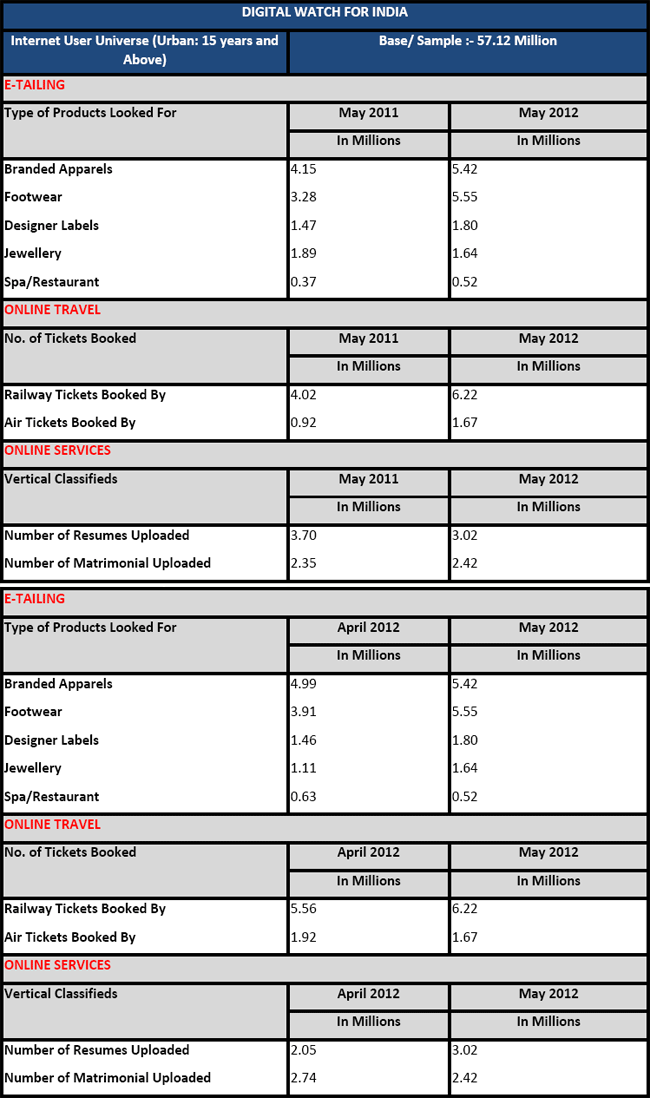
    There has been a surge in the e-ticketing category of the Indian Railway Catering and Tourism Corporation Ltd (irctc.com). In May 2012, IRCTC recorded over 6.22 million bookings as against 4.02 million bookings in May 2011, thus witnessing a year on year growth of 55 per cent.


    While there has been an increase in online railway ticketing and online air tickets, matrimonial profile uploads and activities on e-commerce sites; there has been a slight decline in the number of resume uploads on recruitment sites. These are some of the findings from the Internet Economy Watch data released by IAMAI (Internet and Mobile Association of India).


    The Internet Economy Watch data released is said to be based on absolute numbers captured from relevant sites of verticals encapsulating online usage for e-tailing, online travel and vertical classifieds.


    Besides the online railway tickets bookings, the data also reveals that there has also been an increase in the online air tickets as well. The booking of online air tickets is said to have witnessed an increase of 82 per cent year on year wherein on May 2012 online air tickets received 1.67 million in May 2012 from 0.92 million of the corresponding month last year i.e. 2011.


    Source: IAMAI/ Online Travel Portals


    Vertical Classified Sites:

    Interestingly, the number of resume uploads on recruitment sites have seen a slight decline in May 2012 as compared to the resume uploads in May 2011. Resume uploads on recruitment sites declined from 3.70 million in May 2011 to 3.02 million in May 2012. The resume uploads in April were however 2.05 million. The data captured from 28 online matrimonial sites however shows an annual increase in matrimonial profile uploads from 2.35 million in May 2011 to 2.42 million in May 2012.


    Source: IAMAI/ Vertical Classified Sites


    E- Commerce Sites:

    The study shows there has been an increase in user visits to branded apparel and footwear sites from 5.42 million and 5.55 million visits respectively in May 2012 as compared to 4.15 million and 3.28 million visits for the corresponding month last year. While the designer label segment has registered 1.80 million visits in May 2012 as compared to 1.47 million visits in May 2011. The jewelry category has witnessed 1.64 million visits in May 2012 as compared to 1.89 million visits in corresponding month last year.


    Source: IAMAI/e-Commerce sites


    Compared to April 2012, there has been a significant increase in e-ticket bookings at irctc.com, resumes uploaded on recruitment sites and visits in e-tailing of branded apparel, footwear and designer label segment in May 2012. On the other hand, there has been a notable decrease in online booking of air tickets and profile uploads on matrimonial sites in May 2012 as compared to April 2012.


    Source: IAMAI


  • Multi-brand FDI to hit kirana shops: Metro boss

    By Dipti Jain


    It is not just small traders and kirana stores who are worried over loss of business if foreign direct investment (FDI) in multi-brand retail is allowed. Even international chains such as German retailer Metro Cash & Carry believe that the reform move may impact local businesses.


    While the influx of international retail giants will bring in investments in back-end and supply chain management, the Indian arm of Metro Cash & Carry said this will decrease the importance of small traders in the country as consumers would shift to large format stores from the local kirana shops.


    “Consumers will shift to large format stores, so the relevance of small traders will decrease. Because of substantial increase in disposable income due to a growing economy, the focus has today shifted from small to large format stores,” said Rajeev Bakshi, managing director, Metro Cash & Carry, India.


    The statement by the German company comes as a surprise especially after international chains have been waiting for the opening of FDI in the sector as they reason it would benefit smaller players by way of technological enhancements as well as creation of new jobs, besides giving them an opportunity to tap into the growing retail market in India.


    The government and other retailers have argued that the entry will help local outfits get more efficient and innovative and also check wastage as nearly 40 per cent of the farm produce is lost due to poor storage and distribution facilities in the country. Several global giants such as Wal-Mart and Carrefour are waiting for the government to finally permit FDI in the multi-brand segment, an area that Metro does not intend to enter immediately.


    In recent weeks, the government has pitched for opening up multi-brand retail and even cited the backing it has received from several states.


    The government allowed 100 per cent FDI in single brand retail last year. However, the permission for 51 per cent FDI in multi-brand retail had to be put on hold after widespread protests by Congressmen as well as UPA allies, including Trinamool Congress.


    While the impact on small traders would affect Metro’s business in the country, the company is betting on a growing business from hotels, restaurants and caterers (Horeca) for continued growth. “This will indirectly impact our business, but then the other business takes off. People are eating out much more than before. So our Horeca business will go up. The net effect on us is balanced,” Mr Bakshi said.


    However, Mr Bakshi added that it is not just foreign retail majors, even large cash-rich domestic players have the capacity to exploit the market. Despite discussions that modern stores and wholesale chains would make the local channels irrelevant, Mr Bakshi said with the demand pattern shifting, these models are becoming irrelevant themselves. Metro Cash & Carry entered India in 2003 and currently has 11 wholesale distribution centres.


    The company has already invested close to Rs1,000 crore and plans to open six to eight stores annually, each entailing an investment of around Rs 60 crore. The company recently opened its store in Delhi and Jaipur and is planning two more stores in Chandigarh and Indore.


    Source: The Economic Times

    Copyright © 2012, Bennett, Coleman & Co. Ltd. All Rights Reserved


  • Ranjona Banerji: India’s great football triumph = Viva Espana!

    Ranjona Banerji

    By Ranjona Banerji


    So who was bigger this week? European football or the prime minister as the finance minister? In spite of how much we love the Indian economy and can now all speak knowingly about repo rates and supply side economics, actually it is the question of whether Spain is really the greatest sporting nation in the world or not that concerns us.


    Since everyone stayed up all night on Sunday to find out – all the newspapers that is, not me – we can now safely say that football is the second biggest sport in India, after cricket. In fact, sometimes newspapers do not stay up all night to bring us the results of late night cricket matches, especially where India is not playing, so…


    I point this out because the chances of India playing at the Euro Cup are, of course, zero but the chances of India playing football at the international level are also, er, zero.


    No one, however, cares. Although we are often accused of being jingoistic (by me), when it comes to football, it is the beauty of the game which gets us. All these European countries fighting each other as they chase a ball around a field affects us deeply. We take on loyalties that are deep and meaningful, we become close to all the players and we have no compunctions about fighting with our friends who support the wrong team. I see “we” in a generous sense that has nothing to do with me, since I don’t understand any of this.


    Funnily enough, we don’t even care that we can’t even make tenuous Indian connections which make us so happy at other times – the white mayor of Pigsknuckle, Arkansas once ate an Indian meal made by second-generation Indian immigrant Lucky Kohli, thus proving how great India is.


    Spain is now top country for India (I make this arbitrary judgment based on Twitter), even though I don’t think that Spain has many of the celebrity footballers who make the news the rest of the time when they play for clubs (Messi, Ronaldo, Rooney are the ones who pop up all the time for philistines like me). Also, once the World Cup arrives and the South American teams take part, all these loyalties will shift again.


    Indian TV news does devote some time to football but not as much as Indian newspapers which even sent correspondents to Poland and Ukraine. That is why newspapers are at the vanguard of identifying the sports which fascinate the new India.


    TV news is involved in saving India night after night so sport, unless it involves scandal, is not really that newsworthy. No?


    PS: The prime minister as finance minister? Boring!


  • AdStrat: Mercedes Benz – Pillows

    Ambareesh Chakraborty, Creative Director, RK Swamy BBDO
     

    1. Name of the Campaign: Pillows


    2. Research insights: Pillows

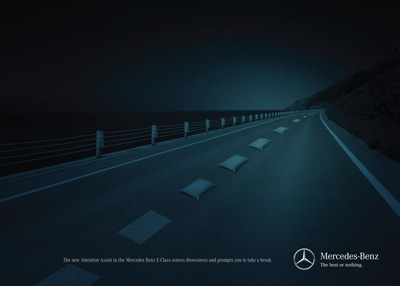
    Sleep can suddenly steal upon anyone while driving. We wanted to dramatise its stealthy appearance through the analogy of the pillows and drive home the fact that the New Attention Assist on the Mercedes Benz will detect any such tendency to sleep and prompt the driver to take a break, an important and thoughtful feature from a brand that has pioneered most of the safety features extant in the automotive world today.


    3. The Brief:

    The task was to make potential customers realize that even though sleep can strike at any time and without warning while driving; the Attention Assist Feature on Mercedes Benz E-Class cars has been designed to tackle just this.


    4. The thought process behind the creative:

    Make potential customers realize the stealthy nature of sleep. This was done through the sudden conversion of the road marks into pillows. Let the visual cue the problem and have the copy simply state the solution.


    5. Media vehicles chosen: Print


    6. Key issues kept in mind while executing the ad:

    It should look premium, and be noticeably different in the way it delivers the message. It should be understated in tone, in keeping with the image of the brand.


    7. Does the treatment do justice to the brief:

    Yes, it deals with the problem in a different way. The restrained tone of voice of the Mercedes Benz brand has been maintained. The look is premium and is capable of intriguing a reader.


    8. What according to you is the differentiating factor about the ad:

    It is simple, yet unusual. It does not have a crash scene, or a man drooling off to sleep, or a shiny car in it, and yet the tone of the ad is Mercedes Benz.


    9. Market and client feedback: Not yet available.


    AdStrat appears every Monday. Compiled by Shubhangi Mehta.


  • Scarecrow bags creative duties for Emami Healthy & Tasty

    By A Correspondent


    Emami Healthy & Tasty has appointed Scarecrow Communications as its creative agency. The account will be handled out of Scarecrow’s Mumbai office.


    Healthy & Tasty, from Emami Biotech Limited with a presence across 6 states, has an ambitious plan to go national during the course of this financial year. Despite being in existence for a short period of just over two years in a highly complex category with various regional variants and preferences and a litany of national and local players, the brand has been able to create a premium imagery and consumer preference for itself and is well on it’s way to becoming a strong national brand.


    Saroj Chakraborty, CEO, Emami Biotech, said: “Healthy & Tasty is a young brand with a strong appetite for growth and needed an equally young creative agency with great creative abilities to be able to match its aspirations. Scarecrow fits the bill and I have no doubt that their creative skills would be able to bring forth the inherent goodness of the brand to the consumer and help translate the brand’s aspirations into reality.”


    Manish Bhatt, Founder-Director, Scarecrow Communications, said: “This is one of the sweetest wins for Scarecrow. Emami is one of the most advertising-savvy companies inIndiaand it is an honor to work on one of their most prestigious brands.”


    Joy Sengupta, Founder-Director, Scarecrow Communications, added: “There are truly very few national brands in edible oil. We hope to create advertising that will help Healthy & Tasty find a place in a woman’s heart and also, her kitchen.”


  • Danone Narang appoints Scarecrow for B’lue

    By A Correspondent


    Danone Narang Beverages has appointed Scarecrow Communications as its creative agency for its beverage brand, B’lue. The agency was selected after a comprehensive selection process. The business will be approximately in the range of Rs15-20 crore once the product gets launched countrywide. The incumbent on the business is Everest Brand Solutions. The win is significant to Scarecrow as Danone, as a brand internationally, is aligned to the Y&R group and has strayed from this in just few markets, and India is one among them.

     

    An official from Danone Narang has confirmed this development.


    The brand B’lue is a new concept in ready-to-drink beverages. It is a restorative drink that leaves you feeling refreshed and uplifted, thanks to it’s unique formulation. B’lue is currently being test marketed in Pune. In 2010, Danone (the world’s second largest bottled water company) partnered Narang Beverages through a joint venture.


    Raghu Bhat, Founder Director, Scarecrow Communications said: “It’s a source of personal and professional pride to be associated with a brand like B’lue from Danone Narang Group. And there is a genuine opportunity to create interventions at multiple levels through the power of creativity.”


    Manish Bhatt, Founder Director, Scarecrow Communications added: “Danone has given the world iconic brands like Evian. Working on this new innovative FMCG brand conceived by Danone Narang – B’lue  – is one of the most exciting opportunities for Scarecrow. ”


  • Anil Thakraney: How ads helped chocolates treble sales

    By Anil Thakraney


    Read an interesting story in The Times of India. It reported that chocolate consumption has trebled in India, not in the last 30 years, but in the last seven years alone! This is a huge rate of growth in any product category, and by any stretch of imagination.


    So, then what happened? Has India suddenly developed a sweet tooth? Can’t be that, because mithais and other sweetmeats have been part of our tradition and eating habits for centuries together. There must be another explanation. TOI’s story seems to link the growth in choc consumption to the rising income levels in this country. I find this link a bit tenuous. Because rising income usually translates into increased expenditure on consumer durables and other high ticket items, those that import some degree of status to a person’s life. How on earth does a bar of chocolate fit in this scenario? It’s a low cost impulse purchase product, much like all other sweets and snacks. So the answer lies elsewhere.


    In my belief, that answer lies inside the marketing office of Cadbury India, the company that enjoys a 70 per cent market share in this category. All those years and efforts the chocolate major has invested in expanding the market in India, to make their brands attractive to the adult segment, have paid off big-time. And Cadbury’s rivals have benefited in the process, too. This is the key reason behind the booming choc market.


    Some of you may not know this, but as recently as 20 years ago, chocolates used to be targetted only at kids, and this imagery of the product totally alienated the vast adult population. In the year 1992 if you dared to consume a Cadbury Dairy Milk bar in a public place, you ran the risk of being scoffed at for ‘shamelessly eating a bachchon ka product’. And in just twenty years the market has turned on its head.


    And this has been achieved by Cadbury purely on the power of advertising. It took some years, but the results are showing now, and how! The Cadbury commercials have won many awards over the years but their biggest victory has been that they turned the fortunes of the entire category. Cadbury India has shown the world the magic you can do when your strategy is innovative and when the creative work shines. The trebling of the choc market in India is the victory of advertising alone.


    * * *


    [youtube width=”400″ height=”225″]http://www.youtube.com/watch?v=YI7Oq8y-jXA[/youtube]

    PS: This is why I am so looking forward to watching The Newsroom, the latest, hottest American TV serial. Am excited not just as a viewer, but also as a journalist. It’s high time the media looked at its own self. This is gonna be something else, going by this kickass capsule. Must watch.


  • The Anchor: 5 reasons why advertisers don’t get desired ROI from Digital Media plans

    By Siddharth Puri


    1. Advertisers inability to identify right metrics to evaluate media plan performance

    Digital Media advertisers end up creating metrics which are not 100 per cent aligned to the business goals, which they wish to achieve, with campaigns being driven via digital media planned. For example, e-commerce advertiser looks to advertise and drive more transactions, but instead deploys money on media and optimizing media plan for a metric such as number of visits received on the e-commerce store front, instead of owning up to all metrics in the funnel till business objective of transaction. Lot of advertisers end up treating metric like on-site conversion ratio as black box instead of demystifying up to product searches, carts created, number of users reaching closer to end metric of transaction and optimizing media plan on deeper in sales funnel metrics.


    2. Cross Digital Media Channel Attribution Management

    Digital Channels have evolved from being a single channel to a medium with multiple media channels like social, search, display, mobile, affiliate among many others. With advent of multiple channels and ability to measure via technology, it is important that the advertiser doesn’t make a mistake in establishing, not only channel which leads to last content before conversion of customer in campaign, but the medias which lead user down the funnel.


    Performance channels like Search and affiliate networks sit lower in funnel and closer to conversion, but study of users’ path before conversion reflects strong display activities with correct frequency and media placement on media plan reflected as high as 50-60 per cent work done to influence conversion.


    3. Digital Media plan created with over-dependency on single creative format type

    To create 360 degree impact, it’s important that all formats, including Mailers and Text Ads, beyond Display should be used effectively to capture the user intent created. What’s required is the ability to synchronize communication across formats to deliver higher ROI than single creative format type plans.


    4. Measuring of Google as single property/channel on media plan

    Google is made up of multiple line items for an advertiser for instance:-

    1. Brand Keywords – Users search for your branded products and are captured via Google text ad words advertisers at the cheapest cost. The ROI should compete with your SEO/organic traffic metrics as there is no effect of advertising but ability for technology to funnel direct demand for you. 30 per cent is the ideal spend for a brand advertiser.

    2. Non Brand Keywords – Spend done on this bucket is for placing your ads in front of category specific searches happening and trying to influence or win SOV – 40 per cent spend for an advertiser

    3. Google Content Network – Spend done on this bucket is to place your ad in contextually relevant environment basis audience targeting driven from content on page taken as input or measurement of relevance. This category constitutes approximately 30 per cent of an advertisers spend


    From a ROI cost perspective, the above channels have been listed in order of their cost to return ratio, indicating clearly that the average ROI delivered by Google is lesser than ROI metric achieved on non brand keyword due to averages from brand keywords making other channels on digital media plan look ineffective in meeting goals. If, as an advertiser you treat all the three as different channels, you will be able to increase ROI efficiency on your media investments by 30-40 per cent.


    5. Ad Network buys which constitute 20 per cent of the media plans are bought on price with comparison of channel against Search than Display Properties

    Ad Networks are fundamentally Display Format Publishers and hence inherit strengths and weaknesses of Display. Their performance and optimization which can be achieved is similar to display properties. One uses Ad Networks over display properties due to the technology which brings along additional optimization capability beyond creative and placement optimization. Digital Media plans are being developed as operations plan rather than strategy plans. If brands marketers/advertisers change their approach to Digital Media plans, they will be able to generate desired ROI since the Demand being less than Supply scenario still exists on digital media.


    Siddharth Puri is the Business Head, Tyroo Direct


  • CNBC-TV18 launches The Olympian Effort

    By A Correspondent


    CNBC-TV18’s special series - The Olympian Effort will be launched at the end of June 2012. Built around the 2012 London Olympics, the show salutes the spirit of sportsmanship and takes an in-depth look at the business of Olympics. The series will offer a 360-degree perspective on London 2012 – from the dreams of sportsmen, to the ambition of global sponsors and from funding careers, to a country’s preparations to host the biggest sporting event in the world.


    The series is devised into six parts, with a focus on different aspects of the Olympics in each episode. A special episode on India and the Olympics will showcase India’s history and track record at the Olympics, the past winners and their moments of glory. The show will then look at the Indian 2012 contingent, their prospects and the country’s expectations from them.


    As the series progresses, it will dive deeper into the business of Olympics and analyze how Indian businesses and companies with Indian stakes are getting involved and leveraging on the games. The show will capture the expectations of various athletes and contingent sponsors as well as the first time broadcaster of Summer Olympics ESPN Star Sports.


    A special episode will be anchored out of London itself that will provide a global view of the 2012 London Olympics and its impact on Brand London. Interviews with global sponsors and organizers will provide an insight to their views and expectations from the games.


    The series will conclude after the closing ceremony which will analyze the 2012 Games and brand London from all aspects.