 One of the most common conversation starters among people is news. It could be news pertaining to politics, business, technology, infrastructure, sports, education or simply anything of mutual interest. Of course, given the current political/cultural environment, certain news items also pit the same people against each other.
How do we consume any form of news? Barring the decreasing percentage of print lovers like me, majority of people access news through websites, mobile apps, YouTube, podcasts, and social media. And thanks to so many available (free) platforms of expression, people across age, economic or social standing, gender, disability et cetera, vociferously share their views.
 Yes, people with disabilities too access news media, in all shapes and forms. They are also informed and opinionated citizens of India. But are news offerings built keeping in mind needs of people with different types of disabilities? Are product developers aware of what these accessibility requirements are? Do they know there are more than 1 billion people with disabilities who have the right to equal access to digital content, and that there are laws mandating the same?
Sadly, very few news media organisations understand and cater to their access needs. But those who do, deserve acknowledgement and appreciation. Recently, Newslaundry launched NewsAble, making their website and mobile app accessible to everyone. I caught up with Chitranshu Tewari, who is their Product and Revenue Director, to find out what impelled this change. He leads a cross-functional team that manages product, subscription, tech, and audience.
Q: As a news media company, what prompted Newslaundry to think of accessibility?
A: As a subscriber-led organisation, our product strategy has always focused on serving the user needs of our subscriber community. Way too often, in mainstream media, tech and product resources are used to serve ads faster or optimise for ad revenue at the cost of reader experience. Our subscription model, on the other hand, enables us to try innovation in product and tech.
We first encountered the importance of accessibility for our app and website when a young blind subscriber reached out to us, expressing his struggle to access our journalism despite being a paying subscriber. His email was a wake-up call, leading us to engage with more disabled users and educate ourselves on accessibility. The more we interacted with users who had lived experiences, the more we realized the significant gap in India’s news market for accessibility. Their stories and struggles became our motivation to make the change.
Q: What’s different about the accessible version? What features have changed, and how did you go about working on this project? Tell us all about NewsAble.
 A: Accessibility is not a shiny feature or an add-on; a good product is accessible by default. Accessibility must be baked into the DNA of the product. Frankly, if you’re starting a new product or an app, making it accessible is not rocket science and can be done relatively quickly. There are enough resources and Web Content Access Guidelines (WCAG) to help developers and designers.
But if you’re dealing with a 12-year-old tech stack, which is a combination of third-party software, native tech and code that is just holding it together, it’s a different challenge altogether. This is where we were, but we didn’t let that daunt us — we cleaned up and rewrote a lot of front code to make sure it was compatible with screen reading software used by blind users and set up the foundation on which settings and controls under accessibility could work. It was a painstaking process which took more than six months, but it was worth it to ensure our product was accessible to all.
At the outset, we researched accessibility, spoke with accessibility experts, and most importantly, learnt how disabled users access the internet, leading to a survey with a cohort for the kind of settings and contours they would like the most. We started the engineering work only when we had that info locked in. Then we did a beta launch where we again tested and iterated based on users’ feedback. We also partnered with the students at the Michigan University to do a heuristic evaluation of our design.
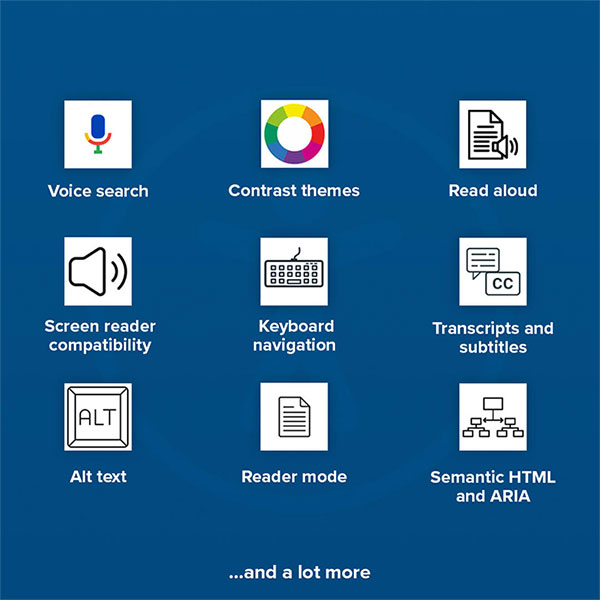
As a result, our website and app are now accessible—we launched them publicly for everyone on April 30. They’re compatible with all leading screen reading software and offer controls such as read-aloud for all text stories, transcript for all podcasts, contrast themes for users with colour blindness, motion control, keyboard navigation, alt text, semantic HTML, and ARIA to make our product compatible with assistive technology. For instance, our read-aloud feature allows visually impaired users to listen to our news stories, ensuring they can access our content without any barriers.
Q: Despite the legal mandate for compliance, organisations refrain from making products and services accessible because of the costs involved. And that perhaps also makes it difficult to get a leadership buy in. What’s your experience been on that front?
A: We have the Rights of Persons with Disabilities Act, 2016, but organisations hardly comply. Two major reasons are that the bodies enforcing it lack the teeth to take action or impose substantial penalties. Compare that to the US and Europe, where businesses must keep their sites accessible to avoid hefty lawsuits.
In our case, having an accessible product directly overlapped with our goal of putting users’ needs first. So, even though it was resource-intensive, it wasn’t a roadblock. Also, it helps when you have a small team. We could move into this quickly without the bureaucratic hurdles you see in larger companies.
Given that this required considerable engineering and development efforts, we needed resources to sponsor that cost. We pitched accessibility as an idea and its need to Google News Initiative Innovation Challenge, a global programme to empower news organisations that pioneer new age thinking in online journalism. Folks at Google backed the idea, helping us fund much of our engineering effort.
Q: What was the response of your internal teams, especially designers and developers, to this change?
 A: I will be honest. News organisations lag way behind when it comes to product or tech innovations. This is mainly due to two factors: first, product and engineering resources are primarily used to serve SEO or ad revenue needs, leaving little incentive for product innovation. Second, often product decisions are made by executives and journalists who are quite short-sighted. Not to forget, newsrooms always have limited tech bandwidth and don’t attract the kind of tech talent that goes to say, an out-and-out tech company.
At Newslaundry, we have taken great pride in designing products that have been ahead of the market and have brought innovation, whether it’s a podcast player, crowdfunding platform, or app that has everything from multi-tiered subscriptions and e-commerce to custom notifications and podcast players.
When we first considered accessibility, the team readily saw its potential and the impact it would have on the news ecosystem. As a reader-supported outlet, I always tell our team that our work and its effects will outlast our careers in the news.
Q: Many news websites remain inaccessible, denying Persons with Disabilities their right to information. As someone in the same space, what do you think can motivate other companies to make their offerings accessible?
A: India has a significant population of people with disabilities, with conservative estimates putting the number at 25 million. These figures are likely under-reported. The World Health Organisation’s estimate is almost double. By making their sites accessible, executives can tap into this vast, underserved audience. The potential business benefits are clear, and the moral imperative to provide equal access to information should not be overlooked.
More importantly, accessibility or accessible design is not just for people with disabilities; it’s for everyone. It makes the app more user friendly and useful for everyone. For example, a font size control can easily be used by an elderly person who’s short-sighted.
Q: Do you think developers and designers lack the understanding of accessibility as they don’t have much feedback from a user base that comprises of Persons with Disabilities?
A: There needs to be more awareness. But we live in a world where information is just a click away. So, I won’t consider this an issue of a lack of understanding. In media, we have primarily invisibilized people with disability, leading to no feedback. A lot of blame goes to us for that. Especially if we look at how they are represented or talked about in India, even the use of words like divyang. Any disabled user should be able to use the internet with similar ease like you and me.
Q: Are organisations aware of Web Accessibility Guidelines and the compliance needs per the Rights of Persons with Disability Act 2016?
A: Very rarely.
Q: What role do you think mainstream media can play to sensitise people about the need for digital accessibility?
A: To start with, we need to focus on disability rights and the challenges faced by people with disabilities. Our cities and public infrastructure are notoriously inaccessible. Media can make the right noises to demand more accountability for making it accessible. We need representation of people with disabilities on our team. Our workplaces need to be accessible too.
Q: In this exercise of making the product accessible, has there been any rub off on the editorial side vis-a-vis a deeper understanding and reporting on issues of disability inclusion?
A: That’s certainly the plan. Last year, at Media Rumble, we did a panel discussion on accessibility in news products that discussed policy, legal, and engineering aspects of the issue. We are also working on a deep dive, long form podcast on accessibility, covering various aspects with domain experts. The idea is to push this in reporting, but we are a small team. We have covered a few stories on and off, but hopefully we will pursue it as a beat. My hope is that as more disabled users interact with our app and website, more people will write about issues around accessibility — nudging editors to put more reporting resources into it.
Q: Is there anything else that you would like to share?
A: I want to credit and acknowledge my team that worked hard and made this possible. We are a small team that takes great pride in punching above our weight, and we hope our work nudges other publishers to consider accessibility. If we, as a small team in an independent digital newsroom, can do it, outlets 10x our size surely can.
Lastly, people often claim accessibility for PR. They will put a few overlays and widgets that offer the bare minimum user control and call it accessible. There is a lot of research and literature on this. So, if you’re thinking of working on accessibility, don’t take the shortcut. Speak with experts, speak with disabled people, and do it right.
Get a sneak peek into the changes made by Newslaundry team here.