Category: Uncategorized

  • Starcom bids adieu to Mallikarjun Das

    By A Correspondent


    Mallikarjun Das

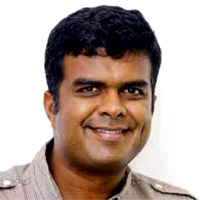
    Starcom CEO Mallikarjun Das (Malli) has decided to move on from the organisation.  Malli, as he is known in the fraternity, joined Starcom India as CEO in 2011.   Said Malli:“Working at Starcom over the last seven years has been a peak experience – it has left an indelible impression on me and shaped me as a professional and individual. Wisdom of hindsight is a dangerous thing, but I count myself lucky to have had large, complex business challenges come my way in this stint. I have had the full support of my team, Anupriya and my previous bosses in facing up to these challenges. Our results speak for themselves – Starcom India has grown four times the last four years; our India operations ended 2017 as Starcom’s Global Office of the year. I wish everyone at Starcom and Publicis Media all the best for the future.”


    Anupriya Acharya

    Added Anupriya Acharya, Group CEO, Publicis Media India: “We are going to miss Malli. His tenure at Starcom has been exemplary and working with him has been a wonderful experience. Starcom has had a phenomenal journey under his leadership and he has made a tremendous contribution to giving a strong foundation to Publicis Media too. Our best wishes are with him for his next assignment.”


    The agency will be making an announcement shortly on new leadership for Starcom India.


  • Mullen Lintas celebrates laziness in latest film for Crabtree

    By A Correspondent


    Mullen Lintas Delhi has conceptualised the latest campaign for Crabtree to promote its Home Automation solutions. In this campaign, Mullen Lintas highlights how with Crabtree Home Automation Solutions, an eccentric billionaire celebrates laziness in its truest sense. While his maids and butlers are frustrated about feeling unemployed, the film playfully demonstrates the angst in them.


    Commenting on the creative strategy, Shriram Iyer, NCD and President at Mullen Lintas, said: “The campaign aims at launching Home Automation Solutions from Crabtree. The film plays out the life of an eccentric billionaire who has inadvertently put his maids and butlers out of work by getting various appliances automated. The heaters, the lights, the curtains – all function without any manual intervention.”


    Added Amit Tiwari, Vice President of Marketing at Havells: “At Crabtree, our efforts are concentrated in providing a premium and comprehensive connected smart home experience to our end-user customers. Fulfilling our promise of WhatALife experience, our solutions let homeowners personalize and tweak the scenes at home to their changing temperature, music, and lighting preferences. The shifting and thriving India demands a modern home and futuristic lifestyle and Crabtree is here to fulfill them.”


  • Sanjeev Kotnala: ‘Brand-I’, Advertising and ‘My Gita’ by Devdutt Pattanaik

    By Sanjeev Kotnala


    ‘My Gita’ by Devdutt Pattanaik does not demystify GITA for a common person. It places his interpretation and understanding of multilayered discourse by Lord Krisha. It has taken me a long time to complete it. It is a tough book to follow, and you have to go slow digesting every framework presented in it, thus this hugely delayed reaction. So here are my feelings about ‘My Gita’ by Devdutt Pattanaik.

    We are not rational creatures who feel. We are emotional creatures who rationalise. Page 131.

    It is quite commendable and brave of Devdutt not to attempt yet another Verse by Verse desertion of Gita. In the process, he brings alive the soul of Gita in a narrative that puts human first. It’s storytelling of a different level. It is much different than many of his other work in the mythological narration like Jaya- Mahabharata , Business Sutra  , Sita and 99 Thoughts on Ganesha. My respect for Devdutt Pattanaik grows many folds after reading ‘My Gita’.

    It is all about understanding and not judging, action and engagement and not about in-action and detachment.

    Our emotional experiences can also inform and shape our concepts. So, when a rock or a river gives us joy in some way, we declare it must be a deity. Concepts, therefore, help us rationalise emotions; emotions help us rationalise concepts- it is a two-way process. Page 60.

    It is an interpretation from Devdutt’s point-of-view. In a way, he never proposes it to be the truth or the best understanding thus predictably protecting himself from any harsh reaction in the current social environment.

    He guides us through a thematic representation of a re-aligned synchronised narration of GITA. They almost seem to fall into a sequence of possibilities starting with Observation (Darshan) and moving on to Rebirth (Atma), Mortal Body (Deha), Body’s Immortal Resident (Dehi), Cause and Consequence (Karma), Appropriate Conduct (Dharma), Exchange (Yagna), Introspection (Yoga), Trust (Deva-Asura), Potential (Bhagavan), Expanding the Mind (Brahmana), Contracting the mind (Avatar), Tendencies of Matter (Guna), Propreitorship (Kshetra), Measurement (Maya), Attachment (Moha), Liberation (Moksha) before ending with Union (Brahma-Nirvana).

    Human hunger is not just about food. We seek emotional and intellectual nourishment too. We seek meaning, validation, significance, value, purpose, power and understanding. We seek ideas about wealth, power, relationship and existence. We seek entertainment. We seek food to liberate us from the fear of the predator, security to liberate us from the fear of invalidation. It transforms every meeting into an exchange. Lovemaking is yagna. Childbearing is yagna. Child rearing is yagna. Feeding is yagna. Teaching is yagna. Service is yagna. War is also yagna. Exchange can be used to satisfy our desires or repay our debts. It can entrap us, or liberate us. It depends not on the action, but on the thought underlying the action. Page 106.

    Part of this conceptual Gita finds expression in Brand-i, and a lot sounds like NLP Presuppositions. ‘My Gita’ is about both being unique and independent in an interconnected world. If that is not confusing enough, you may try reading it. On a personal note, ‘My Gita’ helps me in representing some of the concepts in ‘Brand-I’ in a different context and framework.

    “My deha is different than yours. My hunger is different from yours. My assumptions are different from yours. My capabilities are different from yours. My experiences are different from yours. My expressions are different from yours.” Page 66

    It is heavy reading. Even after being genuinely interested in the subject and claiming to have a decent understanding, I found it layered. It is recommended reading, if and only if you wish to immerse yourself and promise to go slow by spending time on each of the chapters.

    I have taken more than 75 days to complete ‘My Gita’, a book of just 245 pages. I went slow, allowing each of the chapters and interpretation to sink-in a bit deeper before moving to the next section.

    I read other books in between and came back to ‘My Gita’ in bits and pieces. I suggest you do the same.

    People in advertising, marketing and brand building will be able to see many parallels in understanding and explanation of current theories of intervention and human emotion in ‘My Gita’. The seekers get what he focusses on.

    “Arjuna, fair or unfair, the results if any action depends on five things;  body, mind, instruments, methods and divine grace. Only the ignorant think they alone are responsible for the outcome.” Bhagwat Gita, Chapter eight Verse 13 to 16 (Paraphrased and presented in My Gita- Page 82)

    Even though I am a fan of Devdutt and his work, I could never bring myself to pick the book off the shelf. However, after my visit to Hemis Monastery at Leh last August, I was genuinely intrigued and interested in reading about Naropa; one of the eighty-four mahasiddhas, the ‘saints’ of Vajrayana. Someone there suggested I read this first. Thus I picked a heavily underlined copy of ‘My Gita’ from my brother  Rajiv Kotnala posted at Leh.

    Krishna Knows That In A World Without Boundaries. There Will Always Be Another Chance, And Then Another’ Page 274

    And as I continue my quest of reading more and more about Naropa, I get a fair sense of well-meaning recommendation. My ‘Gita’ is anyway different than Devdutt Pattainaik ‘Gita’, just like your ‘Gita’ is bound to be different after you finish reading ‘My Gita’. Go ahead. I know it will make sense to you.

    ‘MY GITA’ by Devdutt Pattanaik. INR 295. Pages 247. Rupa Publications


  • RIL appoints Jyoti Deshpande to head M&E biz, acquires stake in Eros

    By A Correspondent


    Reliance Industries Limited and Eros International PLC have announced that RIL, through a subsidiary, has agreed to subscribe to a 5%  equity stake in the NYSE-listed Eros at a price of USD15 per share, which represents an 18% premium to last closing price. The transaction is subject to customary regulatory and other approvals.


    Furthermore, RIL and Eros International Media Limited (“Eros India”) announced that they have agreed to partner in India to jointly produce and consolidate content from across India. The parties will equally invest up to Rs 1,000 crores in aggregate (approximately USD150 million) to produce and acquire Indian films and digital originals across all languages.


    In addition, it was announced that Ms. Jyoti Deshpande, Group CEO and MD of Eros will be stepping down from her executive role after more than 17 years in Eros and move on to head the Media and Entertainment business at RIL as President of the Chairman’s Office. Deshpande will start her role at RIL from April 2018, but will continue to remain as a Non-Executive Director on the Board of Eros. Mr. Kishore Lulla will resume his position of Group Chairman and CEO of Eros.


    In her new role at RIL, Deshpande will lead the company’s initiatives in Media and Entertainment to organically build and grow businesses around the content ecosystem such as Broadcasting, Films, Sports, Music, Digital, Gaming, Animation etc., as well as integrate RIL’s existing media investments such as Viacom and Balaji Telefilms with a view to build, scale and consolidate the fragmented USD 20 billion Indian M&E sector.


    Said Mukesh Ambani, Chairman & Managing Director, RIL, in a statement: “We are pleased to join hands with Eros, as it will bring further synergies into our plans, making for a win-win partnership. We are delighted to welcome Ms. Jyoti Deshpande into the Reliance family and believe that she will not only give wings to our plans but also play a pivotal role in transforming the sector.”


  • M&E to cross Rs 2tn by 2020: FICCI-EY report


    By A Correspondent


    FICCI-Frames 2018 took off on Sunday evening with I&B Minister Smriti Irani as Chief Guest. As part of the inaugural session, the annual M&E industry report, this time presented by the team at Ernst & Young (EY). The venue this year is the Grand Hyatt in Santacruz East, away from the Renaissance at Powai where Frames has been happening for 16 of the 18 editions.


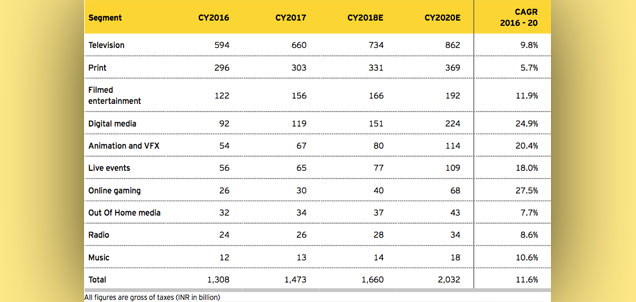
    Back to the report: the Indian Media and Entertainment (M&E) sector reached almost INR1.5 trillion (US$22.7 billion) in 2017, a growth of around 13% over 2016. With its current trajectory, it is expect to cross INR2 trillion (US$31 billion) by 2020, at a CAGR of 11.6%. The digital segment-led growth, demonstrating that advertising budgets are in line with the changing content consumption patterns The  FICC-EY report is appropriately titled ‘Re-imagining India’s M&E sector’ and captures key key insights from the Indian M&E sector.


    The M&E sector continues to grow at a rate faster than the GDP growth rate, reflecting the growing disposable income led by stable economic growth and changing demographics. The report states that subscription growth outpaced advertising growth in 2017 but advertising will continue to grow till 2020 led by digital advertising. The report estimates that approximately 1.5 million consumers in India today are digital only and would not normally use traditional media. It is expected that this customer base will to grow to ~4 million by 2020 generating significant digital subscription revenues of approximately 20 billion. Going forward, micropayments, enabled through the Unified Payment Interface (UPI) and Bharat Interface for Money (BHIM) platforms developed by the National Payments Corporation of India (NPCI) will further accelerate subscription revenues for entertainment content.


    Said Farokh Balsara, Partner and M&E Leader, EY India:  “Indian M&E sector reached INR1.5 trillion in 2017 led by digital. With digital subscribers expected to reach 20 million by 2020, has Indian M&E reached its digital tipping point? We now need to re-imagine the future of  Indian M&E sector.”


    Added Ashish Pherwani, Partner and M&E Advisor Leader, EY India: “Growth in 2017 was led by the digital, film & animation & VFX segments. We expect sectors like digital and gaming to grow between 2 to 3 times by 2020.”


    Key findings

    :: Television:
    The TV industry grew from INR594 billion to INR660 billion in 2017, a growth of 11.2% (9.8% net of taxes). Advertising grew to INR267 billion while distribution grew to INR393 billion. Advertising comprised 40% of revenues, while distribution was 60% of total revenues. At a broadcaster level, however, subscription revenues (including international subscription) made up approximately 28% of revenues.

    Key insights– While advertising is 41% of the total revenues today, the report expects it to grow to 43% by 2020. There are over 30% households in India which are yet to get television screens, but being at the bottom of the pyramid, these households will tend to move towards first towards free and sachet products.


    :: Print:
    Print accounted for the second largest share of the Indian M&E sector, growing at 3% to reach INR303 billion in 2017. Print media is estimated to grow at an overall CAGR of approximately 7% till 2020 with vernacular at 8%-9% and English slightly slower. This growth is expected despite the FDI limit remaining unchanged at 26% and therefore, restricting access to foreign print players and the imposition of GST at 5% on the advertising revenues of the print industry for the first time in history. While magazines contributed 4.3% to the total print segment, the segment was at largely status quo with not many significant new launches in 2017.

    Key insights– Today, 98% of readers read dailies and 20% read magazines. Reader base is 395 million, or 38% of the population. Readership has grown by 110 million over the last 3 years. Rural (52%) reader base is larger than urban (48%). 44% of children (aged 12 to 17 years) read a newspaper or magazine. Magazines have a higher readership in urban areas (57%) as compared to rural areas (43%).


    :: Films:
    The Indian film segment grew 27% in 2017 on the back of box office growth – both domestic and international – coupled with increased revenues from sale of satellite and digital rights. All sub-segments, with the exception of home video grew and the film segment reached INR156 billion in 2017.The Hindi films comprise the majority component of the Indian film segment. They contribute almost 40% of the net domestic box office (BO) collections annually, despite comprising only 17% of the films made. Films in 29 other Indian languages account for approximately 75% of the films released but they contribute approximately 50% to the annual domestic box office collections. Hollywood and international films comprise the balance. The top 50 films contributed approximately 97.75% of the total net box office collection. Box office collections of the top 50 films grew by 11.60% in 2017.

    Key Insights: Regional movies drove the growth in number of releases in 2017. Screen count increased from 9,481 in 2016 to 9,530 in 2017. Number of Hindi movies crossing the INR1 billion mark was highest in 2017 in the past 5 years. From 31 movies in 2016, Hindi dubbed movies increased more than 3 times to 96 in 2017.


    :: Digital media:

    Digital media has grown significantly over the past few years, and continues to lead the growth charts on advertising. Subscription revenues are emerging and are expected to make their presence felt by 2020. In 2017, digital media grew 29.4% (27.8% net of the impact of GST) on the back of a 28.8% growth in advertising and a 50% growth in subscription. Subscription, which was just 3.3% of total digital revenues in 2016, is expected to grow to 9% by 2020.

    Key insights: 250 million people viewed videos online in 2017 and expected to double to 500 million by 2020. Around 40% of total mobile traffic came from the consumption of video services in 2015. This figure is expected to touch 72% by 2020. 93% of time spent on digital videos is in Hindi and other regional languages. OTT subscription in India is expected to touch INR20 billion by 2020.

    M&A in M&E


    The Indian M&E sector witnessed a relatively new trend in deal activity with emerging segments such as gaming and digital gaining momentum, while the deal activity in the traditional media segments was slower. The slowdown can be partially attributed to challenges faced by the advertising segments of the industry due to demonetisation and GST. Overall, the number of transactions in the M&E sector decreased from 56 deals in 2016 to 40 deals in 2017. Further, the total deal value was also lower at US$1,261 million in 2017 compared to US$2,863 million in 2016.


    The entire report can be accessed at here


  • Goafest 2018 on April 5-7

    By A Correspondent


    The Advertising Agencies Association of India and The Advertising Club have announced the dates for the 2018 edition of Goafest. It is scheduled for April 5 to 7 to be held in Goa.


    The event will be helmed by Ashish Bhasin, Chairman & CEO South Asia Dentsu Aegis Network and Vice President of Advertising Agencies Association of India (AAAI), who has been elected as the Chairman of Goafest 2018. Ajay Kakar, CMO Aditya Birla Capital and Vice President of The Advertising Club will be Chairman of the Awards Governing Council.


    Speaking about the focus of the 2018 edition of Goafest, Vikram Sakhuja: President, The Advertising Club said: Goafest is a landmark event that is marked in every brand and media professional’s calendar. The festival is the definitive platform for industry to engage, network and celebrate the pioneering creative work done through the year. At Goafest 2018 we will continue to up the ante on lifting the standard of creative brilliance. Watch this space.”


    Speaking on Bhasin’s appointment as Chairman of Goafest 2018, Nakul Chopra President AAAI said: “Ashish is an industry veteran with indepth understanding of the global media and entertainment industry dynamic. He played a decisive role in ensuring that Goafest 2017 was a grand affair that saw many pioneering initiatives. Goafest 2017 under his aegis is sure so see many more interesting and groundbreaking initiatives that will further up the bar on engagement.”


    Added Bhasin who had also chaired the organising committee at Goafest 2017: “Goafest has been at the center of celebrating transformational brand stories and fostering the media and entertainment industry’s growth agenda.  Our endeavour continues to be create a festival experience that is inclusive, inspiring and delivers an immersive ideas exchange platform to all festival goers.  Goafest, 2018 is sure to provide learning enrichment and facilitate synergies, thereby providing significant value to all festival goers.”


    And this is what Ajay Kakar, Chair of the all-important Awards Governing Council said: “The Abbys have,historically, been both aspirational and inspirational beacons for the advertising, media and marketing industries. This year we intend to bring about exciting changes that will remind people why they have always loved the Abbys. And also remind them why the Abbys have always been regarded and recognised as the gold standard in creativity.”


    Other members of the Awards Governing Council include:

    • VikramSakhuja: President, The Advertising Club & Group CEO – Madison Media & OOH – ‎Madison World
    • Nakul Chopra; President AAAI and Senior Advisor, Publicis Communications
    • Ashish Bhasin: Chairman & CEO South Asia Dentsu Aegis Network – ‎Aegis Group plc
    • CVL Srinivas, Country Head – India, WPP & CEO, GroupM South Asia
    • M G Parameswaran: Founder, Brand-Building.com
    • PunithaArumugam: Entrepreneur and Digital Evangelist
    • Ramesh Narayan: Founder – ‎Canco Advertising Pvt. Ltd.
    • Partha Sinha: Vice Chairman and Managing Director, McCann Worldgroup
    • Shashi Sinha: CEO, IPG MediabrandsIndia.
    • Nagesh Alai: Founder, Independent Business Advisory


  • Indian sports sponsorship grew 14% in 2017


    By A Correspondent


    Indian sports sponsorships grew by 14% in 2017 surpassing the USD 1 billion  mark for the first time as per the 2018 report on sports sponsorship released by ESP Properties, the entertainment and sports arm of GroupM and Sportz Power. Media investments contributed to the largest portion of the pie (55% of overall spends), followed by ground sponsorships. Sports advertising rose to Rs. 7,300 crore, a substantial leap from Rs 6,400 crore in the previous year.


    The year 2017 was a milestone year in sportssponsorship, asthe US billion-dollar mark was crossed for the first time. As per GroupM’s This Year, Next Year advertising investment forecast, Indian advertising expenditure in 2017 was Rs. 61,263 crore, and this report estimates 12% contribution to the overall adspends are from sports sponsorship alone.


    Sponsorship of non-cricketing sports grew in 2017. India’s second biggest sport by participation and attendance, football grew by a considerable 64%. India hosted its first ever FIFA U-17 World Cup that became the most attended in the history of the event. Attendance for this Football World Cup was a record 1,347,133, surpassing China’s 1985 audience of 1,230,976.


    Since last year, ISL is a 10-team, 18+ week showcase, up from eight teams and 10 weeks in the last season. ISL sponsorship has grown by 22% from the previous year. The gap between PKL and IPL TV ratings is narrowing – PKL delivered 1.5 TVR with 312 million reach and IPL delivered 2.7 TVR with 411 million. Football has a tremendous reach in West Bengal, the North East, Kerala and Goa, similarly PKL delivers well in Patna, UP, Jaipur and Hyderabad among others. 2017 also saw the birth of five new franchise-based leagues – UTT, SBL, SFL, Cue Slam and P1 Power Boating.


    Brands are bullish about investing in emerging sports; 25% increase in franchise fees came from developments in other sports, as Cricket remained unchanged. Thirty-six new franchises were added across all new and existing leagues. While demonetisation and GST hit overall ad expenditure in 2017, the sports sector has been able to ride the storm with a steady and positive trajectory. All major sporting leagues managed to bring on board sponsors at a 100% or more incremental value for the title sponsorship. Specifically, the IPL has emerged as one of the top five most valuable global sports properties in the world.


    Vinit Karnik

    Said Vinit Karnik- Business Head, ESP Properties: “2017 was truly the ‘big’ year for the business of sports. With Pro Kabaddi League emerging as the second-most popular league in India after the Indian Premier League, and the India edition of U-17 Football World Cup creating history in terms of audience attendance, has given sports sponsorship enjoyed a bull run. As popularity of sports grows in India, sports stars also expand their brand endorsement portfolios. Virat Kohli led brand endorsements with 19 brands and 150+ crore in value, while PV Sindhu leads the non-cricket endorsement space with 11 brands and 30+ crore in value.”


    Thomas Abraham

    Added Thomas Abraham, Co-Founder, Sportz Power: “With the 2017 momentum and the economy also looking up and set to grow at 7.3% in 2018-19, sports is looking at an even bigger year. As the industry anticipates clarity on the structure of Club Football in India, among the new leagues on the horizon, Volleyball seems the most promising. In the media firmament, while new revenue benchmarks are expected from Television, it will be traction in the Digital arena that provides real pointers to where the industry is going over the next few years.” Based onmedia events across various leagues and tournaments, 2018 looks like a good year for cricket and other sports, which will give rise to deeper engagement with brands and sporting fans in India.

    Sporting Nation In The Making – V

  • Goafest 2018 in pictures

    All the Goafest 2018 (and Abby Awards 2018) images courtesy of the Goafest 2018 organising committee


    Goafest 2018 Day One
     Goafest 2018 Day Two
     Goafest 2018 Day Three
  • Happy Ganesh Chaturthi! Next update on Monday, Aug 28


    Our offices will be closed on Friday, August 25 on account of Ganesh Chaturthi


    Our offices will be closed on Friday, August 25 on account of Ganesh Chaturthi. We wish our readers a happy and joyous festive season. We will not carry any news updates on Friday, and will be back with our newsletter on Monday, August 28

  • IPL further exposes ‘Crisis Of Entertainment’


    By Shailesh Kapoor


    The first IPL ratings are out, and they look good. Early digital numbers released by Hotstar are healthy too. In a long tournament such as IPL, one has to wait for 3-4 weeks before meaningfully comparing to the previous years and arriving at conclusions, but this could be one of the best IPLs ever in terms of viewership.
     

    Several close and high-scoring matches, two cornerstones of IPL match-level ratings, in the first week helped the league’s cause. It will be difficult to sustain that kind of luck over seven weeks. High-scoring matches may be easier to come, but the second week has already started seeing some one-sided games.


    But cricketing factors apart, the main reason why I’m backing this year’s IPL to be top-of-the-pile on viewership is the environment of television content today. Deep analysis of the last 1-2 years of content would suggest that ‘short-format’ content, ranging from movies to T20 to reality shows to episodic fiction (e.g. comedy) has grown on television.


    Given the clutter and the distractions, this rise of ‘short-format’ content should only be evident. Yet, it’s a format GECs across languages, including Hindi, have been reluctant to adopt. There have been some attempts, largely limited to the weekends. But staple content on the GECs are daily soaps, where you need to commit to a show and characters for a period ranging from a minimum of 6-12 months to a maximum of 6-12 years!


    Hindi GEC ratings dropped further (they drop every other month, and then, find a new low again) in the first week of IPL. The 150-GRP mark in Urban HSM, till as recently as a year ago, was only good enough to be the no. 3 or the no. 4 channel. Today, the top channels are operating in the 130s.


    Even as that happens, films like Bahubali 2, Golmaal Again, Judwaa 2 and the likes continue to deliver, holding onto their high ratings in their multiple runs. Here’s a staggering stat: Hindi Movie Channel (HMC) genre ratings were 55% of Hindi GEC genre ratings at the same time last year. Today, HMC stands at 72% of Hindi GEC.


    Why then are mass Hindi movies not “general entertainment” and have been made off-limits for the GECs (except a rare weekend appearance) is beyond any intuitive understanding. But that’s a topic for another


    Even as theatrical business struggles in general (despite a very good first quarter this year), and digital content is still finding its footing, television should have emerged as the only stable, reliable source of consistent entertainment. I take no pleasure to say this, but Hindi (and now even English) news channels often have more entertainment on their prime time than Hindi GECs today. And with all the issues of sensitivity and propriety that plague the former, this surely cannot be a happy sign.


    By the end of this year’s IPL, we should know with more certainty how deep is this ‘crisis of entertainment’. The bigger question is: Who’s going to fix it?


  • Sandeep Goyal assumes charge as Prez of Forum for Ethical Use of Data

    By A Correspondent


    Veteran adman (and now a prolific writer) Sandeep Goyal took over as President of the Forum for Ethical Use of Data (FEUD) as a  few senior industry people came together to create a platform which will “engender the right atmosphere and the right mindset sensitised to the ethical use of data”.


    Media veterans Ambika Srivastava and Paulomi Dhawan assumed the positions of Vice Presidents. Srivastava is former Chairman of Vivaki Exchange and Zenith OptiMedia and Dhawan Paulomi is an active office bearer of the Indian Society of Advertisers (ISA) and has spent over 30 years at organisations like Raymond and Rediffusion. Vivek Mohan, former Country Head for Alcatel Lucent India, will be an Executive Member. A graduate from Harvard Business School, Mohan currently spends most of his time in Silicon Valley. A full-time professional CEO will be named soon, notes a communique.


    Said Goyal: “The Forum for Ethical Use of Data (FEUD) has been formed in response to the current vitiated sentiment, both globally and in India, as a result of all the controversies like what is happening at Facebook today, and all the fears that are being voiced even on Aadhar,” adding:  “The Forum will bring together all interest groups and get them to discuss, debate and devise a viable way forward in the handling of data so that it stays confidential, it stays protected and its keepers stay trusted. In India there is yet a lot of work that needs to be done to ensure that data of all kinds is protected and secure so as not to compromise the privacy and confidentiality of customers. Far too many organizations have access to far too much data, but they are not investing enough to keep that data well protected. At the Forum we will provide help, knowledge, guidance and eventually certification to help organizations stay ethical with the use of data at their command”.


    The Forum for Ethical Use of Data, adds the communique, will soon be inviting banks, credit card companies, insurance companies, telecom operators, airlines, hotels, FMCG companies, retail entities, media agencies, digital agencies and all others who are repositories of big data to join the Forum. Even government organisations will be invited to become members of FEUD.


    Said Srivastava: “We are plagued today by multiple issues in data protection and its ethical usage. For starters, most organizations are not even aware of who has access to, and who uses sensitive data within their own ecosystem. Compliance regulations and guidelines are very lax. No one even spends time cleaning up toxic data dumps. There are no investments to protect sensitive data appropriate to its value. At the Forum for Ethical Use of Data (FEUD), we will stimulate necessary awareness and action across organizations.”


    And this is what Dhawan said: “Outsourcing data and allowing uninhibited access to vendors and partners can create unprecedented situations like in the case of Facebook. At Forum for Ethical Use of Data (FEUD) we will bring about risk assessment and security awareness programs that will instill both understanding and trust within our member organizations, and their customers in turn.”


  • Media’s May of Political Maybes


    By Shailesh Kapoor


    Television news media does a swell job of pushing election result dates. Before #May16 became a hashtag in 2014, one doesn’t remember specifically any election result date. After May 16, 2014, when the Modi election results were declared, highlighting dates has become quite a trend. The latest one has been May 15 this year, when Karnataka election results were declared.


    News channels saw a cliffhanger morning on the Gujarat election results day not too long ago. But that nail-biter last about two hours. It seems May is a luckier month for news channels when it comes to election results. The Karnataka results unfolded a plot with more twists that what the most seasoned writers of political thrillers would be able to come up with.


    The first two hours were a bit like Gujarat, where there was a close contest, and BJP made a late surge, and eventually, it seemed they will cross the halfway mark comfortably. Election result fanatics like me decided to go on with our usual day, having seen what we thought was the final verdict of the people of Karnataka.


    A couple of hours later, a cursory glance at a TV screen made me jump out of my chair. BJP 104. In Assembly elections, where seats are decided on a few thousand (sometimes a few hundred) votes, a swing of less than 10 seats in late rounds of counting is not surprising. But this was a scenario where it meant a party moved from majority to minority.


    Still nursing its wounds from Goa, Congress ensured that its response was anything but sluggish this time. Before the day ended, both entities (BJP and the post-poll Cong-JD(S) alliance) had staked their claim to form the Government. News channels handled it in its usual way, taking political positions that suit their narrative. Nothing unusual still.


    It was Wednesday, the day after the results, that brought in more drama. It seemed like the news genre had hit a jackpot. A 2-3 hours results event was now going to be week-long, it not even longer. The Governor invited the BJP to form the government, and in a fascinating turn of events, the Congress-JD(S) combine decided to approach the Supreme Court in the middle of the night. A hearing well past midnight speaks of a vibrant judiciary, all recent issues notwithstanding.


    News channels were caught somewhat off guard. But one thing we cannot doubt our news channels for is a zest for breaking news. All top anchors (or their second-in-command in some cases) decided to continue through the night, knowing well that there is no viewership at 3am, unless it’s India playing a huge World Cup match. But a big story is a big story, and it must be followed.


    In particular, I was pleasantly surprised with young news channel Mirror Now continuing through the night. They have stayed away from the mad rush for breaking stories in the past, focusing more on civic issues and less on politics. But as the channel completes one year and aspires for more, the realisation that after having covered Karnataka extensively, they must not let it go at the crucial last leg, must have made the channel do a very watchable late-night show with its star anchor Faye D’Souza at the helm.


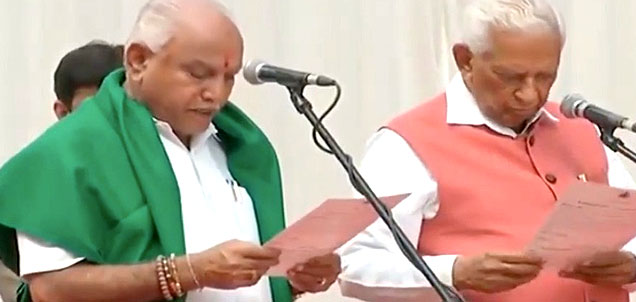
    Thursday was a day of little activity, except a rather drab swearing in, where BS Yeddyurappagot sworn in, all by himself, without a Cabinet. The next Supreme Court hearing is scheduled for morning today. The weekend, and indeed the next week or two, will be a period of immense excitement for news channels. By the end of May, some of the top Hindi and English editors may have learnt a bit of Kannada too.


    It’s the IPL of politics unfolding itself. And even it becomes a Test match, the thrill will be no less.