Category: THE ANCHOR

  • Budget 2012 Anchor: 5 M&E ways in which the govt can make monies on the Budget

    By A N Chorrea


    Bizarre as these sound, given that the government appears to be in need of money if all the extra taxes are an indication, here are a few ideas which Pranabda may like to consider for his speech next year.


    1. Take a couple of breaks in the Budget speech. Ensure channels shell out 50 per cent of the revenues earned in these breaks to the government

    2. Since it’s a high ratings and readership game, suggest options for profit share to media organizations or just impose stiff charges for budget text document (instant delivery in various formats) and live video

    3. Run a contest on channels, newspapers and mobile phones where you can ask for Predict the Proposals. Those who guess it right, can get prizes as well as entry to the Budget speech. Ask mobile companies to part with revenues

    4. Democratize the Budget. Take views of the public on what to do with proposals. For instance, taxes on cigarette. Press A for 5 per cent, B for 10 per cent, C for 15 per cent and D for no change. Make money through SMS charge profit share

    5. In-speech placement. Shah Rukh’s gain is Saif Ali Khan’s loss. Rather than plug Ra One, Saif should’ve lobbied to ask for a mention of Agent Vinod. Would’ve worked wonders given the March 23 launch. Select in-speech brand placements could get big money (one shaayari in the form of song lyrics may also be allowed).


    A N Chorrea is a seasoned media-watcher who writes the MxMIndia anchors under a pseudonym


  • Utterly Butterly Tondulkarlicious: 25 Amul ads that tell the Tendlya story

    By A Correspondent

    While the news media reflects on current affairs and trends, one wouldn’t be incorrect in saying that the Amul Butter billboards are an excellent mirror of what’s top-of-mind in urban India. So even as headlines and captions in print do their jobs well, there’s nothing like the Amul ad, crafted by Rahul da Cunha and his team at da Cunha Communications for the Gujarat Cooperative Milk Marketing Federation Ltd.


    From the time he started out in the late ’80s, Sachin Tendulkar has been at it… breaking virtually every record at the book and regaling us with his splendid performance and commitment on the field. And off it.


    Last week, MxMIndia brought you the Amul ads with Rahul Dravid… here are a silver bunch of Amul ads telling you the Tendlya story. For his feats on field, and some off the field too. Enjoy!


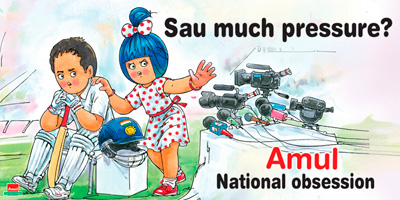
    Sau much pressure?

    India’s obsession with Sachin Tendulkar’s 100th hundred  (January 2012)


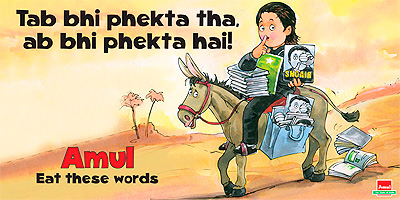
    Tab bhi phekta tha, ab bhi phekta hai

    Former Pakistani fast bowler Shoaib Akhtar’s ouburst against Sachin Tendulkar in his autobiography (September 2011)


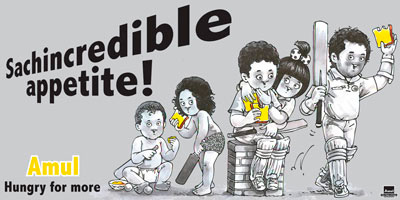
    Sachincredible appetite!

    Sachin Tendulkar, the first batsman to score 50 test centuries (December 2010)


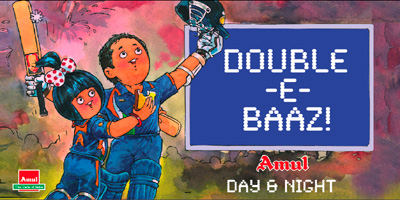
    DOUBLE -E- BAAZ!

    Sachin Tendulkar scores a double century against South Africa in the second one-dayer (February 2010)


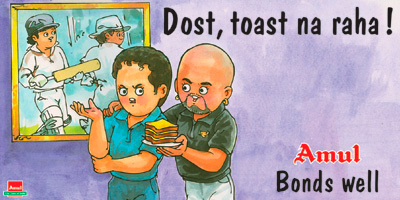
    Dost,toast na raha!

    Controversy surrounding the friendship of Sachin Tendulkar and Vinod Kambli (July 2009)


    Gilly, don’t be silly!

    Controversy surrounding Adam Gilchrist accusing Sachin Tendulkar of not having a sporting attitude & being a liar, in his about to be released autobiography (October 2008)


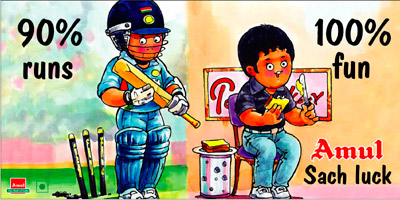
    90% runs 100% fun

    Indian master blaster Sachin Tendulkar missing century in cricket one-dayers.(November 2007)


    Maska Blaster!

    Indian batting maestro Sachin Tendulkar – the Master Blaster to appear as superhero in a new range of comic books, animation and games (March 2007)


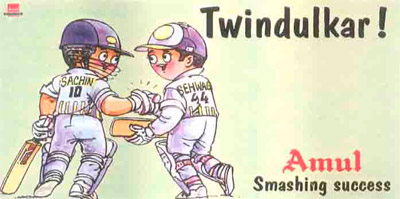
    Twindulkar

    Celebrating the smashing Sachin-Sehwag partnership


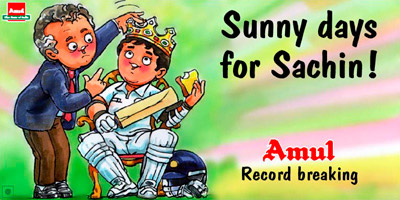
    Sunny days for Sachin!

    On master blaster Sachin Tendulkar’s 35th Test Hundred making him the highest century maker in the history of Test Cricket (December 2005)


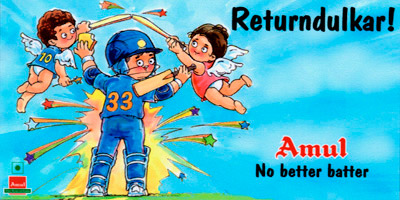
    Returndulkar

    Sachin Tendulkar marks his return to international cricket with a sparkling knock (October 2005)


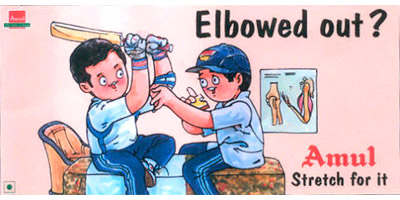
    Elbowed out?

    On Indian star batsman Sachin Tendulkar’s tennis elbow aliment which has kept him out of cricket (October 2004)


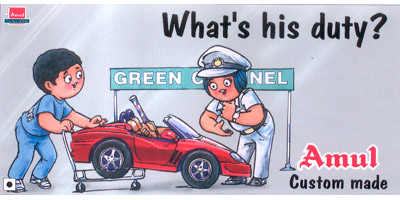
    What’s his duty?

    On the waiver of import duty on the Ferrari gifted to Sachin Tendulkar (September 2002)


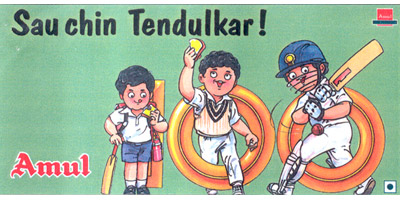
    Sau chin Tendulkar

    On Sachin Tendulkar playing his 100th Test Match (September 2002)


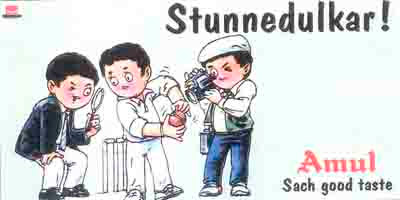
    Stunnedulkar!

    Sachin Tendulkar accused of ball tampering (November 2001)


    Madenness!

    Mike Denness finds Sachin Tendulkar guilty of ball tampering (November 2001)


    Unfeet?

    On Sachin Tendulkar’s foot injury (July 2001)


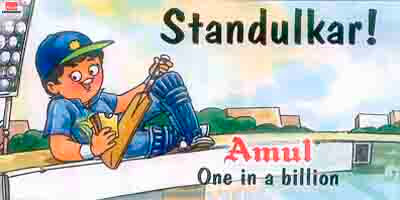
    Standulkar

    On a stand in a cricket stadium being named after Tendulkar and signing a billion rupee contract – May 2001


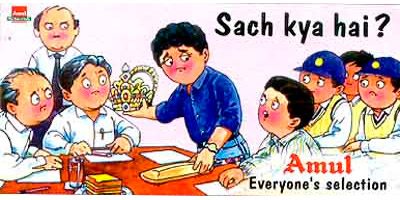
    Sach kya hai?

    Questions being raised on the resignation of Sachin Tendulkar from the captaincy of the Indian Cricket Team.” (Feb 2000)


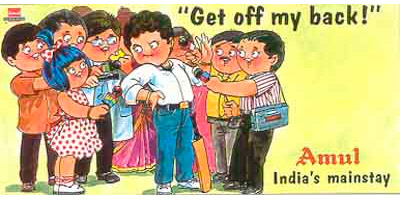
    Get off my back!

    Media speculations on Sachin Tendulkar’s back trouble affecting his future career (September 1999)


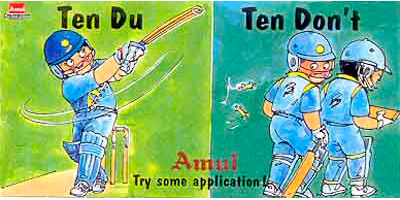
    Ten Du Ten Don’t

    On the lone success of Sachin Tendulkar, while his team-mates keep failing


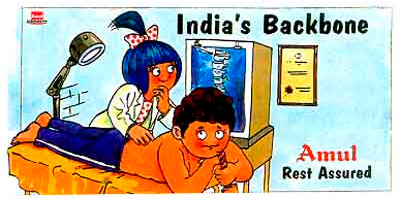
    India’s Backbone

    Sachin Tendulkar’s back injury


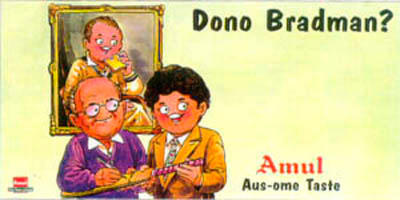
    Dono Bradman?

    About the similarities between Don Bradman and Sachin Tendulkar


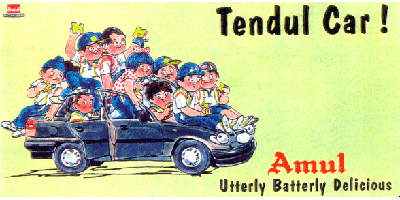
    Tendul Car!

    On Sachin Tendulkar winning a car for the cricket finals between India & Australia


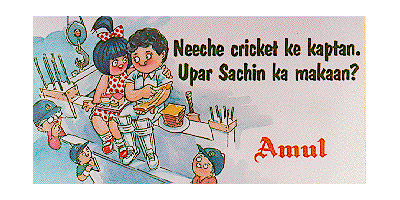
    Neeche cricket ke kaptan — Upar Sachin

    Ajit Wadekar wants Wonderkid Sachin Tendulkar to be given a flat in Sportsfield – a highrise specially built by the Government for sportsmen – as a gesture of appreciation


  • 12 ‘must-do’s when engaging a celeb for your brand

    By Anujita Jain


    #1 First, the key is to identify the need for a brand ambassador ­ whether it is to get noticed, or to catapult to a leadership position, or to change image or create demand, or other.


    #2 Think of a brand endorsement as a mid to long term investment. Quick successes or failures of endorsements are not representative. Riding on the equity of a known personality is a strategic call. By itself, the decision cannot guarantee success, it needs correct usage. For instance, an endorser doesn’t come at the cost of a good creative.


    #3 Go with a mindset to alter the script or storyline of a advertising creative if required, while approaching an endorser. While the communication strategy is brand objective dependent, the storyline may need to be re-thought with the chosen endorse in mind. Neither should the endorser be ideally selected with just one script in mind. The investment on an endorser often deserves and asks for that.


    #4 Match endorser motivations with your brand motivations, to get more out of the endorsement than what the contract promises. This may not just yield in the celebrity commitment to brand but also in the ripple effect the communication may create.


    #5 If as a brand manager, you are looking for a deal or a quick bargains, the only way is not in going for smaller names, but may also be about bigger names who are looking for new dimensions in their own stated personality. Match that need, and you may have a deal! While top end luxury brands have always had this advantage from even A-lister celebrities, this is often true for many other brands with respect to some potential endorsers.


    #6 Plan out how you will use the endorser days thoroughly, so that you don’t end up with expensive days you struggle to use within the year, a common issue with the bulk of endorsement deals. The first few days are often easily utilised through shoots etc., but the balance 2-3 days end up being hurriedly utilised for sub-optimal activation that doesn’t get the right ROI for the day cost.


    #7 Always have alternatives in mind while approaching endorsers. Options not only in the same grade of celebrities, but also pan grades and genres. This not only allows more creative thought for utilisation of the celebrity days, but also results in smarter value-benefit deals.


    #8 Unless you have 4X budget for media and magnification, don’t put more than X for the endorser.  If amplification is the chief reason for using the endorser, it defeats the purpose to cut corners in the resources put behind it.


    #9 Modern-day endorsements are best approached not only in terms of day count, but also digital or equity usage rights.  This again means a clear strategy of endorser usage, clear ideas of utilization of celebrity equity beyond just his/her days, and a strong plan


    #10 If the brand works its communication around the endorser, the likelihood of the endorser working their schedules around the brand is that much more. An endorser, being a human brand, is highly likely to value good planning by the brand, and go that extra mile to deliver.


    #11 Sharper the brand focus versus the category, the better the endorser choice.  So think of the brand positioning and attributes that define brand image, and then create your endorser consideration set. Often brands approach endorsers from the point of view of their category, failing to then translate an edge in their communication, resulting in a diluted or under-utilised endorsement.


    #12 Often, especially for mid-segment brands, considering a set of niche endorsers may bring more value than going for a single mid-range endorser. This de-risks the brand, at the same time allowing them to ride on to a cluster of icons that have a deep and strong, albeit smaller follower base. Today, there is a whole new breed of such celebrities, who have a die-hard loyal following in their chosen fields, who work as strongly as special interest channels do versus a general entertainment one, for the relevant brands.


    Anujita Jain is Founder & COO, Alchemist Talent Solutions.


  • The Anchor: 4 reasons why radio needs content innovation

    By Amitabh Srivastava


    #1 Emerging Technologies:

    Keeping in view the emerging technologies, it is very important that everything is taken into consideration; for instance social media can be of great help in terms of getting more interactive with listeners.


    #2 To Engage Listeners:

    These days the maximum listenership is through moving vehicles, so if there is some innovation catering to those audiences, then it would be a very good option.


    #3 Rise of Internet Radio:

    Internet radio is fast growing all over the world, and India is no exception. Internet radio will be emerging as the big thing very shortly.


    #4 Two-Way Communication:

    This is most important because the moment you get interactive there will be an increase in participation from the listeners also.


    Amitabh Srivastava is the Country Manager – South Asia, Radio Netherlands Worldwide.


  • The Anchor: 6 ways to measure the effectiveness of PR

    The blame game is interesting, for agencies want to blame the client for not giving a proper brief, and the clients want to blame the agencies for not understanding the brief, and attempt to take the campaign in a direction of chance.  Fingers pointed at both sides – for agencies have a credentials presentation replete with case studies that is akin to saying, I am xyzee and I scored a double century five years back, or a month back, and hence I am an accomplished person and suited for bagging your account. While the case studies are anecdotal and embellish an agency presentation, the client’s requirements may be completely different.


    So instead of mutual finger pointing, the attempt here is to be shaking hands.  As public relations increasingly influences corporate communications strategy, and regularly takes its place in the marketing communications ‘mix’, pressure has mounted, both from clients and from within the profession, to measure the effectiveness of PR.


    1. Questions for setting the right objectives

    Every one from the agency side tends to ask, please tell me the objective of your engaging us, but in actuality, What are your objectives is not the first question, it is in fact the last.  The questions to perhaps introspect to set the right objectives are: Where are we (company) starting from? Which audiences do we need to reach? What are the messages and the appropriate channels of communications? How do we want those audiences to respond or behave as a result? When do we need them to react? What do we need to measure to determine whether the objectives have been achieved and therefore whether the PR activity – including the cost of measurement – is worth the investment?


    In this context, the objectives must be viewed in the context of the total brief, and thus relate to the current environment, to intended audiences, messages, desired response and timescale. If all those elements are in place, then objectives can be measured and it becomes possible to say whether – and to what extent – the PR activity has succeeded.


    2. Selecting a PR Consultancy 

    Having done the most important step of determining your objective, one has to get into selecting a PR Consultancy through a process of systematic search that would involve steps like checking on the Expertise of the agency, specializations if any like Corporate, Financial Services, Technology, Lifestyle, Entertainment, Sports and Events, and so on, the  reach – as a national, regional, local or boutique agency.


    3. The process of short-listing

    Talking to a B2B segment or journalists that cover a specific beat related to you business could help in terms of getting some top of mind companies that could emerge in the shortlist. Of course, the conventional method requires one to send a RFP, asking the agencies of their credentials, background detail, resources and special skills possessed, the current clients and activities and significant achievements.


    At the time of the presentation, clients like to judge on the depth of the homework done by the clients, their perception of the PR Problem, and any creative routes to handle the same or just the usual listing of tools and media, the team and expertise offered, campaign effectiveness for other clients, and the infrastructure and facilities, and their modes of charging – project basis, monthly retainer, hourly basis, and/or rate card, and so on.


    Don’t be overly concerned with setting communications objectives, but being very clear about the organisation’s strategic aims, business objectives and how it wishes to be perceived, and rely on the PR professionals to develop the appropriate communications response like ‘defining PR objectives’;  ‘identifying the techniques’ to be deployed to reach the relevant audiences and messages, the ‘budget and resources’ required from the client, the ‘financials and service term’, and most important, ‘the resources’ offered by the agency.


    4. Identifying and sharing the strategic goals

    It is important to share with the prospective PR agency about the overall strategic goals, the business/marketing objectives, external or internal climate (social, political, competitive, industrial relations factor), the company’s present reputation and how does it want to be perceived, the objectives set for advertising and other communications disciplines, and the criteria by which we will judge the success of the communications programme?


    5. Tools to measure the content

    Publicity in print and broadcast media remains the biggest single products of public relations. Analysis of the content of media coverage is the most commonly used tool of measurement, but by no means the only one. Today, tools to measure presence in media as well a market research can be used to gauge PR effectiveness.


    With a scientific base, PR is more readily accepted as a valid communications tool, better able to justify its budget.  It helps to bring PR into the broader corporate decision making process and makes the PR practitioner a more credible advocate in the boardroom.


    6. Output, Out-take & Outcome

    Outcome could be a three pronged approach one could adopt as a measurement process.


    Outputs show whether the message was sent and aimed at the target audience through analysing media coverage including number of articles and interviews, prominence and message.


    Out-take refers the degree to which the audience is aware of the message, has retained and understand it through interviews among target audiences for instance, pre-and post-campaign stages – qualitative research and one-to-one depth interviews to assess reaction to a programme and future intentions.


    Output helps in knowing whether – and to what degree – public relations activity is actually helped in changing people’s opinions attitudes and behaviour, by detailed interviewing and focus groups among target audiences, research among representative samples of media and other opinion formers or simply observation of people’s behaviour.


    If measurable PR objectives are set, measurement and evaluation will enable the client to judge the cost/benefit of the investment in PR.  This provides the basis of PR planning helping the client and the PR adviser to build on the ideas that worked well, and modifying or abandoning those that did not. It helps clients take a longer-term view of PR’s potential contribution to corporate performance. It assists in judging the effectiveness of PR against other corporate communications and marketing techniques, ensuring the most efficient ‘mix’, and thus shaking hands rather than pointing fingers at one another!


    Sudarshan Srinivasan heads Prognosys Marcom Services that manages 7C’sContent-Creatives-Collaterals-Connect-Coaching-Conversations-Campaigns for their clients.
     

  • The Anchor: The 6 Cs of the TV business in South India

    By Anup Chandrasekharan


    Consumer: The consumers in South India are probably the most complex lot to understand. Each state in South has more than 20 districts and each district is a state on its own. Hence one can imagine the varied preferences of these consumers, and one has to find a path that will cater to and appease this varied audience.


    Connectivity: CNS penetration is more than 90 percent in all the four states put together in the South including TN, Karnataka, Andhra Pradesh and Kerala. In fact, in states like Tamil Nadu it is said that they have more TV homes than toilets!


    Content: Content is the key to success for anyone in the business. In the South, audiences like to watch content which is good for family viewing. In terms of difference in content, in Tamil Nadu and Andhra Pradesh the general rule is that audiences like to watch content that is loud whereas in Kerala and Karnataka content that is subtle is preferred.


    Cost and Earnings: It is possible to invest prudently in content while keeping the cost of operations on a tight leash, thereby ensuring that ROI is high. The mantra is to invest in smart content and keep running and operations cost minimum, which is possible among the Southern channels.


    Capability: It’s a sad truth but the talent pool is scarce as there are hardly any good institutes which can impart basic training for a foundation to enter the TV industry. Hence most of the learning comes while being on the job.


    Competition: There are 17 channels put together in Kerala and Karnataka and 35 in total in AP and TN. Therefore, there is no space for being smug and content if one enjoys a leadership position. The tables can turn any time and the heat is forever on, as competition intensifies among the existing players.


    Anup Chandrasekharan is the Business Head, Suvarna Channel.


  • The Anchor: 5 reasons why this is the most important week in the year

    By A N Chorrea


    1. Heck, we are on March 26. Last few days to shore up revenues and this is decidedly the last week of the financial year for a good part of Indian companies. So for that one last time, go for it!


    2. It’s the last few days to make those tax-saving investments. If you don’t make them now, you could have to pay more tax for the year and, of course, save less.


    3. April will see appraised salaries, if not higher. It’s also the time of the year which sees a maximum number of people quitting, given not-very-nice pay hikes. So time to get those resumes cleaned up and get the LinkedIn profiles in order.


    4. For adland, April is Goafest month. Time to rejoice, win awards and along the way, gain some gyaan.


    5. Jan 1 is when most people do it, but this is yet another opportunity to make new year resolutions. Get teams energised for the next fiscal. Achieve higher targets.


    Enjoy.


    A N Chorrea is a seasoned mediawatcher writing under a pseudonym.


  • The Anchor: 6 must-have traits for entrepreneurs

    By Vijay Singh


    There is a newfound zeal these days for being an entrepreneur, and a number of folks are chucking away the securities & comforts of “salary on the 1st” and venturing into the unknown.


    Entrepreneurs are the best thing that can happen to a society, economy and country. Entrepreneurs create value out of nothing, create opportunities and fuel overall growth, and they need to be deeply respected for it.


    However being an entrepreneur is the toughest job in the world. There are no cushions; no soft landings and the failure rates are very high.


    In an environment where most won’t make it, while luck might play a huge role, there are other traits that I believe an entrepreneur must have to break through:


    #1 Imagination: A good entrepreneur sees not just the big picture but well beyond the picture. He / she needs to imagine ideas that will create solutions to obvious and everyday problems.


    #2 Foolishness: Now made famous by Mr Jobs’ speech, foolishness is a virtue that is a must have, to pursue a dream that others don’t see, understand or give a damn about.


    #3 Stubbornness: An entrepreneur lives in a lonely and often unkind world – especially in the early years. There are, more that you need, armchair advisors and critiques that would question the validity everything starting from the macro business environment, to the business model, to scalability, to ability, to sustainability. The entrepreneur needs to stay the course with persistence.


    #4 Willingness to evolve: While staying the course, it is important to learn from mistakes and spot opportunities along the way and evolve into a better idea. It is my view, however, that one should stay true to the original & pure DNA of the idea and not drift at every opportunity (or failure) that pops up, as there would be plenty of both.


    #5 Team: As an entrepreneur one you get into every aspect of the business, however, to do justice to the organization that you are going to create bring in specialized talent for specific roles and ensure they are better than you at that task.


    #6 Passion for the idea:  Take up your entrepreneurial journey for the right reasons – the reason being absolute belief and passion for the idea that you have imagined. If one feels deep down that the passion has started to drain, that is the green light to quit and maybe take up a lucrative 9-to-5 assignment.


    Not everyone has the mental toughness required to face up the uncertainties and challenges associated with a start-up; however, it is my belief that everyone with a real passion for an idea will acquire that toughness over time and they should jump in.


    Professionally let me assure you there is nothing more fulfilling that to create something of value – out of nothing.


    Vijay Singh is the CEO & Managing Director, AaramShop, and can be followed on Twitter @vijaysingh.


  • The Anchor: 5 ways a brand can stay relevant

    By Alpana Parida


    #1 Rejuvenate

    An old brand like Pepsi has remained relevant for Gen X in the ’80s and now Gen Y as it has constantly rejuvenated itself. If a brand never changes the way it appears – it atrophies and dies. It must constantly rejuvenate itself to infuse freshness and youth into the brand.


    #2 Reinvent

    Environment keeps changing and brands need to reinvent the brand proposition to create relevance. Amul Ghee was slowly losing relevance even in homes where ghee was loved. A dry roti was becoming the norm. At DY Works, we realized that the consumer needed a nudge in reassuring them that there was enough according to Ayurveda that said one spoon a day was good for you.


    #3 Repurpose

    No amount of logo rejuvenation can keep a brand from dying if it does not repurpose its core deliverables in a changing environment. By not taking the threat of digital cameras seriously and in a timely manner, Kodak joined the brand graveyard which is littered with examples of giants who did not read the writing on the wall.


    #4 Retract

    Flexibility is key. Admitting mistakes is greatness. Wrong decisions get taken but brand leaders, like great generals, know when to retreat. Coca-Cola became an American Classic when it quickly retracted its New Coke formulation.


    #5 Restore

    As I was passing by Metro Cinema in Mumbai the other day, I was struck by how little interest there is in restoring its glory. Metro Cinema (1938) is an example of our Art Deco heritage. Today it is a multiplex movie theatre in Mumbai. It was built and originally run by Metro-Goldwyn-Mayer (MGM), the Hollywood studio. This has the ability to become a destination landmark and the equivalent of the Kodak Theater in LA for Bollywood. Sometimes, all that great brands really need is a little restoration.


    Alpana Parida is President, DY Works.


  • The Anchor: Nagesh Alai on 6 ways advertising & promotion can prosper in the new fiscal

    By Nagesh Alai


    #1 Economic Situation:

    This is one of the prime factors driving advertising and promotions. In a challenging economic environment, which the GDP downtrend seems to be indicating, ensuring brand recall and staying top of mind with the consumers will be a necessity. While the sluggishness in anticipated growth started showing signs on the back of inflation, high interest, falling currency, etc., in the second half of last year, in a research conducted by our Group’s consulting arm, Cogito Consulting, the bold Report 2012 (available on www.cogitoconsulting.com) shows that CEOs and CMOs of leading companies have predicted a slightly more positive outlook this year with a marginally higher growth rate than earlier years. Some see it as the beginning of a slow return to the high growth rates in the past. My expectation is that the more aggressive companies will take advantage of this trend and try and be the early drivers of growth in their respective categories, thereby investing ahead of their competition to establish an early lead.


    #2 The London Olympics

    Usually there is very little interest in the Olympics and more often than not this event slips by the advertisers radar. However, this year there is some interest in Men’s Hockey, Boxing, Wrestling, Badminton, Tennis and the firing range etc….which might pull in a larger number of sports hungry Indian audiences as they search for heroes beyond their usually preferred cricket


    #3 CAS and Digitisation will lead to better segmentation and availability of more robust data about the audience, this will encourage companies as they will be able to measure the efficacy and coverage in a more systematic manner. The recent Star-Zee combine efforts and push for ensuring real reporting of actual subscribers should also give a further fillip in capturing better viewership data, as will the industry bodies ( IBF, ISA and AAAI ) coming together on BARC.


    #4 Blockbusters on TV

    As everyone knows, movies are a big, big draw in India. Nearly 40-50% of total content on TV is directly or indirectly based on films. The entire movie distribution model has changed. Unlike in the past, now blockbuster movies come on TV within weeks of their release in theaters, instead of months earlier. DTH, Pay TV and Video-on-Demand are shortening the time frames dramatically. This is also drawing audiences and therefore attracts higher spends by advertisers, ultimately helping grow the advertising industry


    #5 New/Dormant Categories getting active

    The general anticipation (though some call it sheer optimism) is that the government will open up new categories like retail. An upward trend to the economy would also help drive spends in financial services etc. The government is keen on generating funds for development by diluting it stake in several public sector companies. It is also a reality that there is a huge pent up queue for IPOs planned by various private sector companies as well….an improving economic situation will encourage companies to go public to raise funds and thereby spur the need for corporate campaigns and IPO advertising which will expand the industry further.


    #6 And lastly, but not the least, the increasing “through-the-line” emphasis, whereby communication concepts are conveyed to target audience/consumers seamlessly through print, TV, out-of-home, activation, internet, social media, etc. will ensure that advertising and promotion will prosper. At the end of the day, it is all about building the brands and the clients better see advertising and promotion as an investment (which prudent clients do) and not as a cost – it is important to have long term view of brand building and not be blindsided by quarter pressures.


    Nagesh Alai is the Director – Draftcfcb Ulka Group India Operations and the President, AAAI.


  • The Anchor: 5 IPL players brands can ride on this season

    By Tuhina Anand


    1. Sachin Tendulkar:

    Good ole Sachin is the God of cricket even if the man himself has been telling everyone around that he is just Sachin. With his 100th 100, brand Sachin is in news. His handing over the baton of Mumbai Indians to Harbhajan Singh to concentrate on the game once again shows that for Sachin the game always remains his utmost priority. He is dependable, trustworthy and what we call ‘lambi race ka ghoda’ which he has proved time and again.


    2. Mahendra Singh Dhoni:

    Captain Cool has a lot riding on his shoulders. Having led CSK to re-create the IPL magic and win IPL 4, all eyes are him once again. MSD is picture of poise under duress and that’s a great attribute that brands can cash on.


    3. Chris Gayle:

    Return of the prodigal, that’s how Gayle’s IPL 4 stint can be aptly summed. He entered RCB last year as a replacement in the middle of the series and then created ripples by leading his team to the finals. This year Mumbai Indians were keen on having him on their side though RCB managed to retain him. Being among one of most recognized and popular players of IPL, his brand equity is currently high, which brands can benefit from.


    4. Virat Kohli:

    The 23-year old is already hot choice for brand endorsements. Being touted as dream player for ODIs, Kohli is being projected as a youth icon. He is endorsing around 10 brands including PepsiCo, Fair & Lovely, Titan Fastrack, TVS Sports Motorcycle among others. He still is behind Sachin and MSD in terms of number of endorsements so brands get on the Kohli brandwagon.


    5. Lasith Malinga:

    The Sri Lankan playing for Mumbai Indians has created quite a stir with his unruly locks and fierce bowling style. He is amongst the most popular faces of IPL and his quirks and style only adds to his appeal. Malinga, the name is enough for brands to get instant recognition.


  • The Anchor: The top 5 things we can expect from IPL 5

    By Rajneesh Chaturvedi


    #1 Watch out for new sponsors:

    Look out for and identify new brands that will be using IPL in their marketing communication, all for the first time.


    #2 New campaigns and Innovations:

    Watch out for new and innovative campaigns in IPL this year. Traditionally Vodafone has always launched new campaigns around IPL year on year, and every year we see some or the other innovative advertisements on the ground and on air. This year too we can expect new and innovative campaigns during IPL.


    #3 What’s new from Max this year:

    It would be interesting to see what Max has to offer, considering that the advertising and media fraternity is slightly apprehensive of the ratings this year.


    #4 New on-ground experience for viewers:

    What are the new things viewers can expect – the entertainment, the opening ceremony, all this is related to the experience a person gets in the stadium across the 12 venues.


    #5 New IPL winner?

    Last but not the least – are we looking for a new IPL winner this year? Last two IPL seasons, we had the same winner – Chennai Super Kings. Will we have a new winner in season 5?


    Rajneesh Chaturvedi is the National Director, MEC Access.