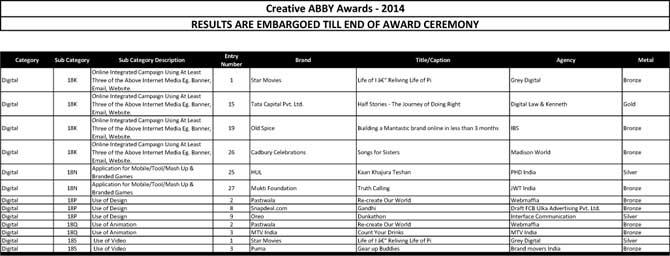
Click here for larger view
 By Shobhana Nair
The concluding day of Goafest 2014 was a fitting finale to the three-day extravaganza. Information and Broadcasting Minister Prakash Javadekar appears to have impressed most in the fraternity with his honest, no-nonsense address. “I absolutely loved what Mr Prakash Javadekar spoke. He was prepared and made a lot of sense. He left the room with lot of positivity.” said T Gangadhar, Managing Director, MEC Global.
The pre-afternoon knowledge seminars were conducted by Vanitha Narayanan Managing Director, IBM India and Ajay Chaturvedi, Founder and Chairman, HarVa. Founder of Arsha Vidya Mandir, Swami Paramatmananda Saraswati reminded the ‘always loaded with work’ delegates about the fundamental principles of life through his seminar. Pearls of wisdom like “plenty can give temporary satisfaction and not permanent contentment” were shared by the Swami.  “There are some basic things in life irrespective of which industry you are in. He said things like chase happiness which is what we are not doing. You do forget what you are doing in your day-to-day life,” said Ashish Bhasin, Chairman and CEO South Asia Dentsu Aegis Network, Chairman Posterscope and psLive – Asia Pacific.
Alicia Souza, Illustrative designer and E-Commerce entrepreneur stressed the fact that ideas are always around us. Norm Johnston, Chief Digital Officer, Mindshare got the audience hooked with his graphical illustrations on the power of digital. “85% of users watch TV and have a mobile device handy at the same time” was what he said during his session. Â Said Colvyn Harris, CEO, JWT India on the session: Â “Norm Johnston was very insightful as to where our entire industry is moving. His way of showing interactivity through the dart board and the tennis table racquets were nice. What I liked was how marketers are using this technology in different ways. His width and depth with what he showed us today in a short time was good.”
The founders of Bharath Gyan, DK Hari and Hema Hari conducted a seminar who believed in developing pride in the people of India about our rich culture and heritage. Habib Faisal,Screenwriter and Director was present the Goafest 2014 as one of the key speakers.
The other speaker who struck a chord through his seminar was Rajan Anandan, Vice President and Managing Director, Google India. His session ended with the Google Reunion Campaign evoking much response from the audience. “The real power of the Internet is to tell stories and tell them in an amazing way!” shared Mr. Anandan. Said Kunal Lalani, Managing Director, Crayons Advertising on the session: “Rajan Anandan’s session was on how digital will change most of the things in the world. It was all about how interactive the world is going to be, how connected the world will be and how information access will happen.”
The three-day fest concluded with the awarding of the last of the Creative Abby awards.

By A Correspondent
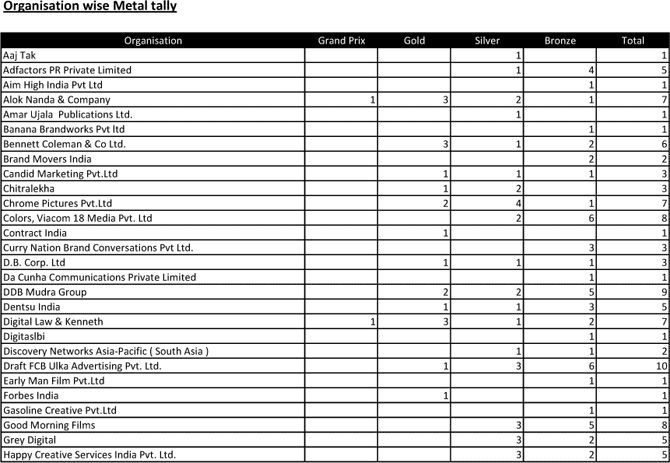
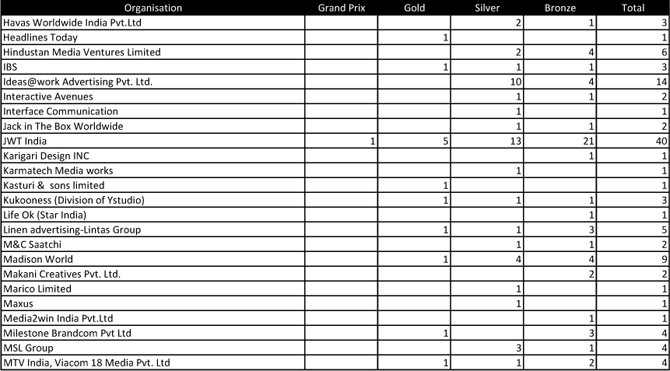
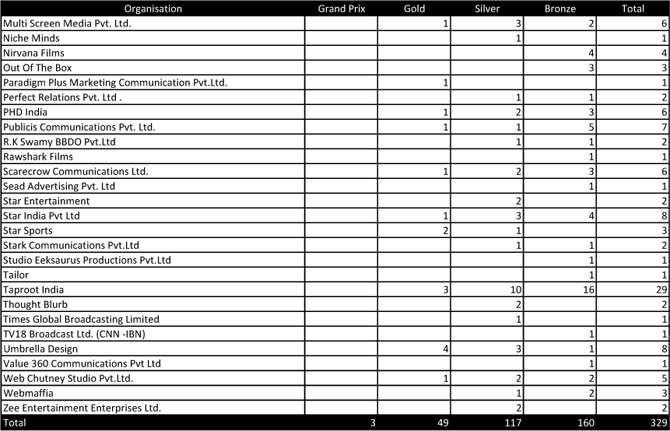
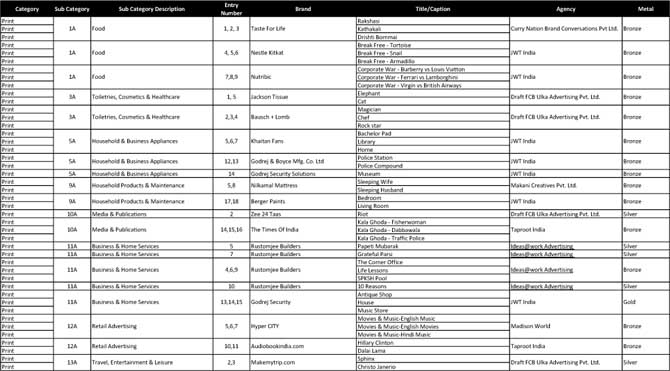
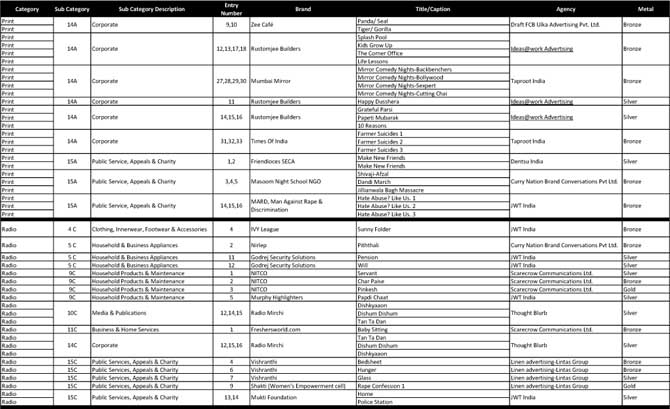
It was the Big Night for Colvyn Harris and his team at JWT. The agency bagged 40 metals, and emerged as the agency with the highest number of awards won. There was of course a Grand Prix that it also bagged for Direct.
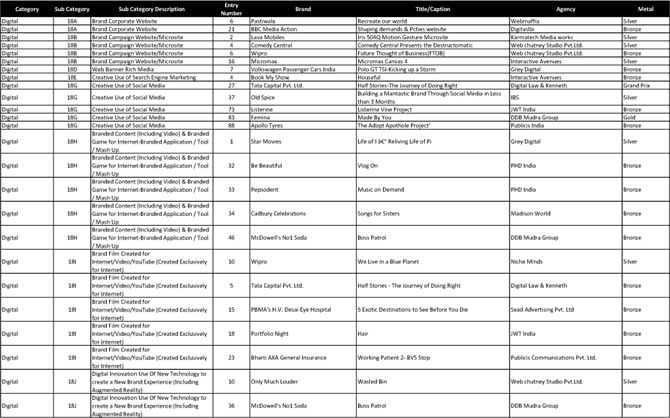
Taproot was the second-most awarded agency with 29 metals. There were three Grand Prix awarded in Creative – JWT for Direct, Alok Nanda for Design and Digital Law and Kenneth for Digital.
In terms of Golds, JWT won five, followed by Umrella Design with four. There were many agencies/organisations taking away three Golds – Alok Nanda, Bennet, Coleman, Digital Law and Kenneth and Taproot India.
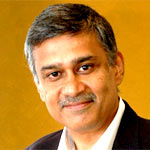
Colvyn Harris, CEO, JWT India is a delighted man as his agency has win several metals including a Grand Prix for Direct. Shobhana Nair caught up with him hours after the win.
What does winning so many awards including the Grand Prix mean for JWT?
Personally, we want to do the best for our clients and their brands. This happens to be a validation of the work that we have done. We are delighted and we are more delighted when we win for our clients. As far as the creative team is concerned, their winning is a validation that the work they do is better than what the industry does.
What’s your personal favourite from amongst the winning entries?
The Grand Prix winning is obviously a favourite. If you get recognition from peers through a fair jury process, why would you wish anything better?
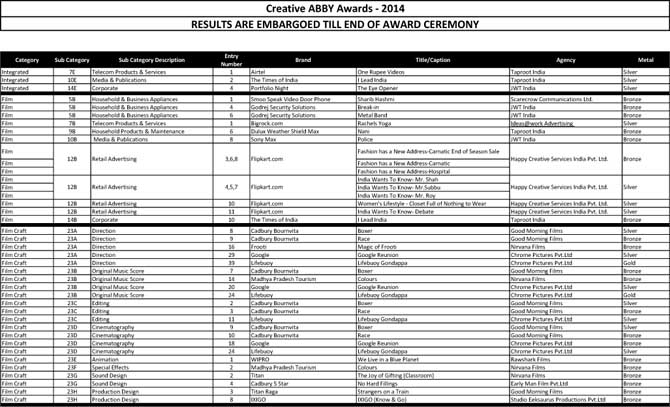
What was the idea behind ‘Genomusic Project’ for Bay Beat Collection which won a Grand Prix in the Direct Response Digital Category?
The idea around this was that your DNA can be used to create a unique music track. It’s an end-to-an end platform. On Facebook, there is an app to express why you should be there. Somebody is sent across to take your DNA samples which will be blended in to the music. So it’s unique and never done before.
Back to the Creative Abby, did the fact that some top agencies not participating increase your chances?
The Olympic Games takes place despite countries not participating in them. In Cannes, some agencies participate and some don’t but the ones who win believe their work is good. Coming back to India, Goafest is a property by the industry, for the industry. It’s very easy to boycott an industry function. Do we want to do that? No. We want to support this institution thinking that it will do well. If some agencies choose not to enter for whatever reasons, it’s not political. This is a clean event as there’s a jury. People have done a good job and they should be recognized.
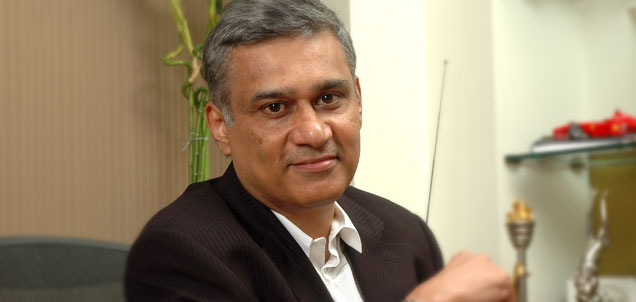
Colvyn Harris, CEO, JWT South Asia is delighted as his agency won the maximum number of metalsfrom among the entrants at the Creative Abby. This included a Grand Prix for Direct. Shobhana Nair caught up with him hours after the achievement.
Forty metals and the #1 agency in the Creative Abby at Goafest 2014. Your comments on this victory?
The team is extremely delighted. As South Asia we have won 41 metals (Contract Advertising included) of which we have won 6 Golds. It’s fabulous to win so many awards. We have won across many client categories including digital, direct and traditional.
What does winning so many awards including the Grand Prix mean for JWT?
Personally, we want to do the best for our clients and their brands. This happens to be a validation of the work we have done. We are delighted when we win for our clients. As far as the creative team is concerned, their winning is a validation that the work they do is better than what the industry does.
What’s your personal favourite from amongst the winning entries?
The Grand Prix winning is obviously a favourite. If you get recognition from peers through a fair jury process, why would you wish anything better?
What was the idea behind ‘Genomusic Project’ for Bay Beat Collection which won a Grand Prix in the Direct Response Digital Category?
The idea around this was that your DNA can be used to create a unique music track. It’s an end-to-an end platform. On Facebook, there is an app to express why you should be there. Somebody is sent across to take your DNA samples which will be blended in to the music. So it’s unique and never done before.
Back to the Creative Abby, did the fact that some top agencies not participating increase your chances?
The Olympic Games takes place despite countries not participating in them. In Cannes, some agencies participate and some don’t but the ones who win believe their work is good. Coming back to India, Goafest is a property by the industry, for the industry. It’s very easy to boycott an industry function. Do we want to do that? No. We want to support this institution thinking that it will do well. If some agencies choose not to enter for whatever reasons, it’s not political. This is a clean event as there’s a jury. People have done a good job and they should be recognized.
What would you say to all those agencies who decided to stay away?
I think they should have participated. The other awards show (Kyoorius Awards) has other agencies which doesn’t worry us. The right approach to this would have been to enter both the awards.
The Abby is an institution. We continue to enter this event by supporting it because it has been created by the industry. But it’s over now! We are happy and delighted.
By Shobhana Nair
 If the big boys from creative-land were missing, the mood and atmosphere more than made up for it. The show, as they say, went on. And that’s what made the difference.
Day 3 of Goafest was the Big Night for Colvyn Harris and his team at JWT. After his agency bagged the coveted ‘Grand Prix’ for Direct on Friday, after the last of the awards were presented on Saturday, JWT recorded 40 metals and emerged as the agency with the highest number of awards won. Taproot India was the second-most awarded agency with 29 metals. There were three Grand Prix awarded in Creative – other than JWT, Alok Nanda & Company for Design and Digital Law and Kenneth for Digital.
In terms of Golds, JWT won five, followed by Umrella Design with four. There were many agencies/organisations taking away three Golds – Alok Nanda, BennetT, Coleman, Digital Law and Kenneth and Taproot India.
As reported earlier, Lodestar UM won the maximum awards this year at the Media Abby. Said Pratap Bose, President, The Advertising Club and Chairman of the Awards Governing Council. “I am very satisfied. The onus was on to deliver an award which is rewarding the best possible work in terms of processes by being fair and transparent. I think we achieved that.”
Around 1700 delegates participated at the 2014 edition of Goafest which was held indoors. “This year Goafest has been refreshingly different and what we are not used to seeing it earlier. Bringing it on the beach was really repetitive for the last few years but this time it has been nice. It has given the much needed change that was needed,” said Lara Balsara, Executive Director, Madison World.
“It was a successful Goafest,” said Arvind Sharma, President, Advertising Agencies Association of India and Former Chairman & CEO India Subcontinent at Leo Burnett, adding: “And I hope that it is not a view of a few people or the many people that I have spoken to but to a majority of people who have been there.”
Srinivasan Swamy, CMD, RK Swamy and Hansa who took on the role of the Chairman of the Goafest 2014 organising committee in February was satisified with the arrangements and turnout. “We put in a good amount of effort to make this happen. From the feedback we have received, lot of people have said that they are very happy with all the arrangements and quality of speakers.”
Meanwhile, the concluding day of Goafest 2014 was a fitting finale to the three-day extravaganza. Information and Broadcasting Minister Prakash Javadekar appears to have impressed most in the fraternity with his honest, no-nonsense address. “I absolutely loved what Mr Prakash Javadekar spoke. He was prepared and made a lot of sense. He left the room with lot of positivity.” said T Gangadhar, Managing Director, MEC Global.
The pre-afternoon knowledge seminars were conducted by Vanitha Narayanan Managing Director, IBM India and Ajay Chaturvedi, Founder and Chairman, HarVa. Founder of Arsha Vidya Mandir, Swami Paramatmananda Saraswati reminded the ‘always loaded with work’ delegates about the fundamental principles of life through his seminar. Pearls of wisdom like “plenty can give temporary satisfaction and not permanent contentment” were shared by the Swami. “There are some basic things in life irrespective of which industry you are in. He said things like chase happiness which is what we are not doing. You do forget what you are doing in your day-to-day life,” said Ashish Bhasin, Chairman and CEO South Asia Dentsu Aegis Network, Chairman Posterscope and psLive – Asia Pacific.
Alicia Souza, Illustrative designer and E-Commerce entrepreneur stressed the fact that ideas are always around us. Norm Johnston, Chief Digital Officer, Mindshare got the audience hooked with his graphical illustrations on the power of digital. “85% of users watch TV and have a mobile device handy at the same time” was what he said during his session. Said Colvyn Harris, on the session: “Johnston was very insightful as to where our entire industry is moving. His way of showing interactivity through the dart board and the tennis table racquets were nice. What I liked was how marketers are using this technology in different ways. His width and depth with what he showed us today in a short time was good.”
The founders of Bharath Gyan, DK Hari and Hema Hari conducted a seminar who believed in developing pride in the people of India about our rich culture and heritage. Habib Faisal,Screenwriter and Director was present the Goafest 2014 as one of the key speakers.
The other speaker who struck a chord through his seminar was Rajan Anandan, Vice President and Managing Director, Google India. His session ended with the Google Reunion Campaign evoking much response from the audience. “The real power of the internet is to tell stories and tell them in an amazing way,” said Anandan. Commented Kunal Lalani, Managing Director, Crayons Advertising on the session: “Rajan Anandan’s session was on how digital will change most of the things in the world. It was all about how interactive the world is going to be, how connected the world will be and how information access will happen.”
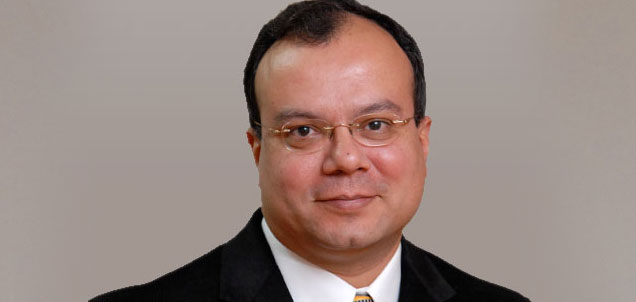
It’s been a grueling few months for Pratap Bose, President of the Advertising Club and Chair of the Awards Governing Council. While the controversies may have embroiled the Creative Abby awards last year, Bose reaped the fruits this year with around a 50 per cent drop in number of entries. Hours after announcing the awards, Bose spoke to Pradyuman Maheshwari in sunny Goa.
Are you happy with the way Abby 2014 has turned out to be?
From the point of view of both the Advertising Agencies Association of India and the Ad Club, I think we’ve achieved what we set out to. As President of the Ad Club, my No 1 objective was to make it an ethical show. Cut out all the crap that we had last year and restore the faith. At least in the way we judge the entries, in the way that we awarded what we did award and clearly establish clear-cut processes and  control systems. Not that it was missing last time but we just tightened it to a higher degree of efficiency. And I’m happy with the results.
But you couldn’t get Ogilvy back!
No, I couldn’t. Yes, but Ogilvy didn’t participated even last year. That’s a decision that they’ve taken. A lot of efforts were made to get them on board. But at the end of the day, I think you have to respect their decision.
But they spoke of some pre-conditions, issues that they had which had to be resolved and that didn’t happen.
Pre-conditions don’t work. Because you have to be empathetic to a system and a process that is for the industry. Â I don’t think we’re going to bend backwards for any agency however big or however small they would be. And therefore you know if someone is coming on a negotiating table to enter awards, then I don’t think that’s something we’re gonna entertain beyond a point.
But you were willing to negotiate with them a bit. As in, hear them out..
Yes, of course. There’s no issue on listening or meeting with people.
And that didn’t happen.
Yes, the meetings did happen. I didn’t personally meet but meetings did happen with Ogilvy urging them to participate but they just stood to their earlier guns.
And are they going to come back next year?
Next year is the 10th anniversary of the Goafest. We’ve got to put a lot of effort. We’ve realized that putting a festival and bringing it up really to the glory years needs a huge amount of rethinking, a huge amount of effort on all our part (both AAAI and Ad Club) and I honestly would start working on it 6 months before the event.
When we spoke when you had just taken charge of the Ad Club, you were all set to look at the Abby but you still couldn’t get Ogilvy…
No, I think it’s not just about the awards. I think you have to look at it in various lenses. Is this an industry conclave? Is it attracting the top clients? Is it attracting people like Prakash Javadekar who we had … more and more such people who are relevant to our business? Is the judging process absolutely fair, unequivocally fair? Are the processes adhered to? Are you awarding the best pieces of work? Is the content of the festival of the highest level? So, you’ve got to improve on all of those things. You’ve also got to give back. And that’s something, we can’t judge. Only those who’ve been to the festival, experienced it, can comment.
Just one last thing about Ogilvy. Ogilvy did participate at Kyoorius. So obviously there’s something where they agreed to that philosophy & they didn’t participate here. Your comments.
I think we’re making a big issue out of that, right?
Of Ogilvy’s participation?
Yes! For example if Ogilvy didn’t participate in Spikes and participated in Adfest, would it be an issue? In my view, it wouldn’t be . They’re gonna be at a lot of award shows. It’s your prerogative. The huge amount of pressure on delivering numbers and margins, you can’t possibly enter everything. So there is a dramatic decrease and shift in the participation worldwide and not just in India. If they decide to participate in X vis-Ã -vis Y, that’s their decision. And we respect that decision. There are many agencies that didn’t participate in Kyoorius either. You could got to look at it very pragmatically.
No comebacks on Lowe at all? Is it a gone-case story?
I respect their decision. I think the one thing I like about Balki and Lowe is that they’ve been consistent in what they’ve said all through, And they’ve not been dilly-dallying and sitting on the fence. Having said that , I would’ve loved to have them in the Creative Awards. But that’s a decision they’ve taken not just for awards in India, but internationally also.
But they participate in the Effie.
Yes, so they’re not participating in creative awards. They’re happy to participate in awards where the client’s work is recognized in terms of the Effie’s and even globally. So Balki doesn’t enter Cannes. So generally he’s not entering creative awards. I wouldn’t like to call it a policy, but he’s taken the stand that he doesn’t want to be judged in terms of creative people, in terms of work that he does.
Goafest organizing committee chairman Srinivasan Swamy said that Goafest is a lot more than just awards.
Yes, absolutely.
But ask anyone in the industry and they’ll tell you that Goafest is all (or only) about awards
We’ve been asked that question a lot. So I’ll answer it in two ways. Goafest needs to stand for more than just awards. If you raise the level of content to such a great degree that assuming there were no awards, and you had a festival that had such an incredible standard, but if you had, say, a thousand people just for content, then I think you’re really moving in the right direction. Having said that, in the way that it’s perceived right now, people come to Goa to win the Abby. That’s because it’s been for a long, long time.
So do you think there’s an attempt to distance from the Abby because it wasn’t having enough participation this year?
There are various reasons for that. I’ve said the Abby needs to move to a platform where it recognizes everyone in the communication business. So just in the sheer number of categories and verticals we’ve expanded. And it will continue to do so. Even Cannes is doing that.
The bread and butter of an ad awards is still Creative, right?
I think that’s a perception that the media and the old blokes as I call them, have. That’s not true. I don’t buy that. When I go to Cannes, I’m interested in branded content. I’m interested in social media. I’ll be extremely interested in health this year. It’s the new categories that excite people.
If you ask this question to a true blue creative person
Well, he’ll still say it’s print, craft, radio and whatever. But I think that’s a narrow version. If you look at the number of people who’re coming to Cannes today who are expert in design just to a category, it’s an ever-evolving challenge. Design can be limitless. I personally look at it from a very wide angle lens. I’m a photographer myself. I think if you look at every part of the communication process, there’s a lot more rather than just limiting to the creative.
In terms of the reputation of the Creative, in terms of the way it’s done, do you think the reputation has gone up? If last year was 3.5 on 10, what do you think would it be this year?
Yes, considerably. But to be very honest, you know I keep saying. I think here media are just looking for spicy hot news to break in and make a big story out of it. I don’t know you must’ve heard me saying this a 100 times. When we all came to Goa last year, there was no problem when we arrived in Goa. All the problem happened when we left Goa.
Come on! It happened because of the advertising people. The media just reported it. You look at what happened at Tata Chemicals…
I’m not getting into the details. It’s not just put the brakes on. I don’t agree we were 3.5 on 10.. I don’t know. Perceptually 6 on 10 or 5 on 10. I think it’s gone up quite a few notches to about 8 on 10. But at the end of the day you must realize you’re judging the best of creative work available for that period. So I could argue that in 1993, the quality of advertising and the awards given was substantially better or worse than this year. So, you must understand one thing. Even in the biggest advertising festivals in the world, you’re limited by the number of entries you get and the quality of entries you get.
JWT was the No 1 agency this year with 40 medals. In the absence of the big guys, is it a case of, as they say in Hindi, ‘Andhon mein kaana Raja’? How will history look at their perforrmance? Five years later, obviously nobody would know that this is what happened. What’s your view?
So if you go for a Test series in the old without Sourav Ganguly, Sachin Tendulkar and you’ve still won it, in the record books you’ve won it, you can’t criticize the people who’ve put in their 100 per cent on the field just because stars weren’t there irrespective of the result.
So what are the takeaways from Abby 2014?
There are many. I think we’ve got to go back to the drawing board earlier well in advance. Probably October this year is when we’ve gotta really look at creating a festival. As I said earlier, this year was about getting it back on the rails especially in the way it’s judged. Irrespective of the number that’s fallen down, the process is very good, we’ve fixed that. Now we’ve really got to get the tempo up and take it back to where it should belong.
By Shobhana Nair
It’s that time of the year when the advertising fraternity gets together to celebrate top creative work, network with fellow industrywallahs and party hard. Goafest 2014 may be over a month late due to the Lok Sabha elections but the excitement is palpable.
Over 1700 delegates have registered for three days of fun, frolic and gyaan to be held at Goa’s Grand Hyatt hotel. So are the organizers ready to meet everyone’s expectations? Says Srinivasan K Swamy, Chairman of the Goafest 2014 organising committee: “You are never ready for a big programme like this till the last minute. Preparations are on in full swing. And people will definitely find it difficult to choose between sessions.”
Top faces from the advertising and marketing fields have been invited to speak to delegates on a variety of topics. The theme for this year – ‘Brand Baaja Baaraat’ – indicates that everyone will celebrate and have fun. However in the midst of the celebrations, one cannot overlook the fact that top agencies like Ogilvy & Mather and Leo Burnett have chosen to stay away from participating in the flagship Creative Abby awards. Is a drop in the number of entries a cause for worry? Arvind Sharma, President, Advertising Agencies Association of India and Former Chairman and CEO India Subcontinent at Leo Burnett says: “The number of entries has dropped as large creative agencies have decided not to be a part of it. However, the numbers are still high. This festival has always recognised categories which are becoming important like the digital entries and they have doubled this year.”
The mood though is of optimism. Said Rana Barua, CEO, Contract Advertising: “I am not going this time though I wish them all the best. My only wish remains that all the agencies come together. It’s sad for the industry that only half of them are coming. There are a lot of agencies who are not participating but my hope remains to see them all together.”
It is estimated that Goafest 2014 has received around 2700 entries which includes 2000 for Creative and Digital and 619 for the Media Abby. To ensure there is no encore of controversies in this edition, the organizers have streamlined the judging process. “Clearly there was a lot more to be done to ensure the awards were conducted and judged in a fair manner. This we have achieved. We’ve got pretty much everything right in terms of judging processes and putting out the shortlists in the public domain,” said Pratap Bose, President, The Advertising Club and Chairman of the Awards Governing Council.
In the seventh year, the Goafest has clearly grown over the years as Bobby Pawar, Chief Creative Officer, South Asia, Publicis puts it, “It has gone beyond advertising. Digital, media and broadcast are also a part of it. It has got the right direction catering to many areas of the marketing. As far as my expectations are concerned, we want to see some sparkling creative work. Hopefully, I don’t get disappointed.”
“I believe that one is a student from cradle to cortege and in that context, knowledge seminars of the likes of Goafest are indeed useful. Over the years, we have had some great speakers from diverse expertise areas and it has been engaging,” said Nagesh Alai, Group Chairman, FCBUlka and a former AAAI president, adding: “AAAI has built a great equity with Goafest over the years and it is a great forum for mind over matter. The partnership with Ad Club for the Abby awards is an added value. One hopes that youngsters take full advantage of it and not just soak in the sun and sea.”
Did the fact that the D&AD-backed Kyoorius Advertising to be held within a fortnight of Goafest impact the participation at the Abby? According to Mr Bose, “each has its space”. “In many countries, there are many awards and many, many award shows,” he said.
Meanwhile, Mr Swamy promises that Goafest 2014 will be three days well-spent. “Wonderful content, wonderful fun time, wonderful award nights, wonderful parties… overall a good experience.”
 By Ashish Bhasin
Rationalization of Tax Practice on Advertising and Media Industry: Here, specific reference is to the service tax which has to be rationalized. The surcharges need to be removed. Service tax is chargeable only on our kind of service industry therefore there should not be any VAT-related harassment.
Simplify Tax Processes: Nobody minds paying the tax but the interpretation particularly by tax authorities, government and the entire chain is inclined towards harassment. Grey areas are deliberately left open for interpretation which allows them the power to exploitation. So the simplification of the process has to be made completely transparent and easy for any person to follow.
 Policies for General Economic Development: Advertising as an industry is very dependent upon how the overall industry is faring. We would like to see policies which are for the general benefit for the industry which then directly or indirectly benefits the advertising industry.
Special Incentives for the Advertising and Media Industry: We have never been recognized as an industry. For example, Cement, Iron and Steel, etc. have been there for hundreds of years and therefore recognized as an industry. We are significantly newer in terms of contribution to exchequer. We have never been given status as an industry. Therefore there should be incentives to do more research and development, to create opportunities for teaching advertising as a craft and as a profession. Some benefits should be announced which will accrue and help us become a more robust industry.
Clear Decision-Making: Policies like FDI, foreign investment in media, monitoring agencies and FM Phase III require clear decision making and the implementation of the same.
Ashish Bhasin is Chairman & CEO South Asia Dentsu Aegis Network, Chairman Posterscope and psLive – Asia Pacific
 By Anisha Motwani
With strong fundamentals, the Indian economy has tremendous growth potential. The new government has shown intent in the right direction and the Union Budget must turn them into actions to make a difference.
The country’s economy grew by less than 5% in FY2014. To regain the 2006-7 buoyancy of 9.6%, fiscal discipline in the near term is very important to maximise growth in long term. The new government should make effective use of resources to boost revenue generation. Implementing the Goods and Services Tax (GST) and broadening the tax base would help create the fiscal space for accelerated growth. Also, a reform in Direct Taxation could provide much needed impetus to sluggish Indian economy with simplified tax structure and transparent tax laws.
After some months of moderation, food inflation again reached 9.5% in May 2014. The new government must control high inflation, as it eats into disposable income of households that affects the savings capacity. Supply side reforms are essential for a lasting solution and a comprehensive monetary and fiscal policy should be in place to rein in inflation across various components of WPI and CPI.
Keeping in view the dented disposable income in the hands of individuals, the Finance Minister should provide relief in income tax burden to individuals so that household savings rate could again pick up.
Life insurance plays a critical role in utilisation of small savings for infrastructure development. To help the sector further enhance this role, the government has to provide right tax savings support to the long-term savings instruments and clearly differentiate it from short-term financial instruments.
The insurance industry expects the Finance Minister to make announcement related to FDI increase in the sector and also implement the long pending Insurance Bill amendment.
Specific to life insurance industry, there is a need to increase the limit for deducting tax at source on annual commission payable to agents from current Rs 20,000 to Rs 50,000. There is also a need to rationalise service tax rate on life insurance policies which was increased to 3% on first year premium.
Anisha Motwani is Director and Chief Marketing Officer, Max Life Insurance
Series coordinated by Shobhana Nair
 By Sanjay Tripathy
In the absence of a formal social security framework there is a need to provide tax incentives for growth of disciplined savings behaviour. I believe Life Insurance plays a critical role in using small savings for capital formation. To encourage savings for the growth of economy, the present limit for deduction under section 80C of the Income Tax Act needs to be increased for life insurance premium or there should be a separate limit for such long-term financial products.
Service tax exerts adverse pressure on insurance companies to offer plans at a more affordable rate. Revision of these rates and exemption of the tax on preventive health check-ups will be a welcome move from the Government. Further, to give impetus to long-term financial planning, Annuity and NPS payouts should be brought under EEE regime. An important step to help the Indian insurance industry would be to increase the investment flow through higher FDI limit (from 26% to 49%). This move by the government can be a game-changer for the financial sector and also help in improving the economic sentiment of the nation.
Sanjay Tripathy is Senior Executive Vice President – Head Marketing, Products & Direct Channels at HDFC Life