By Sandeep Puraname
There are several highlights of the Railway Budget presented by D V Sadananda Gowda today. If you thought that there would be no more fare hikes, pause for a bit. While saying that there will be no more hikes, he mentioned that the fare will now be linked to fuel price changes.
 There have been various provisions for Public Private Participation (PPP) in the railways which will include the setting up of the first Bullet Train between Mumbai and Ahmedabad.
Various initiatives were announced, but the some of the moves that will mean a huge fillip to the media is the push to the e-enablement of railway services. Two categories of railway stations will now be wifi-ed and food can now be ordered at food courts via SMS. Closed circuit TVs would possibly throw up opportunities for advertising.
Here then are the highlights of the Railway Budget:
:: Increased passenger amenities, more safety measures, timely completion of projects and increased financial discipline are the main highlights of the Railway Budget 2014-15 presented by the Minister of Railways Shri D. V. Sadananda Gowda in Parliament today.
:: The Budget seeks course correction in the light of mismanagement, apathy, populism in starting projects and severe fund crunch that have inflicted the railways over the years, the Minister averred. For this, structural reforms will be introduced and resources will be mobilized through PSU surplus, FDI and PPP.
:: The Budget proposes multi-pronged approach to make Railway journey safe and secure and comfortable for passengers. More thrust has been placed on passenger amenities, cleanliness and efficient station management. Now all major stations will have foot-over bridges, escalators, lifts etc.
:: On safety and security, the Budget has proposed introduction of advance technology for rail-flaw detection to check causes of accidents, a significant amount has been kept for road-over and road-under bridges and a pilot project will be launched on automatic door closing in mainline and sub-urban coaches. In order to make women safer while travelling, the Railway will recruit 4000 women constables. Coaches for ladies will be escorted.
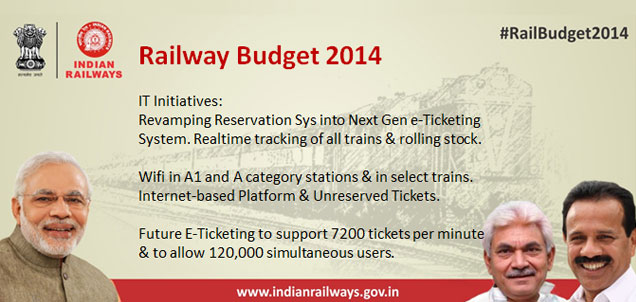
:: IT initiatives get a big boost in the Budget. Revamping Railway Reservation System into Next Generation e-Ticketing will be taken up with provision of platform tickets and unreserved tickets also over internet. The Railway has proposed real-time tracking of trains and rolling stocks, mobile based Wakeup Call System for passengers, mobile based destination arrival alert and Wi-fi Services in A-1 and A category stations and in select trains. Indian Railways has also planned paperless offices in 5 years.
:: In order to make Railway management more efficient, Budget has proposed setting up of Railway University for training in both technical and non-technical subjects besides establishing Innovations and Incubation Centre to harness the ideas generated from staff.
:: In a bid to modernise Indian Railway network, Bullet train has been proposed on Mumbai-Ahmadabad sector besides increasing speed of trains to 160-200 kmph in select 9 sectors. The Railway has also planned setting up of Diamond Quadrilateral Network of High Speed Rail connecting major metros and growth centers of the country. Identified stations will be developed to international standards with modern facilities on lines of newly developed airports through PPP mode. Railway has also proposed harnessing solar energy by utilizing roof top spaces of stations, railway buildings and land.
:: To augment resources of Railways, the Budget has proposed schemes to facilitate procurement of parcel vans and rakes by private parties, special milk tanker trains, increased movement of fruits and vegetables in partnership with Warehousing Corporation and setting up Private Freight Terminals on PPP model.
:: The Railway has proposed to bring in more transparency in administration and execution of projects. The status of ongoing projects will be available online, E-procurement will be made compulsory for procurement of higher amount and online registration of demands for wagons will be introduced within next two months.
:: The Budget has passenger centric focus on suburban and metropolitan rail services. 864 additional state-of-the-art EMUs will be introduced in Mumbai in two years. Study to explore possibility of enhancing existing railway network for better connectivity needs of Bangaluru will be taken up.
:: The Railway Budget 2014-15 has proposed 58 new trains besides extending 11 existing trains. Provision has been made for 28 surveys for new lines and doubling or gauge conversion of lines. Higher funds have been proposed for ongoing projects in Northeast and remote areas. Special packaged trains on identified pilgrim circuits, two tourist trains and a special train featuring life and work of Swami Vivekananda has been proposed in the Budget.
According to the Budget estimates, the Railways will earn Rs 1,64,374 crore through various resources and will spend Rs 1,49,176 crore during 2014-15. The operating ratio is expected to be 92.5% which is 1% better than that in 2013-14.

 Yet, India’s golden age with its youth, rising millionaires and entrepreneurs will lead right up to 2025. India has a great future, the next 2-3 years are critical and this Budget should attempt to clear bottlenecks and layout the roadmap to unlock potential. Needless to say, this must be one of the toughest Budgets to present.