Category: RESOURCES

  • Amazon, Asian Paints & Tata Tea are India’s Most Purposeful Brands: Kantar BrandZ India 2021

    By Our Staff


    India’s Most Purposeful Technology Brands Rank India’s Most Purposeful Non-FMCG Brands Rank India’s Most Purposeful FMCG Brands Rank
    Amazon 1 Asian Paints 1 Tata Tea 1
    Zomato 2 Samsung 2 Surf Excel 2
    YouTube 3 Jio Taj Mahal 3
    Google 4 MRF 3 Parachute 4
    Swiggy Tata Housing 4 Maggi
    Flipkart 5 Airtel 5 Britannia 5


    Amazon, Asian Paints and Tata Tea emerge as the most purposeful leaders in India across technology, non-FMCG and FMCG categories respectively. This emerged as insights and consulting major Kantar released the 2021 edition of its annual BrandZ India report on Thursday. This year, the report has moved gears to offer a ranking of 2021’s Most Purposeful Brands in India. According to Kantar BrandZ data, consumers believe that these brands lead with a clear sense of purpose to make their everyday lives better.


    The technology ranking has Amazon followed by Zomato, YouTube, Google and Swiggy jointly in fourth place, followed by Flipkart. The non-FMCG ranking is dominated by telecom brands, with Samsung and Jio jointly second, followed by MRF, Tata Housing and Airtel. The FMCG category ranks some of India’s biggest names: Tata Tea followed by Surf Excel, Taj Mahal, Parachute and Maggi both in fourth position and Britannia completing the list.


    Kantar conducted an analysis of 418 brands across 30 categories and found that in India especially, perceptions of a brand’s purpose, its ability to ‘make people’s lives better,’ is crucial to establishing a brand’s Meaningful quotient and thus, boosting prospects for growth.


    Said Deepender Rana, Executive Managing Director- South Asia, Insights Division, Kantar:  “Brand Purpose provides an anchor amidst constant uncertainty, both as a North Star for brands, but also as reassurance to consumers. Purpose as a contributor to brand equity is 10 times more important in India, in comparison to globally. This shows that a larger societal purpose is even more critical to success for brands in India. Of course, vague slogans and one-off ‘corporate charity’ events do not work, and it is not about jumping on the bandwagon of the latest fashionable cause either. Instead, real Purpose flows from, and builds on, a brand’s existing core values and DNA. This reinforces the need to understand and measure if a brand’s Purpose is perceived as adding real meaning to consumers lives.”


    Key Findings:

    2021 Kantar BrandZ data for India, in conjunction with other Kantar consumer sentiment tracking, has revealed several patterns in what Indian consumers deemed ‘Purposeful’ in 2021. Some of the key highlights:

    >> Amplifying or communicating purpose is critical.

    >> Tech brands show how everyday convenience contributes to brand purpose. These brands have been able to scale-up and showcase a wide range of products plus enter new categories at a time when consumers were desperate for at-home & delivery solutions. Everyday convenience in turn made lives easier and fueled saliency for brands

    >> FMCG brands are focusing on reducing their carbon footprint and taking a social stance. FMCG brands that score high on brand purpose have shown that purpose and profit can go hand-in-hand. They are working to reduce their environmental impact and promote social causes – which in turn attract customers, partners, and talent.

    >> Non-FMCG brands are now adopting marketing strategies that promote the brand in ways that look beyond the function of product or service; the key is to do more than just meeting consumers’ immediate needs, adding new and potentially differentiating associations.

    >> The Indian consumer, on a par with many of their Asian counterparts are actively engaging with sustainability; 77% are prepared to invest time and money in companies that try to do good


    Speaking about Kantar BrandZ’s report in India, Soumya Mohanty, Managing Director- Client and Quantitative, Insights Division, Kantar added: “Purpose can work as a strategy for brands, when it’s based on the right consumer insights, and executed effectively. In India, Kantar BrandZ data suggest that a brand’s Purpose ranking has a direct impact on its Meaningfulness score – which in turn is one of the cores, proven building blocks of brand value growth.”


    The Kantar BrandZ Spotlight on Brands in India 2021 Report, Rankings and extensive analysis are available online: https://www.kantar.com/campaigns/brandz/india



  • Global health media trends of 2021: SPAG & Baird’s CMC report

    By Our Staff


    A report titled Global Media Trends on Health Topics 2021 has been released by PR and advocacy firm, SPAG Healthcare, in collaboration with Baird’s CMC. According to over 40 health editors and journalists across four continents, health reporting will change permanently, but conversations around digital healthcare technologies are increasingly taking centerstage across key Asian markets including India, Singapore, Malaysia, Philippines and others.


    As a part of the global network of communications consultancies Baird’s CMC, SPAG worked with firms across the globe to interview 40+ health journalists and editors across Asia, Africa, Latin America and Europe to understand health media trends. SPAG along with Alfa Communications, Fundamento, Havas PR and Hyderus conducted these interviews.


    As per the findings of this report, Singapore and Asia are expected to see a significant spike in conversations around digital healthcare technologies, global public health, infectious diseases and NCDs. However, other parts of the world will focus on Covid-19 variants, vaccines benefits, impact, accessibility and acceptance as well as universal health coverage.


  • New age of growth for the advertising industry: DCMN report

    By Our Staff


    DCMN, the growth marketing partner for digital brands, has released its global Growth Guide: A new report looking at marketers’ goals, strategies and challenges going into 2022. The results point to a new period of growth for the industry: 66% of marketers surveyed expect their budgets to increase next year, with this figure rising to 71% for Indian marketers alone. This compares to 75% in France and 68% in the US.


    The research, conducted by Censuswide on behalf of DCMN, surveyed 600 inhouse marketers in the US, the UK, France, the Netherlands, Germany and India. The results offer an understanding of how the marketing landscape has changed after a tumultuous few years and how optimistic brands are heading into 2022.


    Key findings show that:

    It’s good news for marketing and advertising agencies, with the vast majority of Indian respondents – 93% – planning to increase their spending on agencies in the next 12 months.


    Aside from spending on agencies, budgets will go towards experimenting with new formats and advertising channels. Outside of digital advertising, the three channels Indian marketers plan to focus on and invest in the most are mobile advertising, podcasts and linear TV.


    The research also shows that 62% of Indian marketers are more focused on long-term branding efforts, versus 33% for performance-oriented goals. This is remarkably in-line with global figures, at 65% versus 31%.


    But the new year also comes with its own challenges. As advertising campaigns grow ever more complex, marketers in India are most concerned about managing and reconciling large amounts of data across channels. Keeping up with privacy regulations comes in second place, as policies targeting iOS and the future of cookies are set to dramatically reshape the marketing world – perhaps for good.


    Bindu Balakrishnan
    Bindu Balakrishna

    Said Bindu Balakrishnan, Country Head India at DCMN: “At DCMN, we wanted to take a closer look at where the marketing industry stands right now, and the impact of a disrupted 2020 and 2021. The results are impressive, and point to a marketing rebound in the coming year – both in India and in other countries around the world. Overall, we’re seeing that branding efforts remain top of mind for marketers. It’s also clear that brands still have huge faith in linear TV, with mobile advertising and TV set to be some of the most popular channels for marketers to invest in next year.”


  • Podcasts hit a high note


    India is witnessing a steady uptick in the usage of podcast entertainment over the last few years. The rise of DIY platforms has facilitated the emergence of independent content providers, resulting in an increase in the availability of new content. The popularity of smart gadgets like Amazon Echo, Apple HomePod and Google Home has made it easier to find and listen to podcasts. Here are some key insights into the industry.


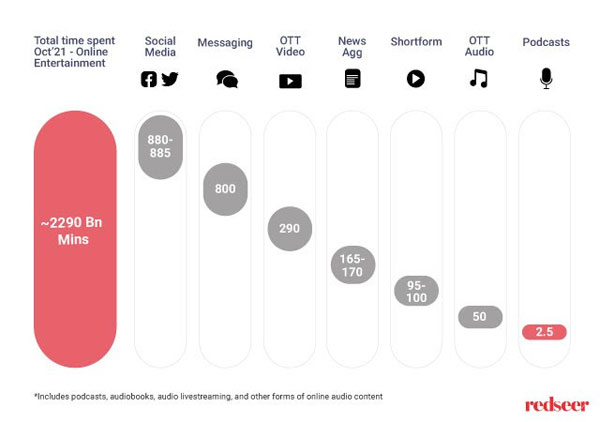
    1. Podcast has picked up well in India and already constitute 1% of the total time spent

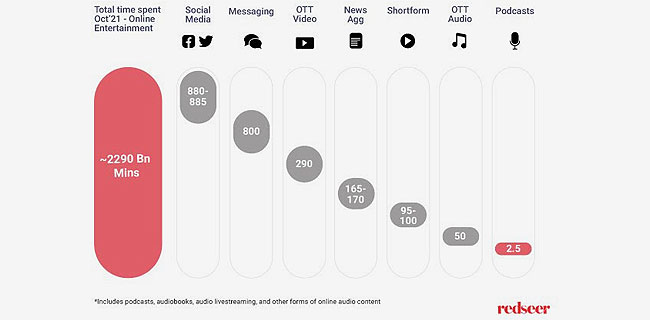
    According to our RedSeer analysis, the total time spent in Oct’21 – Online Entertainment was around 2290 billion minutes. Social media takes up the most time (885 billion minutes), followed by Messaging, OTT Video, News Aggregation, and Shortform App. In the month of October, podcasts accounted for 2.5 billion minutes.


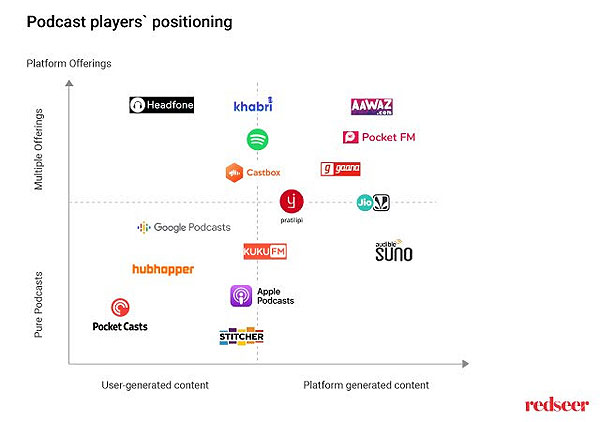
    2. In order to keep the audience engaged platforms are focusing on and generating their own content, high-quality UGC would take longer

    To acquire popularity and keep content development costs low, Indian platforms started with both UGC and PGC models. However, the platform’s ability to preserve brand value and quality is hampered by UGC material. Platforms are increasingly devoting more resources to producing high-quality content and bringing on celebrities to narrate and host shows. Few platforms, such as Headphone and Khabri, are investing in stronger UGC filtering and recommendation engines.


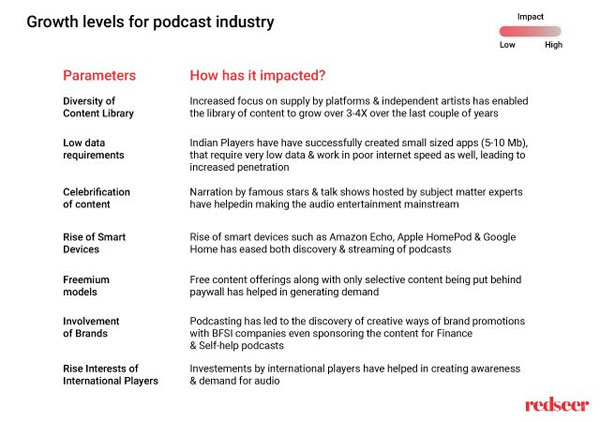
    3. This growth is happening on the back of diversified content, smart devices and low data tariffs

    Indian players have successfully created low data usage apps to deliver podcast content, with diversification around vernacular, and celebrity-driven content. The mix of free and premium models to subscription also allows new users to experiment and consume this new form of entertainment.


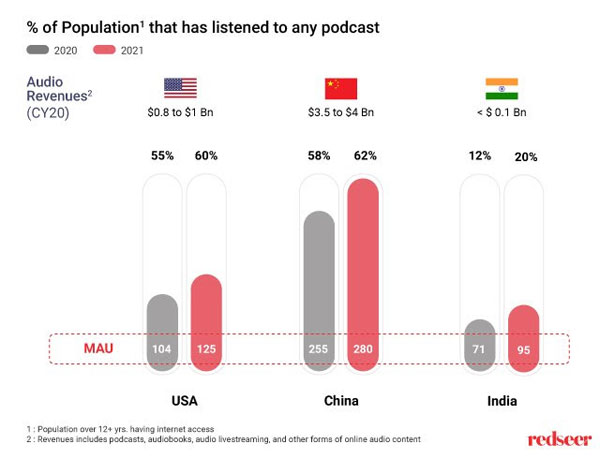
    4. We have seen a 34% jump in the MAU during 2021, capturing 20% of the potential market

    By the end of 2021, India will have 95 million monthly active users, a 34% increase from 71 million active users in 2020. The report also suggests that only 12% of the Indian population has ever listened to the podcast, indicating immense room for growth.


    The newfound popularity of podcasts is attracting advertisers and brands. Platforms with multiple offerings generate the highest traffic. Although players are diversifying into other audio entertainment avenues to increase user engagement & traffic, still podcasts are the major focus for all the players. As India’s internet user base grows with a larger audience warming up to this new entertainment format, the podcast market will unravel in exciting ways.


  • Indian Research and Insights industry to double by 2026


    By Our Staff


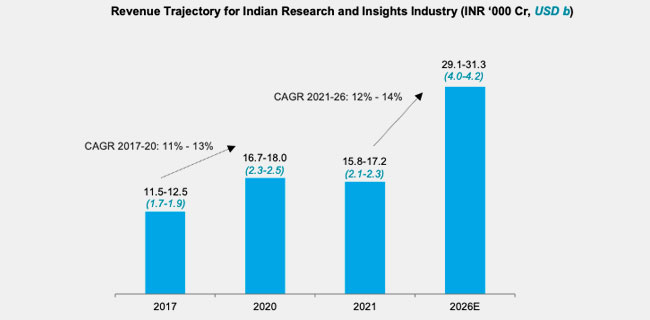
    The Market Research Society of India has launched the inaugural edition of its Indian Research & Insights (R&I) Industry Report. As per the report, the Indian R&I industry is expected to grow at a 12-14% CAGR to INR 31,300 crore by 2025-26, compared to INR 17,200 crore in 2020-21. Moreover, India is fast becoming the global analytics hub, with international markets accounting for 3/4th of its revenues. As per the report, the Indian R&I sector employs more than 125,000 people.


    During 2020-21, Marketing Analytics services accounted for 52% of the total Indian R&I industry revenues, while traditional Market Research and Syndicated/ Publishing services stood at 32% and 16%, respectively. By 2025 26, Analytics services will account for 59%, while Custom Market Research and Syndicated/ Publishing services will account for 27% and 14%, respectively, as per the report. The FMCG and Retail sectors are the largest consumer for Research and Insights with a share of 27%, followed by Information, Communications & Telecom (16%) and Banking, Financial Services & Insurance (15%).


    Commenting on the report, Sandeep Arora, President, MRSI, said, “The Indian Research & Insights industry has staged a robust recovery and is emerging as the most sought-after destination for analytics, globally. The availability of talent coupled with proven expertise in data handling, technology, infrastructure and cost competitiveness will lead to an orbital shift in the industry by 2030. We not only expect the R&I industry to grow 2X in the next five years but can safely estimate the industry size to reach $10 bn by 2030, especially with the strategic direction that most providers are adopting to move towards MR 3.0. We are excited and proud to launch the inaugural edition of the Indian Research & Insights industry report.”


    MRSI partnered with Value Notes as the research partner for the report. The report curates the findings from exhaustive desk research, secondary data of 198 companies, and more than 140 interviews conducted with the industry professionals. The 150+ paged report is available on a subscription basis on the MRSI website (www.mrsi.co.in).


    According to the study, the “global landscape for “research and insights” has evolved dramatically over the last decade. The explosion of data volumes, types of data and sources, and falling technology costs have driven client budgets towards tech-enabled solutions for both data collection and analysis. As a result, the scope of “research and insights” has substantially expanded and enabled many non-traditional methods as well as service providers.”


    Adds the report: “India emerged as a global player in IT services a little over two decades ago, and the global impact of Indian service providers continues to resonate. The Insights Industry in India has a diversity of research providers, along a continuum ranging from “traditional MR” players servicing domestic demand, to companies focused on the global opportunity. From the early days of outsourced MR operations and secondary research, the Indian Insight industry has moved up the value chain, and now supports sophisticated tech-enabled and analytics services. As a result, Indian providers earn around 3/4ths of their revenue from international markets. India is ranked fourth in position by industry size, according to the ESOMAR report on Global Market Research 2021. The country witnessed an increase in revenues with a growing share of tech-enabled research that comprises of a thriving analytics segment.”


    And what’s the future for the business?


    Today, notes the report, “growth is fuelled by the quality of talent (across skills and management levels) and technological sophistication. This is a giant leap forward from the early days when offshoring to India was primarily driven by labour rate arbitrage.”


    Consolidation is changing the contours of the industry, the executive summary of the report adds. “With the role of technology growing dramatically and declining share of wallet for traditional services, the definition of a “full-service” research agency is changing and lines between player types are blurring. Large full-service agencies are adding analytics capabilities inorganically and also selling DIY tools. Market research outsourcing companies are also adding analytics services, and some even getting into syndicated research. IT and BPO companies are muscling into market research as well as analytics. Report publishers are increasingly offering consulting or custom research services. Large cash-rich companies in traditional consumer MR and IT/BPOs are aggressively acquiring niche analytics firms and this consolidation is further likely to intensify to capture the share of customer wallet.”


    Enthusiasm for Indian start-ups coupled with the robust global demand outlook – mean that private and public funding is likely to scale new peaks in India, notes the report,” adding: “With the role of technology growing dramatically, clients are pushing their agencies to extend their services to include digital and analytics initiatives. While this means a larger pie for providers, the need to build capabilities and acquire talent is becoming critical. This is leading to increased demand for experienced data management and analytics professionals, as well as domain experts. As analytics becomes more core to decision-making, we expect further traction in acquisitions over the next few years. India boasts a large number of start-ups in analytics and these will prove attractive targets for a variety of players.”


  • Starcom India tops in RECMA New Business Balance Report 2021

    By Our Staff


    Starcom India has ranked #1 in new business in RECMA’s New Business Balance Report for 2021. Starcom, as per a communique from the agency, has gained the top position in competitive pitch wins across Consumer Products (CPG),  New-Age and App Economy which includes clients in Auto,  D2C, FinTech, Ecommerce, Gaming etc.


    Said Rathi Gangappa, Chief Executive Officer, Starcom India, said, “It is an honour to be recognised as the number 1 media agency in new business wins, in the prestigious RECMA Report 2021. Starcom’s strong consumer understanding, data-led insights, integrated talent, focus on efficiency using competitive pricing and flawless activation has led to us emerging in the top position. We will continue our strong growth trajectory, through very human , personalised brand experiences at scale and market-leading work.”