Category: NEWS

  • [Noosemaker] It doesn’t add up for poor Monty

    By Ranjona Banerji


    I suppose, if you add it up, you have to feel sorry for Montek Singh Ahluwalia, the deputy chairman of the Planning Commission of India. Of course, it is important to remember that I cannot add and neither, it seems, can Ahluwalia. He can however subtract. That is, if you have so many poor people and you want to reduce their numbers, you just reduce the numbers that make them poor. This is an effective tool but sadly no one in this country, except business journalists (the same ones who see any schemes for the poor as burdens on the exchequer), agree with Ahluwalia. Most people find subtraction a heinous and reprehensible method especially since people seem to be multiplying.


    About here is where I run out of mathematical analogies. Because everything sounds like those school maths problems now – if a train is running at 100 km an hour and Peter has six apples, how many oranges does John deserve? For all I know, Ahluwalia also subscribes to my version of mathematics.


    Anyway, where were we? Ah, yes, how many poor people in India? A few months ago, Ahluwalia and the Planning Commsion (subtraction department) told us that if you could live on Rs 32 a day in a city and Rs 28 in a village, then you were above the poverty line. Faced with universal outrage – where many tried to live on that amount and couldn’t last more than 10 minutes – Ahluwalia huffed and hawed in his very good accent and told us that his figures have nothing to do with whether these magician-like poor people were eligible for benefits or not. The Planning Commission, it seemed, just needed these figures to help them in some way or the other.


    So now we know in which way: to reduce the number of poor people in India. This time, in its final report, the Planning Commission lowered the number of poor people by lowering the numbers. Instead of Rs 32 in a city, now you are poor if you manage on Rs 28. In villages, the figure is down to Rs 22. This has led to a dramatic reduction in poor people.


    Sadly for Ahluwalia, no one bought it this time either – except business journalists. The prime minister just quietly dumped the Planning Commission’s number and decided that someone else would start counting. Hopefully, it will be someone who can add, subtract, multiply and divide. Even fractions might help – the way business journalists and the rest of the tribe appear at times.


  • No fluffy business for the wool market

    By Tuhina Anand


    The Woolmark Company and AWI operate worldwide with offices in over 18 countries, with the headquarters in Sydney, Australia. Woolmark is the iconic fibre brand symbolising the best wool in the world. Created in 1964, by Italian graphic designer Francesco Saroglia, the Woolmark logo perfectly represents the softness, elegance and modernity of wool. Today it is still amongst the ten most recognized and appreciated brands in the world. Used on over 2 billion products since its launch, Amir Sheikh, Country Manager India, The Woolmark Company gives MxMIndia an insight into the company’s plan in India.


    Q: How does Woolmark view the current industry for woollens in India both the current status and opportunity?

    India is a big market for woollens with huge growth potential in the domestic market. It is the second largest Australian Merino wool importer after China, though a distant. As per the recent survey and forecast report, the consumption of wool in India is going to grow with shift in market dynamics.


    Recently wool prices have seen increase due to growth in global demand and weakening rupee, making wool import in India expensive. And due to pressure on price points, retailers have gone for blends to sustain the market. The current economic scenario though does not look good with mix corporate results of the last quarter but retailers are optimistic on woolens.


    Fine wool products are becoming a luxury, and brands see this natural fiber as an important tool to attract consumers in premium and luxury segment. Wool being a natural fiber will always be in vogue and there is always a demand for this natural fiber. With growing awareness among consumers for eco-friendly products and being conscious of environment they prefer to have clothes made of natural fibre and wool is among one of the premium natural fiber to cater to their demands.


    We see India as a market of opportunity for premium natural fiber like Merino wool as it is one of the emerging and growing market with swift changes in retail formats and consumers’ mindset who have increased disposable income and wants to adopt international fashion trends. All these factors will help us to build a strong demand for premium quality wool products in India and it is important for us to educate the value chain and bring innovative product ideas to Indian market to meet this growing demand.


    Q: Some of the leading names have the Woolmark approval already in India, what is the task ahead?

    As Indian fashion and apparel industry transforms through modern retail catering to educated consumers it becomes important for brands and retailers to win the consumers’ confidence not only on their brands but also on the quality of product they are selling. This is where we add value with Woolmark certification and licensing program in which garments carrying Woolmark ticket and label assures that it has passed through stringent quality testing and meet consumers requirement which builds confidence. Over the years we have build this quality assurance program globally and many brands and retailers have confidence on the Woolmark brand which will grow as we expands our horizon from traditional to modern retail in India. As you see there has been an increased consumption in woollen products like knitwear, scarves, suits, etc in Indian market and good brands offering quality and natural products, we see a huge demand in Indian domestic market Woolmark certified products. This becomes important for us to reach to brand and retailers who may not be aware of this program or would like to associate with us in future.


    Q: How do you intend to educate customers on the benefits of buying a Woolmark product?

    This is important to us as we educate the value chain about Woolmark certification it is equally important for us to reach to consumers and inform them about Woolmark certified product. This awareness we are doing through various mediums and the best way is through association with retailer by in-store promotions, retail staff training, etc. We have recently done consumer awareness campaign ‘Wool Celebration’ in association with brands and retailers through various media to educate Indian consumers in targeted Indian market. Digital marketing is also one of the focused approach to educate consumers in effective manner. We will continue to educate consumers about wool and Woolmark in future.


    Q: What are few steps you are taking to popularize the concept among the trade to adopt Woolmark status?

    This includes educating the entire value chain about Woolmark through participation in various trade fairs and making them aware about Woolmark. Usually manufacturers are licensed for Woolmarkwith whom we work closely and offer innovative product ideas on wool which in turn can be created and offered to their prospective customers – brands and retailers. At the same time we are offering our services to brand and retailers to expand their knowledge on wool with wider global trends fitting to local demand. Through this knowledge sharing we intend to educate the end of the trade – brands / retailers who are keen to offer values to their consumers with Woolmark certified products. To our valued trade partners we offer sourcing solutions with our global network, new product ideas in different product categories, technical guidance and trend forecasting through our famous business development tool ‘The Wool Lab’. We are increasing our trade activities to reach to wider section of trade as the market demands.


  • [PR] Crisis makes the adrenalin flow: Prema Sagar

    Video and Text By Shruti Pushkarna


    She launched her firm, Genesis in November 1992 with just one client and one colleague, and today it has grown into one of India’s most trusted communications firms in the country. In 2005, Genesis merged with Burson-Marsteller, the gold standard in public relations, to become Genesis Burson-Marsteller. Prema Sagar, Principal and Founder of Genesis Burson-Marsteller spoke to MxM India about the growth of Genesis, issues that the industry faces today and where India stands in the international PR domain today. She also feels that all PR is now actually ‘digital PR’ and integrated communication is the way forward.


    Prior to setting up Genesis PR, Prema was the Editor-Publisher of Genesis – The City Guide, a travel magazine, and co-founder of Genesis Printers. An alumna of the Frank Jefkins Institute, UK, Prema has played a leadership role in the industry as the Founding President of the Public Relations Consultants Association of India, Council Member for India of the International Public Relations Association and member of the global Board of Management of the International Communication Consultancies Organization.


    Part 1:
    [youtube width=”400″ height=”200″]http://www.youtube.com/watch?v=yIhL1PNatp0[/youtube]
    Part 2:
    [youtube width=”400″ height=”200″]http://www.youtube.com/watch?v=wy7bzvz87LI[/youtube]

    Q: Tell us a little bit about the growth story of Genesis, especially post the BM partnership.

    Genesis started in November 1992 and many years later there was an inquiry from Burson Marsteller about partnering with them. I always admired Burson Marsteller and particularly Harold Burson, so when they called us we got into an affiliation. And it was for several years that we were affiliated with them and then finally came the big question about whether they could acquire a percentage of Genesis. I was very clear about one thing, that if we have to do a sellout of the company, it had to be either 100 percent or 0. I don’t like joint ventures because there is confusion about who runs the company and who makes the decisions, and so that happened seven years ago when they took the acquisition route with Genesis. Since the last two years we are 100 percent Burson Marsteller.


    Q: Did you ever think that Genesis could lose its identity given BM’s larger than life presence?

    Not so far.


    Q: Genesis started 2012 on a high note; what are the key focus areas set for the year going forward?

    Going forward is really about specialization which is something I started a year ago. Deep specialization, whether it’s corporate responsibility, whether it’s consumer marketing, whether it’s telecom and technology, whether it’s corporate and financial, and the new area is going to be healthcare. The fact is that people want expertise, general advice doesn’t work across different businesses. And instead of having one leader in this organization, in these last two years we have created 20. The idea is to create 40 in this year. So it is about creating far more leaders who have not only the expertise and depth but they have the leadership skills and you give them the space to grow.


    Q: Given the growing clout of digital media, how does Genesis plan to integrate digital media into its campaigns? Do you think integrated communications is the way forward?

    Everybody around the world is struggling with it. It’s very clear that you cannot do PR without digital, so it is really ‘Digital PR’. So when you look at any campaign, for example in the West, 50 percent is digital part and 50 percent is the traditional media. If we look at it here in India, everyday it’s growing. It started with consumer technology where it was a definitive requirement in the campaign plan. So it’s just rolled into the PR campaign just like how from print, television became popular and now digital is popular. I think there is a lot of focus required in digital in India. There are not enough experts, there are a lot of people running all over the place but if you want to see the impact of what digital is doing, there is a journey to be made.


    Q: How critical do you think it is to have a strong central body to represent and voice the needs of the PR industry as a whole?

    I set up Public Relations Consultants Association in India (PRCAI). I think there is a leadership need where we need to get people from Asia Pacific, not necessarily from the globe but have far more interaction of what’s happening in different markets. A lot more needs to happen on a thought leadership status, that is a long journey that needs to be done. I think a lot of it is very tactical right now and I think the body needs to take it to the next level.


    Q: What’s your view on international agencies entering the Indian market increasingly?

    They are already here, they are all here, in whatever form or fashion and a lot of them are even very small. One of the international competitors who asked me that what my advice to them was when I was at the World Economic Forum last year, I said to them take one, build it brick by brick. Don’t try and do everything in one go and hire people and run after clients, you have to show value, it’s a service and that is still my advice.


    Q: Where do you think the Indian PR industry stands today in the international arena?

    It’s very interesting that yesterday we met a very big multinational company, and they rung me up this morning and said that we are confused because everyone who has presented, has presented fabulous stuff and we didn’t know that the PR industry in India was so advanced. I was worried in one way thinking that I was way ahead but on the other hand, I was very proud that somebody had to say that about India.


    Q: How big a challenge is attracting talent into the business?

    Talent is moving too fast particularly in the middle level. I think a lot of people come here to learn and when they reach the middle level, a lot of the corporates pick up the middle level people and without further training, they are corporate communications heads. It doesn’t matter because at the end of the day it is happening to every industry in India and it’s the same story internationally. So we have our own GBM School and we keep training and looking at developing future leaders. I don’t think we should worry, I think we should invest in people, in team bonding, in leadership skills, those areas definitely need us to make that investment in them.


    Q: What are the other challenges that face the industry today?

    I think it’s all going well, I won’t worry too much. We just need to stick to ‘ethical’ influencing because influencing is part of life. We all influence each other in one way or the other and I think doing it the ethical route is what we need to stick to. We are at the threshold of announcing Public Affairs Forum of India. I think this association should make that difference now in India for the future about ethical influencing. So those are the challenges, and I think that’s always the challenge in any service business, to stay the course in terms of ethical influencing.


    Q: BM is primarily known for its crisis management and political lobbying. How critical do you think is crisis PR? Also, what are your views on lobbying?

    We love the issues in crisis because it takes us away from the day to day campaign planning and execution, issues in crisis makes the adrenal flow. And we really do feel that we made a difference and that’s the challenge, whether we helped in a positive way or not. On lobbying, it’s a part of life. As CEOs say it’s not just a lobbyist, the CEO is also lobbying. Within politics there is lobbying, within the corporate world there is lobbying. Everybody is lobbying for something or the other and I think we need to confront that. It’s a part of life, it’s nothing sleazy, it’s just a word from the dictionary, it’s interpretation of how you are doing lobbying.


    Q: There are some who believe that the PR industry itself needs a bit of PR, given all the bad publicity it’s received: Niira Radia, the Times of India management saying Medianet is a result of PR folks bribing journalists etc.?

    These things happen in the service industry particularly. On Niira, who knows what was right or wrong, how much is the truth, what is not the truth, all of those things are going to never be known. But having said that it is good that all of this is coming out because I think India is in that gold rush stage and the fact that journalists are bringing these things out in the open, is really a good thing. If it didn’t happen, we would have gone the wrong way, and civil society is putting the pressure and it will change, change for the better.


    Q: Is measurement a good thing to talk about, but difficult to implement?

    Not at all, because if you meet Aseem Sood of Impact who does the measurement and research analysis, there is a way in which it can be measured. And that too a third party has to do the measurement, you can’t measure yourself. There are agreed parameters with the client, and we have something called the Service Quality Index which is put out to the clients. What they have to do is, to assess the team for the results that they deliver. And this measurement and analysis provides absolute results, so you can see whether you have achieved what you set out to achieve. You have to set a measurable goal, only then can you evaluate whether you met that goal or you didn’t meet that goal.


    Q: What’s your view on PR awards? Did Genesis participate in them?

    We try and participate, we have not been very active on that front but going forward, we are definitely going to participate more. I think it’s a good thing to have. I need to just see on what basis do the juries evaluate, is it just a discussion or the parameters are very stringent. It would be good to tie up with some of the international awards, and to learn from what they are doing and how they are doing it. I was on the jury of PRWeek Awards and I know the stringency with which they select the winners. I do believe that even they are not perfect but we certainly have a journey to make and we should develop much more stringent parameters.

     

  • Continuing the WorldSpace legacy @ Timbre

    By A Correspondent


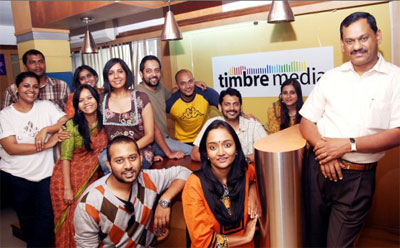
    The year 2012 has already begun with a series of announcements of radio on the web and other digital platforms. PlanetRadiocity.com for instance has launched a new genre – IndiPop Radio on their Web Radio station in March, 2012, and a Bengaluru based internet radio company- Venturenet Partners will be launching a premium model internet audio service- Radiowalla in April 2012. Formed in 2010 by former employees of WorldSpace India, Timbre Media is also slated to announce its internet radio station – Timbre Radio. All these players not only aim to provide innovative but, differentiated content and world class radio programming to their listeners, all through the power of audio.


    Besides the internet, Timbre Media plans to exploit the potential of the audio medium across digital platforms including mobile and DTH Television. On the mobile front, the Bengaluru based Timbre Media has already aligned with Vodafone India to offer listeners multiple music genre radio stations across the country. Listeners will have to pay Rs. 30 per month for 300 minutes of free usage. However this mobile radio service is not available in Andra Pradesh, Gujarat, Himachal Pradesh and Kolkata. Saregama India Pvt Ltd. which has acquired 10 per cent stake in Timbre Media provides the company (Timbre Media) with access to their music database.


    Timbre Media offers customised radio content for multiple broadcast platforms. It has four studios in Bengaluru and two studios in Mumbai among other studios in different parts of the country. In conversation with MxMIndia, M Sebastian, Co- founder and CEO, Timbre Media spoke about business model of Timbre Media, his break-even plan, the trends to watch out for, on traditional FM radio and much more.


    Q: Can you share with us how Timbre Media was formed? And what was the thought process behind the launch?

    Timbre Media was formed in 2010 by the erstwhile employees of WorldSpace India, to continue the legacy of world class radio programming that we provided through WorldSpace to our listeners.


    Q: What is the team size? Timbre Media is currently headquartered in Bangalore… Will you be setting up offices in other parts of the country too? When?

    We are a team of around 80 people, spread across different Indian cities.


    Q: Timbre Media specializes in programming radio contents for corporate entities, FM stations etc… Can you throw some light on the USP of Timbre Media? Also are you in talks with any FM station for radio content?

    Timbre Media has the unique advantage of a talent pool that introduced subscription based radio service in India and popularized the concept of genre based radio programming in our country. Our content is different, rich and compelling. We have learnt a lot about the expectations and aspirations of our target customers in the last 10 years of our association with WorldSpace Satellite Radio and its elite customers who valued quality and variety.

    We are in discussions with potential customers in every vertical that we are operating in.


    Q: What is the business model of Timbre Media? Is it advertising-led or a subscription model?

    Our business model is based on our philosophy that is to provide customized content that is different, rich and compelling and monetize the same in the best possible manner. It could be advertisement- or subscription-based depending on the vertical and the ecosystem we are operating in.


    Q: How many channels are in the offing? Which genres will you be offering? Will news also be part of it?

    We can’t say at this moment how many and what types of channels we will be offering. As I said, it is a function of the vertical and the prevailing ecosystem. We are focusing on providing customized content solutions to various customers and it could vary from one to the other. We are not averse to a particular type of programming or platform.


    Q: When are these channels scheduled to launch? Will it be only through mobile or will one be able to access them on the internet and DTH as well?

    We are not averse to any programming or platform. We are interested in utilizing our experience and expertise to meet the aspirations of the end user by using every available opportunity and monetizing the same to ensure the growth of Timbre Media.


    Q: Whom do you consider as competition?

    As such I do not think there is anyone who has the same experience and expertise that we have, and provide the same products and services that we offer.


    Q: How has 2012 welcomed Timbre Media? What are your growth plans?

    We have made considerable progress in the last two years. Thank God and the committed and passionate team that Timbre have, we have done extremely well compared to most of the start-up enterprises. We want to be a unique media enterprise that touches every customer who values quality audio content through all possible platforms and devices in the next 5 years.


    Q: Any specific trends you see in the Indian radio industry, particularly in the internet and mobile space?

    Radio industry is growing, and listeners are appreciating quality content for which they are willing to pay. The technology and platforms are enhancing the ecosystem every day and enabling the consumer to get what he wants, in the way he wants at the time he wants.


    Q: Also, should traditional radio begin to worry with your entry?

    There is sufficient space for everyone to co-exist and grow. Rather than worrying, we need to identify areas of partnerships that lead to mutual benefit and faster growth and work towards realizing the full potential of the audio medium.


  • [PR Channel] Sports PR: A new wave of specialization

    By Neha Mathur Rastogi


    For long I have had a strong belief that specialization is the only way to create true value in the often undervalued world of Public Relations in India.


    There are agencies which have gone down this route in more sound sectors like IT, Financial and even Pharmaceutical PR. But few have treaded the path of Sports. Sports PR is a qualified specialization by the virtue of the nature of work involved. You need to be spontaneous, think and write on your toes and work with a very passionate set of media, sportsmen and women as well as the all-important cog in the wheel – the corporate sponsors. Each dimension presents you with a unique challenge.


    It is common knowledge now that in the past few years, India has slowly become a global hub for sports, moving beyond conventional cricket to the recent Commonwealth Games, Hockey World Cup, F1 and several golf events being held here of international repute.


    Each of these initiatives has been made possible due to a surge in corporate support to sports. No longer is corporate sponsorship in India considered as a mere philanthropic exercise. There is a direct linkage of these associations with the brand communications strategy and how it can be best leveraged.


    The advent of such high involvement of corporates with sports has given an impetus to a latent demand in the PR industry for a specialised approach to sports. It is also great for the sporting talent in the country who also benefit from professional help in communicating more effectively with the media. We have in the past and present worked with the likes of Narain Karthikeyan and Ronjan Sodhi who are extremely talented sportsmen but needed the right kind of media exposure to be able to generate the deserved awareness about their sport and performance.


    The key in sports PR is to strike the right balance between meeting media’s expectations of receiving quality material on the sport and sportspersons, and to ensure the corporate involvement is sustained since media presence is pretty much the key measure of success.


    Sports PR is also extremely challenging since we need to always ensure the media exposure of a sportsman or woman is beneficial to them and does not in fact interfere with performance and practice.


    Having worked with media across sectors; I have also noticed a unique quality in sports media. They are all extremely passionate about the sport they cover. It is quite common for many of them to have a real background of playing the particular sport they are covering. This makes our job even tougher, since we need to understand the technicalities of each sport we represent before presenting it further to the media.


    Initially this proved to be a challenge for a person like me who has not physically played any sport at all! But the key was to learn from observation and a lot from the media and their style of writing itself. The adrenaline one feels while playing any sport pretty much rubs off on the PR around it as well.


    We need to write content in real time as the result of a day’s event is announced. There is always a Plan A, B and C basis the results and performances of the day and then it needs to be implemented from the word go.


    Our experience with reputed global organisations like Laureus and FIH has given us a taste of how international organisations have been setting standards in how one should optimise performance in sports PR. Working with Laureus in particular has been a great learning experience where a large part of their campaign revolves around generating media votes for the coveted Laureus World Sports Awards. Here the traditional PR assignment (though the word ‘traditional’ does not exist in the world of Sports PR) assumes the role of being similar to a political campaign where we meet media across different regions and sports and bring them on board to vote for their favourite sports personalities across the globe. The entire exercise culminates at the grand Laureus World Sports Awards ceremony where we accompany a group of select Indian journalists to be part of the most prestigious sports awards in the world. In the past, Laureus had a peripheral presence in India. But since the last few years they have upped their stake in the country and the exercise conducted by us is a big part of it.


    One may question a specialisation in sports PR on grounds of sustainability and it being a more project or event driven model. There is some truth in this, where my company has also borne the challenge of seasonality in the world of sports. It takes a lot to convince any sports property or association of the benefits of long term and sustained communication instead of a burst purely around the culmination event.


    Some brands, however, have discovered the benefits of this including the Women’s Golf Association of India, who have one key event at the end of the year but have decided to invest in PR for the association and Indian women golfers across the year which then builds up towards the Women’s Open. The media by then has enough exposure and interest in an otherwise niche area of reportage.


    The other way we have sustained our presence in the area is via strategic partnership with reputed sports agencies and associations which work with several events and sports personalities across the year.


    To conclude, sports PR is fast emerging as a beneficial specialisation for us to have honed over the past few critical years of the growth of the sports industry. There is tremendous potential and power in what PR can truly do to add value to sports in India. Beyond commercial success, the credibility attached to a job well done in sports PR is what keeps us going.


    Neha Mathur Rastogi is Founder & CEO of WordsWork.


  • Maruti Suzuki will not shut down car production at Gurgaon

    By A Correspondent


    During a media interaction, Maruti Suzuki’s top management had announced plans to set up a diesel engine manufacturing plant in Gurgaon. Some sections of the media had taken this to mean that Maruti Suzuki would shut down production of cars in the Gurgaon plant and shift car-making to Gujarat. The company has clarified that there is no plan to stop production of cars in the Gurgaon plant, and car-making operations at the Gurgaon plant will continue.


    A statement from Maruti Suzuki said, “The company will reduce the number of cars produced at the Gurgaon plant and make available space for expanding the engine manufacturing capacity, including a new diesel engine plant. The company will continue to increase production at Manesar, where a third plant with an annual capacity of 2.50 lakh units is coming up. Once the capacity in Manesar is fully utilized, the company plans to set up a new facility in Gujarat. Together, the facilities at all three locations – Gurgaon, Manesar and Gujarat – will be used by the company to manufacture vehicles to meet market demand.”


  • Kannadada Kotyadhipathi betters KBC in first week

    By Tuhina Anand


    If one were to go by the first week numbers of Kannadada Kotyadhipathi or KBC in Kannada which debut on Suvarna Channel then surely the show has made an impression. Launched on March 12, the show has opened with a TVR of 7.32 (Source – TAM, CS 4+ Years) in the Karnataka Market. The average TVR for the show in its first week is 7.66 (Wk 11) which is better than the latest version of Kaun Banega Crorepati which opened at 5.24 TVR in top 3 metros (Mumbai, Delhi and Kolkata) and 4.5 TVR (Source :TAM) in its first week in the HSM market. The show Kannadada Kotyadhipathi in its initial week also became the No.1 show in Karnataka.


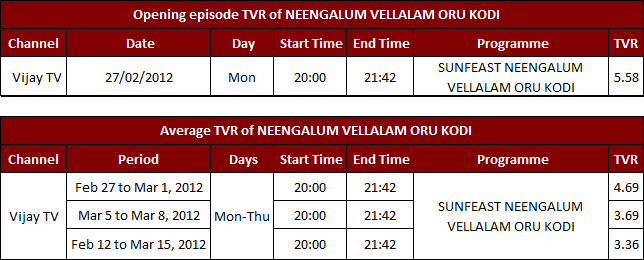
    In fact its counterpart, Neengalum Vellalam Oru Kodi which made its debut on Star Vijay managed a TVR of 5.58 on its opening day and since then has been on a decline with average TVR from Feb 27 to March 1 being 4.69, 3.69 (March 5-8) and 3.36 (Feb 12-March 15).


    Puneeth Rajkumar who comes from the first family of Kannada cinema is hosting Kannadada Kotyadhipathi whereas Suriya is hosting Neengalum Vellalam Oru Kodi.


    Anup Chandrasekharan, Business Head Suvarna Channel commented, “We are very happy with the initial response of Kannadada Kotyadhipathi, we have got a lot of positive feedback about the show from our viewers. This show is also made us the leader in week day prime time. We hope we are able to sustain the initial ratings.”


    On its comparison with Hindi KBC he added, “It is not correct to compare the two shows in terms of ratings as they belong to different markets, KBC is analyzed in the Hindi Speaking Markets (HSM) & Kotyadhipathi is analyzed in the Karnataka Market.”


    In the past, KBC was aired in Bhojpuri on Mahuaa TV as Ke Bani Crorepati with Shatrughan Sinha as its host and in Bengali as Ke Hobey Banglar Kotipoti hosted by Sourav Ganguly on Mahuaa Bangla. Both the shows did not garner much in terms of numbers. Bangla KBC averaged TVR of 2.29 (period June 6 to August 12, 2011), the Bhojpuri version saw an average TVR of just 0.45 (period June 6 to August 12, 2011). (Data source TAM).


    So it remains to be seen if KBC in Kannada will do the magic and retain its high ratings in the weeks to come.


    Source: TAM Peoplemeter System
    TG: CS 4+ yrs
    Market: Karnataka
    Period: Wk 11: Mar 11 to 17, 2012


    Source: TAM Peoplemeter System
    TG: CS 4+ yrs
    Market: Tamil Nadu
    Period: Wk 9 to 11: Feb 26 to Mar 17, 2012


  • [95 Days to D-Day] No negotiation on deadline: MIB

    By Shruti Pushkarna


    Once again the government of India maintained its hard stand on the issue of digitization. Speaking at a FICCI organized seminar, ‘India going Digital: An Industry Interaction with Stakeholders’, Additional Secretary, Ministry of Information & Broadcasting, Rajiv Takru, made it very clear that the June 30th deadline is not subject to any negotiation. Addressing all stakeholders, the LCOs, MSOs and the broadcasters, Mr Takru said, “All analog will be switched off from July 1. The June 30th deadline is not negotiable at all. So all stakeholders should pace up and brace the change.”


    The seminar on digitization was organized by FICCI in New Delhi in partnership with the government of India. Participating in the event were all stakeholders, from local cable operators (LCOs), to multi-system operators (MSOs) as well as broadcasters. The seminar was organized to address issues faced by various stakeholders in the run up to the switch over from analog to digital.


    Mr Takru started off by saying that there are several rumours in the market that he would like to belie. The first being the unavailability of set top boxes (STBs). He said, “In Delhi there is a requirement of around 33 lakh STBs out of which 7 to 8 lakh STBs are already installed. And around 28 lakh STBs have already been ordered for and they are at various points in delivery. So whoever tells you that there are not enough STBs, is all false.” Secondly, he said there is a lot of talk about the sunset date being extended, he said that the deadline was absolutely sacrosanct and all industry stakeholders will have to follow it as an order. However, he admitted that the task that lay ahead is not easy but knowing the weaknesses of analog, this seems to be the best way forward for all. Mr Takru said that digitization is good for everyone and especially for the consumer. He said, “Digitization is in the larger interest of the consumer and if it hurts a few then so be it. This initiative is not being undertaken to promote any particular business interest, it is a larger step in the move towards digital.”


    Also addressing the gathering was Ms Supriya Sahu, Joint Secretary (Broadvast & Policy), Ministry of Information & Broadcasting. Sharing some numbers with the audience Ms Sahu said, “There are 33 lakh cable TV homes and around 5000 cable operators. There are 5 national MSOs and several independent MSOs. The task ahead is difficult and we need to especially reach out to the migrant workers and slum dwellers.” She also said that the government was doing its bit by running ads on radio and TV for consumer awareness. A toll free number has been set up for all kinds of queries on the matter, and the ministry also has a Facebook page where issues can be addressed. However, she urged the LCOs to get into the act now. She said, “You need to start contacting all your consumers to pass on the message because time is very limited.” She assured all stakeholders that although the rules are still being framed by the ministry, once out, they will only ease the process of transition for everyone involved. She said that there were no substantial changes that the ministry is going to make to the existing framework for the benefit of all stakeholders.


    Despite all assurances of support from the government representatives, the industry stakeholders seemed unconvinced. Ministry representatives invited questions for discussion from the audience and it was evident from the several points raised at the forum that there were varied levels of discomfort among the stakeholders. While some were hoping that there will be an extension to the sunset date, some hoped that there will be subsidies in sight. But putting all doubts to rest, Mr Takru said, “There will be no free STBs provided for by the government, just like there is no such thing as free lunch. There are no subsidies being contemplated by the government at this point.” He said however, the service providers are putting their services out in the market with heavy amount of subsidy built in, like the cost of a set top box is already subsidized.”


    A concern was voiced by a local cable operator with regards to the quality of STBs. He said, “Often there are issues with the set top box provided by the MSO and once the customer buys the STB, he/she is stuck with it. Since the LCO is the link between the end user and the MSO, what does the LCO do if the consumer wants to return the STB and get another one?” Addressing his query Mr Takru said, “The government is devising a scheme where a customer can return a STB he/she has purchased. The refund guidelines etc. are being worked upon by the ministry. The LCO can also return the STB to the MSO and get a refund in return.”


    Addressing a concern over the tariff for channels, Mr Takru said that TRAI will soon notify the tariffs which will apply to all, including the LCO, MSO, broadcaster as well as the customer. On repeated complaints over lack of availability of STBs from the MSOs’ end, Mr Takru told several LCOs present that they were free to change their MSO if the MSO refused to provide them with required STBs. But he also urged the cable operators to cooperate with the MSOs in the switch over process.


    The seminar was followed by a press conference by the ministry officials. Addressing the media, Mr Takru said, “The discussion with the stakeholders was very interesting and we managed to address several concerns of all the stakeholders.” The Additional Secretary reiterated for the media that there were more than required STBs available in the market and the deadline was non-negotiable. Speaking of the tariff for channels, Mr Takru said, “We don’t expect the tariff structure to rise or to go beyond what it is today.” He also said that consumer awareness initiatives are being undertaken by the ministry, which has already put up radio jingles on AIR FM Gold and Rainbow. Two TV spots will be on air soon on all national and private channels. The IBF and NBA are also carrying tickers as an initiative to raise consumer awareness on the subject.


    Mr Takru concluded by saying that this process might leave a few unhappy but because it is being done in the larger public interest, the government is forced to ignore certain concerns being voiced by a smaller group. He said that digitization will empower the customer who will now have the ‘choice’ to watch what he/she desires to watch unlike the present day scenario when the customer is dependent on what is offered by the cable operator.


  • The Mindshare Mantra for the Digital Age


    By Johnson Napier & Insiyah Rangwala


    With a new global CEO at the helm and a host of other reshuffling activity on the talent front, the most recent being the appointment of Greg Brooks as Global Marketing Director, it’s been a busy 2011 & 12 for Mindshare Worldwide. But organizational changes are just one aspect of the overall vision that the global media and marketing behemoth has charted out as it prepares to confront new challenges that the future will inevitably throw up.


    In India for a one-day seminar titled Mindshare-Brand Equity Compass 2012, Marco Rimini, Leader, Business Planning, Mindshare Worldwide opened up to MxMIndia on how his agency is preparing to deal with the digital tide that is expected to sweep the sector off its feet, on the agency’s plans for India and emerging markets, and his mantras for surviving the slowdown blues. Excerpts:


    Q: What is the moment of truth facing media agencies today where the medium of digital is concerned? How is Mindshare Worldwide gearing itself to face the medium for the challenges that it will throw up tomorrow?

    The world is seeing a digital revolution and everything changes as a result of that. It will be important for organizations to get their balance right in the way they approach the medium of digital. As for Mindshare, first of all, it is about making sure that we have people who understand that we have information we share between people who understand the medium of digital. Also, the fact that we have to deal with technology ourselves.


    Q: As one moves across markets from the US to Europe to Asia Pacific, what are some of the new digital trends that have sprung up in the recent past?

    The most important thing is the amount of time people spend online and that differs by market and by region. And so obviously, the amount of time you spend online marketing to them changes remarkably by region as well. So in some markets, we are already seeing a 30-40 per cent spend by sectors such as financial services and telecom, going towards digital. Countries which are leading that race include the US and the UK.


    Q: Asia Pacific is being touted as the region that’ll churn out highest growth numbers where the medium of digital is concerned. What are your views around this thought?

    I think where digital is concerned, the Asia Pacific market is ahead because they can leapfrog ahead of the US and UK and because they have less infrastructure issues. For example, where wireless is concerned the Asia Pacific markets can leapfrog ahead because they don’t have to go through the cable revolution.


    Q: But despite the decibels and the glory, why are adspend figures around the medium still abysmally low? Do you see the low growth as an opportunity or a challenge for the sector to deal with?

    I definitely see it as an opportunity for both marketers and agencies to get it right, but to ensure that you go ahead you have to make sure you get your today and tomorrow also right. But I am positive of seeing healthy numbers being posted as we move forward.


    Q: What are the growth numbers that you anticipate for the medium in 2012?

    I think we will see an immaculate growth coming from the medium and it will differ across sectors. It is observed that sectors which sell online spend the most on online. Also, the sectors in which the advice is given the most online spend the most online. So you’ll see cars, telecom, retail, etc all have become very big spenders whereas you see less fast growth in the FMCG space.


    Q: Which are the categories that will drive online growth in 2012?

    I think it’s the ones that have a better online distribution presence; online distribution and online services will be the ones that will drive the growth. Examples include retail, banking, telecoms and cars. These are the top four high-probability sectors that I can think of.


    Q: Going forward, can we expect a renewed focus on some of the emerging markets for Mindshare Worldwide?

    There won’t be any renewed focus on any of our markets – we have always been strong in Asia and we expect Asia to continue to be strong for us. Also, within Asia we expect markets like Indonesia to drive substantial growth for us. If there is anything new it will be growth in Latin America and Africa.


    Q: Mindshare India has seen some reshuffling in the recent past where a host of people have been promoted and new talent inducted too. Globally too, there have been a few key appointments as well. What more can we look forward to on the talent front?

    Nick Emery has taken over as the global CEO for us and we wish Dominic Proctor well in his role as Group M in-charge now. Nick comes from a planning and strategy background and I think he is going to make sure that we all drive the company strategically and also do our marketing right. In fact we have just announced a new global marketing director for Mindshare Worldwide – Greg Brooks. Greg is coming from C Squared which was the organizer of the Festival of Media and also publishers of M&M magazine. So Greg is a digital maven; a digital consultant who used to be a digital journalist and his job will be to market Mindshare in this new digital age.


    Q: Has the much-spoken about slowdown impacted growth at Mindshare?

    I’ve heard a lot about this in the last 24 hours since I have been here but I have to tell you that if you come from Europe all of you here are being far more pessimistic; 6-7 percent growth is still very good and I am sure this will only be a very short-term slowdown in India and growth will continue to come. At the end of the day 6-7 percent is a very significant amount to stand by.


    As for Mindshare, we expect it to grow more or less with the average growth rate of the economy. The target for us is to grow as per the relevant economic conditions; so we say that our target in Europe is to beat the economic growth that gets registered.


    Q: What is the number you are looking at?

    We only set targets at the WPP level and I’m afraid you will have to look at their targets rather than ours. Obviously the growth in Asia Pacific is higher than Europe and we expect the growth to continue to be high. Logically, Asia Pacific is a very important region for us. Also, recently Latin America has also become an important region for us.


    Q: It was interesting to see representatives from P&G grace the panel for a Mindshare event. Worried about how Unilever will react to this?

    (Laughs) I didn’t choose the panel, Vikram Sakhuja did. But we are very proud to work for Unilever and hope that we continue to do so.


    Q: The team in India seems to be busy behind the Unilever pitch with hectic travel and meetings being the order of the day. Would you delve on what’s the current status of the pitch?

    We are all very engaged in the pitch; we knew it was going to happen and look forward to doing it. We hope to continue working with them as they have been one of our founding clients and through JWT and Ogilvy before that — we have worked with Unilever for over 100 years so we hope to continue our association with them.


    Q: What are the sentiments amongst your clients where advertising budgets are concerned?

    I think in 2008-2009, you saw dramatic cutbacks but in the last 18 months or so we have seen clients being more confident about their spending decisions. As we know, some clients are spending right in the middle of recession. So I don’t see so much of restraint from the client’s end. I think the point here is that the financial community is more nervous than the client community — it’s a government issue and not a corporate issue that’s facing us this time. In 2008-09, it was more of a corporate issue.


    Q: What will be your single largest agenda for 2012?

    The focus will be on people – there’s a lot of talent out there especially in Asia. We have to make sure we get our fair share. It’s a work-in-progress; it’s always a work-in-progress.


  • Sandeep Sharma joins RK Swamy Media Group

    By A Correspondent


    The R K Swamy Media Group has appointed Sandeep Sharma, former head of sales and marketing at Times Global Broadcasting, as President. Mr Chintamani Rao, who held the position until earlier this week, is likely to move to another role within the group.


    Confirming the development, a spokesperson for the RK Swamy/Hansa group indicated that Mr Sharma joined the organization on Monday, March 26.


    Speaking to MxMIndia, Mr Sharma said he’s looking forward to leading the four companies under him – Media Direction, Hansa Media Services, Digital Direction and Hansa Outdoor and Hansa Media – to newer heights. “I have a great team working with me and we hope to grow in a big way,” he said, that his first priority to familiarize himself with all aspects of the group’s businesses.


    Mr Shama, a chemical engineer from IIT Bombay, has an MBA from the NMIMS, Mumbai. In a career spanning 22 years, he has worked with Times Global Broadcasting (as Senior VP – Sales and Marketing), at Star India (as VP – Sales and Business Head) and Lowe Lintas (VP, Unit Head).


  • Digital is the way forward for Zee

    By Rishi Vora


    The future is definitely Digital, and Zee Group has its sights set firmly on it. In addition to its recent launch of Ditto TV, the broadcast major has been fairly active in the digital space to promote properties such as Dance India Dance 3 (DID) and Punar Vivah.


    The channel has also taken a new and different step to enhance consumer interaction. It has introduced ‘free voting’ for contestants (where the viewer is asked to give a ‘missed call’ to his favourite contestant) as against the industry norm of pay-per-message.


    To further intensify its focus on Digital, Zee has now unveiled a WAP site and a mobile application that connect with DID fans on the go.


    The WAP site has interactive features which enable fans to interact with the contestants and judges and allows them to vote by a click of a button apart from a few other interactive features.


    MxM India spoke to Marketing Head Akash Chawla about these and other digital initiatives.


    Q: This whole focus on Digital… is this something that will take Zee a step ahead of competition?

    That is what we expect to do. We hope to be ahead of the competition with regard to this particular thing. From our perspective we’re not looking at how competition is doing on this front, because our entire objective is to be very close to the consumer. There are times when we do it by being on the ground and there are times when we do it by actually going to their homes. In the age of interactivity it is apt that we use digital media to the best. And that is exactly what we’re looking to do.


    Q: Does this take away anything from the way you use traditional media?

    The one mantra which we’re going after is driving conversations with the customers. So, even when we’re using the traditional media – a print ad for example – the attempt is to make it more interactive. Any my belief is that you can also use traditional media to drive a lot of audience on your social network.

    I’m not saying that traditional media is something we won’t do, but our attempt will be to drive more conversations through our communication.


    Q: You’ve been fairly active on social media and that seems to be a big thrust going forward as well. But there is a saying that social media is a double-edge sword and that it could well turn out to be harmful to a brand like yours.

    It is too soon to say that. In the case of iconic brands or sectors such as automobiles you can see a sizeable community. In the GEC space we’re just beginning to do that. So our first objective is to build a sizeable community. Once you get a sizeable community then how to use that is the second objective. Traditional media will irrespectively be required as social media in India is growing.


    Q: This missed-call concept which you’ve introduced for DID is something very different altogether. How did you come up with a concept like that?

    At Zee, we’ve been doing talent hunts such as Sa Re Ga Ma and DID. When we started this interactivity thing in 2005 with Sa Re Ga Ma Pa Challenge, we used to get a lot of votes. If we sit down and draw a trend, votes have actually gone down over a period of five to seven years. Most of the formats today are interactive in terms of asking for votes. Second, the credibility aspect. Consumers have come up to us and said that it is just a revenue making mechanism because the SMSes are charged higher than the normal SMSes. Frankly, as a broadcaster, for us, at this particular time, it is more about building the brand salience than the small amount of revenue that’ gets generated through votes.


    Q: That revenue – is it that small enough to be left out?

    It’s a tradeoff. Tomorrow we may not be able to do it for all our reality shows, but at the end of the day if it is about a brand like DID – from the consumer’s perspective, credibility is of primary essence. And whatever brings us that credibility is something we would want to go in for.


    Q: Is this a beginning of a new trend in broadcast?

    You cannot do this for everything. It is not a model that can be followed by all brands. There are certain attributes of DID in terms of how many people were connecting with it, in terms of it being a brand which is already known and the kind of credibility it has at this juncture…


    So I don’t think it’s a concept that’ll fit all brands. How many more people will start following us on that? We don’t know. But we did try this again for another show, Punar Vivah. We decided to apply that to the show because as a concept it applies to a segment where we could afford to be more interactive and it gave us phenomenal results.


    Q: Does a show like Punar Vivah attract a lot of traction on social media?

    Actually if you go to our Facebook fanpage, Punar Vivah is one of the topics that is heavily discussed. You’re right that you cannot do things on social media blindly. And I’m worried about that. If something is successful people will start using it as a formula. The aspect we’re following for Punar Vivah is very different. We’re doing Punar Vivah symposiums across 18 cities of India, where every week we have a couple of symposiums which includes a psychotherapist, a marriage counsellor and one reputed NGO of that particular city or state. We also have people on the panel who have gone through the remarriage process, our viewers and media.


    Our attempt is to bring this so-called taboo topic out of the closet. You may do with social media with a particular level. But, we feel for Punar Vivah that is the one that is actually more relevant than just social media. So yes, you’re right. Social media has to be used keeping the segment that you’re chasing in mind.


    Q: You’re at No 3. Neck-and-neck with your nearest competitor. Where next?

    No 1 next. It was a matter of 1 GRP with Sony last week.


    How long for No 1?

    (Smiles) I told you three months ago that we will be No 2 in three months. We’ve become No 2 in three months.


  • RAMcheck: More surprises for FM players

    By A Correspondent


    TAM Media’s Radio Audience Measurement (RAM) – which covers four key metros, Mumbai,Delhi, Kolkata and Bengaluru – released its latest radio listenership figures for Wk 4 to Wk7 (Last two weeks of January 2012 and first two weeks of February 2012).


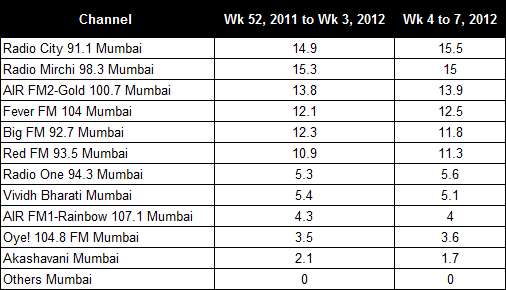
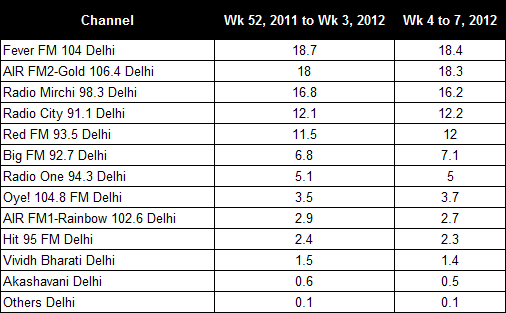
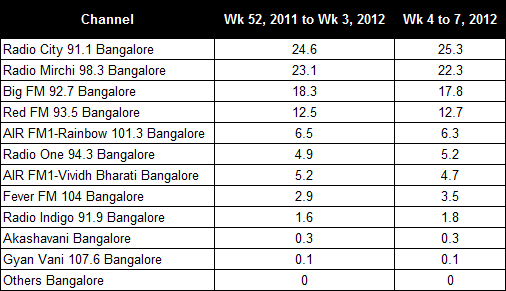
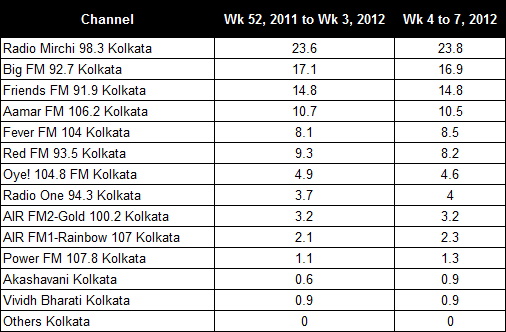
    According to the latest RAM data, for listeners of 12 years of age and above, all places of listening, and according to radio channel shares,RadioCity, Radio Mirchi, Fever FM, Big FM, Red FM, Radio One, Oye! FM were some of the top FM stations in the big four metros.


    Mumbai:

    Radio City surged ahead of Radio Mirchi as the most popular FM station in the city with 15.5 per cent channel share from Wk 4 to Wk7, 2012 whereas Radio Mirchi’s channel share stood at 15 per cent. Ranked three is AIR FM2 Gold which more or less remained unchanged in listenership share from wk 4 to 7, 2012 as against Wk 52, 2011 to Wk 3, 2012. As compared to Wk 52, 2011 to Wk 3, 2012, six FM stations witnessed growth in their listenership share in Wk 4 to Wk 7, 2012 namely, Radio City, Fever FM, Red FM, Radio One, Oye! FM and AIR FM2 Gold.


    Source : RAM

    Market: MUMBAI

    Demographic: All People 12+ Filter Demographic: None

    Statistic: Share %

    Daypart: Sun – Sat 12:00 AM – 12:00 AM

    Place of Listening: All


    Delhi:

    Fever FM once again manages to retain its leadership position inDelhi, its nearest rival in Delhi is Radio Mirchi, if the government owned AIR FM2 Gold is excluded. According to figures for Wk4 to Wk 7, 2012, AIR FM2 Gold is close behind Fever FM for the top spot. What remains to be seen is whether or not Fever FM is able to retain its leadership position inDelhi.


    The Wk4 to Wk 7, 2012 RAM numbers reveals that in comparison to Wk 52, 2011 to Wk 3, 2012 only five FM stations witnessed any growth in the Delhi market. The FM stations to have seen growth in their listenership shares are Radio City, Big FM, Red FM, Oye! FM and AIR FM2 Gold.

    The other FM stations in the Delhi market are Radio One, Hit FM, AIR FM1 Rainbow, Vividh Bharathi and Akashavani Delhi.


    Market: DELHI

    Demographic: All People 12+ Filter Demographic: None

    Statistic: Share %

    Daypart: Sun – Sat 12:00 AM – 12:00 AM

    Place of Listening: All


    Bengaluru:

    In Bengaluru too, Radio City continues maintain its numero uno position, the FM station has managed further grow its listenership share in Wk 4 to Wk 7, 2012 as against Wk 52, 2011 to Wk 3, 2012. The second most popular FM station in Bengaluru is Radio Mirchi followed by Big FM and Red FM, ranked third and fourth respectively. Ranked fifth is AIR FM1 Rainbow and Radio One is ranked sixth. The five of the eleven FM stations in the Bengaluru market which witnessed growth in listenership share areRadioCity, Red FM, Radio One, Fever FM and Radio Indigo.


    Market: BENGALURU

    Demographic: All People 12+ Filter Demographic: None

    Statistic: Share %

    Daypart: Sun – Sat 12:00 AM – 12:00 AM

    Place of Listening: All


    Kolkata:

    Radio Mirchi has not only maintained its leadership position in the city, but has also witnessed some growth according to the Wk4 to Wk 7, 2012 RAM data as against Wk 52, 2011 to Wk3, 2012. Kolkata is the only RAM market to have seen no change in atleast the top three rankings. Radio Mirchi, Big FM and Friends FM continue to be the top three FM stations in the city. Ranked four is Aamar FM, followed by Fever FM, Red FM and Oye! FM. Of the thirteen FM stations in Kolkata, six FM stations in the city have witnessed growth in their listenership shares: Radio Mirchi, Fever FM, Radio One, Power FM and AIR FM1 Rainbow. Although Friends FM remained stagnant in its listenership share, nevertheless it is comfortably placed at number three. The other FM stations in the Kolkata market include Radio One, Power FM, AIR FM1 Rainbow, AIR FM2 Gold, Akashavani Kolkata and Vividh Bharati.


    Market: KOLKATA

    Demographic: All People 12+ Filter Demographic: None

    Statistic: Share %

    Daypart: Sun – Sat 12:00 AM – 12:00 AM

    Place of Listening: All