Category: NEWS

  • Intnl radio stns will soon enter India: Amitabh Srivastava

    By Robin Thomas


    Amitabh Srivastava is the Country Manager – South Asia, Radio Netherlands Worldwide. Prior to working with Radio Netherlands, Mr Srivastava was the Director, Affiliate Relations at Walt Disney Company and General Manager at TV Today where he worked for a total of five years. In conversation with MxMIndia’s Robin Thomas, Mr Srivastava spoke at length on the six-year-long journey of Radio Netherlands in India, on phase III developments, various initiatives of the Dutch international broadcaster in India and much more.


    Q: Radio Netherlands has been in India for the last six years. How would you rate the year 2011 for RNW and the journey since the India launch?

    Radio Netherlands Worldwide had exponential growth, both in terms of brand building and our key responsibility areas of promoting issues related to human and nature welfare. Our milestones were partnership with Reliance and State Radio Service AIR on co-production, which propelled the growth from thousands to millions. Apart from this, we have also tied up with regional and university radio – IGNOU Gyanwani, which has equally benefited us to mark our footprints in smaller areas, thus leading to a gradual development in this part of the world.


    Q: How are you viewing the Indian market from the radio perspective?

    India is a big nation and above all a huge audience size to attract any international broadcaster. Its diverse nature and broad media landscape ensures that any broadcaster invests resources on both commercial and for welfare means.


    Q: You had launched web and mobile sites Lovematters.info and Lovematters.in in November 2011; how has the response been so far? How do you plan to take this initiative forward?

    We had an overwhelming response and great uptake from our partners on both the versions of the websites. We had tie up with Reliance to launch the WAP version of the site which has been a great success. Also we had marketing campaigns (On Ground and Web) with various web portals and campuses which resulted into further promotion of our websites. We are also trying to get partnership with other telecom operators on pay mode to ensure sustainability in a longer run. FPA (Family Planning Association of India) also joined hands with us for this noble cause.


    We are planning to launch Love Matters to other parts of the world, for example in Latin America.


    Q: There are so many websites and information available on sexual health; how is Lovematters any different? How does the mobile site work? Is there a separate team working on these sites?

    We are an independent broadcaster which provides reliable information. Also, we have experience in making journalistic content for a young audience. It’s a one-stop solution and a comprehensive database for all sexual-related issues. It is to have a Dutch purview, but has been customised especially for the Indian audience with its cultural sensitivities taken care of.


    We have the mobile site on the WAP model on a lighter version which works quite brilliantly on the GPRS mode too. We have a dedicated editor in India as well as a complete editorial and technical team already on it from Hilversum, Holland.


    More so looking at the response we have a Hindi website too, which is www.lovematters.in.


    Q: Besides the audience, are advertisers, particularly youth marketers keen on advertising on the website?

    We are a state-funded organization, hence this is no issue for us.


    Q: In 2010 Radio Netherlands tied up with Web 18 for news on in.com as well as for international music on their website. Tell us more about how the deal has shaped up today? What are the other digital technologies you have invested in?

    Yes indeed we had a tie up with Web 18 for their web portal www.in.com. We are successfully running our strategic partnership with RNW music content on their sites as web stream radio and experienced good uptake by our listeners.


    We have developed APPS for Apple products, RNW Apps (Light Version) and other application programming Interface to strengthen our footprints in the new media.


    Q: Are you observing the FM phase III developments? The government has given its nod to air news on FM radio sourced from the government-owned All India Radio (AIR). FDI limit has been marginally increased from 20 to 26 per cent, there will be additional 800 stations in 300 new cities. How does Radio Netherlands India view all these developments?

    With this initiative I am sure many of the international broadcasters will try to base themselves, which will further enhance the need for talk radio which is already an established model on the global platform. The embargo on news and current affairs in India will be lifted as a result of this initiative, thus giving us more space to do some quality partnering with FM channels.


    Q: Are there any specific challenges that a foreign media faces when it enters the India market especially from a radio perspective? In a few years from now do you see these challenges being met or overcome?

    As stated, I believe, soon we will find the Indian radio industry catering to audiences from a global perspective. Besides this, since a new investment opportunity will also lift the embargo on news and current affairs, it will also make talk radio available in India. Hence I am hopeful to see these developments in the near future.


    Q: Do you agree that radio is a highly regulated medium in India and that it needs to be self-regulated?

    Yes radio is regulated to some extent which encompasses a restrictive circle to adhere to. In my opinion, we must have news and current affairs also to be part of the programming rights which will certainly prove a boon to the radio industry, as Bollywood songs and other contents are being exploited to a much desirable extent in other forms of media as well.


    Q: What are some of the lessons the Indian radio industry can learn from their international counterparts?

    Interactivity is the element that seems to be missing in the FM channels in India. Talk radio is the key to ensure that we have the missing piece in place. We are seeing the same already running successfully on the global platform.


    Q: Can you throw some light on the India-specific plans of Radio Netherlands? What is the business like in the South Asian markets?

    Radio Netherlands Worldwide needs to cut 70 per cent of its budget from 2013. We will focus entirely on making journalistic content to encourage free speech. It’s difficult to say anything about plans for the South Asian markets, because that’s still undecided.


    Q: How different is the radio industry in, say, Pakistan or Sri Lanka?

    The South Asian subcontinent on the landscape has primarily the same behaviour. Hence I don’t see any structural difference, however I do agree that press freedom is much curtailed and there is lack of free speech in these countries as compared to India.


    Q: What is the team size in India and in other South Asian markets? Any expansion plans?
    In India we have an office in New Delhi and dedicated producers for All India Radio co-productions. Apart from the distribution team we also have an editor based in the same region too.


    Q: On a lighter note what is a typical day like for Mr Amitabh Srivastava, Country Manager- South Asia, Radio Netherlands Worldwide?

    Well, I work in two countries at the same time. All my partners and potential partners work according to IST (Indian Standard Time) which normally starts at 10am, and since I have my team in Hilversum hence I have to work till the office timings in Netherlands which is 11pm IST. I enjoy being busy!! Plus I love meeting people and also spent good amount of time on social media for personal and professional reasons which helps me a great deal.

  • MPG India appoints Ruma Sengupta as Director of Strategy

    By A Correspondent


    MPG India, the flagship brand of Havas Media, has announced the appointment of Ruma Sengupta as Director of Strategy.

    Based out of Mumbai, Ms Sengupta will work closely with MPG’s four key offices in Mumbai, Delhi, Bangalore and Chennai, to take charge of the agency’s strategic offering and product development in keeping with the vision of Leading New Thinking. She will also take custodianship of Havas Media’s proprietary tools and processes.


    Ms Sengupta will report to Anita Nayyar, CEO of Havas Media South Asia and also work closely with the regional strategy team based out Singapore.

    Ms Sengupta joins the agency with 15 years of experience and expertise across marketing, branding, sales, strategy, MR and analytics. She was most recently the Director of Business Insight for Synovate, where she was responsible for key international clients across FMCG categories. Prior to this, she has worked as Business Head for IMRB International. Her diverse experience also includes working in senior marketing roles at Adlabs Films Limited owned by Reliance ADAG and United Spirits Limited at UB Group.


    Ms Sengupta’s longest stint has been with Ranbaxy Global Consumer Healthcare where she launched OTC & DTC business and managed it successfully through marketing and sales-distribution.

    Commenting on the appointment, Ms Nayyar said: “Havas Media is well-known for the high quality of its strategic product and tools and Ruma has the right credentials and attitude to take control of our strategic offering. Her flair is evident from her extraordinary background having worked with top research agencies like Synovate and IMRB. Her previous experience in spearheading marketing and innovation capabilities with brands is a plus.”


    MPG anchors Havas Media, the world’s fastest growing global media network and recipient of the network Service Award at the 2010 Valencia Festival of Media. MPG provides media planning & buying, strategic consulting, branded entertainment and interactive marketing services for a range of clients in every region of the world. With offices in 109 countries, MPG consists of over 3,500 media professionals working across a broad variety of disciplines and categories.


    Havas Media, the global media network of Havas, is one of the world’s fastest growing media groups having grown from 10 markets in 1999 to 122 markets in 2012. Havas Media services its clients through a portfolio of specialist global networks and agencies. The group is organised to maximise local market dynamics whilst leveraging the extensive global insight and strategic support under its Meaningful Brands framework and analysis.


    The companies within Havas Media include: MPG (Havas Media’s global media communications network), Arena Media (Havas Media’s tailor-made communications network), Havas Digital (Havas Media’s global interactive network) and Havas Sports & Entertainment (Havas Media’s global sports and entertainment communication network).


  • Elephant gives an identity to Daimler’s BharatBenz

    By A Correspondent


    Elephant Strategy + Design has come out with its brand identity for Daimler’s India-specific range of trucks. The association with Daimler is two years old for Elephant, as Ashwini Deshpande, Director for Elephant Strategy + Design explained: “Daimler asked us for expression of interest nearly two years ago. The involvement asked was for development of identity for their India specific range of trucks. We were selected after they were satisfied on stringent global parameters as this was a unique case where the brand and products were to be developed outside Germany.”


    She continued, “It was a daunting task to partner with Daimler teams from India & Germany. Daimler owns legendary brands like Mercedes Benz. There was a huge learning in the process of development as the scale & reach of this brand as briefed to us was for making history, for changing the trucking landscape of India.”


    The name BharatBenz was chosen as it showcased Daimler’s commitment to the Indian market very effectively. “However, to continue the legacy and yet create a framework for contemporary Indian ethos was a challenge,” added Deshpande.


    She also shares that between Pune and Delhi, Elephant has added over 25 new clients in 2011. They include Axis Bank, BCCI (CLT20), Delhi Duty Free, Ericsson, Essar Steel, General Mills, Glenmark Pharmaceuticals, Heinz, Karrox, Mars International, Piramal Realty, Promethean Power, Reckitt Benckiser and Wagh Bakri Tea. Over a hundred projects of varying sizes and impact were executed between Delhi and Pune. Complan re-launch, Experience Strategy and visual language for Axis Bank, strategy, identity and communication for Delhi Duty Free, Visual language for Champions League T20 and innovative cookware ranges designed for Nirlep are some of the highlights. One of their most recent brand assignments was for Britannia NutriChoice Multigrain Thins where the agency designed the shape of the biscuit, the brand and the packaging.


    “We have created a character called Adem for Mead, the global giants who probably sell the most number of notebooks in the world. Excitement has come in all shapes and sizes. From notebooks to cricket stadium!” concludes Deshpande.


    Going ahead, the agency aims to see action from Service Design. There is also a plan to continue to grow the ongoing practices of product innovation and branding. There will be broader focus on Asia as the Singapore team of Elephant is ready to bring in richer insights.


  • Will Marathi content be a shot in the arm for FM in Mumbai?

    By Robin Thomas


    What’s common between radio stations in Kolkata, Bangalore, Chennai, Hyderabad, Ahmedabad, Kolhapur, and Kochi? They give almost equal prominence to local music along with the Hindi or Bollywood songs. This is in direct contrast to the Mumbai market where FM stations mainly play Bollywood songs which are quite popular with the Mumbai listeners.


    According to RAM’s (Radio Audience Measurement), Radio Establishment Survey 2011 findings, although the mother tongue of 51 per cent of FM device owners in the city is Marathi, an overwhelming 80 per cent of them prefer Hindi music and RJ talks on radio. Nevertheless, the survey also revealed that as compared to 2007, the preference for music and RJ Talk in Marathi has witnessed an increase in 2011.


    It’s not that the all the FM stations in Mumbai have ignored the Marathi speaking audience. Big FM, Radio Mirchi and Radio City play Marathi songs, but only on Sundays and they are the only radio stations to do so.


    Big FM, for instance, has been airing Masala Chaha every Sundays between 7am to 9am since 2009, much before Raj Thackeray’s diktat to the radio stations to play Marathi music. But even then, a Big FM spokesperson was of the view that although there is a market for Marathi music, Mumbai being a cosmopolitan city, most Mumbaikars prefer listening to Bollywood music. “There is surely a market for Marathi music, given the high population of Marathi speaking public. However, Mumbai is a cosmopolitan city with a wide audience base, and a mass channel has to play the music that appeals the most… which is Hindi, a lot of it being Bollywood. Phase III will unleash the true potential of radio and will allow for more differentiation in content, along with newer genres and radio stations that will cater to a more specific audience base.”


    Radio Mirchi airs ‘Mumbai Dhol’ every Sunday, between 12 noon to 3pm, hosted by RJ Rohit. ‘Mumbai Dhol’ covers the culture of the city, the happenings and plays back to back Marathi music, contemporary and the classics.


    Indira Rangarajan, VP, Programming, West & Central, Radio Mirchi stated: “The response to our Marathi show – ‘Mumbai Dhol’ has been very good. Following the resurgence of Marathi films and music, we had decided to experiment with a slot specifically for Marathi songs and it has worked well. I believe there is plenty of scope for Marathi music in Mumbai and over the years this popularity will increase further.”


    RadioCitytoo plays Marathi retro songs every Sunday evening between 5pm to 6pm during ‘Sandhikali Aasha’, a radio programme hosted by RJ Vishaka.


    After looking at the Marathi content being offered by these three stations, one wonders if there scope for more Marathi content on Mumbai radio stations? Or will the Marathi music lovers have to wait a little longer for a radio station that caters to their tastes?


    Unlike the private radio stations, the government-owned FM stations, AIR FM2 Gold and AIR FM1 Rainbow, play a mix of Hindi and Marathi songs every day. The private radio stations would do well to take a lesson from these government-owned radio stations.


    Naval Toshniwal, CEO, Tomato FM, a Kolhapur-based FM radio station, was also of the view that although the potential for Marathi music is huge, Mumbai being a cosmopolitan city will play more Hindi or Bollywood songs. “Yes, there is a huge scope for Marathi music in Mumbai. However, no private FM station would want to play only Marathi music, it will have to play Bollywood or Hindi songs too because of the cosmopolitan listenership. Looking at the current FM scenario where every station sounds the same, I believe that a radio station which plays a little more Marathi music will create some amount of differentiation in the market.”


    FM stations in the city play Marathi hit songs during prime-time, especially on occasions like Maharashtra Day or Gudi Padwa. For instance, Big FM Mumbai will be playing Marathi songs during the breakfast show from March 19 to March 23, celebrating the occasion of Gudi Padwa.


    According to Janardhan Pandey, Associate VP, Mudra Max: “Although the market may not be big, the potential for Marathi listenership is huge in Mumbai. The issue, however, is that there has not been any serious attempt by FM stations to woo the Marathi listeners. Awareness about Marathi programmes aired on radio stations seem to be non-existent, the Marathi programmes or music are played during mostly non-prime time. However unless a FM station does not aggressively promote its Marathi programmes, and plays Marathi songs more frequently, it will neither add new listeners nor will it attract new advertisers. There are a lot of retail advertisers in the city catering to the Marathi audience.” Ajay Rao, Vice President, Dentsu stated: “There is a huge scope for Marathi listenership in Mumbai as Marathi generates high level of passion.”


    The good news is that increase in the frequency of Marathi music on radio stations could mean attracting new listeners to radio, and perhaps even new advertisers. Moreover, multiple frequencies may bring some good news to the Marathi music lovers as it will bring new genres of radio stations.


  • Nilesh Naik is Senior CD, Percept/H, Bengaluru

    By A Correspondent


    Nilesh Naik has been appointed as Senior Creative Director, Percept/H – Bengaluru, effective February 2012. Prior to joining Percept/H, he was working with Dentsu Marcom, Mumbai as Creative Director.


    In his new role as Senior Creative Director at Percept/H, Mr Naik will be spearheading the creative team in Bengaluru and will be focusing on developing and strategizing innovative campaigns for the clients.


    Commented on the new appointment, Prabhakar Mundkur, Chief Executive Officer, Percept/H, said, “Our Bangalore office is growing from strength to strength. Getting Nilesh on the team is part of our effort to strengthen the creative product at Percept/H.”


    Elaborated Mr Naik: “Percept/H is the right fit in terms of brands, the people, and their vision for the place. It’s a great opportunity to create work that’s refreshingly different yet works wonders for the brand.”


    With experience of 13 years in the advertising industry, Mr Naik has worked with leading agencies such as Everest, Euro RSCG, Ambience and Bates. He has had the opportunity to work for different verticals namely FMCG, Finance, Real Estate, Publications, Telecom and Insurance, and his creative work has won him several accolades at both local and international award shows.


  • Hiring expected to pick up in the coming quarter

    By A Correspondent


    Indian employers are treading on a cautious yet optimistic trail and maintaining staff levels across major industries. Employers have definitely become selective and are conscious about the need for ‘right’ hiring at this juncture. The good news is that this period of uncertainty is better than 2008, since there are no large layoffs or hefty cost cuts and people are not losing jobs.


    The inaugural issue of the TimesJobs RecruiteX Quarterly Report throws light on this trend providing expert opinions and data-backed insights into the demand for skills and talent and the supply of human resources & capital.


    The report is segregated into three sections: top ten industries, locations and experience ranges. For the industrial section, the report provides the views of market experts alongside the research analysis thereby providing a balanced and comprehensive view of the recruitment market. Similarly, for locations and experience levels, the findings are confirmed with the interviews of senior executives from major HR consultancies and companies.


    Industrial Hiring Patterns-


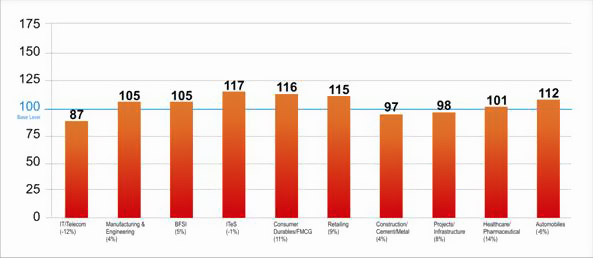
    The TimesJobs’ RecruiteX reports that all major industries clocked stable hiring patterns during the October-December 2011 quarter. According to the quarterly analysis of the RecruiteX, only three industries, BPO/ITeS, Consumer Durable/FMCG and Retail, out of the top ten industries, reported double-digit growth over the base level recorded in December 2010. Demand in support functions such as HR and Accounting & Finance has overshadowed core functions across top ten industries.


    This in-depth journal of statistics, information and analyses on employers (demand) and jobseekers (supply) and will serve as a reliable reference guide to present and future developments in recruitment.


    Geographic Hiring Patterns –


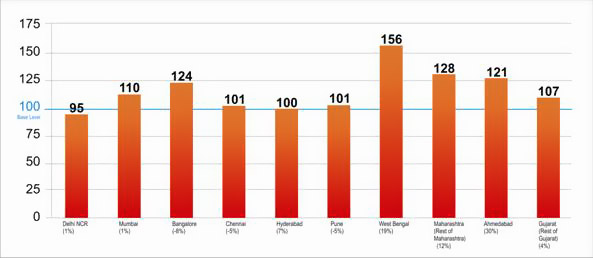
    As per TimesJobs’ RecruiteX, both, Delhi NCR and Mumbai have performed poorly on the demand index. Market experts opine that the hiring activity was negative in metros due to the poor macro-environment and negligible business investments.


    Among the other geographies that the TimesJobs RecruiteX covers, Pune witnessed decent growth in demand during the October-December 2011 quarter. Bangalore reported an increase in hiring activity and was the top performer during the same period.


    Work Ex Related Hiring Patterns –


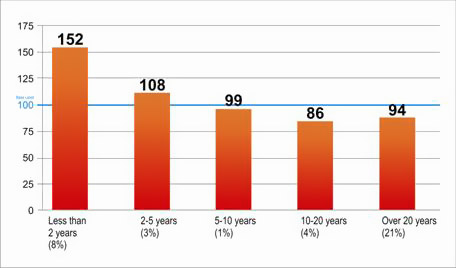
    Hiring activity for fresher/junior level and executive level positions witnessed a substantial fillip while recruitments in the middle-management level were sluggish. In comparison, recruitment for top management positions was healthier.


    Demand for candidates with less than 2 years of experience was robust across industries and locations. The Demand Index for this segment registered an 18-point growth in December 2011 compared to July 2011.


    This TimesJobs RecruiteX Report reinforces the portal’s efforts in becoming a strong medium to pull Indian employment market closer to the line of reality and presents a balanced outlook on the positions & perspectives of employers and job-seekers in Indian employment scenario.


    Other Key Findings:


    • Hiring expected to start picking up during the transition period of January to March 2012
    • Consumer Durables/ FMCG, Automobile, Energy and Infrastructure sector could be major employment drivers in the coming months
    • Demand in support functions such as HR and Accounting & Finance has overshadowed core functions across top ten industries
    • Engineering is the only major profession to maintain consistent growth pattern during the quarter in allied industries, locations and experience levels
    • Amongst top locations, only Bangalore and West Bengal have been able to maintain healthy supply of talent
    • Demand for senior experienced professionals will grow in Education, Healthcare/ Pharmaceutical domain


    RecruiteX Methodology


    To minimise the scope of inaccuracy, the TimesJobs RecruiteX analysis is based on demand and supply data integrated with numbers collected by our offline teams and then segregated according to top industry verticals, experience ranges and locations. Demand for talent is computed by factoring activities of recruiters on TimesJobs.com. Supply of talent is calculated by the activities of the jobseekers on the portal. The base value of RecruiteX has been kept as 100 for the month of December 2010. All RecruiteX values for subsequent months represent the trend of RecruiteX viz-a-viz December 2010.


  • Mirchi Kaan Awards to celebrate best in radio advertising

    By A Correspondent


    Introduced in 2004, the Mirchi Kaan Awards acknowledges and honours the contribution of individuals and organizations that have led the way in creating clutter breaking radio advertising. The awards have been instituted to encourage continued creative focus on radio advertising and are now synonymous with excellence in creativity in radio.


    While every year, the journey to the awards ceremony is a fun-filled, vibrant process keeping in mind the personality of Radio Mirchi, this year the focus is centred solely on the quality of work. Which is why, this year’s edition will see world renowned radio guru, Tony Hertz, conducting a workshop on the art and craft of radio advertising. Mr Hertz’s passion for radio has seen his career, which spans over 40 years and across six continents, as creative director at multiple agencies and the boss of two radio specialist outfits.


    With his experience, he has served twice on the Cannes Lions Radio Jury, on the 2011 D&AD Radio panel and as president of the Clio Awards Radio Jury. Apart from 22 Clios, multiple Gold and Silver ILR Awards, London International Awards and The New York Festivals Awards, Tony is also the only person to have won both D&AD Black and Yellow Radio Pencils.


    The country’s most prestigious radio awards, Mirchi Kaan will work towards raising professionalism and talent among writers. And their new mantra is to listen, learn and shine.


    The last date to send entries to Kaan Awards is March 18.


    Entertainment Network India Limited (ENIL),India’s leading private FM radio broadcaster, popularly known as Radio Mirchi, operates across 32 cities in the country. Launched in 2001, Radio Mirchi has the highest listenership across the country and a track record of developing innovative content, thus expanding and retaining its audiences and advertisers through the years. Radio Mirchi has delighted listeners and the industry with its exciting properties like the Purani Jeans Film Festival and the Mirchi Music Awards.


    Radio Mirchi’s continuous innovations across different platforms like Visual Radio or Mirchi Mobile have been instrumental in gaining leadership in the private FM Radio industry. Radio Mirchi makes its international foray with the launch of the brand in the UAE. From February 1, Radio Mirchi will be heard inDubai,Abu Dhabiand Al Ain and will the first Indian radio brand to go international.


  • Vipin Nair joins Head of Communications at Wipro

    By A Correspondent


    Vipin Nair has joined as the Head-Communications at Wipro. He will be handling the communication mandate for Wipro Technologies and the Corporate.


    Mr Nair brings with him diverse experience in the media and a rich experience of close to two decades. He has worked with print publications as well as international news wires. He has worked as the Executive Editor of Ticker Plant. Prior to that he has been with NewsWire 18 and CRISIL Marketwire. He has also worked with print publications including The Economic Times and Financial Express among others.


  • Budget comes alive on moneycontrol.com

    By A Correspondent


    Moneycontrol.com recently launched its Budget 2012 campaign Rock the Sabha, which shows some well-known political personalities hitting the high notes.

    The latest moneycontrol.com commercial, which is currently on the air, has set the ball rolling for moneycontrol.com’s Budget 2012 campaign. With key politicians like P Chidambaram, M Karunanidhi, Mamata Banerjee and Finance Minister Pranab Mukherjee playing guitars and jiving to the beats of rock music, the rock concert effect introduces the Budget 2012 coverage on moneycontrol.com in an unexpected way.

    The bold punchline, ‘Budget Comes Alive’, brings to life the brand’s rather sober attitude and creates the right amount of curiosity towards the newly incorporated interactive elements like poll, debates, slideshows, online chats, LIVE blogging and videos on  moneycontrol.com’s budget page, said a release from the company.

    Commenting on the campaign, Lakshmi Narasimhan, CEO, Web 18, said, “Apart from communicating that moneycontrol.com presents the biggest Budget coverage online, one of the key objectives of this campaign was to give a fresh perspective to moneycontrol.com and reach out to new users.”

    Ravi Deshpande, Chief Creative Officer, Contract Advertising, said, “Moneycontrol.com is the undisputed No.1 financial portal of the nation. It has redefined the way finance is presented and consumed in today’s day and age. Which is why we thought its communication too has to make a bold, emphatic statement. If the Budget campaign is disruptive, it’s only to mirror what the brand is actually doing in the marketplace.”

    Kaushik Roy Senior Creative Director & AVP, Contract Advertising said, “It’s absolutely eye-opening! The way in which moneycontrol.com is taking the boredom out of the Budget presentation. The ‘Rock the Sabha’ campaign is an attempt to make that point loud and clear. We hope it will attract newer, younger audiences, in addition to exciting millions of existing users.”

    The ad can be viewed at http://t.in.com/budget2012.


  • Dentsu Creative Impact wins Tetra Pak creative mandate

    By A Correspondent


    Dentsu Creative Impact, Dentsu India’s full-service advertising agency, has bagged the creative duties for Tetra Pak, the world’s leading food processing and packaging solutions company.


    Tetra Pak India delivers aseptic packaging material and processing, packaging and distribution solutions to the Indian food processing industry.  Their customers include leading players, both national and regional, from the private sector as well as the dairy cooperatives. Tetra Pak works in close partnership with the food processing industry to promote consumer and key stakeholder awareness on the importance of aseptically processed and packaged foods, and how they provide benefits of food safety, consumer wellness and environment sustainability.


    Rohit Ohri, Executive Chairman, Dentsu India Group said, “We are delighted to partner Tetra Pak in India. The communication opportunity which Tetra Pak offers Dentsu India is very exciting and clearly beyond conventional media. We’re looking at communication across every touch point in the packaged milk and beverage ecosystem. This communication approach is at the heart of Dentsu’s offering in India.”


    “Past communication from Tetra Pak has focused on the key message of how Tetra Pak aseptic technology best protects foods like milk and juices.  Our plans are to continue strengthening communication around the Tetra Pak credentials and around our brand promise ‘protects what’s good’”, said Jaideep Gokhale, Communications & Environment Director, Tetra Pak South Asia Markets.


    On the choice of Dentsu Creative Impact Jaideep added, “With this premise in mind, we were looking at how the communication task could be addressed with a fresh perspective without losing focus of the imperative to remain consistent and true to our brand personality. With our new agency partner Dentsu Creative Impact, we are now in the process of developing our 2012 campaign which will explore communication channels beyond the conventional.  Our media buying will continue to be handled by Carat.”


  • 7 Indian finalists at INMA Awards 2012

    By A Correspondent


    As many as seven Indian entries are among the 89 finalists announced in the world’s premier competition for marketing newsmedia brands by the International Newsmedia Marketing Association (INMA) on Tuesday.


    Of the 89 marketing campaigns from 66 newsmedia companies in 23 countries selected as finalists for the INMA Awards 2012 competition by a global panel of judges. In India, there are seven finalists from five newsmedia companies for the INMA World Congress May 6-8 in Los Angeles.


    According to the INMA site, from these finalists, 30 first-place recipients across three audience groups will be announced Tuesday evening, May 8, at the conclusion of the INMA World Congress at the JW Marriott/LA Live in Los Angeles.


    The announcement also said, “The INMA Awards 2012 competition judging was completed recently by 24 industry expert judges from media companies, advertising agencies, trade magazines, and more. Judges came from the Australia, Canada, China, France, Germany, India, Mexico, Oman, South Africa, Spain, Sweden, Turkey, United Kingdom, and the United States.”


    Earl J Wilkinson, executive director and CEO of INMA, said, “Almost all of the finalists were multi-media in nature aiming to motivate cross-platform subscription sales, integrated advertising solutions, and hybrid print/digital products.”


    Indian Finalists for the INMA Awards competition:

    (under each of the 10 categories, there were three sub-categories of under 75k, 75-300k, above 300k)

    Category 1: Marketing Campaign With the Best Results

    Over 300,000

    • The Economic Times, Mumbai, India, “The Economic Times – Young Leaders.”
    • The Telegraph, Calcutta, India, “t2.”


    Category 3: New Brand/Product/Audience Development

    Over 300,000

    • The Economic Times, Mumbai, India, “The Economic Times – Young Leaders.”


    Category 5: Marketing Solutions for Advertising Clients

    75,000-300,000

    • Mint, New Delhi, India, “Mint Brand Solutions – Values & Fortunes.”


    Category 6: Digital Audience Usage and Engagement

    Over 300,000

    • The Economic Times, Mumbai, India, “The Economic Times – Young Leaders.”


    Category 9: Print Single-Copy Sales

    Over 300,000

    • Malayala Manorama Weekly, Kottayam, India, “Haritham Kitchen Garden.”


    Category 10: Public Relations and Community Service

    75,000-300,000

    • Mid Day Infomedia Ltd., Mumbai, India, “Mid Day Domestic Violence Campaign.”

    Read more and check the complete list of 89 finalists at: http://www.inma.org/blogs/main/post.cfm/89-top-marketing-campaigns-named-finalists-in-inma-awards-2012-competition#ixzz1p1VpGNoJ


  • [MJR] A little respect for readers, please

    By Ranjona Banerji


    Living in big cities, you accept the privileges given to you with an entitled sense of arrogance. Yes, we have pubs everywhere in Mumbai, dear Virginia, and women can walk out at any time without fear of being raped.


    But this grouse is not about that. It’s about trying to read a newspaper in non-big city India. The past three weeks in Dehra Dun mean that all the news in the English newspapers are between 24 and 48 hours old and given the pace at which TV spews out the stuff, completely outdated. Internet facilities in the capital of Uttarakhand – and I am stationed a few km above Dehra Dun – have improved considerably. This means that by the time you get The Times of India, The Hindustan Times or The Hindu in your hands, your only interest in the front page is which paper has given more importance to which news.


    I understand all the compulsions which newspapers face about printing and travelling times and the costs incurred in transportation. But there has to be a better way of dealing with “dak” or “mofussil” editions than methods used decades ago. In fact, just a decade ago when I was with The Times of India in Ahmedabad, we were aware of the problems faced by our readers in Vadodara and Surat and pushed the management to look closely at the logistics.


    The most amusing newspaper which we get here is The Asian Age, which really is a day old since it’s the Delhi edition. With it, you play the game to see which front page item is completely redundant.


    A little more respect for readers may not be such a bad thing, perhaps.