Category: NEWS

  • Mail Today launches in London

    By A Correspondent


    The large population of Indian descent in and around London have reason to cheer. Mail Today, a product of the joint venture of London’s Daily Mail and the India Today group, has announced its entry to London. The paper had launched in New Delhi four-and-a-half-years ago and Chandigarh more recently.


    “Targeting the large south Asian population in London, Mail Today wants to connect with the diaspora by bringing the best of Indian news packaged in a modern avatar,” Aroon Purie, Editor-in-Chief of the paper, wrote in the e-edition of the newspaper.


    British citizens of Indian descent as well as the growing number of Indian nationals studying or working in England have reason to cheer given the India Today group’s pre-eminence and of course Daily Mail’s local leadership.


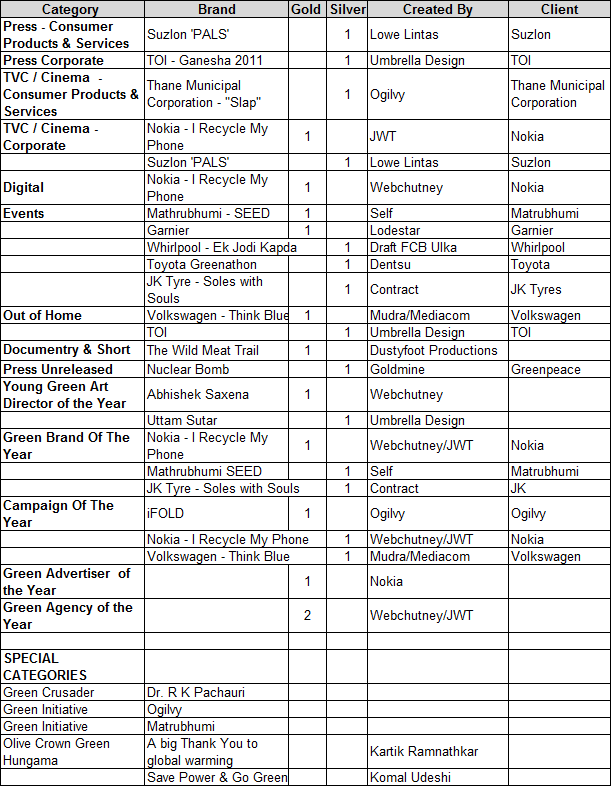
  • Nokia is Green Brand of the Year, JWT & Web Chutney Green Agencies at Olive Crown awards

    By A Correspondent


    The India Chapter of the International Advertising Association (IAA) presented the Olive Crown awards for excellence in Green advertising on March 3 at a glittering function held at the Taj Lands End in Mumbai.


    The Olive Crown Awards are the first and only awards in the country that celebrate excellence in communicating sustainability.


    The event, witnessed a heady mix of creativity, entertainment, a touch of seriousness, a dash of Bollywood and some of the biggest names in the advertising, marketing and media industry walking the “green carpet”.


    Singer Sona Mahapatra entertained guests with BollyJazz – Bollywood songs presented with a touch of Jazz. Funny man Vikram Sathye with his rib-tickling performance ensured that the guest had a great time The Guests of Honour at the function were Ms Nita Ambani, Chairperson Reliance Foundation and Member of ParliamentMs Priya Dutt.


    A special Green Crusader was presented to Dr. Rajendra Pachauri who won the Nobel Prize as Chairman IPCC.


    Olive Crowns were presented to winners in 14 categories and were judged by a panel of judges that included some of the most respected creative names in the business. Music Channel 9XM was the title partner for the event.


    IAA Olive Crown Awards – 3rd March 2012

  • IRS 2011 Q4: Dainik Jagran maintains leadership; Vanita is most read magazine

    The numbers from the latest round of the Indian Readership Survey (IRS) are out as the Media Research Users Council (MRUC) and Hansa Research Group (HRG) announced the findings of the fourth quarter of 2011.


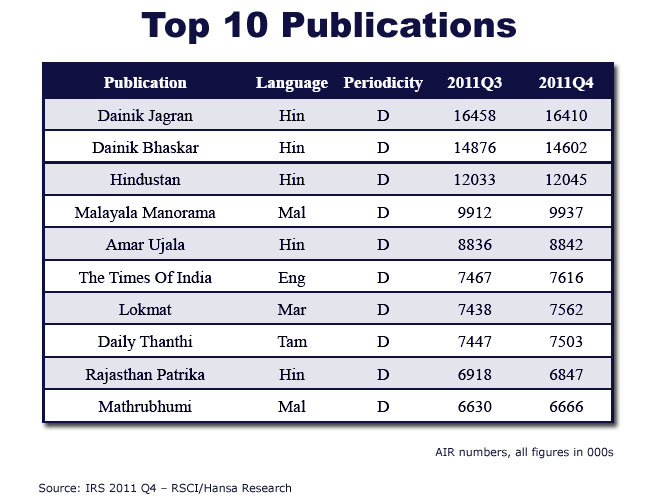
    No surprises here… According the AIR (Average Issue Readership) figures, Dainik Jagran continues to lead as the most read publication across the country. While Times of India is the only English daily to make it to the top 10 most read publications, Lokmat is the only Marathi daily in the top 10 most read publications. The rankings of the top six publications have not changed, however; the Marathi daily Lokmat has further strengthened its readership position, emerging as the seventh most read publication according to the AIR whereas the Tamil Daily Thanthi is now ranked eighth in its AIR.


    The rankings of the top 10 dailies are the same as the top 10 publications.


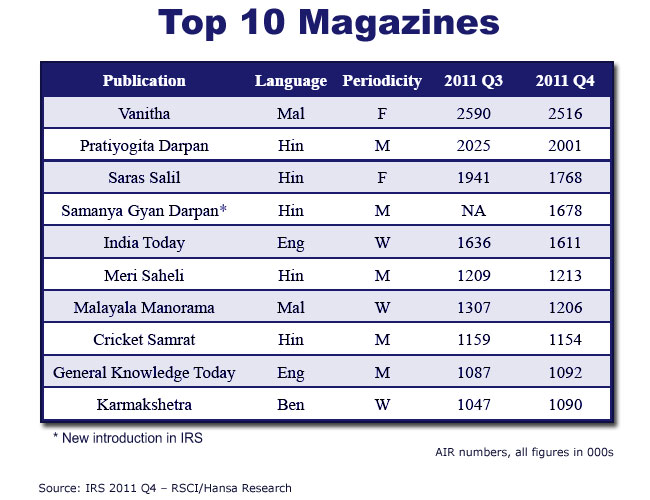
    The top 10 magazines of the country are mainly dominated by Hindi languages followed by English and Malayalam language magazines. Malayalam fortnightly magazine Vanitha continues to be the most read magazine across the country followed by Pratiyogita Darpan and Saras Salil.


    IRS Q42011 has a new entrant with Samanya Gyan Darpan; the Hindi monthly magazine is already ranked fourth most read magazine of the Country.


    Note AIR  or Average Issue Readership is defined as the readers of an average issue of a publication i.e. the estimated number of those who have read or looked at any issue of the publication within a specified time interval, which is equal to the periodicity of the publication (excluding the day of the interview).


  • IRS 2011Q4: Not much change in rankings but dailies witness significant growth

    By A Correspondent


    Top 10 Hindi Dailies:

    IRS Q4, 2010 v/s IRS Q4, 2011

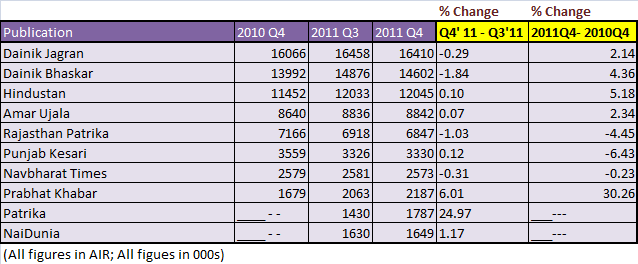
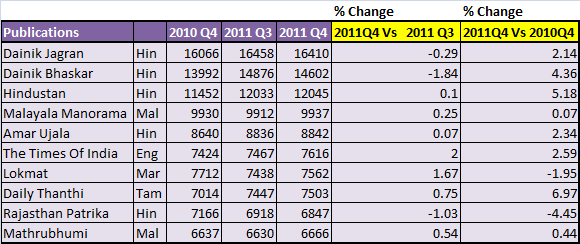
    There is not much of a difference in the rankings of the Top 10 Hindi Dailies. Dainik Jagran, Dainik Bhaskar,Hindustan, Amar Ujala and Rajasthan Patrika continue as the Top 5 Hindi Dailies. When compared to IRS 2010 Q4, IRS 2011 Q4 reveals the Top 4 Hindi Dailies, namely Dainik Jagran, Dainik Bhaskar,Hindustanand Amar Ujala have further strengthened their readership.


    A look at percentage change from Q4, 2010 to Q4, 2011 finds that Dainik Jagran has witnessed a growth of 2.14 per cent, Dainik Bhaskar grew by 4.36 per cent,Hindustanby 5.18 per cent while Amar Ujala grew by 2.34 per cent. The only Hindi daily to have witnessed double digit growth is Prabhat Khabar with a whopping 30.26 per cent growth in Q4, 2011 as against Q4, 2010. A total of five Hindi dailies have witnessed growth Quarter on Quarter.


    Q3, 2011 Vs Q4, 2011

    But the results for IRS Q4, 2011 Vs Q3, 2011 have a slightly different story to tell. The top two most read Hindi dailies – Dainik Jagran and Dainik Bhaskar – have witnessed a decline in Average Issue Readership (AIR), the decline is however marginal. Besides Dainik Jagran and Dainik Bhaskar, the Hindi dailies to have recorded growth in Q4, 2011 v/s Q3, 2011 are Hindustan, Amar Ujala, Punjab Kesari and Prabhat Khabar.


    Top 10 English Dailies:

    IRS Q4, 2010 Vs IRS Q4, 2011:

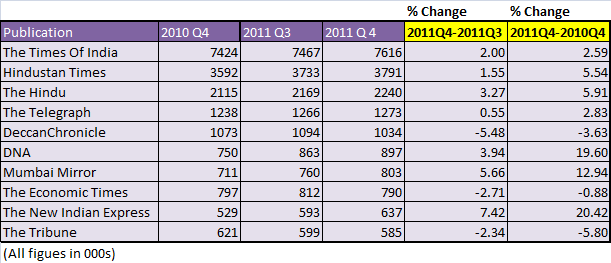
    The English dailies have performed exceedingly well in Q4, 2011. Seven out of the Top 10 English dailies have registered growth in their AIR. While DNA, Mumbai Mirror and The New Indian Express have registered growth in double digits, the top four English Dailies: The Times of India, Hindustan Times, The Hindu and The Telegraph have also witnessed growth quarter on quarter.


    IRS Q4, 2011 Vs Q3, 2011:

    The results for Q4, 2011 in comparison to the previous quarter also highlight the growth for most of the top Ten English dailies.


    Top 10 Language Dailies:

    IRS Q4, 2010 Vs IRS Q4, 2011:

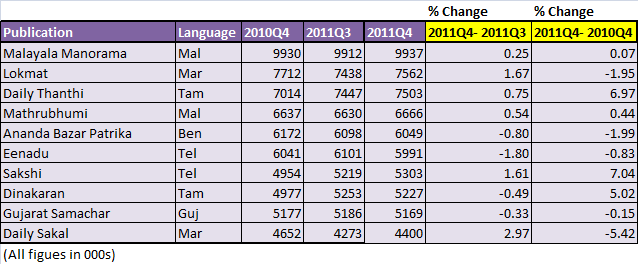
    The Q4, 2011 results as compared to the Q4, 2010 results have shown mixed reactions for Language dailies as only five publications witnessed growth since Q4, 2010 to Q4, 2011. Malayala Manorama continues to be the number one publication among the Language Dailies. According to IRS Q4, 2011 v/s Q4, 2010 findings, the Malayalam daily grew 0.07 per cent.


    Ranked second is Marathi daily, Lokmat which saw a decline of 1.95 per cent. The other Language dailies to have registered growth in their AIR are Daily Thanthi, Mathrubhumi, Sakshi and Dinakaran.


    Unlike the top two dailies, Daily Thanthi, ranked as third Language daily, grew by 6.97 per cent in IRS Q4, 2011 when compared to IRS Q4, 2010.


    It has been observed that the Malayalam dailies – Malayala Manorama and Mathrubhumi and the Tamil dailies – Daily Thanthi and Dinakaran have recorded growth in their AIR. Malayalam, Marathi, Tamil, Telugu, Gujarati and Bengali are some of the popular language dailies to have found a place in the Top 10 Language dailies.


    IRS Q4, 2011 v/s Q3, 2011:

    The top four Language dailies: Malayala Manorama, Lokmat, Daily Thanthi and Mathrubhumi have registered growth in their AIR numbers in IRS Q4, 2011 v/s IRS Q3, 2011. Besides the top four language dailies, Sakshi, the Telugu daily and Daily Sakal, the Marathi daily have also witnessed growth in their readership numbers.


    AIR or Average Issue Readership is defined as the readers of an average issue of a publication i.e. the estimated number of those who have read or looked at any issue of the publication within a specified time interval, which is equal to the periodicity of the publication (excluding the day of the interview). This is the preferred currency of media agencies across the country though often publications quote Total Readership (TR) when their AIR numbers are not impressive. MxMIndia only uses AIR in its IRS reportage.

  • IRS Q4 2011: Dailies flourish Year-on-Year


    The fourth quarter results of 2011 for the Indian Readership Survey were published on Monday and a quick look at comparing the numbers of IRS Q4 2011 versus Q4 2010 data, eight of the Top 10 publications – Dainik Jagran, Dainik Bhaskar, Hindustan, Malayala Manorama, Amar Ujala, The Times of India, Daily Thanthi and Mathrubhumi ­- have grown in their AIR (Average Issue Readership) Year-on-Year (YoY). Tamil daily Daily Thanthi and Marathi Daily Lokmat and Hindi Daily and the second most popular newspaper, Dainik Bhaskar  have registered the highest growths in AIR.


    When we compare Q3 2011 V/s Q4 2011, Dainik Jagran, Dainik Bhaskar and Rajasthan Patrika witnessed a slight decline in their readership. Dainik Jagran, Dainik Bhaskar, Hindustan, Malayala Manorama and Amar Ujala have retained their spots as the top five publications.


    After looking at the numbers, MxMIndia spoke to some of the publications for their views on the IRS Q4 2011 Topline numbers. Mr Rahul Kansal, Chief Marketing Officer, Times of India Group said: “Overall, I am quite happy with results, we have done pretty well in most of the markets including Delhi, Mumbai and Chennai, where we have seen very good growth.”


    However, Mr Rajiv Verma, CEO of HT Media Ltd, is disappointed with the IRS numbers but said in a statement, he will continue with investments in various markets. “While Hindustan Times has for long been No 1 in Delhi and No 2 in Mumbai, and Hindustan and Mint have consolidated their positions in their respective markets, as a group we are disappointed that these IRS numbers don’t reflect the full picture of our growth, and the reality of our investments and our efforts in the various markets across the country. However, we will continue to invest in various markets, to meet the needs of our readers and our advertisers, and will hope that the readership growth will be fully captured going forward.”


    Mr Sanjeev Kotnala, Vice President, Dainik Bhaskar Group said: “The IRS figures justify our focus on the urban, non-metro cities. Dainik Bhaskar is the only Gujarati newspaper to have a readership of more than 10 lakh in cities like Jaipur and Ahmedabad. If you see the figures for only the urban, non-metro cities, then you will realise that Dainik Bhaskar dominates the list. As far as the overall figures are concerned, we feel that it is a minor fluctuation, nothing major as far as our own perspective is concerned.”


    Speaking on trends from IRS Q4 findings, Mr Gautam Dalal, Vice President, Marketing, DNA said: “We observe that within Mumbai there is an increase in the overlap of English dailies readership – for every two readers there are three dailies being read. Mumbai, therefore, is seeing more penetration of English dailies and the trend of reading multiple newspapers is on the rise. Having such a high overlap percentage is a positive sign.”


    “In Mumbai we have had the highest number of growth for DNA, and these numbers are a testimony to our stand of having a high level of copy supported by the cutting edge editorial and by a focused market programme,” he added.


  • IRS 2011Q4: Same old magazine story

    By Robin Thomas


    While consuming the data for magazines, it may be remembered that many magazine publishers have been critical of the IRS numbers as worthy  indicators of their readership. The Association of Indian Magazines has readied an Engagement Study in order to educate advertsiers and agencies. Having noted that, let’s look at the IRS 2011Q4 topline figures for magazines.


    Top 10 Hindi Magazines

    IRS2010 Q4 Vs IRS2011 Q4:

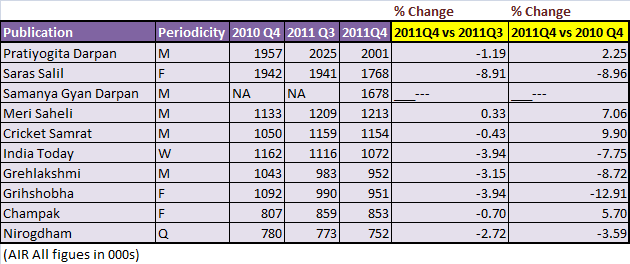
    AIR figures for Q4 2010 vs Q4 2011 may bring mixed feeling for the Magazines, as only four of the Top 10 Hindi magazines have grown in AIR (Average Issue Readership). Hindi monthly magazine, Pratiyogita Darpan is the most read Hindi magazine and is one of the Top Ten Hindi magazines to have witnessed growth in its readership figures. The other three Hindi magazines to have also grown in their AIR numbers are Meri Saheli and Cricket Samrat, both of which are Hindi monthly magazines, and Champak, Hindi Fortnightly has also witnessed growth.


    Interestingly, Samanya Gyan Darpan, another Hindi monthly magazine is a new entrant in the IRS and has already emerged as the third most read Hindi magazine with a readership of 16,78,000 AIR in Q4 2011.


    IRS 2011 Q4 Vs IRS 2011 Q3:

    The Q3 Vs Q4 2011 AIR numbers could certainly be disappointing to most Magazine publishers as only one in the Top 10 Hindi magazines has registered a growth in readership. Hindi monthly magazine Meri Saheli is the only Hindi magazine to have witnessed a growth, the growth however is a marginal 0.33 per cent. The most read Hindi magazine, Pratiyogita Darpan declined 1.19 per cent. Its nearest rival Saras Salil also declined 8.91 per cent.


    It may be noted that the most popular Hindi magazines are mainly monthly magazines followed fortnightly magazine. There is only one weekly magazine in the Top 10 Hindi Magazine category.


    Top 10 English Magazines:

    IRS2010 Q4 Vs IRS2011 Q4:

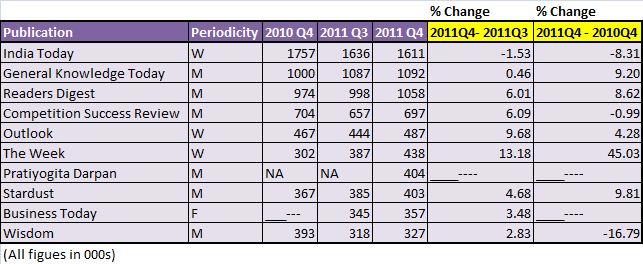
    The English magazines may bring some cheer to the industry as an overwhelming seven out of ten English magazines have registered growth in AIR. The Week has received the highest growth in its AIR from IRS 2010 Q4 to IRS 2011 Q4 data i.e. it grew from 302000 in Q4 2010 to 438000 in Q4 2011, that is a 45.03 per cent growth in AIR.


    India Today is the most read English magazine however the Weekly witnessed a decline of -8.31 per cent in AIR. The other English magazines to have increased in readership are General Knowledge Today, Reader’s Digest, Outlook, The Week and Stardust. Interestingly, the most popular English magazines are mainly monthly magazines followed by the weeklies.


    IRS 2011 Q4 Vs IRS 2011 Q3:

    The Q4 vs Q3 2011 results seem to be even more encouraging for the magazine industry, especially those in the English magazines as nine out of ten English magazines have witnessed growth in AIR. The only English magazine to have received a decline in readership is India Today, the number one English language magazine. The Week has again witnessed a double digit growth wherein its AIR grew from 3,87,000 in Q3 2011 to 4,38,000 in Q4 2011, a growth of 13.18 per cent. English monthly magazine, Pratiyogita Darpan is a new entrant and has already emerged as the seventh most popular English magazine of the country with an AIR of 404000 in Q4 2011.


    Top 10 Language Magazines:

    IRS2010 Q4 Vs IRS2011 Q4:

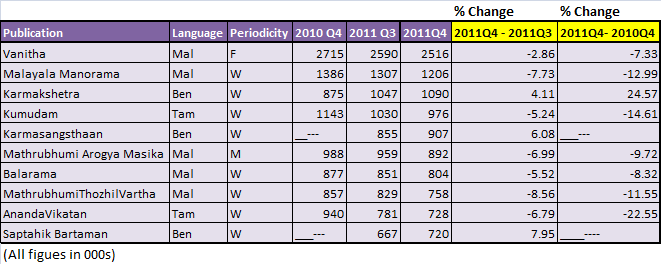
    The Top 10 Language Magazines reveals a gloomy result as nine out of the Top 10 Language magazines have witnessed a decline in readership. The only magazine to have grown in its AIR is the Bengali weekly, Karmakshetra. The weekly received an AIR of 10,90,000 in IRS 2011 Q4 as against 8,75,000 in IRS 2010 Q4, a growth of 24.57 per cent. Vanitha and Malayala Manorama are also among the Top 10 Language magazines to have declined in readership.


    IRS 2011 Q4 Vs IRS 2011 Q3:

    The scene is no different when compared to Q3 2011. However Bengali weeklies are the only magazines to have recorded growth in AIR. While the Bengali weekly Karmakshetra continues to grow even against Q3 2010 numbers, the other two Bengali language magazines to have witnessed significant growth are Karmasangsthaan and Saptahik Bartaman.  It may be noted that unlike the English dailies or even the Hindi dailies, most of the language magazine readership i.e. those in the Top 10 categories are coming from weekly magazines.


  • Havas Media wins Air France global account

    By A Correspondent


    Havas Media retained the global Air France account following a competitive pitch with VivaKi (Publicis Groupe) that commenced in the second half of 2011. MPG, the largest media network under Havas Media, will support the win. MPG will manage the Air France account out of the French hub.


    As the global agency of record, MPG and Havas Digital will continue to handle both the online and offline media responsibilities for the airline in all 54 Air France markets. In addition, Havas regained digital markets throughout Asia that had previously been managed by VivaKi, including China, Hong Kong, India, Malaysia, Vietnam, Singapore and Philippines.


    “On behalf of the whole team, I would like to thank Air France for renewing their confidence in Havas for the fourth time, thereby continuing the relationship that has been in place since 1992,” said Pascal Dasseux, COO Havas Media France.


    Havas Media – a real-time Global media agency leader – seeks to bring to Air France real-time solutions and constant reactivity thanks to a widely interlinked network; all Havas Media agencies will collaborate more closely and efficiently using their proprietary Flightdeck tool as well as the management and optimisation of paid, owned and earned media.


    MPG anchors the world’s fastest growing global media network, Havas Media. MPG provides media planning & buying, strategic consulting, branded entertainment and interactive marketing services for a range of clients in every region of the world. With offices in over 100 countries, MPG consists of over 5,000 media professionals working across a broad variety of disciplines and categories. MPG was named Mediapost’s Media Agency of the Year 2009-2011.


    Havas Media, the global media network of Havas, is one of the world’s fastest growing media groups having grown from 10 markets in 1999 to 122 markets in 2012. The companies within Havas Media include: MPG (Havas Media’s global media communications network), Arena Media (Havas Media’s tailor-made communications network), Havas Digital (Havas Media’s global interactive network) and Havas Sports & Entertainment (Havas Media’s global sports and entertainment communication network).


  • Chaitanya Prabhu joins Jump Games as Business Head

    By A Correspondent


    Chaitanya Prabhu has joined Jump Games (subsidiary of Reliance Entertainment Digital) as of March 1, as Business Head - India. Mr Prabhu has an experience of over 13 years, out of which seven have been in pure digital arena.


    His last stint was with Nokia, wherein he was responsible for setting up the Ovi Music Unlimited Service inIndia. After the success of the Ovi Music Unlimited inIndia, he was moved within Nokia to build the developer ecosystem for the Nokia store business. He worked with developers’ ecosystem to build monetization models for publishers/ developers and created some marquee apps for Nokia with Windows devices.


    Under his guidance and leadership, app download from Ovi store shot up from one  million a week to 2 million per day.


    Ask him one thing that made him leave the music lineage and join hard core gaming and the prompt reply: “Looking at how content owners play a key part in the success of the mobile ecosystems, I was very excited when I got an opportunity to head theIndiabusiness at Jump Games. I did foresee a big opportunity for Jump Games to be an integral part of the content and developer ecosystems and work with them to create exciting monetization models around gaming”


    Before Nokia, Mr Prabhu has worked with several renowned companies like Universal Music and Reliance Retail. He has completed his Masters in Business Administration from NMIMS, Mumbai.


  • Sahara One hikes ad tariff post healthy ratings

    By A Correspondent


    Sahara One Media and Entertainment’s Hindi GEC Sahara One has increased its ad rates by three times, on account of improved performance over the last few months.


    The channel’s ratings have increased from 45 GRPs in week 04 to 54 GRPs in week 08 (TAM, C&S, Females, 15+ ABC, HSM).


    As a part of the strategy, Sahara One has not only raised the bar on some of the existing shows but have also got more banners on board to produce a couple of promising fiction shows, beginning with two horror shows which went on air in the second half of February 2012.


    Commenting on the new launches, Vikas Khanchandani – Director, Aidem Ventures said, “Sahara One has been consistently delivering numbers in the recent past, with almost all shows showing consistent growth.”


    Commenting on the ad rate hike, Gunjan Rege Karkera, Business head, Broadcast Media (Entertainment), Aidem Ventures said, “Sahara One’s ratings have been increasing gradually but consistently over the last one year. The increase in ad rates was necessitated by rising cost of talent, increased cost of production, spiralling marketing expenditure and wider distribution platforms. Owing to this Sahara One’s advertiser base has widened substantially. We have got several new brands on board this year and we are looking forward to adding more to the list. Besides, owing to our wider distribution network the advertiser benefits from a lower cost of reaching 1000 people. This rate increase is a part correction in lieu of this growing network.”


    The said increase has already come into effect. All proposals include fixed spots considering all the prime time shows have been performing consistently well.


  • ASCI upholds complaints against 17 of 31 ads

    By A Correspondent


    The Consumer Complaints Council (CCC) of Advertising Standards Council of India (ASCI) received a complaint against Bollgard, which had made claims of boosting cotton farmers’ income by Rs31,500 crore, reducing usage of insecticides, containing in-built plant protection and increasing yields. The CCC concluded that the claims made in the advertisement and cited in the complaint, were not substantiated. The advertisement contravened Chapter I.1 of the ASCI Code.


    The complaint was upheld.

    PassPortDeodorant’s TVC, which focuses on a woman’s body and lewd expressions on the face of the male actor, was pulled up by the CCC. It was concluded, that the advertisement was obscene and that, in the light of generally prevailing standards of decency and propriety, the TVC was likely to cause grave or widespread offence.


    The complaint was upheld.

    Telemart Shopping Network Pvt Ltd’s advertisement of Sandhi Sudha was under scanner as the TVC made claims of curing arthritis and spondylitis and of a ‘Money Back Guarantee’, if the product was ineffective. The CCC concluded that in the absence of scientific substantiation, the claim “Sandhi Sudha cures the disease of arthritis and spondylitis” was not substantiated and was misleading. The complaint regarding “money back guarantee” was misleading as the terms and conditions for the refund were not mentioned in the TVC.


    The complaint was upheld.

    Association of Mutual Funds inIndia’s booklet states that “Every Mutual Fund is managed by a fund manager, who, by using his investment management skills and necessary research work, ensures better returns than what an investor can manage on his own”. The objection is to the word “ensures” as it could be misleading.


    Hence it was upheld.

    Dr. Ayurveda Power Prash and Body Growth’s advertisement for ‘enhancement of sexual power’ was questioned for its claims stating “increasing sperm count, helping people suffering from infertility to have kids.” The CCC remarked that these claims were not substantiated. The advertiser should provide clinical data in substantiation of these claims. The CCC concluded that the TVC contravened The Drugs & Magic Remedies Act.


    Hence, the complaint was upheld.

    The advertisement of Glen Appliances Pvt. Ltd’s print advertisement states “Do you know cooking in aluminium can be harmful?” while the website states “Do you know aluminium cookware is not safe?” These claims are not truthful, and have not been substantiated by any reputed international organization such as the World Health Organization (WHO) or by any country noted for a high standard of vigilance in consumer protection. The claims are not based on facts, and incapable of reasonable substantiation. It also unfairly denigrates attacks and discredits all aluminium cookware directly. The CCC concluded that the print ad’s and the website’s claim that cooking in aluminium is not safe were misleading.


    The complaint was upheld.

    Vanesa Inc’s advertisement of Denver Deodorant contains the tagline “play it cool”. However, the brand John Player’s has been using the same tagline since 2005. Since copying the slogan amounts to plagiarism, the advertisement contravened Chapter IV.3 of the ASCI Code.


    The complaint was upheld.

    In the personal hygiene segment, the CCC received a complaint against Stayfree All Night. As per the complaint, the advertisement claims that “Stayfree all night has the unique five guard. This in comparison to your Ultra is longer, wider, with more body coverage, more absorbent and drier too.”


    This claim means that the Stayfree All Night is better than all the pads in the market which use the word “Ultra”. But in reality this is not the case as has been admitted by the TVC itself in the form of a super which states, “When compared only with Ultra napkins of 280 mm length and 105 mm back width.” Making comparison against product in different segment is unfair and misleading. As the comparison was not made between products of a similar size, the TVC was considered misleading.


    The complaint was upheld.

    Health drink Complan’s advertisement was under the scanner this time around. The TVC claimed that “children who drink Complan grow 2 times faster than children who drink other health drinks”. This claim was substantiated through independent clinical research.


    This complaint was Not Upheld.

    However the comparison in the Chart between Complan and non-Complan drinkers is likely to mislead consumers that Complan is superior on the basis of its main ingredient (Milk Solids)


    Hence, this complaint was upheald.

    In the education sector, Noesis Education and Management Services was pulled up for their advertisement which made claims of being ‘Biggest in India, attended by 1200 students at a time’, ‘Do not miss out on being trained by the best subject experts from all over the country,’ ‘High quality contents from Bestselling authors, rank holders and subject matter experts.’ In the absence of comments from the Advertiser, the CCC concluded that the claims mentioned in the advertisement, and cited in the complaint, were not substantiated.


    Hence the complaint was upheld.

    In the healthcare and pharma sector, Pfizer’s advertisement on Gelusil Antacid was questioned. As per the complaint, the TVC shows “a boy running along a parked vehicle and using a sharp article scratching the vehicle, possibly scraping the paint and even denting the body”. The question asked: “Does this make your Heart burn” followed by “Gelusil be used to avoid heart burn and acidity”.


    The CCC concluded that the depiction of the young boy vandalizing a car is likely to encourage minors to emulate such acts, the careless use of which could lead to their suffering cuts or other injury.


    The complaint was, therefore, upheld.

    Eureka Forbes’ Aquasure water purifier’s TVC claimed that the product provides ‘World’s Safest Water’. The TVC does not provide any basis, facts or reference to any study or research work which substantiates this claim. The CCC concluded that, whilst the water from Aquasure water purifier is safe, the claim of the “World’s safest water”, is misleading. The complaint was upheld.


    The CCC also received a complaint against Eureka Forbes’ Aquasure Xtra water purifier’s leaflet which makes comparisons and propagates false statements about Pureit products, Classic and Compact. The tabular format compares the product features and puts a ‘?’ against Pureit products. The CCC concluded that, while Eureka Forbes has gained trust of the consumers, to say that Pureit products have not, is disparaging. By marking a ‘?’ against the Pureit brand is misleading and creates doubts in the minds of the consumer. It was thus concluded that the leaflet contravened the code.


    The complaint was upheld.

    During these two months, the CCC also received complaints against Cadbury- Bournville, Piramal Healthcare Ltd’s Supractiv Complete, Jockey, MetLife India Insurance Company Ltd, Ad promos of C.I.D., Fast Track watches, Killer Deodorant, Wild Stone Deodorant, TATA Docomo, Colgate Palmolive, Dulux Paints, and Santoor Soap amongst others. As these advertisements did not contravene ASCI’s codes or guidelines, the complaints were not upheld.


    Advertising Standards Council of India is a self regulatory voluntary organization of the advertising industry. The Role and Functioning of the ASCI & its Consumer Complaints Council (CCC) is dealing with complaints received from Consumers and Industry against advertisements which are considered as false, misleading, indecent, illegal, leading to unsafe practices, or unfair to competition, and consequently in contravention of the ASCI code for self-regulation in advertising.
     

  • How the WPP and Interpublic Group fared in 2011

    By A Correspondent


    WPP reported record profits of more than $1.45 billion for 2011, up a whopping 43 per cent from the year prior, and the holding company expects to see continued momentum in 2012 due to increased ad spending for the US presidential election and this summer’s Olympic games, according to Ad Age.


    Reported revenue for WPP, the biggest ad holding company in the world and home to creative agencies such as Ogilvy, JWT and media-buying behemoth Group M, was up 11.4 per cent year-over-year to $16.05 billion. However, WPP’s CEO-Executive Director Martin Sorrell is less optimistic about 2013, as there are no big events to bolster ad spend, and political ad dollars will drop off following the election.


    “We think 2012 looks similar to 2011, maybe at a slightly reduced level,” said Mr Sorrell. “But the one big cloud on the horizon we feel the need to address in 2013 is deficit reduction after the US election.”


    WPP said North America performed well, and in Europe the debt crisis is impacting growth, but overall the company said it still fared well in the region thanks to strong growth in the UK and acquisitions in Western Continental Europe.


    The company reported that Austria, Germany, Switzerland and Turkey, all showed strong like-for-like growth for the year, but France and especially Greece, Portugal and Spain remained affected by the Eurozone debt crisis. In 2011, nearly 30 per cent of WPP’s revenue came from Asia Pacific, Latin America, Africa and the Middle East and Central and Eastern Europe.


    The company said that emerging markets in Asia, Latin America, Africa and Eastern Europe represent the highest growth regions for WPP. The company plans to spend between $470 million and $630 million on acquisitions this year, Mr Sorrell said. The focus will remain on small and medium-sized agencies, particularly those in new markets or specialising in digital work, data analytics and technology.


    The past year saw a number digital agency acquisitions, including: F. biz and Gringo in Brazil; Rockfish and Lunchbox in the US; Who Digital in Vietnam; Promo in Russia and A4A in China. The company made a total of 38 acquisitions and 10 investments in 2011.


    The Interpublic Report-Card 2011

    US-based ad holding company Interpublic Group of Cos has reported that it nearly doubled its net income for 2011, up 96 per cent to $551.5 million, up from $281.2 in 2010, according to Ad Age. The company’s annual revenue was up 7.8 per cent, to about $7 billion.


    “Building on a very good 2010 result, we continue to show organic revenue growth that is at or near the top of our peer group,” said Interpublic CEO Michael Roth. “This performance keeps us on track to deliver on our goal of fully competitive profitability in 2014.” Mr Roth added all of the company’s regions grew in terms of organic growth in 2011, except for Europe, which is in the midst of a debt crisis.


    For the full year, continental Europe was down 0.1 per cent. The best region for organic growth last year was Latin America, which was up 17.8 per cent. For the fourth quarter, US organic growth was up 2.2 per cent, Latin American was up 30.4 per cent and Europe was down 3.2 per cent. Interpublic’s digital agencies, MRM, part of the McCann network, Huge and R/GA, significantly contributed to the company’s growth.


    In 2012, the company is targeting 3 per cent organic growth, noting “significant macro uncertainty on the global level.” Interpublic agency networks McCann Erickson and DraftFCB both saw major accounts defect in 2011. McCann Erickson lost Nescafe and other accounts, while DraftFCB lost SC Johnson and is now having to share Miller Lite with Publicis Groupe’s Saatchi & Saatchi.


    Source: The Economic Times

    Copyright © 2012, Bennett, Coleman & Co. Ltd. All Rights Reserved


  • [MxM Journalism Review] Why must TV news depend on print eds for analyses

    By Ranjona Banerji


    Where would TV journalists be without their colleagues in print? (I thought I’d say cousins but then that would make me related to TVwallahs too so…) Every time there’s some big issue to discuss (which in TV land is every day), out come a whole array of print seniors (and sometimes not so seniors).


    During the election coverage on Tuesday we had Shekhar Gupta, Vinod Mehta, Neerja Chowdhury, Manini Chatterjee, Siddharth Vardarajan, Vandita Mishra, Hartosh Singh Bal… and many more worthies.


    I’m thrilled for my friends and colleagues in print who I see on TV all the while at other times – Ayaz Memon, Sidharth Bhatia, Anil Dharker, Arati Jerath… At any time you are likely to see Dileep Padgaonkar, Bachi Karkaria, Tavleen Singh giving their considered opinion on this and that. The list is endless and I apologise to anyone I have left out. I don’t mean it. But it makes me wonder about our esteemed TV anchors and editors. Do they trust their own judgement so little that they cannot carry a programme by themselves? Have they not managed to hone their opinion creating abilities? And if that’s true, what have they been doing for all these years in TV?


    TV wallahs often feel that print journalists are too critical of them. But when they do nothing to change those perceptions and instead feed them by calling print journalists as experts all the while? How often do you see print journalists on BBC and CNN?
    My advice to TV wallahs is: have a little faith in yourselves.


    Having said that, I then remember the columns which Rajdeep Sardesai, Sagorika Ghosh and Barkha Dutt write for Hindustan Times (since few other print publications condescend to give them a platform and rightly so) and I really wonder at myself!