
|
By A Correspondent
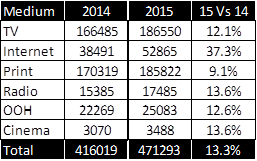
India advertising revenue increases by Rs 48,420 million to touch Rs 416,019 million in 2014.
Television revenue will grow by +12.1% to reach Rs 166485 mn while Print, though loses market share by a percentage point at 41% will grow by +10.4% to Rs 170319 mn. These two categories hugely benefited from the national elections in H1 2014 which contributed 25-30% of the incremental dollars.
Digital media continues to grow the maximum at +39% to touch Rs 27686 mn and increased its market share by a point to 9%. Within digital while desktop grew at +26.4% mobile doubled its revenue though on a smaller base. Search and Display with 72% share dominates the pie but Social is closing ranks with Display.
Radio on the back of increased volume will grow +12% and OOH at +12.3% to touch Rs 12385 mn and Rs 25339 mn respectively.
Sectors contributing to the increase is led by retail especially e-commerce followed by telecom, FMCG and Automobile in addition to non-recurring political advertising.
The outlook for 2015 is set to strengthen with improved confidence and business-friendly reforms. Falling inflation will support real income and promote consumption. Corporate investment momentum will gain because of political stability at the Centre.
The BFSI category will see action with the government push for increased access to banking services, RBI opening up to payment banks and increase in FDI for Insurance. E-commerce will continue their customer acquisition spree though at some point in time customer experience & sustainability will start creeping in. Cellular phone and services, Auto and FMCG will support the momentum.
Television will be exciting more than ever with Digitization though with decreasing pace, advertising time restriction pending decision, BARC’s viewership measurement and innovation in access tariffs by platform owners. Print industry awaits release of new round of IRS. Radio has been crying wolf for some time now and with the Government finally ready for Phase III, this medium will take a leap in spends. Digital will continue to expand the maximum, Digital India initiative by Government will add to internet access population and payment banks will boost e-retail.
MagnaGlobal estimates total advertising revenue to touch Rs 471,293 million in 2015. India will be most dynamic among the four BRIC countries with expected growth of +13.3% in 2015
|
 Jaldi 5 with Venkatesh S, EVP, Director Intelligence Practice: TV & Print will play duopoly for some time to come in India Jaldi 5 with Venkatesh S, EVP, Director Intelligence Practice: TV & Print will play duopoly for some time to come in India
01. Your forecast of 13.3 per cent growth in 2015 is resting on developments the timelines of which are unknown. For instance, we don’t know when the next IRS will be out, and if it does if the various players are going to accept. The adcap ruling is caught in the courts and then there is no solution in sight as yet. Activity on BARC is happening, but the launch date is not known. Radio Phase III has been happening for the last few years and it’s not happened till now. Digital, as you know, is just a pipedream. Spends via digital are so low. Pardon this rather long question, but don’t you think there are just too many ifs and buts here and that could impact your forecast?
These are some of the key movements expected in 2015 which brings along its own challenges to each of the medium. One will have to wait to see how much of these will impact on ad revenue. Our 2015 forecast is neutral to all these movements.
02. The BJP promised “achche din†but ask any media organisation and they’ll say that save the spends on the general and state elections, the spends haven’t really happened in right earnest?
Large part of the spending is through offline which is measured. It is true that state elections impact on advertising have not been significant.
03. Do you see spends from the government increasing in the next year, given that we have a regime that’s fairly publicity savvy?
I won’t rule out some of the government flagship programmes getting marketed well. On the contrary this will swell competition in some of the sectors which will result in increased advertising.
04. Your global report doesn’t paint a very healthy picture for India’s digital media. Â India is not going to see Digital become the #1 media even in 2017. What do you think is the reason for this?
Global share of Digital will catch up with Television only in 2019. India is a mobile-first country and though mobile-centric impressions are growing it is largely led by social, video is tied to bandwidth constraints and measurement is still a universal problem not limited to India. However the good news is mobile era has begun. Smartphone penetration, localisation, exclusive and compelling content, experimentation will aid growth
05. In terms of adspends do you see a reducing reliance on traditional media like print and television in favour of digital and BTL in the coming years?
Television and Print in the case of India will continue to play duopoly for some time to come. The first effect of losing share will be on Print though. Whenever the shift of budget from offline to digital happens, that will not be of equal measure because of productivity change from exposure to effectiveness.
|
Magna Global Forecasts Global Advertising Revenues to Grow by +4.8% to $536 billion in 2015
Top Stories
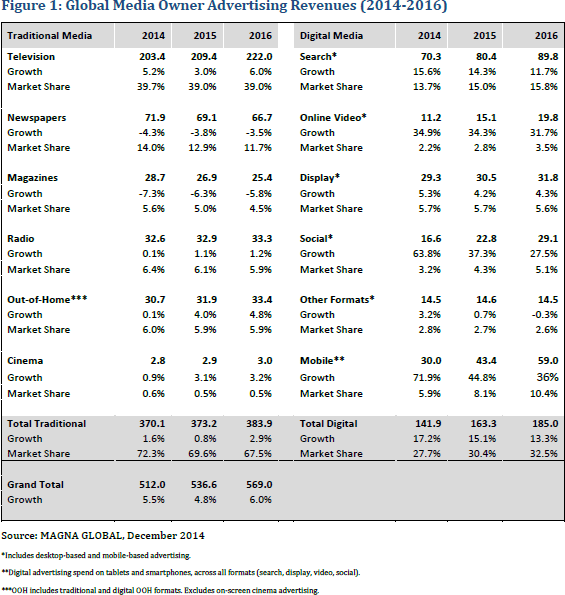
1. Globally, media owner advertising revenues are forecast to grow by +4.8% in 2015 to $536 billion. The new growth forecast is in line with our previous forecast (+4.9% in June 2014) and represents a deceleration from 2014 (+5.5%).
2. The stronger economic environment expected for next year (+3.8% for real GDP compared to +3.3% in 2014) will not quite offset the negative impact caused by the absence of non-recurring drivers like Winter Olympics, FIFA World Cup or the US mid-term elections this year. We believe these events generated one extra point of advertising growth in 2014.
3. Despite the stability of our top-line growth forecast for 2015, significant revisions have been made on a country-by-country basis. On the upside, Australia, India, Japan, Spain and the UK will grow faster than previously forecast. China, Russia, Germany, Brazil and Canada will grow as well, but at a lower rate than previously expected.
4. In the US, media owners advertising revenues grew by +4.0% this year to $165 billion – an acceleration compared to 2013 (+2.4%) but below our previous expectations. Factoring in the positive impact of non-recurring events in 2014, which accounted for approximately 1.5% of the total growth, the 2014 performance was not strong for an even year. The solid improvement in the US macro-economic environment since the second quarter has failed to translate into an acceleration in marketing and advertising demand so far. For 2015, we are expecting advertising revenues to grow by +2.7% (previously: +3.3%).
5. As predicted, Western Europe finally returned to growth this year (+3.0%) and we are expecting a similar growth in 2015 (+2.8%). Our 2015 forecast for Eastern Europe is cut significantly, from +6.4% to +3.0% to reflect the massive economic headwinds faced by Russia and Ukraine. Asia-Pacific will continue high-single-digit growth (+6.4%). Latin American advertising spend will grow by double digits (+13%) with inflation (especially in Argentina and Venezuela) remaining the main driver, amidst a sluggish economic environment.
6. The non-recurring sports events of 2014 contributed to the global growth of television (+5.2%). The FIFA World Cup was a clear positive in some markets like the UK and the US, but it was neutral in Germany and below expectations in Brazil. The Winter Olympics and mid-term elections bonanza proved below expectations in the US. TV is expected to grow again in 2015, globally, driven by a positive pricing trend in Europe and parts of Asia (+3.0%).
7. Digital media grew strongly again this year (+17.2% to $142 billion) driven by mobile campaigns (+72%) and social formats (+64%). We forecast global digital revenues to reach 30% market share globally in 2015 (+15.1% to $163Â billion). Based on our long-term forecasts, digital media will catch up with television in 2019, when both account for 38% of global advertising revenues.
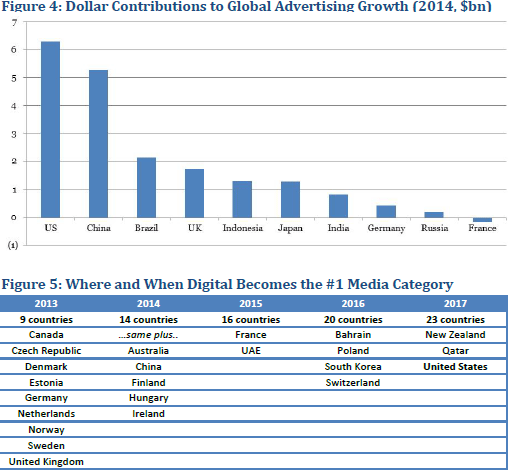
8. Digital media is already the #1 media category in 14 of the 73 markets analyzed by MAGNA GLOBAL in this update, including the UK (highest share in the world: 47%), Australia, Canada, Germany, China, Sweden and the Netherlands. In the US, digital will outgrow television revenues by 2017.
9. Most other media categories suffered from the competition of television and digital in 2014. Newspaper ad sales decreased by an average -4.3% while magazines ad revenues shrank by -7.3%. Radio was flat (+0.1%) and out-of-home media grew by +3.4%.
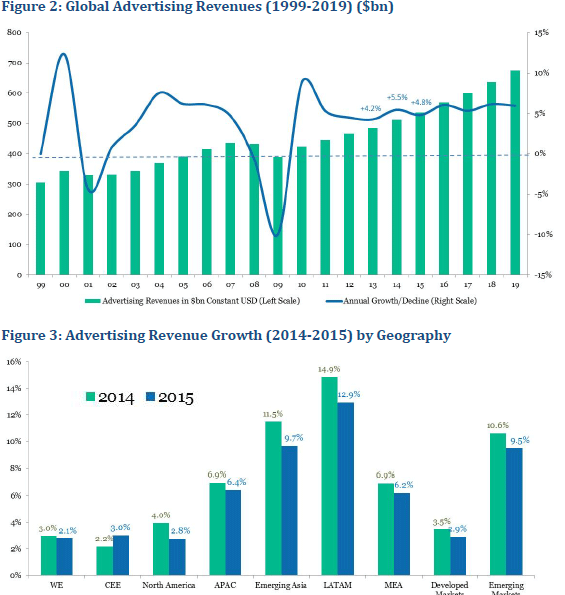
In its latest study of global media owner advertising revenues, covering 73 countries, MAGNA GLOBAL estimates that ad revenues grew by +5.5% this year, to reach the half-trillion mark ($512 billion). Advertising sales will grow by +4.8% in 2015 to reach $536 billion.
The new 2015 forecast is in line with our previous forecast of +4.9% published in June 2014. This represents a slight deceleration from the 2014 pace but factoring in the ad revenues generated by the non-recurring events of 2014 (mostly the Winter Olympics, FIFA World Cup and US mid-term elections) that accounted for approximately one point of incremental ad spend growth, the 2015 growth should be considered decent by recent standards. 2015 is still going to be stronger than the growth experienced in the last odd-numbered year of 2013 (+4.2%).
This acceleration in the underlying growth rate reflects a general improvement in the current macro-economic expectations for 2015. In its October 2014 forecast update, the IMF anticipates global output (real GDP) to grow by +3.8%, which is marginally below its April forecast but still significantly stronger the level of economic growth recorded in 2014 and 2013 (+3.3% in both years).
Behind the apparent stability of our top-line growth forecast for 2015, some significant revisions have been made on a regional and country basis. Compared to our last global update in June, we increase the growth expectation for North America (from +2.5% to +2.8%), for Western Europe (from +2.5% to +2.8%) and for Latin America (from +11.5% to +12.9%). On the other hand, we reduce our forecast for Asia Pacific (from +6.9% to +6.4%) and for Central & Eastern Europe (CEE) (from +6.4% to +3.0%).
Looking at individual markets, some of the most significant revisions in our 2015 forecasts are found among BRIC markets. China and Brazil advertising revenues are still predicted to grow by a decent amount (+8.6% and +5.9% respectively) although two to three points below previous expectations. Russia is the single biggest negative revision, due to the combination of declining energy prices and the partial withdrawal of Western investors amidst geopolitical tensions; the 2015 advertising growth forecast is cut from +7.0% to +0.8%. India will thus become the most dynamic among the four BRICs, with an expected ad spend growth of +13.3% following a similar pace in 2014 (+13.2%). The biggest upwards 2015 revisions come from Indonesia
(from 13% to 17%) and Argentina (+22% to +36%) and the most significant among top 10 markets comes from the UK (from +3% to +4.7%).
According to Vincent Letang, MAGNA GLOBAL’s director of global forecasting and author of the report: “In 2014, the long-awaited European recovery finally came in time to partly offset a weaker-than-expected growth in the US and the BRICs. In 2015, the lack of non-recurring events, the continued slowdown of the BRICs and the deflationary effects generated by the rise of digital media will inhibit global advertising growth, in a slight disconnect with the positive acceleration in the macro-economic environmentâ€.
Western Europe: Britannia Rules and the Eurozone Periphery in “Vâ€-Shaped Recovery Mode
As predicted Western Europe finally returned to growth this year (+3.0%) and we are expecting a similar growth in 2015 (+2.8%).
Once again the UK advertising market increased strongly this year (+7.7%), driven by television (+5.4%) and digital media (+16.8%) in the wake of a buoyant economic environment (real GDP +3.2%). Television benefitted from incremental spend generated around the FIFA World Cup (partly broadcast on commercial network ITV) and the scarcity created by an unexpected drop in audience levels in the first quarter generated double-digit CPM inflation in the first half of the year.
At the same time, the Eurozone periphery markets, which had suffered the most from economic recession and advertising recession over the last five or six years, have finally experienced the long-awaited recovery (Greece +7.7%, Spain +5.6%, Portugal +12%, Ireland +3.6%). Television pricing, recovering from the rock-bottom lows reached in 2013, was one of the key catalysts of that strong rebound, as soon as the economic environment merely stabilized. We believe all those markets will experience high-single digit growth again in 2015 even though the economic recovery remains modest. The sub-region grew by +6% this year and media revenues are expected to increase by +6.6% next year.
Finally a third group of markets is displaying little or no growth in the context of a continued fragile economy: Italy (-1.8% this year, +1.1% next year), France (-1.1% in both years) and Germany (+1.8% this year, +2.0% next year). With a much weaker economy than anticipated (+1.4% in real GDP) Germany managed to grow advertising slightly. Paradoxically, Germany’s victory at the FIFA World Cup did not help because it was broadcasted on State-owned stations that are largely ad-free, and diverted audiences from commercial channels. By contrast the world cup was a clear driver in France, where leading commercial broadcaster TF1 was showing most matches, but even that was not enough to boost television’s pricing power beyond Spring as the protracted economic stagnation (+0.4% in real GDP) and historically low business confidence took their toll on marketing demand.
Nordic markets displayed moderate growth this year (+1.5%) and should accelerate next year (+2.6%). The Winter Olympics of 2014 only had a small impact on the region despite the popularity of Winter Sports. The reason was the fact that the Games were generally not broadcast on commercial, ad-funded stations. The exception was Norway, where the availability of Olympic broadcasts on a commercial channel for the first time, contributed to a record +8.5% growth for the relatively small Norwegian TV market.
Central and Eastern Europe: Hit by Russian Woes
Central & Eastern European advertising revenues are expected to increase by +2.2% this year, a significant deceleration from last year’s +7.2% growth rate, and lower than our spring forecast of +6.3% growth. The region has experienced increasing headwinds: decreasing energy prices impacting the economies of several prominent CEE countries, as well as spillover from the tensions between Russia and Ukraine, including budget pullbacks as a result of general increased geopolitical uncertainty even in countries not immediately impacted by the conflict. Energy prices continue to fall and political tensions haven’t subsided. Many of these headwinds will linger, and growth next year is expected to be +3.0%, slower than previous expectations. In addition, the recovery towards the long-term trend of approximately +7% will be slower than previously forecast.
While Ukraine is seeing the largest percentage declines in spend, the largest contributor to the decreased growth in the region is Russia due to its much larger market size. Not only is there the expectation of much slower Russian real GDP growth (IMF forecasts down over 1% since the spring), but Russia is also at the epicenter of many of the regional headwinds. Compounding these impacts are ad market specific headwinds, including the upcoming ban on Pay TV advertising as well as OOH inventory reductions.
Growth in the region if one excludes Russia and Ukraine (although they represent 53% of the total spend in Central & Eastern Europe), is expected to be +5.2% this year, much closer to our previous forecast of +6.3% excluding Ukraine and Russia. Tensions are high, but spillover thus far has been manageable for the remainder of the region and hasn’t impacted growth quite as severely: Poland is expected to grow by +4.2% this year vs. our spring forecast of +6.4%, and Turkey is expected to grow by +7.3% this year, slightly down from our spring forecast of +8.8%.
The highest growth in Central & Eastern Europe will be in Estonia, where the advertising economy will grow by +8.4% this year. The lowest growth will be in Ukraine, where total spend in local currency terms will shrink by nearly -20%.
Within formats, we expect digital to continue to be the strongest growth driver in the CEE region, with growth of +19.0% expected this year. It’s almost the only ad format still growing, as TV and Radio (both +0.8% expected in 2014) are barely remaining positive. Newspapers (-9.7%) and magazines (-11.8%) continue to see sharp declines, and even OOH (-3.7%) is struggling. Historically one of the stronger regions driving global growth, CEE is now below the global average and falling behind other undeveloped ad markets such as APAC and Latam.
Asia-Pacific: China Slows Down, India Accelerates
APAC advertising revenues are expected to increase by +6.9% this year, slightly lower than last year’s +7.1% growth and marginally lower than our spring forecast of +7.6%. The chief driver of this slowdown is the softening economic prospects in the region.
Chinese growth forecasts continue to move lower and GDP growth is pacing at the lowest rates in five years. While Chinese ad spend growth (+11.6% this year, +8.6% next year) remains significantly ahead of global levels, the weakness in housing sales, property development, and manufacturing activity continue to add headwinds to the economy.
In Japan, the shock created by the sales tax increase this year has hit economic activity but this is more or less offset by a new inflationary economic environment driving up media costs; we thus expect advertising spend to increase by +3.0% this year and by +2.7% next year.
The Indian advertising market showed strong growth this year (+13.2%) following two lackluster years (2012: +4.6%, 2013: +8.0%). The general elections that took place in the first part of the year generated massive incremental spend. The outcome of the election, bringing a new BJP-led Government to power, improved business and consumer confidence, which prompted us to increase our 2015 ad growth forecast to +13.3%. The new Government is also committed to invest billions in order to connect millions of rural Indians to broadband internet, in a plan advertised through a recent meeting between the new Prime Minister Narendra Modi, and the Facebook founder Mark Zuckerberg.
The strongest growth in the APAC region in 2014 came from Indonesia (+21.5%). It has been another strong year for the Indonesian market off a low base (just $29 per capita is spent on advertising in Indonesia). The poorest performance in the region came from Thailand with a -2.3% decline in advertising spend, hit by a tumultuous year politically and economically.
Digital remains the largest growth driver in APAC, and increased by +22.7% this year to represent over one quarter of total advertising spend for the first time. Growth continues to moderate, but digital continues to take share from every other format. TV remains the leading format in APAC, but digital advertising is rapidly developing and will pass television to become the leading format by 2019.
Within digital, the fastest growing formats are social (+58.6% growth), followed by video (+37.6% growth) and search (+25.5% growth). Social spend has advanced rapidly and now represents 7% of all digital spend in APAC. Social and video are a focus of brands in APAC, and will grow to match what is spent on banner display by 2019. Mobile spending in the region represents over 20% of total digital spend this year, and this will rapidly grow to over 40% by 2019. Mobile spend on social formats continues to lead the way, and other formats will follow.
Television remains the dominant format for advertising spend in APAC, and spend will grow by +3.5% this year and represent slightly over 40% of all advertising dollars. Broadcast television continues to dominate the TV landscape, although multi-channel television is gaining share due to slightly higher growth rates, and by 2019 will represent nearly one quarter of TV dollars. Print continues to lose market share, and newspaper and magazines together will represent less than one in five advertising dollars this year. This is down from one third of all spending as recently as 2008.
APAC will continue to be one of the stronger regional drivers of global advertising spend, although its lead on the global growth rate continues to narrow. Its total share of global ad spend will only increase slightly between this year and 2019, from 29% to just over 30% of total spend.
North America: Weaker-Than-Expected US Growth
North America advertising revenues grew by +4.0% this year, with a similar growth on both sides of the border: US +4.0%, Canada +3.9%.
For the US, +4.0% advertising growth in an even-numbered year (benefitting from massive incremental spend generated by Olympics and political spend), is actually a mediocre performance. By comparison, 2010 growth was +6.6% and 2012 grew +5.0%. This is all the more counter-intuitive that the economic environment keeps improving gradually.
We believe three factors contributed to this tepid performance.
First, the non-recurrent drivers proved below expectations for the first time in a number of cycles. The Sochi Winter Olympics delivered lower ratings and advertising revenues than expected, and our estimate for incremental advertising sales has been revised to $450m, down from $600m (the incremental sales delivered by the Vancouver Olympics in 2010). By contrast the FIFA World Cup generated the highest interest ever in America for a soccer event. Ratings grew by approximately 20% on Spanish-speaking television (boosting the revenues of Univision and the entire Spanish segment) and by 52% on English-speaking networks (ESPN & abc). However soccer remains a secondary sport in the US and the incremental ad sales, in the vicinity of $100 million, did not quite compensate for the lower-than-expected Olympic bonanza. The mid-term general elections generated less spending than the previous election cycle of 2012, partly because the main “battlegrounds†were located in relatively small markets while big markets like New York or California presented little uncertainty and therefore little incentive to throw huge amounts of ad spend. We estimate the incremental ad revenues to be around $2.2 billion, i.e. 17% smaller than 2012 and barely on par with 2010.
A second factor was the micro-recession that the US experienced in the first quarter, partly due to a severe weather that hit retail, restaurants and automotive dealers, three of the biggest advertising spending sectors. The economy started to steadily grow again from the second quarter, but many advertisers had already entered into a cautious, saving mode.
The last and most fundamental factor in the slowdown of 2014 is the shift of media mixes towards digital. The market share of digital media (27% in 2013, 30% this year) is barely above global average and still relatively low compared to the most advanced markets in Europe and Asia. We believe that in the last 12 months a number of large verticals that were lagging behind and relatively conservative in their media mixes (e.g. CPG/FMCG, pharmaceuticals) have started to embrace digital formats on a bigger scale. Thanks to the availability of new reporting tools and new buying mechanisms, digital media are increasingly used in branding campaigns and by brand-oriented advertisers, and not just in direct response campaigns or by direct response advertisers. Marketers are now more comfortable with the level of brand safety and accountability provided in the digital media space than they were just one or two years ago, and they are also keen to seize the opportunities created by data-based programmatic buying techniques. The shift to digital is having a deflationary impact on the entire market as digital formats, whenever comparable to traditional format, look cheaper and therefore erode the pricing power of traditional media categories.
Weaker-than-expected even-year drivers and increased, diversified competition from digital media formats combined to cause a disappointing year for television. Overall TV ad revenues grew by +4.8%, i.e. below our spring forecast (+8.6%) and much below the previous even-year performance (+8.7% in 2012). Local TV ad revenues grew by +9% (compared to +16% in 2012) while non-political revenues were flat. Excluding Olympics, broadcast networks ad sales decreased by -3.9% and cable networks ad revenues slowed down to +3% (compared to +5.8% last year). Cable is still outperforming broadcast networks in viewing and monetizing trends but both national TV segments are now hit by the same syndromes: gradually declining ratings and reduced pricing power. This year’s TV Upfronts (advanced sales for the broadcast season 2014-2015) led to a decrease in volumes and lower inflation rates than in previous years while the “scatter†market (short-term buys) showed lower-than-usual price increases.
Meanwhile digital media was the big winner in 2014, with ad revenues expected to grow by +15.6%. Search grew by +12%, video by +28%, social media by +65%. Those growth rates were partly achieved at the expense of traditional media, but also at the expense of traditional banner display (+1.3%) which represents only 16% of total internet advertising. Mobile impressions (on tablets and smartphones) accounted for $12.5bn (+77%); this represents 25% of digital media spend, compared to just 9% two years ago.
All traditional media categories saw a decrease of market share. Print continued its decline with newspaper declining by -9.2% to $16.4bn and magazines losing -10.9% to $10.7bn; that does not include ad revenues derived by publishers from digital platforms, but those are not growing fast enough to offset the decline of paper-based sales. Radio ad sales decreased by -3.2% to $14.7bn; again that does not include digital radio advertising. Digital radio is growing double digit but again it is still too small so far to offset the erosion of revenues on the legacy linear broadcast platform. Out-of-home media revenues decreased by -0.8% as the growth of digital OOH sales (+16%) no longer offset the stagnation of traditional billboards (-0.9%) and in cinemas (-6%).
For 2015, MAGNA GLOBAL is expecting US advertising revenues to grow by +2.7% to $169.5bn. This is equivalent to the 2014 growth if we factor out the non-recurring revenues of 2014, and slightly stronger than the last odd-numbered year (2013: +2.4%). Television revenues will decrease by -1.4%. Digital media will grow by +15.5% to reach a 31% market share. Newspapers will decrease by -8.2%, magazines by -9.4% and radio by -1.2%. OOH will re-accelerate to +3.7%.
Latin America: Driven by Media Cost Inflation
LATAM advertising revenues increased by +14.9% in 2014, accelerating from last year’s +13.1% growth. We expect that advertising revenues will grow by a similar rate in 2015 (+12.9%) despite the lack of the FIFA World Cup tailwinds seen in 2014. LATAM has the strongest nominal advertising spend growth of any global region, and is significantly ahead of the global growth rates of +5.5% this year. LATAM will grow from representing 8.5% of total ad spend this year to representing 13% of total ad spend by 2019.
Ad spend growth in LATAM is a multi-faceted and paradoxical story. On one hand, economic growth in many of the largest markets is slowing down; the IMF recently reduced its forecasts for LATAM real GDP growth to just +1.3% this year and +2.2% next year, compared to the growth rates of 5%-6% experienced three years ago in the region; Brazil’s real GDP only grew by +0.3% in 2014 according to the IMF which also cut the 2015 forecast to just +1.4%. On the other hand, inflation is rampant in markets such as Venezuela and Argentina (30% or more), and moderately high in Brazil or Mexico (mid-single digit rates) which is driving media costs and, mechanically, media spend. As a result, much of the strong LATAM advertising growth (and almost all of it in Venezuela and Argentina) is a result of nominal price increases and latent currency devaluation rather than real term spending growth.
Furthermore, the growth trajectory of the region was uneven throughout the year. The FIFA World Cup was a boost earlier in 2014 in many of the largest markets, especially in the host country Brazil. While overall the World Cup driver was not quite as strong as anticipated due to the economic difficulties and social unrest, it still resulted in high year-on-year growth earlier in the first half of the year. Run rates since then have come down dramatically so there is little positive momentum heading into 2015. Positive one-time event impact will be seen again in 2016 with the Summer Olympics in Rio. In 2015, many brands might therefore be conservative with regard to ad spending. Following a +12.2% increase this year, we therefore anticipate the market to slow down to +5.9% in 2015 (i.e. barely the national inflation rate), before reaccelerating to +8.3% in 2016 with the Rio Olympics.
The highest growth rate in the region came in Venezuela (+40%) due to the very high economic inflation in the country, reflected in media costs. Argentina was a close second at +34% (with economic inflation in the vicinity of 30-35%). The lowest growth in LATAM was found in two smaller markets with low inflation and new regulatory restrictions that hit advertising spend this year: Ecuador (-3.7%) and Chile (-2.6%). Mexico grew by +9.4%, close to expectations.
TV remains the dominant media format in LATAM, with total spend share of nearly 59%. While this is slightly lower than years previous, it remains the highest of any global region and well above the global average (39.7%). Digital, on the other hand, remains small in LATAM at just under 14% of total spend, far below the global average this year (27.7%). It is growing rapidly from a small base (+25.9% growth in 2014) driven by strong growth in social media advertising (+67.3%) and video (+51.2%). While search and display are currently the dominant digital formats in the region, social is expected to pass banner display to become the #2 digital format by 2019.
Digital Media Reach 30% Market Share in 2015
Digital media grew by +17% this year to reach $142 billion. This is $20bn more than in 2013. The rise of digital is barely slowing down compared to the growth experienced in 2012 and 2013 (18-19%). Digital media (search, display, video, social) now attract 27.7% of global advertising spend. Digital media revenues are expected to grow by +15.1% in 2015 to reach 30.4% market share.
Digital is still significantly smaller than television on a global level (39.7% share in 2014) but it’s now slightly larger than print and radio combined, and digital media is already the #1 media category in 14 of the 73 markets analyzed by MAGNA GLOBAL in this update, including the UK (highest share in the world: 47%), Australia, Canada, Germany, China, Sweden and the Netherlands. Two more markets will join the list in 2015 (including France) and seven more by 2017 when the total reaches 23 (including the US). Other markets, like India or Russia, are lagging behind, but based on our long-term forecasts, digital media will catch up with television in 2019, when both account for 38% of global advertising revenues.
In terms of formats and segments, digital is driven by social (+64% this year, +37% next year) and by video (+34% this year and next) while search remains robust (+15.6% this year, +14.3% next year) and banner display is barely growing (+5% this year, +4% next year) and actually shrinking in many markets. Paid Search remains the #1 digital advertising format, with 49% of global dollars, followed by display (21%), social (12%) and video (8%)
Digital spend is also migrating towards mobile devices at an accelerated pace. Mobile-centric impressions (on tablets and smartphones) generated 21% of global digital dollars this year (nearly $30bn) up from 14% last year. Mobile advertising grew by +72% and we expect it to increase by 45% again in 2015. The mobile share of digital impressions and dollars varies greatly by format, with social being at the forefront (60% of total spend) and video lagging behind due to bandwidth and content limitation in many markets but the trend is similar on all formats. Driven by penetration and improvement in measurement, mobile will continue to grow to represent one third of total digital revenues by 2016.
As mentioned earlier in the US context, we believe that one big driver in 2014 lied in previously-lagging spending categories (typically: FMCG/CPG) finally embracing digital formats on a large scale. Large mainstream brands started to divert sizable budgets from traditional media (as opposed to fueling digital marketing through small experimental budgets) to invest in all digital formats, and not just the safe option of premium display. The reason why previously reluctant advertisers have finally passed the exploration phase is the availability of new tools allowing marketers and agencies to manage and monitor digital spending in a more precise, transparent and effective ways than two years ago. Large brands and retailers also have new opportunities to leverage user data and client data to make digital dollars work harder and better. Digital media are thus increasingly used to complement traditional media plans in the context of branding campaigns, not just direct response. This is exemplified by the increase in the share of digital dollars sold on a CPM or impression basis, as opposed to clicks or performance (34% in the first six months of 2014 according to the IAB, compared to 31% three years ago).
Digital media buying is also being revolutionized by programmatic trading technologies. Digital media inventory transacted through programmatic methods – data-based automated transactions including, but not restricted to, Real-Time Bidding (RTB) – reached $21 billion globally this year (+52%). Globally, programmatic spend grew to 42% of total display-related (banners, social, video) spend this year, compared to 33% last year. Programmatic techniques may have a deflationary effect on the digital media space as the so-called “remnant†inventory can be traded at lower costs per thousand impressions but, on the other hand, more of that low-demand inventory can be monetized today at scalable transactional costs. Perhaps more importantly, the new opportunities created by programmatic buying have contributed to make digital media more attractive to large advertisers blessed with large client databases and interested in the multiple targeting tactics accessible through programmatic platforms.
The rise of digital has a dual effect on the total size and growth rate of the overall advertising market.
On one hand, digital media are expanding the “media†pie by attracting budgets previously spent with below-the-line mechanisms (direct mail, directories, in-store etc.) and by “long tail†small and local businesses (some of whom were perhaps not spending anything in marketing). This is clearly a source of growth for search and social in particular.
On the other hand, the budgets shifted from traditional media (TV, print, radio, OOH) to digital media create a deflationary environment, reducing the media pie and slowing down ad spend growth prospects in the mid and long term. We refer to this as the “digital deflation†phenomenon: when a dollar is shifted from traditional to digital media it’s no longer a dollar but 95 cents or less, simply because of the productivity gains created by digital and the lowest cost apparently required to achieve a given marketing goal. When shifting budgets towards digital, advertisers are not just following users and “eyeballs†but also expecting to save on their overall advertising and marketing spend. Any superior return on investment translates into optimization rather than increasing the investment. This trend has been at work for a few years but as digital media reaches critical mass, each market share point gained by digital has an increasingly big impact on traditional media. For instance in 2014, $7bn was shifted from traditional to digital media in the US. That’s the equivalent of the entire OOH advertising market, or half the radio market. Globally, it was more than $20bn this year.
Overall we believe the expansionist effect has already played its part in the last 10 years whereas the deflationary effect gradually becomes more dominant. This is why MAGNA GLOBAL anticipates a weaker-than-before conversion factor between economic growth and advertising growth. In our long-term scenario the growth of advertising spending will lag behind GDP growth.
The next MAGNA GLOBAL advertising revenue forecasts will be published in June 2015.
 Havas Worldwide has announced it has named Nirmalya Sen as CEO of Havas Worldwide India. He will report to Juan Rocamora, Chairman/CEO of Havas WW Asia Pacific.