Category: NEWS

  • JWT – celebrations unlimited @ 150

    By a correspondent


    150 years is a long time and surviving the market odds and dishing out consistent growth performances year-on-year is indeed an achievement in itself. As part of its 150th anniversary, advertising hotshop JWT has announced a yearlong program of innovative events and activations to highlight its pioneering spirit and rich history around the world.


    “JWT’s 150th is much more than just a birthday. This is a platform to galvanize our employees around our pioneering roots and spirit of inventiveness, and to share our mission with our clients and the world,” said Chairman and CEO Bob Jeffrey.


    “Every day is an opportunity to reinvent tomorrow, and together with our pioneering clients, we will continue to seize that opportunity for the next 150 years,” added Jeffrey.


    To kick off the anniversary celebrations, the agency unveiled a commemorative logo that revives the original historical mark from JWT’s earliest visual branding: the Owl and the Lamp. The owl, long a symbol of wisdom in many cultures, and the lamp, an emblem of light and clarity of vision, together symbolize that experience and knowledge lead to success.


    Additional 150th celebrations that will take place throughout the year include the commodore challenge – an internal contest in search of the three most pioneering ideas for the world, with cash prizes; Cannes seminar on pioneering and innovation; pioneering Influencer Series with clients, alumni and industry icons; Helen Lansdowne Resor Scholarship for female creatives; interactive historical timeline; historical content series highlighting JWT’s first and best stories from around the world and the JWT Intelligence 150th Initiative.


    Over the decades, JWT has maintained a number of the industry’s longest-standing client relationships including: Unilever (109 years), Kimberly-Clark (84), Nestlé (81), Kellogg’s (80), Rolex (68), Ford (67), U.S. Marines (66), Johnson & Johnson (51) and Shell (49).


    In celebrating the agency’s rich history of pioneering, JWT drives forward in its mission and vision for the future to invent pioneering ideas that people want to participate in and spend time with.


    “It is an honor to join JWT during such a momentous time. This is an agency with pioneering DNA – the brand, the clients and the people,” said Gustavo Martinez, Global President for JWT Worldwide. He added, “Our strategy for growth in the year ahead as a company will also draw its strength from our spirit of pioneering.”


    From hiring the first female creative director and pioneering magazine advertising to being the first agency to expand overseas and the first to send a Kit Kat into space, JWT has pioneered in the world of advertising with groundbreaking ideas that are bold and engaging, and introduced many of the world’s most memorable communications.


    In 2013, JWT’s innovative work won a number of accolades at global awards shows including the preeminent Cannes Lions International Festival of Creativity. JWT’s “Fakka” for Vodafone brought home numerous awards, including a gold lion and was also the most awarded piece of strategic work in the industry last year. Additional award-winning campaigns were JWT Beijing’s “Missing Children” app for Baobeihuijia.com and JWT New York’s “Yes, Virginia the Musical” for Macy’s.


    In 2014, JWT will continue to reinvent and bolster its digital capabilities. Actively managing digital change, JWT touts more than 2,000 nontraditional specialists dedicated to delivering digital work for clients. The agency will continue to acquire pure-play digital agencies, with a special focus on emerging markets – recent acquisitions include Thomas Idea in Thailand, Post Visual in South Korea, Designercity in Hong Kong and Lemon Sky in Poland – while expanding existing digital networks.


    New business growth is an important signal of JWT’s contemporary relevance, as it often involves attracting clients from newer industries. The agency was recently named global agency of record for PUMA, confirming JWT’s credibility in the booming sectors of sport and fashion. Other new business wins included Energizer personal care brands, Air Canada and The Singapore Tourism Board.

     

  • It’s here. Kyoorius Ad Awards on June 12


    By A Correspondent


    Kyoorius, a not-for-profit initiative by Transasia Fine Papers and D&AD have unveiled details of the Kyoorius Advertising Awards to be held on June 12 in Mumbai.


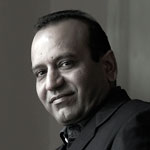
    Rajesh Kejriwal

    Announcing this to the media and later a select group of industry captains, Rajesh Kejriwal, Founder CEO, Kyoorius and Tim Lindsay, CEO, D&AD underscored the emphasis to ‘merit’ at the inaugural edition. “We will only award work that is worthy of the award. No matter how big the brand, or how small the names behind it and how wide the media reach is or the number of re-tweets, the ultimate goal is to create outstanding work that works,” said Kejriwal. The Kyoorius Awards will have no winning tier structure - no gold, silver or bronze, and it is the jury’s prerogative to award one or multiple entries in any one category, whereas none in another, if entries are not up to the mark. The Award to be given away to each winner is called the ‘Blue Elephant’ while the ‘Best of Show’ will be the ‘Black Elephant’.


    Tim Lindsay

    According to Lindsay, who has had experience of overseeing the Indian operations of Lowe when he worked with the agency network, D&AD has big plans for India. “We have expanded the awards to include advertising and digital alongside the existing design and student categories. Moreover, our’s is a not-for-profit initiative and through the Kyoorius Awards, we will plough back all our profits to the industry and the talent here,” he said.


    For the advertising awards, international jury members include Rosie Arnold – Deputy Executive Creative Director, BBH, as Jury Foreman, accompanied by Graham Kelly – Regional Executive Creative Director, Isobar, and Woon Siew Hoh – Regional Executive Creative Director, Hakuhudo. From India, jury members include Abhijit Avasthi – Executive Creative Director, Ogilvy & Mather, Agnello Dias – Chairman & Co-Founder, Taproot India, Senthil Kumar – National Creative Director, JWT, and Sonal Dabral – Chairman & Chief Creative Officer, DBB Mudra Group with more to be added soon.


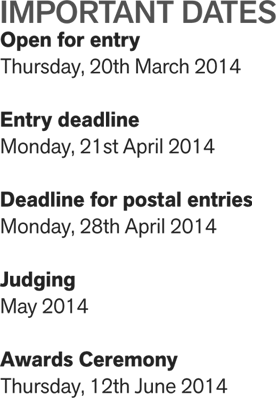
    The entries will be accepted from March 20 onwards and the deadline for entries is April 21 with April 28 being the last date for postal entries. While the first round of judging will be done online, the entiry jury will assemble in Delhi in May 2014 over three or more days to select the winners from the shortlists.


    Meanwhile, the Abby Awards which will be held from May 29-31 has not yet announced its jury presidents or call for entries.


  • #FF14 Day 1: Seamless content delivery across multiple platforms the way forward

    By a correspondent


    With so much being written and said of the emergence of multiple platforms and content delivery mechanisms in India, it was only apt to gather opinion from those that are driving the change to get a firsthand feel of the effects being spotted. The session on ‘Television 3.1’ on day 1 of FICCI Frames saw the panelists assess the future of the broadcast industry, in terms of content, marketing and distribution strategies in the era of convergence and multiplatform delivery mechanisms.


    The panelists comprised speakers like Tarun Katial, CEO, Reliance Broadcast, Vikram Chandra, CEO, NDTV Group, Mathieu Bejot, Executive Director, TV France International, Bharat Ranga, Chief Content and Creative Officer, ZEE Entertainment, Ashok Mansukhani, President, MSO Alliance and Todd Miller, CEO, Celestial Tiger Entertainment. The session was moderated by Janine Stein, Editorial Director, Content Asia.


    Vikram Chandra began by highlighting how 4G and smartphones will be the next big change agents in the Indian media landscape. “The recent months have witnessed a lot of people moving to the second screen to access content of their choice and with the access becoming more fast and affordable, smartphones will be the next big thing where content consumption is concerned,” he said.


    For Todd Miller, what will drive India in the months ahead will be the explosion of HD technology. Assisting that would be content from China that would be finding its way around the world, including India.


    Providing a different perspective, Bharat Ranga said that the way his network functioned it was a matter of tackling markets on a ‘meta’ level. Meta-national approach by companies that caters to market-specific conditions will drive the growth for broadcasters. Also, it will be essential for broadcasters to have a consumerist understanding of data and not marketing understanding. With the emergence of new platforms, Ranga noted that the industry will see the emergence of budding talents who will be able to bring in a different perspective.


    Ashok Mansukhani proposed that each stakeholder should be able to make money from the digitization exercise but that the consumer should have the final say. He said that the phase 3 and 4 of digitization will see a lot of players going fiber. While that will boost output, it is essential that the distribution rights of such an exercise are retained with the distributor, he noted.


    Tarun Katial said that India was ready to see content as the core subject that can be created for various platforms. The ability to have good investment strength and also the right mix of talent and content will help companies achieve the goal faster, he noted. Mr Katial added that while earlier ‘Content was King and Distribution was God’, the phrase has now changed to ‘Content is king and Technology is God’. Going forward, it is important that broadcasters have a hold on the IPs as that is what will matter in the future. And while much of the content at Reliance is being rented, Mr Katial added that very soon they will be working on producing content that would be their own.


  • #FF14 Day 1: Frames takes transformational route in 15th year


    By a correspondent


    The 15th edition of the much anticipated annual event of the Media & Entertainment industry – FICCI Frames 2014, got off to a captivating start in Mumbai on March 12, 2014. The event began with an inaugural session that saw the big guns from the media and allied sectors including the I&B Ministry delve on the theme of the conclave – Transforming Lives – while also highlighting the current state of the M&E sector and its scope for the future.


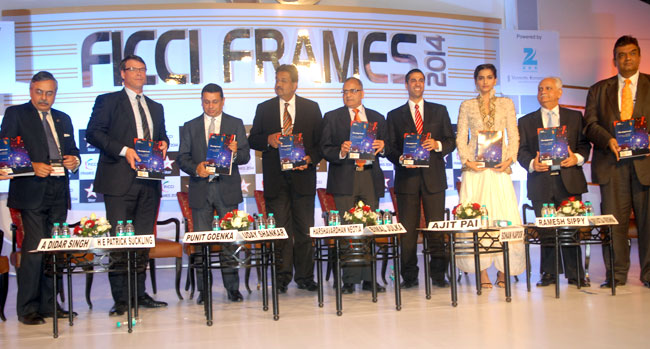
    The lineup of the dignitaries for the inaugural session included Harshavardhan Neotia, Vice President, FICCI; Uday Shankar, Chairman, FICCI Media and Entertainment Committee, and CEO, Star India; Punit Goenka, CEO & MD, Zee Entertainment Enterprises Ltd; Shri Bimal Julka, Secretary, Ministry of Information & Broadcasting, Government of India; Shri Srivatsa Krishna, Secretary, Department of IT, BT & ST, Government of Karnataka; H.E. Patrick Suckling, Australian High Commissioner to India and Ajit Pai, Commissioner, FCC, USA.


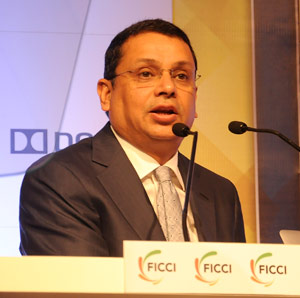
    Highlighting the state of the M&E industry in 2013, Uday Shankar said that while there was much talk about doom and gloom in the economy it was not the case for the M&E industry that grew by almost 12 per cent. But he cautioned that the goal of attaining the $100 billion landmark was a distant dream as yet. Mr Uday went on to highlight the role that the government could essay in simplifying several issues facing the industry and how it could work in tandem with the industry in resolving them.


    Echoing a similar point of view, ZEEL’s Punit Goenka too laid the pitch for a collaborative effort as he said that the M&E sector has played a key role in enhancing the prospects of the economy, especially on the jobs front. “The M&E industry has been a shining example of how an industry could work towards achieving a common goal of inclusive growth and being a facilitator to all concerned. It is a matter of pride for the sector to be employing more than 6 million people with the scope of providing employment to many more in time to come.”


    Mr. Goenka further highlighted the role that digitization has played in the year gone by, and how it would alter the broadcast landscape in the future. He affirmed to the audience that it was time to give back to the industry for whatever it has given us and that the same should be done by unleashing innovation and creativity as the core. In fact the collective aim should be to transform the lives of the global community and not just India, asserted Goenka.


    Having been introduced to the various loopholes and issues facing the industry at the introductory session, Shri Bimal Julka, Secretary, Ministry of Information & Broadcasting was vocal when he said that it was not just the government but the industry that should take responsibility in finding a solution to the problems at hand. “The role of the government is that of a facilitator, it would be great if the industry takes a collective stand on issues themselves and come to us if at all they face any hurdles.”


    Highlighting the several initiatives undertaken by the I&B ministry, Mr Julka said that the first two phases of digitization have met with reasonable success in about 42 cities and it could be credited as being the smoothest and fastest such initiative of its kind. The focus now would be on Phase 3 & 4 of the drive where an additional 110 million STBs are scheduled to be rolled out. “While there are a few issues concerning the digitization exercise, we are taking efforts to sort them out including at the level of broadcasters, MSOs, LCOs etc. But the good thing is that digitization has managed to bring in transparency in the broadcast sector, which was the main goal of the whole exercise.”


    Mr Julka said that the I&B ministry was also concerned about the content that was being shown to the viewers and urged the broadcasters to practice self-regulation. With 800 channels already existing and a further 250 plus awaiting clearances, it was important for broadcast companies to figure out how to dish out content that is accepted by the viewer.


    Mr Julka also touched upon the challenges facing the industry including control on monopoly & cross-media ownership, content monitoring, transponder capacity problem facing DTH players etc.


    The session proceeded to an engaging perspective on the US broadcast market that was provided by Ajit Pai, Commissioner, FCC, USA and also a keynote address by Shri Srivatsa Krishna, Secretary, Department of IT, BT & ST, Government of Karnataka.


  • #FF14 Day 1: Issues abound but collective stand will help boost industry morale

    By a correspondent


    Starting off from where the inaugural session left, the session on ‘De-bottlenecking the regulatory hurdles’ on Day 1 of FICCI Frames 2014 saw the panelists touch upon grave issues facing the industry and how the government could play an integral role in allaying the fears of all the stakeholders concerned.


    The panelists for the session comprised Bimal Julka, Secretary, Ministry of Information & Broadcasting, Government of India, Uday Shankar, CEO, Star India, Sudhanshu Vats, Group CEO, Viacom18 Media Pvt. Ltd, Punit Goenka, CEO, Zee Entertainment Enterprises Ltd, Rahul Johri, Sr VP & GM, South Asia, Discovery Networks and  Ajit Pai, Commissioner, FCC, USA. The session was moderated by Vikram Chandra, Group CEO, NDTV.


    Taking the opportunity to open up, Uday Shankar began by saying that the regulatory scenario in India was very diverse in its approach with some sectors being over-regulated while the others were under-regulated. “Lack of clarity on the intent of a regulation is something that is of concern. It has to be aligned with goals that have been set by the society”, said Mr. Shankar. He went on to highlight other issues that needed industry attention including the 10+2 ad cap provision and also the just introduced aggregator policy for stakeholders.


    Sudhanshu Vats presented a few indicators of his own as he said that there was a need to have a purpose to regulate. This, he said, could be achieved by having multiplicity of choice, have the need to operate like a free market and have adequate transparency and data. Adding further he said that the other essential needs were clarity, accountability and foresight.


    Rahul Johri pitched in by saying that there was indeed a need to have clarity on where the industry was headed on the issue of regulation and finding out what the core objective is. “We have regulated ourselves very well but there are too many regulations being imposed right now and we need to find a way to tackle them systematically. The aim should be to regulate well for the future of India.”


    Left to defend his turf, Shri Bimal Julka did a decent job of pacifying the panel as he said that it was a collaborative effort and that the responsibility rests with all stakeholders to get the job done. “Whatever the issues, we can agree in cohesion that it is the viewer towards whom our efforts have to be directed. Thus keeping such interests of the viewer in mind, the policies are framed with the intention of achieving inclusive growth,” he asserted.


    On the several impending problems facing stakeholders, Shri Julka said that the focus by the government was to throw open the field for a healthy discussion amongst all players so that they could arrive at an amicable solution. Mr. Julka asserted that despite the problems the digitization exercise was showing positive results as well including the carriage fees reporting a downward slide and more transparency being bought into the system.


    Mr Julka went on to add that the challenge would be to complete the phase 3 & 4 schedule of digitization and only after that could the issues of subscription versus carriage fee be resolved. But he cautioned that the stakeholders also had a role to play including deciding on how to make their content standout amongst a plethora of options facing the viewer.


    Sudhanshu Vats went to the extent of saying that there was no need to have a licensing system except for the spectrum allocation and that even if there is a licensing system there needs to be a fixed timeframe to address that. He added that things will be clear once the entire digitization exercise is complete but prior to that it was important that the industry take a hard look on addressability factor of digitization.


  • #FF14 Day 1: Text of Uday Shankar’s speech

    Mr. Uday Shankar, Chairman of Ficci’s M&E Committee and Star India CEO giving the Opening Remarks at FICCI Frames 2014

    Opening Remarks by Uday Shankar, Chairman, FICCI Media and Entertainment Committee, and CEO, Star India, on Day 1 (March 12) of FICCI Frames 2014. Text courtesy: PR Department, Star India


    Good morning and welcome everybody.


    Honourable minister Manish Tewari, United States FCC Commissioner Ajit Pai, Dr. Khullar, Secretary Julka, my dear friends Punit and Karan, the wonderful team of FICCI that have organized this event, ladies and gentlemen.


    Amidst an environment of gloom and doom, the media and entertainment industry registered an impressive growth of 12% last year. The fact that we have been able to deliver this in light of an overall economic growth of 4% and a major resetting of exchange rates is a testament to the tenacity of the industry’s leaders and stakeholders. However, while delivering a growth rate three times that of the country at large is cause for satisfaction, the truth is that in dollar terms, we have barely made a dent this year. And, even more importantly, we remain at a great distance from the goal of growing the sector to 100 billion dollars.


    But, this is not a sector whose value is measured just by the size of its financial contribution. Media and entertainment remains central to defining the direction of India’s social and economic path; its work remains key to the imagination and inspiration of a billion Indians every day; and its health will be central to the ethos and values of the society we collectively shape.


    And, therefore, it is hugely important that we are gathered here in the days and weeks leading up to the national elections – one which comes at a particularly important time in our post-independence history. We have run the course on exploiting the momentum of the first set of economic reforms unleashed in 1991. We have created enormous opportunities and wealth for many. And, now, we are faced with a far more complex set of economic and social choices, including on the ideal role of the government, its relationship with industry and, in fact, the relationship of the private sector with the overall society at large.


    And no relationship is more important than the one between the government and the media. In many ways - and not uniquely to India - this is a relationship which by the very nature of its constituents is conditioned to be adversarial.Governments and political leaders are deeply aware of the power of shaping the message. The natural instinct of the state is to control the message. And, where it can, to control the messenger. The natural instinct of the media, whether the news media or the creative community, is to resist control, is to question authority. There is, therefore, tension inherent in the conflicting instincts of the two constituents.


    In India, that relationship has often moved from being just adversarial to flirting on the boundaries of dysfunctionality. Used to only a compliant state media, successive central governments have often used policy to limit free expression.And, increasingly, state governments have crossed the boundary to actually own and run private media enterprises.Why just run channels when you can integrate across the whole value chain, and run entire businesses from delivery to content?


    It is surprising indeed that irrespective of the political party or government, the expectation from the media is that they will always be flag bearers for the party line. So, there is no complaint when the media builds up the image of a clean, technocratic Prime Minister. Nor is there any problem when the media trumpets the idea of a youth leader or champions the development achievements of state leaders. But dare they cross the line into seeking accountability or evidence ofperformance, they are dubbed as incompetent, or worse,corrupt. What truly outraged me was the recent turn of events. It was the media that had created rock stars out of a bunch of street artists and protesters. It was the relentless 24 by 7 coverage of fasts and high decibel theatrics that created a political party from thin air and installed them in the government. You would have thought these leaders would have been grateful to the media for nurturing them. And, yet, even they resorted to accusations of corruption the minute the conversation turned to accountability for their choices and performance!


    Of course, the media has been more than just a silent victim in creating this environment. Too often, the news media has focused on what is sensational rather than what is important. Too often, the point of news seems to be to reduce the extraordinary diversity of the country to the most banal, a contest between extremes that can only be resolved through a shouting match on live television. With singular dominant narratives, the trend seems to be of creating heroes on a particular day only to be labelled as thugs and crooks the next.


    Legend has it that, in the early years of independence, Prime Minister Nehru used to write criticisms of his own government under pseudonyms published in leading newspapers. So concerned was he about a press that was not free and was not fiercely independent. It is ironic that today, it is perhaps easier to get articles published for a fee in newspapers than to place an honest criticism of the government. Nehru’s successors, both in politics and in the media, have strayed a long way away from that aspirational vision of the role of media in Indian society.


    Instead, it is now a broken relationship, and one that has dire consequences for both the industry as well as the government. The failure to establish credibility and importance has meant the industry perennially stays on a back foot, defending itself against every new wave of regulation aimed only at further curtailing its wings. In return, the government has not been able to leverage either the impact that mass media can have in India or harness the power of media as an economic engine that can create jobs and wealth.


    It is therefore appropriate that the weeks before the elections is the right time to call for a new contract between the government and the media. One that reaffirms both stakeholders to the theme of this year’s FICCI Frames: Transforming Lives.


    The central principle of this contract should be the recognition that this industry is a unique and powerfuleconomic enterprise. It is capable of creating employment and wealth much faster than most other sectors and with the ability to be a force multiplier, like it is in most countries. It is particularly relevant in India because it can be an employment generator without sizable public investments and without being hampered by the deficiencies of public infrastructure.


    Why would you not nourish an industry which has the potential to become a huge employer? Why would you not fuel an industry that can grow with more policy support than resource support?


    Second, the next government should recognize that it matters what the agenda of the Information and BroadcastingMinistry is. It matters what the Ministry sees as its dominant priority.  Do you see media as a tool for transforming lives thereby using it in the interest of serving the population or as something so powerful that it needs to be controlled? The regulatory agenda is one of the most crucial parameters that will shape how this industry will look like in the next 5, 10 and 15 years, and after some progress in the last few years, this agenda has now completely stalled. Whether in accelerating the digitization of television delivery, or creating progressive frameworks on consumer pricing, this agenda is waiting the arrival of a transformational government.


    And, this is particularly important when you review the media landscape today. It is littered with unviable and unhealthy media companies that cannot survive in the current framework. And unless all stakeholders are committed to retaining the vibrancy of the sector, the biggest victim will be free expression. No value is more important to this countrythan preserving the ability of a free media to showcase plurality in opinion and creative expression.


    I hope that the next few days will give us an opportunity to lay the foundations of a constructive relationship with a newgovernment for the next 5 years.


    Thank you.


  • Frames: Fifteen years of being the biggest M&E event in India

    Source: KPMG in India Analysis


    By A Correspondent


    The fifteenth edition of FICCI-Frames had reason for some special celebration. But, save the strong mention of this milestone, it would appear like any other Frames.


    The presence of a film star at the inauguration, the FICCI officebearers, a representative or two from the government and a large industry presence.


    Yet, it’s possibly the biggest event of the media and entertainment sector each year, and even the curation of the conference was wanting, as a celebration of the industry, it was unparalleled.


    But first a disclosure. MxMIndia is a media partner of the event, as it is of many FICCI M&E events through the year. Though that’s not the reason why we are covering the event. By the sheer presence of industry heavyweights around, it gains importance.


    Unlike the issue of digitization in the year 2012 which made the thirteenth edition of Frames such a huge pull, what we had last year was a disappointment. And this year’s edition is a continuation of that. To say that it’s a conference of the entire media sector may be incorrect. Successive editions of the event have given shoddy treatment to the print and sectors other than television and cinema.


    The FICCI-KPMG report on the sector -  in the backdrop of the various adspend reports published by media agencies – is a reference volume for the trade. Although the report is available online, the near-9MB, 293-page hardback is best consumed on print.


    An extract from the summary capturing the highlights of 2013:

    The Indian Media and Entertainment (M&E) Industry, one of the most vibrant and exciting industries in the world, has had a tremendous impact on the lives and the Indian economy. As the M&E industry widens its reach, it plays a critical role in creating awareness on issues affecting, channelling the energy of and building aspirations among India’s millions. As it entertains and informs the country, the M&E industry has been a catalyst for the growth of large parts of the Indian economy. Take for example, a villager – illiterate and previously unaware of what life has to offer, who begins to see a better life through entertainment programs on TV and aspires for a better life for him and his family. This drives demand for various products and services. These aspirations have been key to self motivated transformation taking deep root in India – Transformation not just from handouts and government schemes, but transformation stemming from ambition and aspiration. The media plays a significant role in our lives today and is all pervasive with touch points ranging from television to newspapers to films to radio to outdoor properties. With the addition of new media such as social networking services, animation and VFX, online gaming and applications running on mobile devices, a new dimension has been added to the world of media that was dominated by traditional media. In addition to their implicit impact, all media platforms provide a great opportunity to carry explicit messages to create social impact. Further, interactive and social platforms give people a voice.


    Examples include –

    • Films: Short films on disadvantages of tobacco consumption/smoking before each film screening in a theatre


    • Television: TV shows on social issues to raise awareness, such as Crime Patrol – Dastak (Sony Entertainment Television), Savdhaan India – India fights back (Life OK) and Satyamev Jayate (Star Plus).


    • Radio: Content highlighting social initiatives aired on radio such as Mirchi for Muzaffarnagar (Radio Mirchi), Munni Vardaan Hui (Red FM), and Green Ganesha (Big FM).


    • Print: Friends of Hindustan (Print campaign by Hindi daily Hindustan in Patna), Good is in our DNA (print campaign by DNA).


    Social Media: UNICEF India’s campaign of ‘Take Poo to the Loo’ on Facebook, Twitter and Youtube to spread the message of the harmful effects of open defecation;4 connects consumers with each other and provides a platform for opinion generation.


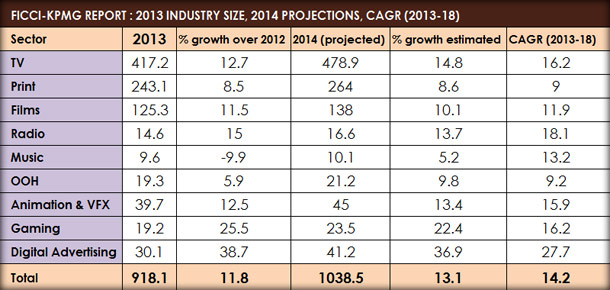
    In calendar year 2013, the Indian Media & Entertainment (M&E) industry registered a growth of 11.8 per cent over 2012 and touched INR 918 billon. The overall growth rate remained muted, with a slow GDP growth and a weak rupee. Lower GDP meant lower demand from the consumer and this impacted advertising. At the same time, the industry began to see some benefits from the digitisation of media products and services, and growth in regional media. Gaming and digital advertising were the two prominent industry sub-sectors which recorded a strong growth in 2013 compared to the previous year, albeit on a smaller base. For projections till 2018, digital advertising is expected to have the highest CAGR of 27.7 per cent while all other sub-sectors are expected to grow at a CAGR in the range of 9 to 18 per cent. Overall, the industry is expected to register a CAGR of 14.2 percent to touch INR 1785.8 billion by 2018.


    The Indian M&E sector showed some resilience and began to grapple seriously with some structural issues it has long talked about but not engaged with. These include TV and Print industry measurement, advertising volumes, inventory and rates, actions to see digitisation through and reap its benefits, working out the MSO-LCO relationship, copyright laws and operational efficiency. Many of these remain alive and will take a few years to sort through. Others, like phase III of radio – are still pending regulatory action.


    Increasing digitisation across sub-sectors of M&E industry, rate increases in TV, channel packaging by MSOs, innovative strategies to monetise digital content, rapid growth of new media powered by increasing smartphone penetration, and campaign spending during the general elections are likely to be the key levers of growth for the Indian M&E industry in 2014. A well thought out, consistent and long term outlook on regulation is also the key to create an M&E industry that is world class in scale and plays its part in transforming India.


  • Media Owners rise, professionals fall in Indian Express powerful Indians ranking

    By A Correspondent


    The Indian Express list of the Most Powerful Indians has been released with today’s edition of the paper (Thursday, March 13) and while there are no omissions from the list, the media owners see a dramatic rise in ranking. Samir and Vineet Jain of Bennett, Coleman and Company Limited have moved up from #74 last year to #51 this year. Mahendra Mohan Gupta and Sanjay Gupta of Jagran Prakashan are up from #75 to #52. HT Media’s Shobhaha Bhartia is up from #77 to #68 while the ABP Group’s Aveek Sarkar is up from #85 to #72.


    Arnab Goswami though has had a huge fall – from #43 to #80 and Uday Shankar three ranks down from #78 to #81.


    The report curiously misses out on some other biggies in the business: Subhash Chandra and son Punit, Kalanidhi Maran – the most profitable television media empires, Raghav Bahl of Network/TV/Viacom 18, the Agarwals of Dainik Bhaskar, the Kotharis of Rajasthan Patrika and given that they control the fortunes of most media companies: CVL Srinivas of GroupM and Sam Balsara of Madison. The list of omissions could go on, but it must be mentioned that in one of the side lists of Top 10 in sports, Star India CEO Uday Shankar at #4 is ahead of a certain Sachin Tendulkar at #5.


    We have of course not factored in the fact that the likes of Mukesh Ambani, Anil Ambani, Shah Rukhi Khan, Salman Khan, Cyrus Mistry, Sunil Bharti Mittal are also on the list, but, of course, media is not their mainstay business.


    Rank Name  Organisation Rank 2013

    51

    Samir and Vineet Jain Bennet, Coleman & Co Ltd

    74

    52

    MM Gupta and Sanjay Gupta

    Jagran Prakashan

    75

    68

    Shobhana Bhartia Hindustan Times

    77

    72

    Aveek Sarkar Ananda Bazar Patrika

    85

    80

    Arnab Goswami Times Now

    43

    81

    Uday Shankar Star India

    78


  • Tista Sen, Malvika Mehra, Tapas Sen & Abhijit Chaudhuri join Prasoon Joshi in first list of Cannes Lions jury

    By A Correspondent


    Tista Sen, Malvika Mehra, Tapas Sen and Abhijit Chaudhuri join Prasoon Joshi in the first list of Cannes Lions jury announced yesterday. While Mr Joshi is Jury President of the coveted Titanium and Integrated category (as announced earlier), Ms Mehra will be adjudicate in the Press category, Ms Sen in Outdoor, Mr (Tapas) Sen in Radio and Mr Chaudhuri in Film Craft.


    Commenting on this year’s jury line-up, Philip Thomas, CEO of Lions Festivals says, “We are delighted to welcome this group of high calibre professionals to judge entries and award creative excellence in their respective categories. Every year the outcome of the judging process at Cannes Lions sets new benchmarks in creative communications for the global industry. By pulling together this collection of leading names we can expect the outcome of the jury’s deliberations to continue to achieve this.”


    The entire list of the juries for the five categories is as follows:


    Titanium & Integrated


    Prasoon Joshi, Chairman, CEO and Chief Creative Officer, India & South Asia, McCann Worldgroup – Jury President

    Alexandre Hervé, Vice President – Executive Creative Director, DDB Paris, France
    Anselmo Ramos, Founder, David, Brazil
    Gaston Legorburu, Worldwide Chief Creative Officer, SapientNitro, Global
    Jacki Kelley, CEO North America & President, Global Clients, IPG Mediabrands, Global
    Katrien Bottez, Executive Creative Director, Duval Guillaume, Belgium
    Kentaro Kimura, Co-CEO, Executive Creative Director, Hakuhodo Kettle, Japan
    Kevin Brady, Executive Creative Director, Droga5, USA
    Steve Vranakis, Executive Creative Director, Google Creative Lab, UK
    Tor Mhyren, President/Worldwide Chief Creative Officer, Grey, Global


    Press


    Rémi Babinet, Founder and Creative Director, BETC, France – Jury President

    Alvin Lim, Group Creative Director, Draftfcb, China
    Damisa Ongsiriwattana, Creative Director, JWT Bangkok, Thailand
    Damon Stapleton, Executive Creative Director, Saatchi & Saatchi, Australia
    Danilo Boer, VP Senior Creative Director, BBDO New York, USA
    Darren Bailes, Executive Creative Director, VCCP, UK
    Fernando Tchechenistky, Executive Creative Director, DDB, Argentina
    Gabriel Roman, President/General Creative Director, Lowe Ginkgo, Uruguay
    Götz Ulmer, Executive Creative Officer, Jung von Matt/Alster, Germany
    Juan Silva, Executive Creative Director, Shackleton, Spain
    Kalpesh Patankar, Creative Director, Y&R Dubai, UAE
    Leslie Sims, Executive Creative Director, McCann NY, USA
    Malvika Mehra, National Creative Director & Executive Vice President, Grey Worldwide, India
    Marcelo Reis, Creative VP and Partner, Leo Burnett Tailor Made, Brazil
    Mariana O’Kelly, Joint Executive Creative Director, Ogilvy & Mather, South Africa
    Maurice Wee, Creative Director, Bartle Bogle Hegarty, Singapore
    Nuno Jerónimo, Partner & Creative Director, O Escritório, Portugal
    Volkan Karakasoglu, Creative Director, TBWA\Istanbul, Turkey


    Outdoor


    Jose Miguel Sokoloff, President, Lowe Global Creative Council & Co Chairman and CCO Lowe SSP3 Colombia – Jury President

    Alemsah Ozturk, Chief Happiness Officer, 41? 29!, Turkey
    Brett Morris, Chief Executive Officer & Chief Creative Officer, Draftfcb, South Africa
    Cristina Tin Sanchez, Executive Creative Director, BBDO Guerrero, The Philippines
    Darren Spiller, Executive Creative Director, DDB Group Melbourne, Australia
    Eugene Cheong, Chief Creative Officer, Asia Pacific, Ogilvy & Mather Asia Pacific, Singapore
    Gigi Lee, Executive Creative Director, Y&R Malaysia, Malaysia
    Gonzalo Ricca, Executive Creative Director, DON, Argentina
    Jeff Kling, Chief Creative Officer, Fallon Worldwide, USA
    José Valdir Bianchi, Art Director, Agência Mood, Brazil
    Juan Sanchez, Chief Creative Officer, TBWA\España, Spain
    Keiichi Higuchi, Creative Director, Dentsu, Japan
    Kevin Lee, Executive Creative Director/Partner, Leagas Delaney, China
    Luis Elizalde, Executive VP Chief Creative Officer, Saatchi & Saatchi, Mexico
    Matthieu Elkaim, Executive Creative Director, CLM BBDO, France
    Stefan Kolle, Founder and Chief Creative Officer, Kolle Rebbe, Germany
    Tista Sen, National Creative Director & Senior Vice President, JWT India, India
    Vicki Maguire, Deputy Executive Creative Director, Grey London, UK


    Radio


    Tony Hertz, Owner & Creative Director, Tony Hertz: Radio & Brand Sound, The Philippines – Jury President

    Danny Searle, Chief Creative Office/Vice Chairman BBDO Asia, BBDO, Singapore
    Emma Eriksson, Creative/Partner, Le Bureau, Sweden
    Felipe Luchi, Creative Vice-President, Lew’Lara\TBWA, Brazil
    Jan Leube, Chief Creative Officer, Y&R, Germany
    Josh Rabinowitz, EVP/Director of Music, Grey Group, USA
    Max König, Creative Director, Simple, Chile
    Raf Debraekeleer, Producer – Director, Cobra Radio Brewery, Belgium
    Rafael Arnau, Producer, Composer, Sound designer, Rafael Arnau Freelance, Spain
    Shane Bradnick, Executive Creative Director, DDB, New Zealand
    Simon Blaxland, Owner, Blazland Productions, UK
    Tapas Sen, Chief Programming CrOfficer, Radio Mirchi, Entertainment Network, India
    Tom Eymundson, Partner, Director, Pirate Group, Canada
    Vanessa Pearson, Executive Creative Director, House of Brave, South Africa
    Victoria Marie Evensen, Copywriter, Dinamo, Norway
    Vince Lagana, Creative Director, Leo Burnett Sydney, Australia


    Film Craft


    Brian Carmody, Co-Founder, Smuggler, USA – Jury President

    Abhijit Chaudhuri, Director, Q.E.D. Films, India
    Augusto Gimenez Zapiola, Director, Argentinacine, Argentina
    Corey Esse, Managing Director/Executive Producer, Exit Films, Australia
    Felipe Vellasco, Director, Sentimental Filme, Brazil
    Jenny Gadd, Head of Integrated Production, Johannes Leonardo, USA
    Kerstin Heffels, Producer, Heimat, Germany
    Martin Loraine, Deputy ECD, AMV BBDO, UK
    Pia Dueholm, Executive Agency Producer, INGO Stockholm, Sweden
    Roel Welling, Director, Wefilm, The Netherlands
    Thierry Buriez, Creative Director, Being, France


    With the introduction of the new Product Design category, a total of 17 juries will be judging in Cannes this year. Members of the remaining 12 juries will be announced shortly. Cannes Lions, the world’s leading celebration of creativity in brand communications, will take place 15-21 June at the Palais des Festivals in Cannes, France. For information on how to enter work, or register to attend, please visit www.canneslions.com.


  • It’s a Holi-day! No MxM edition on Mon, March 17

    By A Correspondent


    If you are working on Monday, March 17, your mid-morning water cooler conversation will need to have a different them. We are shut on that day as our editorial office is in Mumbai where Holi is celebrated with colour and water and many eats-and-drinks.


    But in all of this, we will have our smartphones tucked in a plastic ziplock back. So if you have anything urgent, do mail or text or call. If there’s that significant ad that you want inserted, please call, sms or mail. We’ll get back to you soon.


    Meanwhile, we’ll be back with our updates and editions on Tuesday, the 18th.


    Please play responsibly. Use safe, organic colours.


  • #FF14 Day 2: Despite advent of multiple platforms, television still rules

    By A Correspondent


    With the explosion of a host of content delivery platforms in India, it is increasingly becoming demanding for traditional mediums to spruce up their offering and do it in a manner that is platform-agnostic. The observation is particularly true for the medium of television that is being confronted with newer challenges as a host of platforms are making a beeline to offer content in their own unique ways.


    The session on ‘Television is Dead – Long Live Television’ on day 2 of FICCI Frames discussed how content providers can reach out to consumers in a multi-platform world and who will be the ecosystem winners and losers in the future. The panelists comprised of Anuj Gandhi, Group CEO, Indiacast Media Distribution; Sanjay Gupta, COO, Star India and Todd Miller, CEO, Celestial Tiger Entertainment. The session was moderated by Vivek Couto, Executive Director, MPA.


    Mr Couto began by shedding light on how the traditional medium of television was still ruling the viewership pie and was not being as impacted by the emergence of other digital options including mobile. He presented the example of a developed market like US that was still seeing a healthy growth trend. Asserting that the future will be about consolidation, Couto said that the medium needed to get away from its garb of being a defensive medium and rather play the role of being an aggressor.


    Sanjay Gupta began by taking the audience back to a decade ago where it was prophesied that the medium of print would die with the invasion of television. “But that is obviously not the case with the medium of print growing by two times its total share today. We therefore are living in exciting times as new mediums are providing newer opportunities.” Mr Gupta advised that instead of looking at it as a TV business, the players should be platform-agnostic and receptive of changes that the newer platforms have to offer.”


    For Anuj Gandhi, the last two years were indeed exciting for the Indian broadcast industry largely for the digitization exercise that was undertaken on a national level. “While there were more than 40 companies that were launched, more than half of them shut down after facing challenges. The problem is that we lack scale,” said Gandhi. Mr Gandhi affirmed that it was still looking at opportunities on the digital platforms in terms of providing content for ‘binge viewing’ format.


    Todd Miller pitched in by saying that whatever the prevailing trend, the important medium to connect with the viewer still continues to be television. Despite the emergence of multiple platforms, television will still be the preferred vehicle as that is where the viewer’s tend to be the stickiest, he said.


    Offering an advice to the audience, Sanjay Gupta said that there was no attempt being made in terms of scale for viewing content of choice on linear platforms. “That is a challenge that the content creators need to resolve,” he said.


    According to Anuj Gandhi, the challenge still remains that the bandwidth speeds for accessing data on internet continues to be problematic. And this is despite the explosion of smartphones and tablets in the country. He cautioned the gathering that brands needed to be ready with high-value content when technologies like 4G etc take off. But come what may, television will continue to evolve as a medium and will become more ‘pull’ medium for attracting viewers than being a ‘push’ medium.


  • #FF14 Day 2: Need to monetize big in a multi-platform era

    By A Correspondent


    There’s a lot that is being said on how the advent of technology has revolutionized the M&E ecosystem. With the emergence of newer technologies and players offering these services, it becomes a challenge to find a balance in providing technology with creativity and content. The session on ‘Monetization Opportunities in the Multiscreen World’ sought to throw light on how the ecosystem was witnessing an interesting shift in revenue-sharing models and how companies could monetize effectively during these challenging times.


    The panelists included Sam Balsara, Chairman & MD, Madison World; Satyan Gajwani, CEO, Times Internet Panel; Chakrapani Gollapali, General Manager, Consumer Channels Group, Microsoft India; Neeraj Roy, MD & CEO, Hungama Digital Media; Rishi Jaitly, India Market Director, Twitter; Nikhil Naik, Head – Director, Global Content and Distribution, Vuclip; Karan Bedi, Founder & CEO, Tutorific! and Ramki Sankaranarayanan, CEO, Prime Focus who moderated the session.


    Presenting an insightful outlook, Sam Balsara highlighted how the television and mobile will be the only two mediums that will continue to be dominant in the future and how the interplay between the two would result in positive growth of the industry. Balsara said that while television continued to find favour with advertisers, they were gradually waking up to the medium of digital as well. “But advertisers need to be flexible about how the viewer’s see their ads; not just on television but across multiple screens.”


    Cautioning the audience, Balsara expressed discontent on how the older norm of doing business was seeing a shift that was not healthy. “The older model of doing advertising was 50-50; half from subscription and half from advertisers. But that has changed of late with more revenues coming from advertisers allowing them to have a greater say in content. It is important that we move back to the old model of 50-50 so that equilibrium is maintained and focus around content remains intact.”


    According to Neeraj Roy, it is not true that monetization in India is not up to the mark. “Around Rs 1500-2000 crore is still being directed towards content and that was a very positive sign. But he expressed worry as he said that the monetization exercise was being limited to certain mediums only. The way out is to have a balance in the advertising-transaction ratio, said Roy. With the shift to 4G being imminent, Roy urged content providers to focus on providing content that is high on value as consumers will be willing to pay more provided they get quality content.


    Providing a synopsis of his company, Rishi Jaitly said that more than 25 million users use twitter to discover content. Jaitly said that if companies concentrated on investing in value then the monetization will actually go up. “The world today is becoming mobile-first, so content providers needs to work on providing content that is of context and relevant. As a network, our focus would continue to be on fueling public conversation across multiple platforms,” affirmed Jaitly.


    Highlighting the scope and challenges faced by his company, Satyan Gajwani said that it was great to see the digital ecosystem in India thriving but the challenge is in delivering content that is high-quality because at the end the customer is going to pay for it. Talking about the issue of piracy facing his portal gaana.com, Gajwani said that the only way to overcome that was by offering such high-value and widespread offering that the user will be forced to come back for anything and everything got to do with music. This will indirectly bring down the number of users going to pirated websites to seek such services.