Category: NEWS

  • FoxyMoron asks Femina readers to slow down

    By A Correspondent


    In an attempt to shut off from the streams of opinions at Twitter, unceasing parade of people living their lives in fast-forward on Facebook, to enjoy life and to relive the great moments without rushing, Femina roped in Foxymoron for their digital campaign.


    Femina’s anniversary issue, which hit the stands in November, celebrates slowing down, choosing the scenic route and taking a deep breath. Tanya Chaitanya, the editor of Femina, said, “Exhale! Femina’s anniversary issue tells you to do just that. In a world where time is at a higher premium than real estate, it’s smart to invest time in yourself — to find a hobby, to catch up with friends, read all the books in your bucket list… Femina’s 53rd anniversary issue asks you to relax, revel, recharge.” Soela Joshi, brand publisher, Femina, added, “The issue won’t tell you how to make more time; you’re already a pro at it. But it has a few ideas for what you can do with all that time you’ve saved up from years of rushing around.”


    Aiding Femina in communicating this message was the digital agency, FoxyMoron. Starting November 14, FoxyMoron brought this message alive on the digital platform via an innovative and comprehensive campaign on a variety of mediums like Facebook, Twitter and Pinterest.


    Harshil Karia, Founder & Online Strategist at FoxyMoron, said, “The brief was about rewinding and going back in time. Femina creates digital campaign for its every issue. This time, however since it was the anniversary special, we created the campaign in three phases. The first phase asked the women to switch off from browsing the internet, women to make time and enjoy the smaller pleasures of life and unwind. The second phase was about completing the story wherein, Femina released two lines, which started to a story. Fans, followers and pinners continued that story from there and take it forward to their desired end.” A new story was released every day, According to Karia, this gave the readers a chance to ponder and do something they always wanted to do but didn’t have the time for.


    The third phase is yet to come. Femina will be running a contest on its digital channels that ask women to express a moment in their life that they wish they could rewind and relish. And three lucky winners chosen by Femina will be given the chance of a lifetime to actually relive that special moment that they did not do justice to the first time around.


    The contest targeted at 25-40-year-olds has garnered fantastic response, according to Karia. He said, “On the first day of the campaign, about 650 women took part. We had a special application built around this campaign, which helped us to create higher engagement rate. Till date, we have received about 600 stories asking to relive the moment. “The content performed well for the brand,” he asserted. The 15-day campaign will end on November 30 as Femina gets ready for the next issue.


  • MTunesHD takes music ‘On The Streets’

    By A Correspondent


    MTunesHD, India’s first Bollywood music channel in HD, takes its ‘Feel the music!’ proposition another step closer to its viewers with their latest innovation titled On The Streets (OTS).


    Launched in October with the YouTube sensation Gangnam Style, MTunesHD has since taken some of the most popular songs to its viewers to make them experience the channel USP first-hand. Aga Bai from Aiyyaa, Dil Garden Garden from Kya Superkool Hai Hum, Po Po Po from Son of Sardaar and most recently Sooraj Ki Bahon Mein from Zindagi Na Milegi Dobara are some of the other tracks that have made the people on the streets, feel the music! The videos are available online; e.g. http://www.youtube.com/watch?v=sIh9vIo1IV8&feature=plcp.


    Commenting on the concept, Sunil Sahjwani, Group Creative Director, Pioneer Channel Factory said, “OTS is the best way to capture the pulse of the viewers. Through the dance, style, humor and spontaneity, we capture emotions across TGs, reaching out to viewers and making them express how they feel the music. We’re looking to travel the length and breadth of the country with OTS.”


    Adding to the above, Saravanan. P., CEO, Pioneer Channel Factory said, “Keeping to our tag of pioneering music innovation, OTS is an initiative to involve viewers with the channel and make our music properties more interactive. While we play music on-air, we also take them on the streets to add to the ‘Feel the music!’ experience. More such interactive initiatives are being lined up in the times ahead. I take this opportunity to thank all music companies who have been enthusiastically supporting all our music innovations.”


    While the concept was entirely conceived by the channel, the success of the initiative also depended on the cooperation of the music labels like TSeries & Universal who supported the activation whole heartedly.


    Devraj Sanyal, MD, Universal Music India commented, “Our association with MTunes ‘On The Streets’ (OTS) started with a bang. We brought in the global blockbuster ‘Gangnam Style’ for the first time on Indian Television screens through MTunes. Followed it up with a direct contact with the audience through OTS. The way the audience swayed, reacted & rode horses was maddening and reflects the power of the property OTS. Apart from our association with OTS, we will also be bringing in famous International & Indian music albums other than Bollywood to partner with the MTunes property which is aptly titled AlterNative.”


    Vinod Bhanushali, President – Marketing, Media & Publishing at T-Series added, “We are proud and happy to be associated with all the music innovations of MTunes. Their Latest innovation ‘On The Streets’ not only reaches our songs directly to the audience but also involves them, gets their instant reactions and adds value in popularizing our songs. We welcome such music innovations and would love to partner with MTunes on many more such innovations in future.”


  • Reliance Broadcast launches new multiple-media campaign

    By A Correspondent


    Reliance Broadcast Network Limited (RBNL) has announced the launch of a Multiple Media Customer focused campaign across its bouquet of English and regional channel offerings. This campaign, targeted at key marketing decision makers, media planners and buyers, aims to demonstrate the unique advantages of leveraging the different channels in the RBNL bouquet. While RBNL’s joint venture with CBS Studios International – the Big CBS Network – has announced ‘The Choice is Obvious’ campaign, it’s regional offerings – including Big Magic and Spark Punjabi are also executing similar campaigns to reach out to their relevant customers.


    The Big CBS Network’s ‘The Choice is Obvious’ campaign highlights key entertainment options available across the network, like American Idol, The X Factor USA, India’s Sexiest Bachelor Season 2, Bridelicious and International Music Favourites among others, which pose as ideal platforms for marketers to showcase their respective brands to the urban elite.


  • Jaldi 5 with Naresh Gupta: ‘Growth from new geographies beyond Indian borders’

    The six-month-old creative agency Bang In the Middle has recently opened its office in Kolkata. For the new territory it has appointed Meenakshi Sen as Managing Partner on board. Led by Prathap Suthan and Naresh Gupta, the agency has big plans.


    Naresh Gupta, CSO, Managing Partner at Bang in the Middle, talks to MxM India about the new market.


    01. How big is the Kolkata market for Bang in the Middle, and what scope does it present to a new agency?

    We expect Kolkata to be a significant contributor to our operations. Kolkata is a fairly challenging market for most agencies, and will be a big challenge for a new start up agency. We believe that there are brands in Kolkata who have traditionally looked at the few large agencies to be interested in our offering


    02. What clients is the Kolkata office going to cater to?

    We are currently in conversation with a host of clients; we should be able to announce the clients shortly.


    03. What are the unique challenges that Kolkata as a market presents?

    Every market is a challenge, Kolkata is a unique challenge. Kolkata is not a large market say like Mumbai, but is a fairly significant market with its own demands. Kolkata has a host of heritage and new age brands from across categories and they do need modern cutting edge advise on the whole gamut of communication.


    04. How different will your approach be here?

    We marry the traditional with new age. We leverage our understanding of mainline brand building and then also craft the new media strategy to offer our brands a singular brand proposition that is truly media agnostic. We expect to offer the same services to our clients in Kolkata.


    05. After Gurgaon and Kolkata, what is the next stop for Bang in the Middle?

    There are new opportunities we are exploring. The new phase of growth will come from new geographies beyond Indian borders and from newer ideas!


    As told to Ananya Saha


  • Berger Paints ties up with ‘Being Human’

    Berger Paints India Ltd has announced an exclusive association of its flagship Green brand of paint ‘Breathe Easy’ with Being Human – The Salman Khan Foundation, a registered charitable trust set up by Salman Khan for helping the cause of the underprivileged.  For every litre of ‘Breathe Easy’ paint sold, Berger will donate Rs. 4 to Being Human – The Salman Khan Foundation. Berger has committed to provide ‘Breathe Easy’ paint to two schools and one hospital supported by Being Human.


    This association has been the cornerstone in the launch of “Breathe Easy”, India’s first Green Paint with international certification. Breathe Easy is the only paint which conforms to strictest VOC (volatile organic compound) norms even as per International standards. “Breathe easy” is not just a brand name for a Green Paint which serves to preserve health and environment. It goes beyond that and transcends the brand border. Breathe Easy is the umbrella under which the entire corporate social activity of Berger is being undertaken.


    Speaking on this association, Abhijit Roy, Managing Director, Berger Paints India Ltd, said, “We are excited to associate with Being Human for our green paint brand, Breathe Easy. As an organization, we are committed towards fulfilling our responsibility towards the welfare of society. This tie-up is part of our effort to support the cause of providing education and healthcare to the underprivileged. We are looking forward to a fruitful association with Being Human.”


  • Must-read book on advertising


    Trying not to see
    By Kurien MathewsWikipedia describes Elephant in the room thus:

    “Elephant in the room” is an English metaphorical idiom for an obvious truth that is either being ignored or going unaddressed. The idiomatic expression also applies to an obvious problem or risk no one wants to discuss.


    It is based on the idea that an elephant in a room would be impossible to overlook; thus, people in the room who pretend the elephant is not there have chosen to avoid dealing with the looming big issue.


    All of us in advertising, for almost as long as I have been in it, have suffered and have been greatly affected by ignoring or not addressing some very obvious truths that have been staring us in the face. Forget about addressing it; we never even spoke about it, and went about our lives pretending that everything was just fine, and if there was a problem it was just temporary and would soon go away.


    Around the time I joined advertising, nearly three decades ago, everything was in fact just fine. No too many elephants in the room. If they were there, they were baby elephants, the playful kinds.


    In those days talent was good and abundant. Advertising was glamorous. Money was plentiful. Clients respected agencies, and thought of us as people who generally knew much more than them. We wined and dined. Almost everything was done in English, and then translated. Commercials were broadcast on one channel. No one asked for discounts. It was fun with many other such wondrous things in place.


    In his book, Anant Rangaswami speaks of many, many Elephants in the room today. All carefully chosen. All well articulated.


    These Elephants started emerging, one by one, somewhere in the mid 90s- perhaps with the arrival of satellite TV and the birth of the AOR. Suddenly the sacrosanct 15% was thrown out of the window. Before you knew it, agency revenues started shrinking and the demands on them started increasing. Simultaneously, the brighter MBAs found that there were other fun jobs that paid better, and then the vicious downward spiral of low pay, lower quality talent, suicidal discounting and the need to find revenue at any cost started.


    Soon more Elephants started appearing in the room and by the beginning of the new millennium the room was beginning to fill up, fast and furious.


    But no one cared. No one wanted to talk about it either.  If there was the odd murmur, it was quickly rubbished. Ostriches, all of us.


    In ‘The Elephants in the room’ author Anant Rangaswami not only points out to all the Elephants so glaringly visible to him, but he does so without holding back or being polite or gentle. He tells it like it is. He names names, speaks of incidents, and at places proposes action as well.


    If you have anything to with the business of building brands then this book is a must-read for you. While it is about serious business it is a fun read. Best of all, it is free - comes only in the form of an e-book, which can be downloaded from www.firstpost.com


    Kurien Mathews is Chairman & Managing Director, METAL Communications Pvt. Ltd, Director, Rage Communications Pvt. Ltd and Director, Conscious Food Pvt. Ltd


    Trumpets and snorts: A book review of sorts
    By Paritosh Joshi1984. That was the other book with a date in it that popped into the mind. A book that caused a proper noun, Orwell, to be recast as an adjective, Orwellian.


    And so to “Elephants in the Room – The Future of Advertising in India, 2016”, Anant Rangaswami’s self-published book launched with minimal fanfare on November 19.


    Prognostication is often grim business. With a date in the name, you are sort of prepared to deal with dystopic speculations on where Advertising is headed. The author doesn’t disappoint. This is sentence no. 1. “Let’s not fool ourselves; it’s going to be a tough few years ahead”.


    It is not unusual for business professionals at a certain stage in their lives to turn to writing and wish to be published. A few decades spent winning more business battles than they lost and they fancy themselves to be keepers of recondite truths that are hidden from the little people. Hindsight, a self-congratulatory attitude and a desire to elevate banality to wisdom compel them to couch their “insights” in prolix prose.


    Anant’s book, refreshingly, is at the exact opposite pole.


    The ‘elephants’ that populate this book are incipient problems that the Advertising industry will face over the next few years. The author has the journalist’s insatiable appetite for conversation. From the lowly Account Manager to titans that bestride the narrow world like Sir Martin and Sir John, he talks to them without fear or favour. His inquisitiveness is unbridled and uninhibited. The ‘elephants’, therefore, are distilled from empirical knowledge and documented anecdote, not idle speculation. From the endless hand-wringing over talent scarcity, through the challenge that digital specialists pose to the traditional creative agency to a near future where many of today’s marquee names from the advertising industry may retire, each ‘elephant’ warrants a chapter where the author attempts to lay out the problem as he sees it, a prognosis of where it will go next and prescriptions that may alleviate or remedy that problem.


    What makes the exercise utterly unusual is the author’s unabashed willingness to name names, individual and corporate that are the protagonists in this unfolding epic. To be clear, there is not one reference that might be considered libelous or intemperate, though there will be several that will cause people to squirm.


    Now while the author is almost consistently objective in his assessment, he is human enough to let some deeply held beliefs; they are logically constructed so they cannot be labelled prejudices; show through. One such, which I have had the pleasure of debating with him on many occasions, is the role and functioning of the Advertising Standards Council of India. He devotes a sizable chapter to the theme and in the interest of full disclosure I record my vigorous disagreement. There will be a rejoinder in these columns soon.


    Here is my big problem: The urgency that informs the book, while making it a real page-turner, does it a huge disservice. This is not a rash pamphleteer whipping up a mob to frenzy but a thoughtful commentator’s significant contemplation of important questions that plague, arguably, the wider Communications industry and not Advertising alone. Identical or analogous problems exist, inter alia, in the broadcast industry. And none of these problems will suddenly disappear in 2016. Media & Communications professionals, particularly those holding senior responsibilities would all be well advised to read what Anant has to say in “The Elephants In The Room”, now and for many years to come.


    And finally this. I wish, I really wish, that I had bought this book and not got it gratis as I left the launch party. Content creators, particularly when they create content as important as this, have the right to demand fair economic value for their work. Now Anant will almost certainly see this as his responsibility towards the industry he calls home, we will be unable to show our appreciation and gratitude if we can’t pay for the cry of the conscience keeper.


    Elephants in the Room: Essential reading!
    By Pradyuman MaheshwariI’ve read the book twice over. Well, actually, two-and-a-half times. First to decide what part to pick for an extract… that was a pdf which Anant shared with me a few hours before the formal launch. I did a rapid read, like the ones you do when reading those tomes that come out from government or regulator documents posted online.


    So how many enemies will I make, Anant asked me at the launch. I muttered a couple of names but also told him that the book was brilliant. And unputdownable.


    The half-read was when I had to actually pick the extract. I decided on two to give MxM readers a perspective on what to expect from it. The first on whether it should be a suit or creative who should head an agency. And the other on Goafest.


    The last time I read it was after Paritosh Joshi suggested the idea of this joint review.


    The Elephants in the Room is not an academic account of what ought to be done by the industry. It’s no white paper. Yet, in its chatty style, it highlights all that needs to be stated about the business. Racy in style, it’s almost like some of his blogs on Campaign India put together. Except that here they are longer, and the issues are dealt with in detail.


    I tend to agree with his views on industry associations – the AAAI and ASCI specifically. There is much scope for improvement, in fact what’s needed is an overhaul. The Advertising Club also needs to get into activities that attract the youth. And above all: Goafest. Why have it in Goa in April?


    So, my sub-140-character review continues to be what I gave on the morning after the launch: Unputdownable. If you’re in the biz of advertising, download now!


    I wouldn’t want to get too much into the book, and would urge readers to download it off Firstpost, but I have two peeves about the book. Or possibly three.


    The first: In the attempt to make it quick-and-racy, I think Elephants in the Room rushes through some of the issues that impact the business. For instance, corruption. I could list a few more.


    Second: The focus is Creative. It delves into digital, talks a bit about media, but it’s essentially the big creative agencies and gods who have been discussed.


    And, third: why the hell has Mr Rangaswami not priced the book. Why offer it as a free download? Printing a book doesn’t take an arm and a leg. I would’ve been happy to have MxMIndia publish the book. Or possibly Firstpost could have.


    The Elephants in the Room is an excellent book. It’s essential reading for all those in advertising, and all those who deal with creative folk and creative agencies.


    Pradyuman Maheshwari is Editor-in-Chief and CEO, MxMIndia


  • Azim Premji wins Forbes India’s inaugural philanthropy award

    By A Correspondent


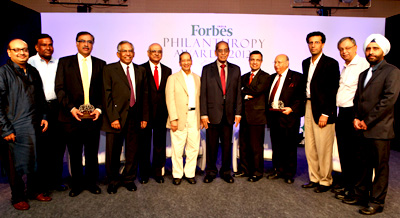
    Azim Premji with the jury (L-R): Abraham Moses, Sanjiv Sarin, MV Subbiah, AN Singh, Bhawarlal Jain, Narayanan Vaghul, Nachiket Mor, Lord Raj Loomba, Ashish Dhawan, Dr Madhav Chavan, Gurmeet Singh

    Azim Premji, chairman of Wipro Ltd, won the inaugural Forbes India Philanthropy Award in Outstanding Philanthropist category for 2012. Mr Premji, 67, the third richest Indian with a net worth of $12.2 billion, has pledged close to $2 billion from his personal wealth to Azim Premji Foundation, which is working to improve elementary education across India. He was among the ten outstanding individuals who received the award under different categories.


    The philanthropy awards were instituted by Forbes India to recognize the efforts of individuals who have given time, money, skill and expertise to solve some of the most pressing societal issues, to create model institutions and to inspire others. The winners received their awards – metalwork keepsakes depicting the Mubhi Tree, which symbolises the art of giving – at an event in Bangalore on Wednesday.


    “Our hope is that business should emerge as a strong force for good in this country and that our list of nominees for each of the ten categories will continue to grow as more and more people from the world of business step up and find new exciting ways to give back to society,” Indrajit Gupta, editor of Forbes India, said during the event.


    Mr Premji spoke about how his foundation’s university, which has 230 students and 70 professors, complements the field work they do in education. “Our objective is that we have to get more results and to scale up much more significantly in the grassroot level in the field,” he said. Later, he joined his fellow winners N Vaghul, former chairman ICICI Bank and MV Subbiah, former chairman Murugappa Group in a fireside chat to discuss what it takes to build a network of engaged corporate citizens, deepening the culture of giving back, galvanising corporate action, and how to take philanthropy in India to the next level. The session was moderated by Subroto Bagchi, chairman and co-founder Mindtree.


    In yet another fireside chat, Nachiket Mor, Chairman of the Board of Directors, SughaVazhvu, Ashish Dhawan, Founder and CEO of Central Square Foundation and Ramji Raghavan, founder Agastya International, discussed the challenges that philanthropists face when they work with multiple stakeholders, especially the government, in bringing about change. Ajit Rangnekar, dean of the Indian School of Business in Hyderabad, moderated the session.


    The event was attended by entrepreneurs, executives and academics with interest and passion for philanthropy and social good. They shared their views on themes related to philanthropy. Kiran Mazumdar Shaw, chairman and managing director of Biocon said that philanthropy is about making changes, and partnerships play a crucial role in that. Mr Mohandas Pai, Chairman of Manipal Global Education, and one of the driving forces behind Akshayapatra a mid-day meal programme, said he was motivated to do more when he realised that he was lucky to have won ‘the ovarian lottery’, many others aren’t so fortunate. Lord Raj Loomba, founder of clothing company Rinku Group, whose foundation works for the cause of widows, said his inspiration was the story of his mother, who became a widow when Raj Loomba was just 10 years old.


    The latest edition of Forbes India devoted to philanthropy was also released. Containing features on philanthropy with detailed case studies about each of the award winners, the special edition has four covers, featuring four of the winners Azim Premji, N Vaghul, MV Subbiah and Ashish Dhawan and a caption that runs across four covers: Philanthropy, done right, is too important to restrict to one cover.


    Speaking on the occasion, Gurmeet Singh, CEO, Forbes India said, “We at Forbes India strongly believe that Wealth and Philanthropy are two sides of the same coin. Therefore it was logical that we scaled up our earlier events on “Purpose Of Wealth”, “Business as a Force For Good” and “Conscious Capitalism” into a full-fledged Philanthropy Awards Evening.  Forbes India Philanthropy Awards and Dinner was a very well attended evening bringing India’s biggest philanthropists, guides and catalysts on the same platform and exploring what motivates leaders to embrace philanthropy and how India Inc needs to bring a stronger giving culture”.


    The winners were selected by a jury comprising of Narayanan Vaghul, Former Chairman, ICICI Bank, Madhav Chavan, Founder and CEO, Pratham, Shashi Tharoor, Member of Parliament and Dr Devi Shetty, Founder Chairman, Narayana Hrudayalaya Hospitals.


    The complete list of award categories and winners:


    Outstanding Philanthropist:

    The flagship award recognises an outstanding individual whose leadership and contributions of time, money, skill and expertise has brought in new thinking into solving complex social issues.

    Winner: Azim Premji, Chairman, Wipro Ltd


    Outstanding Corporate Foundation

    This award honours foundations that have taken up a social issue and have long term vision, strategy, a sustainable model and have created significant impact in their chosen areas.

    Winner: Tata Trusts


    Distinguished Family of the year

    This award honours families who have dedicated their private wealth for public good and benefited an institution or organisation in recognisable and sustainable ways across different generations

    Winner: Murugappa Family


    NextGen leader in Philanthropy

    This award recognises the accomplishments and contributions of emerging leaders in philanthropy, those who have signaled their intent through meaningful giving, have also begun to contribute significant time, skills and resources to the causes they have helped advance.

    Winner: Ashish Dhawan, Founder, Central Square Foundation


    Cause Marketing

    This award is for a company that has successfully marketed products or services in conjunction with a charity and brought significant benefits to both parties.

    Winner: Tata Tea – Jaago Re


    Corporate Catalyst

    This award is for a senior business leader who has used his influence to promote the cause of giving back not just in his or her company, but also across the entire industry.

    Winner: N Vaghul, Former Chairman, ICICI Bank


    The Good Company

    This award recognises pioneering strategic initiatives undertaken by large business corporations, where they have used market-based models to balance the twin objectives of doing well, while also doing social good.

    Winner: Jain Irrigation Systems


    The Good Samaritan Award

    This award is for an exceptional individual at any level in a company who has successfully led and galvanised support within the organisation to mount programs that help more people within that organisation to support worthy causes and give back to society.

    Winner: Abraham Moses, Director, Administration & Facilities, MindTree Consulting


    Distinguished Non-Resident philanthropist

    This award is for a non-resident Indian who has contributed significantly to a social cause in India, by giving wealth, time and expertise.

    Winner: Raj Loomba, Loomba Foundation


    The Crossover Leader

    This award seeks to recognise a professional who has successfully made the transition from a thriving career in the corporate world to work for the social or not-for-profit sector and has served as an inspiration and role model for others.

    Winner: Nachiket Mor, Non-Executive Chairman of the Board of Directors at SughaVazhvu

     

  • IAMAI announces 3rd annual India Digital Awards

    By A Correspondent


    The Internet & Mobile Association of India (IAMAI) has announced the third annual India Digital Awards for the internet and mobile value added service industry. The awards night, to be held on January 17, 2013 at New Delhi, celebrates excellence in originality, effectiveness, communication and creativity, and applauds work in the following six main categories: Digital Advertising, Website, Mobile VAS, Digital Payment, Digital Social and Economical Empowerment, and Special Awards.


    Covering the entire gamut of commercial activities around internet and mobile, the India Digital Awards are the only comprehensive awards for the digital industry in India.


    The nominees and winners of the awards will be selected by members of the jury which include Rajan Anandan, Managing Director & Vice President, Sales and Operation, Google India; Abdul Khan, Senior Vice President and National Head of Business Marketing, Reliance Industries, Dinesh Agarwal, Founder & Chief Executive Officer and Alok Mittal, Managing Director, Cannan Partners, among many others.


    The last date for submission of entries is November 24. More information and registration details are at www.iamai.in.


  • India Inc opts for sports as preferred marketing

    By Tuhina Anand


    Sports emerged as the most preferred marketing tool, over celebrities, events and product placements in movies, music or art, according to a study conducted by SportzConsult, India’s premier sports management company. The study encompassed over a hundred senior marketing professionals across sectors such as FMCG, Automotive, Telecom and BFSI . Of this group, 83 percent have already used sports in their marketing campaigns and 72 percent have seen positive results. Of the brands that have not yet used sports as a marketing tool, 77 percent have affirmed it as a course of action in the near future.


    The study was designed to demonstrate the trends and perceptions in the use of sports as a marketing tool among brands in India, including the primary reasons to engage sports in marketing, the channels of engagement, key audiences and evaluation of such campaigns.


    Commenting on the findings, Jitendra Joshi, Co-Founder and CEO of SportzConsult said, “Sports has the power to mobilise and motivate. In coming years, brand managers have the huge opportunity to leverage the positive attributes of sports and earn better ROI on marketing spends. The growing adoption of sports for marketing among corporate India will be a win-win for both brands and consumers,”


    Key findings of the study

    Passion, and not iconic sportsmen, drive brands to sports

    Passion, youthfulness and the association with active lifestyle came up as the top attributes for choosing sport over other options. Nearly 75 percent of the respondents favoured one of these attributes as the key driver for a sports engagement. Only one quarter of the respondents cited iconic nature of the sportsmen as the key reason for associating with sport. Given the fact that over 50 percent of the population are under the age of 26 years, marketers believe that sports is the most attractive platform to engage their target audience.


    Future of ‘other’ sports looks bright

    Marketing campaigns are using niche sports events to address niche audiences.


    While popular sports like cricket & football are still the top choices for marketers but they are realizing that they may not always provide the real bang for buck especially if you want to concentrate on niche audience. For many brands ( more than 40 percent of the respondents) an exclusive sport like Golf or a traditional sports like Kho-Kho & Kabaddi is a much better way to engage the relevant TG. Moreover, the heightened need for a healthy and active lifestyle among working professionals is making marathons more and more popular among brands. 24 percent of the brands prefer marathons as an ideal marketing opportunity.


    (Passion, and not iconic sportsmen, drive brands to sports)


    Sports is a strategic and long term commitment among Indian marketers

    More than half the respondents looked at their association with sports for brand-building as strategic and long term, indicating the growing relevance of sports in the marketing mix. Of this group, 67 percent of the respondents considered using sports as a strategic long term decision rather than a tactical approach.


    While over 70 percent of respondents count TV advertising spots as the main component of their engagement with sports, almost 95 percent cited professional event sponsorships as the best option for brands looking at stepping up their reach among the TA. While over 85 percent of the brands used existing sports properties, 45 percent of them had also created their own properties around sports as part of their marketing campaign. However, the survey also revealed the perception that creation of sports properties is risky, as against investments in popular properties.


    ‘Number of participants and spectators’ emerged as the most important criteria brands use while evaluating a sports program. ‘Opportunities to leverage brand with the event’ and ‘media promotion & impressions’ were the next two important factors while evaluating a sports program.


    Sports is a strategic and long term commitment among Indian marketers


    Spend on sports sponsorships to go up

    Over 65 percent of the brands that were part of the study have spent over Rs 1 crore on sports-led marketing campaigns, while 35 percent of the group has spent over Rs 5 crore. 60 percent of the total respondents have confirmed an increase in their investments in sports in the coming years. However, despite this buoyant interest in sports as a marketing tool, around 30 percent of the respondents still spend less than 10 percent of their marketing budget on sports, citing the nebulous nature of sports sponsorships in India.


    Current year:

    (Spend on sports sponsorships to go up)


    Next One year:

    (Spend on sports sponsorships to go up)


    Leveraging sports sponsorships

    The study revealed that while sports sponsorships are popular, Indian marketers, have not mastered the art of leveraging sponsorship programs for continued and long-term marketing success. While sponsorships help brands attain reach and visibility among TA, leveraging the sponsorship is generally more crucial to meeting one’s marketing and organisational goals. In India, only 7.2 percent of the brands have invested 100 percent equivalent of the sports sponsorship investments in leverage programmes( which is a norm in more advance markets like US and Europe), while nearly 38 percent of the brands invested an equivalent of less than 25 percent of the sponsorship spend on these programmes.


    Effectiveness of sports-led marketing campaigns tied to sales and customer perceptions

    As much as 82 percent of the respondents measure perception changes owing to the sports-led campaigns, while 62 percent of the group preferred tangible results such as direct impact on sales as the top criteria for evaluating the success of a sport-led marketing campaign. Yet, over 50 percent of the group believe that the need of the hour is a more effective evaluation toolkit to measure the impact of sports-led campaigns.


    SportzConsult has been working with leading marketers and media networks to help them meet their objectives through sports strategy, sponsorship consulting and event management services.


  • Jaldi 5 with Sunil Punjabi: Action, drama, entertainment

    Sony Pictures Television Networks Asia is geared up for its next original production, The Apprentice Asia, which will premiere on AXN across 21 countries in Asia in the first half of 2013. Call for participation for the India region began on November 15. We asked Sunil Punjabi, Business Head, AXN India Networks, why the channel needs The Apprentice.

     

    01. Programmes like The Apprentice and reality shows in the same genre have not done very well in India earlier. And this series will premiere across Asia. What was the rationale behind bringing the show on board?

    As far as The Apprentice and other reality shows are concerned, programmes that have some amount of interactivity built in tend to do better than plain shows that go on air. We ourselves did India’s Minute to Win It two years ago, and we built in a fairly large amount of interactivity. With the amount of interactivity and local presence, content offtake is higher because the viewer also starts engaging with the programme. Hence, engagement at the consumer level with localization is going to be the big differentiating factor for such shows.


    For The Apprentice at the Asia level, participants will be taking part from India in the selection process. It is where we believe local flavour comes in. Apprentice Asia should see better traction on the ground.


    02. How is AXN planning to create buzz around the show?

    We have pushed in the online campaign, apart from opening for entries on November 15. We are doing a lot of ground activation, contacting some 150-odd corporates across six cities with the aim of reaching working people one-on-one.


    We will reveal more plans as we come close to the airing of the show.


    03. Does The Apprentice or Minute to Win It gel with the programming of AXN, which essentially is Action TV?

    We have always been a thrill channel, and thrill can be action or drama. Or even dance. If you look at our top shows like So You Think You Can Dance, it is all about excitement. It is a very high-energy show and it gets the eyeballs, apart from other top-rated high-drama series like CSI and CIS, Leverage, Supernatural and Amazing Race. These are content blocks with lots of thrill built in, and that is the positioning that we’ve always maintained.


    India’s Minute To Win It – every activity that you look is based on the excitement. For that matter, Apprentice is going to be one challenging task. If you see the US and UK versions, every task that participants go through is time-based and there is heavy involvement in these episodes. And that is how it fits into AXN.


    04. Is AXN aiming to include all genres in its programming, and thus moving away from the original concept of an action channel?

    We have broadened the perspective. We have broadened the content line-up because at the end of the day we believe that there is a lot of International content, which can be brought to the India viewer. Apprentice has never been done in India, it has been done only in the US and UK. Actually, we are looking at an Indian version of Amazing Race soon. These are high-intensity formats.


    We believe that consumers want different types of content. The revised positioning of AXN is based on the consumer feedback that we have got over a period of time saying that they need more programmes that are high-energy.


    05. Apart from The Apprentice, which other non-action shows is AXN targeting?

    Amazing Race will start in January. There is Voice 4, which is slated for March. A strong drama series of Steven Seagal called True Justice 2 will be coming up also in January. It is a 12-part one-hour series that we are launching as part of Big Thrill Fridays, which is positioned around fresh and as-close-to-US-launch content. There is a new series of Leverage, a modern-day Robinhood series, which will begin in the month of Feb-March. An original production of Sony Pictures, Hannibal, will debut in March. It is an original AXN US production.


    It is a fairly good mix of high-drama, high-action, high-energy entertainment.


    As told to Ananya Saha


  • Paritosh Joshi: ASCI is not an Elephant though it might be a herring… a red one

    By Paritosh Joshi


    If you are an mxmindia.com habitue, you couldn’t have missed Anant Rangaswami’s thought-provoking “Elephants in the Room”. And if you have already dived into it, it won’t be long before you reach page 96, where a presumptive elephant called the Advertising Standards Council of India resides. Presumptive because no matter his vigorous prose and evident disenchantment with this institution, many of the barbs he directs at it are perhaps better directed elsewhere.


    Let’s enumerate the infirmities that Anant cites.

    – ASCI does not have a professional management team.

    – ASCI is unknown to the very consumers whose interest it is supposed to protect.

    – ASCI is toothless. Its decisions have little penal and no deterrent impact.

    – ASCI is slow to react, making whatever actions it does take infructuous.

    – ASCI doesn’t use technology effectively.

    – ASCI doesn’t adequately engage its principal constituencies, most critically the Media.

    – ASCI only functions under duress, such as the imminent arrival of the National Consumer Protection Agency, but is otherwise largely inert.


    If I was to read back through the chapter, I may yet spot some more but these constitute a daunting enough list to work my way through, so off we go.


    ASCI is a Section 25 company. It exists solely for promoting the cause of Self-Regulation in Advertising thereby ensuring the protection of the interests of the consumers. Unlike similarly incorporated entities that work as special interest lobbies or sports administration bodies that almost by definition have a very large operational throughput and often, substantial revenue sources, ASCI is a lean, low-cost body. The two operating but mutually autonomous components of the ASCI system: the Board and the Consumer Complaints Council, both depend upon voluntary and essentially pro bono effort. ASCI does not contribute to advancing the success of any business. It actually goes about censuring businesses that fall out of line. I also serve in another Section 25 company whose outputs directly impacts the ability of an entire industry to sell its products and even that company finds it impossibly hard to find funding for its activities. I wish our constituents were enlightened enough to see the self interest in generously funding ASCI to the point where it could have a top-notch professional team to advance its agenda. To be fair, the lean Secretariat that ASCI runs does a reasonably competent job of keeping the complaints pipeline, such as it is, well administered.


    ASCI does not have large bags of money to splash out on consumer communication. It does, however, use its public-spirited objectives and, more pragmatically, its Board members’ contacts and influence, to secure pro bono advertising inventory to air creative pieces also generated pro bono. Is this enough? Heck, no. Can ASCI use new media? Surely it must and here too if someone has a great idea, (s)he must reach out to ASCI at the contacts that I provide at the end of this piece.


    ASCI is a self-regulatory organisation. It is not the police. The power of self-regulation lies in ‘Naming and Shaming’, not penalty. Do the perpetrators of mischief get named and shamed enough? I don’t think they do. Again, keep in mind that ASCI does not have advertising budgets to publish its monthly ‘rogues gallery’ but it does issue the decisions of the Consumer Complaints Council after every meeting. If someone has a great idea to ensure they become much more visible, yup, contact ASCI.


    ASCI’s CCC now meets fortnightly, up from a monthly that it had maintained for 25 of the ~27 years that it has existed. Can it meet more often? Should video-conferencing and other technological means be investigated? Remember that the functioning of the CCC depends on close adherence to a well developed ‘due process’. The Board is certainly getting its arms around all the possibilities and ensuring that they pass standards of legal propriety before institutionalizing them. Some changes have already come in. More will surely follow.


    If the ‘Naming and Shaming’ system works better than it does today, the possibility of being thus shamed should become the biggest deterrent that a marketer must fear and respect before (s)he does something that falls out of line. Also, ASCI must evangelize the principles of the Self-Regulatory Code, most critically with recruits at entry levels in Media, Advertising and Marketing businesses. Does it do enough? No, it doesn’t. Again, ideas, ideas.


    The suggestion that ASCI only functions under duress is a low blow. When it was set up in 1985, it was truly an idea ahead of its time, promoted by a bunch of right-thinking people who recognized the perils that lay ahead. The remarkable durability of the Code, albeit with periodic additions to address specific areas of concern, is testament to the thinking that went behind it. Interestingly, global best practice suggests that self regulators often exist in very productive partnerships with statutory consumer protection bodies. The putative NCPA doesn’t have to become an ASCI competitor; it could very usefully become the appellate, penal body, dealing with situations where ‘Naming and Shaming’ have failed and more onerous forfeits are imperative.


    Finally, the ASCI is now, and for all times to come, a work in progress. The best way of making it better is for all good men and women to come to the aid of the party.


    Here are the contacts:

    Advertising Standards Council of India

    Tel: (022) 23521066/23516863

    Toll Free Number : 1-800-22-2724

    Fax: (022) 23516863

    Website: www.ascionline.org

    E-mail: contact@ascionline.org


  • Jaldi 5 with Apurva Purohit: ‘Great networking with fantastic women’

    The lack of networking is also seen by women themselves as one of the top three impediments in their progress. Leading radio station netword Radio City decided to make building connections between women easier by launching a forum where the women can all come and spend time with one another. Apurva Purohit, CEO, Radio City 91.1 FM explains the rationale of starting ‘Women at Work’.


    01. Do tell us more on Women at Work all about?

    Women at Work is a platform where women from all walks of life can come together and optimize their networking time to further their professional and personal growth. It is a networking forum where the members use the platform to connect and explore possible opportunities related to their profession/ business.


    02. And how did Radio City get down to developing this forum?

    As an organization, Radio City has quite a few women leaders, who fulfil their responsibilities equally or sometimes better than their counterparts. While it is a fact that men have several occasions to interact with each other through formal or informal networks, women don’t have such opportunities. Whilst multi-tasking with their responsibilities at work and at home, there is no room left for after-office networking. Women also often do not find a support group to seek solutions to their problems or enough networking opportunities to excel professionally. The senior women at Radio City thus decided to create an opportunity for women to interact and this was in fact the driving factor behind developing this online forum.


    03. How many forums is ‘Women at Work’ planning to hold, and in which cities?

    Our first on-the-ground networking session was held in Mumbai a few months ago and witnessed participation from nearly 100 women. It was amazing to experience the energy it created, through re-forging old connections and building new ones. Many women who attended the forum shared intimate parts of their lives with each other, and this turn helped them forge important relations. The next on-ground forum is being held in Delhi on December 1, and we are looking forward to some great networking with some more fantastic women. Though we are all virtually connected with each other, we plan to conduct one such on-ground meeting in different cities once every quarter.


    04. So how many women have become members of Women at Work?

    The forum has more than 800 users from across the globe and many more joining in daily. In fact, we have started receiving proposals from like-minded women from the US to start an international chapter too.


    05. What can one expect from the Women at Work forum?

    Apart from building connections, the members of the forum can look forward to sharing successes and learnings from each other. The forum has been created with the motive of building a bridge, an umbrella where working women across different cross sections can come together and talk about anything related to our work lives – from bad bosses to office spouses, from stilettos to mojitos, from babies to boyfriends!


    Interviewed by Ananya Saha