Category: NEWS

  • Vizeum bags media duties of Bloomberg UTV

    By A Correspondent


    Aegis Media’s Vizeum India announced their appointment as media AoR for Bloomberg UTV. As Bloomberg UTV prepares itself for an aggressive growth strategy, Vizeum is roped in as the Media AoR and will play a vital role in the channel’s future growth plans.


    Confirming the same, Sriram Kilambi, President, Bloomberg UTV said: “We were on the lookout for a passionate, result-oriented partner who would think like us and find value for us. Vizeum came to us with strong references and once we met, we knew they had what we were looking for. We are looking forward to working together.”


    Commenting on the win,S Yesudas, Managing Director – Indian Subcontinent, Vizeum said: “We had a dream of attracting clients and talent to Vizeum automatically in our 4th year of operation, rather than us having to go out, based on what we do. As we are embarking on the 4th year, I am delighted with the progress we are making. I take this opportunity to welcome Bloomberg UTV into the Vizeum family. We are thankful to Sriram and his team for considering us worthy. This business will be handled out of our Mumbai office.”


    Vizeum successfully operates in 55 countries with a philosophy of in-depth understanding of the co existence of lives, brands and media in the actual world.


  • Zoot review for Junior Horlicks

    By Shubhangi Mehta


    The new campaign for Junior Horlicks using Zoot Review has been released inIndiain Hindi, Tamil and Bengali versions. This is the third advertising campaign in last 2 years for Junior Horlicks which uses the Zoot Review format which has a celebrity nutritionist talking about Junior Horlicks. As in the past, the media vehicle used is television.


    The basic idea to use Zoot for Junior Horlicks is to drive sale and focus on the relevance of Junior Horlicks as an expert in early childhood nutrition.


    On the campaign, Sanjeev Singhai, Business Director – Indian Sub Continent, said: “We used a credible nutritionist to educate consumers (moms) on the needs of having right nutrients for child’s growth and communicate about the two available variant: Junior Horlicks 123 and Junior Horlicks 456.”


    The Zoot Review ads majorly focus on educating consumers, here mothers, on the need for getting the right nutrition specific to kids for right physical and mental development of their small kids.


    The Usage of third party authority platform like Zoot Review and a credible nutritionist makes the campaign more acceptable by the masses.


    Though an all India Client feedback for current TVC is not available as campaign has just been released, since client is using the same route third time in last 2 years, it’s evident that client is able to achieve his objectives and hence is continuing with usage of Zoot Review TVC template.


  • Rough roads ahead for M&E, but not everyone’s complaining


    By Johnson Napier with Tuhina Anand, Shruti Pushkarna, Meghna Sharma and Shubhangi Mehta


    Not many in the business arena would want to relive the harsh moments of 2008-09, which saw the economy at its most downward. While the phase did see a few corporate entities engage in a growth spree of daredevilry proportions, most brands were put to the ultimate test of surviving the slowdown odds or risk folding up business. The phase was, as most experts would agree, the toughest that had hit the Indian shores in a long time. And that there wouldn’t be anything harsher than that in a long time to come.


    But then that phase was a thing of the past and if one has to assess the current scenario, there is a sentiment of adversity that’s staging a strong comeback yet again. Given the spate of hurdles facing the economy like rising inflation, hike in petroleum prices, falling value of rupee and global uncertainty, the question doing the rounds is whether the current economic crisis is putting as much strain on the industry as it did in 2008-09? And, importantly, will the gloom see the growth numbers nosedive to lower levels than what was originally anticipated for 2012-13?


    To recap the growth numbers that was predicted for the media industry for 2012, Mindshare’s annual report – ‘This Year, Next Year: Indian Media Forecasts’ – had projected net revenue for 2012 at Rs37,397 crore, slated to grow at 12 per cent over 2011. This was somewhat close to the kind of growth that was witnessed in 2011, which stood at 12.8 per cent. But with the current crisis refusing to die down and with the sector already moving at a slow pace since January this year, the growth figures may see a marginal fall or remain stagnant.


    Sectoral evaluation

    Providing his outlook, Sujay Ghosh, Senior Vice President, DDBMudra South said that there is indeed a slowdown being felt across sectors. “There is a slowdown across several sectors like retail, apparel, real estate to name a few. As it happens with every slowdown, consumer spending gets concentrated on essentials and indulgences get affected. So, footfalls have shrunk and “like to like” buying has also come down. And with the petrol price hike, things will worsen further.”

     

    Divya Gupta

    Sharing a similar sentiment, Divya Gupta, CEO, Dentsu India said that there is a slowdown being witnessed in certain sectors, but then there are others that are doing business as usual.


    When analysed further across sectors, the buzzword that’s doing the rounds is “caution”. Expressing such a trend in the domain of television, Ravikumar Gilganchi, VP, Sales, Kasthuri TV shared that in the last two months there has been an increased demand from the advertisers on returns and they have become very rigid on spending: “The dip would be around 15-20 per cent. However, I would like to believe that this is a short-term scenario and by June things would bounce back to normal.” His reason being that since it’s just the start of the financial year many would still be getting their budgets approved and hence, June is when the action would begin.

     

    Sujay Ghosh

    He further shared: “For the first rung channels, there is not much choice for advertisers and they will go with whatever price is being quoted with not much negotiation as they would want that channel to be part of their media plan. They would start negotiating hard with second rung channels where there are many options available.”


    And it’s not just broadcasters who are feeling the heat. Production houses that play an integral part in the broadcast business too are seeing a rough patch. Hemal Thakkar, Director, Playtime Creations, whose show ‘Ruk Jana Nahi’ airs on Star Plus said, “This time economic slowdown has brought inflation with it which is the biggest cause of concern. This has led to a spike in manufacturing cost of product and budget limitation puts everyone in a spot. Interest costs too have shot up in last two years and so it triples the burden of execution in limited budget.”

     

    Hemal Thakkar

    But Rahul Kumar Tewary from Swastik Productions Pvt Ltd  whose show Navya airs on Star Plus thinks there is also an opportunity in all this: “The economic downturn has affected the industry as can be seen with the shutdown of channels like Imagine, but it hasn’t made any impact on the major players. The TV industry is on track for major growth as per the industry reports.” According to him, there are unlimited opportunities in the media space as it is a growing industry.


    Another sector that may see a saturated growth pattern is print, which is the second favourite with the brands after television. Alok Sanwal, Project Head & Editor, Inext, expressed concern as he said, “Largely, there is a note of caution for each one of us and this phenomenon is something that a lot of ad agencies had predicted from the beginning of the year for us. If we look at the larger advertising scenario, it was not good even last year. As of now things have been fine for most publications, including us. I feel each one of us have to be sceptical of how things would shape up in the second and third quarter of 2012-13.”

     

    Rahul Kumar

    As for the larger players, Sanwal feels that there is a word of caution there and the trend is utilitarian, by which he means, it is extremely sales driven: “So to that level, I think, it is a challenge for them. At the end, revenues may continue to grow but the larger challenge would be how to control expenses or optimise investments.”


    R Rajmohan, publisher, Open said: “What we are seeing now is worrisome but the print industry has been witnessing a slump from January this year onwards. The range varies across newspapers and magazines and in some cases it is much more than 20 per cent drop in revenues. The market sentiments have not been positive for a long time and this has led to people curtailing their ad spends on a large scale.” As for the brands, he feels they are playing the game of caution. “They will only spend where they see a genuine need. As for the genre, I feel the lifestyle magazines would continue to do well while the others may not do so well. But the scenario may change with the onset of the festival season. Till then it is wait and watch.”


    But there are those who believe that the scenario is not as bad for the sector and that it is on track for recording modest growth. Krishna Prasad, Editor, Outlook said: “I don’t know if the sentiment is as gloomy as it looks. If you look at the papers and magazines, there are so many sectors that are still promoting ads in them. The media, per se, has been witnessing tremendous action with so many new channels being launched and so many acquisitions and takeovers being the order of the day. So from a macro view, the economic gloom is not really taking a toll on our industry. But that does not mean all our problems are over, far from that. Oil prices are shooting through the roof, the value of rupee is falling further and all these factors will make our growth a challenge. We will have to see how things pan out in a couple of months from now.”


    He added: “Brands are being careful with their spends. Even big brands are treading cautiously and are not going overboard, unless required. We will have to wait and see what the forthcoming months will unfold for the print industry.”


    Agreeing with him, Mr Ghosh said that there are indeed pressures being felt by the clients as well: “There are client pressures in terms of numbers and therefore the client expects us to value add…in terms of strategic thinking on how to get more share of wallet. So our involvement with the client has gone up significantly. Similarly, the clients are concentrating on trying to get more out of their spends from everywhere.”


    He further stated: “I think the spends will remain constant or probably fall a little but nothing drastic will happen. Because the clients have been through it earlier and are experienced enough in not going overboard with expenses…especially with hiring, inventories and so on. So they won’t have to cut down much on marketing spends or any other spends for that matter.”


    Need for self-introspection

    KV Sridhar

    Always the one to be bridging the gap between the client and the consumer, the advertising agencies too are approaching the gloom with a note of caution. Providing his outlook, KV Sridhar, NCD, Leo Burnett, said: “If the industry is affected, the agency is affected and all this is caused by our internal issues more than the external issues. There are three pointers to this. First, advertisers do cost cutting and there are agencies available that are ready to work at lesser prices, this in turn affects the complete industry. Second, there are inefficient government policies, where the government is neither affected nor concerned about the sky-scraping inflation. And third, it’s the fact that we are all a part of a global family as an advertising fraternity. Keeping all this in mind we can still expect a double digit growth, the issue being that growth is also not enough for us, we are always aiming for more.”

     

    Agnello Dias

    Agnello Dias of Taproot India spoke on behalf of small and independent agencies when he said: “Ours is a small and independent agency, and hence personally, I do not think that agencies like us get affected by slowdown. It’s actually the bigger agencies having clients who play a part in the rise and fall of the economy of the country who get affected by the slowdown.”


    Representing the industry as president of AAAI and also the Executive Director – India Operations of Draftfcb Ulka Group, Nagesh Alai too feels that the current slowdown is affecting the advertising industry: “The advertising industry, to a considerable extent, is linked to the fortunes of the country’s economy/GDP. The recalibration of GDP growth to under 7 per cent, the high inflation, the high interest rates, falling FDI inflows and share portfolio pullouts, the plunging rupee, lowered credit rating, policy paralysis at the government et al have significantly heightened concerns in the business world and that is reflected in poor business confidence.” According to him, while a few sectors like FMCG seem a bit more confident, most other sectors are seeing a softening and are seeing revenue and profit pressures.


    Suggesting the possible solution that agencies could adapt, he said: “Overall, it’s going to be quite a challenging 2012. Most agencies will be affected and may have to relook at their numbers. Having said that, it is better to accept the situation as a business cycle and weather it with prudence and caution. It’s certainly not gloom and doom. My sense is that this time around, it is entirely up to us to rescue the situation and the sooner we do it, the better it will be for everybody. I only hope that the incumbent government gets out of paralysis and inaction and takes some positive steps in the interest of our economy and its people, if they are hoping to win at the 2014 general elections.”


    Though a relatively small domain, Out of Home too is seeing the effects of the slowdown. Sunder Hemrajani, MD, Times OOH highlighted the trend as he said: “After the last slowdown which happened in 2008-09, when the industry actually declined, subsequently the industry had two good years, 2010-11 and virtually 2011-12. The last year, 2011-12 started well for the industry, in the first half from April to September, the (Out of Home) industry saw good double digit growth rates. The slowdown started in November and carried on right upto March and April this year. So overall, you had a situation where the industry grew at about 8 per cent but first half was significantly better than the second half.”


    According to Mr Hemrajani, what has happened is the whole environment, and this is true not just of OOH but all media segments, has become very uncertain. “As a result of that uncertainty you find that people are holding on, clients are not making long term commitments. Earlier one used to get an annual deal or a six months deal, but now they have become three months and one month…so the level of commitment is becoming more short-term rather than long-term. Secondly, the pricing…it’s becoming difficult to increase prices and in some segments the prices have declined as well.”


    But the situation is not as bad for Rajan Mehta, Founder and CEO, LiveMedia. He said, “Contrary to the current economic situation, our business is growing quarter on quarter. Possibly because it’s new and hasn’t hit saturation as yet and also because it is very well targeted and hence cost effective. We are seeing that marketers for whom we were not a priority medium earlier are beginning to consider us as their media budgets have been reduced. They say ‘necessity is the mother of invention’ and therefore it is in these hard times that when advertisers are being challenged to get a bang for their buck that they are discovering and adopting mediums like LiveMedia.”


    Adding his thoughts, Haresh Nayak, MD, Posterscope Group India said, “From trade point of view we are seeing trends as close to 2008 and clearly non occupancy has gone up resulting in loss of business. This coinciding with monsoon which is supposed to be the lean period for OOH has brought down business and according to our estimates the non-occupancy has gone to 50 per cent. Though we implemented 18 campaigns last month, we are seeing a trend of quick availability and ease in implementing large campaigns due to slowdown.”


    With the rupee showing slow signs of recovery and with petroleum prices expected to be hiked further in the coming months, the M&E industry will have to look at alternative strategies to see itself emerge stronger from the economic broil. It may help that the mediums of digital, radio and so on are putting up a strong show, especially digital that is scheduled to grow in excess of 30 per cent. Radio, too, could make merry with the stage set for phase 3 rollout, providing them alternate streams for revenue generation. For now, players are opting to tread on the cautious route and one will have to wait a couple of quarters before the fate of the sector could be ascertained.



  • Zee denies awarding Khana Khazana mandate to Leo Burnett

    By Shubhangi Mehta [updated]


    Earlier today, we had carried a news report saying that following a multi agency pitch, Zee has selected Leo Burnett to handle the creative mandate for its food channel Khana Khazana and an upcoming channel  projectnamed Zee Q. While sources close to the development confirmed the news to MxMIndia, Zee Khana Khazana has categorically denied it saying that neither has the channel called for a pitch and nor has it awarded it to Leo Burnett


    Zee Television Network had launched ‘Zee Khana Khazana’, a 24×7 food channel on December 8, 2010. A property of Zee Entertainment Enterprises, Khana Khazana has several syndicated shows on international cuisine along with Indian fare.


  • Red FM invites agencies to handle creative

    By Shubhangi Mehta


    The radio channel 93.5 Red FM has called for a creative pitch. The pitch is at a very initial stage as of now. The agencies participating in the pitch include names like Lowe Lintas, RK Swamy BBDO, Law &Kenneth and others. Though no confirmation from Red FM could be obtained at the time of filing the report, sources close to the development have confirmed the news to MxMIndia.


    The incumbent agency on the account is Ogilvy & Mather, who have been handling their creative mandates for the past five years. Even the marketing spends could not be ascertained at the time of filing the report.


    Red FM is a property of Sun TV Network, India’s largest television network which has 20 TV channels, 45 FM radio stations, two daily newspapers and four magazines in several Indian languages.


  • So which scores higher – Brand Guj or Maha?


    By Shubhangi Mehta


    Maharashtra and Gujarat can be regarded as two of the most prosperous states of India. Where Maharashtra outshines in the industrial aspect and Bollywood Bling, Gujarat, the state of our father of nation, Mahatama Gandhi, is a state which has bounced back despite major natural calamity like the 2001 earthquake.


    Manish Bhatt

    In terms of promoting the state, Gujarat’s campaigns featuring the Bollywood icon Amitabh Bachchan are all over the media whereas we haven’t seen any such promotions from Maharashtra. The reason for this is the capital of Maharashtra – Mumbai – which is by itself is a matter of publicity for the state. Iconic names like Sachin Tendulkar, Lata Mangeshkar all belong to Maharashtra and there is also Bollywood.


    Says Manish Bhatt, Founder Director at Scarecrow Communications Ltd: “I think Gujarat is being branded well because its government has a strong political view and agenda. The spirit of Gujarat is like a phoenix, they have a never say die attitude. Where as Maharashtra lacks a strong political drive towards branding the state with no consistent political rule hence they lack uniformity in the political agenda”.


    Lloyd Mathias

    Lloyd Mathias, well-known marketer and until recently with Tata Tele, reasons: “It’s a recent trend that we are seeing states promoting themselves by focusing on campaigns. Gujarat has managed the total branding really well whereas Maharashtra has been left behind, not only in terms of brand building but also because it needs a 360-degree development approach. In my opinion,  bureaucrats must try and use the public money in developing the state and using these state days as an excuse to launch their development programmes.”


    Gujarat has over 50 million people (5 per cent of India’s population) and contributes 21 per cent of exports and 13 per cent of India’s industrial production. The state has the distinction of achieving the highest GDP over 11 per cent in the country. In Maharashtra, Mumbai became the gateway to India in many ways. Today, it is the business capital and the entertainment capital of the country.


    Bharat Kapadia

    According to veteran mediaperson Bharat Kapadia both Maharashtra and Gujarat progressed remarkably well though in recent times, Gujarat is “doing wonders in terms of progress due to the consistent and visionary leadership”. “The quality of leadership in Maharashtra has not been stable for quite sometime. Maharashtra does have a rich heritage but it’s losing edge due to unstable political system, bad infrastructure and so on. In my opinion there isn’t any limit to growth, but it requires great vision which the leaders in Gujarat are showing,” he adds.


    Though the terror attacks in Mumbai and the portrayal of the city in films like Slumdog Millionaire may have stained the image of Maharashtra, but the region and its people are known since the old days for their strength and valour. While the famous Salt March started in Gujarat, it may be argued that the culmination of the Freedom Movement occurred in Mumbai with the naval revolt (or the Bombay Mutiny), which, many say, was what got the British to finally decide to leave India.


    Sudarshan Banerjee

    Says Sudarshan Banerjee, Head, Mudra Ahmedabad and Director, NBD, DDB Mudra: “When we speak about brand building, Maharashtra has in the past, done campaigns promoting the state and so has Gujarat. Though in recent times, Maharashtra is low key on such activities. The reason for this can be that Maharashtra is a state which does not need to talk so much about itself, people anyway come here. Gujarat, on the other hand, has promoted itself so well in the recent past that not only tourism but also the number of investors investing here has increased. And the future only promises growth for the two states.”


    It is obvious that both the states are economically extremely important for the country. But whereas the Gujarat government is taking a stand and developing it by leaps and bounds, a similar effort and vision is needed for Maharashtra as well.


  • Sheran Mehra quits Dhanlaxmi, joins Mahindra Holidays

    By Shubhangi Mehta


    Sheran Mehra who was SVP & Head, Marketing, Dhanlaxmi Bank will now be Head-Marketing, Mahindra Holidays. Industry sources close to the development have confirmed the news to MxMIndia.


    Sheran Mehra is a marketing and advertising professional with strong brand management credentials. She began her career in 1998 in advertising with a stint at SSC& B, Lintas and Ogilvy, handling several large brands across categories including HLL’s Huggies, Kotex, ICICI Direct, Amex and Pfizer. At Ogilvy, she was part of the account management team that was rated as the best by Kimberly Clark Lever Ltd (KCLL) in the Asia Pacific region. She has also won the prestigious Effies award for Huggies.


    Later, she moved to HSBC, where she managed their brand portfolio in India. Mehra had launched the popular brand campaign ‘Different People, Different Views’ and was part of the team that won the Best Brand Activation Award at the HSBC Annual Asia Pacific Regional Awards.


    She moved to a bigger challenge of launching UK’s biggest bank in India – ‘Barclays’. As Head of Marketing at Barclays, Mehra was responsible for devising and implementing marketing and corporate communications strategy for the bank. True to Barclays essence of ‘inventive spirit’, the launch of brand ‘Barclays’ and its products and services, including the first ever mobile banking service – Hello Money – were consistently innovation driven.


  • Who’s better for brands – mascots or celebs?


    By Shubhangi Mehta


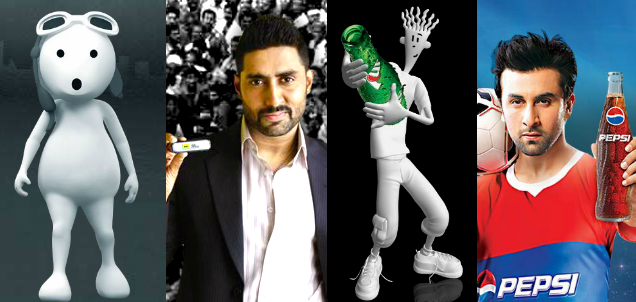
    Mascots can be regarded as the face of a brand. Be it the ‘Amul Girl’ who is a part of every household since 1967, ‘Chintamani’, 2005, the common man ‘RK Laxman’, 1954, ‘Maharaja’ 1946 or the latest ‘ZooZoo’. Mascots provide an identity to a brand which is equivalent to the brand itself.


    It was in the late ’90s when the advertising industry gained pace with more and more brands wanting to endorse themselves to reach out to the consumer is when the brands started associating with celebrities to create a mass appeal.  With Sachin Tendulkar, Amitabh Bachchan, Shahrukh Khan and every other celebrity promoting not one but half a dozen brands.


    So what does a consumer gets hooked to Sachin’s Pepsi commercial or Fido’s 7UP? Abhishek Bachchan for Idea or Zoozoos for Vodafone?


    Sameer Satpathy

    Says Sameer Satpathy, EVP & head, Marketing, Marico Ltd, “Choosing a celebrity or a mascot depends on your brand strategy. Both are a legitimate way to communicate your message.  The celebrity route has higher risk as you get both the positives & the negatives of your brand ambassador, but you can get results quicker as it only depends on the ability of your brand to leverage the equity of the celeb. The mascot needs to be built, invested into and in time can become a powerful and exclusive property. Also, certain categories lend themselves better to brand ambassadors like beauty brands and some categories to mascots for example brands targeted at children. For me the most memorable celebrity for a campaign would be Tiger Woods! J But for the wrong reasons.”


    Abhijit Avasthi

    According to Abhijit Avasthi, NCD, Ogilvy &Mather, “There is never a set rule whether a brand should go with a celebrity or a mascot. It mainly depends on the nature of the campaign. A well known celebrity face has its respective positives and so does a mascot. Though there is a great chance of a brand being lost in the clutter while using a celebrity. Mahendra Singh Dhoni is presently endorsing over 20-25 brands but when it comes to recalling a brand I can only think of 5-6 of those. Hence it is very important that the celebrity, if used, is used perfectly. For me the ‘Amul Girl’ and ‘Zoozoo’ are two of the most memorable mascots. When it comes to celebrities, I think Titan and Coke have used Amir Khan perfectly and so has Pepsi used Sachin.”


    It may be noted that a mascot is created by keeping in mind the brand whilst a celebrity being a mortal, may be a perfect choice to endorse a brand at a particular time but with time the image of the celebrity may change, which in return may or may not fit with the brand image.


    Ajay Kakar

    Says Ajay Kakar,CMO – Financial Services,Aditya Birla Group,, “It is true that a brand can ‘own’ a mascot. While a celebrity is an asset shared by many brands. But I do believe that both these mnemonics or devices are not necessarily interchangeable. Both of them have a unique role that they can play in the life of a brand. Now it depends on the specific brand, as to what is the desired role.


    “A celebrity can definitely create a more immediate pull for a brand, because the celebrity is already well known and has a fan following. On the other hand, a mascot may take time to ‘grow’ on its target audience. Similarly, a celebrity can help create a more emotional or personal connect, due to the ‘human’ factor. So, it is a question of horses for courses.


    “The Amul girl is a ‘mascot’ that immediately comes to mind. It has withstood the test of time, across ‘generations’. “As far as a celebrity-brand partnership is concerned, regrettably, today’s celebrities tend to take-on one too many brand associations, so it is difficult to associate them with any single brand. The two exceptions that do come to mind are Abhishek Bachchan and idea. And Yuvraj Singh and Birla Sun Life Insurance.”

    The fact also remains that a celebrity can give instant boost to a brand whereas a mascot needs time investment before it becomes a household name. At times a mascot may not click with the audience but the ‘non-click’ risk remains minimal in the case of a celebrity.


  • E-shopping hits busy young mums too

    [youtube width=”400″ height=”200″]http://www.youtube.com/watch?v=5zi9nBtflKY[/youtube]

    By Shubhangi Mehta


    Babyoye.com has come up with its first advertising campaign and it aspires to convey a series of messages to the new and young working mothers who are pressed for time. Babyoye.com gives consumers more than 120 brands and over 30,000 products to choose from. With just a click of a button mothers can avail the best products for their children.


    The current campaign was worked internally by them along with the production house. Their media agency is OMD.


    The biggest innovation that Babyoye.com is, by bringing world class baby and kids products at the click of a button thus enabling parents to spend quality time with their baby. By providing a wide variety of choice, parents can make an informed decision.


    [youtube width=”400″ height=”200″]http://www.youtube.com/watch?v=biWxrRxGsio[/youtube]

    Arunima Singhdeo, Director & Co- Founder Babyoye.com said, “We had initially been focusing on the digital medium which still remains to be a big promotional tool. However, we have recently started experimenting with offline mediums also and if the response is good, we will definitely continue with the same”.


    Babyoye.com is focusing on digital-led campaigns which are generally product-led. They have recently launched their own line of baby apparel. The collection has been designed very thoughtfully keeping in mind the new born essential needs.


    Apart from that, the brand campaign is currently being run on the offline mediums – TV and they are evaluating using other mediums as well. They are also in the midst of tying up with various brands that target kids to run a few co-branded campaigns.


    The focus area for babyoye.com in 2012 would be to add more and more product range and catering to higher age group of kids as well and building the brand name would remain a priority.


    On the association, Karisma Kapoor comments, “I was thrilled to shoot for this campaign. As I personally indulge in shopping from Babyoye.com, I truly believe that Babyoye is a convenient platform for new mothers with hectic schedules who can shop while baby is sleeping or while watching TV.”


  • The road ahead for Excluzen.com

    By Shubhangi Mehta


    The e-commerce boom has attracted a new player, Excluzen.com, a Delhi-based company offering luxury brands on the web. Launched in Jan 2012, the company aims to offer exclusive, tailor-made and personalized experiences to its members.


    The current size of the e-commerce industry is $11.2 billion with 8-10 million transactions a year. A lot of international luxury brands are providing their products and services in India through e-commerce channel. In November 2011 itself, 27.2 million online users in the age group of 15 and above accessed retail category from home. The fact that nearly 3 out of 5 internet users shop online speaks volumes about the impact and growth prospects of this industry.


    Excluzen not only provides premium brands but also lays emphasis on experiences that no other e-commerce portal offers, such as personalized charters, yachts, or group and individual coaching with pro golfers around the world. Also, some of the offers which are solely made for Excluzen members are not available under the respective brands.


    Urvashi Bahuguna Sahay, CEO & founder, Excluzen.com, said, “We don’t believe in the word ‘competition’. Excluzen is not a regular discounted portal. Even though online, it can customize and personalize services, right down to individual customers needs. The key target audience for us is HNIS, Corporate, SMEs, NRIs and Expats. Excluzen provides exquisite experiences for the customers.our major focus area is to position Excluzen as the finest brand and lifestyle experiences on the web. We have roped in Perfect Relations for our media relations and India Bulls for Digital ”


    The marketing and ad spend for the company is 30-35 per cent of its investment cost. They are also looking at magazine advertising. Excluzen has been doing below-the line activities like running a contest on its Facebook page. Online advertising is geared towards a user base outside India. They are targeting 50,000 transactions by end of next fiscal. The company is not following any advertising model but function on profit sharing with their partners where they charge 10-20 per cent of the product value as commission. They also have an ‘exclusive’ offering every month where a select partner can promote a limited edition product at a premium price and for this service, they charge higher margins.


  • Sriram Kilambi quits Radio Mirchi, GG Jayanta is new national marketing head

    By Robin Thomas and Shubhangi Mehta


    Sriram Kilambi who was the National Marketing Head for Radio Mirchi has called it a day. GG Jayanta Regional Marketing Head – South Radio Mirchi will be the new National Marketing Head. Prashant Panday, CEO, Radio Mirchi, confirmed the news to MxM India.


    GG Jayanta was the business head of Andra Pradesh for three years and Regional Marketing Head- South, Radio Mirchi and hence handled two roles simultaneously for Mirchi.


    Mr Kilambi will be serving his notice period till March end. It is being speculated that he might be moving to UTV.


    In May 2011, Sriram Kilambi, who was the Senior Vice-President and Cluster Head, ENIL Mumbai, had been promoted as Marketing Head for Radio Mirchi.


    Mr Kilambi has spent more than 12 years across FMCG and media sectors in various roles like sales, marketing, and customer management, and had started his career with Coca-Cola India in 1999. In 2006, he joined ENIL as Vice-President and Cluster Head, East, where he successfully ran the Kolkata station and launched the Patna centre.


  • Rajat Uppal is the new GM Marketing, Red FM

    By Shubhangi Mehta


    Rajat Uppal has quit Fever 104 FM and moved to Red 93.5 FM as General Manager- Marketing. On being contacted Mr Uppal confirmed the news to MxMIndia.


    In his new role, Mr Uppal will be responsible for strengthening the brand “RED” and drive all marketing initiatives of Red FM. Mr Uppal comes with close to 10 years of marketing experience across Liquor and Media Conglomerates like UB Group, Radico Khaitan, Reliance BIG Entertainment (BIG FM) & Hindustan Times (Fever 104 FM).


    Prior to working with Red FM, he was the Deputy General Manager- Marketing at Fever 104 FM (HT Media Ltd.)


    At Fever 104 FM, he was working as part of the national marketing team and handling marketing for Fever 104 FM, Fever Entertainment( Events Division) & FAT Productions, a new business venture of creating, aggregating and selling content for all digital media including, but not limited to, Mobile, Internet, radio, TV, CDs and other similar storage hardware devices. He was also responsible for managing key national campaigns for trade & consumer audiences besides spear heading online, digital & new marketing innovations.