Category: NEWS

  • AdAsia: Experiencing India

    By Tuhina Anand

    AdAsia 2011 has seen more than 1000 delegates registered from 25 different countries. While Indian delegates lead the pack as it’s the host country, there are also many delegates from different other parts of the world including UAE, Pakistan, Vietnam, Japan and Indonesia among others. At the venue of AdAsia one can see these delegates soaking in the Indian culture and cuisine and also attending the various sessions that comprise stalwarts from the industry from across the world sharing their insights with the audience. For some, travelling thousands of miles is standard networking practice, for others it’s a chance to know what is happening in the other parts of the world, learn from them and apply some of the discussed pointers back home.

    Anis Khan, the MD of Leo Burnett in Karachi, Pakistan says his reason for being at AdAsia is to get an opportunity to listen to his colleagues from across the world and pick up new learnings from their sessions and interaction with people. He said, “After the downturn in 2008, AdEx across the world has dipped though many countries have bounced back. I am specifically looking at understanding how different industry people from various countries have been combating this challenge. Also I would like to learn more on the alternate and digital media and I think the AdAsia platform will help me in this.”

    Chris Thomas, Chairman and CEO of BBDO Asia, Middle East & Africa, Chairman of Proximity Worldwide is in India as a speaker for one of the sessions. But besides that he is upbeat about the vibrancy and scale of discussions. He said, “The theme this year is interesting and content built around the various subjects around the theme is good learning. We do get an India perspective but also getting international and an external perspective to the theme. It gives us an idea how alive and kicking the industry is in Asia and particularly in India.”

    Then there are those like Keith Thomson, International Business Development Director, BlackLite Media FZ-LLC, an outdoor agency in UAE for whom the platform is a good opportunity to connect with people beyond UAE. He said, “While Arabic population is aware of BlackLite but I am looking at acquainting people with what we do beyond this geography and also people who are already spending in this market to connect with them and persuade them to allocate additional sum and look at our medium.” But Thomson says that the networking bit is bit restricted as he doesn’t know too many people here and will use the list provided by AdAsia to connect with delegates later on their emails. He says, “It’s work in progress.”

    Trung of Vietnam is at AdAsia with a group of 30 people from his country. His motive is to study and experience AdAsia and be ready when their country hosts AdAsia in Vietnam in 2013. He has one grouse though, that in his group, especially people in a slightly older age category, are not enjoying the lavish spreads laid out for the guests. There should be food that would appeal to their palate, he feels, as not everyone enjoys Indian food.

    Food is not a problem for Jerry S Justianto, Director, Masima (contents + channels) which runs a number of radio channels in Indonesia. It’s his first visit to India and he is enjoying the food to the hilt, “especially the dessert”.  He also finds a common link between middle-class Indonesia and India which he feels enjoy similar kinds of popular culture.

    The delegates have enjoyed the gala extravaganza and have talked about it with appreciation. But it’s not all work and no play – some have even managed a bit of tourism.  Yukinori Sasaki, Deputy Director, External Relations Office, Dentsu Inc, said, “Its my second visit to Delhi. I was expecting to meet lot of people and not just from advertising industry. I have managed that, but I didn’t get to meet many advertisers.” However, Sasaki has other plans on his itinerary which includes a visit to the Taj Mahal in Agra.

    Some delegates also shared what AdAsia should do differently next year. Mehwish Rafi, Chief Strategy Officer, Adcom from Karachi, said, “As far as knowledge, case studies and information goes, we have had a lot of it. But the sessions should have been more interactive. Even if there was an option of receiving questions online beforehand and then addressing those during the session, it would have made so much sense.” This definitely should be noted especially when one is talking about listening to consumers and how digital should be used, perhaps the industry should start practicing what it preaches.
  • Video Report: The new rules of engagement


    By Shruti Pushkarna

    [youtube width=”350″ height=”200″]http://www.youtube.com/watch?v=iQBVjzNGF9I[/youtube]

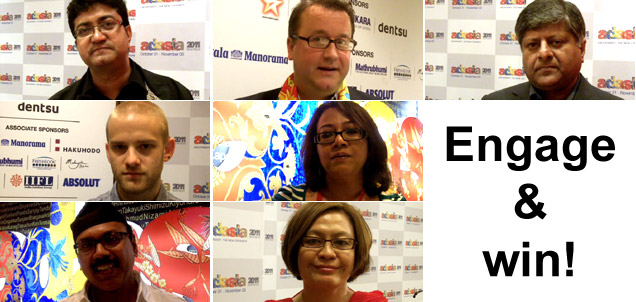
    Amid discussions at one of the biggest marketing, media and advertising meets, or AdAsia as we call it, one common thread to many a conversations was the changing reality of advertising from the consumer’s perspective. Several members of the fraternity expressed concern over the pressing need to ‘engage consumers’ in a fast changing world. MxM India caught up with a few to find out what really are the new rules of engagement.

    Keeping up with new technology and being able to deliver a digitally enhanced experience to the consumer is a growing area of focus but the underlying idea echoes the same old principle, ‘reaching out’ to the consumer.

    Prasoon Joshi, Chairman & CEO McCann Worldgroup India, Executive Creative Director of the Asia Pacific region and Chairperson, McCann Global Creative council said, “There are no new rules…it’s just that there is a new reality out there. You have to be able to understand the lives of consumers…I think if you are connected with your market, then rules or whatever you call them, will come naturally to you.”

    Furthering Mr Joshi’s view, Kelly Clark, CEO, Maxus Worldwide said that the new rules of engagement are the old rules of engagement and we have to start out by understanding customers’ relationships with brands.

    Shashi Sinha, CEO, Lodestar UM said that engagement has to come from a sum total of different activities, but foremost you need to know what the customer really likes and will participate in. Josy Paul, Chairman and CCO, BBDO India made an interesting point, saying that understanding the new rules of engagement starts from knowing that advertising might not be the only solution. Emphasizing on a collaborative model between advertisers, regional partners, PR partners and activation partners, Mr Paul said, “…it’s really about shedding your sense of the past and forgetting whatever you knew before but using your experience to assimilate and synthesize the new world.”

    Three rules of engagement recommended by Contagious Communications Consultant, Will Sansom are transparency, experience and meeting an unmet need. He said, “…First and foremost be honest…second rule is use emerging technology…and third is about identifying an unmet need and then meeting it.”

    Kitty Lun Chan, Chairman/CEO, Lowe China said that we live in exciting times where internet has revolutionized everything, and in this ‘socially-networked’ world, everyday new forms and new approaches of engagement are being created.

    Keeping it to the basics, Basabdatta Choudhary, CEO, Platinum Media underlined “relevance” as one of the constant rules of engagement in these changing times.

  • AdAsia: Change, the only constant


    By Shruti Pushkarna and Tuhina Anand

    [youtube width=”400″ height=”300″]http://www.youtube.com/watch?v=VswkUKXre-I[/youtube]


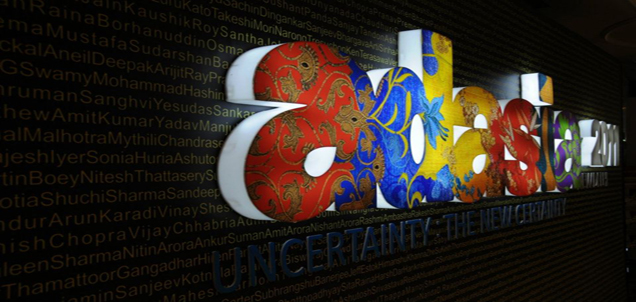
    The AdAsia 2011 conference opened to a jam-packed hall at the Taj Palace yesterday in New Delhi. Welcoming over 1200 delegates, Minister for Information and Broadcasting Ms Ambika Soni said who else but the government of India could understand the theme of this conference better, for which “uncertainty is truly the only certainty”. Going further with the Minister’s perception of change being the only constant, MxM India’s Shruti Pushkarna and Tuhina Anand caught up with a few delegates to see what ‘Uncertainty: The New Certainty’, the theme of this edition of AdAsia meant for them and their respective businesses.

    Through the sessions, speakers and delegates seemed to be in general agreement on how the world is changing rapidly, especially in terms of technological advancements, and it is the pace at which one adapts to this change that will determine how successful or unsuccessful one is.


    Michael Roth, Chairman and CEO, Interpublic

    Michael Roth, Chairman and CEO, Interpublic said that the focus is on change, and with the global economy changing, the highlight of this conference is the need to stay ahead of the curve in terms of new technology and new economies. While Piyush Pandey, Executive Chairman & Creative Director, South Asia Ogilvy & Mather also agreed that the focus of the theme is about keeping our minds open to change, he added, “It does not mean that you have to change tomorrow morning… but prepare yourself for the change, if you are not ready for it, you will get left behind.”


    Tom Doctoroff, JWT North Asia Area Director Greater China, CEO


    Tom Doctoroff, JWT North Asia Area Director Greater China, CEO, however also put some stress on consistency. He said while the theme of the conference might be provocative, we have to acknowledge that which remains timelessly true, like robust brand equity and big brand ideas.


    Vikram Sakhuja, CEO, GroupM South Asia

    Vikram Sakhuja, CEO, GroupM South Asia put it in simple terms, saying, “Uncertainty is the new certainty in the context of marketing primarily because communication to consumers has moved from a sequential, controlled, advertiser talking to consumer, to much more devolved, fluid and instant conversation with a consumer”.


    Ravi Deshpande, Chairman and CCO, Contract Advertising

    Talking about the correlation that the politico-social world shares with the sentiment or the idea of a brand in a consumer’s mind, Ravi Deshpande, Chairman and CCO, Contract Advertising said, “…You are bound to have an impact on marketing or advertising when the world around us keeps changing… if the world is uncertain, so are we in our business.”

  • AdAsia: From chat rooms to Twitter

    By Akash Raha

    That the digital revolution is already here, and is here to stay, is a given. But marketers are still perplexed on how to make full use of this phenomenon. In AdAsia 2011 a complete session was devoted to this very issue, and to be more precise, the subject of social media was discussed. The session in context was called ‘From chat rooms to Twitter… what next?’

    The panelists at this session were Kate Day, Communities Editor, Daily Telegraph Online, Arvind Rajan, Managing Director & Vice President, Asia Pacific and Japan, LinkedIn and Earl Wilkinson, Executive Director and CEO, INMA. The session was moderated by Rishad Tobaccowala, Chief Strategy and Innovation Officer, Vivaki.

    The session proposed that discussions were going to be a reverse of what this conference is about ‘Uncertainty: The new certainty’. What the session proposed was ‘Certainty: The new uncertainty’. It is certain that over the next few years the driving force will be social media. However, the uncertainty aspect is only what it means to marketers, media company etc.

    Ms Day said, “The question one often asks is, ‘What is the next big platform?’ My answer is it’s all about the people rather than the technology. Actually the underlying shift is with the patterns of behaviours of the people involved and audiences. Brand and customer relationship is the key. If that’s the case, then what platform is next does not matter because the people are here.”

    All the panelists stressed on the need to build consumer relationship and make the social media experience more real and humane. The consumers today want to interact with a human rather than with an automated interface, they want real conversation, moreover, in real time. It is essential to “get your own house in order and make the customers feel at home”. Also, often while we talk about social media, there are assumptions made about the product, content and consumers. Such clichés are something one should stay away from and not base one’s social media plans on them. Crating content and platform for ones invaluable customers is the key.

    FB, Twitter and LinkedIn are three global platforms, but as Mr Rajan said, the reason they are used still remain different. Twitter is a syndication platform. FB is for friends and family and LinkedIn is a professional network. The social media platforms are still new, there is still a lot to be done and lot of understanding needed. The essence is to have meaningful conversation with the audiences, connect with the customers and once that is done, it can be leveraged upon.

    Earl Wilkinson, of INMA also shared his learning in the field of social media apropos newspaper publishers across the globe. He pointed out how sharing has becoming the value added special sauce for journalism online. And in a way, he emphasized that digital times have saved journalism. Now that social media is here already, and everyone knows that communication is essential, the trick is how to structure the communication. For newspaper publishers, the way forward is going to be projecting newspapers and news brands as a trusted voice out in the community and the blog-sphere and get the audiences back on the websites.

    Arvind Tobaccowala of Vivaki said that the essence to being leader in social media space is differentiating content. Speaking about social media platforms he expressed hope for Google+. He said “Google is an amazing company… Believe it or not, Google+ will work, and it will work in a very big way. I don’t know how it will fit into broader eco system but it will be interesting to watch.”

    Pointing to sharing content on the social space as an interesting behavioural aspect and social media phenomenon, the panelists expressed hope that it will only grow further as it is a great way to engage with the audiences. Mr Tobaccowala also pointed out that on the social media space it is important to understand the behavioral aspects of the consumers. There are heavy users and heavy influencers. Right now the focus is less on heavy influencer… Heavy influencers can be further be divided into advocates and detractor. In a nutshell, he stressed that it’s imp to talk to detractors because they are the ones who are more vocal, even more than the advocates. Social media helps rediscover the idea of sharing in new and different ways to new and different audience. The essence is to start with Social media and start with it now. The panelists beseeched everyone to get on it and one might stumble upon something wonderful… “It is not necessary that you always know what you are doing,” said one of the panelists. Also, one should not look for any returns, one will get it eventually. Social media is new and still developing. Not everything that one experiments with comes out right, but one should try nevertheless. Ms Day emphatically suggested, “Don’t throw the baby out with the bathwater,” advocating that even if a few ideas don’t turn out right, it is a must to explore social media, as it is the big thing of the future.


  • AdAsia Exec Summary: Lively sessions mark Day One

    By Tuhina Anand

    AdAsia 2011 was inaugurated with the anthem of the Republic of AdAsia and a performance by the Shillong Choir Group.  This was followed by lighting of lamp by the Minister of Information & Broadcasting Ms Ambika Soni along with Dr Bhaskar Das, Co-Chairman of the Organising Committee and President, The Times of India Group and Mr Madhukar Kamath, Chairman Organising Committee for AdAsia and Group CEO and MD, Mudra Group. The flag for AdAsia was hoisted by Shahrukh Khan who also addressed the audience and reminded people of all the brands he has endorsed in his short speech. He however did emphasise that he believes advertising is not just for entertaining but about informing the consumer of a product so that when he or she is making a purchase he can make an informed choice.

    The keynote address was delivered by Mr Ram Charan, Author, Speaker and Business Advisor. The first session of the day was on ‘The Game Changers’ where Mr Harish Manwani, Chief Operating Officer, Unilever , and Chairman, Hindustan Unilever Ltd gave an insight into the company reinventing itself according to the changing times.  Mr Michael Roth, Chairman and CEO, Interpublic posed questions to Mr Manwani who answered all with aplomb. The key that emerged from this session was on the importance of adapting to the changing environment thus making the brands relevant to its consumers while at the same time being able to sell its products.

    The second session was on ‘Decoding the New Age Consumer’  where Mr Adil Zainulbhai, MD-India, McKinsey and Company Inc and Mr Laxman Narasimhan, Director, New Delhi, McKinsey & Company Inc, Mr Kochi Yamamoto, GM, Global Solutions Center, Dentsu tried to understand the behavioural pattern of the ‘New Age Consumer’.  The session gave insight into the changing world where the future remained uncertain and how marketers are grappling with this reality and trying to understand today’s consumers.

    Tom Doctoroff, JWT, North Asia, Area Director, Greater China CEO moderated the next session on ‘Asian Creative? A New Brief. On the panel were Akira Kagami, Global Executive Creative Advisor, Dentsu, Bruce Haines-Chief Strategy Officer, Cheil Worldwide, Kitty Lun, CEO, Lowe China and Piyush Pandey, Executive Chairman and CD, South Asia, O&M India. The panel gave an insight into creative from different countries where they operate including Japan, Korea, China and India. While Ms Lun talked about challenging authority and showing by example to help youngsters come up with great ideas. Mr Pandey brought into fore the relevant issue of remuneration where he stressed, ‘if you want good people, start paying them better’. Defending  standard of Indian advertsing, Mr Pandey said, “Just because a market is not in international domain for a century doesn’t mean that India is not into brand building.” He mentioned The Times of India and Cadbury’s advertising over the years that have made them successful brand in the country.

    Mr Kagami on the other hand who too was on the panel discussed the importance of corporate brand building that is critical in Japan as this helps in creating trust for thecorporate and its brands.

    Nikesh Arora, Senior Vice President and Chief Business Officer Google gave a ‘Google’ angle to his session where he began by asking people to put questions to him as QandA was not allowed in the earlier sessions. This set the mood for his session.  The next discussion was on ‘From Chat Rooms to Twitter…What Next?’. Kate Day, Communities Editor, Daily Telegraph Online, Arvind Rajan, MD and VP, Asia Pacific and Japan, LinkedIn, Earl Wilkinson, Executive Director and CEO, INMA were on the panel which was moderated by Rishad Tobaccowala, Chief Strategy and Innovation Officer, Vivaki.

    The last session of the AdAsia on Day 1 was on India 2020 where Kurush Grant, Executive Director, ITC, Sanjay Kapoor, CEO-Bharti Airtel Ltd, India and South Asia, Ravi Swaminathan, MD and Regional VP (Sales and Marketing), AMD South Asia shared views on how India can be made a truly global brand in the next 10 years. The session was moderated by Pankaj Ghemawat, Global Strategist.

  • AdAsia: Learning the rules of the game from Harish Manwani

    By Tuhina Anand

    So what does behemoth like Unilever do when a shampoo sachet priced at Rs 2 and projected at doing big sales doesn’t take off in the market? It focuses on listening to the consumers and gets an insight into why the market is not responding as expected. Then goes into reverse engineering which helps in bringing down the cost of the product, builds a manufacturing plant for sachets and prices the sachet at Rs 1, a pricing figure that consumers were more comfortable with thus getting the perfect recipe for success. This and many more such insights were shared by Harish Manwani, Chief Operating Officer, Unilever and Chairman, Hindustan Unilever Ltd (HUL) who was speaking at AdAsia 2011 on the topic ‘The Game Changers’.

    Mr Manwani termed HUL as the `emerging market company’ as the economic centres shift to emerging markets. In fact, 54 percent of their business comes from the developing market. But one of the lessons to keep in mind is that it’s not one India but many Indias and how one caters to such heterogeneous consumers is the key to succeed. Affordability and accessibility needs to be kept in mind but at the same time one has to make money too and that’s where consumer insight comes in handy. He also talked about having a sharper focus on shoppers than consumers.

    The key that also emerged from this session was Unilever’s belief in doing well by doing good like the project Shakti that has empowered women which has also helped them in selling their product. The strategy that has emerged is of making brands meaningful as well as brands that are marketed should have a social purpose. Mr Manwani said, “We have been ensuring that all our brands just don’t have functional benefit but also has social benefit.” In fact Unilever factories have been working relentlessly towards sustainability and creating products through innovation that would also help in bettering our environment.

    This shift can also be seen in communication that Unilever has adopted like in the case of Surf where initially the messaging was simple and talked about the whiteness that is the basic want from detergent to taking the route of saving and addressing the housewives the obvious customer for the product in famous Lalita Ji. The communication has now taken the route of saving two buckets of water, thus the brand becoming socially responsible. So there is a technology that helps in building product that is superior and then there is communication that helps in delivering a social message with brands that have social purpose. That’s Game Changers.

    He also pointed that power of brands will not change, power of consumer insights will remain and so will the ability to create great advertising and its power will remain unchanged but going forward what will change or bring about a change will be the advent of the digital medium, the ability to work with consumers, importance of 360-degree communication, having a strategic and not opportunistic relationship with the agency and creating tools that will help marketers in knowing exactly where there money is going when they spend on advertising.


  • Ad Asia set to take off

    By A Correspondent

    Close on the heels of the Formula One extravaganza comes the annual Asian advertising mela, AdAsia 2011, which begins tonight with an opening gala. The three days that follow will see sessions featuring some of the biggest names in the advertising, media and marketing fraternity take the stage and share their views with the more than 1,000 delegates from 25 countries who have registered for the event.  The theme of the congress is ‘Uncertainty: the new certainty’ but there is nothing uncertain about the buzz around AdAsia 2011, New Delhi.

    Over the 20 sessions planned for the congress, panels will share their invaluable experiences, insights and sharp analysis of ongoing events, providing new ideas, concepts and a firm handle on how the changes we are witnessing today will translate into trends in the future. They will go beyond analysis to address the question of ‘How’, and to elaborate innovative ideas and solutions to key global challenge.

    Some of the key members who will share their views include Harish Manwani, Chief Operating Officer, Unilever, and Chairman, Hindustan Unilever Ltd, Nikesh Arora, Senior Vice President and Chief Business Officer, Google, Indra Nooyi – Chairman & Chief Executive Officer, PepsiCo, Joseph Tripodi – Executive Vice President and Chief Marketing & Commercial Officer, The Coca-Cola Company, David Droga – Founder, Creative Chairman, Droga5, Kelly Clark, Worldwide CEO, Maxus and Mainardo De Nardis, CEO, OMD Worldwide among othes.

    Piyush Pandey, Executive Chairman and CD, South Asia, Ogilvy & Mather India will be part of a session on `Asian Creative? A New Brief’ which will discuss if Asia can lead the next creative renaissance, what is lacking to achieve this and how it can be tackled. There will also be a session on ‘Conversation as a route to driving certainty’. The topic will be addressed by Chuck Brymer, President & CEO, DDB Worldwide and Nikesh Arora Senior Vice President and Chief Business Officer, Google who has wide experience in various functions at Google. There will also be a session by BCG Japan on ‘Marketing to Women Consumers in Asia’ which will share insights and analyse traits of the Asian Woman Consumer and will try to ascertain whether her DNA affects her shopping habits. An interactive session with Luis DeAnda, Chief Operating Officer, TBWA\Hakuhodo, Japan will follow.

    Commenting on the Agenda and the delegate participation, Madhukar Kamath, MD & CEO, Mudra Group and Chairman of AdAsia 2011 said, “The amount of buzz and excitement this event has generated is truly incredible. I can confidently say that this is an Asian event that has caught the interest and attention of the world. Apart from Asia and the Middle East, even delegates from countries like USA, UK, Australia, Poland and Africa have registered for the event. The magnitude of the event this year is much larger than the previous years with nearly 50 speaker confirmations from across the globe. Delegates of AdAsia 2011 can look forward to intellectually thought provoking sessions of debates and discussions which will redefine how we look at the world we operate in. Speakers will include leading lights from the fields of business, marketing, advertising, media and communications.”

    This year AdAsia 2011 will also be different as it will bring to attention, provoke debate, and challenge the minds present to think of providing creative solutions to one of the critical issue on ‘The girl child’. During the AdAsia, this effort will surface in different aspects and areas of the congress. It will include a special presentation dedicated to ‘The Female Equation: Communicating with Conscience’  by  Frederika Meijer, Representative – India & Country Director- Bhutan, UNFPA.

    AdAsia began as a three-day Asian Advertising Conference in 1958 sponsored by the Japan International Advertising Association (JIAA). The principal objective of the conference was to give Asian advertising a boost in the post-war era. The conference was attended by delegates from six countries including Japan. The modest conference grew into a congress in the 1960s and was named AdAsia in 1984. AdAsia2011 is being organised under the aegis of the Asian Federation of Advertising Associations (AFAA).

  • Epsilon aims to win customers over for good

    By A Correspondent

    Perhaps one of the most challenging tasks for marketers today, in a scenario where competition is burgeoning, is to convert existing customers into loyal customers. And of course, the bigger challenge is how to retain them for a long period, how to ensure they move hand-in-hand with the brand through its evolution phase in the marketplace. The challenge can be even more significant in categories such as telecom and financial services, where a huge number of players are eyeing to out-size each other in terms of new customer acquisitions.

    “The trick is to do effective loyalty programmes,” says Adrian Hoon, Vice President, Sales, APAC, Epsilon International. Epsilon is a multichannel marketing services company that specialises in Customer Experience marketing and Mr Hoon along with his key members of the team are in India to talk to marketers and the trade on the importance of loyalty marketing and the services they provide.

    The company, in association with LoyaltyOne, specialists in loyalty programmes, has released a detailed report that seeks to identify underlying differences in cultural approaches in six countries; three emerging economies – India, China and Brazil and three developed countries – United States, Canada and Australia. Mr Hoon says that the report has enough insights that talk about consumer behaviour in the six markets, and how brands, particularly in India and China can make best use of loyalty programmes to service consumers for many years. He further states that when companies know they need to practise loyalty marketing, they aren’t sure about how to do that on an ongoing basis.

    The scope of the research spreads across consumer attitudes, preferences, and behaviours.

    As far as India is concerned, the study says that more than 40 per cent of Indians are eager to join loyalty programmes.

    Key findings from India


    • Word of Mouth (WOM) is a big factor when it comes to purchase decisions. WOM conversations are rated at 7-8 on a 10 point scale in India, in terms of importance. And that’s a good 15 – 25 per cent higher than developed countries. This insight is of great significance for brands looking to create early adopters and loyal ambassadors.


    • Indian consumers are fairly optimistic about the country’s growth, with 34 per cent of Indians feeling strongly that the country’s economic prospects will improve over the next decade.
    • 42 percent of Indians belong to at least one reward programme, it is significantly lower than American counterparts, 74 per cent of whom are enrolled in such programmes.
    • 20 to 33 percent of Indian consumers are “extremely loyal” to their favorite brands across six major categories — clothing retailers, grocery retailers, financial services providers, dining, auto fuel and travel providers.
    • 56 percent of Indians believe that most businesses can be trusted. This is significantly higher than all other countries surveyed. A high number of Indians (56 percent) also seem to have inherent trust towards international brands over domestic brands.
    • Email and text messages rank No 1and No 2 respectively as the preferred means of receiving marketing messages among India’s middle class consumers, beating television and print advertising.


    The survey was carried out online with a sample size of 500 for the Indian market (A sample of 1200 d was taken for developed economies – US, Canada and Australia). Interviews were carried out across segments: SEC A, B and C.

  • MxMIndia partners ‘Paid News’ event

    By A Correspondent

    MxMIndia has partnered the event ‘Paid News: Fooling People all the Time’ organised by Moneylife Foundation and Citizens Action Network with the support of industrialist Cyrus Guzder.

    To be held in Mumbai’s Madame Cama Hall (Opp Lion Gate, Kala Ghoda) on Friday, November 18, the evening will see the screening of the documentary ‘Brokering News’ followed by a panel discussion with senior journalists and the film-maker Umesh Aggarwal.

    About the film: The Delhi-based non-governmental, not-for-profit Public Service Broadcasting Trust (PSBT) recently released a documentary titled “Brokering News—the inside story of paid news”.

    The film by Umesh Aggarwal addresses a significant challenge facing Indian democracy today—which is the state of its media. The film looks at three aspects of paid news—how politicians are paying for positive coverage during elections, with the result that those who don’t pay are blanked out by the media; how the coverage and reviews of movies are orchestrated and paid for and of course, paid news about business and industry. It depicts in detail how journalists were forced to broker deals to offer editorial coverage to politicians.

    Details of the Event:

    Panelists: Umesh Aggarwal, Ayaz Memon, Paranjoy Guha Thakurta, Bhawana Somaaya, and Sucheta Dalal.

    Timings: 5.30-7.30pm (Registration and Tea starts at 5pm)

    Venue: Madame Cama Hall, KR Cama Hall Institute, Bombay Samachar Marg, Opp. Lion Gate, Kala Ghoda, Mumbai 400 023

    Admission: While admission is free, please register well in advance. Contact details: Call Judith/Seraphina on 022-24441058-60, or mail at mail@mlfoundation.in,or log on to www.mlfoundation.in

    While MxMIndia.com is Media Partner of the event, other media organisations (including trade media) are welcome to register and cover the event

  • Newspapers: Reinvent or Perish?


    By Tuhina Anand

    The newspaper industry is undergoing transformation and the only way ahead is to look within and reinvent. While it may be too much to say that for the print industry the only option is to reinvent, else they will perish, but it won’t be far from the truth to say that if they don’t adapt to the changing times they will be groping in the dark and will only pave the way for their downfall. Early adoption and partnership with technology are a few ways by which the industry can look at transforming itself to cater to the Gen Y.

    Expressing his view, Mr I Venkat, Director, Eenadu, said, “Yes, we have to reinvent. I think the time has come when we no longer can continue in the traditional way. While the future of newspapers in India is still strong and will be for at least for 10-15 years and what happens henceforth I can’t really say. But in that time period, one should have reinvented and come up with multiple platform and strengthen them so that they become established models to generate revenue.”

    He maintains that printed word will remain sacrosanct though the content would undergo change to meet with the various platforms. In fact, Mr Venkat points that even now the way news is being consumed is changing where they have witnessed a significant rise in people coming to digital platform to access news.

    Shahrukh Hasan, Group Managing Director, Jang Group, Pakistan is of the opinion that the newspaper industry would not perish even if they don’t reinvent because there is lot of inherent growth still left in the print business. He said, “That said, I think reinvent I would, even if there are no threats as it is imperative for our continued growth. As it happens the print media is under lot of strain and we have seen globally it has been losing readership but in our part of the world the fundamentals that drive the business is strong, like literacy rates going up, growing middle class, migration from rural to urban areas, a very young population and the erosion of the joint family system. These are factors which impact growth and circulation. In fact they are all working in our favour.”

    “The important thing is that we have to realize that the business we are in is evolving and we have to adapt for that reason. We have to abandon tradition and adapt to reengineer to remain relevant. We are not competing with new media or television but we have to adapt in terms of how we process the news and understand what kind of news we have to provide to our readers in these changing scenario where different platforms with different speed of delivering news exist.”

    While Mr Hasan points that reinvention is not necessary but he will still go with it to be future ready. There is also another opinion which stresses that the newspaper business doesn’t need to be reinvented but it’s the newsroom that need to reinvent. Sanjay Gupta, Director, CEO and Editor, Jagran Prakashan Ltd, said, “Newspapers will remain. It will never die and it’s seen that in the most advanced economies where digital has taken over newspaper still exist. But it’s their relevance to the marketers that is changing.” Newspapers may not be relevant to the marketer as a touch point because of more varied and systematic approach that digital offers and for media companies to make journalism sustainable, Mr Gupta points that there is need to go into different revenue streams and digital comes into play in that aspect.

    So the interesting point that comes in this discussion is the decreasing relevancy of newspaper to a marketer hence bringing the digital platform to up the revenues. Also many media company pointed of unbundling of packages to advertisers that comprised a 360 degree approach.

    Reinvention in terms of digital may be the mantra for many to follow but for KN Tilak Kumar, Joint Managing Director and Editor Deccan Herald, the potential in print in its existing avatar is immense.  He said, “There is a lot of scope for print media especially rising population, growing literacy and urbanization signify that there is a lot of potential for print media to grow. We have been trying to reinvent in terms of content, design and layout. Digital is the future but it’s not a concern In India as we see it now.”

    Content is the key and even for Prabhat Khabar’s MD, KK Goenka. He reaches to his consumers in Bihar, Jharkhand and West Bengal and the paper has reached the status of the 7th largest read Hindi daily and this has happened primarily by the physical newspaper. Digital he says doesn’t play a role in the growth of his paper but yes content is the key. He says, “It’s the credibility and trust of people that we have built over the years that is responsible e for our success. It’s the issue that we have taken that is no less than a movement that has helped in building what Prabhat Khabar is today.”

  • Yesterday’s story: Keerthivasan tunes out of Fever, Harshad Jain is new biz head

    By Ritu Midha

    S. KeerthivasanMr S Keerthivasan, CEO, HT Music and Entertainment Ltd, has decided to call it a day. Mr Keerthivasan, who is currently pursuing higher education at the Kelloggs Business School, plans to explore new opportunities once he completes his course.
    The responsibility of Business Head, Radio would be now handled by Mr Harshad Jain, who is expected to join the organisation shortly. He moves from Airtel DTH at Bharti Airtel Ltd. Prior to which he has also spent productive time at Pepsico and Worldspace India.
    Praising Mr Keerthivasan for his achievement at HT Media, an internal communique by Mr Rajiv Verma , CEO, HT Media, states, “Under his leadership and sharp focus, the radio business has done very well. In five short years,  Fever has become one of HT Media’s most successful businesses with annual revenues poised to cross the Rs 100 cr mark, exiting on a growth of almost 70% last year. “ He adds, “While he will certainly be missed, I am sure he will be very successful and be of great value to any team he joins. I wish him the best of luck in all of his future endeavours.

    Mr Keerthivasan joined HT Media in 2004. He has over 15 years of experience. In HT Media, he spanned various large leadership roles including Head – Business Excellence, where he was instrumental in creating a blueprint for future development of the division. Mr Keerthivasan has also been CFO of HTML. He has previously worked in companies like Whirlpool, Xerox and A F Ferguson and is a Chartered and Cost Accountant by qualification.

    Picture: From the HT Media website (http://www.htmedia.in)

  • Business Standard celebrates use of Hindi in biz

    By Akash Raha


    Business Standard Hindi recently celebrated Hindi Diwas and activated the initiative which was aimed at promoting the use of Hindi language in business parlance. This initiative of Business Standard is going to commence at the end of this month. The tag line for this initiative is “Behtar Business woh, jo aapke bhaasha mein ho!”


    Speaking on necessity and efficacy of spreading the business language in Hindi, Mr Arun Natesh, Head-Marketing, Business Standard said, “This initiative was important as there are a lot of people in the country do their business in Hindi, because that is the language of the masses. But inspite of that, there are a lot of words and terminologies that people use that is not easily understandable as it lacks homogeneity. So the idea is to promote business terminology and language in Hindi. Since our newspaper gives them comprehensive information on business, our initiative empowers them in understanding the effective terminology of use.”


    For this initiative, they compiled a special pullout which looked at the usage of the Hindi language online, in mobile and the growing interest globally for the language by the likes of Microsoft and Google.


    As a part of this initiative Business Standard organized quizzes testing knowledge of business terminology. Enthusiastic participation was seen across Mumbai, Delhi, Lucknow, Patna, Bhopal, Raipur and Kolkata. Business Standard went to the premises of organizations like SBI, LIC, Allahabad Bank, NABARD, BHEL, Bhilai Steel Plant, Bank of Baroda, Union Bank etc.


    Business Standard, in Hindi, reaches out to small and medium entrepreneurs, traders, small investors etc. Keeping this focus, the paper itself is designed around meeting this need by adding locally relevant content. Business Standard also brings to the reader what its editorial team is famed for – incisive and in-depth analysis of events. In recent times, the paper has strengthened the coverage of local commodity information immensely benefiting the large trading community.