Category: MxM JOURNALISM REVIEW

  • Ranjona Banerji: Journalism touches new low with Essar leaks expose

    By Ranjona Banerji


    As the Indian media was trying to cover the Union Budget in as dramatic and in some cases as unbiased a way as possible, it was being hit by an internal crisis. The Indian Express has published internal correspondence between employees of the industrial giant Essar which reveals that favours were done not just to politicians but also to senior journalists across media houses. The result is that at least two have lost their jobs and others will follow.


    So far, Sandeep Bamzai has resigned as editor of Mail Today and Anupama Airy as energy editor of Hindustan Times. The other people named in the leaks from Essar include Meetu Jain of Times Now, Mayur Shekhar Jha of News24, Dev Sharan Tiwari and Shereen Bhan of CNBC.


    There are also allegations that Tehelka attempted to spin stories in favour of Essar since Essar was a sponsor of the magazine’s “Think” festivals. Other journalists in Jharkhand seen as “sympathetic” to Essar also got various favours.


    Interestingly, most of these favours as seen from press reports seem to consist of offering cars and cab services, hosting parties for journalists and allowing them to use Essar facilities like guesthouses. By any of today’s standards when it comes to freebies, these are small cheese. But judging from the way top journalists have resigned, one suspects that the actual transgressions are much bigger.


    Indeed, as anyone in journalism knows, ethical standards when it comes to accepting favours and junkets have practically vanished. It more or less depends on the personal value system of every journalist. For the past 15 years at least, managements have even encouraged journalists to accept particular favours, if it cuts down on their newsgathering costs. In the worst case, the hand-over-fist bartering of editorial space in newspapers by journalists led to Bennett Coleman introducing Medianet, so that the company could take over the sale of news space.


    As the fight between Airy of Hindustan Times and her bosses shows, the lines have become very blurred in media houses, over what is acceptable and what is not. At the risk of sounding unbearably self-righteous, when I started working in journalism in the 1980s, nothing was allowed. Colleagues who were caught accepting favours lost their jobs. Within 10 years, all that had changed. Managements encouraged journalists to go on junkets. Business press conferences were all about gifts which were flaunted around offices. Senior editors openly wrote puff pieces about politicians and were rewarded with flats.


    Just about every media house which raised its eyebrows when the Times of India started Medianet has since succumbed in one way or another. One very senior journalist who wrote very strong pieces against Medianet was exposed by the Radia tapes. If Medianet is restricted to glamour news, the phenomenon of “paid news” refers to the pages once seen as sacrosanct. Business sold out long ago. At the risk of being dramatic, there is no part of a journal or a broadcast which is not for sale.


    The Radia tapes dented the credibility of all of us. The Essar leaks have pushed us to a new depth. Or rather, Indian Express has exposed to the public what we within the profession already knew. Contrarily, I can only hope that this is just the opening of the can of worms. For a profession that is so sanctimonious about corruption in other fields, if we cannot clean our own stables then we deserve all the opprobrium placed on our heads. I can be even more self-righteous and say that if we do not take heed then we are doing not just ourselves but democracy a disservice.


    The Indian Express expose: http://indianexpress.com/article/india/india-others/essar-leaks-2-journalists-resign-third-put-on-notice/

    http://indianexpress.com/article/india/india-others/wooing-politicians-with-high-end-phones-journalists-with-cabs/99/

    The Tehelka angle: http://www.dnaindia.com/india/report-essar-links-take-its-toll-on-media-2064909

    The Airy-Hindustan Times fight: http://www.newslaundry.com/2015/02/28/allegations-and-counter-allegations-at-hindustan-times-after-essar-leaks/

    **


    After this, are you really interested in the Budget? You haven’t had enough of it? I have!


  • Vinod Mehta: I just want to fade away quietly (Text + Video interview)


    This interview with Vinod Mehta was conducted in November 2011 soon after the launch of ‘Lucknow Boy’. As we look at the late Editor’s life and times, we replay this interview – in text and video – which so effectively captures what made him such a great journalist. Read on…


    By Shruti Pushkarna


    Soon after he launched his memoirs ‘Lucknow Boy’ in the capital, MxM India caught up with Mr Vinod Mehta, Editor-in-Chief of Outlook magazine, for an exclusive interaction in his Delhi office. He spoke at length about his memoirs, his editorial journey and of course, his dog, Editor.

    Prior to his memoirs, Mr Mehta has also authored biographies of Sanjay Gandhi and Meena Kumari. In 2001, he also published a collection of his articles under the title, ‘Mr Editor, How Close Are You to the PM?’

    Popularly referred to as ‘one of the most independent editors’ of our times, Mr Mehta has founded and edited numerous publications, including The Indian Post, The Independent, the Delhi edition of The Pioneer and also India’s first Sunday paper, the Sunday Observer. At present he is the Editor-in-Chief of the Outlook Group, which brings out ten magazines including the weekly newsmagazine Outlook.

    Q: Tell us a little about your memoirs.

    It’s not just my life that I am presenting; it’s a snapshot of India from 1974 when I started, to 2011 which is now. And I am giving you a kind of history of India from that period, a personal history as I have seen it. So it’s more than my life, it’s a history of India – and whether they agree with my version of history or not, that’s another point but I have tried to present people, places, incidents that I saw and I interacted with since 1974. In that sense, this is not just about a journalist writing about his life, it’s about a very important period of India’s history which should be remembered, and I hope that I got some of it right.

    Q: Why Lucknow Boy? You’ve always prided yourself as a Bombay Boy…

    No, I was born in Lucknow, and studied in Lucknow and I reached Bombay much later. So I called it ‘Lucknow Boy’ because I am, my education etc. was all in Lukcnow.

    Q: Was it tough writing a free-and-fearless memoir? Especially the admission about your daughter?

    Well, these things are never easy but if you’re writing a memoir then you have to tell the story of your life and you must tell it in its entirety, the good and the bad. So you can’t hold anything back, otherwise it’s half the story.

    Q: Anything that you’ve not mentioned in your memoirs? In hindsight, would you have liked to include anything?

    No, no; I made sure that everything that I wanted to put in my memoirs, I did put in my memoirs. There were so many other things which were not important, the more important things I’ve put in my memoirs.

    Q: Given that you had moved jobs rapidly before Outlook, what’s the secret of your lasting so long with the Rajan Raheja group?

    Well, I’ve been here for 17 years and I think the mean reason is the fact that I got the kind of editorial freedom which I didn’t get elsewhere, so I lasted so long – because I was allowed to do my work, and I was allowed to produce a magazine according to what I thought was right, and what my colleagues on the staff thought was right, and there was very little or almost no interference from the proprietors.

    Q: We missed you at the World Magazine Congress. Why were you not there?

    Well, I am told the magazine congress was mostly about the management side of things and not editorial, but I wasn’t invited.

    Q: If given the opportunity, would you like to edit a daily newspaper again?

    No, I’m too old now. I’ve done three daily newspapers and now I don’t want to do anything new. I’ve reached the end of my career so I just want to fade away quietly.

    Q: Wouldn’t it have been good to have an Outlook current affairs programme for television, if not a full-blown channel?

    No, we thought about this many times in Outlook and nobody in Outlook, including the proprietor, was very interested in television, simply because there were so many other… there are already about 300 news channels. So we felt that we couldn’t provide anything new or different and we were quite happy with print. And since I’m mostly interested in print, I didn’t show any great interest, neither did the owners, to get into television.

    Q: Your word of advice to a wannabe media baron?

    Well, my advice to a new media baron would be – don’t get into this business if you are just interested in making money. This is a business where, of course, profits are important but this goes beyond profits. So if you have any kind of commitment to the country and if you can withstand occasionally some kind of losses even to your investment, then get into the business. But if you are getting into the business because you think there are profits, or you think that you will have great political clout in the government etc, then those are all the wrong reasons for getting into publishing.

    Q: And your advice to someone working with a wannabe media baron?

    Be good at your job, that’s very important. Whatever you do, you must be very good at your job, outstanding at your job; therefore if you are outstanding at whatever you do, if you are sub-editor, or a correspondent or a photographer, if you are outstanding in your job, somebody somewhere will always hire you.

    Q: Debonair is dead. Would you like to revive it?

    No, that was just the beginning of my career and I wouldn’t like to go back there. But the seven-eight years that I spent there were very interesting, and I learnt a lot in that period.

    Q: Back to the book: worried about it upsetting anyone? Vijaypat Singhania?

    I don’t think so, because I’ve been fair to everybody. In his case, he was also under a lot of political pressure so I had full sympathy for his situation, where between Indian Post and his own business interests, he couldn’t sacrifice his entire business interest because at that time you had this license permit raj and the government would be active in economic affairs.

    Q: Did you read those barons wrong… Singhania and Thapar especially? And Ambani and the Jains?

    No, I didn’t read them wrong because they also I suppose, did not realize how difficult it is to be a media baron at that time, I am talking of 1980s and 90s, when businessmen who had say 5 percent interest in publishing and 95 percent interest in other things. If they attacked the government, then their other business interests would suffer, and I don’t think they fully appreciated this.

    Q: Any career regrets?

    Oh, I think there are always some regrets, some things that you should have done and you didn’t do. But by and large, I think I have played it by the book, as I say. I have no regrets. I think life has been very fair with me.

    Q: Do you think the news TV folk sensationalize more than inform?

    Yes, I think there is some need for self-regulation, there is some need for accountability. You can’t have a free-for-all as far as the channels are concerned. And I think most channels now are realizing that they are losing public support; the most important thing is their viewers’ support and therefore they need some professional guidelines. There is that appreciation now and I think that in the next few months, you will see something, some self-regulation.

    Q: We know you don’t agree with this, but still: do you think news only constitutes current affairs and matters of national importance?  For instance, would current affairs only mean political news or also whom Ranbir Kapoor is dating?

    No, I think current affairs is current affairs, anything which is current, for example, film stars, Aamir Khan made a film called Peepli Live , that was very much part of news. Entertainment is part of news, entertainment and news are not separate, but I think that there is a place for everything. Entertainment has a place, national politics has a place, everything has a place. So you must find the right balance I think; that’s the job of an editor.

    Q: Is there a need for a Press Council-like body, or should the print media too have a NBSA- like self-regulator?

    Well, we do have a Press Council but I think even the print media now realizes that the Press Council doesn’t have any teeth, doesn’t have any punitive powers. So, there is some need even in the print media for a new set of guidelines.

    Q: Your dog is called Editor. If you had another dog, what would you call it?

    Editor Junior. Well I have already got Editor Senior so I got Editor Junior now. But I can’t keep another… We tried to keep another dog, my wife was very keen that we should have two dogs. But Editor wouldn’t just allow another dog to come in. So we tried once or twice, actually brought a dog into the house but he made life hell for that dog, so we finally had to give him away to somebody because he is very possessive and he likes 24/7 attention.

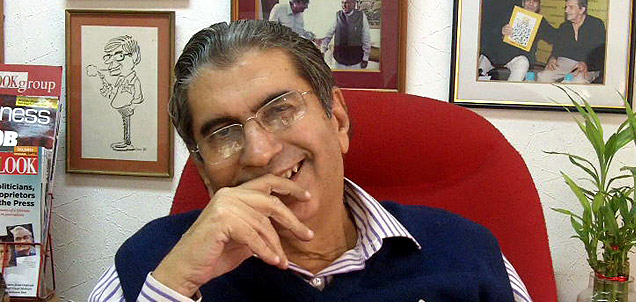
  • Vinod Mehta (1942-2015). Editor of Editors


    By Ranjona Banerji


    To the reader, Vinod Mehta was a witty, self-deprecating columnist while to the TV news watcher, the man who appeared on TV with a drink in his hand and a joke to share. But to the journalist he was an editor of editors. An editor who stood by his staff, who stuck his neck out for a good story and who did not bend to his own advantage as political winds shifted. If he did not win everyone’s love, he certainly gained almost everyone’s admiration.


    It is almost impossible to explain just how Mehta had that editor’s touch. It is not that he did not make mistakes and paid dearly for it when it came to both the Indian Post and The Independent. But more than that, Mehta had that ineffable instinct for the fresh and the refreshing. He did away with the pompous gloom associated with an editor’s office and instead imbued his publications with that terrible cliché: both style and substance.


    This was evident in every publication he touched, from Debonair to Sunday Observer to Indian Post to Independent to Pioneer to Outlook. He also had those other qualities which sets a great editor apart from a self-important bore: he was irreverent and able to laugh at himself. This saw him in good stead through his career in journalism and possibly his life.


    His last great story for which Indian journalism should be permanently grateful is the publishing of the transcripts of the Radia tapes. Between his Outlook and Open magazine, then edited by one of his protégés Manu Joseph, the world discovered the invidious links of power and payment between corporates, politicians and senior journalists. Eventually, the story cost him his job at Outlook, largely thanks to the ire of Ratan Tata, and he was removed from the newsroom which he ruled for 17 years to a more ceremonial post. It seems fitting in a way for an editor who was one of the last to be willing to risk management wrath for a good story.


    His last two books, Lucknow Boy and Editor Unplugged, told his story in his own words and no one can do it better. He has written about his successes and his failures, both professional and personal. His style is intact in both although Editor Unplugged is somehow darker. Both should be required reading for all journalists, old and young.


    The media is full of stories of personal tributes for Mehta. Many have wished that they could have worked with him and that is, undoubtedly, the best tribute any editor could wish for. It is ironic that in this age of journalists taking selfies with politicians and behaving like fangirls and fanboys, Mehta who did neither, managed to attract India’s top politicians to his funeral. Perhaps there is a lesson there for young journalists – you can earn respect even of people you disagreed with if you have professional integrity. Given the state of Indian journalism today, yes, I am laughing as I write these words.


    Mehta has been lambasted for being unabashedly secular and was often accused of being a Congress stooge. He discusses this in his books as well. The letters page in Outlook was full of such accusations and Mehta was courageous enough to carry all the opinions against him while sticking to his own stand.


    Of the several tributes, one of the most ungracious comes from veteran columnist Swapan Dasgupta on Twitter who appears to have dismissed Mehta as a gossip with facile political understanding. This might seem a bit rich coming from someone who propagates through his columns the point of view of the BJP but that is Dasgupta’s prerogative and he has his right to his own opinion. It is a cheap fallacy that once a person is dead he or she must be universally praised. However, as every journalist worth his or her salt knows, gossip is the cornerstone of our existence.


    I never worked with Mehta and I do not build my life around regret. But I did meet him a few times, the last when he was given the Lifetime Achievement Award for 2012 by the Mumbai Press Club. Having a drink after the event, he looked around him and asked me, “Are these people really journalists?”


    It was a good question then and remains one now. How many of us really are any more?


  • Ranjona Banerji: News or Entertainment?

    By Ranjona Banerji


    This is a story which I heard the other day. A friend who lives abroad went to a restaurant in Mumbai one evening to get some food packed. He found that the TV screens were all on Arnab Goswami and Times Now. He asked the owner how he could bear it. The owner laughed and said, “But sir, this is more entertaining than any soap or serial.”


    I write this as several media commentators have made some very succinct, incisive and well-argued comments on the damage done to journalism by Goswami in his crusader mode, especially when he fought for India’s image with his #NirbhayaInsulted hashtags, railing against the India’s Daughter documentary.


    However, I might want to argue that in many ways TV in India has gone beyond journalism. There is almost no space for the boring, anodyne, journalistic stuff any longer. It’s now all hysterics, outrage, anger, reaction and provocation. And finally, you just have to laugh. I would argue that Goswami is a pioneer in India who has redefined TV news. There was a time when I compared him to Howard Beale in Sidney Lumet’s 1976 classic Network. But Goswami has gone beyond Beale and created a distinct and enviable persona of his own. The mood at dinner time or in drawing rooms rises and falls to the cadences of his voice as he builds up his case for the night.


    And whether they admit it or not, half the news anchors in India either emulate, copy or want to be like him. There are a few who are hanging on to their shreds of sanity. And there are some star TV anchors who bemoan what TV has done to journalism. But those are just the last remnants of a lost civilisation.


    News is now entertainment in India and it will take a revolution to change that.


    **


    The most intriguing love-hate relationship in India is between TV journalists and the Aam Aadmi Party. When it was the India Against Corruption movement, TV loved it. TV cameras exaggerated crowd figures as did reporters. TV anchors made us believe the whole country had come to a standstill. Even I believed it and dragged a friend interested in politics to Azad Maidan with me to watch this phenomenon. It was sorely disappointing to watch a straggling crowd of a few hundred when I had been led to believe it was thousands. Luckily, the Mumbai Press Club and cheap Old Monk is close enough to drown all sorrows and outrage at TV, er, lies.


    That was 2011. Since then it was been a very rocky relationship between TV and Kejriwal and clan. No other political party in India, and this is in spite of all the efforts of Sanghi trolls and Congi agents, has been under such close scrutiny as the AAP. Every move it makes or doesn’t make is analysed in high decibel theatrics.


    The AAP has been peculiarly obliging to the media too, letting itself and its supporters down with clockwork regularity. All its shenanigans seem to be made for TV too, with sting operations and press conferences and public dissent and revolution. AAP and TV media are now involved in one of those symbiotic or parasitic relationships you read about in nature, where one organism cannot survive against the other.


    All the established parties can spend millions and try as much as they like to win PR battles. AAP has figured out the publicity game perfectly even if it is often to its own detriment.


  • Ranjona Banerji: Stand-outs in the world of selfie-taking journos

    By Ranjona Banerji


    The conversation continues to be about internet sites which provide a higher class of journalism than many mainstream newspapers. This is mainly because so far they run on investor money and not advertising or corporate pressures say the cynics and cynics are usually right. The focus for all journalists therefore has to be how to find a better mean between money and good journalism. The money is necessary, no point pretending that it is not and taking a Commie-leftie position on it. A state-sponsored media is no media at all (I leave aside for now all jokes about how many senior journalists and media houses have become de facto PR agencies for the current government).


    Meanwhile, congratulations to Supriya Sharma of scroll.in for winning the prestigious Chameli Devi award for an Outstanding Woman journalist for 2014-15. Sharma is the first online journalist to win this award and has done some ground breaking work for scroll on election coverage, the “ghar wapsi” programme of Hindutva rightwing outfits and workers’ security. Scroll.in has been praised here and elsewhere for the excellent job it has done in promoting old-fashioned journalism based on hardcore reporting. The future is here.

    http://scroll.in/article/713959/Scroll.in’s-Supriya-Sharma-wins-prestigious-Chameli-Devi-Jain-award


    **


    The Indian Express stands out as a newspaper which has been doing great stories, sticking to news gathering and taking difficult positions. This is not new for the Express which has a long reputation of being effectively and consistently anti-establishment. But the recent months have seen the paper step up the ante when others have succumbed.


    One understands that journalists based in Delhi are under tremendous pressure, almost as much as bureaucrats are. But is this enough reason for the sort of sycophancy and cowardice some of these journalists display? It is particularly disappointing to see middle level journalists – those ready to handle the reins – falling to the level of autograph hunters. How else would one describe this trend of taking “selfies” with politicians?


    The poor Aam Aadmi Party must be wondering however why it can never get that level of “luurrrve” which Narendra Modi and Amit Shah of the BJP manage to garner. AAP, having built up expectations in the media and with the people of Delhi is under very close scrutiny from journalists. Modi, Shah and the BJP however have been given a comparatively longer rope.


    The tragedy which these middle-level journalists have not understood yet is that eventually, the rope will win. And all those selfies may not be quite so useful then.


    I decided when I started writing this that I would not either take on or mention Arnab Goswami of Times Now. But I do it now to agree with him – the cosy club of Delhi journalists is one which needs to be challenged and taken on by all those in the media who live and work in the rest of this vast and wonderful nation.


    **


    Having started off by praising internet sites for the new blood and enthusiasm they have transfused into traditional journalism, I end with a complaint. Those websites which expect people to write for free and those journalists and columnists who succumb for the sake of publicity are doing a great disservice to the profession as a whole. They are the equivalent of scabs which are brought in by the management to break strikes and trade unions. I don’t mean to sound like a Commie-leftie so I’ll end like a good right winger instead: they are traitors to the profession. To loosely translate a good old desi phrase, they are kicking those who write for a living in the stomach.


  • Ranjona Banerji: Exclusive, Lesser, Uggh!

    By Ranjona Banerji


    I’m picking this up straight from an observation on Twitter by a friend and senior journalist. She remarked that people seem to think “the media” is a single organism when it is rather a collection of rivals. Most people who make comments about “the media” are well-read, informed and intelligent. And yet, they cannot seem to comprehend that all outlets of journalism are in competition with each other.


    Moreover, newsrooms are full of competing journalists, each trying to give their own story or their choice the best chance. Edit meetings can be contentious at times, with raised voices and intense arguments. If it’s that bad within a newsroom, it should not take much imagination to figure how bad it can be in a rival newsroom.


    Those who subscribe to The Times of India in cities which also have a Mirror tabloid might consider how the Mirror often trumps TOI with great local stories. The two newspapers may be distributed together and presented to the reader as a package, but they work as separate entities.


    In the days before Bombay Times became a Medianet operation run by the management, it also ran a rival newsroom to the Mumbai edition of the Times of India within the same building.


    TV news in India may have made a mockery of the word “exclusive” but in newspaper parlance it is supposed to mean that no other publication has that particular story. You might ask, why do so many newspapers carry the same story as lead then? Surely there is some collaboration. However, it can easily be seen that the same story is the lead because it is the biggest story of the day – and perhaps that journalists think in a similar manner. There will always be differences in the other choices on the front page.


    As far as 24-hour TV is concerned, channels pick up from each other because they are involved in a vicious minute-by-minute competition for rating points. They have the viewing percentages of the day worked out to a fine calibration – people under 20 who wear shorts to bed and watch TV only between 3 am and 4 am and 50-year-olds who smoke cigars and watch news from 8 pm to 10 pm and so on. If rival news channels have the same story then it is the nature of the beast.


    If there is a secret nightly meeting of all editors across India to decide on the uniformity of the next day’s top stories then I must confess that I have never heard of it. Mea maxima culpa.


    **


    I am taking the liberty to rant about my favourite bugbear: the misuse of the word “lesser”. (I have given up on the misuse of apostrophes.) The current ad running on TV for the detergent brand Henko features film star Madhuri Dixit talking about her clothes being ruined in the wash. Henko is good she says because there is “lesser lint”.


    Dear copywriters for Henko, “lesser lint” implies that the lint from Madhuri Dixit’s clothes is of an inferior quality not that using Henko means “less” lint. That is an insult to the beautiful and well-dressed Madhuri Dixit.


    This addition of “er” is an interesting Indian suffix, like “sponsorer” as even the Union finance minister used in his Budget speech and “neighbourer” which so many of our “neighbourers” refer to themselves as…


  • Ranjona Banerji: When journos fried community believing cooked up claims

    By Ranjona Banerji


    When public prosecutor Ujjwal Nikam revealed at a conference recently that he had cooked up the story about Pakistani terrorist Ajmal Kasab demanding and being served biryani in a Mumbai jail, there was understandable shock and distaste.


    But let us set aside for now Nikam’s professional integrity or the smug satisfaction with which he revealed how he had in effect demonised a community in order to stop a sympathy wave for Kasab. Instead, let’s ask just why Nikam became such a media hero that no one thought to question his claim in the first place.


    Nikam first sprang into the limelight as the public prosecutor into the March, 1993 Mumbai bomb blasts case. The case took so long that by the time the sentence was pronounced most of India – and many of the young Mumbai reporters I worked with at DNA – thought that the bomb blasts preceded the post-Babri Masjid demolition riots of December 1992 and January 1993. Such is the curiosity of the “patriotic” journalist of today – and we can see the result on our TV channels. Indeed, it mattered to few that there had been no justice at all for those who suffered in the riots. Bollywood films like Black Friday, for all its good intentions, further cemented the myth that the bomb blasts caused the riots. I met reporters who used the script of the film as the basis for their reports.


    Nikam capitalised on this sentiment and thus sprang to prominence as the public prosecutor who fought for justice. It was a rare journalist who questioned him because in today’s India that can be akin to sedition.


    It was hardly surprising that Nikam was public prosecutor in the 2008 terror attacks case. However, when it came to Ajmal Kasab, there was no doubt about his involvement or his guilt. The world had seen him on television, there were many witnesses and policeman Tukaram Ombale made the ultimate sacrifice in making sure that Kasab was caught alive. By that one act, India had proof that Pakistan was involved in terror activities against India – whether by the state or by “non-state” actors. Whichever you prefer to believe.


    Nikam therefore had little to do. In fact, what his large group of admirers in the journalistic community prefer to forget is that the only two Indians who the investigation managed to charge were acquitted. Nikam and the police investigation therefore failed to convince the judge except when it came to the open and shut case of Kasab.


    So what were our reporters doing? If Nikam was lying about the biryani, then a simple questioning of the jail authorities should have been enough. In fact, we had a huge media uproar about how much Kasab cost the government and why was the government feeding a terrorist from across the border a choice dish like biryani and a clear belief that this was some sort of appeasement policy of Muslims by a Congress government.


    By these insidious means, Nikam managed to demonise a community – Muslims and their supposed undying attachment to biryani – by creating a “meme”. And parts of the media helped him. For those who claim to be too innocent to get it, the connection is clear: Kasab is a Muslims; Muslims like biryani. The lens therefore shifts to all Muslims, especially Indian ones. This connection was used by the BJP in their 2014 election campaign as well.


    In a superb piece for Mumbai Mirror, its editor Meenal Baghel reveals that Kasab’s last meal was a tomato: http://www.mumbaimirror.com/mumbai/others/Dum-lagaa-ke/articleshow/46648313.cms


    I reserve the right to chuck tomatoes at my fellow journalists who use jingoism as an excuse to ignore their primary responsibility to their profession.


  • Ranjona Banerji: Same old news on AAP

    By Ranjona Banerji


    Was it lack of news that made Indian news channels get stuck to the fighting within the Aam Aadmi Party or lack of imagination? Or was it true? Was there really nothing else of any significance happening in India or the world? The AAP, which took Delhi by storm, may have spelt hope to millions of Indians but in cold hard terms although it swept the Delhi Assembly polls, it has little presence in the rest of India. But it does have two former journalists in its upper echelons and they seemed to have ensured constant news coverage.


    So we got press conferences and counter press conferences and allegations and counter allegations. The problem as far as the viewer was concerned is that none of the protagonists was very charismatic and none of the allegations were salacious enough. The result was the same old same old being played over and over again.


    It could safely be said that had India won the Cricket World Cup, the AAP’s event managers would have had to delay publicising their squabble.


    **


    While on the AAP, it is also evident that they got stung by their own addiction to “sting operations”. Arvind Kejriwal, Delhi chief minister, had asked members of the public to conduct their own sting operations to expose government corruption and wrongdoing. But much more than that, we have seen members of the AAP conducting sting operations on each other. A serious strategy bzzztake in the long run if you ask me.


    **


    The crash of the Germanwings plane into the French Alps seems to have stretched the international media. The story has emerged in a piecemeal manner. The facts however have been chilling. It is interesting to note however that the international TV channels have been bog-standard in their reporting. All the speculation and questioning that accompanied both the Malaysian Airlines tragedies – one plane shot down, the other vanished – are missing here.


    It is disappointing that Indian news channels have not gone further on the story. Some grilling of Indian companies on their safety and medical protocols would not have been amiss. One understands that an air crash is not as exciting as the quarrels within AAP and Virat Kohli’s relationship with Anushka Sharma, but still..


    **


    It is interesting to see that Times Now, in spite of the thrashing it got from social media on its appalling coverage of India’s loss in the Cricket World Cup, is sticking to its usual obnoxious style and to its employees, no matter how intolerable their behaviour. Jeremy Clarkson, recently sacked from Top Gear by the BBC, could try Times Now because it is clear that no matter how little you respect any sort of journalistic ethics, Times Now will stand by you.


    **


    Conversations with journalists who live in the national capital reaffirm the same conditions – fear of the current government at the Centre and in particular of BJP president Amit Shah. There is also the additional problem that managers of media houses face – all government ads now run through the prime minister’s office. Which means that one way or another, various Big Brothers are watching.


  • Ranjona Banerji: Journos get hysterical on Twitter on Mihir Sharma’s religion

    By Ranjona Banerji


    Last week, Twitter went into frenzy mode over the religion of journalist Mihir Sharma, who writes a popular column for Business Standard. Let me amend that sentence: the Indian right wing of Twitter was most agitated. Apparently, according to the tweets, Mihir Sharma, whose name indicates he is a Hindu, is actually a Christian called Simon Mathew. Your first thought on reading this should be, so what? And indeed, it would have been even a year ago.


    But Sharma, you see, is often critical of the Bharatiya Janata Party and the Narendra Modi-led government and that is reason enough to attack him. The logic, if you really don’t understand it, is clear: Mihir Sharma is hiding behind a Hindu name to criticise a pro-Hindutva government because he is actually a Christian minority. Or that is, no real and proper Hindu would criticise a pro-Hindutva government. If any do, then they are communists, liberals, naxalites, anti-nationals, secular and so on.


    Dig a little deeper and all you find is a reaffirmation of the Hindutva creed – that all Indians who do not embrace their Hindu origins are traitors. Underlying that is the other idea that religion determines your loyalty. So an Indian Christian automatically pays allegiance to the Vatican and so on. The idea that all Christians are not Catholics or all Muslims are not Sunnis and so on is irrelevant to your argument.


    The flip side is the reaction to Julio Ribeiro’s column in the Indian Express about his fears as a Christian as attacks on churches and Christian gatherings have gone up in the past few months in India. Ribeiro, one of India’s most respected police officers, was immediately dismissed as someone who was given to exaggeration and whose intent was to malign the Narendra Modi government at the Centre.


    A tangential view of this defence is visible in the columns of Tavleen Singh, also in the Indian Express, where everyone else but the prime minister is to blame for the Central government’s shortcomings. Singh also called the reactions of Christian’s “hysterical” in her Sunday column.


    But at the bottom of it all, lies this: as a journalist (or indeed as a citizen) you are free to call yourself what you want and criticise whoever and whatever you want. There is no rule and there cannot be a rule which says that you have to belong to X religion to comment on Y government. Who cares if Sharma is a Christian? Why should that invalidate his opinion? Similarly, journalist Rana Ayyub is attacked because she investigates and writes about atrocities committed on Muslims in India. Her name becomes reason enough to question her journalism.


    There would be no need for this comment if the “hysterics” on Twitter about Mihir Sharma’s religion had been limited to those known as “trolls” and to BJP supporters. But when journalists themselves jump in, then you have a problem. As we do.


    **


    One problem that thinking editors face is how to deal with “source” journalism used commonly by all reporters. Veteran journalist and author Katherine Boo suggests doing away with it altogether and using freedom of information acts instead. Here, the Columbia University Graduate School of Journalism makes it clear how dangerous “source” journalism can be. It tears apart a Rolling Stone report on rape through sharp forensic analysis.


    A strict lesson in how journalism should not be practised: http://www.nytimes.com/2015/04/06/business/in-report-on-rolling-stone-a-case-study-in-failed-journalism.html?smid=nytcore-iphone-share&smprod=nytcore-iphone&_r=2


  • Ranjona Banerji: The curious use of the term “presstitute”

    By Ranjona Banerji


    A little storm whirled around in the world of Indian journalism when former chief of army staff and a junior minister in the NDA government at the Centre General (retired) VK Singh put out this tweet:
    Friends what do you you expect from presstitutes. Last time Arnab thought there was ‘O’ in place of ‘E’ #TimesNowDisaster
    – Vijay Kumar Singh (@Gen_VKSingh) April 7, 2015


    This was compounded by former Supreme Court judge and current Press Council charman Markandey Katju who came up with this tweet:

    The vast majority of mediapersons wld certainly fall in d category mentioned by@Gen_VKSingh , as my experience in Press Council taught me.
    – Markandey Katju (@mkatju) April 9, 2015


    One could argue successfully that there is nothing wrong with criticizing or disapproving of journalists and their behaviour. After all, I do it twice a week in these columns. But the choice of language used by a prominent member of society and backed by another is certainly open to question. The term “presstitutes” is not new but it is derogatory. It is also, in today’s climate, deeply insensitive to those who are now known as commercial sex workers. There is a long ongoing struggle to phase out the word “prostitute” because of its obvious connotations.


    But when a former army chief and a former Supreme Court justice think they have made a clever joke then you understand the stranglehold of regressive patriarchy on our society.


    Then there’s the question of journalists. The term “presstitutes” was used through the 2014 general elections specifically for journalists who did not support the BJP campaign or Narendra Modi’s candidature. These journalists are also called “paid Congi agents” – that is the Congress Party pays them to attack Modi and the BJP.


    However there is a logical fallacy here. A presstitute by definition would do anything for money and would therefore switch allegiance without any problems. So here’s a further dilemma. Many journalists have switched allegiance to the BJP after Modi’s dramatic rise to prime ministership. Is Singh therefore addressing a support group within? Of course, the mistake is mine because the theory goes like this: All journalists who support parties other than the BJP are presstitutes and all journalists who support the BJP are patriots.


    It is fascinating to see how many pro-BJP patriot journalists have jumped in to support VK Singh. Some of these have been journalists who have become PR people (er, what term is one supposed to use for them given what they now do for a living?). Others work for media groups which practise the worst forms of selling editorial space without informing the reader. Since these people do not quit their jobs, it makes you wonder whether they are practising some form of self-flagellation when they call journalists “presstitutes” or whether they are only pointing fingers at other people. I would suggest that working journalists who feel so strongly about abhorrent media practices invented by the people who pay them their salaries need to take a strong stand and pay the price for their principles by becoming jobless.


    But you know and I know that these journalists are not just shameless but are also caught up in that old trap of left versus right and everyone versus the BJP. They see no irony in the fact that they are attacking people for doing exactly what they themselves do. So all journalists who criticize the BJP are abominable and yes sir, of course I will remake the page to fit in all those paid news, Medianet, private treaty stories.


    And how is anyone supposed to respond when well-known journalists and columnists who spend all their time on TV and in print supporting the BJP then agree to become board members of large corporate and at the same time applaud the use of the term presstitutes?

    http://www.business-standard.com/article/companies/columnist-dasgupta-joins-l-t-board-115020901148_1.html


  • Ranjona Banerji: Not enough on Sania!

    By Ranjona Banerji


    The world of Twitter exploded when Indian tennis star Sania Mirza became world number one in the women’s doubles version of the game. She is the first Indian woman to scale those heights; Leander Paes and Mahesh Bhupathi have both been number one in men’s doubles. Mirza and her partner, the uber-talented multiple Grand slam winner Martina Hingis, won three titles on the trot to claim the ranking.


    So congratulations were in order, except for a few well-known internet dyspeptics who dislike Mirza because she’s female, a Muslim, married to a Pakistani or not a singles player. I have not been able to find similar bile directed at Paes or Bhupathi, who also did not reach number 1 ranking in singles either. Hence, my conjecture at the reasons for the hatred of Mirza.


    But loons on social media aside, how did traditional media respond? Sunday, April 12, had also seen two Indian Premier League matches and two English Premier League matches. That is, cricket being played in India and football, being played in England with not a single Indian player in sight.


    Here’s a roundup of some of the newspapers I looked at on Monday. The Times of India reduced Mirza to the middle of an inside page, after the IPL stories which get the first sports page. TOI though is notoriously skint when it comes to tennis stories. The Hindustan Times, which has much better tennis coverage usually, stuck Mirza on that annoying front page jacket but had a Manchester United player above the masthead on the, er, real front page. The story was relegated to the inside sports pages.


    DNA and Asian Age carried the picture on page 1. Mumbai Mirror also had a front page mention. The Economic Times did not mention Mirza at all. I gather from tennis fans across India that major language papers were no different.


    Anyone who works in a newspaper understands the pressures and pulls of a newsroom at deadline. But it is still intriguing, especially when we have become so collectively jingoistic about India, Indians and their achievements. Newspapers often waste space on some unknown person of Indian origin winning a municipal election in an obscure American town just because of the Indian connection. But Mirza clearly did not make the cut.

    Ah well.


    **


    The other big stories of the week were obviously the prime minister’s overseas trip, the declassified files on Subhas Chandra Bose’s family being under Intelligence Bureau surveillance and the Indian purchase of Rafale jets. I am ignoring the twitter squabble between some journalists and Modi fans over the shawl the prime minister has been wearing in Europe because it is so silly.


    But if you ever want to get really confused, you could concentrate on the Nehru-spied-on-Bose’s-family and why-did-we-buy-the-jets stories. For those who are not obsessed with Indian contemporary history or India’s defence deals, these are veritable minefields which are impossible to traverse safely with mind and body intact. My point is, the media don’t help!


    **


    What is more easily accessible is the online and now offline fight to protect “net neutrality” or that is, to stop mobile and internet service providers from allowing access to websites that pay them. And make you pay for the sites you want to go to.
    Get into it!


  • Ranjona Banerji: Rahul G is back. Yawn

    By Ranjona Banerji


    Given that the prime minister and chief newscatcher of India is away in foreign lands, Indian TV media found its dose of breathless excitement in the return of Congress vice-president Rahul Gandhi from… somewhere. He’s back after 56 days or 57 days or eight weeks or six weeks or the Indian Express told us this morning, 53 days. Many days obviously, but we are short on detail even there.  We don’t know where he went, we don’t know for how long and we just about vaguely know why: Introspection or some such political excuse. So much for all the Ws and Hs, once essential in the practice of nuts and bolts journalism.


    What we got was a moving picture of a car window through which I at least could see nothing. In one newspaper this morning, there was a shadowy face worthy of a Dan Brown conspiracy theory but two very cute little doggies. The doggies were not named or identified so the reader is none the wiser on pointless trivia.


    Some Congress party members burnt fire crackers in celebration and provided some anodyne sound bytes. Some BJP people sniggered. In short nothing unusual or newsworthy was on offer apart presumably from the fact of Gandhi’s return. With nothing to say, reporters egged on by anchors, speculated on what Gandhi was doing, could be doing, should be doing, might not be doing, would do if he was the reporter or the anchor or another person. We are indeed lucky they did not tell us he was eating breakfast, having a bath and so on. Or who knows, maybe any facts would have been more interesting than this piffle.


    So there we are. Rahul Gandhi is back in India. Yawn.


    **


    There is an intriguing difference between city coverage in newspapers in Delhi and Mumbai. Mumbai newspapers are obsessed with crime, civic issues (this covers just about everything), infrastructure development (whatever’s left) and the green narrative. Politics takes a backseat. Delhi newspapers are obsessed with politics and its colleges. I read a whole page on some childish little fight in St Stephens College that was neither spicy nor exciting nor even that interesting. Who woulda thunk that the Dalliwallahs were so big on education? All right, I apologise. Having spent most of my life in Mumbai, I do know that when Mumbaikars speak education, they’re talking money. Not: my principal is so mean.


    And for an outsider, it seems like crime should be a big Delhi thing…


    The Delhi obsession with St Stephens College is odd, though. Why?


    **


    Prime Minister Modi is away of course but not forgotten. His tours of France, Germany and Canada have been covered extensively by all the new channels. If you think there has been any shortfall, blame it on the time difference. The Canadian media has also covered the visit, especially the uranium deal. Time Magazine has got US president Barack Obama to write a profile on Modi, surely a coup.


    Indian newspapers however, have been more on the deals struck than the hoopla around the visit. I must here admit that I am sorely disappointed with the NRIs of Canada for not providing a song-and-dance show like their counterparts in the US and Australia.


    Or maybe the evil media didn’t show it?