Category: TV

  • ESPN Star Sports bags SFL broadcast deal

    By A Correspondent


    ESPN Star Sports has announced a five-year broadcast deal with Mixed Martial Arts property Super Fight League (SFL), which is the brain child of Raj Kundra, owner of Rajasthan Royals and Sanjay Dutt, Bollywood action star.


    The network will cover 23 SFL Fight Nights live on a fortnightly basis from the 2013-14 season which kicks off in Mumbai on March 29 and will continue all year round till March end 2014.


    Ever since its launch in 2012, SFL has gained a lot of traction amongst MMA enthusiasts in the country. This year a total of around 250 fighters, male and female, from India and abroad will fight it out for the coveted Championship Title Belt and the right to be crowned SFL World Champion. This season will see participants from top notch MMA playing countries like Japan, Brazil and USA. A lot of NRI MMA fighters from countries like Australia, UK, Canada, Germany and USA will also be in seen in action and add a lot of flavour in this high octane contact sport.


    Vijay Rajput, Chief Operating Officer, ESPN Software India Pvt. Ltd, said, “We believe in offering the best of sporting content to the Indian sports fans across genres and this acquisition firmly reiterates our constant endeavor in this direction. This acquisition enables us to expand our content in MMA fighting and we think this property will get a lot of traction with fight fans across the country. We will soon start a high decibel marketing campaign across our entire network leveraging top fighters of the league and Bollywood star Sanjay Dutt to build up to the season launch.”


    Raj Kundra, Founder Chairman, Super Fight League, said, “The broadcast tie-up with ESPN Star Sports will provide a major boost to our efforts to promote this property across South Asia. We are very enthused with the response that SFL has been able to generate in its very first year of operation. The league is today ranked amongst the top five MMA leagues in the world. As a result, we have seen a lot of interest from leading MMA fighters to compete in SFL season 2. Good quality fighters from India and abroad will help the league reach new highs. We are also expanding in a big way. The new season will see 11 title belts on offer, up from 5 title belts in the first edition. Male participants will fight it out across eight weight categories from bantamweight to heavyweight while the ladies’ section will see action in three weight categories from flyweight to featherweight.”


    Sanjay Dutt, Co-Founder, Super Fight League, commented, “SFL is about real heroes, real fight, real action. SFL fights are also intense where one good move can help an underdog come up triumphant over an established champion. One has to be alert as there are no second chances here. I get inspired when I see these fighters prepare for action. The broadcast deal with ESPN Star Sports will give SFL a big boost especially riding on the success of the first year.”


    M C Mary Kom, Brand Ambassador, SFL, added, “People need to understand that it is very difficult to be an MMA fighter. It is a full contact sport that allows the use of both striking and grappling techniques, standing as well as when you are on the ground. MMA includes Boxing, Wrestling, Brazilian Ji-Jitsu, Muay Thai, Kickboxing, Karate, Judo and other styles. I get dazzled every time I see actual MMA action in front of my eyes.”


    SFL season 2 is set to kick-off in Mumbai on March 29 this year and will take place every fortnight till March end 2014. More information is available at www.superfightleague.com.

     

  • Delhi HC upholds Star India’s cricket rights on mobile phones

    By A Correspondent


    The Delhi High Court has prohibited Telecom Operators and Mobile Value Added Service (MVAS) providers from exploiting Star India’s exclusive cricket media rights by providing live updates of matches to their subscribers. Star India has the exclusive media rights to cricket matches organized by the Board of Cricket Control in India (BCCI) until 2018.


    The court, in its order on Wednesday, reaffirmed Star India’s exclusive digital rights to BCCI cricket matches on mobile as well and barred telecom operators from using match and score updates for commercial gains. It asked telecom operators and MVAS providers to either disseminate score updates with a lag of 15-minutes or pay a fair share of revenue generated through broadcast of live and contemporaneous scores to Star India by procuring a license. This is a vindication of Star India’s stand that match information and facts generated from a sporting event is a proprietary right which accrues to the event organizer in the digital space.


    “The honourable High Court has vindicated Star India’s stand by passing this historic judgment. The lack of clarity was severely compromising the ability of rights owners to invest to create great experiences for sports fans.  This decisive verdict finally creates clarity on who owns the rights and a mechanism for monetization and fair revenue share. For me, this is a huge boost to the entire digital and mobile space. Finally, we have a foundation on which to build great products as well as successful businesses and the biggest beneficiary will be the consumer,” said Uday Shankar, CEO of Star India.


    Hearing Star India’s petition, the High Court also observed that providing live score updates prevents Star India from effectively monetizing its exclusive rights.


    “It would be just and reasonable for the defendants to either obtain a license and gain equal rights to their subscribers, or make them wait for some time, in order to not prejudice the right of the plaintiff (Star India) to earn revenue from the match information,” the court said in its order. “Those who do not obtain a license from the plaintiff, may not disseminate the score update or match alert before 15 minutes from the moment such score update or match alert is telecasted or broadcasted by the plaintiff (Star India).”


    Star India intends to provide content to sports fans through multiple engagement platforms, including web, mobile phones and tablets.

  • BIG RTL to ‘Thrill’ Mumbai & Delhi

    By A Correspondent


    BIG RTL Thrill, the action channel from the joint venture between Reliance Broadcast Network and Europe’s RTL Group, will now be available on digital distribution platforms in Mumbai and Delhi. Launched earlier this year with much fanfare in Uttar Pradesh, the channel with the tagline Action ka Baap, airs internationally acquired content dubbed in Hindi.


    Tarun Katial

    Speaking on the occasion,  Tarun Katial, CEO, Reliance Broadcast Network said, “BIG RTL Thrill has performed excellently in the regional market of Uttar Pradesh, consistently delivering strong numbers. With its distinctive international dubbed content, the channel has already outperformed other regional male-targeted channels and now makes its entry into the metros of Mumbai and Delhi.”


    On plans for the future, Mr Katial said the channel plans to further grow to other key markets in the Hindi-speaking belt in a phased manner.


    In Mumbai and Delhi, the channel has signed deals with Indigital, Hathway, Digicable, 7 Star, JPR Spacevision, ABS, Siticable, Home Cable and Star Broadband enabling it to expand its coverage to reach out to over 6.5 million households across both cities. This move is in line with its business plan of reaching out to audiences across 1mn+ towns in the Hindi-speaking markets (HSMs) in a phased manner.  The channel aims at creating a new genre of entertainment for male audiences across Hindi-speaking markets.


  • BCCC conducts session on Portrayal of Women on TV


    By A Correspondent


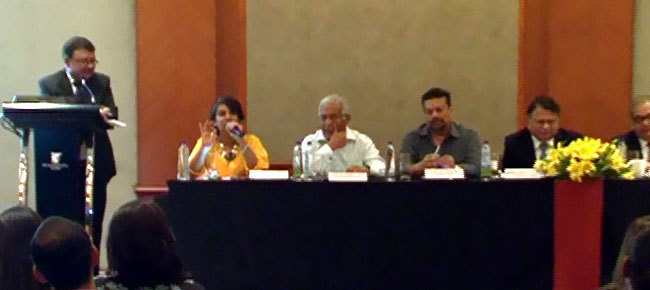
    Broadcasting Content Complaints Council (BCCC), the independent self-regulatory body for non-news general entertainment channels set up by the Indian Broadcasting Foundation (IBF), conducted an interactive session with the S&P/Creative/Programming teams of its member Channels to sensitise them about the ‘Portrayal of Women in Television Programmes’ recently in Mumbai.


    A.P. Shah

    BCCC members and representatives of the channels discussed women-related thematic issues that ranged from sex, nudity, obscenity, stereotyping and violence.


    BCCC Chairman Justice (Retd.) A.P. Shah said, “Scenes of violence against women can have a damaging impact on all sections, especially children. For instance, such violent depiction can put a vulnerable section like women domestic help at high risk. Such scenes should be done in a subtle manner.”


    Shabana Azmi

    BCCC Member Shabana Azmi said, “The business of camera is the business of images. If fragmented images of a woman’s body are shown, it is actually robbing the women of all autonomy and subjecting her to male gaze. If we objectify women, there will be a little chance that society will have great respect for them.”


    Talking about violence, Ms. Azmi said, “Violence may be necessary for the story. But mistreatment should not be glorified. It can be suggestive and creatively done. It can be done in a way that doesn’t reinforce violence against women. It is time to introspect how we can contribute to minimise violence against women.”


    Vir Sanghvi

    BCCC Member Vir Sanghvi said, “Our concern is with entertainment that promotes stereotyping of women in a situation where they are portrayed in a negative fashion and where they are consistently portrayed as victims who are to be enjoyed or to be mistreated. If mass media promotes that image, it will have horrific consequences.” Mr. Sanghvi said if content auditors look into the content as dispassionate viewers themselves, the chance of objectionable content being aired gets minimal.


    Sudhir Mishra

    The Council also invited filmmaker Sudhir Mishra to interact with the Channel representatives on stereotyping of women. Mr Mishra said, “Stereotyping leads to tragic ends. If we are corroborating the stereotypes, then we are corroborating the idea of women needing protection and, in turn, corroborating awful things.”


    “If you project yourselves on screen the way you are, there will be no stereotyping,” Mr Mishra said.


    The BCCC members reiterated their intention of not curtailing artistic freedom of the content creators but only to sensitise them.


    Issues like portrayal of Children and stereotyping of Minorities in television programmes were also discussed at the interaction which was well attended by all general entertainment channels.


    Wajahat Habibullah, Chairman of National Commission for Minorities, and also a member of BCCC said, “Targeting a particular community can cause lot of damage to the psyche of that community. We need to develop practices that are constructive and are not curtailing creativity.”


    The session turned out to be a fruitful one for the broadcasters as they also got an opportunity to share their sensitivities and structural limitations regarding content that goes on air.


    In view of the increasing number of complaints pertaining to southern Channels, BCCC will conduct a similar session in Chennai/Hyderabad in the coming months.


  • Not just playing around: Angry Birds on Cartoon Network

    By A Correspondent


    Cartoon Network has partnered with Rovio Entertainment to bring Angry Birds Toons, an animated TV series based on the globally successful and trendsetting game, Angry Birds, to Indian children’s television. Premiered on Saturday, March 16, the weekly series will air in the mornings.


    The series is based on the life of the Angry Birds living on Piggy Island. Red and his fearless feathered companions, Chuck, Matilda, Bomb, Blues and Terence, must band together to protect their eggs – and their future – from the wily plotting of the Bad Piggies. With only their wit and determination to guide them, they must overcome the Piggies’ superior technology and seemingly insurmountable numbers. But they have one great edge…t he Piggies’ astounding stupidity! Angry Birds Toons brings to life the characters and adventures from the popular game, and reveals the fun and sneaky worlds of the Birds and their nemesis Piggies.


    “We’ve long wanted to tell our fans the story of the Angry Birds and the Bad Piggies, to introduce their personalities and their world in detail,” said Mikael Hed, CEO of Rovio. “We’re delighted to partner up with some of the best video-on-demand providers and TV networks across the world. It is an important milestone for us on our journey towards becoming a fully-fledged entertainment powerhouse.”


    “We’re delighted to introduce the Angry Birds and Bad Piggies characters and their world in more detail to our Indian fans. We combine the look and feel of cartoon classics with modern twists to slowly reveal a vast backstory. Our team has been working tremendously hard to once again delight our fans with a new way to experience these loveable characters”, said Nick Dorra, Head of Animation at Rovio Entertainment.


    Krishna Desai

    Krishna Desai, Senior Director and Head of Kids vertical, Turner International India Pvt. Ltd. said, “At Cartoon Network, we pride ourselves on understanding kids and delivering innovative and entertaining content to them. The Angry Birds games are a global phenomenon with kids and adults and we look forward to partnering with Rovio Entertainment as the broadcast partner for Angry Birds Toons animated series. We are certain that kids will be enthralled and excited to watch this adaptation of Angry Birds on Cartoon Network!”


    Angry Birds Toons will feature 52 episodes.


  • AdoRoi launches response-led media planning

    By A Correspondent


    Mumbai-based AdoRoi Marketing Science has introduced two new product offerings – Response Led Media Planning and Ad Insertion-to-Sales tracking.


    Amit Nevrekar

    Said Amit Nevrekar, Chief Operating Officer, AdoRoi, “It’s a scientific way to study the effectiveness of the media plan through Response per Spot (RPS) and Cost per Response (CPR)”. Explaining the concept, Mr Neverkar said: “The Ad exposure/ response are identified through unique Ad-Tracking codes for each media vehicles across TV, Print, Radio and Internet.” The response is analysed through a proprietary real time reporting software and Client Dashboard. The main advantage of this methodology is it provides Advertisement Exposure for a particular issue/insertion as against the current Media Vehicle Exposure based on Reach & Frequency model. The responses can further be analysed by media, creative, spot duration, placement, Ad-size, page no etc. The model, according to Mr Nevrekar, is beneficial for brands, which don’t just carry out brand awareness creation exercise but aggressively practise direct marketing for instant conversions through call for action or promotional offers.


    In this method, the dealer panel in PAN India Print campaign is replaced by AdoRoi’s unique Ad-Track tele code per media vehicle, thus saving the effort and also cost per sq cm. When any customer calls for an enquiry, his/her call is directly patched with the nearest dealer basis his Geo-position and the dealer database through our patented technology. Each customer enquiry is provided with a promo-code linked to media vehicle which can be tracked against sale. The responses generated per insertion across media vehicles can be analysed on real-time client dashboard. The learnings can be efficiently used for optimizing the media plan for better ROI by maximizing RPS and minimizing CPR.


  • Jaldi 5 with Robert Bakish & Sai Kumar: It’s fair to say that we have a pipeline

    Robert Bakish
    Sai Kumar

    Most of their broadcast products in India attained leadership position in the genre that they operate in. In recent years, some of them have managed to attain that in record time like the Hindi GEC Colors or English comedy channel Comedy Central.


    Viacom has had a fantastic innings in India thus far and much of that growth has been possible due to its win-win partnership with entertainment hotshop Network 18 in India.


    On the sidelines of FICCI Frames 2013, MxM India caught up with Robert Bakish, President & CEO, Viacom International Media Networks and Sai Kumar, Group CEO, Network 18 to find out what’s making the network surge ahead in India and what’s in store next. Excerpts:


    01.  With Viacom being a major player, what is your top-level view of the content business that exists in India?

    Robert Bakish: Like most things there are some common elements and there are some unique elements where content is concerned. Generally speaking, it’s about creating content that an Indian consumer is very engaged with. They could be watching their content anywhere, so in that sense the dynamics remain the same. The next end is funded partially through advertising and distribution and through consumer products. Now some of the specifics to India are different. Today everybody is talking about digitization and that’s a seismic shift in the television distribution marketplace in India, which quite frankly has been a long time coming. This has been a market where you have to pay for distribution where you really didn’t get paid. In most markets around the world on that basis they are making a lot of money from distribution. So we look forward to the day that happened in India and thankfully it’s happening now. So that’s one big unique element and that’s certainly to the benefit of leading content companies. So unless you have very strong content and brains you may not be able to do that and that’s what Viacom 18 is in a good position at.


    Another thing about this market is that there are many countries within India itself. These are still early days for exploitation by major content companies like us but there are tremendous opportunities ahead.


    In a sense you are going to have many countries in the Viacom 18 umbrella itself given Hindi and the various languages under ETV. So you do not have to look elsewhere for refashioning content in other languages…

    Robert Bakish: One of the advantages of Viacom 18 being a global company is that we can cast a very wide net for hit content in terms of format etc. But at the same time we can focus on the Indian market whether it is something that came out of our national set of services or may be some regional opportunity… or maybe from Eenadu with which we are still doing some regulatory diligence but there are already some national formats that are travelling to regional it’s only a matter of time before some regional format moves over to become national on Colors and maybe even exported to the US, the UK, Middle east etc. So there’s pretty broad opportunity that exists there.


    02.  Like you’ve said, Colors and the regional channels have had some successful content to their credit. Are you looking at taking that content and repurposing that for airing in international markets?

    Sai Kumar: That has already started whereby content from Colors is now available across 130 countries. That’s pure syndication. Now if you see, syndication is largely for the Indian market oversees. But if you look at the local market we have already started shipping formats. Uttaran has entered Africa as a format so it is going to be completely produced. Now that’s a green shoot that we have seen in the past two months. We are already having conversation around 3-4 of our soaps… so reverse migration has started. By which I don’t mean only syndication, I mean format migration which could be a very healthy revenue line for us.


    03.  In terms of revenues, what are the numbers you are expecting post-digitization?

    Sai Kumar: I’ll tell you what our wish-list is: two years down the line we will be happy if Viacom 18 gets about 45 per cent of its revenues from domestic distribution and about 10 per cent of revenues from international distribution…so a range of over 30-60 per cent is what we are looking at over the next two-four years which is something that will change our P&L dramatically. And I dare say that we are on track.


    04.  Comedy Central has been a big success in quick time. Are you looking at playing that content across other languages in India?

    Robert Bakish: Comedy Central is our third great global brand behind MTV and Nickelodeon. If you look at the last 12-18 months with Comedy Central, we have not only lit up India but also Russia, South East Asia, Africa, Latin America etc. So Comedy Central is a big deal for us. The brand obviously has a great ability to connect with the consumers all over the world, and obviously the services are different all over the world. So we will be launching additional services in India; we are not going to say what they are going to be but there will be more opportunities.


    05.  In terms of new offerings from the Viacom stable, can we look forward to more channel offerings…

    Robert Bakish: We are not here to announce any new products but it would be fair to say that we have a pipeline. From a Viacom standpoint, India is a very important market with a huge potential ahead of it. We know that part of accessing that potential will involve creating more products… we launched a couple of new national products last year including Comedy Central, Sonic etc and it’s safe to assume we will launch additional services in the future.


    Robert Bakish (pic source: blog.viacom.com)


  • Vikram Malhotra quits Viacom18 Motion Pictures

    By A Correspondent


    Vikram Malhotra, Chief Operating Officer at Viacom18 Motion Pictures, has resigned. Having spent a little over two years at Viacom18 Motion Pictures, Mr Malhotra is leaving to pursue his entrepreneurial aspirations. He will continue in his current capacity till July 2013, to ensure a smooth and seamless transition. He also headed the strategic distribution alliance with Paramount Pictures International.


    Sudhanshu Vats

    Announcing Mr Malhotra’s departure, Sudhanshu Vats, Group CEO, Viacom18 Media Networks, said, “Vikram has admirably led the reboot of this business to put Viacom18 Motion Pictures amongst the top players in the industry. Over the last two years, we have had tremendous success, stretched the envelope and redefined the rules of Hindi Cinema, making critically acclaimed films that were commercial successful as well. We have an impressive lineup ahead with movies like Chashmebadoor, Bhag Milka Bhag, Madras Cafe and Boss” He further added, “As he now ventures out to pursue his entrepreneurial dream, I wish him all success in his new venture.”


    Commenting on the development, Mr Malhotra said, “I have had a personally fulfilling and proud time at Viacom18 Motion Pictures and am privileged to have lead a talented team that redefined many a things in both production and distribution of Hindi as well as Hollywood films (marketing and distribution of Paramount movies).” He added further, “I am excited to now pursue my own dream and aspiration in the same space.”


  • IPL ratings will look up: MEC forecast

    By A Correspondent


    Media buying and planning agency MEC, a founding partner of GroupM, has announced the findings of its IPL TV Rating Estimation Study, now in its fifth edition.


    A combination of primary research and high-end analytics, the study has achieved 100 percent accuracy in the past, including last year. The research was conducted in Mumbai, New Delhi, Kolkata, Chennai, Bengaluru, Hyderabad, Jaipur, Pune, Chandigarh and Ahmedabad. As in previous years, the study has been carried out in association with Meritus, WPP’s analytics company.


    Key findings of the study are:

    Average TV rating for the league stage is expected to go up from 3.8 last year to 3.9 – an increase of 2.6% (15+ years, Male/Female, SEC ABC)

    MI (4.5), KKR (4.2) and CSK (4.1) games to have the highest ratings

    Home team (84%), favorite team (79%) and Indian stars (64%) continue to be deciding factors to watch a match. Time of the match (49%) is also gaining importance.

    MI (23%), Chennai (19%) and KKR (14%) are the most popular teams. Support for Hyderabad has gone up by 200% (2% to 6%), Bangalore has dropped by 50% (12% to 8%)

    Sachin Tendulkar (80), MS Dhoni (79), Yuvraj Singh (76), Virat Kohli (74) and Virender Sehwag (73) are the most popular Indian players in the League; Chris Gayle (60), Ricky Ponting (55), Brett Lee (51) and Kevin Pietersen (50) are most popular foreign players


    T Gangadhar

    T Gangadhar, Managing Director, MEC India, said, “Our study suggests that IPL seems to have matured as a property. The study clearly establishes that ratings in the first phase (first 18 games) impact the fate of the entire league. With Pepsi activating their title sponsorship in a big way, the BCCI launching the IPL Fantasy League and India’s strong performance against Australia, the first stage of the league could get further momentum. We expect the IPL Fantasy League to become a key part of the live broadcast experience and as a result, social chatter around IPL could grow significantly,” he added.


    Sunder Muthuraman, Managing Partner, Meritus Analytics, also believes that the IPL brand is reflecting the behaviour of a typical mature consumer product. “Our proprietary survey, that is integral to the forecast, shows that there is a segment of audience who will watch more than last year (say, the loyalists) and another segment who will watch lesser (say, the rejecters). Given that the former segment is larger than the latter, the ratings are likely to be marginally higher than in 2012. Given our past successes, we hope our pioneering rating forecast methodology will be adopted by all broadcasters and advertisers,” Mr Sunder concluded.


  • MIB to launch Centralised Monitoring System for encrypted signals

    By A Correspondent


    In a major initiative to monitor the progress of digitization and to ensure the mandatory adherence of transmitting digital encrypted signals by Multi System Operators (MSOs), the Ministry of Information and Broadcasting is in the process of installing a Centralised Monitoring System to keep a tab on the encryption of channels by MSOs. The Centralised Monitoring System will be able to detect those MSOs which do not carry the mandated encrypted signals. MSOs are required to carry encrypted signals of TV channels in areas where digitization has been implemented as mandated by Section 4A of Cable Television Networks (Regulation) Act, 1995. Transmission or re-transmission of unencrypted signals would amount to violation of the terms and conditions.


    For the above purpose, a web based pilot project for the DAS monitoring system installed at Bangalore is undergoing field trials. Once implemented, it will enable the ministry to keep a watch on the implementation of DAS by all the MSO licensees through this system. To start with, this system will help the users to centrally acquire, log, analyze and prepare reports on the status of DAS parameters like total number/name of channels, encryption status etc of cable TV signals of head end of each registered MSO across the country in real time. This system can be augmented in future for content monitoring of the cable TV channels at local levels. It is expected that the system will also evolve as an alternative indicator of television viewing by consumers.


  • Mindshare Appoints Rajit Desai as Partner – Consulting

    Mindshare, the flagship GroupM media agency, has further strengthened its consulting and analytics discipline in the west with the appointment of Rajit Desai as Partner, Mindshare Consulting.


    In his new role, Mr Desai would actively contribute towards developing and restructuring Mindshare’s business consulting offering for clients in west region. He will be reporting to the Sandeep Pandey who is the head of practice.


    In his last role, Mr Desai served as the Vice President and Head of Lab Centre (research and strategy hub) at Lodestar UM. Having worked in the marketing vertical and as media consultant for various leading companies such as HTA, Sony, Times Now, Loadstar, Media e2e and Turner Broadcasting, Mr Desai comes with 16 years of work experience in the media function.


    Said Mr Pandey on the appointment, “Our nature of work requires people from strong consulting and business strategy profile and Rajit has a combination of both. It is part of our larger talent restructuring within consulting discipline and you will hear soon about many senior profiles joining from different industries.”


    On his move to Mindshare, Mr Desai said, “This exciting role is a logical next step for me. I see this as a big opportunity and I look forward to help address client’s marketing and business problems and grow the practice along with the high quality team at Mindshare.”


  • TRAI notifies duration of ads on TV channels

    By A Correspondent


    The Telecom Regulatory Authority of India (TRAI) has notified the regulation “Standards of Quality of Service (Duration of Advertisements in Television Channels) (Amendment) Regulations, 2013. This regulation mandates the broadcasters to restrict the duration of advertisements in their channels to a maximum of 12 minutes in any given clock-hour as prescribed in the existing rules.


    In order to monitor and ensure compliance with these regulations, broadcasters are now also mandated to report the duration of advertisements carried in their channels to the Authority on quarterly basis in a proforma prescribed by the Authority.


    TRAI has studied the issue of duration of advertisements being carried in TV channels. The data obtained from the Ministry of Information and Broadcasting and that collected from the broadcasters, clearly established the general perception that most of the TV channels are in brazen breach of the existing rules on the subject, notified by the Central Government in the Cable Television Networks Rules, 1994.


    The duration of advertisements being carried on TV channels is closely related to the quality of viewing experience of the consumers which is akin to the quality of service being offered by the service providers to the consumers.


    Also, according to the Regulation, every broadcaster shall, within fifteen days from the end of a quarter, submit to the Authority, in the format specified by it by order, the details of advertisements carried on its channel.


    The Authority has noted that the duration and format of advertisements, being carried in TV channels are generally, not in accordance with the provisions of the advertising code as prescribed in the CTNR, 1994. Therefore, with the primary objective of striking a balance between giving a consumer a good TV viewing experience and protecting the commercial interests of broadcasters, after following the due consultation process, TRAI notified the “Standards of Quality of Service (Duration of Advertisements in Television Channels) Regulations” dated 14th May 2012. These regulations, besides prescribing that the limit of advertisement duration should be adhered to on clock hour basis, also provided that (i) advertisements should be carried only during breaks in live sporting action (ii) time gap between consecutive advertisement sessions should be of minimum 30 minutes in case of movies and 15 minutes otherwise (iii) no part screen advertisements should be permitted etc.


    The regulations were challenged by some of the broadcasters in the Telecom Disputes Settlement and Appellate Tribunal (TDSAT). The broadcasters had challenged the said regulations, inter alia mainly on the following grounds: (a) regulation on advertising time and its corresponding effect on the broadcaster’s revenues would adversely affect the growth and competition in the broadcasting industry (b) Sports channels, by very nature of the business, stand on a different footing as compared to other genres because of the reasons such as periodic availability of content, limited shelf life and mandatory sharing with Prasar Bharati. Also, the content is obtained at huge cost and with very stringent conditions which strictly regulate how the events would be broadcast with specified timelines allotted to advertisements.


    In order to minimize other breaks during certain live sporting events, in which natural breaks either occur after relatively long periods or there are no natural breaks such as F1 races, part screen advertisements should be allowed (c) the “part screen” and “drop down” advertisements are integral forms of advertising and (d) statutory rules already exist under the Cable TV Act to regulate the format and duration of advertisements that may be carried on television channels and the regulations are beyond the purview of TRAI and in conflict with the provisions of rule 7 of the CTNR 1994.


    Meanwhile, the New Broadcasters Association (NBA) has expressed “deep shock and concern” on the Telecom Regulatory Authority of India (TRAI) notification and is appalled that by way of advertisement regulations, the TRAI has issued the most sweeping and intrusive “controls” not just “regulations” in relation to advertising that may be carried on TV channels. According to NBA, these regulations have been issued at a time when news channels are facing a most unfriendly business environment. Dependence on advertising remains absolute with over 90 percent of revenues coming from it. The NBA has urged the government to ensure that the said regulation is kept in abeyance till such time digitization is fully implemented in the country (with consequential benefits of no or low carriage fees and credible subscription revenue) and DAVP recommences advertising on news channels at rates which are fair and acceptable.