Category: TV

  • Jaldi 5 with Amit Nair: Khana Khazana should do well with digitization

    Indians love food. Yes, it is a fact and Khana Khazana is a proof of that. In the early 1990s what started as a show with Chef Sanjeev Kapoor as host and in 2010 turned into a full-fledged channel just certifies it. India’s first-ever food channel is all set for re-branding and give its viewers better and new shows to look forward to. MxMIndia’s MEGHNA SHARMA quizzed the channel’s business head, Amit Nair, to get a taste of channel’s strategy. 


    1.After the new and refreshed content, what can the audiences expect from the channel?

    The content strategy is very info-entertainment oriented. All our shows are very chatty, conversational and interactive unlike regular cookery shows. We are delighted to announce the start of four new shows on air all back by research and by understanding the pulse of women by interacting with them extensively. These our shows are Food Ka Mood, Bacha party, Breakfast express and Ab Har Koi Chef. Each of them have been designed with specific needs in mind. In the coming months we plan to launch a lot of new shows that will also target a broader TG. There will be more travel + food related to reality shows and will dish out more theme based or concept driven shows every quarter keeping our TG in mind.


    2. So how has been the ride so far?

    Khana Khazana has always been synonymous with great food experiences and has a unique place in the heart of homemakers and cooking enthusiasts. Hence, since our evolvement to a 24-hour food channel the response has been very heartening.


    3.Is there enough audience for a food channel in India? Where do you see the genre in the next few years?

    Food as an offering on television has been growing since the days of Khana Khazana. GECs had cookery shows, then we started having food shows within the regional space. Subsequently even news channels got into it and on the GEC front it evolved from instructional cooking to food reality. With dedicated food bands on lifestyle channels the time was ripe for a dedicated food channel and Zee was the first to do so. In mature television markets, there are 3 -4 dedicated food channels so we are very bullish about this genre. With digitization and greater monetization, specialized offerings like food are expected to do very well.


    4.But given the limited viewership, do niche channels like yours see enough advertisers?

    While our core target audience is female, we have seen enough and more men venturing into the kitchen to try out recipes that are different from the norm. So while we may have FMCG and durables as main advertisers there is a lot of interest from home and lifestyle related brands to advertise.


    5. With competition growing, what is the marketing strategy of the channel?

    We will be closely working with our DTH/cable partners to increase interactions with consumers. Focus predominantly will be on digital and activations and build close viewer connect.


  • Tryst with destiny @ FICCI Frames in March

    By A Correspondent


    Uday Shankar

    Announcing the launch of the 14th edition of India’s foremost business conclave on media and entertainment, FICCI Frames 2013, Uday Shankar and Karan Johar, the Chairman and the Co-Chairman respectively of the Media & Entertainment Committee, unveiled the theme of the conclave, ‘A Tryst With Destiny: Engaging a Billion Consumers’.


    Speaking on the occasion, Mr Shankar said, “While the industry has made spectacular progress in the last 20 years in increasing the intensity of engagement with the Indian consumer through superior content, there is still a gap in our ability to monetize the engagement and use the resources generated to advance both access and content. The year 2013 is one of many milestones in the media and entertainment industry and Frames will offer an opportunity for us to put these developments into perspective, look at the larger picture and engage on such a bold and important theme.”


    Mr Johar said, “The M & E industry has the potential to become the catalyst for social change and a force of good for every niche of society. FICCI Frames has been the most eminent platform for the M&E sector and its initiatives over the past decade have improved the quality of content generation, skill development and stature of the industry. We believe that our new agenda will be the change agent for social and commercial development, connecting a billion people, while shaping and informing their opinions and getting influenced by their collective needs in turn.”


    At Frames 2013, the aim is to deliberate on the growth of the industry and find ways to maximize both its creative and economic potential by engaging with the billion strong consumer base in our country. We have key international thought leaders, studio heads and academics lined up to speak on a range of topics covering the main objectives of the sector – digitization, making big budget films and being successful in Bollywood, censorship, marketing, exhibition, distribution, viability of the sports broadcasting business, the future of content consumption in an era progressively getting defined by the digital media, innovation and planning required in various policy issues within TV, cinema, animation and gaming.


    The line-up of stalwarts includes Andy Bird, Chairman, Walt Disney International, Anne Sweeney, Co-Chair, Walt Disney International & President Disney ABC Television Group; Bob Bakish, CEO, Viacom Media International, Teri Schwartz, Dean, University of California, Los Angeles (UCLA),  Colin Maclay, MD, Berkman Center for Internet and Society, Harvard University, Andy Kaplan, President, International Networks, Sony Pictures Television, Mira Nair, film-maker, Dominic Proctor, President, Group M Worldwide, Seymour Stein, Vice President, Warner Bros Music, David Womart, the Producer of the Oscar-nominated Life of Pi, film maker Gurinder Chaddha, Jonathan Taplin, Director, Annenberg School of Innovation, The University of California school of communications and journalism, Andy Weltman, the international head of Pinewood studios, and Graham Broadbent, the British producer of the Best Exotic Marigold hotel.


    Key stakeholders and regulators will also be present, from government to industry leaders. Attending for the first time will be the information ministers of SAARC countries, forming an exclusive panel on forging bilateral ties to augment growth amongst geographically and culturally connected countries.


    FICCI Frames 2013 will be held from March 12 to 14 at Hotel Renaissance, Mumbai.


  • Is Digital eroding relevance of TV and Print?


    By A Correspondent


    The traditional media of print and television are under siege, as it were. Though they are still dominant media, they are seeing a sea change in the way they are being consumed. The explosion of new media also threatens their relevance and hold. Or so it is believed. But is it an overreaction and does digital not pose that much of a threat to TV and print?


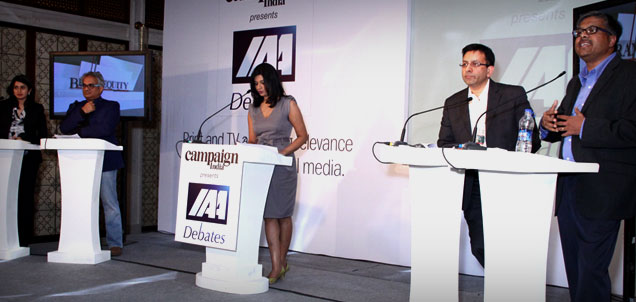
    To find out, the India chapter of IAA organised a debate in Mumbai on Monday (Feb 18) on whether television and print are losing relevance with the growth of digital in India. The debate series is being sponsored by Campaign India and the co-chairs of the IAA debates initiative are Partho Dasgupta and Neville Taraporewalla.


    Seasoned professionals Virginia Sharma of IBM and Mahesh Murthy of Pinstorm (and Seedfund) argued for the motion while Sanjay Gupta of Star TV and Arunabh Das Sharma of The Times of India group argued against the motion. The debate was moderated by Sonali Krishna, Anchor of Brand Equity show of ET Now. A cross-section of industry professionals were in attendance. As were some representatives from MxMIndia.

    We bring you some of the highlights of proceedings. Note, this is only a part of what was discussed.


    Mahesh Murthy: If you look at the Census report, if you see rural India there are just 33 percent homes that have television vis-a-vis 54 percent that have mobile phones. Overall if one compares, urban plus rural, TV used to take 32 percent penetration in 2001 which has grown and is at 47 percent at the moment. But mobile has grown from 9 percent in 2001 to 56 percent today. Mobile today is 24 percent larger in Indian households especially rural where the number is about 50 percent more.

    If you look at the numbers further, television has about 111 million viewers whereas mobile has about 133 million users – which further consist of 400 million users of SMS, 900 million SIM cards, etc. When one compares the publication number of The Times of India that is at 3-4 million which is dwarfed by 18 million users of Facebook every day in India.

    If you look from the consumer’s POV the three most desired audiences from an advertiser’s perspective is the 15-24 yr-old youth that barely reads a paper or watches TV and is highly digital-savvy; 25-34 yr-old females – Facebook alone has 11 million of those and I do not think any other medium in India can give you that kind of access to this age group; and finally 35+ age group – it will be hard-pressed to reach a CEO today as long as he is on his tablet or i-Pad or email, etc.

    When we move on to the advertisers, all of two years ago digital was all of two percent of the ad pie which has now become about 8.5 percent, meaning that digital has grown by 400 percent while the share of television or print has gone down.

    If you look at how digital has been explored by other people like politicians who have more than 200 people to handle just the digital medium, which I do not think is the case with other media. Even when one looks at the credibility factor, Nielsen states that the most credible medium is word-of-mouth, followed by what strangers write online followed by what is written on websites and then comes print.

    So what we are seeing is that print and television are not going zero; while they still have relevance they are losing their relevance because of the advent of digital. I’d like to end by requesting each one to ask themselves as to where do you see yourself in the future – whether five years from now you’ll be seeking a job in a company that does not do digital. The honest answer will decide where your preferences will skew towards the end of this discussion.


    Arunabh Das Sharma: I’d like to begin by saying that what we are discussing here is relevance. Is it about ad dollars; is it about ‘x’ percent more mobile penetration or is it about what these media have stood for the longest time – which is curated content. What digital has done is created a proliferation of choice and when that happens big becomes bigger. In such a situation everything grows. I’d like to share here an example of how the growth of social media has fuelled the growth of television and print and how they the two mediums are getting healthier now that the investment in content is becoming stronger and stronger.

    In the 1950s, it was said that radio was going to kill the medium of print and was followed in the 1970s where it was said that television would kill the medium of radio… none of that happened. There is a reason why different media play different roles in our lives. A recent study by research firm Ipsos talks about what are the global rules that different screens play in your life. So while the mobile screen is a lover, the computer screen is a sage while the tablet is a wizard but the fact of the matter is that you need a lover, wizard and a sage; the fact of the matter is that every medium has a special role to play and we ourselves will be very myopic if we assume that television is linked to a cathode ray tube or that a newspaper is linked to a piece of paper.


    Virginia Sharma: Is your motion that TV and print continue to be relevant or that they are growing in relevance?


    Arunabh Das Sharma: I think the topic needs to be redefined whether print and TV are losing relevance but whether digital will ever gain relevance? In fact I’d like to say here that 2012 saw some of the biggest gains in stock prices of print companies because of one aspect – they had figured out their business model. The issue was that in 1992 when the readership started dropping they had to figure out a business model which wasn’t to be.


    Virginia: Do you have any comparable stats to validate your observation?


    Arunabh: It doesn’t even show on the scale for India. I’d like to add here that a lot of people wouldn’t know about this but a gentleman in the US just brought a bunch of regional newspapers with the assumption that the growth of print will happen through hyper-local and regional papers, which is exactly what will happen here too.


    Virginia Sharma: I’d like to start off by answering the question, ‘What does relevance mean?’ In today’s world relevance means business impact. The fact that it was said that digital does provide a platform of choice is correct; also the fact that social as a medium has grown is also correct.


    Arunabh: If relevance is defined as business impact, are we talking the same scale in that sense in India?


    Virginia: What I am saying is business relevance to advertising agencies…


    Arunabh: But I thought it was also about ad dollars…


    Virginia: No ad dollars is about expense. Business relevance is about business outcomes and about what the CEO measures, particularly the RoI. To quote numbers from a CEO study that was conducted, the use of social and web from 11 percent to 48 percent for social and from 37 to 49 percent for the web in the primary way to interact with the customers.  That for me is business impact and what the boss sees this as a way to engage the audience. What do most brands like Coca Cola, Pepsi, ICICI, HDFC etc have in common – it’s their innate belief that this medium is relevant and their investment in this medium is not just what the ad agency says it is.

    So, two big cases. First, the primary metric of the CEO study for marketers for success is RoI. You can measure RoI based on the ability to understand customers and target them with what they need. You can only measure digital better than you can measure print and television. Therefore the future for marketing where RoI is concerned as a primary measure for success has got to be digital if you want to make the case.


    Arunabh: I think the challenge is not about measurement but about conversion and that’s how a medium works. Measurement that you are saying is how many people have seen the ad not how many people because they have seen the ad went and watched something.


    Virginia: Measurement for me is actually measuring consumer behaviour and doing it successfully. To sum up, the business case is very simple, if you want a good RoI you have to use digital as a key medium to be able to feature consumers and that ultimately is going to be key.


    Sanjay Gupta: When I started working 20 years ago I thought print is going to die and today print is about Rs 14,000 crore from Rs 6,500 crore it was a decade ago. For television the growth has been from 5,000 crore to 16,000 crore. The key points that I’d like to present here are that firstly, consumers love television and it is thriving. The thing is that if you find something relevant you spend time with it. Around 700 million people in this country spend three hours every day watching TV. When they start it is for two hours, which then picks up to three hours. Also in the last one year, 70 million new people have started watching television. That’s more than the number of people who watch digital in any given point in a month. The same is the case in developed countries like the UK and the US where the time spent is around 4-5 hours every day.


    The other thing is that big is becoming bigger on television. The belief is that proliferation of choice will make users fragment. A recent example I’d like to share is of the movie ‘Dabangg’ which was watched by 150 million people. Even shows like Balika Vadhu etc aggregate about 40-50 million viewers in that half an hour. The point I’d like to make is that social media is actually helping the business become bigger and better. The people fall in love with our characters and they do that only on television and not anywhere else.


    Mahesh: So essentially your point is that even TV uses digital…


    Sanjay: TV does use digital. To quote an example our show Satyamev Jayate was the biggest show that we did and we used the channel of social media to make people come and watch it. It was in fact the highest trending topic on Twitter. So what I am saying is that digital is driving our business to do better.


    Virginia: Is it content that drives behaviour and interest or is it the medium?


    Sanjay: It is content. To cite figures, in the UK people watch about 80 minutes of video and out of that 80 percent is either pornography or YouTube – that’s the power of that medium there. Whereas if you provide good content it makes the viewer keep coming back to watch more and more.


    As to what is changing, digitization is changing the way television companies do business. Till now only 20 percent of the revenues from digital medium came to the broadcaster but the transparency with DTH that number is moving from 20 to 100 percent. So subscription revenues of TV companies have grown five times and what does it give us – the power to invest in content. That is what will make it even more relevant in the future.


    Murthy: So your point is that television is using DTH or rather digital to deliver itself to homes?


    Sanjay Gupta: The point I am making is that the medium is powerful, profitable and is growing. The fact is that people will not consume any one or two mediums, they will consume all the mediums. The question is: how do we use the power of each of these mediums as they have to be relevant.  So print and TV will not lose their relevance they will continue to grow. The real question is that we need content aggregators and devices. Digital as a medium is just an aggregator of content and fundamentally the question we need to answer is how meaningful can this content get on the medium if it has to grow even further.


    Arunabh: Statistics do give us a picture. The fact of the matter is that both these media are huge and growing. If they were not then we could have turned around and said that it is not but like all new media they are finding newer ways – whether through a screen, a mobile, an app – of growing the medium. We are not here to debate whether one medium is better than the other, the fact is that we as consumers love to consume media and do it the way we want to. It is not about whether x, y or z is losing relevance, the fact is it is bigger and it is growing. In fact the next round of growth is already visible to us – it is coming from regional markets. Because of our infrastructural issues it will take digital some time to pick up speed but until such time our friends in the digital world would do really well to figure out what kind of content creates stickiness and what kind of content keeps readers going for 175 years. The day one of these digital mediums complete a 175 years in the form and fashion from what they started then we can talk about it further.


    Virginia: I think the four of us together have made a very compelling case for the growing relevance of digital and that it is powerful, profitable and here to stay. Such a combination would make this medium indeed relevant. Print and TV is going digital, decision-makers are going digital, politicians are going digital… the big question is, which side do you want to sit on? And no, digital does not want to be the medium it was 175 years ago, it wants to keep up with the times as well as the generation it is catering to and it will constantly evolve and is eager to change. It will make money regardless of the shape it will take. The question is, are you ready for the future – digital?


    The debate was won by the team against the motion. Before the debate started, 44 people from the audience were against the motion and 31 were for it. After the debate ended, the numbers were 42 against and 34 for.
  • India TV Yuva Awards honour the rising stars

    By A Correspondent


    In a glittering ceremony held recently in the capital, Uttar Pradesh chief minister Akhilesh Yadav was given the most popular youth icon India TV Yuva Award in the politics (male) category. The event was laced with the presence of politicians, industrialists, actors and eminent sportsmen.


    Chhavi Rajawat, a young MBA-educated girl working as a sarpanch in Rajasthan village bagged the India TV Yuva Award for best youth icon in the politics (female) category. Team India cricketer Yuvraj Singh was given the best youth icon (male) award in the sports category by BJP president Rajnath Singh. Olympic bronze-winner Manipur boxer Mary Kom got the best youth icon (female) award in the sports category.


    Pratyusha Banerjee of the ‘Balika Vadhu’ fame bagged the best TV actor (female) award. Siddharth Shukla, best known as Collector Saheb in Balika Vadhu, received the best TV actor (male) award.


    In the Business category, Balaji Telefilms owner Ekta Kapoor bagged the best youth icon (female) award, and Indiabulls group co-owners Sameer Gehlaut and Rajiv Rattan won the best youth icon (male) award.


    In the Music category, Mamta Sharma won the best youth icon (female) award, while Sonu Nigam won the best youth icon (male) award. Three youth icon awards were also given in the Special category to Bollywood actor John Abraham, Manish Paul and Rani Mukherjee.


    India TV Chairman and Editor-in-Chief Rajat Sharma said, “The Yuva Awards given to youth icons in the fields of politics, sports, music, television and business were an aspirational salute to young men and women, who through their grit and determination have inspired people and have shown exemplary leadership and extraordinary excellence with achievements much bigger than their age.”


    The winners were decided on the basis of a stringent process of nominations through a nationwide research by a well known research agency followed by audience votes. The Jury was chaired by Sarod Maestro Ustad Amjad Ali Khan and included the Chairman & editor in chief, India TV Rajat Sharma, cricketing legend Kapil Dev, VLCC founder Padmshri Vandana Luthra and Prof. Pushpesh Pant.


  • Big Magic International strengthens reach in Canada

    By A Correspondent


    Big Magic International (BMI), part of Reliance Broadcast Network Ltd. (RBNL), has announced a strategic distribution tie-up with Telus and Cogeco, providing the largest coverage in Canadian markets. This additional distribution sees BMI gain a stronghold in Canada. Having launched in 2012, with Ethnic Channels Group (ECG) as its exclusive distribution partner, the channel is now present in 5 of the 6 platforms, across GTA, East and the West Coast.


    With this move, BMI reaches out to the South Asian diaspora living across the length and breadth of Canada, with the extremely popular shows like Rasoi ki Rani and Big Memsaab Season 6, already huge hits locally in India. Also planned in the pipeline are local shows targeting youth and a business show on the success stories of Indians in Canada.


    BMI is the first variety entertainment channel to connect with the Indian community in Canada.


  • Vh1 India and Hungama launch app for Facebook

    By A Correspondent


    Vh1 has announced its entry into the digital space with the launch of a new generation app, Vh1 Pulse. The app will enable fans to be in sync with their favourite tracks, any time of the day.


    Powered by Hungama.com, Vh1 Pulse is a music streaming application on Facebook which will enable over 1.7 million fans of the channel to listen to Vh1’s picks of the best international music.


    On the application, all songs will be picked by Vh1 and fans can listen to the playlist specially created which includes the best of all English music.


    Speaking about the new app, Ferzad Palia, Senior Vice President & GM – English Entertainment, Viacom18 Media Pvt. Ltd. said, “With a fan base of nearly 2 million ardent music lovers, this addition to the Vh1 India Facebook page is part of our philosophy of ‘Vh1 Everywhere’.”


    Siddhartha Roy

    Siddhartha Roy, COO – Consumer Business & Allied Services, Hungama Digital Media Entertainment, said, “Social communities are the new media real estate for brands where they can increase interaction and engagement with their consumers. There is an increasing demand for international music and Hungama is committed at satisfying this need by powering this service via its platform and content.”


  • Paritosh Joshi: When is a TV no longer a TV?

    By Paritosh Joshi


    The arrival of a new mobile device has triggered a dramatic transformation in the TV viewing experience at La Casa Joshi.


    What does a mobile device have to do with the television? In these technomorphing times, everything. The mobile device possesses a remarkable capability – it functions as a WiFi router (aka mobile WiFi hotspot). In the process, the wireless internet connectivity it accesses can be shared with up to as many as five other devices. This is what I did. I activated the smart television features of the set. It asked for type of connectivity. I indicated a preference for WiFi. It searched, and promptly found, the mobile device. I entered the passcode that enabled the connection and presto, I was off unlocking a side of my own television’s personality that I had known nothing at all about.


    Initial exploration, and I’ve only spent half an hour fooling around with this shiny new toy that popped out of a TV that had graced the wall for a good year before this moment of epiphany, reveals the following:


    1. The television has operating software that runs quietly in the background staying on top of whatever is going on. How do I know? Soon as I connected it all up, there was this little prompt – popup box and everything, that indicated that new software was available and sought my permission to download and install it. I agreed and the usual download bar started filling up left to right as it always does (but not on TVs, or at least not until now).

    2. Once the menus are up on the screen, there’s a whole frame with ‘Apps’ and when you navigate to it, you open a drop-down menu with a whole range of choices, “Humour & Comedy”, “Travel & Lifestyle”, “Food & Drinks”, “Action/Adventure”, “Science”, “Technology & Gadgets” and a few others. In each section there are a number of downloadable apps. “Travel” offers you TripAdvisor, “Food” brings up Epicurious, “Technology” decodes as “Engadget” and so on.

    3. In the midst of all this embarras de richesses I found an app called YouTube and in a flash, my TV world changes. For ever.


    In that moment, my content choice changed from the hundred-odd channels that the DTH service provides to the endless and continuously expanding Alladin’s Cave of audiovisual treasure that we all know and have come to love. Except, with a huge improvement. Called YouTube Leanback. Suddenly, I wasn’t at bustling content bazar with tantalising goodies tumbling out everywhere the eye turned to a tidy departmental store with everything assigned to tidy aisles, ready to be navigated. Wife searched for Adele and this is what we got on our TV screen. A huge playlist featuring that supremely talented, young British artist kicked in. Rolling in the Deep played. Moved out and made way for Skyfall (the latest Bond caper’s title song, surely you remember?). Then Someone Like You. And it just went on. YouTube was delivering us a ready to run Adele channel.


    On a whim, I did a search for Sivaji Ganesan and presto, the fondly remembered court sequence from Parasakthi, and dozens of other equally memorable moments from that great star’s oeuvre were ready to trip the light fantastic. The Beatles. Salil Chowdhury. Amjad Khan. The genie of the endless wishes was raring to please.


    A lot of televisions that are moving into consumer homes are now ‘smart’. They are designed to work not as passive devices that receive and render audiovisual streams but as intelligent entertainment appliances waiting to get connected to the internet. And once connected, they really come into their own. While the devices have reached, the connectivity may still be suspect, after all there aren’t that many homes that sport a WiFi network (although it is instructive to turn on a search for networks available in any somewhat genteel residential or office neighbourhood- smart youngsters routinely survive all their torrent streaming by stealing connectivity from their unwary co-residents who haven’t figured out WEP, WPA and such and couldn’t be bothered by little bumps in their data bills). All this is set to change.


    The arrival of LTE aka 4G is imminent and in a fell swoop, you go from struggling with 1 Mbps to smooth delivery of 100 Mbps. Now a typical Hollywood film blu-ray DVD runs to about 15 Gb or 15400 Mb. With the monster speeds that LTE should offer, that ought to download in somewhere between three and five minutes. For a full HD, Dolby Surround Audio experience. And out goes the WiFi router and all the paraphernalia around the home. What replaces it is a small dongle that will attach to the HDMI port of the television set. Like this one for instance. Or this one. Available now. For less than Rs. 2000.


    What will an LTE-enabled home that has fully unlocked the smart power of its new television do once the dongle is in its dock? Hard to say just yet, but this much is clear. The depth and fury of the change will dwarf all our previous notions of what ‘disruptive technology’ means to the entertainment business.


    Paritosh Joshi has been a marketer, a mediaperson and a key officebearer on industry bodies. He is developing an independent media advisory practice. His column, Media Matrix, appears on MxMIndia, usually on Thursdays


  • BoxTV inks deals with Sony Pictures Television and Disney UTV

    By A Correspondent


    BoxTV has announced content agreement with Sony Pictures Television and Disney UTV to offer premium titles on its video streaming service. Launched by Times Internet, BoxTV is a premium video service that offers movies, TV shows, short films, documentaries and much more, which users can watch on a regular web browser or through the device of their choice.


    To this end, BoxTV has also partnered with UTV Motion Pictures, Shemaroo Entertainment Rajshri Entertainment and Everymedia Technologies for Bollywood and Regional content in addition to their agreements with major International studios; Sony Pictures Television, Disney UTV and Celestial Entertainment for premium Hollywood content.


    Angel Orengo, Executive Vice President, Distribution, Asia Pacific from Sony pictures Television said, “We are happy to offer some of our premium titles on BoxTV’s on demand service. The Indian digital media industry has grown rapidly in the last few years and we support their efforts to launch this service and another exciting medium for content consumption in this evolving digital landscape.”


    We are excited to offer some of our best content from ABC Studios, Disney UTV Pixar, Disney UTV and Disney UTV Studios to the consumer at one destination. We believe that Box TV will be a great platform for us to showcase our wide breadth of entertaining and world class content,” said Amrita Pandey, Executive Director – Syndication, International Distribution & Disney UTV Media Distribution, Studios, Disney UTV. Satyan Gajwani, CEO of Times Internet Ltd, said, “We are very excited about the agreements we have forged with premium International studios. BoxTV is a one-stop source for all video entertainment and we strive to consistently deliver greater value to our customers by bringing the best anytime, anywhere entertainment on multiple platforms. With these partnerships, we provide our users access to a vast content library of popular choices to watch.”


    The service will be available across iPhone, iPad, Android phones and tablets; Kindle Fire, EvoTV, Woxi Pod and Roku. Apps for Windows 8, J2ME and Blackberry platforms are currently in the pipeline.


  • Yannick Colaco is managing director, NBA India

    By A Correspondent


    The National Basketball Association (NBA) has announced that Yannick Colaco, the former chief operating officer of Nimbus Sport, has been named Managing Director, NBA India. Mr Colaco will manage the NBA’s India office, based in Mumbai, and oversee the league’s business and basketball development in the country. He will report to NBA President, International, Heidi Ueberroth.


    “Yannick Colaco has the ideal combination of experience and knowledge of the sports landscape in India necessary to lead our expanding operations in the country,” said Ms Ueberroth. “Basketball is on the rise in India and we are thrilled to have Yannick lead our extremely talented staff as we build towards the future.”


    Mr Colaco will be responsible for leading the growth of the NBA in India. He will continue to build on the league’s efforts to grow participation in basketball in partnership with the Basketball Federation of India (BFI). Mr Colaco, who played basketball at the national university level in India, will work with the league’s media, marketing and merchandising partners to make the NBA more accessible to fans in India.


    “The sports market in India is poised for significant growth and as basketball participation increases further there is a tremendous opportunity for the NBA,” said Mr Colaco. “The league has a strong staff in Mumbai and I look forward to joining their efforts to carry out the NBA’s mission to grow basketball in India.”


  • High expectations from Bhansali’s Saraswatichandra on Star Plus

    By A Correspondent


    Nikhil Madhok

    “Expectations are high from this show as it would be from any other show that we launch. Saraswatichandra is being mounted on a very large scale,” says Nikhil Madhok, vice president, Marketing, STAR Plus when asked about Saraswatichandra.


    The serial marks the debut of filmmaker Sanjay Leela Bhansali on the small screen. The filmmaker, credited for creating memorable characters in his epic love stories, will replicate his magic through a modern-day portrayal of Saraswatichandra and Kumud. The show will feature Gautam Rode as the multi-layered Saraswatichandra while Jennifer Winget plays the role of Kumud. Actors Monica Bedi and Chetan Pandit will also play pivotal parts in the show. While Sanjay Leela Bhansali is also the creative director, Arvind Babbal will be the series director for the show.


    The show premieres on Star Plus on February 25, and will run Monday to Friday at 7.30 pm.


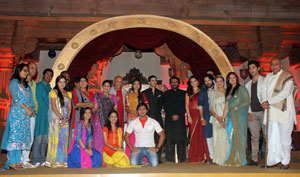
    Sanjayleela Bansali along with the entire cast of SaraswatiChandra

    “Mr Bhansali has got into every detail of every character. He is amazing in making us understand our role. I have been amazed and have been able to understand the character of Saraswatichandra better as he explained it to me brilliantly,” said lead actor Gautam Rode, on how different it was to work with the filmmaker on a daily soap.


    “The show is being promoted through beautifully crafted and mounted TVCs, building up the enigmatic hero Saraswatichandra and the quintessential heroine Kumud. We also did a exclusive web premiere of the show on Valentine Day and a spectacular light and sound show on the elaborate sets to formally announce the show launch. The visual splendour of the show will be further built on outdoor and print closer to launch,” added Mr Madhok.


  • Kartikeya Sharma acquires majority in Barun Das’ Cent Percent

    By A Correspondent


    Kartikeya Sharma, MD of ITV network, has inked a deal with Cent Percent to buy a majority stake in the company. Set up by Barun Das, until recently CEO of Zee News, and Amit Tripathi, formely sales head at Zee News., Cent Percent Media Solutions is on outsourcing adverting sales organization with its core focus on regional and niche TV brands.


    Mr Sharma has embarked on an aggressive journey to make ITV a robust and successfuly news network. Last year, he acquired English news channel News X which he plans to relaunch soon. The ITV network has another six channels including India News. Leading news anchor Deepak Chaurasia is the new face of India News, having joined the channel from ABP News.


    Commenting on this acquisition Mr Sharma said, “Barun and his team have tremendous track record in managing news television business in the highly competitive genre. Given the proliferation of niche and regional channels that I foresee, riding the digitization of Cable distribution, Cent Percent is an extremely exciting proposition.”


    Said R K Arora, CEO of ITV network, “We have the largest number of news channels for any network in the HSM markets. Our thrust is on content and marketing strategy, which has already started showing results.”


    Said Barun Das, “Kartikeya has a great vision for his media business. The fact that he found value in what we have set out to do, augments my confidence many folds. Regionalisation and digitization are the primary growth drivers of TV media, where so far the profitability has been the prerogative of only a select few. With capacity growing exponentially due to digitization, Indian TV industry is poised for the next big leap. In a country of 1.24 billion people with 22 official languages, niche and regional language channels would realize their true potential, now. I expect more 200 new channels, mostly regional and niche, would be launched in next 3-5 years. Cent Percent would be a one-stop shop to meet the advertising revenue challenge of all niche and regional channels who may not find it viable to build a strong national sales team”


    Highlighting the plans for the company, Amit Tripathi added, “We will have a strong national team with about 70 leading sales professionals. Our initial plan is to build a bouquet of regional news channels which would be the biggest and most effective one from the point of view of national advertisers. Within the first fortnight of its operations, Cent Percent has signed up with seven high potential regional news channels. We are confident that before the new financial year, we will be setting up a bouquet of 10 regional news channels. Our primary bouquet will have a channel each from leading regional TV markets of India. We will carefully handpick those channels.”


  • NDTV Good Times Lifestyle Awards announced

    By A Correspondent


    Lifestyle channel NDTV Good Times has announced its first Lifestyle Awards. The awards are scheduled to be held on Saturday, March 2, at Jaypee Greens Golf & Spa Resort in Greater Noida.


    The NDTV Good Times Lifestyle Awards aims to celebrate icons who have left a lasting impression on Indian lifestyle, and will recognize people from the fields of food, travel, technology, fashion and luxury.


    The awards have an extensive short-listing process and a high-powered jury including Alex Kuruvilla, Gautam Singhania, Raseel Gujral, Sabyasachi Mukherjee, Sanjay Kapoor, Suhel Seth, Vir Sanghvi and Smeeta Chakrabarti (CEO, NDTV Lifestyle).


    The award categories:

    :: Lifestyle Destination of the Year (International & India)

    :: Hotel/Resort of the Year

    :: Home and Accessories Brand of the Year

    :: Best Designer of the Year (Indian)

    :: Lifestyle Label of the Year (International)

    :: Restaurant of the Year

    :: Spa of the year

    :: Fitness Icon of the year

    :: Luxury brand of the year

    :: Lifetime Achievement Award in Luxury

    :: Jaypee Greens Lifestyle Icon of the Year (Viewers’ Choice)