Category: TV

  • Only the logo will change: Venkatramani


    As the clock strikes 12 midnight, the logo on popular Hindi, Bengali and Marathi news channels Star News, Star Ananda and Star Majha will change. In fact as the communication from the channels has been emphasizing, save the brandname, nothing else will. Following the announcement of the discontinuation of the Star brand affiliation with MCCS (Media Content and Communications Pvt Ltd), the the Ananda Bazar Patrika and Star India jv, the three 24-hour channels will be rechristened. Star News to ABP News, Star Ananda to ABP Ananda and Star Majha to ABP Majha.


    MCCS unveiled its new logos for the three channels and kicked off its communication campaign around the rebranding on May 7. The creative communication campaign was developed by Lowe Mumbai and the media buying plan was formulated by Mindshare. The aggressive communication campaign based on the theme, “Our Stars don’t change, our News does not change, only our Name changes”, was launched across media, on TV, Print, Radio, Outdoor and Internet to familiarize viewers and stakeholders about the new name and logo.


    Just hours ahead of the rebranding, MxMIndia spoke to Mr Ashok Venkatramani, CEO, MCCS on the acceptability levels of the new name, measures being undertaken to retain viewership and the road ahead for MCCS.


    What time will the change happen?

    Tonight. 12 midnight.


    Since you spoke to us the day the announcement was made to now, what are the reports that your front-facing sales and editorial forces bring you – in terms of acceptability of the name… especially for Star News to ABP News?

    So far the feedback has been positive and encouraging. If I were to divide the stakeholders into three parts – the viewers, the newsmakers and the media buyers and the trade, for the first segment which comprises viewers, the change has not happened. It’s going to happen from tomorrow. But since the time we announced, there has been no change in our ratings. We report daily news, and as long as it is the same set of people doing the same set of news in the same manner, I don’t expect much change there. The second constituent which is the newsmaker, there is absolutely no issue there because ABP is a very strong name in the newspaper and magazine industry. It’s been there for long and ABP has very strong news credentials. The third segment which is the trade and media buyers, feedback has been positive… virtually no problem with the large houses. There again, ABP is not a new name, everyone buys print so they know. So it has been positive, and it’s best manifested in the sales that have happened in the last couple of months. I am fairly confident that we will be able to pull this through comfortably.


    But the biggest component is the viewer, which is untested yet and that’s where the ratings come in.

    Frankly, unlike the entertainment media where your ratings are linked to some big property and the fate of the channel is linked to that property, in a news channel, where even before the name change there is a fair degree of clutter and poor differentiation. Over a period of time, each channel has established rating levels based on consistency of its content. And that consistency is driven by the way we report, the speed of reporting, the honesty, the faces or the anchors who come on our channel, the kind of programmes we have. Now those things don’t change, the reporting and the people are the same. To my mind, just a logo change in the corner doesn’t dramatically change impact of the news channel. And if you take the two regional channels, Ananda and Majha, they are clear market leaders, and there again nothing changes- the anchors are the same, reporting is the same, and the position of the channel in the EPG is the same.


    Any attempts to retain viewership… like contests et al? And any specific measures to retain advertisers? And for the distribution trade?

    No, we are not resorting to any short-term activity to garner quick eyeballs because our genre doesn’t subscribe to that. What we can potentially do is break big stories but there is already so much action happening. What we are doing is engaging with our trade, media buyers and distributors. We are having a series of meetings with them, small personalized interactions where we can chat and exchange views with them. It’s more of a personalized engagement with the constituents rather than any on-air activity for the viewer.


    Given that there is a change, are there any specific areas that you are changing in the new channels?

    It would be exactly the same and deliberately so. We just want to do one measure at a time, so at this point there is no change other than the name change. But as we progress into the new name and once the new name gets fully established, people start recognizing it, and then we will look at other measures like relaunching the channel, changing the look and feel etc.


    When is that likely to happen?

    Too early to say.


    Our columnists Anil Thakraney had commented that this is possibly a good occasion for changing some of the typical things that are common on Hindi channels, like over-sensationalizing etc. Are you thinking of doing that now?

    No, actually if you watch the channel, we have done that for the last one-and-a-half years now. This is a common misconception most people have because they don’t see Hindi news channels on a regular basis. This is a genre problem where we have a lingering perception. For example, I have got out of astrology for a year now, I don’t have a single programme on the channel which talks about astrology. It’s been more than a year-and-a-half since we got out of religion. Now we have not gone out on the rooftops and shouted about it but all these things we’ve already done. We have only hard-hitting news on our channel from 5pm to 10pm. And we’ve done this because we felt this is the right thing to do for a genre not because our name is changing. To my mind, in a news channel, these changes take time to notice.


    A programme like ‘Asar’ with Aamir Khan would’ve obviously started on Star News because it was a Star Plus show. Will the preferred partner status continue to exist even after June 1?

    Yes, in fact they are still our shareholders. Secondly, all such deals are purely on a commercial basis but obviously relationships were strong. In fact not many people know that Satyamev Jayate used to be a programme on Star News started by Uday Shankar when he used to be here. And we didn’t have a problem in them doing Satyamev Jayate, so the relationship continues. They continue to be our distribution partners, they continue to distribute our channels internationally.


    There is this news that Star might also exit the JV because they say it is not really worth their while to have a stake when they don’t have any say. Is that something that you have factored in?

    Actually I don’t want to comment on it because it’s a JV issue which only the JV partners can address. And I think it is best addressed by Star and ABP. But I guess any commercial investment by any investor has to be based on commercial returns. Now how an investor evaluates investment in the news business depends entirely on the investor.


    Have you done any brand studies or surveys on the acceptability levels of the new names?

    Yes, we have done research. A name change always has to be a combination of some research and some amount of strategy. One can’t entirely depend on research, it’s like naming a baby, where you look at the ‘granth sahib’ and pick up the alphabet and choose your name. So I think for us, given the fact that ABP is a serious player in the news business and they have long-term ambitions to be in news, including broadcast news, it did make sense to have a master brand which can be built going forward. So it was a combination of strategy and research.


    How active will ABP be, or will it be the same with you running the enterprise and ABP being on the board level?

    Nothing changes even on that front. Even now both the shareholders, Star and ABP continue to be the parents allowing MCCS to do its own thing. They were always available to be tapped, whenever we needed inputs. Any dealing with them is also at commercial terms. I don’t see any change in that.


    The campaign of the name change kicked off rather early, from the time you made the announcement… was it part of the original design or was it something which changed later?

    Obviously we saw it coming and we had a headstart of a month or so. A couple of months were good enough for us to churn out a campaign, so that’s how it was.


    Will see a more robust online presence of the MCCS channels now, including an English news website?

    If you look at our entire strategy, not just online, it is driven by a simple definition of who we are and what we are. We believe that we are not a television news company, we are a news content company. If we are a news content company, we should be platform-agnostic and we should be available on all platforms where a viewer might like to consume news. So we developed all these websites and developed 3G platforms, mobile downloads etc. so that we are available in all platforms. For us the allied platforms were not like profit centres, we were happy to get the revenue but at the same time we wanted to be present in all the platforms. The problem is that the online rights of Star News were international, which is why we didn’t get .in at that point of time. So we had to go with another name. Now going forward, our strategy remains the same.


    Any new channels coming up in the immediate future?

    We are working on newer options… frankly, it’s a question of the right timing. It is not related to this name change or the JV, it is an independent aspect which we in MCCS have been exploring and continue to explore. I would probably wait and watch because next six months are going to be a huge turning point. For example, if the entire digitization process goes on well as planned, it has a big impact on news channels and also our own company in terms of how we project the next five years. If the digitization process gets postponed or deferred then I will be a little more cautious. We do have plans but whether I press the button or not, I’ll probably wait and watch.


    Will it be organic or inorganic or both?

    It could be both, it’s a question of a right opportunity.


    Say, for instance, if a NewsX is available, would that be an option?

    I wouldn’t rule out anything but I would evaluate everything for the value it brings and how much it costs. If it makes business sense, why not. But it’s not as if we would be chasing any particular company or a set of channels or anything like that.

     

  • 73 matches on IPL5 get an average TVR of 3.36

    By A Correspondent


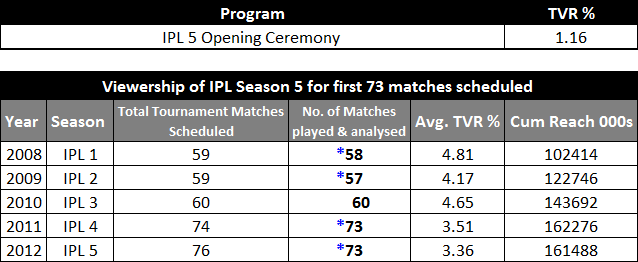
    Despite delivering the lowest television ratings in the history of the tournament, the weekly data released by TAM sports has shown some consistency in its overall IPL 5 viewership. According to the latest numbers released by TAM Sports for the first 73 matches (CS 4+ All India), IPL 5 recorded a TVR of 3.36 per cent, which is slightly lower than the first 73 matches of season four which received a TVR of 3.51 per cent.


    These ratings do not include the final match played between Chennai Super Kings and Kolkata Knight Riders on May 27. A total of 76 matches were played in season five, the highest so far in the entire tournament, and out of the 76 matches played, two matches were abandoned due to rain.


    The inaugural IPL season (IPL1) however continues to remain the most watched tournament till date with a TVR of 4.81 per cent for the 58 matches whereas IPL3, which celebrated the home coming season, witnessed the second highest viewership for the first 60 matches with a TVR of 4.65 per cent; IPL season two which was played in South Africa received a TVR of 4.17 per cent for the first 57 matches.


    What has shown improvement is the cumulative reach for the 73 matches in IPL 5 that stands at 161 million. This is nearly the same for IPL 4 where the reach was 162 million and far better than IPL 3, 2, and 1 where the reach measured was 143 million, 122 million and 102 million respectively.


    It may be recalled that for the first 59 matches IPL 5 delivered a TVR of 3.33 per cent and during the first 48 matches, IPL 5 delivered a TVR of 3.40 per cent whereas for the first 36 matches IPL 5 delivered a TVR of 3.41 per cent, for the first 27 matches, it delivered a TVR of 3.53 per cent and the first 16 matches, a TVR of 3.65 per cent.


    Mr Janardhan Pandey, Associate Vice-President, DDB Mudra Max said that he was not disappointed with the ratings as season five was expected to deliver lower ratings than last year, although he did expect the ratings to be closer to season four. On the factors that might have affected the viewership, Mr Pandey said: “I feel that on the face of very high expectations, too much confusion before the start of this season along with poor Indian team’s performance in last one year and overdose of cricket did impact the IPL season five viewership. I am also of the view that certain IPL teams are weak with few relevant star players as compared to many other teams, so the matches involving them delivered low ratings, thus impacting the overall score.”


    “I believe that the game is extremely popular and audiences are still around. Only the crowd needs to swell further. The weaker teams must get boost up with inclusion of adequate star players” he added.


    Source : TAM Sports, TG : CS 4+ yrs, Market : All India, Channel : MAX, No. of Matches analysed : As mentioned in the table

    * In IPL 1 one match (47th) was abandoned due to rain
    * In IPL 2 two matches (7th & 13th)were abandoned due to rain
    * In IPL 4 one match (20th) was abandoned due to rain
    * In IPL 5 two matches (32th & 34th) were abandoned due to rain


  • Taproot’s ‘sexy’ humour for Fox Movies

    By A Correspondent


    The new campaign being aired for Fox Movies Premium, an Asian movie channel owned by Fox International Channel, subsidiary of News Corporation has created a lot of buzz. The campaign was created for the Thai market, and the film was shot inBangkokwith some lead actors from their TV industry.


    Santosh Padhi, Chief Creative Officer & Co-Founder TaprootIndiasaid: “The brief was very simple to communicate that Fox Channel now offers subtitle free movies, so the product promise is generic but the challenge was how to say it in a way that Fox Channel is on the top of the audiences’ mind. We thought whatever we say had to be entertaining in the first place, which is why one watches the movies, hence a humorous approach. And since it’s targeted for the Thai audience, the second challenge was a very distinctive humor as they are known for their mad humors. We decided to highlight the problem. The whole idea of the campaign or creative device is based on the behavior of the person who watches movies with subtitles.”


    Razneesh Ghai, film director, Asylum Films said: “The rampant usage of subtitles has taken away the cinematic experience of watching films. It has now become a habit to read the subtitles, taking your eyes off the action. We took this simple problem and highlighted it in a funny manner. The humour in the film is very subtle and not in your face. Also, there had to be a simple thread of communication to convey it to a global audience (since subtitles are everywhere!).”

    Manan Mehta, Managing Partner TaprootIndiasaid: “English language channels had struck a chord with the audience in non-English speaking markets due to subtitling. Of course, the next sphere of offering was the regional feed. This allowed the English channels to be relevant and come closer to their audience. Thus, this campaign was conceptualized with the brief of making the audience aware that Fox Channel is available inSouth East Asiain regional language.


    From January 1, Star Movies was rebranded Fox Movies Premium and was available inHong Kongand selected Southeast Asian countries. InIndia,China,Vietnam,Middle East,Taiwanand thePhilippines, the Star Movies brand will continue to be the same.


    TaprootIndiahas been handling Fox International Channel for theSouth East Asiamarket for last few years.


    CREDITS:
    Agency                                                            TaprootIndia

    Creative Director                                            Santosh Padhi, Agnello Dias
    Writer                                                              Santosh Padhi

    Account Servicing                                           Manan Mehta

    Director                                                           Razneesh Ghai ( Razy )

    Producer                                                          Anju Vaswani

    Associate Producer                                         Bhavna Singh

    Editor                                                              Jay Chandran

    Sound Design                                                  Joseph George


    THAI CREW

    Line ProducerThailand( Picnic Features)     Kornpanote Semros

    Director of Photography                                  Sinthop Sophon

    Art Director                                                    Achira Nokthet


  • Rajmohan Nair joins IndiaTV as Prez-Network Devpt

    By A Correspondent


    India TV announced the appointment of Rajmohan Nair as President, Network Development. Prior to this he was VP-Distribution with TV Today. He has been fourth key appointee joining India TV from TV Today in less than three months.


    He will be responsible for Network Development for India TV and upcoming group channels in domestic and international markets. Mr Nair will be reporting to MD & CEO, Ritu Dhawan.


    Mr Nair has a career spanning around two decades, out of which 15 years have been in broadcast distribution space. As a member of the core strategy team of TVTN, he has been instrumental in encryption of the three TVTN channels & its launch in One Alliance Bouquet as a pay service.


    Welcoming Mr Nair on Board India TV MD & CEO, Ritu Dhawan said: “Digitalization is round the corner which will have an impact on the TV landscape in a big way. With Rajmohan coming on board at this juncture, we really feel optimistic that this will further boost the aggressive growth track we are set to follow”


    On his appointment, Mr Nair said, “It is a great opportunity for me to contribute towards further consolidating & cementing India TV’s leadership position in the news genre. What’s also exciting is the changing dynamics in the distribution space that shall also provide with a huge potential to develop pay business revenues for the channel.”


  • Fm y’day: Deepak Lamba quits Bloomberg UTV

    By A Correspondent (updated)


    Bloomberg UTV business head Deepak Lamba has put in his papers. Mr Lamba is reported to be serving notice and he will be at the channel till end-April, sources close to the development informed MxMIndia.


    Mr Lamba, has been business head of the channel since January 2010, and earlier reported to Mr M K Anand and more recently to the Board said to be comprising two representatives from Reliance, one from UTV and a fourth from Bloomberg.


    MxMIndia has learnt that a replacement for Mr Lamba has not been named. Before joining Bloomberg UTV, he was Director – Viacom Brand Solutions and worked with MTV India for five years.


    Mr Lamba is reported to be moving to a larger role in a larger conglomerate, sources tell us.


  • First on MxM! Deepak Lamba joins BCCL as President

    By A Correspondent


    Deepak Lamba who had moved on from Bloomberg UTV as business head in end-April has joined Bennett, Coleman and Company Limited as President.


    Although Mr Lamba was not available for comment and nor has it officially been announced at BCCL, MxMIndia learns that he has joined BCCL today. He is likely to be heading a few new ventures that the group proposes to enter.


    Mr Lamba was business head of Bloomberg UTV from January 2010 to April 2012 and prior to that was Director – Viacom Brand Solutions and worked with MTV India for five years.


  • The Rise and Rise of Deepak Lamba

    By A Correspondent


    When MxMIndia broke the story of Deepak Lamba joining Bennett, Coleman and Company Limited as President, the news spread like wildfire (see link http://www.mxmindia.com/2012/06/first-on-mxm-deepak-lamba-joins-bccl-as-president/). As it spread amongst media circles, it was decidedly the most read story on MxMIndia over the weekend.


    Mr Lamba is one of the youngest professionals in Indian media to occupy the position of President of a large Indian media conglomerate like The Times of India group.


    Until end-April, Mr Lamba was with Bloomberg UTV as business head. He made a sudden exit with no indicator of his next port of call. Except that it was to be with a leading media corporation with diverse interests.


    Although Mr Lamba was not available for comment and nor was it officially announced at BCCL until Friday evening, MxMIndia learns that did join the company on June 1. There is no word on his portfolio except that he is likely to be heading a few new ventures that the group proposes to enter. MxMIndia also learns that the proposed venture may not be in television, the business he has been working with at Bloomberg UTV and MTV, though there may be some linkages.


    Mr Lamba’s rise and rise has been phenomenal and is in fact inspirational to those without any godfathers in the business and/or no Ivy League education. A student of Pune’s premier St Bishop’s School later the Wadia College, he did his MBA from the Pune University thereafter. He was business head of Bloomberg UTV from January 2010 to April 2012 and prior to that was Director – Viacom Brand Solutions and worked with MTV India for five years.


  • From Cricket to Prime, Neo takes a spin

    By A Correspondent


    It was cricket – in the form of the Indian Premier League – that made the most noise amongst all other sports that were being aired on sports channels in India during April-May. But the tide has now turned and has switched partners in the form of Neo Prime, which may now be leading the viewership race by not airing cricket but three different live action sports in India – Azlan Shah Hockey, French Open and Euro Cup (starting next week). For those unaware, Neo Prime is the rechristened channel from Nimbus which earlier went by the name Neo Cricket.


    While most broadcast networks have been contemplating launching a channel solely for airing cricket, it is surprising to see Neo take a turn on the same. Then of course, there was the ugly episode that saw the channel losing its rights to host India matches. Explaining the rationale, Prasana Krishnan, COO, Neo Sports said, “We were one of the first channels to go in for cricket and are probably the first one to be going away from it. When we had the BCCI rights, it made sense for us to do that as you had a lot of domestic cricket that was available; there were a number of days that were available at our end. So we kept the channel for the volume of the game that was available with us. But then it is also about reacting and responding to the change. Though we have lost the BCCI rights, we will continue to take part in the bidding process for other cricketing properties as and when the opportunity arrives. As of now, we have our hands full with a lot of live actions sports and are the only channel that has so much on its plate currently.”


    In fact the network carried out a vital evaluation exercise months ago before it decided to go in for the change. And it had some interesting facets to throw up apart from just cricket. Explained Mr Krishnan: “The basis for our evaluation was that we have five other sports apart from cricket – tennis, football, golf, badminton and hockey, and what really happens is live sports is played mostly during weekends where you have multiple sports being aired simultaneously. So we were faced with the problem of having more than one event at the same time and therefore airing a certain sport and not being able to relay the others. If you look at the sports being aired right now on our channels, one channel is showing Sultan Azlan Shah Hockey while the other is showing French Open tennis. And next week, we will have French Open and the Euro Cup on at the same time. So the scheduling conflict is a constant problem that arises at our end and our effort has been to maximise and ensure that maximum events are being made available to customers as possible.”


    In fact, according to Mr Krishnan, the same pattern was observed in other networks as well where they had scheduling clashes. “What was happening for us was that we were playing hockey and other sports on the cricket channel, which really didn’t make sense. So in that sense, Neo Prime would be more generic and would be playing different genre sports and not just cricket.”


    In fact there was another motive for the channel to contemplate the move. Explains Mr Krishnan: “What we are also doing is that all the content that is being produced is likely to switch towards HD mode sooner or later. Those are the kind of properties we plan to put on Neo Prime. Over the next few months, once we are comfortable with the working of the content, we will also provide a HD feed of the channel. So it is a HD-ready channel that is focussed and programmed in a manner that it is ready to relay action as it happens.”


    When asked on soft stance taken by the channel to communicate the change, Mr Krishnan said: “It’s not that we are going soft with the new change or anything, it’s just that we got approval from the Ministry for the change only on June 1, 2012. So the action and communication will take place over the next few days. Anyways, it’s not as big a news for us as currently all live sports action is happening on my channel be it French Open, Azlan Shah Hockey or Euro Football starting next week. So the idea was to time it with the best of sports action and combine that with a good campaign.”


    Advertisers have been advised of the change and so far the response has been positive. But the channel is not looking at that and has some big plans up its sleeve for the coming months. And yes, it would do so without banking on popular sport – cricket. Affirmed Mr Krishnan: “The change has been communicated to the advertisers and they have been reacting positively to it. But one must understand that it is the property that the brand gets interested in and if they appeal to them then they will obviously come on board to partner the event. And I am proud to state that in the January to March quarter, our network was ranked second by TAM in terms of viewership and that for the April to June quarter, we would easily be the No 1 network for sports in India going by the amount of live properties that we have on our hand right now.”


    It may just be the perfect start that the network is looking for by making a rousing comeback with its many live events. After all, as the saying goes: the past is well forgotten but the future is what you make of it.


  • Peter Mukerjea: Dream On… after all we’re in March 2012!

    By Peter Mukerjea


    So, if I were the next Minister of Information & Broadcasting for the Government (which is about as likely to happen as a month of Sundays) here are the 7 things I would want to do in my first 7 days of taking on the job. Sorry Ambikaji, this, of course, is not to say that you’re not doing a fine job, which you are – but like my school report card said term after term, ‘Could do better’.


    1. I’d start with issuing a mandate to privatize Doordarshan asap and thus enable the public to buy shares in the new entity and operate it like a proper commercial organisation and remove all Government control over it. I’d call a Nandan Nilekani, Deepak Parekh kind of person and get him to take on the project of getting this done in no more than a year. He could in turn invite the world’s best financial gurus and merchant bankers to have them pitch for the job. Then to appoint a proper CEO and a management team to develop a growth plan for the business which would include online, social media, cable distribution and task them with getting on with that in the following 12 months. They would report to a Board and be accountable to them and the shareholders.


    Benefit: The taxpayer would not need to fund DD any longer and its independence would be ensured. Profitability would emerge which would enable DD to become the largest media company in India and compete with the likes of STAR , ZEE or any of the international companies like the BBC or CBS or SKY or FOX. It would then attract the world’s best talent and be seen as a jewel in the crown for India. The company would bring about an amalgamation of all media activities under one roof and take its place in the list of leading companies of the world. If the Oberois can do that with their hotels, there’s no reason why that cannot happen with DD.


    2. I’d create an OFCOM (the regulator in the UK) like organization who would be responsible to the Minister for all the regulatory issues and they would have the power to prosecute and de list broadcasters if they didn’t follow the letter (and spirit) of the law. This would be run by socially responsible individuals with distinction and standing in the community.


    Benefit: This would in turn, enable the various media organizations in the country to be mindful of their social and legal responsibilities and not abuse the same. OFCOM would also be required to ensure that the people that run these various media companies are categorized as ‘fit and proper persons’ to do so. Managing media will then not be the direct responsibility of the Minister who could then take an unbiased view on issues if they were ever escalated to the Minister.


    3. I’d call TAM and get them to install an overnight rating measurement system and give them one year to do that. No more. Meanwhile, to expand the current system to include rural markets across India and to do this in 6 months. If they were not able to commit to getting this done I would invite other Research and Technology companies from India and the world over to replace TAM.


    Benefit: We would move industry to the 21st century and be similar to other developed markets where overnight ratings are the norm. This will help broadcasters , content producers and advertisers alike and will also be a reflection of the consumer. The expansion of the measurement universe would benefit the country as whole and content providers and advertisers would then pay more attention to the needs of the rural consumer and this will help the current imbalance between the urban and rural.


    4. All news channels in the country, both Indian and foreign would be required to present their credentials via a barometer of measurement which is based on quality, integrity and depth of journalism rather than GRP’s (ratings) alone. This would apply to all forms of news – be it entertainment, sports, business, current affairs, social etc.


    Benefit: The consumer would benefit by being presented with news reporting which is responsible and credible but not driven solely by sensational and scandal. Maybe there will be a news channel from India that will emerge to compete with the BBC or CNN in international markets. Here again, if Infosys can be world class, there’s no reason why a news channel from India cannot be world class.


    5. I would remove all financial barriers immediately to foreign participation in all media and would therefore allow 100 percent FDI in media and media related technology businesses. However, those owning and running these media and technology companies must be Indian nationals as is the law in the US.


    Benefit: This will attract the world’s largest companies to participate in the growth of Indian media and speed up digitization and internet connectivity in the process. This would provide a base for on line connectivity for all, across the length and breadth of the country from the smallest of villages to the largest of cities which would in turn accelerate communication and exchange of information for all Indians everywhere.


    6. I would remove all price control mechanisms instantly for the pricing of cable TV & internet connectivity provided by cable operators, MSO’s, DTH and other service providers as this would urge them to provide their services at prices that are market driven and competitive. None of these services are ‘essential commodities’ and therefore should not come under the purview of price control. However, each such service provider would be required to provide channels from each available genre, in proportion to the viewership they attract e.g. GEC channels – say 25 percent, News say 5 percent, Sport – say 10 percent, Natural History – say 5 percent, Music – say 5 percent, languages – 50 percent and so on.


    Benefit: The consumer would benefit the most as services would be provided at commercially viable rates and the quality of service would undoubtedly be enhanced as the various service providers would compete to retain and grow their consumer base for their custom, by improving service levels and quality. The Government should have no role in pricing media and entertainment services.


    7. All private FM radio stations would be free to broadcast news and current affairs, weather, traffic info, business news, for as long as they feel is commercially viable. Private FM radio stations would also be free to broadcast any genres that they choose to and the license fee for each genre would be adjusted (by OFCOM) according to the value of the genre – ie talk radio, sport phone in, 24-hour news & current affairs, Bollywood music, Indian classical music, education, health, western pop music, western classical etc etc.


    Benefit: Consumers across the country would then receive news on their FM radio stations and be informed rather than exist in the dark as they are currently. If we believe that the right to information is a democratic right for all , then we must live upto that ideal and enable private FM radio stations to provide a news service to their listeners 24 x 7.


    I doubt that any of these will see the light of day in the near future but I do hope that decision-makers in India will move quickly to turn all of these into reality as they will help the media industry in India to reshape and reinvent and become truly ‘world class’. Or else we can dream on!


  • Peter Mukerjea: Murdochgate update

    By Peter Mukerjea


    As I write this, it’s Sunday 1st April. It’s April Fool’s day and I thought it was an appropriate day to remind myself that one should not take life in media too seriously at all even though each one of us secretly believes that we matter. If that is so, you live in a fool’s paradise as that’s simply not true. It’s almost a case of ‘Mirror Mirror on the wall – who’s the…. of them all? ‘And that doesn’t just apply to Snow White.


    Do you believe that James looks himself in the mirror when he wakes up and asks himself that question?


    I doubt that somehow. For if he did he would know that he is now toast. Certainly toast when it comes to running his dad’s empire, towards which he was sailing comfortably just over a year ago.


    It’s been a while now, almost a year actually, since I suggested that James should step down. I guess he hasn’t yet done so from all his positions but almost 50 percent of them. But it’s not over yet. And it took him longer than I thought it would, but he did. At least from numerous boards in the UK that enjoyed his presence and executive prowess. The decision with regard to the ‘fit and proper’ test is yet to be taken by the regulator in the UK and in due course we’ll find out what their verdict is. The news which broke last week about the hacking of pay-TV codes will not bode well in their decision-making process even though James probably had nothing to do with it even though he was on the board of the company that claims that the allegations are ‘baseless accusations’. Oddly enough, the very same words used by the company last year when the phone hacking story broke. Since then much water has flowed under the bridge (of sighs) and as we now know, those accusations were never really baseless.


    From what I hear, shareholders in the company are gathering ammunition and momentum to get James off the other boards too but Rupert seems to be paying them huge dividends to keep them from pushing him to pull the plug on James. How long will that continue? Another six months or a year perhaps? But James cannot be in the consideration set for the top job at the corporation. And I think that’s the right decision anyway. He’s simply not there yet. And Chase – he is by far a more charismatic, knowledgeable and seasoned executive and what he knows on the tip of his little finger is more than the man in the sharp suit with a strange accent and super polite manners that make you feel a touch weird. So why is he still there? Perhaps, because, where else will he go?


    In India, where the presence of the Murdochs used to be regarded with the aplomb normally granted to that of a state visit, they now keep their head down and have their executives come to them rather than the ‘let’s visit the troops’ approach because reputations have eroded and some of the earlier public interest litigations may rear their heads once again.


    The fact that there’s trouble in the UK across several fronts is now a well logged fact and getting James to the US may do some damage control but can’t stop the avalanche completely. There’s potential trouble in the US, with the possibility of there being an investigation into the companies’ overseas corrupt practices. There’s a possibility of an investigation in Australia. In China there was trouble a few years ago and the company contracted quite heavily when the companies’ offices were raided and executives were shipped out. So far they’ve been safe in India. So, an earlier suggestion of mine in this column that James should consider setting up base in India now must make more sense to him although his presence in India would be regarded as a predatory move, of course, which will raise the shackles of all competitors. But that’s not a bad thing for the corporation and indeed for the man himself to use this an opportunity to reinvent himself.


    What finally happens will be known to all of us as time goes by but the there is a lighter side to all this. There’s the case of the horse that Cameron borrowed from Rebekkah (seeing as they have a home next to each other in the British countryside) and her hubby’s (who is Cameron’s school chum) laptop, that was found (and is still in the custody by the British police), in a bin in their garage that was ‘accidentally’ put there ! And then there’s the story of the German lingerie company that ran a series of ads in a campaign (last July) where they used James and his dad to full effect. They’re called Blush and if you were to Google – how to make Rupert Blush – you can see the ads for yourself.


    Wonder how far we are from a similar ad campaign like this in India. Piyush, Prasoon, Balki et al, are you listening?


    Sitting on the fence and watching these media moguls do a self-destructing act is motivating for those who don’t take life too seriously and recognize that being born with a silver spoon is as much a curse as a blessing. This entire episode to me is reminiscent of the late Robert Maxwell who was the owner of the Mirror Group of newspapers in the UK and who had a rather sad end. There were plenty of stories about Robert Maxwell but the one where he met two of his bankers on the rooftop of his building on Fleet Street and plied them with oodles of champagne is particularly noteworthy. After several glasses of champagne one of the bankers asked if he could go down to the loo for a pee but Robert Maxwell said that the best way was to pee from the edge of the building down on the street. Both Robert Maxwell and the banker then stood at the edge of the building and peed. When the banker asked “Will no one notice down there?” he was told by Maxwell “No – no one notices anything.”


    I’m sure there are a few more revelations yet to come and we’ve not seen or heard the end of this saga, but maybe by next year’s Fool’s day we’ll have had enough and will be truly sick of the goings-on, unless the new ones are so juicy and closer to home that they make us all sit up and ask for more. By the way – there’s a movie doing the rounds presently called The Hunger Games and it’s all about reality television and the extent to which broadcast companies will go to get ratings, and how it can be manipulated. If you haven’t seen it – you should. Particularly if you’re in the business of buying ratings or selling them. Never mind the content, it’s all about the ratings. More on that next week.


  • Peter Mukerjea: Rupert & Son

    By Peter Mukerjea


    So, it’s finally happened that James, or JRM as he is known within the company, has stepped down. I’d said that he should (see Firstpost.com article) and for whatever it’s worth, I’m glad that he has.


    Enough has been written and no doubt more will be written about the rights and wrongs of the people involved in the entire phone hacking case and we will never know who will finally go to jail for the crimes that are alleged to have been committed.


    But that would be looking back and surely it’s much more fun looking forward and trying to gauge what’s about to happen next. If Rupert is true to his word, JRM will now be spending more time on international operations and on the TV business at large . Now that leads me to suggest that he should for Newscorp’s sake spend at least 75% of his time in India looking at new business opportunities that exist in the country. STAR experienced it’s highest ever growth in it’s business under JRM’s watch when he was the CEO in Asia. That’s not a coincidence, I can assure you. Conversely, STAR experienced it’s lowest growth when JRM left the Asia region and handed it over to pixies in Hong Kong who had no clue about India. For example, the lady who was given the baton by JRM had never visited India ever in her life. Strange decision, it has to be said.


    JRM, on the other hand, was a respected executive and was seen as a path-breaking scion of his father. And the fact that not everyone loved him was simply par for the course and to be expected. He was effective in reshaping STAR’s fortunes and turning a loss making company into a profitable one.


    Incidentally I continue to believe that none of the new channels that popped up in 2007/8 would have happened if Rupert had not taken his eye off Asia but he moved JRM to London to run SKY and with that opened up the gates for newcomers. Some channels failed to make the grade – 9X & Imagine for example, and others did well – Colors & 9XM for instance, but none of these should ever have been allowed to get started given the complete dominance that STAR had on the market. And all the people that went to run these channels, including myself , were almost all from STAR.


    Since then STAR has held up well, although after a wobbly start. Credit for which should be given wholly to JRM for giving autonomy to the current leadership in managing their business and most importantly cutting them loose from the Hong Kong intermediary, which was rightly cut to size.


    JRM’s big opportunity is now to push ahead with developing a range of new TV and other media products for the India market and enable it to grow speedily to create a very clear leadership position with plenty of blue sky space between the No1 and the rest. And only he can make that happen by physically being there and making the big decisions which would otherwise be lost in power point presentations between numerous layers of management.


    This would in turn spur ZEE and Sony and MTV and the rest to do the same and compete with each other and with the pace that STAR would have set for them. This will then collectively turbo-charge and accelerate the industry as a whole and taking full advantage of the economic growth that the country is experiencing. The next 10 years for the media business in India will be huge and despite the slowdown in the global economy the pace of growth will be better than almost anywhere else in the world.


    JRM once said “let’s make the best use of a crisis” or words to that effect and I think this is a crisis that has presented itself for just that opportunity. He has moved to New York from London but may be he should have a home in Mumbai too and really shake up the market. There’s tons to do with a very exciting future for a 40-year-old – like JRM, which regular or even above average executives will simply not be able to take full advantage of. They can at best take limited risk, if at all – but JRM can and he should.


    Will he or won’t he? Or will he slip in and out of the country quietly, once very few months and leave the big opportunity to the pixies once again? If he ends up doing that he will have missed a great opportunity to grow the business and also to get himself back up and be recognised as being one of the best TV executives in the world. After all, he is the son of Rupert.


    Although it started as a fortnightly column, Peter Mukerjea’s Media Mullings will now appear regularly on MxMIndia, but with no definite frequency.


  • English cricket board hits slowdown for a six by selling cricket rights to ESPN Star

    By A Correspondent

    ESPN Star Sports (ESS) has inked a new seven-year contract with the England and Wales Cricket Board (ECB) for exclusive multi-platform rights to broadcast its domestic and home international matches across Asia, the Middle East and North Africa. Although there are no official figures available, British media reports suggest the deal is worth over Rs 850 crore.

     

    The deal, which runs from 2013 to 2019, incorporates exclusive rights for television, online, mobile and radio, covering major cricket markets of India, Pakistan, Sri Lanka and Bangladesh among others across Asia; the broadcast arrangement also includes territories in North Africa. ESS has been ECB’s current broadcast partner in the region, having held the contract for the past five years.


    David Collier

    ECB Chief Executive David Collier’s statement indicated how the deal would help the game and the Board: “In a challenging economic climate with all sports facing tough competition for funding streams, it will also provide an important source of additional revenue for funding the development of our game at all levels,” he said.


    Said Manu Sawhney, Managing Director, ESPN Star Sports (ESS): “We are delighted to further extend our partnership with ECB with whom we have shared a very strong relationship over the past two decades.”


    Manu Sawhney

    “This new agreement demonstrates the enormous appetite for cricket worldwide and the global pulling power of a successful England team and a vibrant County game,” Colliers added. Note: in January this year, the ECB had renewed a broadcasting agreement with Sky Sports for four-year cycle of 2014-17 and with BBC Sport for radio rights to broadcast live commentary on international cricket from 2014 to 2019. The ECB’s agreement with Sky Sports also includes an option to extend for a further two years, which would encompass tours by India in 2018 and Australia in 2019. In a separate arrangement, Channel 5 has been signed on to show highlights until at least 2017. The ECB-Sky Sports renewal  is reported to have been inked at around Rs 2200 crore.


    With this partnership, ESS continues to be the leading cricket broadcaster with the most comprehensive calendar of premier cricket events covering all formats of the game, including exclusive global telecast rights from the International Cricket Council events, the Champions League Twenty20, as well as major international and domestic events from the Cricket Australia. Adding to this impressive line-up of cricket content is BCCI cricket, which will be showcased in partnership with ESS.


    ESPN Star Sports will feature a packed cricket calendar over the next 13 months, showcasing a wide and varied mix of cricket action of over 400 match days starting with the ongoing West Indies’ tour of England  to all the way to ICC Champions Trophy in England in June 2013. In addition to the exciting line-up of international cricket, cricket broadcast will cover over 200 days of vibrant domestic cricket action from India, Australia and England featuring some of the top domestic leagues.


    As a part of the agreement with ECB, ESS will broadcast more than 300 days of live International cricket action, including 47 Test Matches, 63 One Day Internationals and 15 Twenty20 games. Major test playing nations will be competing in England, including New Zealand, Australia, Sri Lanka, Pakistan, West Indies and South Africa. Key highlights of this new agreement include India’s next two tours to England in 2014 and 2018 as well as three iconic Ashes series in 2013, 2015 and 2019.


    In addition, ESS will broadcast 60 days of ECB’s domestic cricket every year, including the Friends Life t20 competition, the CB40 tournament, the LV County Championship, as well as England Lions, England Under 19s and England Women’s cricket. Specifically for the Indian subcontinent, the exciting cricket action will be available during primetime making it an interesting proposition for fans and advertisers alike, a communiqué added.


    Meanwhile, although there have been media reports on the ESPN and Star India joint venture ending, there is no official confirmation or denial of the development.