Category: TV

  • Times Network launches ET Now Swadesh

    By Our Staff


    Strengthening the Network’s footprint in the language space, Times Network is set to mark its debut in the Hindi Business News genre with the launch of ET Now Swadesh. It promises to be a catalyst of growth, energizing every discerning Indian to Rise with India. The channel will also unveil its brand manifesto that reflects its unique proposition in the Hindi Business News category. A special brand film capturing the brand genesis will be released on the Launch day across the Network channels and its social media platforms.


    Led by Nikunj Dalmia as the Managing Editor, the channel features trail blazing editorial team of seasoned financial and business journalists including Mihir Bhatt, Pradeep Pandya, Kavita Thapliyal and Priyanka Anand.


    Commenting on the launch, MK Anand, MD & CEO, Times Network said: “ET Now has been committed to India’s growth story for over a decade and we are now thrilled to launch our maiden Hindi Business News channel, ET Now Swadesh, which not only presents a distinct proposition in the Hindi business news category but further fuels our mission to help every Indian Rise With India. While the pandemic presented unprecedented challenges worldwide, it has undoubtedly been an agent of radical change, to rethink and reimagine businesses and lives. New streams including digital services & payments, financial & investments tools have emerged as the definitive factors that will pave the path to progress. With an unwavering faith in India, ET Now Swadesh with its mission, Badho Desh Ke Saath, will pioneer a new revolution of financial empowerment and progress for crores of Hindi speaking viewers. I am confident that our new offering will resonate with our viewers, fulfilling their dreams and aspirations to Rise with India.”


  • Nikunj Garg is Editor of Mirror Now

    By Our Staff


    Nikunj Garg
    Nikunj Garg

    Times Network has appointed Nikunj Garg as Editor of Mirror Now. Garg will lead the editorial mandate for Mirror Now and closely work with the channel’s business and leadership teams to drive the channel’s growth agenda. In his new role, he will report to MK Anand, MD & CEO, Times Network.


    MK Anand
    MK Anand

    Commenting on the appointment, MK Anand, MD & CEO, Times Network said, “Nikunj has been one of our key assets and has significantly contributed to Times Now’s leadership through his action-oriented news reportage. We are delighted to welcome him to Mirror Now that has successfully redefined the norms and re-written the rules for new-age and viewer-centric journalism. I am confident that Nikunj’s in depth knowledge, expertise and experience will help the channel’s growth plans in serving its mission, ‘You First’.”


    Speaking on his new role, Garg added: “I am honoured and thrilled to take over this new responsibility. With a strategic segmented approach, Mirror NOW has successfully created a whole new genre of content, centred around the viewer’s preference for impact. I look forward to harnessing my best efforts to fuel the brand’s purpose of focusing on issues that impact the lives of Indians.”


  • Sony to broadcast Women’s Big Bash League (WBBL)

    By Our Staff


    Sony Pictures Sports Network (SPSN) will air the Women’s Big Bash League (WBBL) from October 14 to November 27.


    Notes a communique: “The 2021 edition of WBBL has already got Indian fans talking as eight Indian women cricketers who have also represented India will be seen taking the field. Smriti Mandhana and Deepti Sharma will be seen establishing their dominance in the Defending Champions Sydney Thunder, while Shafali Verma and Radha Yadav will play for Sydney Sixers. Poonam Yadav will join Brisbane Heat while Richa Ghosh will be seen in Hobart Hurricanes. India’s T20I captain, Harmanpreet Kaur along with Jemimah Rodrigues will take to the pitch for Melbourne Renegades. In the past, Smriti Mandhana, Harmanpreet Kaur and Veda Krishnamurthy have played in the Women’s Big Bash League with Smriti’s team, Brisbane Heat reaching the semifinals during the 2016-17 edition of the tournament.“


  • Times Network partners Yupp TV

    By Our Staff


    Times Network has announced the launch of Times Now Navbharat, Hindi news channel and ET Now Swadesh, Hindi Business News channel in US, Canada and key international markets, in partnership with Yupp TV, internet-based TV and On-demand service provider.


    Jagdish Mulchandani
    Jagdish Mulchandani

    Said Jagdish Mulchandani, COO and Executive President, Times Network: “We are thrilled to expand our content portfolio by introducing our recently launched Hindi news channels to our global viewers on Yupp TV. Our best-in-class Entertainment & English News channels are strongly positioned in over 100+ countries and we are now excited to present compelling news content in Hindi language for viewers across international markets. Presenting a holistic reportage on global, national, local, financial & business news content, Times Now Navbharat and ET NOW Swadesh will serve as an essential addition to their daily dose of news consumption. I am confident that with our latest Hindi offerings, we will further enrich the TV viewing experience of the viewers in Indian language and continue to keep them informed with in-depth, conclusive and credible news.”


    Added Uday Reddy, Founder & CEO of Yupp TV: “We are happy to announce the launch of Times Network’s Hindi news channels, Times Now Navbharat and ET NOW Swadesh in US, Canada and key international markets. We have seen a huge scope for Indian television with Hindi language in these markets and will be a great value add for our brand. Yupp TV users can now watch their favourite Hindi content globally, giving them more entertainment options to choose from.”


  • Sony enters 2-yr deal with Bundesliga

    By Our Staff


    Bundesliga International, a subsidiary of DFL Deutsche Fußball Liga, has agreed to a two-year deal with Sony Pictures Networks India (SPN) for exclusive media rights to broadcast the Bundesliga in India and the Indian Subcontinent. The agreement includes India, Bangladesh, Bhutan, Nepal, Sri Lanka, the Maldives and Pakistan.


    Said Rajesh Kaul, Chief Revenue Officer, Distribution and Head – Sports Business, Sony Pictures Networks India: “We are excited about announcing our successful acquisition of Bundesliga, which is a part of our ongoing strategy to be the premier destination for the best of International football. The Bundesliga is among the most popular club football leagues in the world and boasts of a strong fan following in India, making it a perfect addition to Sony Pictures Network’s portfolio of elite international events. We are looking forward to working with Bundesliga to serve our viewers in India and the Indian subcontinent with the best coverage of Germany’s leading football competition.”


    Added Robert Klein, Chief Executive Officer, Bundesliga International: “With this new deal, we are able to guarantee Bundesliga fans a place to watch their team every single Matchday. We are looking forward to working with Sony Pictures Networks India throughout India and the Indian Subcontinent to deliver all the twists and turns of the next Bundesliga seasons.”


  • Taarak Mehta to air 6 days a week now

    By Our Staff


    The Sony Sab mega-show Taarak Mehta Ka Ooltah Chashmah (TMKOC) will now air six days a week, with all-new episodes, according to producers Neela Film Productions Private Limited, The change comes on the back of Sony SAB’s decision to extend programming to six days a week.


    Notes a communique: “Taarak Mehta Ka Ooltah Chashmah  is said to be the world’s longest running daily comedy show is in its fourteenth year of uninterrupted airing with upwards of 3200 episodes. Simultaneously, with its subscriber count having crossed 10 million, the show’s official YouTube channel too has been receiving much response from its fans. Taarak Mehta Ka Ooltah Chashmah is authored and created by Asit Kumarr Modi.”


  • Sun Marathi launches, finally

    By Our Staff


    It was set to launch some two years back, and its finally here. Sun TV Network launched  its refreshed Marathi GEC ‘Sun Marathi’ on Sunday, October 17.

    Sun MarathiThe channel’s tagline is ‘Sohala Natyancha’ which means ‘Celebrating relationships’.  The channel has announced three hours of original programming with six shows starting from 6.30 pm to 9.30 pm.

    Notes a communique: “The channel is not only bringing this stellar lineup of shows to its viewers, but has also announced ‘Bagha Roj Jinka Rokh’ (Watch Daily, Win Cash) contest which every day offers an opportunity for more than 1,000 viewers to win up to 2 crores in cash prize from Dusshera to Diwali.  Every day during the contest period, one question will be asked in each of the six shows and viewers will have to give a missed call to register their answers on the numbers provided.”

  • Star ups entertainment quotient

    By Our Staff


    Star India network has unveiled content across channels and languages for the festive season.


    Said Kevin Vaz, President  & Head – Network Entertainment Channels, Star & Disney India: “Viewers are at the front and centre of everything we do; as a network, we understand their pulse and are committed to offering content that resonates with the entire family. We are thrilled to present power-packed shows with the biggest celebrities including Kamal Haasan, Akkineni Nagarjuna, Sonu Nigam, Remo D’Souza to entertain our viewers this festive season. This is a terrific opportunity for advertisers to reach and engage with viewers across demographics and make most of the festive period.”


  • Voot Kids brings home Pokemon

    By Our Staff


    Voot Kids, the content platform for children from Viacom18, has added the popular anime franchise Pokémon to its library. On offer: 21 movies and over 10,000+ minutes of Pokémon Anime series episodic content.


    Speaking on the initiative, Ferzad Palia, Head – SVOD (Voot Select, Voot Kids) & International Business at Viacom18, said: “At Voot Kids we aim at creating a wholesome experience for our young viewers to enjoy and fun learn from their favourite characters in a 100 per cent kid-safe environment. This endeavour of ours has received significant impetus through last year with the kid’s fun learn category witnessing exponential demand growth. The addition of the vast Pokémon slate to our content repertoire will allow us to further widen our audience base and continue to be category leaders.”


    Added Ashutosh Parekh, Head of Content – Voot Kids: “At Voot Kids, we continue to build a roster of compelling stories fronted by top global and local characters. With the consumer at the heart for every initiative on the platform, this was the perfect opportunity to build on the fandom Pokémon holds in India, propelled by kids and those who are kids at heart. Undeniably, this evergreen anime franchise with multiple extensions has evolved to be very relevant to the today’s digital natives, with superlative story arcs and well etched characters that unify action – adventure with humour.”


  • Why the bleak world of Squid Game is a streaming phenomenon


    By Sung-ae Lee


    Squid Game, an original Netflix drama produced in South Korea, is a streaming phenomenon. Released on  September 17, within two weeks, the series has become the most watched Netflix title in 76 countries, including the US, Australia and South Korea. (and India – Ed)

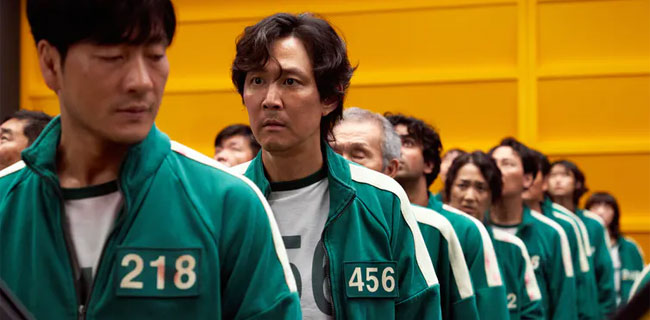
    Across nine episodes, desperate people enmeshed in debt voluntarily participate in a sequence of six sadistic and lethal survival games. The prize for the winner is 46.5 billion won (around A$50 million). At the outset, the 456 participants are unaware there is a twist. There can only be one winner — and the rest of the contestants will die along the way.

    This outcome is foreshadowed for viewers in a segment that precedes episode 1, in which two groups of children are seen playing the eponymous Squid Game (essentially a violent game played by Korean schoolboys). The groups struggle for possession of a squid-shaped area drawn on the ground. Both attackers and defenders must resist being pushed out of the play area, for, according to the commentary, if you are pushed out you “die”.


    Such games are commonly metaphors for life experiences. Games structured as a struggle for possession, or with the goal of overcoming a player in a position of control, are often stories about social aspiration and limited social mobility.


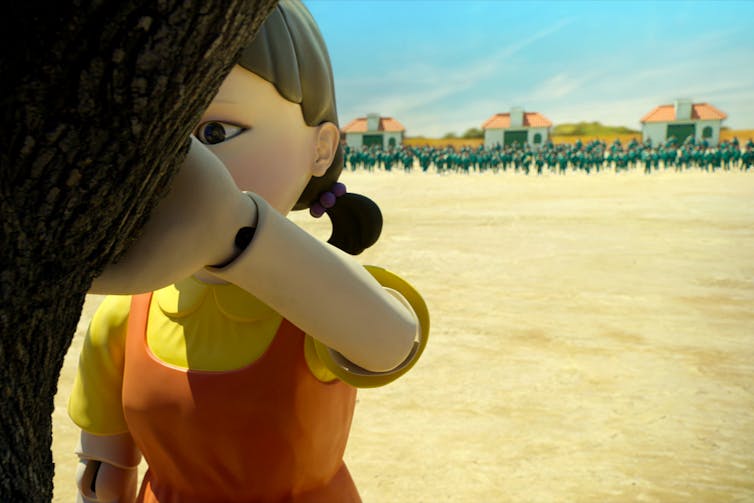
    In the survival game played in episode 1, Red Light, Green Light (also known as “Hibiscus flowers have bloomed” in Korea and “Statues” elsewhere around the world), players can win if they can creep forward when the controlling figure’s back is turned. If seen to move, they are “eliminated” (and in this case, die).


    The brutal adaptation of children’s games at the centre of Squid Game have clearly captured the imagination of the show’s viewers, and also provide a startlingly evocative metaphor for socio-economic inequality and capitalism.


    Television drama frequently portrays Korea as a profoundly unequal and violent society. Its traumatic history throughout most of the twentieth century — Japanese colonisation, the Korean War, almost 40 years of military dictatorship, and financial crises — has left deep psychological scars on the national psyche.


    Dark political narratives in TV and film continue to express the social impact of that history, such as the recent Netflix zombie series, Kingdom (2019–2021), along with D.P. (2021), Signal (2016) and Stranger (2015). The economic gap within Korean society is ever widening, and has become a recurrent motif in TV drama.


    This unequal society is a staple of “Cinderella” stories in which protagonists are displaced into poverty and abused by those with wealth and power until they regain their place. It is also reflected in dramas about the super-rich such as Sky Castle (2018) and The Penthouse (2020-2021), which show how ultra-wealthy Koreans maintain their control over the country’s wealth.


    Bong Joon-Ho’s Oscar-winning Parasite (2019) drew dramatic attention to the economic gap, as have several other films: Burning (2018), Veteran (2015) and Insiders (2015).


    Lee Jung-jae as Squid Game protagonist Seong Gi-hun, a desperate gambler.
    YOUNGKYU PARK/ Netflix

    Economic stress


    Socio-economic inequality in Squid Game is explored through the often heartbeaking narratives of the contestant’s economic stress. These are shown to be often compounded by Korea’s lack of a social safety net and unregulated financial structures.

    Employment in underclasses is precarious: chief protagonist Gi-hun (Lee Jung-jae) has been retrenched, has amassed gambling debts, cannot afford lifesaving surgery for his mother, and has tried to solve his financial problems by borrowing from loan sharks.

    Television dramas widely depict this latter practice as a blight upon society: interest rates are extortionate and borrowers easily slip into a form of modern slavery through ever increasing debt.

    Effective slavery is also depicted in Squid Game in the exploitation of North Korean refugees and South Asian migrant workers, often by other underclass members.

    Squid Game participants who question their commitment to the violent game are warned by those in control that because of their poverty or level of debt they will be much worse off in the world outside. Episode 2, Hell, is a realistic account of the precarious life of marginalised people, and the motivations that drive them into the perilous game.


    Red light, green light is one of the sadistic adaptations of children’s games in Squid Game.
    Netflix

    The popularity of Squid Game


    The global popularity of Squid Game can be attributed to various factors.

    First, it draws on a worldwide cultural obsession with game shows, from quiz shows where winners hope to make a fortune to reality television programs such as Survivor.

    As the participants wake on their first morning in their huge dormitory, the soundtrack rather comically consists of Haydn’s triumphalist Trumpet Concerto, which was previously used as signal music in a popular Korean quiz game titled Janghak Quiz (1973-1996).

    Squid Game also includes a level of violence characteristic of western cinema but rare in Korean TV drama. It forms a potent metaphor for a deep social malaise.

    The series also contains a lot of black comedy and even schadenfreude. There is a humorous contradiction between events on the screen, and the romantic music of the soundtrack.

    For example, the ominous preparation for the first game, including passage along an Escher-inspired staircase, is accompanied by Johann Strauss’s Blue Danube waltz. Having forgotten his daughter’s birthday, Gi-hun gets her a mystery present which turns out to be a cigarette lighter in the shape of a gun. The moment when she opens her present is both very funny and heart-wrenching.

    Finally, the series is a high-quality production. Its visuals are strong and it builds suspense very effectively. Such elements temper what otherwise might seem heavy-handed social critique.

    The success first of Parasite and now of Squid Game is bringing Korean film and media into the international limelight in an unprecedented way.

    Hwang Dong-hyuk, director of Squid Game, had to wait 12 years to find a backer for his script. He has been a highly successful film maker, known for Dogani (2011) and Miss Granny (2014), and currently seems to have his sights set on a return to the large screen. Perhaps he can be persuaded otherwise?


    Sung-ae Lee, is Lecturer, Asian Studies, Macquarie University. This article is republished from The Conversation under a Creative Commons licence. Read the original article.

  • TV9 ropes in Anshuman Tiwari as Editor of Money9

    By Our Staff


    Anshuman Tiwari
    Anshuman Tiwari

    As part of its expansion plans, TV9 Network has strengthened the leadership at TV9 Digital with the appointment of Anshuman Tiwari as Editor of Money9.


    Speaking on the appointment, Barun Das, CEO, TV9 Network said: “TV9 Network is India’s largest television news network with the strongest presence across languages. While language audiences have always been under-served in terms of personal finance, that need gap has only widened with rapid financialization and digitization of semi-urban and rural India. Money9 will serve the finest personal finance content in simple, easy-to-consume formats, accessible in multiple languages. I am confident we will deliver on this promise with Anshuman leading the Money9 editorial team. His knack for breaking down the most complex issues of the economy and public policy and how they impact an individual’s purse, are well known. With him, I am confident, we will set new standards for personal finance journalism in India.”


    Added Tiwari: “After seven fantastic years at India Today, I am excited at the prospect of creating something new in the area of personal finance which has always been a matter of passion for me. I am delighted that I will be able to pursue my profession and passion at the TV9 Network which is a leading platform in the industry.’’


  • India@75: Doordarshan


    By Avik Chattopadhyay

     

    Avik ChattopadhyayWelcome to the third piece in the series on my thoughts about some of the country’s most enduring brands called “India@75”. The first two were on the journeys of ‘Democracy’ and ‘Indian National Congress’ as brands.


    The battle of Kurushetra in the Mahabharata, one of the world’s biggest epics, starts with the words “Sanjaya uvaacha…”. The style of the narration was unique in the format of Dhritarashtra’s advisor and charioteer Sanjaya giving him a ‘live telecast’ of each nanosecond of the 18-day battle. Sanjaya had the divine gift of being able to see and hear everything in person without being at the actual location of incident. He narrates each incident to the king including the killing of his hundred sons at the hands of Bhima without ever flinching. He also describes the entire “Bhoomandal” [universe /galactic system] and entire Bharatavarsha to Dhritarashtra to build the context of all that is to follow in the battle!


    Many equate the direct telecast of Sanjaya to the concept of television, just that it was described somewhere around 1000 BC.


    On September 15, 1959, Sanjaya was reborn as what later got to be called as ‘Doordarshan’. Or DD as the nation prefers to call it. Though not yet 75 years old, but since we attained Independence, it has been one Indian brand that has endured all these years and continues to serve its core purpose.


    From the days of Pratima Puri and Gopal Kaul reading out the short news bulletins, DD grew from a mere part of All India Radio with a five-minute news bulletin to a virtual tour de force in the 1980s. For my generation it was our “Sanjaya”!


    Stamps issued to commemorate the 60th anniversary of DD in 2019


    Since 1982 when colour transmission were launched it was our friend, philosopher and guide on all things proudly Indian while being our eye to the entire world. The 70s and 80s were creatively the best decades for India in terms of exploration and expression. While we were an economically backward nation, when it came to intellectual prowess we were at par with the best. Some of the best institutions of education, research and healthcare had been built. Some of the biggest infrastructure projects on this side of the world had been undertaken. The biggest democratic cooperative movements were here. The 50s and 60s had built the platform to allow creativity take flight, collectively as a nation.


    The country’s biggest cultural movements in terms of art, cinema, theatre, music, and scientific temper started then and what we admire today about our current situation is an outcome of the same. And there was nothing ‘political’ about it, for there was enough upheaval in that field too to add to the magical Samudramanthan that we experienced. And DD was right in the middle of it all, including us all in this journey. It demonstrated the ethos of our Constitution and the values of the democratic system that we had decided to live with.


    The twin principles of DD that made it such a brilliant vehicle of the new Indian ethos were, as I call them, “Door ka Darshan” and “Doordarshita”.


    Door ka Darshan

    Literally meaning viewing far away things, DD helped reduce the distance of knowledge through enjoyment for millions of us who aspired to be one with the rest of the country and the world.


    I was exposed to Fellini, Aravindan, Gopalakrishnan, Ray, Ghatak, Patwardhan, Kurosawa and many more on DD. I gorged tales of Tenali Rama along with Byomkesh Bakshi and Panchatantra. I waited for Spiderman as well as The Old Fox with equal eagerness. I saw movies of all possible languages with subtitles as they were nationally and globally acclaimed. I never learnt to differentiate on language, subject or provenance as I wanted to absorb it all.


    Doordarshita

    Literally meaning vision, DD was carefully crafted by the early leadership of the country as a vehicle that would unite the young nation and equip us with the knowledge and wide perspective to step into the global arena.


    DD was not seen merely as a tool for government propaganda, which all state-owned media platforms are across the world. it was seen as the Indian’s peep into the menagerie that is India and the world.


    A generation of evolved Indians, with a greater sense of empathy and enquiry was built by DD. We were exposed to Chandra Prakash Dwivedi’s ‘Chanakya’ as well as Shyam Benegal’s ‘Bharat Ek Khoj’. We were enthralled by ‘Yes Minister’ as well as ‘Kakkaji Kaheen’. The world was brought onto the screen for us. We watched, consumed, debated and crafted ourselves as evolved Indians with a worldview without even having a passport!


    The Great Indian Thali

    That is what DD was curated as. Right from ‘Krishi Darshan’ [the longest running television programme in the world], to ‘Chitrahaar’ to the Sunday afternoon National Award-winning film, DD had it all.


    It had something for everybody. The sports lover got all the key global events as highlights or direct telecasts. The curious got shows like Quest, Quiz Time and The World This Week. The culturally leaning got Surabhi and Mirza Ghalib. The religious-minded got Ramayan and Mahabharat. The comedy seeking got Yes Minister and Yeh Jo Hai Zindagi. The curious got Sherlock Holmes and Karamchand. The kids got He-Man and Malgudi Days.


    Nobody was left out in DD’s mission to bring the entire nation together. It was a symbol of our unity in diversity!


    Common Conversations

    The nation had similar subjects to deliberate upon. Everybody from Mumbai to Madhyamgram was on the same platform of exposure, entertainment, and knowledge. Every part of the country felt proud to have been amply represented and amplified to the rest of the nation. Indians got to know more about India.


    If an incident disturbed Assam, it disturbed Andhra too, and vice versa. When Adoor Gopalakrishnan received the Swarna Kamal nobody asked “Adoor who?”. When ‘Manthan’ was telecast, the entire nation new of a tiny place called Anand and a man named Kurien. The entire nation debated Salma Sultan’s red rose tucked behind her left ear. We all admired the new reading skills of Tejeshwar Singh. It was inclusive.


    Deliberate Deprivation

    With liberalisation in 1991 came commercialism and private enterprise. With private enterprise came the need to ‘protect and neglect’. To protect the fledgling private television channels, the government neglected DD. Like most government initiatives, this was relegated to being just a mouthpiece of the policy-makers and those in power.


    DD was deliberately deprived of funds to ensure the private channels took over. Equipment was not upgraded, technicians were not paid enough, producers were short-changed, studios were not upgraded, and new technology was not brought in.


    The best talent from DD went over to the private channels and termites had taken over in no time. Management after management had submitted plans of autonomy and revival but to no effect. It was to become a propaganda tool not too different from the likes in China and Russia. Viewership reduced year on year, creating a case of financial unviability and hence no serious infusion of funds.


    The treatment meted out to DD was similar to that towards Air India. To encourage private enterprise the government deprived the shining public enterprises who were qualitatively at par with the best in the world. The intensity of this move was almost to undo the ills of the ‘socialist’ past. And as if all that was public was sub-par.


    Division and Disunity

    DD today is once again symbolic of India today, divided and disunited. We have become more insular while posing as being more global. The broadness of our mind and ability to accept has constricted to all that makes us feel comfortable and ‘superior’.


    The quality of what is consumed today across the country is in direct correlation with the respect towards education and enquiry. The former is totally transactional while the latter is the exclusive domain of a few. Escapism has substituted inquisitiveness. Proliferation has led to dismemberment of issues of national interest and debate. We prefer to escape into a world of ‘reality’ shows and celebrity scandals rather than discuss issues like education and environment. And we don’t care a damn about diversity as we have media that restrict us to our own little worlds of wells.


    As a collective, we are back to being what we were in the early 1900s… some 500-odd kingdoms and principalities busy with ourselves lacking a common identity. Having brought ourselves to such a state over the last 75 years, can DD rise from its ashes and unite us again? While the policy-makers would have none of it and wish to retain it as a political mouthpiece, Prasar Bharati can surely take a long hard look at its child and give it a serious makeover.


    We did hear a statement from the Prasar Bharati CEO a few months back pointing to same, commenting it would be inspired by how the BBC has evolved. For that, one needs both intent and independence. Hope the ministry has the “doordarshita” for the same at the earliest. As we celebrate ‘Azaadi Ka Amrit Mahotsav” we would not like to see one of the country’s biggest brands be finally consigned to the flames. Sanjaya needs to be reborn…