Category: TV

  • The Day After Cricket – Ormax survey of viewer recall

    By A Correspondent


    Ormax Media has announced the launch of the 3rd edition of its Cricket Advertising Recall & Effectiveness research – Day After Cricket (DAC), for brands advertising on IPL 5. DAC was launched in 2010 for IPL 3. In 2011, the research was conducted for IPL 4 and the Cricket World Cup.


    Day After Cricket research has two components. The first one involves day-after tracking, available as bi-weekly syndicated reports to advertisers and media agencies over the seven-week long duration of the tournament. This phase of research will be conducted across the six metros, covering more than 2100 IPL viewers over the course of the tournament.


    The second phase of DAC is post-event research customized to the brand’s requirements and target audience. In this phase, the impact of IPL on the brand’s equity will be determined, by measuring the difference in the performance of the brand on key attributes amongst viewers and non-viewers of the tournament. An advertiser can opt for either or both phases of the research, depending on its objectives.


    Speaking about DAC, Shailesh Kapoor, CEO – Ormax Media, said, “From a research perspective, there are two key deliverables in big ticket cricket advertising – Recall & Equity Impact. Recall needs to be monitored to understand if the brand has managed to stand out in the clutter. Equity Impact is the long-term influence of the campaign, measured in a way that nullifies the role of all other media or promotions, thereby isolating the specific impact of IPL on the brand.”


  • @FICCI-Frames 2012: TV influences life: IBF study

    By A Correspondent


    The Indian Broadcasting Foundation (IBF) has released an in-depth report on the Socio-Economic Impact of Television at FICCI Frames 2012. The IBF has conducted an extensive research in 3 phases to measure the impact of Television on Indian viewers. In the first phase, qualitative research was conducted across 20 focus groups to identify various forms in which television impacts the audience. This information was used to design the questionnaire for the second phase of the research, in which 5400 respondents were interviewed in the 7-60 years age group across 18 cities. They opined on 54 different attributes that encompassed the impact of television on their lives. The third phase of the research was a set of 25 in-depth interviews that amplified the learnings of the previous two phases. This enormous study spanned across 6 months. The research was facilitated by Ormax Media.


    The research findings are published in a formal documentthat is aptly named ‘Posi-TV-ity’. This in-depth report bears testimony to the overwhelmingly positive impact of television on audiences across the country.


    Uday Shankar, President, IBF emphasized, “Posi-TV-ity showcases the wide-ranging impact of Television beyond its conventionally understood & accepted role of being an entertainment destination. Today, television has moved ahead to offer more… a lot more. It in fact impacts the way India thinks and lives. Its impact on the socio-economic fabric of our country is indelible”.


    Today, television gone beyond entertainment and has become a medium that influences public opinion and stirs up sentiments. Everything that one sees on television has an impact and to measure that impact, this extensive study has been conducted by IBF. In this process of understanding the impact, the study has shattered several myths associated with television that were created due to stereotypes associated with it.


    In particular, Posi-TV-ity identifies 7 key roles that television plays in the life of a viewer. The study validates and substantiates these roles and impact of television in the country:


    Education – Respondents agreed that TV has helped them take more informed career decisions, financial decision and also learn new things that they could apply to their jobs.


    Personality Development – Viewers agreed that TV boosted their confidence, helped them become all-rounders and also widened their thinking.


    Social Interaction -Audience today feel that TV has helped them in having a better relationship with in-laws, keeping families together in today’s changing world, and strike a balance between Indian culture & westernization.


    Exposure – Viewers feel TV keeps them updated on the latest fashion & trends, latest products and also aids their purchase decisions. TV also keeps them informed about health related issues.


    Awakening – Respondents felt TV increases awareness of women’s rights, social issues, and rights as a citizen of India as well.


    Opportunity -It is widely believed that TV also gives opportunities to people from all over the country to showcase their talent, makes viewers feel closer to celebrities!


    Rejuvenation – Many viewers feel that TV makes sure that there is not a single boring or dull moment in their lives.


    Shailesh Kapoor, CEO, Ormax Media Pvt Ltd added, “The role television plays in the life of the Indian viewer is grossly underrated. This research identifies seven distinct roles of television, beyond entertainment. Each of these roles have a deep socio-economic or psychological connect with the viewers’ life. The research offers a new way of looking at the medium, in context of today’s India.”


  • Anuj Gandhi joins Network 18, to head distribution & biz dev

    Distribution veteran Anuj Gandhi has joined Network18 as Group Director, Distribution & New business development, with immediate effect.


    Mr Gandhi brings with him almost two decades of rich broadcast experience, across a variety of mandates including leadership roles at some of India’s leading distribution companies and broadcast networks.


    Speaking on this development, Mr B Sai Kumar, Group CEO, Network18 said: “Broadcast digitization and growth in new media will cause paradigm shifts in how media brands create value in the future. Our bouquet of channels straddling genres from news and entertainment to kids, music, factual entertainment etc across national and regional spaces is uniquely placed to make the most of this opportunity and we are delighted to have Anuj on board to drive it. His experience & understanding of broadcasting and distribution in India and his leadership record is impeccable, positioning him well for this task”


    Added Mr Gandhi: “Network18 is a benchmark player in the broadcast and new media space in India and it is now at a very exciting stage in its journey. I look forward to being part of it at such a momentous time and hope to work closely with the team to unlock value for our brands in an increasingly digitized environment”


  • @FF12: Niche isn’t niche any more


    By Rishi Vora


    It is a fact that Hindi GECs command a premium position in the TV space in India and the primary reason behind that is its mass appeal. And thereforea lot of advertiser interest tends to go in favour of the so-called mass channels.


    But there is another set of audiences that prefer a certain kind of content – speciality content such as Action, Comedy, Food, Music and so on; channels that cater to the tastes ofaudiences with a peculiar taste. These channels are termed as niche channels.


    The concept of niche channels started about 18-20 years ago, and now, as experts believe, niche isn’t niche any more as all niche channels put together command a share that is equivalent of the share of Hindi GECs and the mass channels, so to say.


    On day 2 of FICCI Frames, in a session titled “Building Sustainable Models for Niche Content” honchos from the broadcast industry such as Paritosh Joshi, CEO, Star CJ (session moderator); Smeeta Chakrabarti, CEO, NDTV Lifestyle; Monica Tata, General Manager, Entertainment Networks, South Asia for Turner International India; Ajay Chacko, President, A + E Networks I TV 18 JV; Atul Pande, CEO, Sports Business, Zee; and Rasika Tyagi, Sr VP – English Programming, Star India discussed on revenue models to sustain TV content catering to niche audiences and its long-term sustainability.


    Atul Pande talked about the launch of Ten Golf, a speciality channel for Golf followers in India. He stressed on the need to charge premium to audiences who really are on the lookout for speciality content.


    Smeeta Chakrabarti said that as a speciality channel one cannot talk about TRPs, rather it is the brand connect that what needs to be spoken about as far as ad sales was concerned. Rasika Tyagi on the other hand remarked that the whole idea of measuring a speciality interest channel should be relooked at. “It’s not about how many people are watching you, it’s more what kind of people are watching you.” She also said that the audiences of niche channels are of such quality that they do not mind paying, and that broadcast companies should look to tap into that opportunity.


    Atul Pande remarked that the Pay TV as a concept does not yield great deal of revenue as the pricing of the niche channels are on the lower side. “We keep the pricing on the lower side because we don’t want the consumers to be shocked despite the fact that some of the content that we do justifies a price in the higher range.


    On whether the industry requires a different approach as far as measurement for these channels was concerned, Paritosh Joshi said, “The big challenge with respect to measurement is that we need to find a way to measure both quantity as well as quality. The quality aspect is very critical for a speciality channel.” Monica Tata added, “We need to have a different measurement system to evaluate special interest channels.”


    As for the digitization mandate that all channels have to follow, Ms Tata was of the opinion that to move from the present model of advertising to embracing the digital opportunities will be a challenge, and something that will take time before becoming an industry norm.


    The panel also discussed the need to create global content, thus opening up monetisation opportunities across markets.


    Photograph: Fotocorp

  • @FF12: Price control equals creative shackles for broadcast: Hernan Lopez, Fox Intnl Channels


    [youtube width=”400″ height=”250″]http://www.youtube.com/watch?v=MCkprEBcPAs[/youtube]

    Video and Text By Shruti Pushkarna


    As President and Chief Executive Officer of Fox International Channels (FIC) Hernan Lopez oversees a massive international multichannel television organization that operates over 200 channels and their related online and production units. Mr. Lopez is responsible for all operations of FIC, which produces channels primarily under the brands Fox, National Geographic Channel, FX, Fox Life, Fox Crime, NatGeo Wild, MovieCity and Star Movies. He also oversees Fox’s US Hispanic cable networks, Fox Deportes and Utilisima. On the sidelines of FICCI Frames 2012, he spoke to MxM India about digitization, the vision for the Indian broadcast industry, HD penetration and economic uncertainty. Excerpts:


    On digitization

    I believe that digitization is good for consumers, for television industry and for both on the platform side and broadcaster side and like any process of gradual change of technology it won’t be without hiccups. There will be consumers that will be confused, there will be broadcasters who will be getting more or less space than they did before but at the end of the day all television markets that have gone from analog to digital have seen an increase in consumer satisfaction, in industry revenues and in the transparency of the system overall.


    Price control equals to creative shackles

    I argued in my presentation that price controls are putting artificial limit on the total revenue that the Indian television industry can generate and that limit in turn puts a limit on how much can it spend on content, how much you can afford to pay writers, directors, etc. What I have argued is that if the price controls went away, that’ll create a new incentive for television broadcasters to invest more in drama productions that can be here in India and also exported all around the world.


    On economic uncertainty

    We have seen uneven stories as it relates to advertising in Europe, for instance pan European advertising is down in some of the southern European countries but in some European markets, it’s up and it’s also significantly up in Latin America and Eastern Asia. So overall worldwide total advertising revenue is up.


    Advertising vs. subscriptions – what’s the right mix?

    In the US it’s close to 50:50 and I believe it will take many years for India to get to that stage but I think that’s a healthy balance.


    On HD penetration

    HD is a service that today consumers see as a luxury, at some point they will come to see it as a necessity. So around the world, as global television broadcasters, we are very advanced in giving all of our channels in both HD and SD. In fact it’s very much a policy that whenever we launch a new channel we try to do it simultaneously in HD and SD. And when consumers get used to that kind of service, it’s hard for them to go back.


    Do away with price control, Hernan Lopez tells FICCI Frames 2012


    By Archita Wagle


    The morning session on the second day of FICCI Frames 2012 opened with Anto Joseph, Resident Editor, Financial Chronicle, introducing Hernan Lopez, CEO, Fox International TV. Mr Lopez started his address by talking about how India and Indian presence is felt in the US, be it Indian doctors or yoga. But he rued the fact that inspite the ideas or innovations in diverse fields, one area that sadly lacked the innovative ideas and content was television.


    According to Mr Lopez, the reason for India’s lack was due to the fact that Indian talent “operates under price control which equals creative shackles”. Citing the example of Columbia which exports its programs to 80 countries, Mr Lopez compared the two and said that inspite having creative talent, technical expertise and skilled tradesmen at par; Columbia is much ahead as it is not restricted by regulations and price control.


    Mr Lopez said that Indian television industry was almost totally dependent on advertising revenues, almost $2.6 billion per year, which coupled with the fact that there was an overabundance of channels and less number of affiliates meant that the broadcasters were in a tight bind. He added that even then, almost $700 million had to be paid in carriage fees, which meant that paying the talent came last.


    The way forward according to Mr Lopez was if the price control was done away with. He said that this would make it possible to pay the talent in the industry what it deserves and then it can operate without any constraints to produce the best possible content.


    Mr Lopez lauded the move to digitisation which would reduce the carriage fees being paid and increase the revenues for the industry. When asked what is the right ratio for advertising v/s subscription, Mr Lopez said that it is 50-50, as advertising alone can’t fund a large degree of quality content. According to him, a stronger content needs a dual stream revenue model.


    A member of the audience questioned Mr Lopez about the government sanctioning digitisation for broadcast industry and how feasible is the government intervention, he answered that in a country like India, market forces alone can’t help a technology to be established hence government intervention was needed to push the digital solutions. But he was emphatic that now decision about the pricing should be left to the cable operators and consumers can choose the price level they want to pay.


    Asked if better technology is a guarantor to better quality content, Mr Lopez said that there is no guarantee, but he reiterated that if the industry is freed from the price shackles, it will definitely produce better quality content.


  • Suvarna’s new fiction show begins today

    By A Correspondent


    Star Network’s Kannada General Entertainment channel Suvarna announces the launch of their new fiction show “Amrutavarshini”


    The show is about an innocent, docile girl from a poor family who has few expectations in life; she is content with the simple things that her family life has to offer. How her life changes when she gets married into a rich family is the story forward.


    The show will go on air from March 19, Monday to Friday 9.30 PM.


    Anup Chandrashekaran, Business Head, Suvarna Channel says “All our shows are unique and have a different treatment. We at Suvarna ensure that every fiction show has a strong story plot and an engaging screenplay. This show is unique as this showcases the mother in law – daughter in law relationship with a new lens. The making of this show is exceptional and the story will undoubtedly appeal to the viewers tastes. This show is ideal for the 9:30 pm slot as this will be the immediate program after “Kannadada Kotyadhipathi” which is the biggest show on Kannada Television”


    The show is produced by the production house RG Media Stuff which has also produced one of the most successful shows of Kannada General Entertainment “Krishna Rukmini” for Suvarna.


    Ravi Garani of RG Media Stuff says, “We have ensured that the production values of the show are not compromised, and the look and feel is of national standard. I am thankful to the Suvarna team for giving me this opportunity to do this show.”


    Anil Narang, Head of Marketing & Strategy, Suvarna Channel says “This show will enhance the fiction offering of our channel. The story line will relate well to our core audience. We have ensured that the artists chosen to play the key roles in the show are the best fit to the character values they portray.”


  • @FF12: NBSA chief suggests independent regulation for media

    By A Correspondent


    In 1950, Jawaharlal Nehru said that freedom of speech should be granted to good and bad editors, but they should use it in national interest for he believed that if it is left to the government to decide, the good editors will be jailed and the only the chamchas will survive. This was the opening Justice JS Varma, former chief justice, Supreme Court and  News Broadcasters Standards Association (NBSA) Chairperson used for his keynote address for the session ‘Freedom of Media: Significance of self regulation’.


    Justice Varma said that freedom of speech is precious and we have to preserve it. The way to do so is self regulation as the media is mature enough to know to do it themselves and ward off the danger of state regulation.


    He said that it is not media’s right but rather an obligation to keep the people informed so that they can participate in government decision making process. It is the media’s duty to ensure transparency to ensure accountability.


    Justice Varma emphasised that the media should not give the government a chance to step in and hold it accountable. He said that the media (which reports) and judiciary (which decides) are the two strongest pillars of our democracy and they shouldn’t use their strength (power) to harm anyone, lest their power be curtailed due to lack of their accountability.


    Moving on, Justice Varma criticised the media, especially the broadcast media’s tendency for breaking news. He said that the key tenets of journalism should be kept in mind while reporting ‘breaking news’- is it true, fair and in public interest. He said that objectivity and due diligence must be applied while covering news. He cautioned the media, which has tremendous reach, to be cautious in its reporting as the effect of the news it flashes is instantaneous. He closed his address by saying “The more potential for damage, the more is the accountability you have”.


    The moderator, Barun Das, Zee News CEO and Vice President, News Broadcasters Association (NBA) spoke about how the media can’t be regulated as it is an essential pillar of democracy. He opined that free media can be good or bad but media which is not free can never be good.


    Mr Das said that regulation is a process of evolution. The media needs to introspect and understand where it stands.


    He outlined the dilemmas faced by the media while trying balance the content and the bottomline where news is trivialised for gaining eyeballs. The broadcast media especially is constantly grappling with trying to strike a balance between what the audience ‘would like to see’ and what they “should see”.


    The stage was then thrown open for the panel discussion. Each of the panellist was given time to speak and answer questions by the moderator.


    The discussion was opened by KVL Narayan Rao, executive vice chair person NDTV and President, NBA.


    Mr Rao said that there is no question of compromise on the fact that that media is free and that is the way it should be in a democracy. He said thatIndiais the largest free news market with a reach of 500 million households (news TV reaching nearly 115 million households).


    He said that in the early 2000s, after the private players were allowed in, they got together to set up the NBA to set up a code of programming and ethics which will regulate their broadcasting. He emphasised that it was important to have an independent and respected authority to keep a vigil on what is happening in the industry. He was proud of the fact that they telecast a scroll reminding the viewers that they have a forum to go to if they have any complaints.


    He also spoke about the NBSA which has been an advisory to the media with regards to improvement in news coverage and takes up issues suo moto if the media is found lacking.


    When questioned by Mr Das about balance or conflict on interest between news and business, Mr Rao was emphatic that there should be a “Chinese wall separating news and commercial interests”. He opined that news is to inform, educate and entertain the public independent of government and advertisers. He allowed that some compromise may take place but said that with digitisation, more cost can be spent on content and hence the scenario will change.


    Next to take the mike was Nitin Desai, Former under Secretary General, United Nations and member NBSA.


    Mr Desai started by saying that he disliked the term self regulation and “independent regulation would be a more appropriate term”. He said that emphasis should be given to developing the independent regulation in such a way that it is credible in the eyes of the media, the people and the view makers.


    His main concern was about the emergence of new media and challenges presented to regulate it.  He reiterated the need for due diligence to be given to fair and unbiased reporting, rights of an individual to privacy and avoiding trial by media.


    He said that he had already noticed a change in the fact that the mindset of the editors and the non-media members on the NBSA was converging due to the internalising the sense of responsibility.


    When questioned about the trivialisation of content, Mr Desai said that it was being done as the measurements showed that the audience preferred it. He said that there was a need for a different measuring system for news channels. He also opined that news channel have to stop behaving like money making operations and take responsibility to cover news that “people should know”.


    Phillip Turner, Chief of Bureau, CNN International, South Asia said thatIndiahad a long tradition of journalism but we tended to forget it. He emphasised that focus should be on stories that have a relevance to the rest of the world and maintaining the integrity of the media. He agreed with Mr Desai that the new media is presenting a challenge for regulation but he was of the opinion that everything would work out if the media stuck to the basic tenets of journalism – fair, relevant, responsible and accurate reporting.


    When asked about the need for a NBA-like worldwide authority, he wasn’t sure that such a platform could work globally.


    Kiran Karnik, member NBSA and former president of NASSCOM spoke about the challenges of new media. He said that today, when the news is available instantly as reported by citizen journalists and through the new media, it is the responsibility of the media to separate what is true and what is not. He also opined that news media today has shifted from reporting news to making news. He cautioned them to use the power they have responsibly by maintaining their standards and not infringing on the rights of the people.


    When questioned on the challenges thrown up by the new media, he agreed that technology is not amenable to censorship and also the consumer is becoming the creator and consumer. But he emphasised that there should be zero tolerance for unverified news and the news media as the aggregators of news should use their own censors.


    Mr Das wrapped up the session by stating that now is the time to convert challenges into opportunities and inclusive growth through media is the way forward.


  • Brand Sachin still on strong wicket

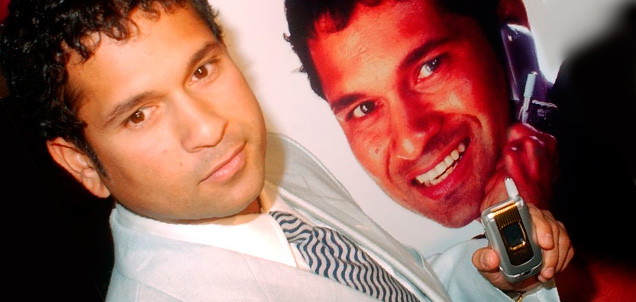
    Sachin Tendulkar launches G-Hanz Mobile


    By Tuhina Anand


    India collectively heaved a sigh of relief when Sachin Tendulkar finally reached his 100th 100. The long-chased milestone had become practically a national issue, and had also brought flak on the master blaster, especially speculation about his retirement. Sachin in his illustrious career has not only reached many cricketing milestones but along with that has also become the face of many popular brands in India. He has been seen in the ads of Pepsi, Visa, Aviva Life Insurance, Boost, Adidas, MRF, Britannia, Toshiba and Castrol India among others. In fact, Future Group has co-created the Sach brand along with Tendulkar which has products including toothpaste and bathing bars. The Sach brand proves the icon’s sheer clout, that a brand can be created with a varied range of products, and is considered a viable commercial option.


    Talking about brand Sachin, Piyush Pandey, Executive Chairman & Creative Director, Ogilvy South Asia said, “Brand Sachin is not just about cricket but it’s the persona that comes with the brand which is appealing. Sachin is a non-controversial, family man with high value systems. He is the son, father, husband, friend that one would want to have and his recognition is beyond the nation. He is a total package if one may say in terms of advertising jargon. He is a successful cricketer but along with that he is an endearing personality and therein lies his brand appeal.”


    Mr Pandey pointed out that Sachin has been able to last so long in his career and done so well only because he has been able to reinvent himself and adapted to changing times. The truth, after all, is that he is no more an 18-year-old and his reflexes will change with age but he has managed fantastically to adapt himself to this change. “Sachin is special and I can’t really think of any other person from cricket who has created such an impression. Rahul Dravid probably could come a close second. But Sachin is Sachin and beyond comparison. The only other name that comes to my mind who has successfully adapted himself with time is Amitabh Bachchan.”


    Looks like the naysayers can keep on debating on Sachin but the masses will continue to hold him in high regard despite the man himself saying: “I am not God, I am Sachin.” Prahlad Kakkar, ad filmmaker and CEO, Genesis Films who has worked with Sachin on many ad films said, “Sachin’s track record is impeccable and his dedication to cricket and the team is firm. His brand value lies in his courage, honesty and sincerity with which he plays. In fact, he is the real gentleman in this gentleman’s game.”


    He added, “Sachin is humble to the point of being irritating. There was a time when we had shot an ad with him knocking a ball with a fly swatter. When Sachin saw the final cut he was not happy with the use of the fly swatter and requested us to re-do the shot. We didn’t find anything wrong with the shot but Sachin had a point of view and we respected and understood his view and re-did the sequence. He has no ego and he is clear that the game always remains bigger than him.”


    Kakkar said that the Pepsi films, especially the one with the Sachin mask, “Sachin Ala Re”, remains his pick of the best Sachin film.


    Hemant Kenkre, former first class cricketer and communications specialist who has had seen Sachin play from close quarters, says that two qualities that stand out in Sachin’s personality is his ability to reinvent and his commitment to the game. Kenkre said, “Sachin delivers and that’s the bottom line. The cynics will be cynics and there will be talks of his retirement but I really can’t think of anyone from the younger lot who can replace him.”


    He added, “While people have been talking of the 100th ton, one should remember the 99 100s that he has scored before. I think his not getting the 100 was a minor bump towards this milestone. He is a man who is obsessed with the game and one can easily bank on him. His retirement is a personal issue and it will come the day he stops enjoying the game. In fact, his current brand value can be understood from the fact that his 100th 100 got 5-page coverage in TOI whereas the retirement of Dravid must have got him a one-page dedication!”


    So there could be speculation on Sachin getting old for the game, but people in the business vouch for his brand value which still remains consistent. Mustafa Ghouse, Head of Sport, Globosport categorically states that Sachin is still the most sought after cricketer in the country when it comes to endorsements. However, he has a point when he says that the brands that he will attract now will differ and will be for products that appeal to older age group like insurance. For youth brands he might not be appropriate.


    Manish Porwal, Managing Director at Alchemist Talent Solutions has a different view on the cricketer’s brand value. He said, “I think this is the first time but in the last two months brand Sachin has taken a beating. There has been criticism all across and this has taken a personal note than remaining professional. So there would have been some loss in terms of potential and revenues that would have come in from endorsements.”


    He added, “This however will be temporary. Indians have a skewed sense of loyalty and one success will again put him back on the pedestal. His equity so to say has fallen on account of his performance but this 100th 100 will give him the jolt and become a personal milestone because of so much speculation around it. However, in terms of his long-term brand persona and brand associations one should look at characters for brands that will express long-term maturity and consistency rather than stamina or performance.”


    Brand Sachin still remains strong and will remain strong in this cricket-crazy country. However, there is a feeling that the brand may have taken a temporary dip because of all the speculation and pressure on attaining the long-elusive 100th 100. However, the consistent view is confidence in Sachin’s ability to reinvent, hence his moving away from brands appealing to the youth, towards advertisers who look for traits like commitment and consistency. Qualities where Sachin fits the bill perfectly.


    Photograph: Fotocorp


  • Sony Max hits a chauka with IPL mauka

    By Rishi Vora


    Sony Max has unveiled a new marketing campaign for IPL season 5.

    A series of four TV ads currently running on air capture the pulse of the audience. The theme ‘Aisa Mauka Aur Kahan Milega’ uses various relations – father-son, friends and also relatives – making the case that IPL brings people together.

    JWT is the creative agency that has conceptualised the campaign.


    Neeraj Vyas, EVP and Business Head, MAX said, “We set out to create a unique piece of communication for a very unique property, which is the DLF IPL. We at MAX are proud to bring our viewers the ‘mauka’ to enjoy DLF IPL 2012 and we are certain that our communication campaign ‘Aisa Mauka Aur Kahan Milega’ will only take the this tournament to greater heights. The films capture the one emotion that binds our country – the undying passion for cricket everywhere.”


    Gaurav Seth, Marketing Head, Sony Max said, “We do a lot of consumer research to gauge the reactions of our audiences. So post IPL 4 we conducted a research with Ormax Media and what we found out was that a lot of people thought IPL was an ‘opportunity’ (mauka, which is the campaign theme) for the whole family to come together (even though they’re not very comfortable together as the ad highlights). Similarly, we found that a lot of kids watch IPL as they have their vacations at that time of the year. Our father-son commercial captures that insight very well, where the son gets a mauka to remind his father that he should go to sleep and not watch IPL as he has office next day…and the commercial where two friends find a mauka to bunk work.”


    The TV campaign started on Feb 23. Besides TV, Sony Max will do Press, Outdoor, Radio, Activation in malls, Digital etc. Print campaign will start as the launch date nears, alongwith Radio.


    “This year you will see a very large amount of noise being created by all stakeholders of the IPL – the franchises and the BCCI. As far as our campaign goes, it’s a complete 360 campaign. We will close our deals with various media service providers next week. I’m sure that IPL will be the most talked about event on TV with all the campaigns running in full swing,” he added.


    The channel has not announced exclusive media partnerships as it aims to broadbase its reach across demographics and geographies in India.


    [youtube width=”320″ height=”200″]http://www.youtube.com/watch?v=ZGgIO6MhwLA[/youtube] [youtube width=”320″ height=”200″]http://www.youtube.com/watch?v=cEjEYmEWhoA[/youtube]
    [youtube width=”320″ height=”200″]http://www.youtube.com/watch?v=UXQsIgN_530[/youtube] [youtube width=”320″ height=”200″]http://www.youtube.com/watch?v=XdDFD08QNpo[/youtube]


  • MxMIndia Comment: Let market forces decide ad duration

    By Pradyuman Maheshwari


    There is no denying that the Telecom Regulatory Authority of India (TRAI) has done some splendid work in the world of telecom. It’s also done its homework well on the recommendations for digitized delivery of broadcast signals. The sunset dates (especially for the four metros) are very ambitious, but TRAI is determined to cleanse the system, and this could well help do that.


    However, there are some areas where TRAI has failed, and come up with outlandish recommendations. For instance, its advisory that only All India Radio news feeds be used on FM private radios. It’s bizarre. When all and sundry players are allowed to air news on television – via satellite and cable, why not have news on radio? I believe that radiowallahs are also to blame for this delay and somewhere the fact that most of them are also in television and print is impacting pushing this agenda.


    Then there’s the issue of cross-ownership. I am aware of the problems that owning various media has, but just following what was implemented in developed nations eons ago is not right. Also, strategic tie-ups between media groups can happen to ensure that they further their collective agenda. An example being of Star and Zee getting together to set up distribution arm MediaPro.


    The newest in TRAI’s proposals which has now asked stakeholders to present views is on the duration and display of ads on channels. Surely we knew that the TRAI was working on it, but the timing was interesting. It’s happening at the end of a tough fiscal, but more importantly, the industry bodies have matured in their outlook and are taking necessary steps to get their acts together (like they did on self-regulation). So why not ask the IBF and NBA to get together and deliberate?


    [youtube width=”350″ height=”200″]http://www.youtube.com/watch?v=8QGcFHfF6kE[/youtube]

    But the issue here is different, should the government really get into the act of regulating ad durations and displays? Let market forces decide (see video alongside where Sunil Lulla, Times TV Network CEO and VP, IBF and NBA board member, advocates the same to my colleague Shruti Pushkarna on the sidelines of the CASBAA convention yesterday). We have already had several instances when broadcasters have dropped ads to up viewership and ratings. Ad breaks on films have been tweaked much to achieve this. I am sure all sports channels know that they can’t play around with the amount of screenspace ads take because it impacts the viewer experiences. News channels go without a break for hours whenever they are pursuing a huge story.


    More than regulations, market forces will help decide all of this. The government must have as much, say, in the matter of ad duration as it has in, say, a Hindustan Lever’s pricing of Dove soap. Tracking the policies in other countries makes for good reading, but is not necessarily a good idea. Broadcasters have appointed top marketing and research talent to think through this. Let them do their jobs… they know what’s good for their channels and their viewers.


    The problem is that the Indian public doesn’t like to pay for content. They wouldn’t mind paying a few hundred rupees per head on going to the cinema for the movies, but will hesitate to pay even 1/10th that for a month’s subscription of a pay movie channel. Broadcasters are largely to blame for this, but that doesn’t mean that they need to pay so heavily for their mistakes.


    The damage is not done yet. I am certain that all stakeholders will damn the proposals and ensure that these regressive policies don’t come in to being.


    MxMIndia opposes them, and recommends a liberal broadcast regime. Let market forces rule.


  • Brand race as Ormax study reveals Day After Cricket recall

    By A Correspondent


    According to Ormax Media’s Cricket Advertising Recall & Effectiveness research – Day After Cricket (DAC), the top recalled brands during IPL 4 were Vodafone, Pepsi, Coca-Cola, & Hero Honda.


    Ormax Media released topline findings of Day After Cricket for IPL 4, while announcing the launch of the research for IPL 5. The table below lists the top brands recalled by the viewers in the day-after recall research conducted during the fourth edition of the IPL.


    Top 10 Brands Recalled (IPL 4)
    Rank Brand
    1 Vodafone
    2 Pepsi
    3 Coca Cola
    4 Hero Honda
    5 Airtel
    6 Tata Docomo
    7 Kingfisher
    8 Idea
    9 Volkswagen
    10 Nokia


    The top 10 most liked campaigns or promotions in IPL 4 are listed in the table below.


    Top 10 Most Liked Campaigns (IPL 4)
    Rank Brand
    1 Vodafone
    2 Cadbury Dairy Milk
    3 Coca Cola
    4 Tata Docomo
    5 Volkswagen
    6 Thums Up
    7 Glucon D
    8 Hyundai
    9 Hero Honda
    10 Kingfisher


    Top 5 innovations with the highest brand recall for the sponsor were Karbonn Kamaal Katch, Maxx Mobile Strategic Time Out and Kingfisher Third Umpire Decision, Kingfisher Fair Play Award and DLF Maximum respectively Day After Cricket for IPL 5 will be conducted in two phases. The first phase involves daily day-after tracking of Ad Recall, Ad Likeability & Innovation Sponsor Recall. The second phase is the post-event association effectiveness measurement phase, customized for a brand.


  • MxMIndia Comment: 101 days to digitization

    By Pradyuman Maheshwari


    Oh, yes. Just 101 more days to digitization. Day 100 is a holiday in the key market of Mumbai on account of Gudi Padwa, so we thought it was appropriate to kickstart MxMIndia’s countdown in digitization a day ahead.


    Not many have appreciated the true significance of digitization. To my mind (and that of various others in the country), it’s the next most important milestone after the advent of colour television and private satellite channels. In relevance, perhaps a shade lesser, but in terms of execution by far the biggest. Which is why there’s no overnight change as they have with petrol fares, and it’s being done in a phased manner with just the four metros of Chennai, Kolkata, Mumbai and New Delhi to start with. And that’s July 1. June 30 is the sunset date. The last day for analogue.


    So are we ready for digitization? Yes, we are getting there, most people will tell you. But the reality is that we are far from it. Loads need to be done in tough markets like Mumbai and Delhi. Awareness levels are low and there is no clear urgency.


    And to top it, last week’s Budget had no sops for set-top boxes, the all-important contraption you need to receive digital transmission. We’ve also had a joint I&B secretary announcing punishment for those who fail to comply.


    Starting today, MxMIndia will bring you updates and bytes from various stakeholders. We’ll tell you how channels are getting ready to retain viewers and cope with the transparency that the new mode of transmission will bring in. We’ll tell you more about how all of this will impact audience measurement and media buying.


    We’ll bring you the ringside view on the real issues. We may not be able to solve the problems, but we’ll do whatever it takes to highlight the problems and solutions.

    And, as always, we’ll tell you what’s good for you.

    Like we believe digitization is a boon for consumers and the industry.

    101 days to go.  Let’s go for it.


    Have a view on digitization? Write to us at editor@mxmindia.com.

    Buzz me if you have a story to tell. Confidentiality assured. There are various ways you can reach me: pradyumanm[at]mxmindia.com, BBM @ 23050B5D, Gtalk pradyumanm[at]gmail.com, @pmahesh, Whatsapp, 98338 76278.