Category: TV

  • Zoom takes off in Sri Lanka

    By A Correspondent


    Zoom – the popular Hindi Entertainment channel has announced its entry into Sri Lanka. Zoom TV will be available on Dialog Television on channel no. 47 on Gold , Emerald, Diamond and Thee packages.


    Dialog Television’s Head of Business, Chirantha De Zoysa, said “Bollywood has a huge following in Sri Lanka, and Zoom will serve as an ideal outlet for the very latest in music, movies and information on the latest action. This is another example of Dialog Television adding significant value to its viewership across all segments via a pioneering partnership, and we look forward to growing this segment in time to come.”


    Commenting on venturing into a new international market Naveen Chandra Head- International Business – Times Network said, “With this launch Times Network is now present in 78 countries and we are happy to see the initial positive feedback from the market. We have recently launched in Seychelles and Mauritius. Dialog Television is the largest pay direct-to-home satellite service provider in Sri Lanka and with their help; we look forward to growing our audience and market in the time to come.”


    Zoom is already present on 4 continents in major diasporic countries like United States of America, Canada, Malaysia, Mauritius, etc.


  • As industry gets set for a new measurement regime, TAM gears for new innings!


    The new BARC television viewership measurement service is scheduled to kick off tomorrow (Wednesday, April 29). While there have been multiple measurement providers in the past, for over a decade, TAM, a joint venture of the WPP-owned Kantar Media and Nielsen has been in existence.


    There has been some resentment against TAM over the years. Not all the reasons though were well-founded. The sample size was one, but stakeholders were unwilling to pay more for increasing the sample size then. Part of the problem these imported and hence attracted a customs duty. The other peeve was the integrity of data. And another was the frequency in which data was disseminated, a cause of great concern to the news channels.


    However, what can’t be denied is the contribution of TAM and its team to the broadcast ecosystem over the years. L V Krishnan, CEO of TAM for the last 15 years, took time off to chat with Pradyuman Maheshwari about life after BARC data gets released… which is tomorrow.


    So what happens to TAM after BARC starts releasing its data?

    Whether BARC exists or not doesn’t really impact TAM. There are two databases allowing users to look at information and analyis for decision-making. It’s a measure of what one wants depending on business needs. I believe the market is large enough for a BARC and TAM to co-exist as long as we provide service or information that covers the essential needs of a consumer…


    But most of your key, high paying clients like Zee and Star have opted out and you obviously need monies to run a service like TV viewership measurement.

    Clients can move out of the business and come back again later if the service is crafted back to what their requirements are. There’s no permanency in the evolving, constantly changing marketplace. When you become the only provider of data, bringing in change may be a little slower because there’s a large constituency of users you need to take into consideration before you make changes on a continuous basis. Yet, I think the productiveness of time during the digitisation phase as well as during the-ever changing environmental space of homes moving from analogue to digital in a non-DAS market reflects the fact that as the market has changed, the system has evolved by itself. If a customer feels that there’s another system that provides a better value, they’re all free to go and subscribe to that system. That doesn’t mean that TAM has to close its offices and cannot deliver information that it’s designed to deliver. What TAM needs to do is to re-craft its business because as of today there are different scales of thought that come into play.


    One, the mass volume game where I measure every corner of the country and try to deliver that information back to the user’s homes which is what BARC’s mission is…. cover urban, rural, J&K to Kerala, North East to Gujarat. That’s not TAM’s endeavour, we don’t have those kind of funds to do that kind of an enlarged exercise. But, we also realise what’s happening in the environment today. From 2001-11, the number of towns with a one million population has almost doubled from 35 to 55 towns. And if you do the projection for 2015, you’re talking about 62-plus towns in the 1 million market. We believe that you don’t need to reach out to the population, the population is reaching out to markets and areas where there’s growth happening and sustained possibility exists and at the same time where they believe that fundamentally the growth prospects for them and family are much more stronger. Migration is one of the biggest elements here.


    So what you’re saying is that TAM will continue as an urban index?

    We believe that urbanisation is going to continue to progress which is what we see in the overall data. When you look at the census data of 2011, it talks about a 65-35% of urban to rural where rural has come down from 2001 from 72 to 65%. Either the population is migrating to big urban markets or more and more markets are becoming urban in nature. In that kind of a situation, given the diversity of the population existing in the 1 million plus markets, does that create an opportunity for segmenting of audiences & bringing in understanding of the behavior of audiences toward media?


    Will your ownership pattern (of being a Kantar-Nielsen 50:50 jv) change when you adopt this new approach?

    Yes, very much, the ownership continues the way it is actually. The service may undergo a sea change. The urban places will be the focus, not the small towns.


    So, will LC1 will go off your serice?

    Possibly. LC1 may not be in the radar, as also rural. It’ll be a permanent urban market. With the focus on the 1 million plus markets which is where we feel segmentation and targeting are becoming more and more easier


    Will GroupM subscribe to this urban-centric service… given that despite being a sibling (owned by WPP),  it unsubscribed to your service?

    We’ve always looked at GroupM as a customer as much as a Star and Zee. From our perspective if they want to try out a new service, they’re welcome to do so. At the same time, we believe that there are opportunities in the market where we can craft the service to the needs of a new customer and we continuously have a dialogue with the old customers too and as and when they feel the new crafted service is important for the old customers, we’ll make it useful for them too.


    When are you announcing the new service?

    There need not be an announcement. It’s a gradual evolution. It’s not like one day we announce this and next day stop it. The way we graduated from analog to digital… it’s a continuous process of evolution.


    You’re not going to be switching off…

    There’s no switching off.. we’re in the data providing area and there are enough customers in the market.


    We’ve had heard rumors of TAM selling its service to BARC… some talks initiated by Sir Martin Sorrell…

    I’m not aware of it. If that’s so, I’ll go with what the industry wants. If they seek a combination of services provided by TAM with an existing talent pool to assist  BARC, I don’t see any reason why we shouldn’t.


    Would you recommend that as…

    I don’t see a wall between us and BARC. There’s always a bridge that can be constructed between two service providers if it’s in the benefit of the industry. Ultimately the customer needs to decide.


    It’s not just the benefit of the industry, it’s the ego too.

    We don’t have any egos that rule. We think it’s the customer and his needs that rules.


    As you see the industry rallying around BARC and as you look back on your 15 years, do you think you should’ve also got the same amount of industry attention and monies?

    TAM is an industry-supported service.


    But it was a joint industry body that endorsed it, right?

    I mean price or spend supported. When it was created, it was a formulated idea. There was  no seed funding for the formation of TAM. It was primarily from subscription itself. When ownership doesn’t exist and it exists with two multinational research firms, then obviously one expects the fact that they will fund and push the services ahead. The difference between the TAM and the BARC system is that in the latter the industry has put money behind it to fund it, and that’s why they are standing behind it. It ultimately comes down to stakeholders. If they are two giant international research companies, they’d want to put the money behind it, make it run and they’ve done that. From where we were with 750 meter and five cities in 1999-00 to a 12,000 meter running the urban panel, it’s a huge milestone that’s being covered. If the subscription money was higher, we could’ve increased it to even higher levels, but frankly speaking there are no regrets to that now. At the end of the day, the stakeholders of BARC believe that they’ll be able to take it to a much more higher level. No regrets at all.


    Do you think that this wouldn’t have happened had the various stakeholders been more actively involved?

    There are two parts to involvement. One is from a technical perspective and the other is a price or a value perspective. When you involve yourself in a technical perspective, some recommendations help in making the measurement sharper. When it comes to price or value part of it, it becomes an investment yield question, in respect to sample size. In the case of TAM, the joint industry body took a call in late 1999 saying they won’t involve themselves in the price or value part of it at all. They only wanted to be the advisory technical perspective. There’s nothing TAM can do about it. It had to then depend on the two parent companies to see how much funding can be possible to keep expanding on a continuous basis. There has been all kind of involvement from a technical perspective into even as late as in 2012 when digitisation was around the corner when the AAAI, ISA and IBF appointed a three-member technical committee to work with TAM to work from analogue to digital. From a financial perspective, could there have been better involvement from them? I don’t think we could’ve rejected it if they wanted to come into it. At the same time, they took a call they didn’t want it. So, we couldn’t push them…


    Do you think they should’ve taken you as one of the components of BARC’s new measurement system.

    We welcomed BARC right from the time they announced it and we also participated in the RFI and then RFP. We’ve no biases on not wanting to be a part of BARC or any industry movement.


    There was no response to RFI or RFPs and we expected the fact that there’ll be a discussion on some of the proposals we put forward.


    Perhaps there was an issue that the then government had about the ownership of TAM, given that GroupM is owned by one of your co-owners?

    I don’t know where the government got involved because it had no role to play on an industry issue. If that’s so then today the way BARC stands, they shouldn’t have allowed that till the information was an all-India service.


    Do you think the industry should’ve continued with TAM and let the BARC system settle in?

    Well, some of the small and medium level users of data are not taking calls at this time. They believe that both systems have their merits or demerits and they want to look at it from their business perspective at what’s important and what’s not. Many of them are taking a call saying there is a new measurement system coming up which will provide the same measurement that TAM has but will have a larger sample and may have more number of markets to cover up in future.


    What could you’ve recommended?

    3 to 6 months is a good time frame.


    What about the dialogue with AAAI and IBF?

    I was never given an opportunity. I was surprised more with the letters even before I could ask for a meeting with the industry body.


    Moving on to one of the fears we’ve expressed in MxM, we’ve seen a joint industry body like MRUC which is populated by key newspapers and publications having a problem like IRS. Here you have an industry populated body and when the results came out the members were up in arms. Do you think that’s a fear for the numbers that are going to come up in BARC? You yourself in a sense faced it. Very recently after LC1 and digitization there were some very dramatic shifts of data. Given that and given the IRS example, do you think there’s a reason for fear?

    One needs to reflect back on the industry and where it stands. Media is a very peculiar category which isn’t an industry but actually a power centre. It’s close what a government or judiciary is. When you look at it in from that perspective, the key factor governing these sectors is power. If power is the centre, nothing else other than remaining at the top or growing continuously matters. And sometimes you tend to know what the ground reality looks like, but at the same time you don’t have anybody to tell you what that ground reality is. It’s in negativism, demoralizes people, runs into quite a few other conundrums that you don’t want to think about at that point of time. From that perspective, measurement is a harsh reality. Whether it’s for the government and the government doesn’t like it, whether it’s for a judiciary who at least gives it a thought and sees how it can overcome that with some way or the other and for media, definitely it’s not something they’d like to see again and again. The only reason why media needs measurement is fundamentally because 50% of the money in print or 75% of the money in television or 100% of the money in radio all runs through advertising. Or else, I don’t think measurement will exist at all in a public, common platform.


    Given the experience that you’ve had in the recent past, reactions to LC1 etc, is there some kind of piece of advice that you would like to give to the BARC folks, as to how they should possibly tackle the media/

    Frankly the fact that it’s a service that is funded by industry bodies should take care of things….


    But in the case IRS that didn’t happen?

    But I don’t think over there, the funding happen with everybody.  The stakeholders were only the publishers.


    Did it upset you at all that TAM has over the years become the favorite whipping boy of everybody, whether it is members of Parliament, industry folks etc. And the whole degradation of content and television, the sensationalism of news television, everything is blamed on TRPs?  

    No, it doesn’t bother me because it was expected, because you are the only one who are providing that particular data. What bothered me was the politicization of that particular exercise…


    Politicization by the politician or by the people in the industry?

    I could say anyone who is doing it.


    Who was a tougher evil, industry folks or the politician?

    The politicisation couldn’t have happened just because of the fact that the government was interested in the measurement exercise…


    So the industry folks…?

    Now one can’t easily draw a line, because at the end of the day some of the broadcasters, owners are also politicians and some of the politicians have also become broadcasters, specifically, if you look at the regional level. So, it’s a very difficult to say where the politicization happened.


    What are your sentiments like as the transition to the new service happens? TAM and you were after all a hugely influential factor in broadcasting over the last 15 years!

    I need to set the emotional aspect of this business aside and look at it very rationally. I can get carried away with emotions of the past but what needs to be look at is the present and the future.


    Well, the fact is that it’s about emotions. I have seen you over the last few years and your contribution to the ecosystem has been tremendous but and you have been the the lone and the sole voice of the rating business… in fact things couldn’t have progressed so far without you!?

    I’ve been lucky to be in this particular phase, of how the industry has taken shape, and I’m thankful to God for giving me a team that actually saw the same objective as me in driving the industry through a measurement exercise. The team has done a herculean task in the last fifteen years and we have worked very well with the industry for whatever misses that we might have had with them or missiles they might have fired at us, that’s part and parcel of the game. On May 1, I’ll still be in business and there is never an end-of-the-road for anything. There will be a new kind of a craft that we will create…


    Any personal high, you would like to look at? Would like to do go on a holiday now?

    There was a high point whenever we came out from a meeting, having heard the client, and we offering our perspectives with the client accepting and implementing it and seeing results getting delivered. Beyond that, I don’t think there is any other major high point. For us it’s always been the fact that there is a customer at the other end, we’ve got to listen to him/her and resolving issues. That’s what finally mattered and matters.
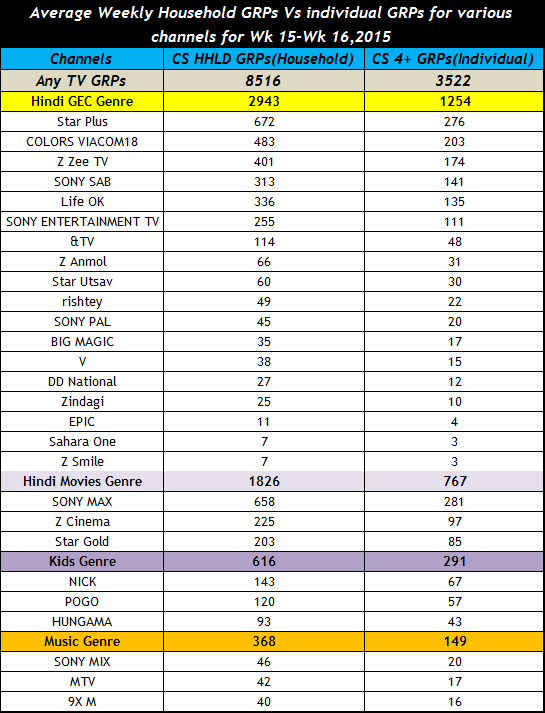
     

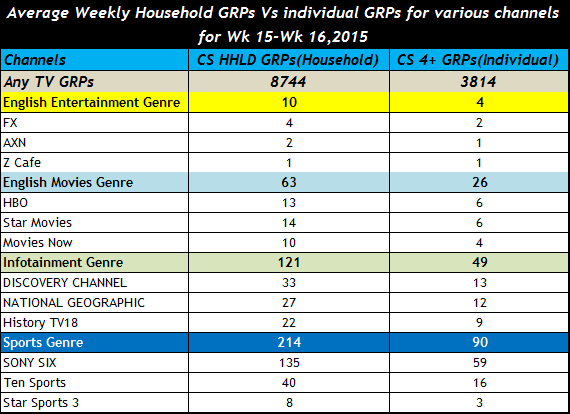
  • TAM data for Household & Individual GRPs for Week 15-16

    Here’s data sourced from TAM giving us Average Weekly Household GRPs Vs individual GRPs for various channels for Wk 15-Wk 16,2015, without LC1.


  • Bloomberg TV lines up innovative content for 2015

    By A Correspondent


    Bloomberg TV India started the year with comprehensive show line-ups for the Union Budget 2015 which showcased the best-in-class insights, analyses, reports, debates and interviews appealing to a large spectrum of audience. The Pre-Budget programming started early January, by capturing the perspectives of leading Indian corporate leaders from across the sectors, policy experts, farmers, social sector representatives and economists on their expectations from Budget 2015.


    With a two-month run-up to Budget 2015, the channel broadcasted innovative large scale programs like Ideas for Transforming India where the country’s top experts discussed ideas for India’s growth while focusing on issues like Infrastructure, Integrated Energy Policy, Connecting India, Housing, Agriculture, etc. While on Invest in India, a first-of-its-kind initiative where Indian policy makers connected with global investors and decision makers to take note of what do global investors want. The Budget 2015 programming comprised of a comprehensive & exhaustive list of market gurus, corporate leaders and policy makers; influencers who move markets and impact business. The channel also implemented the most innovative and viewer friendly interface for the Budget day.


    Living by the defining principles~ First, Factual, Fastest, Final and Future; some of the high-impact news which was delivered by the channel in the recent past are questioning the Spice Jet deal opacity, India’s deal of 36 Rafale Jets with France, Decoding the Rolta stock crash, Interview of Mr. Manohar Parikkar as Defence minister, where he spoke about blacklisting arms suppliers & Make in India in defence sector, the cabinet’s decision to give a nod to the land ordinance, Finance Minister’s  announcement of  1% additional  levy in GST for 2 years,  amongst others.


    Alok Nair

    Commenting on the exciting line-up for 2015, Alok Nair, Executive Vice President and Business Head, Bloomberg TV India, said, “We have consistently sought to bring content of value to our viewers and this is what has reinforced our position in the business news broadcasting market. Our Union Budget coverage was a reflection of our proficiency and experience. Key influencers not only follow us on social media but value our perspective with the PMO re-tweeting us. Following our signature style, this year we have designed programming with sharper and innovative content. To strengthen our content delivery, we have launched a host of new shows and segments targeted at corporate India and market viewers like Street Smart has new segments – Trading Day and Dealing Room which capture the essential insights and early morning market trends when trading begins; Lunch Money, a mid-day wrap that highlights the big stories from the markets along with Deal Street – a segment thattalks about the world of Venture Capitalists, Private Equity, Funding, Acquisitions and everything in the world of Finance ; Market Movers, gives the sharpest and insightful analysis on the biggest stock the market is talking about; The World of Midcaps, gives a detailed insight on all the mid-cap and small-cap stocks of the day and an advertising and marketing show,From Logo to Impact, the inaugural episode of which featured legends like Shashi Sinha – Chairman, BARC India Technical Committee & CEO, IPG Mediabrands India and Partho Dasgupta – CEO, BARC India talking about BARC and how it is poised to redefine the ratings game.The mood is upbeat and going forward we plan to launch more than 20 new shows this year.”


  • Shailesh Kapoor: BARC Is Here: New Ratings, A New Era!

    By Shailesh Kapoor


    Finally, the first BARC ratings were released yesterday. Ongoing debate, both reasonable and fallacious, around the credibility of the ratings system, that lasted over a decade can be set aside. We finally have a “solution” in sight. Just that BARC will have to earn its way into becoming that solution.


    Evidently, what was released yesterday was the first stage of reporting that BARC would eventually deliver. To begin with, it is household data, not individual data. I don’t remember seeing any peoplemeters-based household data in India over the last 15 years. So we definitely have a new measure to keep us statistically occupied, till BARC shifts to individual data. If they continue to report both individual and household data in the long run, we can be in the most interesting viewership analysis that you could potentially have.


    The coverage of urban LC1 and rural markets will be the next stage, which should hopefully be not too far away. And then, of course, is the big promise of increasing the sample to 50,000 over the next three years, a task of monumental proportions, the operational complexity of which is ill-understood by many, including many in the television industry and certainly many in the I&B ministry.


    Comparisons to TAM are bound to happen, though they are highly inappropriate, given that so much has changed, right from the market composition to the change from SEC to NCCS to the change from individual to household reporting in this first round. Yet, the big GEC headline that was doing the rounds in the industry last evening was ‘Life OK beats Zee TV to take the no. 3 spot’. Sometimes, the diagnostics are lost in the pursuit of headlines.


    I also saw BARC “on-air” last night. Never to skip an opportunity, Arnab Goswami had a promotional video airing in prime time, where he quoted the first BARC ratings freely, stressing on the wide gap between Times Now and “other small English news channels.” The promo ends with “Times Now Welcomes BARC”.


    Though a standalone, single-channel promo, it says a lot about how the data could be received by broadcasters in general. You can expect to see a flurry of e-mailers and one-on-one client communication by channels that have done well in these first ratings. And there are bound to voices of dissent from those who haven’t, though I suspect those voices will be more like murmurs, given the whole-hearted IBF backing to BARC.


    TAM, meanwhile, has been portraying the image of a battered soldier who refuses to surrender. It should be worthwhile seeing what they come up with. Clearly, we are not in for a two-currency system. So, it would have to an offering that’s distinctive from the BARC repertoire. We shall know, with time.


    From before-BARC to after-BARC, an era may have changed yesterday. Be prepared for an eventful 2015, where talk about ratings will dominate all talks about content and brands in the television space (so what’s new, some may say). After a two-year long trailer, the film has been released, but it will reveal itself reel by reel, scene by scene. Grab your popcorn!


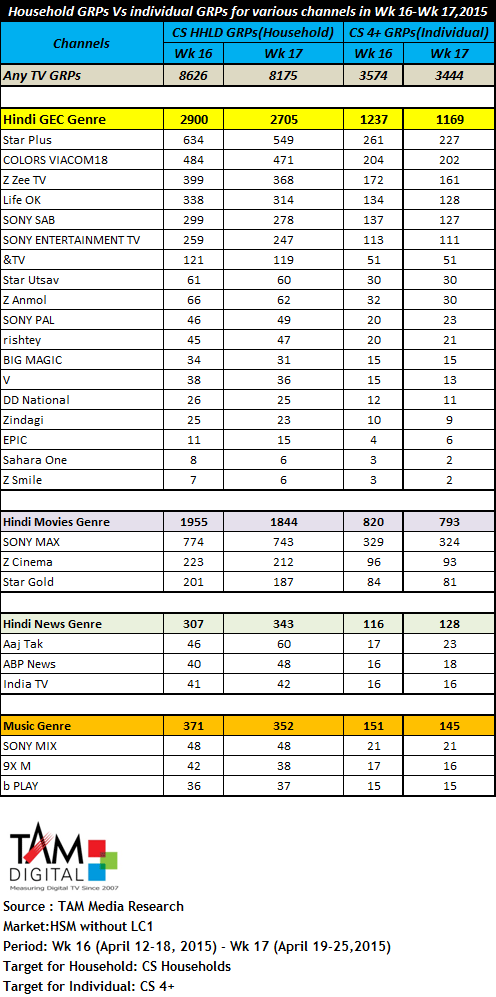
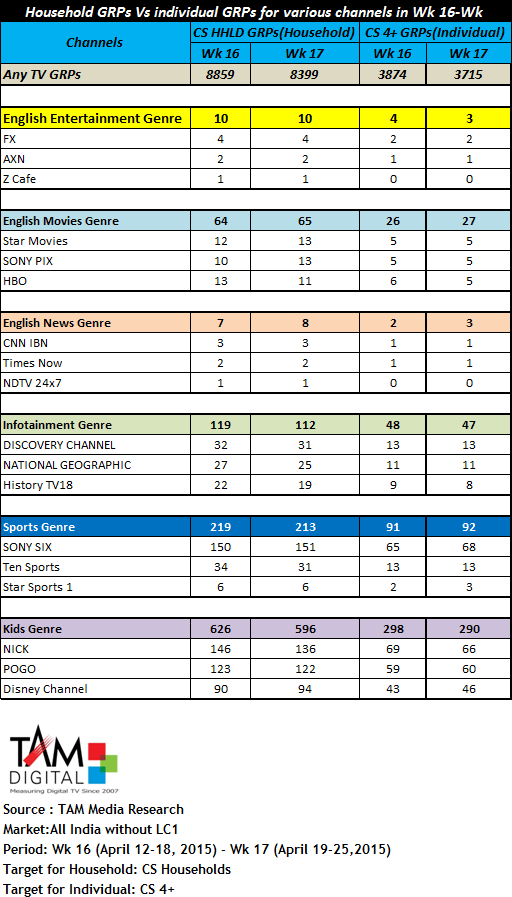
  • Zee is ahead of LifeOk in TAM’s Week 17 data for Households & Individuals

    TAM has released data for Week 17 (April 19 to 25) for CS Households and Individuals for HSM and All-India, offering a comparison between Week 17 and of the previous week (April 12-18). Take a look at the data below (and also at the data released by BARC India).


  • Hindi movie genre dips a wee bit in Week 17: TAM

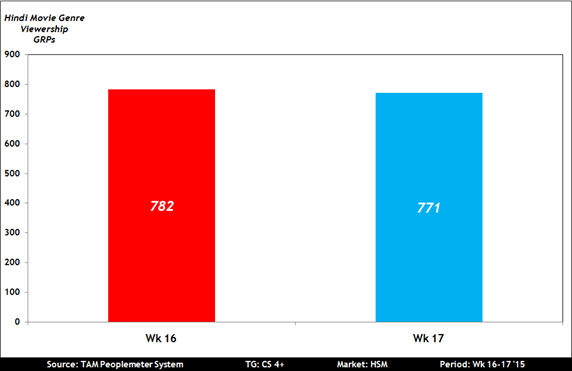
    In Week 17 of 2015, the Hindi Movie Genre dropped by 1% as compared to the previous week, as per analysis conducted by S Group, the strategic consulting arm of TAM Media Research.


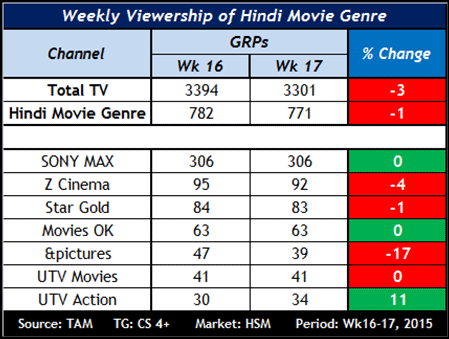
    :: In Wk 17 – 2015, Hindi Movie Genre dropped by 1% as compared to the previous week.

    :: Sony MAX maintained its viewership at 306 GRPs in Wk 17, more than 80% of which came from IPL matches.

    :: A further look into the performance of individual channels –


    > Z Cinema and Star Gold stood at 92 and 83 GRPs respectively, both channels having dropped marginally as compared to last week.


    > Movies OK and UTV Movies have remained undisturbed at an overall level.


    > At 17%, &Pictures witnessed the highest drop in Wk 17 which was driven by the drop in time spent as compared to last week. The channel lost 7 GRPs during weekend alone.


    > UTV Action was the biggest gainer at 11% hike. The channel was able to gain viewership in the IPL-driven day-part of 2100-2359 Hrs, mainly due to the telecast of ‘Avengers’ on Friday.


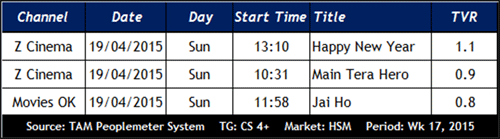
    :: With no premieres on the genre in Wk 17, ‘Happy New Year’ on Z Cinema was the highest rated movie of the week.

  • ZETC opts for a vibrant new look

    By A Correspondent


    ZETC has rolled out a refreshed new look which reflects the culture of today’s youth.The renewed look of the channel has been carried out with an aim to provide viewers the latest Bollywood music and showsalong with the hot trending topics that tinsel town has to offer.

     

    The new logo of ZETC presents a more youthful and energetic feel to the channel with a play on vibrant rainbow colorsthrough animation. The tagline Youth Music Café of the channel,which is an extension ofthe new brand ideology,will help young viewers to identify and relate to the programming on a personal level.


    Announcing the new brand strategy, Vishnu Shankar, Channel Head, ZETC said, “Today’s youth lives in an era of abundance. They have access to the best of the programming content and hence they expect supreme quality from the entertainment providers. The industry has evolved in an interesting way over the period of time and these are the times of transformations. At ZETC, it has been our endeavor to provide our viewers with the best programming content. Our channel has grown with the genre and has developed a loyal fan base which will expand rapidly as we unravel its untapped potential with the new refresh look. In its new manifestation we will leverage the iconicity of Bollywood and transform ZETC into themost preferred Hindi music channel.”


    As a part of the revamp strategy, the channel will see several additions on the programming front.Iconic characters of Hindi cinema will be brought to life in entertaining parody forms along with the music, film reviews and juicy filmy gossip. Highpoints of the programming will be exclusive a talk show hosted by renowned trade analyst KomalNahta and the Bollywoood Business Awards. The talk show will cover the latest developments in the film industry including new releases, interviews, box-office collections, the emerging trends and future forecasts.


  • Popular regional shows now occupy extended primetime slot on Zee


    Zee TV has announced the launch of the dubbed versions of regional shows on its channel. Two of Zee Marathi’s successful shows have been dubbed in Hindi - Julun Yeti Reshim Gaathi as Mohe Piya Milenge and Eka Lagnachi Teesri Goshta as Mile Sur Mera Tumhara. The shows will be aired from Monday-Friday in a new primetime slot ‘Ummeed Ke Naye Rang’.


    ‘Mohe Piya Milenge’ is the story of Meghana who ties the knot with Aditya, an impressive young man much sought after by parents as an ideal match for their daughters – only to reveal to him, post –marriage that she loves somebody else. The show captures how the mature, young man chooses to help her connect with the man she loves rather than exposing or humiliating her for this breach of faith. ‘Mile Sur Mera Tumhara’, on the other hand, is a show that follows the lives of two young lawyers, Om and Isha, who fall in love with each other. Both the shows have some of the finest Marathi actors like Sukanya Kulkarni, Girish Oak, Umesh Kamat, Spruha Joshi, Lalit Badane amongst others.


    Pradeep Hejmadi, Business Head, Zee TV says “It has been our constant endeavor to enrich our content offering and bring more and more great stories and characters to our viewers and the extension of our primetime to 5 PM is a step in that direction.  There is no pecking order for ideas and stories. It’s archaic to think that only Hindi can come up with earth-shattering ideas. When we were generally looking at ideas, we realized that in Zee Marathi there were some really good stories, and when we tested a few of the stories in other markets, they were quite nice. So, we evaluated whether we should completely re-create or dub. When we dubbed the shows, they were well-received and people loved it that way. The two Marathi shows are a mere beginning – viewers can look forward to some vibrant regional content from different parts of the country dubbed in Hindi on ‘Ummeed ke Rang’ in the times to come.”


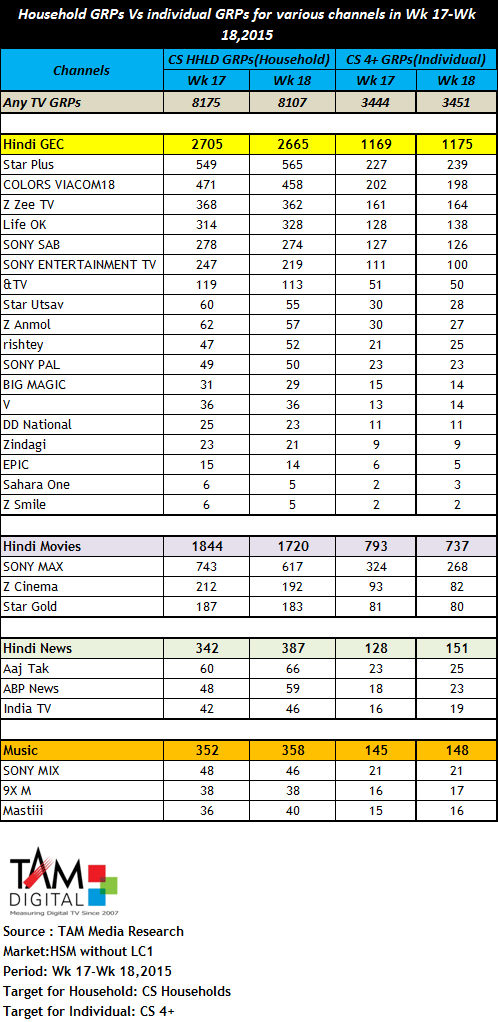
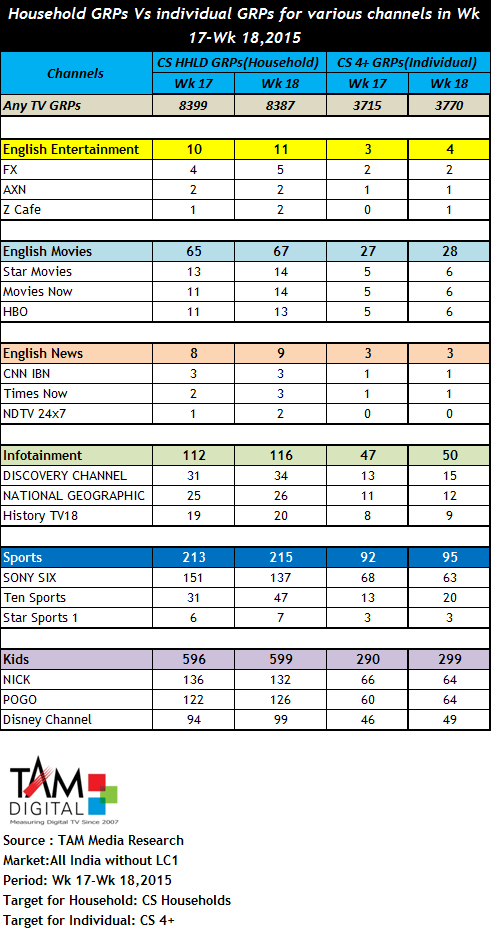
  • Hindi GEC pecking order same as last week as TAM releases Week 18 individual & household data

    TAM has released data for Week 18 (April 26 to May 2) for CS Households and Individuals for HSM and All-India, offering a comparison between Week 18 and Week 17. Some of the BARC data can be seen at barcindia.org.


  • Shailesh Kapoor: Salman Verdict: If GECs won’t entertain you, News Channels will

    By Shailesh Kapoor


    Wednesday was a day of high drama for news television. It was the day of verdict in the Salman Khan hit-and-run case. Thirteen long years after the incident in question happened, it was finally the Judgement Day.


    No news channel worth its weight in the business was going to squander this delicious opportunity. Most promoted their plans of a day-long, non-stop coverage. It was much like Election Results Day – those rare occasions when a news channel actually knows well in advance that a particular day is going to be a day of big news.


    As the day unfolded, channels realised they were getting even more than what they bargained for. First the conviction, then the sentence and then the bail, it all happened within six activity-packed hours. As I write this on Friday morning, another chapter in this dramatic book could be written later today.


    Our news channels have mastered the art of ‘non-stop’ coverage even when there is no content to speak of, in real terms. Cameras are not allowed inside the courtroom, so all reporting was based on accounts of those inside. There were sizeable time gaps during the day, when nothing much happened, but news channels kept themselves busy by showing the ‘excitement’ outside Galaxy Apartments, trailing Salman’s car and speaking to anyone who cared to come on record. And then of course, there were tweets to fill in the time that was still left.


    By the nature of it, this story has essentially no inherent longevity. It could be forgotten in less than a week. Its importance lies in the moment in which the story is unfolding, and news channels are savvy enough to know that. Not to say that print and online media is too far behind. I have received almost a dozen calls over the last two days requesting for a quote on the impact of the verdict on the film business. Most such calls start with roughly the same sentence (no pun intended): Everything that could be written has already been written, but I still have to do a story on it.


    In a fortnight in which it came under attack for its conduct in Nepal, the Indian media proved (yet again) that it does not care much about its reputation. And certainly not when it is out to further its business interests (read viewership or readership).


    And why blame the media for it? After all, there is no such entity as “the Indian media”. It is a mere collection of individual businesses, engaged in cut-throat competition, often taking jibes at each other, through promos and readership claims and counter-claim ads.


    I, for one, am not complaining. We are in an era where weekdays entertainment television is increasingly failing to offer any real entertainment value at all. If news channels have to pitch in to fill the gap, so be it.


    PS: I’d doubt if Salman Khan would host this year’s Bigg Boss, even if he’s out on bail, in the event of the hearing on his appeal dragging over the next couple of years. That, to me, will be the most significant impact of this verdict on mass entertainment.


  • Ruling it with the Game of Thrones


    She has been among the early entrants in the broadcast space and has since grown to be one of the seasoned professionals in the business. But even as she’s accomplished in adsales, it was interesting to see Monica Tata take on mantle of two ad-free HBO premium channels. While she did not disclose subscriber numbers, HBO has been aggressive in the broadcast space and top-of-mind thanks to content on the back of the very successful Game of Thrones. So when we heard about the simulcast of Season 5, we reached out to the Managing Director, HBO South Asia for this chat. Excerpts from a conversation with Pradyuman Maheshwari and Dyanne Coelho:


    Game of Thrones is indeed a big thing with you’ll this time given the simulcast and the overall marketing blitz.

    When HBO Defined came into India, our proposition was of making it the Home of the Originals. So we want to bring all our original content, which we were not airing on the basic HBO channel. Thanks to the shift of content consumption taking place, clearly there was an audience wanting to appreciate and consume this content. By the time Defined entered the country, three seasons of Game of Thrones (GOT) had already happened. So we launched Season 4 last year, and although globally it was well-accepted, it was still picking up in India.


    It’s now reached an all-new high in entertainment consumption…

    Yeah, so we did one week from the US telecast launch last year, which was still a big thing for us. Clearly there was an opportunity there for us to fix that. Hence Season 5 became that big launch for us as well as in many other countries… 170, to be precise. We’re doing a simulcast from the US. That’s a first for India too, and that has helped hugely.


    The leaks notwithstanding?

    Yes, the leak notwithstanding. The reality is that, I think the simulcast is going to help some of those issues that regions around the world were facing with piracy. We’re strong believers and we’re absolutely anti-piracy. We are very strong contenders of bringing the content simultaneously, and diminishing the chances of piracy. So I think such initiatives will really help.


    But don’t you think piracy has been allowed to flourish for so long that while it’s great to watch GOT on a bigger television set, people have gotten used to watching content on smaller laptop or tablet screens.

    Not sure if I agree on that  because I think if you don’t give them a choice then they will look for other means and if you’ve not seen any better way to get it. Now if you’re being given the opportunity to watch it HD quality, 100% ad-free, in the comforts of your home at the same time as it’s being telecast in the US, I find it really hard to believe that that is not reason good enough for a consumer or GOT fan to sit and watch it at home and not to go through that whole exercise of being a pirate.


    Being a person who has spent some of your best years in adsales, don’t you think a show like GOT would’ve attracted great advertising and but since it’s ad-free on HBO Defined, you are deprived of the revenues?

    I’m going to be very politically correct on this, because fortunately or unfortunately, the world of advertising is driven by ratings, and if a show doesn’t rate at all, and if the ratings mechanism did not capture those ratings, advertisers were questioning its existence. And when the ratings are not happening, advertising is not happening, you start questioning its business presence. And that’s why I think original content never made it to the ad-supported platform. But I think that was a while ago, times have changed, consumption content patterns have changed, and I think these platforms like HBO Defined have clearly brought about that opportunity for audiences to consume. So at this stage right now, we want to promise to our consumer 100 percent ad-free originals and hence it’s on HBO originals.


    How is the channel doing in terms of number of subscribers?

    It’s good, in fact from the time we launched, we’ve grown tremendously, almost 10 times to be honest in one-and-a-half years. Our success tells the fact that there is an audience out there ready to pay for content, if you’re giving him/her the value proposition.


    GOT of course has thrown up a lot of revenue-earning opportunities from merchandise, etc, also internationally. What about India?

    No, we don’t have it here, it is managed out of our New York office. It’s a global merchandising initiative, so some of it does trickle into this market too.


    Since your revenues depend entirely on distribution, are those monies taking good care of the kind of spends that you have?

    Can’t talk about money, but, yes, overall we’ve had a robust business, and as a region, we function as a region, so as a region we’ve had a reasonably good year.


    At what stage do you feel it would be hugely profitable?

    I won’t comment on that.


    Going forward are there any major spikes that we’re going to see in the kind of major shows that we’re going to have?

    Game of Thrones is so huge you know, so iconic.


    And after that?

    You know frankly, every show that HBO brings is fantastic, but once in a lifetime something like GOT is created. It becomes a phenomenon; you don’t make such things all the time. This is a one-off. It would be unfair to sit and compare. It even made it to President Obama’s speech… These things just happen once in a lifetime. It would be unfair to compare.


    Yeah, it’s also a challenge when you have something like GOT…

    Yeah you can see the glass as half-empty or half-full and we are seeing it as half-full.. in fact full-full.


    No but what do you do after that? What will you air after GOT Season 5 concludes?

    You create more. There’s one GOT that happened and it’s not stopping. We’re on Season 5 and there is 6 and 7 which is being sanctioned, and let’s see what happens and how all of that plays out. None of us are aware how the production of that will play out. But there is so much more content HBO brings to the table, like the True Detective coming which is the second season of it. The first one was a four-part series which is now the second season is coming as well. So it’s going to be very interesting, iconic, maybe even award-winning engaging content coming out from the house of HBO.


    Does a show like GOT bring in a new set of subscribers for you?

    Yes it does. That’s why we focus our marketing energy on a show like that because it is a hook for us. This channel has a lot to offer, but when you bring a show, the kind of marketing activity we put before the Season 5 launch has shown a spike. So it helps.


    Is there a number that you can share, a percentage in terms of growth?

    No there’s no reference point. This is the first time we’ve put such a large focus on the GOT Season 5 especially with the simulcast aspect of it, because we did focus our energy on Season 4 and we did a good marketing job as well. But there was a slight disadvantage because it was a one week later, but this was something that was fantastic.


    Is there some target you can quote in terms of number that you want grow by?

    We always want to target growth on a regular basis. There is no number, because at the end of the day, the entire universe of digital homes is our universe. That’s the potential really, that’s the whole world out there. But how far can we go, how fast can we go.


    Tell us about this news we read about Star India handing your distribution… is that happening?

    I have no idea. No comments on that.


    Given your own experience with the two HBO premium pay channels, would you says it’s a profitable route to take? Do you think other genres could also adopt it?

    I think there is an opportunity for paid channels in the country. Two HD channels at Rs 99. It costs you 1000 bucks to watch a movie in a theatre, one day, if just a family of four goes to a movie, picks up couple of popcorn, something to drink… . Here you’re getting at Rs 99 a month and a fair deal of content, which is award-winning, fabulous movies in a 100% ad-free environment. I think it’s a no-brainer really. So there is an audience out there who is ready to spend, and Indians are ready to spend. I am personally a very big optimist on that front and hence the proof of the whole thing is that we made a success of a channel, a premium proposition which wasn’t existing.


    But people in India have double standards on consumption. For instance, we see it with newspapers, where people don’t mind spending 10 rupees on peanuts or whatever, but they will not possibly spend that on a content-rich newspaper or magazine. People might spend on movies or going to a restaurant, but as far as paying for a channel….?

    No, but people have paid. See, had I been making this statement without putting my money where my mouth is, then you can question it, but the fact is that we’ve done it. We came in at a time when it was questionable, digitisation has definitely helped a business model like ours and that’s the positive part that digitisation has helped achieve.