Category: MEDIA

  • Femina, L’Oreal announce Women Awards 2012

    By A Correspondent


    Women’s lifestyle monthly Femina in conjunction with beauty products brand L’Oréal Paris has announced the launch of women’s awards property ‐ the L’Oréal Paris Femina Women Awards 2012, in association with Rasvihar, to be held in Mumbai on March 22, 2012.


    The first ever L’Oréal Paris Femina Woman Awards will celebrate and honour the most accomplished women in the fields of art, music, education, business, social activism and cinema for their talents, grace and ability to inspire. The jury includes names from photography, film and the corporate world such as Gayatri Ruia, Jatin Kampani, Nandita Mahtani, Nathalie Gerschtein, Priya Dutt, Sulajja Firodia Motwani, Tanya Chaitanya and Zeenat Aman will choose the winners across various categories.


    Readers are also invited to vote for The Man We Love, The Woman We Love, and The Favourite Face of a Cause by visiting www.facebook.com/feminawoman. They can also participate in the L’Oréal Paris ‘Who’s worth it to you?’ contest by logging on to www.lorealparis.co.in. Commenting on the announcement, Tarun Rai, CEO, WWM said, “Indian women are making their mark in diverse fields including in the traditional male bastions. The L’Oréal Paris Femina Women Awards are both a celebration and a recognition of the achievements of Indian women in arts and entertainment as also science and business. Femina believes that the modern Indian woman can be all that she wants to be and these awards are a tribute to this belief. And we are very happy that L’Oréal Paris is our partner in this celebration.”

    Tanya Chaitanya, Editor, Femina said, “The first‐ever L’Oréal Paris Femina Women Awards set the spotlight on how much a woman can achieve if she believes in herself. Femina, having known the Indian woman for more than 50 years, hopes that the inspiring stories behind each of our winners will help our readers realise their own strength. To women power!”

    Nathalie Gerschtein, Director of L’Oréal Paris in India said, “Our legendary signature – “Because you’re worth it” – has empowered women over the past 40 years. These four timeless words are a reflection of women’s potential to express themselves. L’Oréal Paris is not just a leading beauty brand, but also a brand that embodies self‐confidence and empowerment. Today, being a L’Oréal Paris woman means being an individual with a charismatic personality, a determined outlook and a strong personality. We are happy to honor such women by partnering with Femina to host our first Women awards.”

    Readers can vote in the categories of Woman We Love; Man We Love; and Face of a Cause.

     

  • The Day After Cricket – Ormax survey of viewer recall

    By A Correspondent


    Ormax Media has announced the launch of the 3rd edition of its Cricket Advertising Recall & Effectiveness research – Day After Cricket (DAC), for brands advertising on IPL 5. DAC was launched in 2010 for IPL 3. In 2011, the research was conducted for IPL 4 and the Cricket World Cup.


    Day After Cricket research has two components. The first one involves day-after tracking, available as bi-weekly syndicated reports to advertisers and media agencies over the seven-week long duration of the tournament. This phase of research will be conducted across the six metros, covering more than 2100 IPL viewers over the course of the tournament.


    The second phase of DAC is post-event research customized to the brand’s requirements and target audience. In this phase, the impact of IPL on the brand’s equity will be determined, by measuring the difference in the performance of the brand on key attributes amongst viewers and non-viewers of the tournament. An advertiser can opt for either or both phases of the research, depending on its objectives.


    Speaking about DAC, Shailesh Kapoor, CEO – Ormax Media, said, “From a research perspective, there are two key deliverables in big ticket cricket advertising – Recall & Equity Impact. Recall needs to be monitored to understand if the brand has managed to stand out in the clutter. Equity Impact is the long-term influence of the campaign, measured in a way that nullifies the role of all other media or promotions, thereby isolating the specific impact of IPL on the brand.”


  • LinkedIn survey shows luck helps career, Indians believe

    By A Correspondent


    Professional network LinkedIn has released data about global professionals’ perceptions of the role Lady Luck has played in their career trajectory.


    LinkedIn has more than 150 million members worldwide and over 14 million in India.


    LinkedIn surveyed more than 7,000 professionals globally and found that 84 percent of professionals do believe in career luck. Forty-eight percent consider themselves to have better luck in their careers, compared to other professionals.


    Seventy-nine percent of the more than 500 professionals surveyed in India believe in career luck. Out of the fifteen countries in which LinkedIn surveyed professionals, India ranked as the fourteenth-luckiest country. Thirty-six percent of survey respondents report feeling slightly luckier, or much luckier, than other professionals.


    For professionals in India, the top five most important factors that contribute to luck are:

    • Learning from your mistakes
    • Having a strong work ethic
    • Having strong communication skills
    • Striving to be the best at what you do
    • Having strong technical skills

    Globally, the top five most important factors that contribute to luck are:

    • Having strong communications skills
    • Being flexible
    • Having a strong work ethic
    • Acting on opportunities
    • Having a strong network

    India is the only country with “Having strong technical skills” in its list of the top five factors contributing to career luck.


    “Progressing in their careers and moving up the organizational ladder is crucial for professionals across all levels. The objective of this survey was to discover how professionals perceive luck in their career growth,” said Hari V. Krishnan, Country Manager, LinkedIn India.


  • @FICCI-Frames 2012: TV influences life: IBF study

    By A Correspondent


    The Indian Broadcasting Foundation (IBF) has released an in-depth report on the Socio-Economic Impact of Television at FICCI Frames 2012. The IBF has conducted an extensive research in 3 phases to measure the impact of Television on Indian viewers. In the first phase, qualitative research was conducted across 20 focus groups to identify various forms in which television impacts the audience. This information was used to design the questionnaire for the second phase of the research, in which 5400 respondents were interviewed in the 7-60 years age group across 18 cities. They opined on 54 different attributes that encompassed the impact of television on their lives. The third phase of the research was a set of 25 in-depth interviews that amplified the learnings of the previous two phases. This enormous study spanned across 6 months. The research was facilitated by Ormax Media.


    The research findings are published in a formal documentthat is aptly named ‘Posi-TV-ity’. This in-depth report bears testimony to the overwhelmingly positive impact of television on audiences across the country.


    Uday Shankar, President, IBF emphasized, “Posi-TV-ity showcases the wide-ranging impact of Television beyond its conventionally understood & accepted role of being an entertainment destination. Today, television has moved ahead to offer more… a lot more. It in fact impacts the way India thinks and lives. Its impact on the socio-economic fabric of our country is indelible”.


    Today, television gone beyond entertainment and has become a medium that influences public opinion and stirs up sentiments. Everything that one sees on television has an impact and to measure that impact, this extensive study has been conducted by IBF. In this process of understanding the impact, the study has shattered several myths associated with television that were created due to stereotypes associated with it.


    In particular, Posi-TV-ity identifies 7 key roles that television plays in the life of a viewer. The study validates and substantiates these roles and impact of television in the country:


    Education – Respondents agreed that TV has helped them take more informed career decisions, financial decision and also learn new things that they could apply to their jobs.


    Personality Development – Viewers agreed that TV boosted their confidence, helped them become all-rounders and also widened their thinking.


    Social Interaction -Audience today feel that TV has helped them in having a better relationship with in-laws, keeping families together in today’s changing world, and strike a balance between Indian culture & westernization.


    Exposure – Viewers feel TV keeps them updated on the latest fashion & trends, latest products and also aids their purchase decisions. TV also keeps them informed about health related issues.


    Awakening – Respondents felt TV increases awareness of women’s rights, social issues, and rights as a citizen of India as well.


    Opportunity -It is widely believed that TV also gives opportunities to people from all over the country to showcase their talent, makes viewers feel closer to celebrities!


    Rejuvenation – Many viewers feel that TV makes sure that there is not a single boring or dull moment in their lives.


    Shailesh Kapoor, CEO, Ormax Media Pvt Ltd added, “The role television plays in the life of the Indian viewer is grossly underrated. This research identifies seven distinct roles of television, beyond entertainment. Each of these roles have a deep socio-economic or psychological connect with the viewers’ life. The research offers a new way of looking at the medium, in context of today’s India.”


  • Special for MxMIndia: Budget Wishlist for Media

    By Rakesh Jariwala


    The key issues affecting the sector and the wishlist from the Budget:

    – High entertainment tax burden on industry that showcases Indian art and culture to the world is totally unjustified.  Hence, the entertainment tax structure across the country should be rationalized by bringing down rates of entertainment taxes in important states like Maharashtra, Delhi, UP, West Bengal, Gujarat, Haryana and others.


    – Film producer generates revenues from theatrical and non-theatrical rights both of which are liable to service tax.  Separately, various State Governments classify ‘copyright’ as goods thereby levying Value Added Tax on transfer/ licensing of copyright on non theatrical streams.  To prevent multiple taxation, the government should exempt ‘copyright in theatrical distribution of cinematograph films’ from service tax levy and continue this exemption in the negative list.


    – The Government should take a cue from steps taken by federal/ state governments across the world such as Singapore, UK, Germany, South Africa and the US and incentivize the film industry through a well defined plan, for both, content creation and infrastructure. This will help the industry parallel its western counterpart and showcase Indian creative talents to the world.


    – The concessional rate of 10 percent on gross basis, as prevalent for non-resident sportsperson for participation in any sport in India should be extended for taxation of foreign artists, performers and entertainers.


    – An alternate mechanism for obtaining Income-tax Clearance Certificate (‘TCC’) for clearance or a monetary threshold for triggering TCC provisions is provided as the current set up provisions and administrative burden discourages foreign talent to shoot in India.


    – A clarification from the government that the payment for grant of distribution rights to foreign telecasting companies is not for the ‘copyright’ in the content and hence, is not in the nature of royalty thereby preventing protracted litigation.


    – Entry into premises such as films, theaters, amusement parks could be liable to service tax under the negative list based service tax legislation.  Since these activities are already liable to high entertainment taxes by states, entry into premise where entertainment is held should be excluded from service tax levy.


    – The Government should grant relief from levy and collection of service tax on subscription charges received by cable operators and DTH operators since these charges are already subject to entertainment tax.


    – The weighted deduction (ie deduction for 200 percent of the qualifying expenditure incurred on in-house research and development) under Section 35(2AB) of the Income-tax Act should be made available to products as well as production services companies.


    Rakesh Jariwala is Partner and Tax Expert, Ernst & Young. Please log on to mxmindia.com on Saturday, March 17 for a special budget edition.


  • Anuj Gandhi joins Network 18, to head distribution & biz dev

    Distribution veteran Anuj Gandhi has joined Network18 as Group Director, Distribution & New business development, with immediate effect.


    Mr Gandhi brings with him almost two decades of rich broadcast experience, across a variety of mandates including leadership roles at some of India’s leading distribution companies and broadcast networks.


    Speaking on this development, Mr B Sai Kumar, Group CEO, Network18 said: “Broadcast digitization and growth in new media will cause paradigm shifts in how media brands create value in the future. Our bouquet of channels straddling genres from news and entertainment to kids, music, factual entertainment etc across national and regional spaces is uniquely placed to make the most of this opportunity and we are delighted to have Anuj on board to drive it. His experience & understanding of broadcasting and distribution in India and his leadership record is impeccable, positioning him well for this task”


    Added Mr Gandhi: “Network18 is a benchmark player in the broadcast and new media space in India and it is now at a very exciting stage in its journey. I look forward to being part of it at such a momentous time and hope to work closely with the team to unlock value for our brands in an increasingly digitized environment”


  • @FF12: ‘Console gaming in India is in big trouble’

    By A Correspondent


    Console gaming today has become only an urban phenomenon, in the small towns it is the mobiles which has become a primary source of entertainment. Women too in large numbers are exploring gaming and access to mobile gaming in India is expected to further increase. In a country like India, content needs to be contextually and culturally relevant. These were some of the points raised at the Day 2 session of FICCI Frames 2012 – ‘From East to West: The Next Big Thing in Gaming.’


    This session was moderated by Mr Rajesh Rao, Founder and CEO, Dhruva Interactive. The panel members included, Mr Jithin Rao, Producer with Ubisoft; Mr Ray Sharma, Founder and CEO, XMG Studio Inc;  Mr Howard Donaldson, President, DigiBC; Mr Vishal Gondal, Founder and CEO IndiaGames; and Mr Ninad Chhaya, COO, Playcaso.


    One of the heated topic during this session was the slow death of console gaming and how mobile gaming will play a dominant role. Unlike Mr Ray who strongly believed that the Console market was in deep trouble and that there is a massive value shift happening from console to mobile gaming, his co-panelists Mr Jithin Rao and Mr Howard Donaldson believed that console gaming was here to stay and could still play a dominant role in the Country. “I don’t see the console market going away, it may still have a dominant presence despite the ongoing digital revolution” said Mr Donaldson. Mr Rao of Ubisoft said, “I don’t see console gaming going away even in the next five years because there are still hard core gamers in India. In fact we believe that every platform has its own experience to share with the consumer whether it is big screen or small.”


    Another interesting points raised during the session was the importance of mobile in the rapid growth of gaming in India. According to Mr Chhaya, “The change has been that phones are getting smarter. Consoles have become more of an urban phenomenon but, in smaller towns it is the mobile phones which have become major source of entertainment. The people in small towns are fast adapting to mobile internet. Internet on access through mobile is fast growing and the change which has come is that people have not only become more aware but, the fact that the apps system has also changed the entire environment. I would say for the better.”


    Mr Gondal observed, “Even women are exploring gaming in a big way. We are expecting four to five million Indians accessing Internet from mobile and expecting atleast 50 per cent of them playing games. In a market like India, local IP will do much better that global. On the production values, consumers are looking at higher production values with the best of the breed of contents and I believe that the consumers will not settle for anything less.”


    Mr Rajesh Rao summed up the session stating that while there are many ideas and lots of opportunities and potential in the market, the industry needs to explore them.


  • Rahul Kishore joins Mogae as Senior VP, Priority Projects

    By A Correspondent


    Rahul Kishore has joined Mogae Media as Senior Vice President, Priority Projects. He moves from Vivaki where he worked with the Zenith Optimedia team.


    A career entrepreneur, Mr Kishore ran his own business for well over 20 years before changing tack in 2008 when he joined the exchange4media group as Business Head and later also as Editorial Adviser. An alumnus of St. Stephens College, Delhi, Mr Kishore’s stint at ZO/Vivaki centred around getting closer to the trading currency and purposive evaluation of media.


    “Rahul has entrepreneurial grit and drive. We need loads of that at Mogae,” said Ms Tanya Goyal, Executive Director of Mogae Media. “Rahul is being tasked to look at large opportunity blocks that can benefit from mobile as a medium. We hope he will be able to open up new vistas of opportunity for the company.”


    “Mobile has great opportunity. I am happy to be at the forefront of a ‘new’ medium that reaches 800 million consumers in India,” said Mr Kishore. “Mogae is a great new venture … I hope we create a new market with our efforts here. The response has been very encouraging and in the little time we’ve had, we have locked in two high-profile FMCG giants amongst our advertisers,” he added.


    In recent weeks, Mogae Media has announced many senior level appointments, including Messrs Tusshar Dhingra (from BIG Cinemas), Atishi Pradhan (from Contract) and Pavan Chandra (from Vivaki). Mr Kishore will work with Mr Gaurav Luthra, Chief Business Officer of the company.


    Mogae Media is the sole and exclusive monetization partners of telecom operator Airtel. Veteran mediaperson Mr Sandeep Goyal set up this new venture in January 2012.


  • @FF12: Time to experiment with technology

    By A Correspondent


    Now that digitisation is set to come into effect from July 1, the convergence of media assumes greater significance. This was the topic of discussion in the second session on Thursday at FICCI Frames 2012.


    In a session moderated by Neeraj Roy, MD & CEO, Hungama, Sanket Akerkar, MD, MicrosoftIndiatalked about “The Converged future – Multiple platforms, technologies &transforming applications for media and entertainment”. The theme of his keynote address was significance and emergence of digitisation.


    To illustrate how connected we are today, he cited an example of how a teenaged son of a friend uses Xbox to connect with friends he was with at school and play games. Though this may common enough, he added that the group of friends used the very same environment to connect and do their homework. This can also be taken as learning life lessons of surviving in the digital world.


    Mr Akerkar said that the consumer lifestyles are controlling the conversation, citing the example the “Occupy Wall Street” movement. The industry has to takes its cues from what the consumers want. According to him, even ads will now be consumed as per the consumers’ choice and the advertisers can’t dictate the place and time for the consumption. Now the people are going to become the content creator and content consumer. The main challenge for the industry is now to seamlessly blend and enable technology to become user friendly.


    Jonathan Bill, SVP Internet and Data Services, Vodafone joined the conversation to discuss how the telco-eco system can offer better opportunity to the media and entertainment industry to monetise the services.


    Mr Bill said thatIndia’s telco-eco system is a hyper competitive market which the lowest price points in the global market. It generates the lion share of revenue in the entertainment stream for Vodafone.


    Mr Roy said that technological progress has enabled applications that recognise the customer preferences, be it the Internet or the phone.


    Mr Akerkar agreed and added thatIndiawill have 25 million smartphones by the next year and this connectivity gives the opportunity to the industry to experiment in creating applications for the users. He said that the technology is moving ahead at such speed that one only needs to use their imagination to think ‘what next innovation’.


    All the speakers were in agreement that once the digitisation bill comes into effect, the choice of content available to the user will be limitless. As Mr Akerkar said, “the challenge will be to separate content, be it mainstream or user generated into what is relevant or not.”


    They also discussed the feasibility of creating video content for mobile devices. Mr Bill was of the opinion thatIndiahas huge possibilities as it is the largest internet video consumption market. Mr Roy said thatIndiais poised to become the largest internet market in the next 3-4 years, surpassing evenChina.


    The speakers discussed how even gaming had huge possibilities if one was to look at co-developing games along with films. Mr Akerkar said that there was a business model waiting to happen if one figured how to reduce the initial cost of investment and figure out how to connect a known brand (film) and gaming.


    But the biggest challenge is the transition to the digital eco system. It is not enough to rely only on advertising revenues. Mr Bill said that the way forward is moving from free Internet content to paid content.


  • @FF12: Dedicated tee time as Ten Golf is launched

    By A Correspondent


    Taj Television India Pvt Ltd has announced the launch of Ten Golf, a dedicated 24-hour golf channel. Ten Golf is the fifth channel from Taj Television India Pvt Ltd and began transmission on March 15, 2012. The dedicated golf channel will showcase a mix of live, non-live and feature programming. The channel will also broadcast live, high quality Golf action from around the world.


    Speaking on the occasion, Atul Pande, CEO-Sports Business, Zee said, “India as a sporting nation is fast transforming from a single sport to a multi-sport nation. As India’s leading sports broadcaster we understand that the sports consumption pattern of the Indian viewer raises the need for specialized differentiated sport channels and this is what we hope to deliver to our revered golf viewers. Along with live golf action, Ten Golf will also showcase feature programming on golf including magazine shows and archival programming; making Ten Golf the most comprehensive golf channel in the broadcast space.”


    Ten Golf has acquired rights for European Tour and Asian Tour till 2016, and has also entered into partnership with PGTI for three years to telecast the Indian Tour. Further, Ten Golf will be telecasting 400 hrs of golf programming in association with NBC.


  • @FF12: Niche isn’t niche any more


    By Rishi Vora


    It is a fact that Hindi GECs command a premium position in the TV space in India and the primary reason behind that is its mass appeal. And thereforea lot of advertiser interest tends to go in favour of the so-called mass channels.


    But there is another set of audiences that prefer a certain kind of content – speciality content such as Action, Comedy, Food, Music and so on; channels that cater to the tastes ofaudiences with a peculiar taste. These channels are termed as niche channels.


    The concept of niche channels started about 18-20 years ago, and now, as experts believe, niche isn’t niche any more as all niche channels put together command a share that is equivalent of the share of Hindi GECs and the mass channels, so to say.


    On day 2 of FICCI Frames, in a session titled “Building Sustainable Models for Niche Content” honchos from the broadcast industry such as Paritosh Joshi, CEO, Star CJ (session moderator); Smeeta Chakrabarti, CEO, NDTV Lifestyle; Monica Tata, General Manager, Entertainment Networks, South Asia for Turner International India; Ajay Chacko, President, A + E Networks I TV 18 JV; Atul Pande, CEO, Sports Business, Zee; and Rasika Tyagi, Sr VP – English Programming, Star India discussed on revenue models to sustain TV content catering to niche audiences and its long-term sustainability.


    Atul Pande talked about the launch of Ten Golf, a speciality channel for Golf followers in India. He stressed on the need to charge premium to audiences who really are on the lookout for speciality content.


    Smeeta Chakrabarti said that as a speciality channel one cannot talk about TRPs, rather it is the brand connect that what needs to be spoken about as far as ad sales was concerned. Rasika Tyagi on the other hand remarked that the whole idea of measuring a speciality interest channel should be relooked at. “It’s not about how many people are watching you, it’s more what kind of people are watching you.” She also said that the audiences of niche channels are of such quality that they do not mind paying, and that broadcast companies should look to tap into that opportunity.


    Atul Pande remarked that the Pay TV as a concept does not yield great deal of revenue as the pricing of the niche channels are on the lower side. “We keep the pricing on the lower side because we don’t want the consumers to be shocked despite the fact that some of the content that we do justifies a price in the higher range.


    On whether the industry requires a different approach as far as measurement for these channels was concerned, Paritosh Joshi said, “The big challenge with respect to measurement is that we need to find a way to measure both quantity as well as quality. The quality aspect is very critical for a speciality channel.” Monica Tata added, “We need to have a different measurement system to evaluate special interest channels.”


    As for the digitization mandate that all channels have to follow, Ms Tata was of the opinion that to move from the present model of advertising to embracing the digital opportunities will be a challenge, and something that will take time before becoming an industry norm.


    The panel also discussed the need to create global content, thus opening up monetisation opportunities across markets.


    Photograph: Fotocorp

  • @FF12: Financing, a cause for concern in media and entertainment


    By A Correspondent


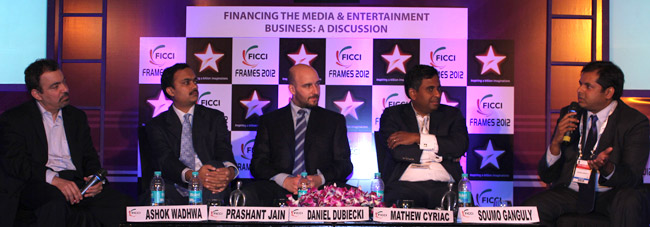
    The media and entertainment industry of India has scripted a glorious growth story in the past decade or so, and the future looks even more promising with digitization and the advent of technology across media verticals such as broadcast, print and also films. But one area of concern is the lack of private equity and VC funds showing adequate interest.


    In a session titled “Financing the Media and Entertainment Business” eminent personalities such as Prashant Jain, Executive Director, HDFC Mutual Fund; Matthew Cyriac, Sr Managing Director, Private Equity, Blackstone; Soumo Ganguly, Managing Director, Moxie Entertainment Pvt Ltd; and Daniel Dubiecki, Founder and Partner, The Allegiance Theatre, Hollywood shared their views on the subject. Ashok Wadhwa, Group CEO, Ambit moderated the session.


    Matthew Cyriac started off the session by pointing out that majority of the investments within the media and entertainment industry were made in television and print as they represent a fairly large share in terms of sheer numbers as against Internet and Radio . The Hindi GECs in TV is where typically where a lot of money into followed by regional GECs and sports channel. For print media, it was the regional publications command a lot of attention as regional advertising is very robust – one which extracts a lot of profit.


    Prashant Jain pointed out thata lot of companies in India have managed to get good funding and that it is not reflective of a very, very sorry picture as is being talked about. “It’s not that all of India in the media entertainment space not attracting funds. Companies like UTV and a few others have attracted investors.”


    Ashok Wadhwa remarked that the film industry in India is not institutionalised enough to attract private equity. Daniel Dubiecki spoke about the need to be more global in concept, widen the scope of the market and thereby making it more viable to attract investments in the films business.


    Photograph: Fotocorp