Category: MEDIA

  • MudraMax’ Misunderstood Scorecard makes a cross-border impact

    By A Correspondent


    On the eve of India-Pakistan WC 2015 match which took place on Sunday, February 15, DDB MudraMax executed a one-of-a-kind outdoor campaign for Zee News.

     

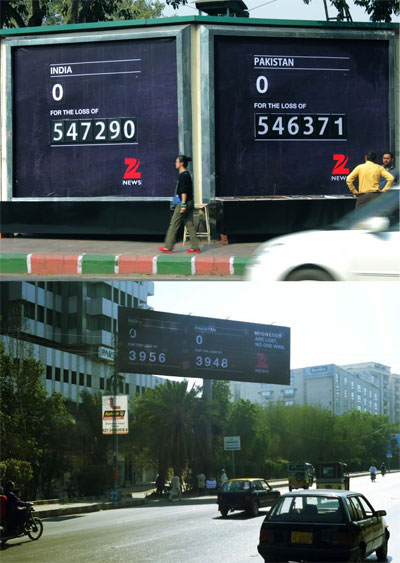
    As the tension built up, with fans exchanging videos of varying statistics of the past matches, DDB MudraMax installed manual scoreboards of a different kind in Jammu & Kashmir, New Delhi in India and Lahore, Karachi in Pakistan. While spectators felt that these were normal run-of-the-mill scoreboards which kept on-lookers updated with the status of the match, they were caught off-guard as the numbers didn’t tally.


    As India started to bat and the first wicket fell, the Indian wickets column displayed ‘1’. Within minutes, the wickets column read ‘2’. Our country neighbors standing in front of the billboards in Lahore and Karachi celebrated. The Indians on the other hand checked the score on their mobile phones and realized the second wicket hadn’t fallen. A few minutes later, the wickets column said ‘3’. Before long, onlookers on either side of the border decided that the scoreboard had gone faulty.


    To the surprise of the spectators, no one came to rectify the faulty boards, instead the wickets column seemed to be in a hurry. It moved briskly from tens to thousands to tens of thousands in no time. A similar pattern followed when Pakistan batted. The scoreboard at the end of the match read: India 0 for the loss of 546030, Pakistan 0 for the loss of 546228.


    After India won the match, the copy on the scoreboard changed. It read “WHEN LIVES ARE LOST, NO ONE WINS”. The numbers kept increasing and stopped at 547290 for India and 546228 for Pakistan – the numbers of lives lost by soldiers since 1947 during the battles fought between both the countries. Thus depicting that neither country won anything by losing her soldiers.


    The message was loud, clear and was well addressed by the passers-by who started lighting candles at the site, in memory of the fallen. Thus, a powerful statement on the futility of war was well-conveyed through the ‘Misunderstood Scoreboard’.


  • Sam Balsara revives talks to sell Madison World’s 75% stake in Madison Media and Outdoor: ET report

    By Pritha Mitra Dasgupta


    Sam Balsara, chairman and managing director of advertising and media buying house Madison World, has revived talks to sell majority stakes in the firm’s media buying and outdoor advertising businesses to the world’s largest advertising network WPP, multiple advertising executives in the know told The Economic Times.


    According to them, while Mr Balsara is also in talks with other advertising networks, including Dentsu Aegis Media, WPP has outbid Dentsu in price and is likely to close the deal in the next two months. Mr Balsara declined to confirm the development, saying, “We are not in active or serious discussions with anyone.”


    In an e-mail response to queries, he added, “Yes, it is true that many agencies have expressed an interest in acquiring part stake in Madison, but we are in no hurry. I must mention that we are not closed to a partnership as long as the partnership can help us improve the quality of service to our clients.”Ashish Bhasin, India chairman and South Asia CEO at Dentsu Aegis Network, denied that the network is in the fray for acquiring Madison Media. “Not at all,” he said.


    According to top officials in both Madison and WPP, Mr Balsara is looking to offload 75% equity in Madison Media and Madison Outdoor, which includes Madison Media’s Sri Lanka unit that handles Proctor & Gamble (P&G) and Airtel accounts among other clients.


    Rest of the businesses of Madison World, including BMB (creative), Madison PR, MATES (entertainment) and PMG (sports marketing), will be retained by Mr Balsara and his daughter Lara Balsara, who is currently the executive director at Madison World.


    According to industry sources, Madison Media’s current revenue is close to Rs 100 crore and therefore the valuation of the deal should be in the region of Rs 250-300 crore. But Mr Balsara’s asking price is over Rs 500 crore, they said.


    Industry executives said CVL Srinivas, CEO at GroupM South Asia, and Prashant Kumar, CEO of South Asia at MindShare, are facilitating the deal for WPP. Srinivas said: “We do not wish to comment on market rumours.” Mr Balsara’s elder brother, who is a chartered accountant by profession, is believed to be helping him with the negotiations.


    While some in the industry said that Mr Balsara may completely exit the media and the outdoor business, the man himself denied it. “We are not interested in exiting the business,” Mr Balsara said. “I am alive and as active as ever before and 2014 has been the best year for Madison World.”


    Ahead of the Lok Sabha elections last year, Madison won the Bharatiya Janata Party’s (BJP) media mandate and helped the party design a corporate style campaign.


    Source:The Economic Times

    Copyright © 2015, Bennett, Coleman & Co. Ltd.

    All Rights Reserved, Licensed to republish


  • ‘Magazines: 2X’ to be the theme for 9th IMC in Chennai

    By A Correspondent


    The 9th Indian Magazine Congress is scheduled to be held on 23-24th of February 2015 at Hyatt Regency, Chennai. The theme of this year’s congress is “Magazines: 2X”. Engage.Connect.Work.


    The Indian Magazine Congress is a premier event for magazine publishing in India and is organised by Association of Indian Magazines (AIM) and supported by the Federation of International Periodical Press (FIPP).


    This is the first time the congress is being held at Chennai, to ensure more participation from South-based publishers. The previous eight editions of the magazine congress had been alternated between Mumbai and New Delhi.


    The Congress brings together the entire magazine publishing fraternity including magazine publishers, policy makers, media owners, marketers, media planners & buyers, along with researchers and industry analysts under one roof. Spread over two days, the Congress is divided into highly interactive and engaging sessions and has an impressive panel of international and national speakers to offer value to its delegates.


    This year too, the Congress boasts an impressive line-up of international and Indian speakers like Siva Vaidhyanathan, Robertson Professor of Media Studies and Law, University of Virginia and Author of ‘The Googlization of Everything’; Juan Senor, Partner Innovation Media Consulting Group, London and Visiting Fellow Oxford University, Jim Bilton, Managing Director, Wessenden Marketing, London, Chris Llewellyn, President & CEO, FIPP, D. Shivakumar, Chairman & CEO , Pepsico India, Girish Ramdas, CEO and  Co-Founder Magzter, Vikas Agnihotri, IndustryDirector, Google India, to name a few.


  • Media Moments launches interactive experiential marketing division

    By A Correspondent


    Media Moments Insights Pvt Ltd, has launched an interactive experiential marketing division that will work on brand campaigns that require innovative interactive methods to connect with their customers. In the last two years, Media Moments has largely grown into a new age digital marketing firm due to the nature of campaigns and demands of the market. Though PR still remains a major division of the firm, an integrated strategy has been the need of the hour for all brands.


    Poonam Ganguly, Founder and Director of Media Moments, said on adding of this new division, “Experiential marketing can be a powerful tool for the brands that want to create an interactive experience for customers that would leave a memorable and lasting impression on them. This would allow them to share details of the product experience with others. The Indian market is hugely opening up for it.”


    Mahesh Umakant Naidu, Director of Experience & Solutions at Media Moments shared, “In the recent years, Interactive experience as a whole, which includes Augmented Reality (AR), is gaining tremendous attention in the consumer market across all verticals. Marketers are aiming to make their brands a tangible experience for consumers through the interactive technology available.”


  • MEC India appoints Mukti Kumaran as West Head

    By A Correspondent


    Mukti Kumaran

    MEC India has announced the appointment of Mukti Kumaran as West Head. Prior to joining MEC, she was heading the Mumbai branch at IPG Mediabrands firm BPN. Based out of Mumbai, Mukti will report to T Gangadhar, Managing Director, MEC India.


    Speaking on the appointment, T Gangadhar, said, “We are delighted to have Mukti on board our leadership team. She is a progressive communications professional and brings with her a wealth of experience. I have no doubt she will be a real asset to MEC”.


    On her appointment, Ms Kumaran said, “My focus will be to ensure that we are pushing our understanding of consumers and evolving smarter and newer ways to engage our brands with them.”


  • Big Magic Ganga now available on Videocon d2h

    By A Correspondent


    BIG Magic Ganga is now available on Videocon d2h network. Available on the base pack, it will be on Channel No. 859 adding another 8 million subscribers to existing reach of the channel. This move enables availability of the regional content of Bihar, Jharkhand & Purvanchal for viewers across the country.


    Commenting on the association, Lavneesh Gupta, COO, Reliance Broadcast Network said, “With this availability, we are happy to present the content of BIG Magic Ganga across the nation for audience who wish to view Bihar, Jharkhand & Purvanchal content. Our strong regional connect, local festivals and true representation of the culture of the region has helped us emerge as No. 1 in the region. It thus makes for excellent platform for the national as well as local advertisers to connect with their focused target audience in the region through this medium.”


    Saurabh Dhoot, director of Videocon Group added, “We have always strived to bring the best package of entertainment to our Videocon d2h viewers and this is a big step in that direction. We want to offer the whole gamut of channels and services empowering the consumer to opt for his preferred choice of language. We will continue to focus on strengthening our regional content offering and at the same time provide quality services. ”


    BIG Magic Ganga is also available on Reliance Digital TV, Dish TV, Hathway, Incable, Manthan, Digicable, GTPL, Siti Cable, Maurya, DEN , Dish TV and other all independent operators.


  • Highlights of Sam Balsara’s presentation of the Pitch Madison Media Advertising Outlook 2015


    Hello and welcome to the Pitch Madison Media Advertising Outlook 2015.Thank you very much for coming this afternoon to find out about what happened in 2014 and what is our prognosis for 2015 in terms of media spends in different media and different categories.We have put together an interesting and hopefully educative afternoon with accomplished speakers talking about subjects ranging from Media to Fmcg to elections to the new age digital companies to corporate advertising.
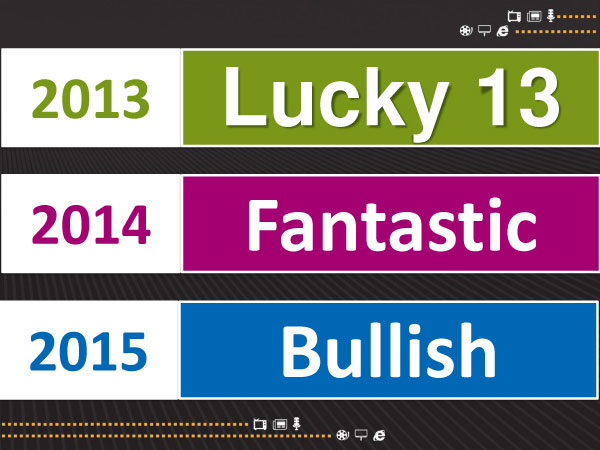
    Last year we said that 2014 would be a Buoyant year and am delighted to inform you that we were right!I would now describe the year just gone by as FANTASTIC!
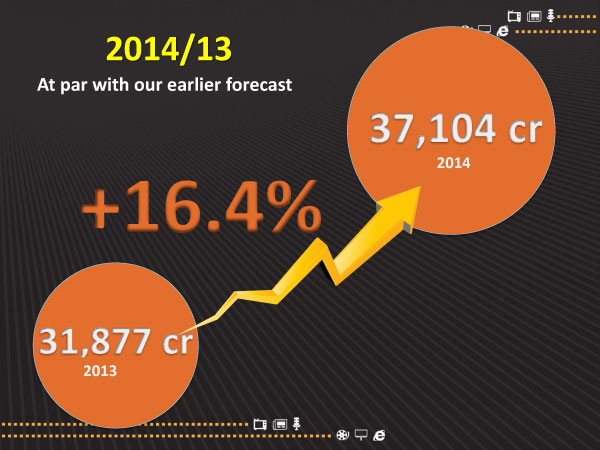
    Why do I say Fantastic?The Indian advertising industry in 2014 grew by 16.4%, almost at par with our forecast of 16.8%. When we projected a growth rate of 16.8% last February mostMedia professionals felt the projected growth was too high and Media sales professionals wondered if their bosses were going to increase their sales targets!

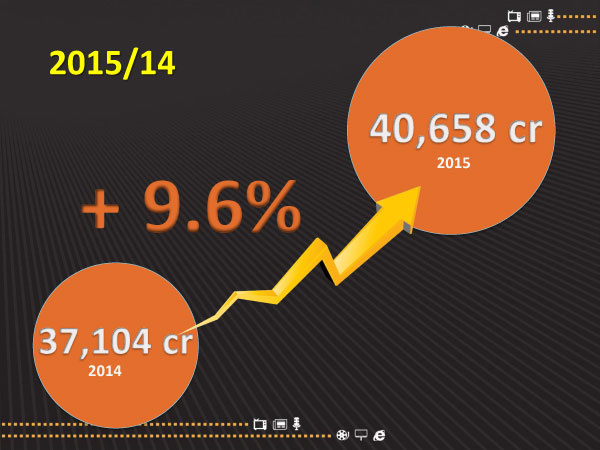
    In terms of absolute numbers, the advertising industry increased by Rs. 5,200 Crs and touched Rs. 37,100 crs in 2014.

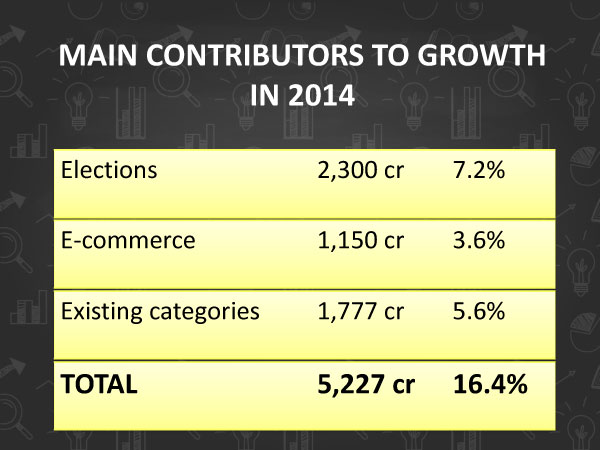
    The 2 main categories that have fuelled the overall growth in 2014 were the Lok Sabha general elections along with the 5 state elections, and E-commerce players contributing as much as Rs 2,300 Crs and Rs 1,150 Crs. respectively. Thus almost half the growth came from Elections alone and the 2 categories account for 2/3rd of the growth. Of the 16.4% growth rate registered in 2014 it is significant to note that nearly 7.2 percentage points is on account of elections alone, 3.6 percentage points is on account of E-commerce. It is again significant to note that existing categories contributed to only 5.6 percentage points of the overall growth.
    What is our growth forecast for 2015?
    Whilst the growth in 2014 was Fantastic, mainly because of election spends, we are equally bullish for 2015 too but our forecast has to recognize that 2015 is not an election year.
    A 9.6% growth rate, is what we forecast in 2015 which will take the industry further up to reach nearly 41000 crores. We expect the overall market to grow by more than Rs. 3500+ crores
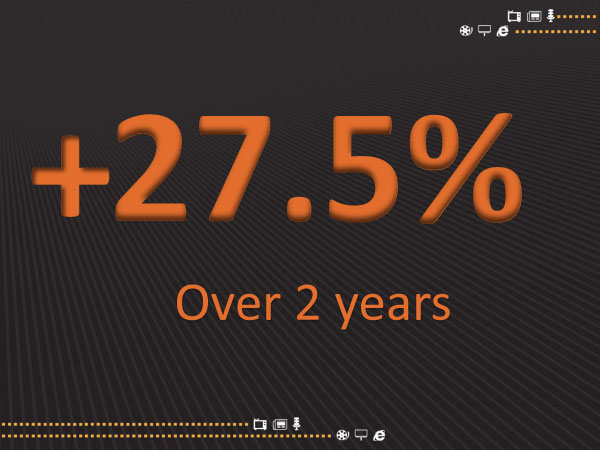
    That’s a spectacular growth of 27.5% over 2 years
    Note, this figure of 9.6% should be compared with the like to like category growth of 5.6% achieved in 2014 and not the overall growth of 16.4%. A stable government at the centre that is focusing on growth of the Indian economy, positive market sentiment, upbeat consumer confidence and India once again attracting global attention, are all the reasons why we are doubling our growth forecast to 9.6% from the earlier years like to like growth of 5.6%.
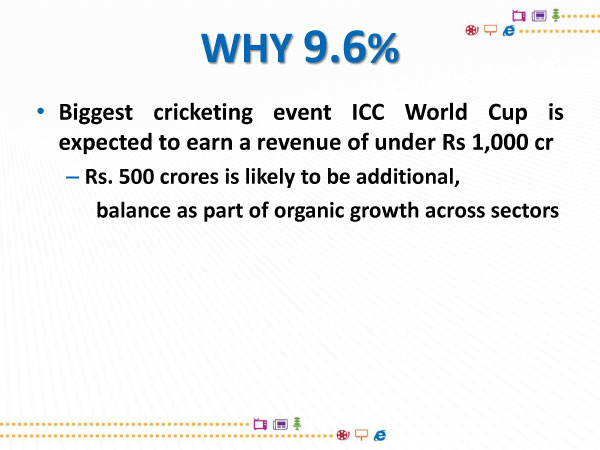
    Getting into the details of why 9.6% Biggest cricketing event ICC World Cup already underway is expected to earn a revenue of almost a 1,000 crores Rs. 500 crores is likely to be additional, just because of world cup and the balance as part of organic growth across sectors
    Other contributing factors to growth are likely to be: New advertisers Separate sales of HD channels, hopefully will attract new premium brands to advertising Facility of Geo targeting ads will attract more, local and retail advertisers on TV New channel launches from existing networks Further push by E-commerce companies and mobile and social apps Spends on Assembly elections in Delhi and two other states Increased government spending on print, since the new government strongly believes in communicating with their electorate about their new thinking, concepts, etc We are confident that government will finally launch phase 3 expansion no later than September 2015, and since a very large number of radio stations are expected to open up, this should pull in atleast Rs. 70 crores of additional advertising revenue in the last quarter of the year
    Here’s a 13 year review of the advertising market, having gone up from under 10,000 crores to almost 41,000 crores over 13 years. We have thus achieved a compounded annual average growth rate of 13% over these 12 years, but it is significant to note that the rate of growth in the last 6 years has been under 10%. Whilst, it appears that the advertising industry has grown steadily over these 13 years, the trend in growth rates as you can see is a wildly fluctuating one.
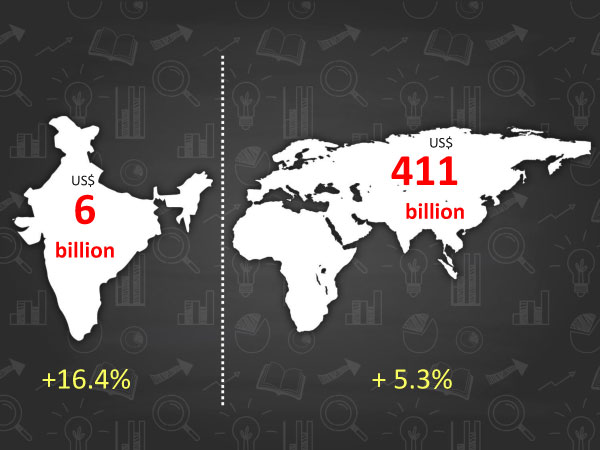
    Compared to India’s growth of 16.4%, the global advertising market grew by just 5.3% but of course in absolute terms the global advertising market is now estimated at US $ 411 billion where as India is at 6 billion which puts India’s share at a far from respectable 1.50%
    India maintained its 12th rank in the global ad market. The US further increased its share which now stands at almost 43% of the global market. China also increased its contribution from 11% to 14% and has overtaken Japan as the second largest advertising market. Japan has dropped significantly in terms of contribution from 13 to 9%.
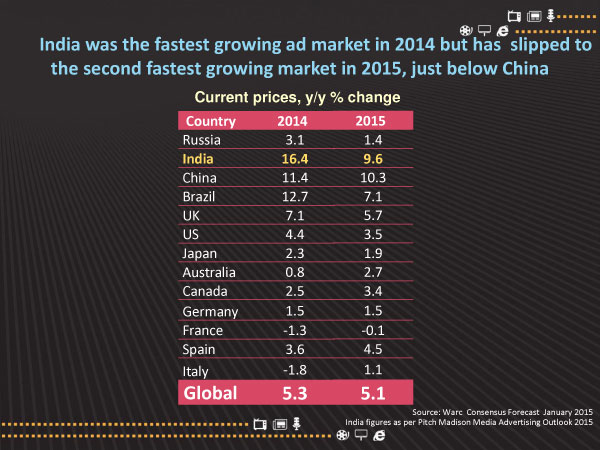
    India was the fastest growing ad market in 2014 but may slip to the second position in 2015, just below China
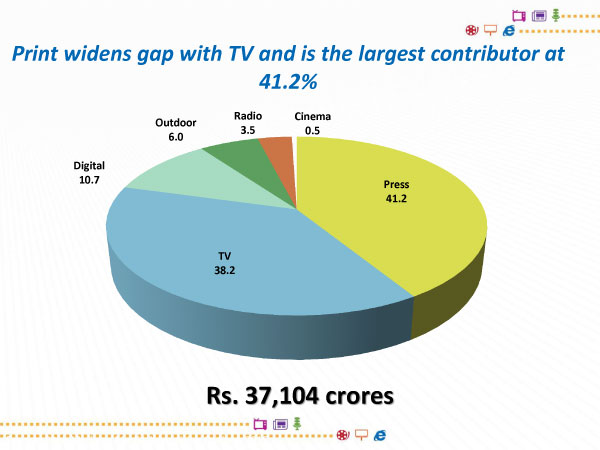
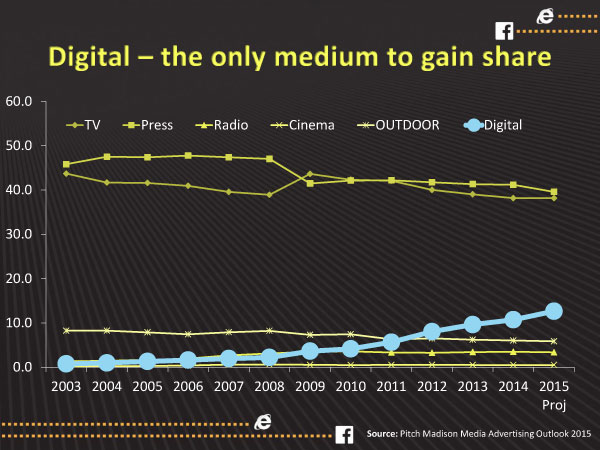
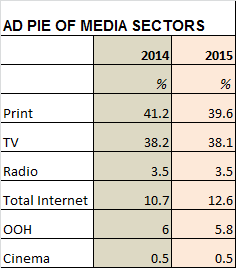
    Coming back to India, let’s look at the Medium wise figures. Print continues to be the largest segment and accounts for 41.2%, followed closely by TV at 38.2%. The gap between Print and TV has marginally widened. Digital has now got used to occupying the 3rd place with a 11% share. Outdoor, Radio and Cinema make up for the balance 10%.
    Digital continues to be the only medium to grow share at the expense of TV + Print + OOH. Radio & Cinema have maintained overall share.
    Digital continues to be the only medium to grow share at the expense of TV + Print + OOH. Radio & Cinema have maintained overall share.
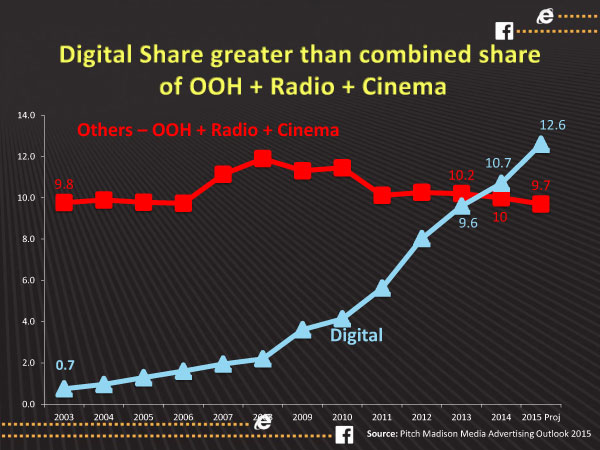
    It is interesting to note that the combined share of OOH, Radio and Cinema is lower than the share of Digital.
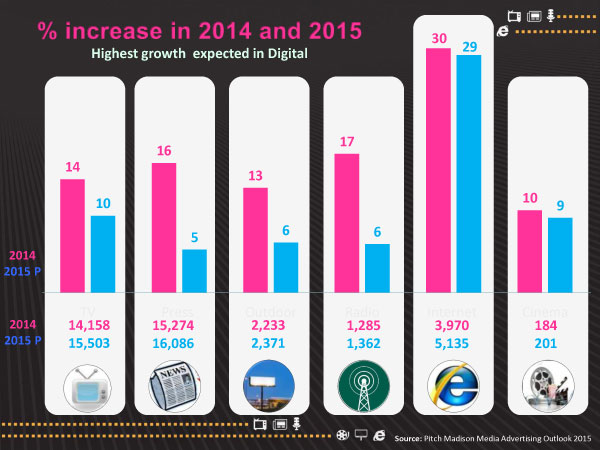
    In terms of growth rates, Digital grew the most in 2014 followed by Radio, Print, TV and OOH in percentage terms. In 2015, we expect TV to grow faster than all other media except digital at 10%.
    Moving to Television
    Television last year grew at 14% to reach Rs. 14,158 Crs but has dropped its contribution to total advertising and is now at 38%. The 2 main categories that have fuelled the overall growth of TV industry in 2014 are Lok Sabha general elections along with 5 state elections, and E-commerce players. The total spending by these 2 categories is in excess of Rs.1,050 Crs out of the total growth of Rs. 1,700+ crs. However this year we expect TV to grow by 9.5% on the back of ICC Cricket WC, Assembly elections in 3 states, HD Channels, Geo Targeting on TV, and new channel launches
    Hindi GEC contributes nearly 27% of the overall TV revenue and continues to remain the leader of the pack. A change in the pecking order saw Tamil Nadu C&S overtaking News to occupy the second rank with their ad revenues growing in contribution from 7.2% to 8.5%.
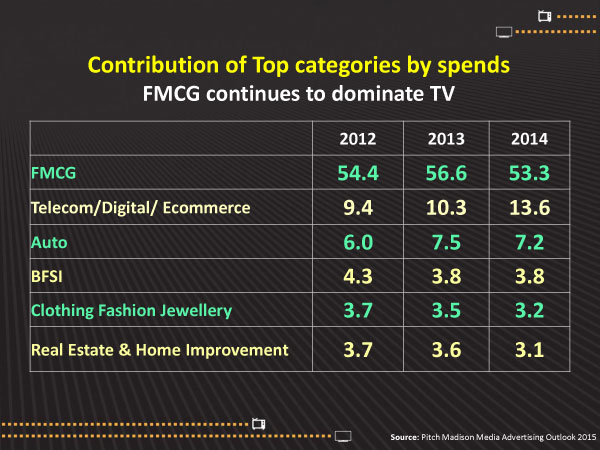
    In terms of category contribution, the pecking order remains the same with a marginal 3percentage points shift in contribution from FMCG to Ecommerce. FMCG, continues to rule the roost contributing 54% share of total TV spends (down from last year’s 57%), followed by Telecom/Digital/ Ecommerce (14%) & Auto (7%).
    In TV, the total FCT consumption has grown by over 18% in 2014. But if you take only those channels which existed in 2013, the growth in FCT comes down to 6.4%. Length of Average duration of a commercial seems to be inching up in the last 3 years and is now firmly at 24 seconds.
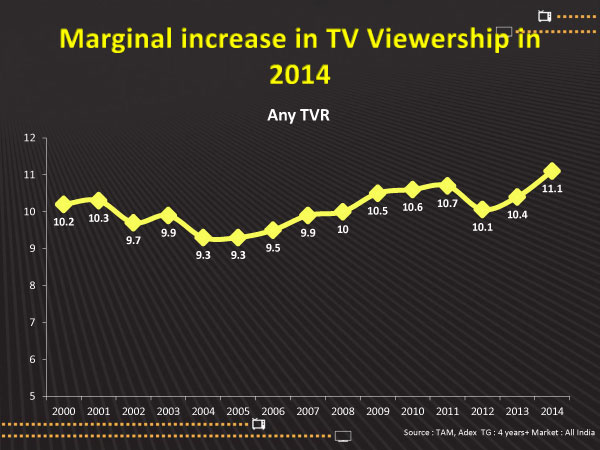
    There is a significant increase in average viewership of any TV channel of 7% in all day parts, but an even higher 11% increase in off prime. The drop that we had seen in 2012 has now been made up and more
    Let’s review Print
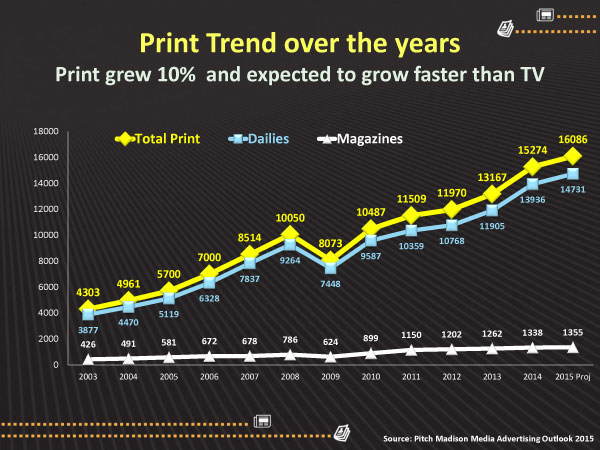
    Print grew by 16% to reach Rs. 15,274 Crs and continues to be the largest contributor in the total advertising pie with a share of 41%. Dailies has grown by 17% and is in line with our earlier projections. Magazines too have grown by 6% and is in line with our projections. Of the total growth of around Rs. 2100 Crs, nearly 85% or Rs. 1,800 Crs has been contributed by Elections & E-commerce players. Increase in advertising during festival season by smaller and retail advertisers has also contributed to the growth. And we expect Print to grow by another 5.3% in 2015.
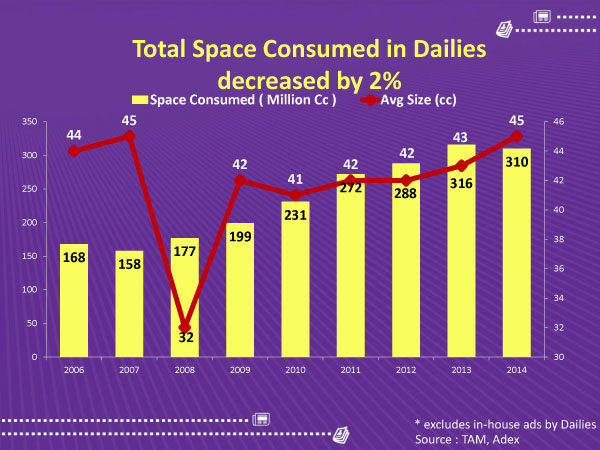
    Total space consumed in Dailies decreased by 2% but the average size of an ad also marginally increased to 45 col. cms.
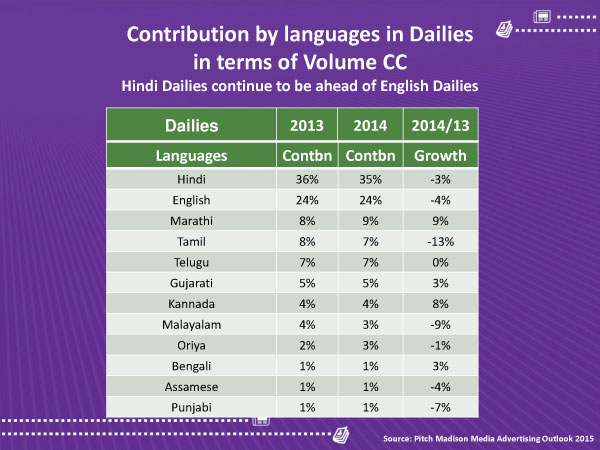
    In terms of Volume of advertising space consumed, Hindi Dailies continue to be ahead of English Dailies contributing 35% of the total volume from Dailies while English Dailies contribute 24%.
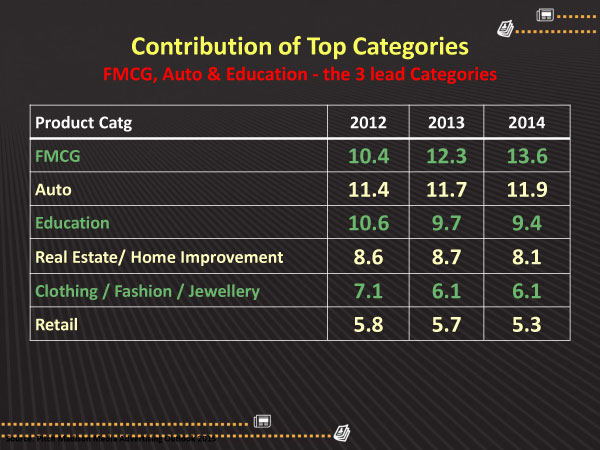
    It is significant to note that for the second consecutive year, FMCG is the largest contributor even in Print, although the contribution is only at 13.6% compared to TV where its contribution is 53%. For years FMCG was not a major contributor and it was Auto, Education and Real Estate that ruled the roost in Print. These categories along with clothing, fashion, jewellery and retail together contribute to only 40% of the total print spends.
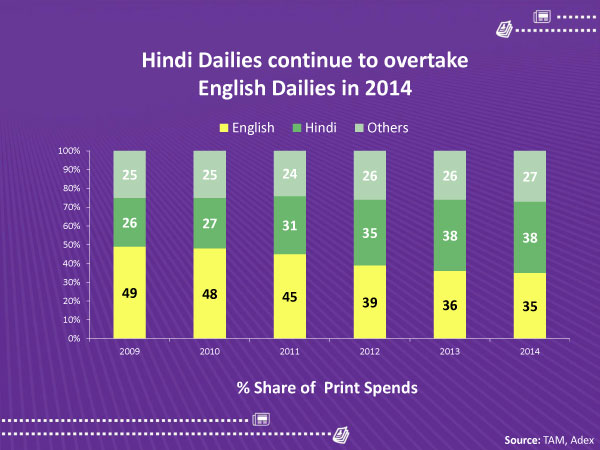
    2014 also saw Hindi Dailies topple English with a share of 38% in spends. The dominance of English newspapers is declining for the second year. Hindi newspapers are now firmly the largest contributor to the Print advertising pie.
    Moving on to RADIO
    Radio being a local medium was extensively used by all political parties including individual candidates for campaigning during the Lok Sabha general elections & 5 State elections. Radio has grown by 17% as against earlier growth projection of 15%. This growth is despite Phase 3 not coming into force as anticipated at the start of 2014. E-commerce advertisers have also used the radio medium extensively for all their tactical offer based campaigns. The growth has also come on the back of higher inventory being sold across stations. Radio has maintained its share of 3.5% of the total advertising pie with total revenue of Rs.1,285 crores in 2014, an increase of nearly Rs. 190 crores over 2013.
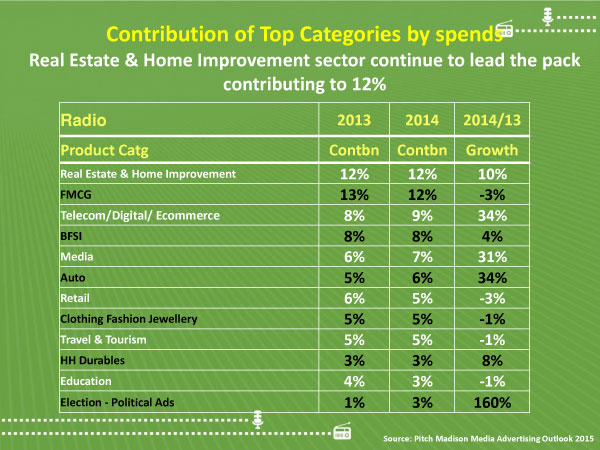
    In terms of category contribution, Real Estate & Home Improvement sector continue to lead the pack contributing to 12% of total Radio spends followed by Telecom/Digital and Ecommerce (9%) & BFSI ( 8%). Revenue from Ecommerce players sees the highest growth rate in 2015 followed by Auto and Media , while revenue from FMCG & Corporate sector shows decline in growth.
    Let’s see CINEMA
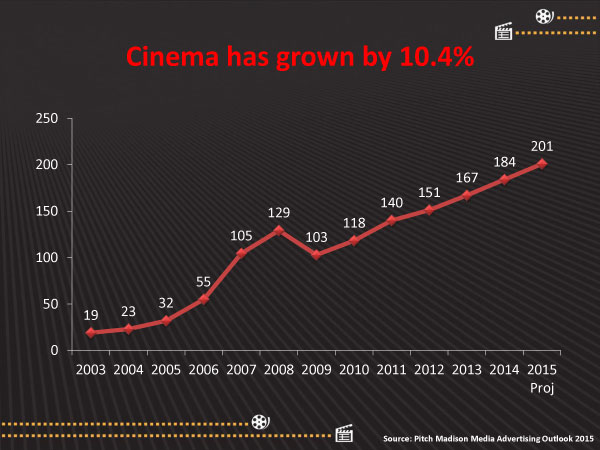
    Cinema has grown by 10% as against the projected growth rate of 7% and is at 0.5% contribution to advertising pie with total revenue of Rs. 184 crores in 2014. The rapid expansion of multiplexes in tier I and II cities is a big reason for the growth of cinema advertising in India
    Let’s see what’s happening in OUTDOOR
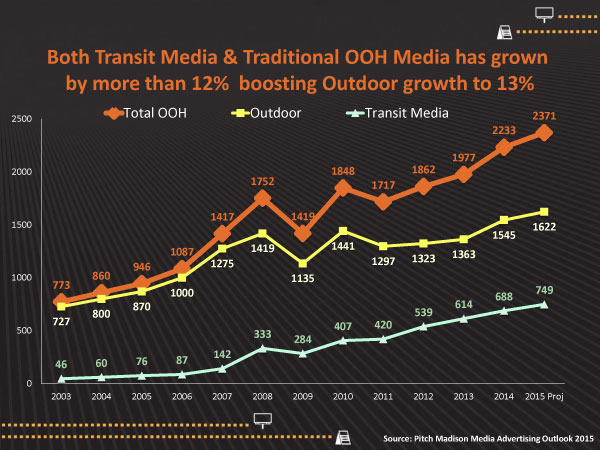
    The total Outdoor spends grew by 12.9% in 2014. Conventional Outdoor, against the projected 7% growth, grew by 13%. Transit Media too grew by 12% as against projected growth of 10%. Political parties spent heavily on OOH for both Lok Sabha Elections & 5 State Assembly Elections. E-Commerce category too gained momentum in 2014. Transit media rode on the back of new T2 terminal in Mumbai, initiation of Metro services in Mumbai & higher organic spends in Kolkata. Organic growth was seen in categories like Telecom, Automobile, BFSI and Retail. Outdoor has maintained its share of 6% of the total advertising pie in 2014 with total revenue of Rs. 2,233 crores, an increase of Rs. 256 crores over 2013.
    Finally we come to Digital
    Display including Video, Social and Mobile grows by 33% while Search increases by only 26%. With more FMCG and telecom players getting into the fray, Video, social and mobile formats saw larger traction. Given the explosion seen in smartphone adoption, we expect the trend to continue in the coming years
    So as you can see there has been a lot of action in the media world and to squeeze value out of this busy, noisy, media world, advertisers need to do a few things differently.I have 5 pieces of advise for my advertiser friends.
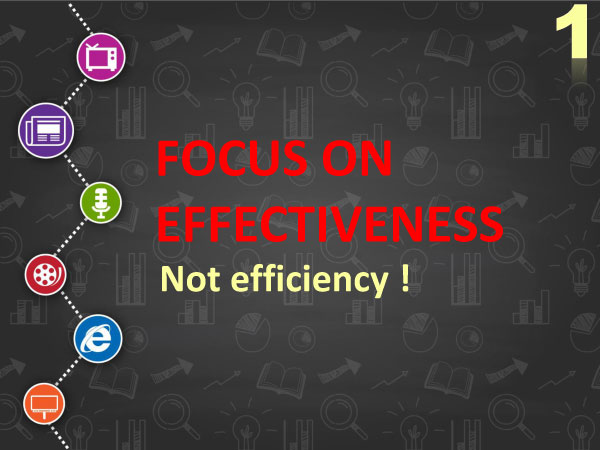
    My first piece of advise is to focus on effectiveness and not only on efficiency. Media seems to get the worst of everyone on rates. But Brands should not forget that the reason they advertise is to improve their brand health parameters and we have seen that certain properties, events and festivals, though expensive can impact brand health parameters in a substantial way, justifying the premium over vanilla buys.
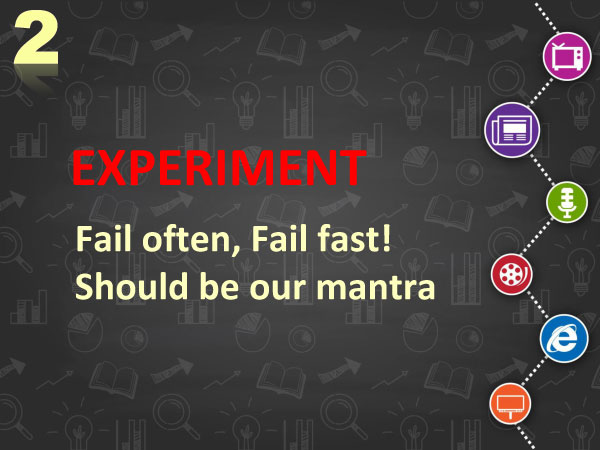
    Experiment should be our mantra. And here our guiding principle should be “Fail often, fail fast”. I have often seen marketing teams are painfully slow on certain media decisions. We often suffer from analysis paralysis.
    Our recent experience with BJP and the aggressive e-commerce spends on Print and TV in the last year have ably demonstrated that “Media can Move Mountains”. But, in my view most brands fail to take full advantage of what media has to offer by under-resourcing their campaigns. Better to focus on few brands and advertise them heavily.
    A corollary point, I would like to make is that since budgets are finite and often limited by P&L considerations, you need to prioritize markets very sharply and in the priority 1 markets spend and exposure must be atleast twice that of priority 3 markets, otherwise prioritization is meaningless.
    For some unexplicable reasons I have noticed that as media spends get larger and larger, media decisions are been taken at lower and lower levels. If you want media to work its magic for you, greater involvement of corner rooms is required.
    Thank you
  • Punit Goenka delivers keynote at WIEF

    By A Correspondent


    Punit Goenka

    Punit Goenka, MD & CEO, Zee Entertainment Enterprises Limited (ZEEL), delivered a keynote at the 19th Wharton India Economic Forum (WIEF) held at The Wharton School, University of Pennsylvania. In his keynote, which was on the theme of the conference ‘India: Delivering the Dream’, Punit Goenka spoke about the changed business environment in India with initiatives by the new government and the current state of the media and entertainment industry in India. He also discussed ZEEL’s journey over the past 20 years and the opportunities and challenges he foresees over the next few years.


    Speaking on the Media & Entertainment Industry in India, Punit Goenka, MD & CEO, ZEEL said, “Widespread technological advances in the ecosystem and the digital experience driven mainly by aspects like digitization of cable industry, has brought a new mindset to make business – quicker, targeted, transparent, and collaborative. This industry is certainly a sunrise sector for the nation’s economy. Proving its resilience to the world, the Indian M&E sector is on the cusp of a strong phase of growth.”


    He, furthermore, commented on ZEEL’s journey saying, “With most industry firsts to our credit, we as a global entertainment conglomerate have always been at the crest of innovation and leadership. We take immense pride in the fact that, unlike other global media companies which have travelled to India to set up their operations, ZEE has travelled against the flow and has successfully set up its presence across 169 countries, entertaining over 730 million viewers across the globe.”


    The Wharton India Economic Forum (WIEF) is a student-led business conference to discuss the opportunities and challenges faced by India. Started in 1996, it is a leading India-focused business forum held annually at The Wharton School, University of Pennsylvania which is among the top 3 institutions in the world for business education. The WIEF attracts business leaders, policy-makers, professionals and students to engage in fruitful dialogue and is attended by over 400 delegates including Wharton MBA, Penn Graduate and Undergraduate students, Wharton alumni and industry representatives and professionals.


  • Adspend to grow 9.6% in 2015: Madison


    By Labonita Ghosh


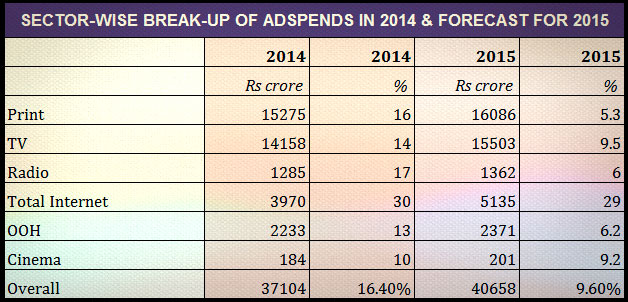
    The advertising industry is likely to grow 9.6 per cent this year, says the Pitch Madison Advertising Outlook Report 2015 released last Friday. While this looks like a tepid sequel to a blockbuster year – in 2014, the industry grew by a whopping 16.4% – the forecast is not without promises. For one, the slight uptick takes the total advertising market to Rs. 40,658 crore by end of 2015, from Rs 37,103 crore last year. Last year’s spurt was largely because of the spend on the Lok Sabha and some Assembly elections, says Sam Balsara, CMD of Madison World, which put the report together along with Pitch magazine. “The projection for 2015 is bullish, though tempered by the fact that this is not an election year,” says Mr Balsara. “There are other options, like the World Cup, the continued aggressive push by e-commerce companies, the launch of new channels and the emergence of new advertisers and new brands.”


    Among the more significant findings, print media continues to be the largest sector in advertising, and is expected to grab a 40% share this year. Brand advertising in print is likely to exceed Rs 16,000 crore. TV is next in line, and expected to touch Rs 15,500 crore. Digital, which has grown phenomenally in the last five years, is now larger than Outdoor, Cinema and Radio put together, will corner 12.6% of the market.

     

    The report finds that the FMCG sector, which has always been a dominant player on TV (contributing over 50%) is now also the largest contributor to print media for a second successive year. Though this contribution is just 13%. “Projections for the FMCG sector appear rosy, which is heartening,” says GK Suresh, Head of Marketing (Foods Division) at ITC, adding: “If this continues, I don’t see any reason media spends should not keep increasing as well. This provides a lot of confidence to manufacturers to launch new products, and companies to invest more in existing brands. I think the report forecast is fairly accurate; perhaps even a little conservative when it comes to FMCG.” While the print market constitutes many categories, FMCG, auto, education and real estate together contribute 43% of the total. For TV, the big players are telecom, digital, e-commerce and auto.


    “I would’ve expected FMCG spends in print to grow more rapidly,” adds Mr Suresh, “mainly because it offers many more opportunities to sharp-focus your advertising, and has less wastage than TV. But we in FMCG are really struggling with digital media right now. Everybody knows it’s growing and we need to be out there, but many of us are using it as just another medium.”


    According to Piyush Mathur, President, Nielsen India, the 9.6 % projection, close to a double-digit growth, is a realistic one. “A lot is riding on e-commerce, which is at an early stage and that means a lot will happen in 2015 and 2016,” he says. “As e-commerce companies get bigger valuations, there will be more spending on advertising.”


    Still, there are a few things advertisers need to do differently, says Mr Balsara. According to him, they should focus on effectiveness, and not just on efficiency, while always keeping in mind that the reason they advertise, is to increase their brand parameters. “I have seen marketing teams to be painfully slow on certain media decisions,” he adds. “We often suffer from analysis-paralysis.” Mr Balsara says most brands fail to take full advantage of what the media has to offer by under-resourcing their campaigns. “They will be well advised to focus on fewer brands of theirs, ignore some brands and advertise those few brands heavily,” he adds. “A corollary to this is that since budgets are often limited by P/L considerations, you need to prioritise markets sharply. Spend and exposure in Priority One markets should be at least three times that of Priority Three markets. Otherwise prioritisation is meaningless, and only remains in the hands of the brand manager.” Worryingly, Mr Balsara says he also finds that as media spends get larger and larger, media decisions get taken at lower levels. “These require greater involvement of the corner-room,” he says, and more participation by senior media agency leaders.


    This story first appeared in ‘dna of brands’ issued dated Febuary 23, 2015


  • IAA hosts ‘World Goes Digital’ webinar with Sanjay Mehta & Hareesh Tibrewala

    By A Correspondent


    The International Advertising Association (IAA) India Chapter hosted Sanjay Mehta and Hareesh Tibrewala, veteran digital media specialist and Founders and Joint CEOs of Social Wavelength for its webinar conducted as part of the ‘World Goes Digital’ series.


    While evangelising the digital media, the duo spoke about the growing acceptance of the digital media by marketers and industry as a whole. “There has been a significant change over the years,” said Mehta. Added Tibrewala: “Digital Media should not be looked at by the ad spends, but also the way they can drive business activity.”


    Srinivasan K Swamy
    Abhishek Karnani

    “The industry – especially young professionals – gained much from the first-hand experiences that Sanjay Mehta and Hareesh Tibrewala shared at the IAA webinar,” said Srinivasan K Swamy, President IAA India Chapter & Vice President, Development Asia Pacific, IAA.


    “We are very thankful to Sanjay Mehta and Hareesh Tibrewala to have answered several queries and doubts that young marketers and advertising professionals have as they are embark on a digital foray,” said Abhishek Karnani, Director, Free Press Journal, who along with Manish Advani, Head – Marketing and Public Relations, Mahindra Special Services Group, is co-chair of the IAA Webinar series.


    The webinar that was viewed live by over 1250 students from different Management Colleges can now be viewed on the IAA YouTube channel –www.youtube.com /iaaindiachapter.


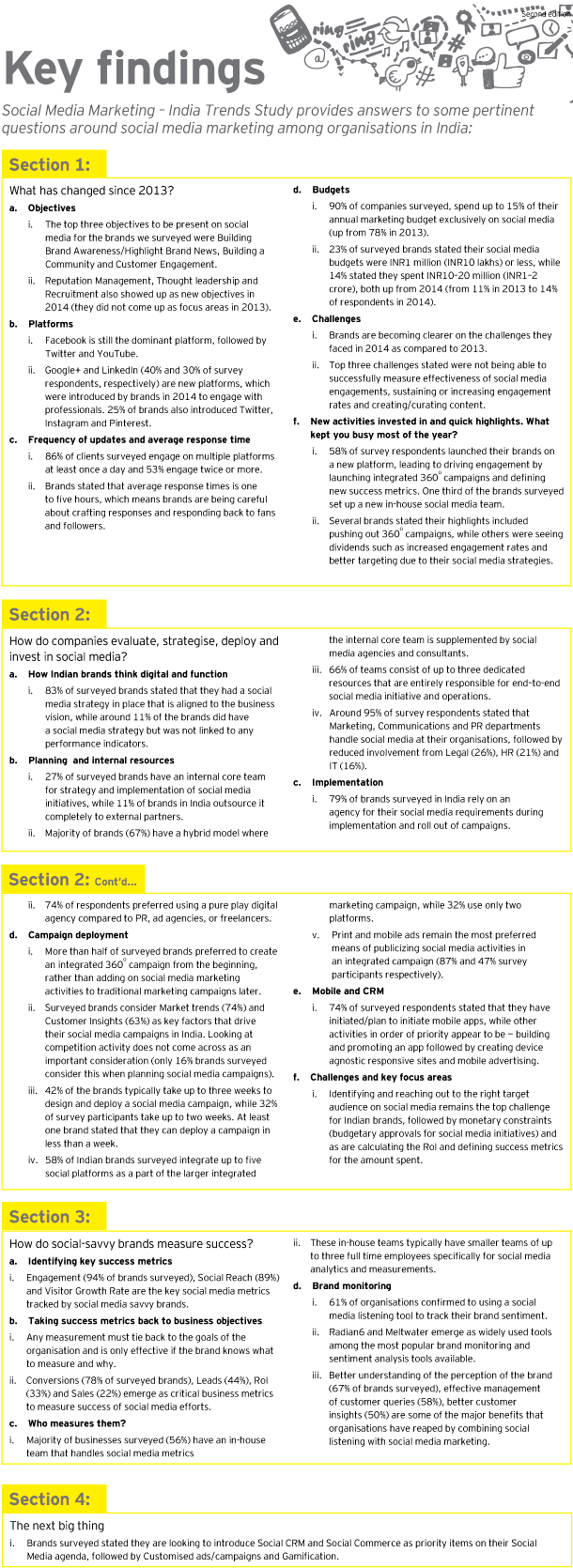
  • 15% annual marketing spends on social media: EY study


    The second annual Social Media Marketing India Trends released by EY has found that brands have significantly increased their social media spends even as they find it challenging to measure the effectiveness of their social media engagements.


    The study analyses how Indian marketers and organizations have been using the various social media platforms and how they go about tracking the performance of their social media initiatives. Brands across industries have realized the significance of social media and its peculiar demands. About 90 per cent of organizations reached out to in this study are planning to spend as much as 15 per cent of their annual marketing budget exclusively on social media, up from 78 per cent organizations in 2013.


    The study also addresses the key issues faced by digital marketers across sectors, attempts help them understand, leverage and navigate the social media space better. There is a distinct need for brands to analyse their maturity levels and explore disruptive opportunities for growth in the digital arena.


    This edition of the study focused on current and emerging social media platforms, how companies evaluate, strategize and deploy investments in social media, how social-savvy brands measure success and the outlook of social media marketing. Digital and social media presence is a key element in the marketing mix of most brands.


    It was also found out that social media is being increasingly used for thought leadership and internal communications, recruitment, and CSR in addition to marketing. About 35 per cent of the organizations said that they use social media for thought leadership and around 27 per cent said they use the medium for CSR. Increasingly the HR department is leveraging social media for internal employee outreach through unique platforms.


    Speaking about the study, Dinesh Mishra, Partner and Customer Practice Leader (India), Advisory services, EY, said: “Through this study we reached out to India’s top social and digital savvy brands from the third quarter of 2014 to January 2015. It is our observation that while brands have invested financially and in processes, there is a need for holistic customer engagement and strong community building strategies through the use of social media. That, in my mind, will strengthen the brand and allow for innovative and meaningful interactions between communities, as well as between the company and the community.


    “About 32 per cent of digital-savvy brands in India depend on the internal core team for strategy but the average team strength is small varying from 1-3 people. Given the mass reach and quick response time in social media, ownership plays a critical role in success. Every organization irrespective of size must focus on developing capabilities and creating a strong internal governance framework.”


  • Ranjona Banerji: Express on the top

    By Ranjona Banerji


    Aah cricket! I can’t believe that I’m writing this but cricket made a difference to the news mix last week. We’ve been so full of politics for so long now and that includes the politics of sport. But the start of the Cricket World Cup and India’s two wins in the first stages meant that we had a break from manufactured outrage.


    Of course there is no doubt that cricket fatigue will set in at some point and I’ll be grumbling here quite soon as this tournament goes on and on… There will be an endless questioning of Sachin Tendulkar and the endless squeaking of Boria Majumdar both on Headlines Today. There will be some needless (I cannot say gratuitous because no money = no appearance) film star presence because cricket is not glamorous enough in India as we all know. There will be outrage over every small fielding position. There will enormous anger that some other team actually dared to play well.


    And not all the deities in the world can save Team India from the media’s wrath if things do not go the media’s way… There you have it. That’s the World Cup in three paragraphs!


    **


    Actually, it’s been a news-filled week and the Indian Express has been at the top of one of the biggest stories: what the media dubbed the “terror boat” from Pakistan. Since the story of the boat that blew itself up on the night of December 31 2014 broke in the first week of January, questions have been raised, not least by India’s intelligence agencies. The Indian Express was at the forefront, asking uncomfortable questions with uncomfortable stories and incisive opinion pieces.


    Last week, they came up with a speech by a DIG of the Coast Guard where he claimed that he was in Gandhinagar when the boat was headed to the Porbandar coast and he had ordered that it be blown up (“We don’t want to serve them biryani”). There was hell to pay after that and denials and counter-accusations flew fast and thick between the Coast Guard, defence ministry, the government and the media, especially (obviously) television.


    The Indian Express waited as the denials became stronger and then released a tape of the DIG’s speech. This led to maximum embarrassment.


    However, fun as all this was, there are a couple of problems here. The first, amusing as it is for the media, is the “I was misquoted” excuse. The electronic age makes this excuse redundant. You can wiggle around saying you were misunderstood or quoted out of context. But even those have limited traction. If you are going to blab secrets or put your foot in your mouth, find a better explanation for your words before someone makes your words public.


    The second problem is more serious. It is the way that every story falls so quickly by the wayside. The coast guard DIG’s statement is serious because, among other things, it points to a frightening lack of communication between our security agencies and implies the defence ministry lied to the nation especially on a subject as fraught with tension as our relationship with Pakistan.


    But we have already forgotten about the story as we have jumped on to the next big one: The auction of Narendra Modi’s suit, the Budget session, the disappearance of Rahul Gandhi, Mohan Bhagwat’s comments on Mother Teresa or the information leaks and robberies from the petroleum ministry to petroleum companies. Some of these are not even that big but stories are judged on how they can be milked for attention and not for their intrinsic worth.


    Ah well.