Category: MEDIA

  • Jitendra Sawant joins Magnon\TBWA as AVP – Key Accounts

    By a correspondent


    Digital agency Magnon\TBWA has announced the appointment of Jitendra Y. Sawant as Associate Vice President – Key Accounts, with a view to enhance its Mumbai leadership team.


    In his new role with Magnon\TBWA, Jitendra will be reporting to Krishna Jha, the Executive Director (Mumbai) of the agency. Jitendra’s key areas of responsibilities will involve nurturing the agency’s client relationships and implementing account growth strategies.


    Jitendra brings with him nearly 15 years of rich experience in marketing, business development and account management in the digital space. His proficiency includes competence in implementing strategies that are adept in establishing and managing client accounts in a competitive digital environment.


    Jitendra, Vineet Bajpai, CEO of TBWA\India Group said, “I take pride in announcing Jitendra’s appointment as we continue to invest in the best industry talent in-line with our business growth objectives. Thereby building India’s leading and most trusted one-stop-shop digital agency. With proven track record in client acquisition and servicing, I’m confident that Jitendra’s brilliant experience will take Magnon\TBWA to the next level of growth”.


    Prior to joining Magnon\TBWA, Jitendra has served as the Account Director, Client servicing (Digital services) of Indigo Systems (Leo Burnett).


  • It’s Amazon v/s Flipkart & Snapdeal


    By Radhika P Nair & Aditi Shrivastava


    Amazon India is casting a snare to draw more small merchants into its fold as it battles India’s top online retailers Flipkart and Snapdeal for supremacy in the country’s booming ecommerce industry. Beginning Wednesday, merchants can sell their wares on the same day they register on Amazon’s portal compared with the nearly two weeks it takes on competing platforms.


    The world’s largest online retailer is also expanding the range of products that will be delivered to customers within a day, displaying the trademark aggression that marks its global operations nearly 10 months after launching services in India.


    “A few thousand sellers have already registered for the new service,” said Amit Deshpande, a director and general manager at Amazon India who said the company already has a roster of 4,000 sellers.


    These moves, coming days after the company launched a high-voltage advertisement campaign including television spots during the current edition of the Indian Premier League, is aimed at getting the largest number of merchants and the widest variety of products for Amazon customers.


    “Amazon is moving from first gear to fourth,” said Arvind Singhal, chairman of retail advisory Technopak. “They have the basics in place.”


    Amazon is Trend-Setter

    Market leader Flipkart, which just reached the milestone of $1 billion (over Rs 6,000 crore) in sales, also has about 4,000 sellers on its marketplace. But it follows an invite-only model to sign on sellers which is more time-consuming.


    “Even though I am already a seller on Flipkart, if I need to add a new category it will take about two weeks to start selling,” said Eshan Arif, 24, co-founder of Bengaluru-based music and movie merchandise store Hysteria. For a first-time registration it takes about three weeks from signing up to a live listing. Flipkart declined to comment for the article.


    Industry estimates peg Amazon India’s sales at over $200 million (Rs 1,200 crore) although the company declined to share sales numbers. At current growth rates, Amazon is capable of clocking sales of $1 billion (Rs 6,000 crore) by the end of March 2016.


    This will make Amazon the first online retailer in India to reach the magic number within three years of launch. Flipkart, which reached the milestone in March this year, took seven years. Snapdeal, launched in 2010, expects to reach $1 billion in sales this year.


    Snapdeal did not respond to email queries. Merchants who do business with all the top Indian portals said Amazon has taken a lead in categories including books and watches and is set to duplicate it in jewellery and baby care.


    The company’s latest delivery service, ‘easy ship’, will allow sellers to ask for a product to be picked up and shipped by Amazon. It will also provide cash-on-delivery for these sellers’ orders, an option so far available only to those who stocked products with Amazon. The service, which has 400 sellers already registered, will be available in 30 cities to start with.


    “We now have a complete suite of services for sellers which will help them sell more and make more money,” said Mr Deshpande, who has been with the company since 2010.


    This is just the latest in a string of initiatives from the Seattle-based company that is stirring up the Indian online retail industry estimated at $3 billion (over 18,200 crore).


    Last December, Amazon launched in-a-day delivery service forcing Flipkart and Snapdeal to follow suit. Flipkart and Amazon also launched their Apple iPhone and iPad applications within a day of each other. “Amazon is forcing Flipkart to push ahead with its customer and seller services,” said Ashish Jhalani, head of advisory services firm eTailing India. In Delhi and Mumbai, Amazon.in is piloting pick-up services where customers can pick up their orders from In & Out stores located at BPCL petrol stations.


    “Amazon is pretty much the trendsetter,” said Mahesh Murthy, founding partner at early stage venture fund Seedfund. “When Amazon started charging for delivery, Flipkart did the same.” Industry experts said Amazon India has done right by first focusing on backend processes instead of blindly chasing customers upon entry. “They built the logistics network, warehouses and built up a large selection of products that is helping them win customers now,” said Technopak’s Singhal.


    The company now has about 1.5 crore products listed on its site and two warehouses, each measuring over 150,000 square feet, in Mumbai and Bengaluru.


    Earlier this month, Flipkart said it had millions of products across 21 categories and 40 sub-categories. At peak times, the Bangalore-based company ships 1.3 lakh products a day.


    Amazon said its strong backend infrastructure is helping it scale up fast. “When we decide on areas of focus, we always work backwards from the customer,” said Mr Deshpande of Amazon.in. “Selection, delivery experience, logistics, payments and website experience are areas we are super-focused on.”


    Customers are taking note. “I used to buy books from Flipkart, but now I buy from Amazon.in as I see better variety there and it is the same price if not cheaper than Flipkart,” said Shradha Patnaik, 24, a communications professional who lives in Delhi.


    Merchants too are happy with their experience on the site. “Margin cut at Amazon is about 6-7%, compared with 10-12% at Flipkart,” said Hysteria’s Arif.


    While these indicate that Amazon is chipping away at the fortress that Flipkart has built, overtaking the market leader will take some doing.


    While prices in categories such as books are similar or Amazon.in is cheaper, in areas such as mobiles and tablets, Flipkart is cheaper in most models and brands. Flipkart is able to do this as WS Retail, a seller on Flipkart, is its subsidiary and gets most of its inventory directly from brands.


    “Flipkart’s WS Retail also buys outright from us and accounts for about 80% of our volume on Flipkart,” said Vivek Prabhakar, co-founder of design merchandise firm Chumbak, for whom online sites account for 18% of overall sales.


    Experts too believe that Flipkart has been able to fight back, for now. “Flipkart has the people and has built processes and technology. They are fighting back powerfully,” said eTailing’s Jhalani.


    Many believe the battle will only truly begin when Amazon.in launches apparel. Flipkart is believed to be in talks to acquire rival fashion portal Myntra to shore up its defences.


    Amazon, which launched other fashion categories lately, the most recent being shoes, is expected to launch apparel in the first two weeks of May.


    Source:The Economic Times

    Copyright © 2014, Bennett, Coleman & Co. Ltd. All Rights Reserved

    Licensed to republish
     

  • Sujay Kutty is Channel Head, ETV Bangla & Oriya

    By a correspondent


    Regional general entertainment network ETV announced the appointment of Sujay Raghavan Kutty as Channel Head – ETV Bangla and ETV Oriya. With a view to strengthen the eastern region, the move will bring in a concentrated effort towards building both the channels in the space.


    In his new role Sujay will report to Ravish Kumar, Executive Vice President and Business Head – Regional Channels|ETV Oriya, ETV Bangla & ETV Kannada.


    Based out of Kolkata, Sujay brings with him over 18 years of experience and has worked extensively in the media & entertainment industry with a keen focus on regional general entertainment channels.


    Speaking on the appointment Ravish Kumar, Executive Vice President and Business Head – Regional Channels |ETV Oriya, ETV Bangla & ETV Kannada said, “The appointment of Sujay will just help us take this growth to the next level. His in-depth understanding and experience in the eastern markets will truly help us transform the Bengali & Oriya GEC landscape via innovative, intriguing and incredible content that will entertain and enthrall viewers.”


    In his previous assignment Sujay was Business Head for Zee Bangla & Zee Bangla Cinema.


  • Sorbojeet Chatterjee moves from dna to Zeel

    By A Correspondent


    Zee Entertainment Enterprises Ltd has announced the appointment of Sorbojeet Chatterjee as Senior Vice President, Marketing for the cluster of Hindi GECs including Zee TV, Zee Anmol, Smile, 9X and Zee TV HD channels. For his responsibilities, Mr Chatterjee will report to Akash Chawla, Executive Vice President and Marketing Head – National Channels, ZEEL. Another movement announced is that of Sapangeet Rajwant who will take over as Zee TV – Marketing Head and will report to Mr Chatterjee.


    Mr Chatterjee brings with him 13 years of experience from both sides of the media business – the creative side as a copywriter and the business side in marketing and strategy. He moves from the Zee Media Corp-owned dna where he was designated as Senior VP – Marketing. His earlier stints have been with Neo Sports Broadcast Pvt Ltd as Vice President Marketing, TV Today Network as Head of Marketing and Special Projects and Gslot.com as Copywriter. He has extensive media marketing experience across television, print and radio brands. He is also an avid quizzer and has been active on various industry forums and associations.


  • Razorfish hires Vik Kathuria as Global Chief Media Officer

    By A Correspondent


    Razorfish has announced the appointment of Vik Kathuria as Global Chief Media Officer. Kathuria will report to Pete Stein, Razorfish’s Global CEO.


    A 20-year industry veteran, Kathuria most recently served as Global Head of Digital Investment for MediaCom, one of WPP’s leading media agencies under the GroupM umbrella. In this position, he was tasked with establishing network-wide best practices, leading relationships with global publishers and driving multi-market client negotiations. Prior to joining MediaCom in 2008, Kathuria was Senior Vice President of Digital Media for OMD and served in senior global marketing positions at Citigroup (New York) and PepsiCo (Singapore).


    In his new role as Global Chief Media Officer, Kathuria will be responsible for leading the agency’s 300 media employees worldwide, driving Razorfish’s exclusively digital media strategy-from its executive level partner relationships to its proprietary data solution infrastructure-and overseeing a global client roster that includes DHL, Starwood, HSN and Best Buy. He will also be involved in further strengthening and aligning Razorfish’s global media practice and commanding significant new business efforts.


    “As we continue to evolve our global media offering and educate clients on the need to employ a digital-centric approach, it is essential we have a leader poised to take us to the next level,” said Stein. “Vik’s experience lies in negotiating digital media strategies that maximize brand investment. He has what it takes to further progress our team, support our shift to programmatic buying and foster our culture of innovation and optimization.”


    Kathuria will begin working out of the agency’sNew York Cityheadquarters immediately.


  • Jhunjhunwala appointed COO at BBC Global News

    By A Correspondent


    Naveen Jhunjhunwala has been appointed COO of BBC Global News India. Jhunjhunwala, who was previously with Turner International India as VP for corporate finance and administration, replaces Preet Dhupar who moved on following her decade-and-a-half stint with the company.


    At Turner, Jhunjhunwala helped launch the company’s India operations including the CN subscription business, launch of new channels like HBO, POGO and WB. He also helped set up the Zee Turner distribution JV, including MediaPro as well as CNN-IBN. Prior to Turner, he was with Ernst & Young in New Delhi.


    Apart from handling finance, Jhunjhunwala will also be responsible for determining BBC’s commercial priorities and targets for news across the country as well as ad revenue, content distribution and audience growth.


  • LinkedIn unveils three new initiatives to drive content marketing forward

    By A Correspondent


    To drive its content strategy forward, LinkedIn has launched three new initiatives to help marketers and agencies build better relationships with target audiences through content. These include Sponsored Updates Partners, Content Partners Program and Sponsored InMail on Mobile.


    Sponsored Updates Partners will provide brands and agencies with campaign management tools to effectively and efficiently manage and optimize large sponsored updates campaigns. They also make it more efficient for brands to use a single dashboard to manage their paid content activities on multiple social channels. Other services offered include managed services to oversee campaign activities on behalf of the client.


    LinkedIn is launching the program with five of the industry’s top companies, including AdStage, Brand Networks, SHIFT, the Salesforce ExactTarget Marketing Cloud and Unified Social. Pilot results show an overall lift of more than 30 per cent in engagement rates on customer’s sponsored updates campaigns, significantly higher than on prior campaigns without partner services.


    A key ongoing challenge for organizations is to have enough quality content to share with audiences. The Content Partners program will connect companies with publishers, platforms, and original content producers to help them deliver content under their own brand name.


    Ten companies have been certified as part of this program, including publishers Bloomberg, CBS Interactive, and IDG; content platforms Newscred and Percolate; and custom content creators like Atlantic Media Strategies, Contently, Freshwire, and SJR.


    Sponsored InMail is available on mobile platforms (iPhone, Android, and mobile web). Where members could previously only see sponsored messages on desktop, this move enables marketers to engage targeted audiences with personalized, valuable content on mobile – which currently drives more than half of LinkedIn Inbox page views.


  • Gamifying Corporate India


    By Lubna Kably


    At Accenture India, a roll of the dice is all it takes for an employee to become boss. But this out-of-turn promotion is only reserved for those with serious game.


    The management consultancy has introduced a four-level gamification tool which lets employees roll the dice and attempt questions on a wide range of topics relating to ethics and compliance, a company focus in 2014. Employees who clear all levels of the game are designated boss of a virtual organization.


    ‘The word ‘gamification’ – in play across organizations globally-is the application of video game techniques to a business setting in order to make tasks fun and engaging. A pat on the back by the boss has given way to badges awarded via internet or mobile app-driven gamification platforms. What’s more, these badges also count during performance appraisal. Companies also use leaderboards, which let players view one another’s scores, to encourage friendly competition. The main reason for the gamification of the workplace is a young, tech-savvy workforce which likes to mix work and play.


    Research firm Gartner has identified some areas where companies are using gamification such as training, employee performance as well as instilling behavioural change in employees.


    According to Gartner by 2015, 40% of Global 1000 organizations will adopt gamification as the primary means of transforming business operations. But, India Inc has a lot of catching up to do.


    “Currently, less than 10% of Indian corporates use gamification actively. Its true value goes beyond mere employee engagement to impact analysis as well as enabling companies to adopt suitable business strategies,” says Prashant John, executive director at ‘kwench, a gamification solution company.


    If the proof of the pudding is in the playing, Freshdesk a customer support software provider, stands out. “Ever since we introduced gamification features in our software products we’ve also deployed it internally for our own customer support staff,” explains Girish Mathrubootham, founder & CEO. The gamification feature gives points for meeting various parameters, such as fast replies or getting good client feedback. Monthly, four trophies are awarded, for instance, the ‘Customer Champion’ goes to the employee with maximum client satisfaction points. eMee’s gamified social appraisal system, which innovatively captures data points on employee performance, annually saves Persistent Systems, one of its first customers, nearly 30,000 management hours.
    L’Oreal deploys three gamification tools for recruitment from diverse fields such as marketing, human resources, sales and operations. “Gamification tools deployed by us call for solutions to real-life challenges. It helps us screen the applicant’s analytical skills which may not be possible via traditional hiring means. We attempt to recruit 20% of the company’s managerial cadre though gaming channels,” says Mohit James, HR director at L’Oreal.


    Companies are also using gamification tools to change behavioural patterns. At Accenture, a 75-day ‘Stepatholon’ gamification event, helped inculcate a healthier lifestyle. Participants were encouraged to take at least 10,000 steps a day which, in turn, helped teams advance on a virtual map and traverse the globe. Accenture India’s employees collectively covered a distance of over one million kilometres and burned an aggregate of nearly 107 million calories. Manoj Biswas, MD, Human Resources at Accenture India, says: “Gamification helps us to communicate differently. It also helps bring employees together around a single goal or idea.”
    “Going forward, gamification will increasingly involve embedding serious behavioural science elements engineered towards attaining desired business goals,” adds Rakesh Mishra, a researcher in this field.


    MakeMyTrip.com first used gamification for orientation of new recruits. TripOn, which was the gamification platform accessible on individual iPads, provided a competitive expedition into the company’s history, businesses operations, policies and people. Rajesh Magow, CEO says: “There has been an increase by at least 25% in satisfaction scores of new employees. They gain a sharper learning curve in terms of role expectations, performance requirements and cultural assimilation.” The company has now expanded gamification for international destination training programs.


    As the popularity of the gamification is set to rise, companies large and small are concentrating on providing gamification solutions. The games have clearly begun.


    Source:The Economic Times
    Copyright © 2014, Bennett, Coleman & Co. Ltd. All Rights Reserved
    Licensed to republish

     

  • How effective are Focus Groups?


    By Rahul Sachitanand, Shephali Bhatt, Amit Bapna & Ravi Balakrishnan


    “It’s really hard to design products by focus groups. A lot of times, people don’t know what they want until you show it to them.” That was Steve Jobs, back in 1998, just before Apple launched the hugely successful iPod. If Jobs’ statement had a touch of swagger to it – much like everything Apple – his words were prescient. A decade-and-a-half later, creatives and marketers are coming face-to-face with the decline of one of the most preferred qualitative measurement tools. As consumers get smarter and more connected, companies find it harder to keep focus groups honest. A tool first used in the 1940s at The Bureau of Applied Social Research at Columbia University to study the then revolutionary medium head – radio – is now struggling for a sense of purpose.


    THE DUBIOUS WISDOM OF CROWDS

    Focus groups may be the most popular mode of qualitative research, but things can get hilariously out of hand


    KV Sridhar, CCO, LEO BURNETT

    “Focus groups are sometimes like award jury members: if one dumb guy doesn’t get it the entire group gets muddled. Once we tested an ad where someone attempts suicide and from the time of him jumping off a building till he falls there is a courier company that delivers a safety net. It was trying to demonstrate the criticality and speed in a hyperbolic way. They never got the connect. They said “Woh toh mar jata tha.” (He would’ve died.) The van was painted in brand colours and they said it should’ve been an ambulance to help the guy.”


    Sarang Panchal, CO-FOUNDER, MRSS INDIA

    “A focus group in Egypt we once conducted bombed because of one incident. A group of female smokers included some non-smokers (of course, a wrong recruitment). We ended up asking all the women to smoke. The non smokers were also made to carry a pack of 10 with lighters. The moment we asked them to smoke, a nonsmoker actually held the cigarette the wrong way – filter ahead and tobacco end in mouth and started praying! “I am sorry Allah to commit this crime, I know it is haram.” We cancelled the whole group before she could light up. In the end, all we got were a few belly laughs at her expense.


    Ambi G Parameswaran, ADVISOR, FCB ULKA

    “The same set of women attends a focus group every day. At a group in Delhi, we overheard the women remarking “Kal ke group mein snacks better the.” (The snacks were a lot better in yesterday’s group).


    Prasoon Joshi, PRESIDENT – SOUTH ASIA, MCCANN WORLDGROUP

    “This was in 2002. We were working on creating a campaign to spread the word about HIV for NACO. Researchers were asking men from men Tier-2, Tier-3 towns if they were inclined to wear a condom. One respondent told them that he wears a condom everyday but added that it gets loose by the evening. He didn’t know a condom is to be worn during sexual intercourse and was wearing it as an accessory that he believed was magically helping prevent STDs like AIDS. It was a great insight to create a campaign.”


    Ajay Kakar CMO – FINANCIAL SERVICES, ADITYA BIRLA GROUP

    “Hum to sab jaante hain. Hum ko koi bewaqoof nahin bana sakta” (We know everything and cannot be fooled) is a very common refrain, capturing the macho attitude of Indian males. If you are knowledgable and sitting on the marketer side, you soon realise such a person has nothing but confidence.”


    Focus groups use a set of people to test what they are thinking about specific new products or solutions. For example, Café Coffee Day may put together a team to tentatively consider additions or subtractions to its menu and overhauling the ambience of its stores. HDFC Bank has used these groups as a sounding board for new products such as offers for the Solitaire credit card specifically targeted at women. They helped Godrej Tyson Foods build a market for its packaged chicken. “In 2002, consumers were not exposed to fresh packaged chicken,” recounts Sushil Sawant, associate vice president with the firm. “Findings culled out from focus groups were used to position and communicate our strategy,” he adds. Companies such as Britannia have even avoided missteps: putting an Indian sweet – Kaaju Katli – as a filling between biscuits, got an emphatic thumbs-down.


    Despite their uses, focus groups are under sustained fire. Saji Abraham, EVP – planning, Lowe Lintas is dismissive: “They are a misnomer,” he argues. “They usually ramble all over the place, trying to pass superficial observations off as insights.” Focus groups are under siege because of the lack of depth and limited interpretation of the data provided, he adds. “Directly asking a question or keeping it thinly disguised through projection techniques is useless, as it alerts the consumer and influences the answer.”


    The madness, it appears, is in the method. For most marketers, the biggest concern is the quality of the audience. Ajay Kakar, CMO – financial services, Aditya Birla Group likens it to visiting the filthy kitchen of a dhaba reputed to serve excellent food. A provider of men’s grooming products discovered the perils of the technique on putting together a small group to try to explore the nuances of men’s fairness creams. Soon after they assembled, not only were the guys reduced to monosyllables; previously talkative men spent their time examining their shoelaces. It turns out even the vainest men preen only in front of their mirrors and not before complete strangers. Instead of getting nuanced insights, the company ended with a bunch of stilted, predictable reactions.


    A bigger problem is when companies and agencies discover their audience is, if anything, a little too much “on message”, or as an agency head cheekily puts it “have lost their research virginity.” Rajesh Mehta, the former marketing head for Western Union and founder of marketing consultancy Agora recounts: “I have seen agencies and field work where recruiting agents have the same respondents across categories.” He adds, “Sometimes the agents are housewives who hold groups at home and reach out only to acquaintances, family and friends. Maybe 20 or 30 people rotate across groups.” Agrees marketing consultant Suvodeep Das, “Unfortunately, there is a widespread incidence of ‘professional respondents’. Seasoned researchers can easily identify them – they are usually asked to leave within a few minutes.” However there are cases where they aren’t and these appear to be on the rise according to most of the people we talked to. Suave respondents with studied and deliberate answers are of no use to anybody – especially not a company trying to extrapolate their opinions to a larger set. And then there are the bullies; the superficially knowledgeable assertive types who speak for the group, not letting anyone else get a word in edgeways. To the point where several agencies and marketers are thinking of alternative routes to consumer insights.


    Research agencies say companies give them little notice and then expect miracles. “They can give us as little as three days,” says Rohini Abraham, senior vice president, IMRB. In this time, she argues, it is challenging to assemble a strong group, a moderator who can guide attendees through questions and then expect cogent findings. Research agencies offer options to standard focus groups. Sarang Panchal, co-founder of MRSS India, suggests “A better use of say conflict groups or jury groups helps meet the client’s marketing objective, compared to a plain vanilla discussion.” In the former, brand advocates face off against a neutral set of consumers. However, most companies are yet to evolve, since they prefer using ordinary groups to meet their needs.


    Of course it’s unfair blaming just the research agencies. In ad agencies too, research and consumer outreach are low on the totem pole. Leo Burnett’s CCO KV Sridhar says wryly, “Everyone wants to come for a shoot with Amitabh Bachchan. But try getting them to show up for discussion on the same film in a small town and they’ll immediately talk about how there are no direct flights and only poor accommodation options.”


    For too many clients, the group is a box that needs to be ticked. It becomes less about uncovering insights and more about playing safe, claiming a course of action was ratified by research. And so, in this as in so many other industry issues, marketers and agencies are their worst enemies. This time around though, there’s a convenient scapegoat.


    Source:The Economic Times

    Copyright © 2014, Bennett, Coleman & Co. Ltd. All Rights Reserved

    Licensed to republish



  • Delna Sethna Patel joins L&K Saatchi & Saatchi as CCO

    By A Correspondent


    Delna Sethna Patel has joined L&K Saatchi & Saatchi as Chief Creative Officer. She was until recently working with Leo Burnett where was Regional Creative Director on Brand Whisper.


    Ms Sethna Patel will focus on the P&G business, specifically: Head & Shoulders, Ariel, Olay and Pampers, according to a communique.


    On joining the agency she said: “I am looking forward to working with Anil and Praveen to grow business and push the creative envelope.”


    Said Anil S Nair, CEO and Managing Partner: “Delna is a kind of creative leader who brings the best out of everyone who works with her, irrespective of the department they work in. We are excited to have such an inspirational leader in our team.”


  • Abki baar, loads of election-themed advertising


    By Delshad Irani


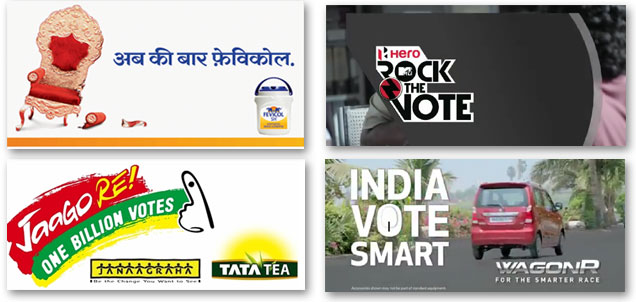
    Last week, just off Peddar Road Bridge in South Mumbai, Bimmers, Bentleys and taxi cabs passed a giant billboard, standing in the shade of posh high-rises that are home to Mumbai’s wealthiest citizens. It featured a tub of Fevicol with these words in blue ‘Abki Baar, Fevicol’. Of course, ‘Abki Baar’ are the now famous (and extensively parodied on social media) opening words of the Bharatiya Janata Party’s general election campaign. So what does glue have to do with it? It’s a simple strategy deployed by brands time and again ride on the coattails of a topical event that has countless masses in its thrall.


    Fevicol, a Pidilite brand and its agency Ogilvy also produced a commercial featuring a conversation between a chaiwalla and a slightly kooky carpenter about three peculiar chairs. A lotus shaped one, an adjustable chair shaped like a hand and the hotchpotch seat that’s the result of different sizes and shapes of kursis glued together. In other words, BJP, Congress and the Aam Admi Party.


    The last time chairs were prominently featured in an ad it was for Facebook’s ‘Chairs’ commercial. However, while the social network’s ad was an ode to chairs, or Ikea perhaps (still a mystery that one); Fevicol’s all about seats of power in this cheeky spot. While most thought the campaign a refreshing and amusing commentary on the elections, it also put the cat among the conspiracy theorists who have suggested this is a surrogate campaign for Narendra Modi-led BJP.


    They also point to the fact that Ogilvy’s chief Piyush Pandey was instrumental in the creation of the party’s campaign. On social media like Twitter some have fielded tweets such as, “Does the new Fevicol ad obliquely suggest that BJP is most likely to win?” which refers to the perceived bias in the commercial.


    However, the point of the ad, according to Anil Jayaraj, chief marketing officer of Pidilite Industries, was simply to put a smile on people’s faces. He says, “Over the years, Fevicol’s advertising has striven to capture a slice of life while reinforcing our core proposition of strong bonds in a contextual situation. We didn’t think about the campaign from an election point of view.” But if you do, it’s highly advisable to exercise a fair amount of common sense when ad plots involve topics like elections, parties and politics. “But the ground rule is to make people smile with these humorous takes,” he says.


    The 2014 Lok Sabha Elections has seen the most high-decibel campaigning in the history of India. It’s no surprise then, that the world’s biggest democratic exercise has prompted marketers to do the poll-ka too. Don’t be fooled, it’s a tricky dance. There’s the finest line between the good samaritan brand which encourages viewers to cast their ballot and the preachy bore which only provokes viewers to draw their mallets. And one could just as easily, consciously or not, colour a piece of communication in certain party hues.


    Brands like Tata Tea have built and sustained the momentum of purpose-driven movements over many years. The Tata Group’s Jaago Re initiative is structured entirely on social causes and issues of citizen responsibility. Meanwhile others temporarily latch on to elections by broadcasting passive reminders.


    Berger Paints did its bit to prompt viewers to be the change they want to see. The brand’s latest commercial has people trying to wash corruption off India’s walls, literally. So did innerwear brand Rupa, with its spot featuring Hero No1 in his white vest and gundas who keep voters away from poll booths; an ad that apparently inspired another similar commercial from innerwear brand Dollar.


    Brands as diverse and tangential to polling as Wagon R and Finolex have thrown their khadi topis in the ring. Looking for a slightly more lasting association, sportswear maker Puma tied up with MTV for its ‘Rock The Vote’ initiative to help further the cause. Says Rajiv Mehta, MD, Puma South Asia, authenticity is key. “Besides we are not telling people who to vote for, we’re just saying vote.” And never spam people’s inboxes with messages and reminders to exercise their democratic right and do their duty for change and country, that’ll just piss people off, is Mehta’s advice.


    For marketers, to join the clamour of election-themed brand campaigns is easy enough, to get viewers to vote is the hard part. Now, all they can do is hope that abki baar is in fact the right time to hitch their wagon to the poll. After all, it’s hard to be heard when noise from the parties’ party drowns out every other campaign online and off.


    Source:The Economic Times

    Copyright © 2014, Bennett, Coleman & Co. Ltd. All Rights Reserved

    Licensed to republish


  • PRCAI elects new committee; Sharif Rangnekar continues term as President

    By A Correspondent


    The Public Relations Consultants Association of India (PRCAI) has elected a new management committee and regional chapter heads for 2014-2016.


    The association re-elected Sharif D Rangnekar, CEO & Director, Integral PR, for the post of President. Nitin Mantri, CEO, Avian Media, was elected as Vice-President and Jaideep Shergill, CEO, MSL India, as Secretary.


    As part of its national outreach, the regional chapter heads elected are Pulkit Srivastava, Director, Perfect Relations, as Chairperson, North; Julie Joseph, Vice-President, Technology Vertical, The Practice as Chairperson, South; Madhuri Sen, MD, Waggener Edstrom, as Chairperson, West; and Basav Bhattacharya, Strategic Consultant, Integral PR as Chairperson, East.


    Commenting on being re-elected President, Mr Rangnekar said: “The dynamics of communications are changing at a very fast pace. The PR industry continues to gain prominence as demand for credible branding, positioning and communications is growing rapidly. In a scenario such as this, the industry association intends to underline the importance of good work, our role and ethics. We, at PRCAI intend to take these factors seriously to our stakeholders, and address these on top priority.”