The International Advertising Association (IAA) India Chapter is organising a Knowledge Conclave with industry stalwarts sharing, interacting and networking with MDs, CEOs of emerging Advertising Agencies.
Titled ‘Emerging Agencies: Taking it to the next level’, the conclave will be held on Oct 26 at Hotel Grand Hyatt in Mumbai. The speakers include Srinivasan K Swamy, Harindra Singh, Ali Merchant, B S Nagesh, CVL Srinivas, Pranay Chulet, Suryanarayana, Vinod Nair and Sandeep Tarkas. The highlight of the event will the Chief Guest Subhash Chandra, Chairman, Zee Group, sharing his experiences on taking one’s business global.
The event (by invitation only) starts at 9.45am and ends at lunch. It has been powered by the Free Press Journal group.
Romedy Now, the all-new English entertainment channel from the Times TV Network stable, has unveiled a 360-degree marketing campaign. To be spread over two months across print, television, digital, outdoor, radio and cinema, the objective will be to spread the innovative language created across all communication platforms. So expect words like Happymeltify, Awesomejoysome, Freehug-a-lugs etc spread all over the media. ‘Love. Laugh. Live’ is the credo of the channel, and the warm colours will be a highlight of the marketing arsenal.
Ajay Trigunayat
Speaking to MxMIndia, Ajay Trigunayat – CEO, English Entertainment Channels, Times Television Network, explained that the reason for the deferred kick-off of the marketing campaign was hectic activity on getting the distribution act together. We should now be reaching 80 percent of our targeted homes, Mr Trigunayat said. While there are still some holes like Tata Sky which has a bandwidth issue, Mr Trigunayat is not fazed because the DTH carrier reaches out to only 3.2 percent homes across the eight metros. But isn’t Tata Sky an important platform for his TG? That’s a myth, he tells us, citing statistics.
While print advertising will happen on all Times group publications, on television, the TVCs will be seen on 20 channels including Times Network offerings. For radio, other than the group’s Radio Mirchi, Radio City and Red FM have also been used. In outdoor, there are over 300 sites across Mumbai, Delhi, Bengaluru and Kolkata and a similar number of multiplexes and single screen theatres have also been taken up. The highlight of the marketing campaign which could well be the biggest in the English entertainment space is the digital media adopted. Digital media whether it’s in the Facebook or Whatsapp users has grown, and the Romedy Now primary TG will be reached through that, Mr Trigunayat said.
The thought behind Romedy Now is to spread love and laughter in everyone’s lives, through movies that strike an emotional chord.  This will be reflected digitally on the official microsite www.romedynow.com, Facebook Page at facebook.com/romedynow, on Twitter via @romedynow and the ‘Love. Laugh. Live’ website.
The Walt Disney Company (TWDC) has announced that Managing Director Ronnie Screwvala will step down on June 30, 2014 and Siddharth Roy Kapur, currently Managing Director of Disney UTV’s studio business, will take over the company’s India operations. Mr Kapur will become Managing Director of TWDC India effective January 1, 2014, and Mr Screwvala will assist in the transition until June 30, 2014.
“It’s been a fantastic seven-year working relationship with Disney,” said Mr Screwvala, “first as a co-shareholder, then when Disney held a majority stake in UTV, and since February 2012 as Managing Director of Disney UTV India. It has been a great experience to be part of the world’s No 1 entertainment company and to have worked with such a talented team to solidify our footprint in India as a diversified and successful business across television, broadcasting, movies, consumer products, games and digital.” After June 2014, Mr. Screwvala will pursue his entrepreneurial goals in some of the impact sectors in India and devote more time with his foundation, Swades.
Andy Bird, Chairman of Walt Disney International added, “I’ve had the pleasure of working with Ronnie for the past seven years and appreciate his entrepreneurial drive and vision for Disney in India. He has successfully managed integration efforts and set the foundations of long term growth for our business. In 2012 when we acquired UTV, Ronnie had a clear mandate to merge two organizations, build a single team and lay the strategic direction for a diversified media and entertainment company that would be part of the growing India growth story. When he passes on the baton in June 2014, almost two-and-half years since the acquisition, he will leave the company in a great place strategically and with a strong leadership team.
“I want to thank Ronnie for helping to shape Disney’s journey in India and for his contribution to our success. We are delighted that he will continue to be associated with Disney in the future,” added Mr. Bird.
Mr Bird also announced that Mr. Roy Kapur will become Managing Director of TWDC India effective January 1, 2014. “Sid has been an integral part of the Disney UTV family and brings to the role a diverse set of business and creative skills and a strong pulse on the Indian audience and consumers.”
“Sid’s innate understanding of the Indian viewer, his ability to leverage those insights in business, coupled with his experience and expertise in fast-moving consumer goods businesses, television and in building India’s leading movie studio made him the natural choice for the role. I look forward to working with Sid to take Disney UTV to its next level of growth in the years to come,” added Mr Bird.
“Disney is one of the most admired media brands in the world and I see this as a great opportunity to work together with the incredible team we have at Disney UTV in India, to take our content and our brands to the next level of growth in one of the most dynamic media markets in the world,” said Mr Roy Kapur. “It’s been close to 15 years for me in media and entertainment, more than half of those at Disney UTV, and it’s wonderful to be part of a fantastic team and the diversified businesses that now make up the combined company.”
The Walt Disney Company India started operations in July 2004 with its head office located in Mumbai, and significantly expanded its footprint in February 2012 after acquiring a controlling stake in UTV
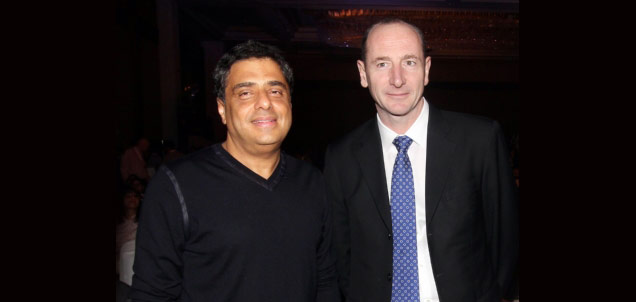
Ronnie Screwvala with Andy Bird. Picture: Fotocorp
By A Correspondent
The exit wasn’t unexpected, the timing may not have necessarily been known. There were many who said while The Walt Disney Company may have acquired UTV, it was the latter which was calling the shots. Yes, indeed. Disney-UTV was a Ronnie Screwvala company, and even though Andy Bird, Chairman of Walt Disney International, was around to oversee that all was well with the India operations, clearly it was Mr Screwvala who steered the business.
With reason. While UTV’s promoters were happy to cash out, Disney needed a UTV for its India presence. It was the film business that was a huge pull for Disney. Meanwhile, Siddharth Roy Kapur, currently Managing Director of Disney UTV’s studio business, has been appointed successor. He will take charge on January 1, 2014.
Winner all the way
Rohinton Screwvala started out big even in the early 1980s. He offered top quality international programming and movies via cable, when people were content watching all of it via video cassette recorders. Ronnie, as the boy in his 20s was known, built a cable TV network called Network and wowed his customers in the Cuffe Parade district of South Mumbai.
Ronnie was popular on Bombay Doordarshan’s youth-centric show called ‘Young World’ as also in the city’s theatre circuit. He soon ventured into producing ad and corporate films and some content for Doordarshan. His crew comprised now-wife Zarina Mehta, Deven Khote, Shernaz Patel, Bugs Bhargava and a few others. Even then, programmes like ‘The Mathemagic Show’ from the Screwvala stable were considered slick and top-grade.
On June 22, 1990, United Software Communications Private Limited was incorporated as a private limited company. The private was dropped in 1995, and the United turned into UTV in 1998.
In 1992, when Subhash Chandra started Zee TV, he commissioned UTV to produce some 250 hours of programming. In the meantime, the company ventured into inflight entertainment for airlines and even started selling airtime for programmes made by non-UTV producers. In 1995, UTV launched India’s first daily soap titled `Shanti’. The soap starred a certain Mandira Bedi who now stars in the Indian version of ’24’.
In May 1995, UTV acquired 54.60% stake in Laezer Production Private Limited (incorporated in 1982) in order to enter into the area of post-production. Laezer Production was rechristened United Studios (USL) the same year. In 1996, Disney contracted USL to dub its library into various Indian languages. Two years later, the firm acquired the animation production company of the renowned animation artist Ram Mohan. Somewhere around then, the company also got into movie distribution business.
UTV’s foray in broadcasting started with Vijay TV in November 1998 and in 2000, Ronnie set up an internet content creation and aggregation business under the aegis of UTVNet.
From then on, there was a fair bit of restructuring and financial consolidation that happened. In 2001, 51 percent of Vijay TV was sold to Star India and in 2002-03 and later in 2004, UTV’s 43.89 percent equity in the Tamil channel was also sold. In the meantime, the studio business of Western Outdoor Media Technologies Limited (WOMTL) was acquired.
In 2005, UTV went in for an IPO which was oversubscribed by 26.35 times. Having forayed in news-based programming early and even anchored some shows, Ronnie set up business channel UTVi which was later called Bloomberg UTV given a tie-up with the overseas financial information network. The business channel saw a stake sale to Reliance Capital.
Given the success it found with many movies , there were several international studios and entertainment majors eying a stake in UTV (including Rupert Murdoch who made an investment), but it was The Walt Disney Company which acquired it eventually. As of February 2012, UTV turned into a wholly owned subsidiary of Disney with Ronnie at the helm.
Succession planning
For a few weeks now, there has been a buzz that Ronnie was stepping down. On Thursday, October 24, the announcement finally came in as the Walt Disney Company (TWDC) announced that Ronnie Screwvala will step down on June 30, 2014 and Siddharth Roy Kapur, currently Managing Director of Disney UTV’s studio business, will take over the company’s India operations. Mr Kapur will become Managing Director of TWDC India effective January 1, 2014, and Ronnie will assist in the transition until June 30 next year. Later in the evening, he hosted a dinner for the staff. An early farewell dinner of sorts.
“It’s been a fantastic seven-year working relationship with Disney,” said Mr Screwvala, “first as a co-shareholder, then when Disney held a majority stake in UTV, and since February 2012 as Managing Director of Disney UTV India. It has been a great experience to be part of the world’s No 1 entertainment company and to have worked with such a talented team to solidify our footprint in India as a diversified and successful business across television, broadcasting, movies, consumer products, games and digital.” Andy Bird, Chairman of Walt Disney International added, “I’ve had the pleasure of working with Ronnie for the past seven years and appreciate his entrepreneurial drive and vision for Disney in India. He has successfully managed integration efforts and set the foundations of long term growth for our business. In 2012 when we acquired UTV, Ronnie had a clear mandate to merge two organizations, build a single team and lay the strategic direction for a diversified media and entertainment company that would be part of the growing India growth story. When he passes on the baton in June 2014, almost two-and-half years since the acquisition, he will leave the company in a great place strategically and with a strong leadership team.  I want to thank Ronnie for helping to shape Disney’s journey in India and for his contribution to our success. We are delighted that he will continue to be associated with Disney in the future,” added Mr. Bird.
Mr Bird also announced that Mr Roy Kapur will become Managing Director of TWDC India effective January 1, 2014. “Sid has been an integral part of the Disney UTV family and brings to the role a diverse set of business and creative skills and a strong pulse on the Indian audience and consumers.”
“Sid’s innate understanding of the Indian viewer, his ability to leverage those insights in business, coupled with his experience and expertise in fast-moving consumer goods businesses, television and in building India’s leading movie studio made him the natural choice for the role. I look forward to working with Sid to take Disney UTV to its next level of growth in the years to come,” added Mr Bird.
“Disney is one of the most admired media brands in the world and I see this as a great opportunity to work together with the incredible team we have at Disney UTV in India, to take our content and our brands to the next level of growth in one of the most dynamic media markets in the world,” said Mr Roy Kapur. “It’s been close to 15 years for me in media and entertainment, more than half of those at Disney UTV, and it’s wonderful to be part of a fantastic team and the diversified businesses that now make up the combined company.”
2013 is drawing to a close soon. In what would have otherwise been a fairly regular year for content on Hindi GECs, “innovation†has come in the form of a genre that has taken the front seat like never before – Period Dramas.
Life OK’s Mahadev emerged as a success story in 2012 – and continues to be so – propelling other channels to give more attention to the mythological and historical genres. Zee TV’s Jodha-Akbar has met with phenomenal success. Sony’s Maharana Pratap is the top weekday show on the channel. Star Plus’ Mahabharat was the biggest weekday launch on Hindi GECs in three years.
With half a dozen launches, most of which have met with success, is it safe to call period dramas a “trend†that has emerged in the Hindi GEC category in 2013? May be not.
It is important to distinguish a trend from just a serendipitous occurrence. It is important to distinguish the symptom from the real cause. And that’s my attempt in the rest of this piece.
Think of it. Why would period dramas suddenly come of age in India? There has been absolutely nothing of note that has happened in our society or nation in the last decade to suggest that our love for historical and mythological content would show this dramatic surge. There is no subtext here. In fact, in many ways, a young and evolving India watching period content is counter-intuitive, if not inexplicable.
The reason for the emergence of this quasi trend is very direct – fatigue. I wrote about this a few weeks back, that viewer fatigue is fast building up in the category. The sameness of content, coupled with slow pace and dragging perceptions, have meant that the overall category satisfaction index of the genre is at an all-time low since 2009. Cynicism and disillusionment are prime emotions that many core viewers are associating with weekday fiction on GECs.
Of course there are exceptions like Diya Aur Baati Hum and Taarak Mehta Ka Ooltah Chashmah. But a handful of shows can’t compensate for the negative imagery created by more than 30 programmes collectively.
As a result, we are in a phase when anything unique will stand out and get its more-than-fair share of attention, as long as it passes the basic relevance cut. Jodha-Akbar does that the best, by focusing on a love story, making it come across like a contemporary story with only the setting being ‘period’.
The question to really ask is: Has there been any other launch in the last year or so that has passed the ‘unique yet relevant’ filter? You will find it tough to isolate even one program outside the period drama genre that fits the answer here.
Hence, the rise of the period dramas is more a ‘default’ phenomenon, symptomizing dissatisfaction, than emerging as a true, stand-alone need gap.
If GECs mistake this to be a trend, they may be tempted to find more concepts in this genre. Two things will invariably happen then. One, the genre will lose its uniqueness if 3-4 more such shows launch, and this will shake the foundation of why it’s working to begin with. Two, in the effort to follow a ‘trend’, channels may pick up concepts that are not entirely ‘relevant’ in the first place.
The need is to look elsewhere. Surely, in a country as diverse and culturally rich as ours, there can’t be a dearth of unique cum relevant stories that lend themselves well to weekday fiction content.
The real emerging trend is ‘fatigue’. Period dramas are the red herring everyone should be wary of. You have been cautioned!
Shailesh Kapoor is founder and CEO of media insights firm Ormax Media. He spent nine years in the television industry before turning entrepreneur. The views expressed here are his own. He can be reached at his Twitter handle @shaileshkapoor
Legendary golfer Gary Player will lead the jury for India’s first golf awards called the Take Solutions India Golf Awards powered by www.golfingindian.com. The awards will reward and recognize excellence in golf and is supported by the country’s top golf patrons.
“It’s important in any industry to recognize leaders, and the India Golf Awards will do just that,” said Mr Player.”The recipients of these awards will have shown that they see the huge potential of golf in India, but their efforts need promotion and a media platform to inspire others. This annual event will help golf gain important momentum to establish itself as a prominent sport in India.”
The India Golf Awards 2013 is backed by Take Solutions, a technology company and a supporter of the game. Vice Chairman HR Srinivasan, who is a prolific golfer himself said, “The Take Solutions India Golf Awards will set new benchmarks and create pathways to bring about positive change to promote golf in a rapidly changing business, leisure and recreational environment.”
Golfingindian.com has been set up by award winning business journalist and golf enthusiast Shaili Chopra. Said Ms Chopra: “It’s a real honour for the India Golf Awards to have such an eminent personality launch this event, which promises to be a benchmark in the sport. Gary’s presence makes it world class.”
The awards will be held on November 5, 2013 in Gurgaon also have other eminent jury members such as Kavita Singh, Director on Ladies European Tour Board and Abhi Parmar, Director General of Indian Golf Union along with former India #1 Vikramjit Singh and former Callaway India boss, Vivek Mehta. The research and jury was conducted by global consultants Technopak.
Starcom MediaVest Group (SMG) has launched a new unit at the company, Zero Dot, a new generation of brand consulting, experience design, strategy and original creation of content. While the unit launched officially now, Zero Dot has already been driving new ideas, innovation and returns for numerous clients, including Procter & Gamble brand Cheer, which recently named Zero Dot as one of its creative partners.
“Consumers are at the centre of everything we do,” said Laura Desmond, SMG CEO. “Keeping ahead of their pace of change and connecting with them in real-time is a part of our DNA. Today’s converged media world has created a need for more agile, multidisciplinary solutions, which is where Zero Dot comes in-serving as a consultancy that can create a new breed of experiences and catalyze speed to market so brands can engage today’s consumers in the moment..”
According to global report from leading mobile advertising network, BuzzCity, mobile banking is on the verge of cashing in, BuzzCity surveyed 17,000 consumers across 22 countries on their attitudes to mobile banking and payments.
Amongst working adults over a quarter (26%) are using their phones for some form of financial or banking transaction, with nearly a fifth (16%) intending to try mobile banking. But it is those without bank accounts, ironically, that are fuelling the growth of mobile payments – a higher percentage than those with bank accounts.
Of those who are already mobile banking, balance enquiries (30%), bank transfers (26%) and cash withdrawals (28%),are the top three most-used banking features. When it comes to non-banking activities, 13% now use their phones to receive their salaries, and 12% pay for goods via their phones.
The research has brought to the fore the emerging demographic group of the UnderBanked – those who do not have traditional bank accounts - who  make up 30% of working adults using mobile. The UnderBanked are connected with exposure to mobile financial services and this is fuelling the growth of mobile payments: a higher percentage (19%) is using mobile payments for paying bills then those with traditional bank accounts (13%). Mobile is bridging the gap for those with no access to traditional banking services – some 12% use mobile money transfer services.
The UnderBanked are not necessarily a high credit risk group. While many (43%) believe they don’t have enough money to open an account, only 8% have a bad credit history. At least a fifth (21%) feel they do not need a bank account probably because banks do not offer services that are important to them, such as fast cheque cashing services (31%) and small cash loans (50%).
Said Dr KF Lai, CEO of BuzzCity on the findings: “Our research is showing a seismic shift in global consumer confidence when it comes to mobile banking, as well as how and what people are using mobile payments for. Mobiles are intrinsically wedded to our daily lives and our research highlights that this now extends to how we bank, whether we are with or without a traditional bank account – and what we are happy to pay for with via our mobiles. For the UnderBanked the mobile phone has become, in addition to a communication and surfing device, a necessary banking and payment channel and is filling a gap that the banks cannot meet.”
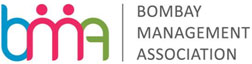
The Bombay Management Association (BMA) has adopted an all-new identity reflecting the changes that are sweeping management thinking. The new logo is an expression of contemporary management thought and has been conceptualized to support the new brand experience that the association aims to provide.
The new logo attempts to celebrate a more collaborative culture that is today’s mantra. The letter ‘m’ in the logo also graphically captures this collaboration and the coming together of two management professionals. Different colours cue the different areas of learning, knowledge-sharing and enhancing managerial competencies that bmapromotes.
The new logo has been designed by Interface Communications. Commenting on the design Robby Mathew, National Creative Director, Interface Communications said that every element in the logo has a story to tell. For example “The lower case used in the logo brings alive a more open culture that typifies today’s management thinking and one that welcomes participation from the younger generation”.
Commenting on the new logo, Yogi Sriram, President BMA and Senior Vice President (Corporate Human Resources) L&T said “Lord Tennyson wrote “the old order changeth yielding place to the new…”. Bombay or Mumbai has seen dramatic changes in its corporate landscape. The pulse beat of business in modern India can be felt most significantly in Mumbai. The pulse is epitomized by youth, color,vibrancy and energy and is ensconced in the new logo of BMA that represents this story of change and robust enthusiasm”
Niteen Bhagwat, Vice President, BMA andExecutive Director & CEO, Asterii Analytics said”This design is a bold step and is a dramatic departure from the past in design and expression, without losing out on the core values of BMA which remain unchanged”.
The Pune-headquartered Sakal Media Group (SMG) has partnered with Pemandu ( Performance Management and Delivery Unit) of the Malaysian Prime Minister’s Office (PMO) to enable a transformation process which can help change a state or a nation in any and every sector within a short-time frame.
This methodology has got global recognition from the likes of Harvard, Princeton, AT Kearney, World Bank and 14 countries who participated in the Big Fast Results (BFR) programme of the Malaysian government.
Abhijit Pawar
This is perhaps for the first time, that a private sector company like ours is actually partnering with a government entity in this particular field,” said Abhijit Pawar, Managing Director of the media group.
“The past one year, has seen the Sakal Media Group undertake several, socially oriented campaigns in Pune and Maharashatra starting with the Pune Bus Day, Tanishka Women’s Dignity Forum, Freedom from Drought, Tandurust Bandobast and culminating with the Delivering Change Programme,” added Mr Pawar.
Executive Summary of The Digital March – Media & Entertainment in South India
by Deloitte Touche Tohmatsu India Pvt Ltd (DTTIPL)
The South Indian Media and Entertainment (M&E) industry is growing in size, driven by the popularity of vernacular content among the region’s populace. While the popularity of film stars remains the most powerful trigger for films, digitization in the television sector is providing consumers access to a higher number of TV channels, a better viewing experience, and other
value added services. Print, both in its English and vernacular forms, is widening its portfolio and markets to capitalize on the readership base in South India.
As listeners become more selective, the radio industry in the South is tuning its programming towards local preferences, thus becoming a more integral part of life in South India. In fact, listeners in South India spend more time on radio as compared to those in other parts of the country.
With a rich M&E industry driven by strong local demand, South India is poised to attain a greater position of strength in the coming years. Converting this potential into reality depends on the industry’s ability to continue to develop quality content as well as to deliver it through best-in-class platforms, both within India and abroad.
Overview of the South Indian market
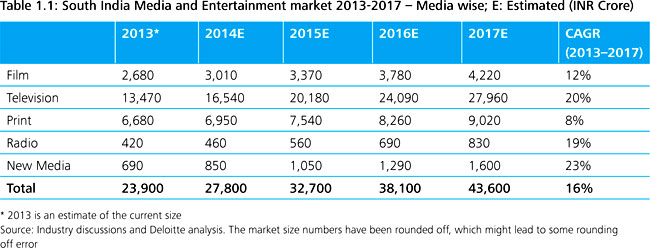
In FY 2013, the overall South India M&E industry was pegged at INR 23,900 crore. Owing to the evolving ecosystem and demand, the market is expected to grow at a CAGR of 16% to reach INR 43,600 crore by FY 2017.
Television constitutes the largest segment of the South Indian M&E industry and is currently estimated at INR 13,470 crore accounting for the largest share of the overall market at 56%. The medium is expected to grow at a CAGR of 20% over the next four years due to benefits of digitization being realized. Print is the second largest segment accounting for 28% of the overall market in FY 2013 at INR 6,680 crore. With players identifying innovative ways to reach out to their readers.
Print industry is also expected to see steady growth going forward. Film, buoyed by an ardent fan following in the South, is the third largest segment at INR 2,680 crore. Radio, with the upcoming Phase III auction and New Media, propelled by the consumer’s demand to access content ‘anytime, anywhere’, are expected to grow at a CAGR of 19% and 23% respectively, over the next four years.
Table 1.1: South India Media and Entertainment market 2013-2017 – Media wise; E: Estimated (INR crore)
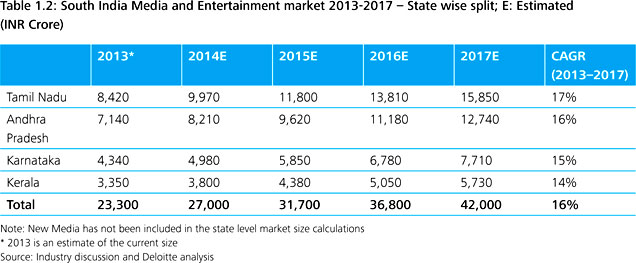
Tamil Nadu and Andhra Pradesh constitute 70% of the South Indian M&E industry. The M&E industry in Tamil Nadu is expected to grow at a slightly higher rate than the other states of the region, with all four media platforms expected to grow faster in the state.
Key emerging trends
Film
The South Indian film industry with 831 films, accounted for over 50% of total films certified across India. The number of films certified increased by 36% over 2011, primarily driven by a spike in Cable & Satellite (C&S) rights’ prices. However, the number of films released increased by only 8%2 during the same period as some producers chose not to release their films due to the high marketing costs associated, and as a result of a correction in the C&S rights’ prices in some of the markets.
With over 90% of exhibitors using digital projection, filmmakers are more inclined to shoot their films digitally. The industry continues to embrace technology in other parts of the ecosystem as well, be it experimenting with scouting talent through social media, adopting newer film making technologies in terms of sound and filming, distributing films digitally or embracing e-ticketing platforms. Furthermore, with the onset of digital prints, increase in C&S and remake rights’ revenue, the producers are getting opportunities to recoup their costs in a shorter duration.
Television
The Television industry in South India is on a transformation path, driven by the Government’s digitization mandate. It is one of the most flourishing regional media segment in terms of availability of content, reach and distribution. Over the years, it has seen increased action from regional as well as national advertisers. In fact, regional advertisers now contribute almost 40% of the TV industry’s advertisement revenues in states such as Tamil Nadu and Kerala. The industry is also leveraging technology to enable multi-screen viewership of television content for viewers who are constantly on the move. Producers and broadcasters are looking to shoot as well as telecast content in high definition (HD) formats. Going forward, developing innovative programming content, identifying niche genres and expanding markets through new content delivery platforms, is expected to drive the South India TV industry.
Print
South India, driven by a high literacy rate and a sizable vernacular readership base (30% of total readership in India) is one of the strongholds of the Indian print industry. Amongst the four regional states, Tamil Nadu and Andhra Pradesh account for ~58% of the total revenue. Most of the markets in the region are dominated by English print in terms of revenue except Kerala, where vernacular prints accounts for nearly 90% of the revenue. However, the advertising revenue from vernacular print in the region is estimated to grow at twice the pace of that of English, largely driven by local advertisers and increasing focus of national advertiser’s beyond Tier 1 cities. Hence, some of the English players are now launching vernacular dailies to not only consolidate their presence in South India but also partake in vernacular growth.
The industry is testing various business models to identify the right monetization opportunities in online space by developing mobile applications and mobile optimized websites. However, the future depends on how well the industry deals with the weak economic environment as well as the key issues of sustaining subscription revenues, monetizing online content and giving advertisers innovative ways to reach out to the readers.
Table 1.2: South India Media and Entertainment market 2013-2017 – State wise split; E: Estimated (INR crore)
Radio
The radio industry enjoys greater acceptance in the South than in the rest of the country and thus stands out amongst its peers. This is indicated by relatively higher average radio listenership in cities like Bengaluru where people spend about 20 hours / week on radio while those in Delhi and Mumbai spend 13-14 hours / week5.
The cultural diversity of cities in the South has fueled demand for localized content on radio. This has led to innovations in the type of content as well as the way in which content is being offered, so as to attract and retain audiences in a marketplace which is increasingly becoming crowded. Increasing presence of radio on the digital medium is also enabling it to reach listeners across the globe. With Phase III auction expected in FY 2014, the industry’s horizon will continue to expand. 229 of the 839 frequencies being auctioned are in 83 cities of the four Southern states. Phase III is expected to result in 294 frequencies (existing plus planned) in South India alone6.
New Media
The internet continues to have a profound effect on consumers’ viewing habits and the proliferation of devices is altering their media consumption behaviour. With the increasing popularity of mobile broadband (3G) and the impending launch of 4G LTE services, mobile phones are expected to emerge as the preferred platform for consuming content. India already has over 65 Million smartphone users currently.
Utilization of existing bank of vernacular content, development of vernacular apps and improvement in connectivity infrastructure would define the growth trajectory of New media in South. The shift of users to web and mobile platforms for media consumption is expected to have a direct impact on growth of digital advertising as well. This is expected to grow at a CAGR of about 23% over the next four years. It would be exciting to see how players across M&E sectors experiment and innovate to effectively utilize and monetize new media platforms.
The Laqshya Media Group has announced that its agency division Outdoor Media Integrated (OMI) will now be called Laqshya Solutions. The decision is effective today (Nov 1, 2013).
This announcement has been made in the wake of the restructuring made at Laqshya Media Group, adds a communique, adding: “The new name has been created to bring about a better synergy among the various group divisions and OMI too will be able to get inherent advantage of Brand Laqshya, which has emerged as a leading, credible brand name in OOH Industry. The division will continue to work with and service its several clients across different verticals.”
Talking about the change in name and logo, Alok Jalan, Managing Director, The Laqshya Group, said: “We’ve identified OOH, Activation and Advertising as the verticals for our growth agenda. While our Solutions division is the largest vertical, its identity has been different from other divisions. This needed to be changed and that’s what we’ve done. The new name and logo also are more in sync with the rest of the Laqshya Group verticals.”
Atul Shrivastava, COO of the Laqshya Group, said, “There was a need for OMI to get directly identified as Laqshya group outfit. We are pleased that the decision has been taken in this regard. Over the next few years, we hope to work with some of the best Indian and international brands, offering them cutting-edge, innovative OOH media campaigns through the Laqshya Solutions division. We are excited about the new look and name the division now has.”


 By Shailesh Kapoor
 By A Correspondent
 By A Correspondent