Category: MEDIA

  • Huge expectations from ‘Good Food’: Tarun Rai

    Tarun Rai has been the CEO since 2008 of the Worldwide Media group which, during his tenure, has seen several new launches and titles. The most recent in the long list of magazines is BBC Good Food which is to be launched on October 21. In a conversation with MxM India’s Akash Raha and Shruti Pushkarna, Mr Rai, who took over as AIM President from Mr Pradeep Gupta, Chairman and Managing Director, Cybermedia, talks about the Engagement Study, Good Food, Zinio platform and the future of magazines in India.


    [youtube width=”350″ height=”250″]http://www.youtube.com/watch?v=KKPL01uKuDA[/youtube]

    Q: You are launching BBC Good Food in India. What are your expectations from the magazine?

    I just got to hear that the magazine is ready; it’s bound, ready for dispatch. We are launching BBC Good Food on Good Food Day, October 21, which we are celebrating and we are encouraging people to try something new on the day. We have huge expectations from Good Food. India is changing, food habits are changing. People are experimenting with food both in their kitchen as well as when it comes to eating out in restaurants. We believe that the time is right for such a magazine. There are no precedents; there are no international food magazines in the country. We are going into uncharted territory and we are beating a new path. There are dangers but as I said, somebody has to do it and we believe that the potential is huge. And the response we’ve got from advertisers for the magazine is excellent and you’ll see it in the number of ad pages we’ve got in the first issue.


    Tarun Rai on Indian magazines becoming successful international brands
    [youtube width=”350″ height=”250″]http://www.youtube.com/watch?v=-gdT17SBAtk[/youtube]

    Q: Several international brands are licensed to India. When do you see an Indian title becoming a successful international brand?

    As you know Femina and Filmfare are heritage brands for us and they are doing fantastically well. Femina already is present in Sri Lanka. Filmfare we’ve licensed last year to UAE and we’re hoping that we will take it to many countries; there is already interest because Bollywood today is international. The Indian diaspora still wants to connect with Bollywood and I think very soon you’ll see Filmfare in many other countries. The other advantage is, thanks to what people say the ‘digital issue’ but I see it always as an opportunity, we are already on the Zinio platform with Filmfare for the past month; and the response has been fantastic. Almost 60 percent of our total sales of all the magazines that we’ve put on Zinio have been for Filmfare because this is the demand which is coming from the international markets and now suddenly it has become very easy to subscribe to Filmfare just at the click of a button. So I think there are going to be huge opportunities on some of the brands like Filmfare and Femina.

    Q: What do you feel at being appointed the President of the Association of Indian Magazines? What does this responsibility mean to you?

    It’s an honour… I have been a part of AIM for four years now, pretty much as soon as I joined the industry. For me it has been a fantastic experience. I come from advertising and I had no idea about the magazine business. Thanks to my membership of AIM, very quickly I was co-opted to the magazine industry. I have learnt a lot from my peers in AIM and I owe a lot to them. Mr Pradeep Gupta, the outgoing President, has had a terrific run in the last two years and as I take over from him I hope to continue the good job that AIM has done over the last two years. We are a small organization but I think we have learnt a lot to collaborate and make sure that we do things that are beneficial to the entire industry. Right now we are too small. We are just 3 percent of the total ad spends. We deserve more, but just by saying that we deserve more we are not going to get it. So we have to do things to convince the advertisers about the strength of our media. That is the reason we instituted the engagement survey and we are going to take it to its right conclusion by having a proper campaign around it and material which will convince the advertisers. That’s just one of the things. Generally speaking, the magazine industry can do with a higher profile.  So my attempt will be to raise the profile of the magazine industry by doing activities. One of the things it will do is to bring more talent to our business. The way our industry is growing we need a lot of people very fast. We need different kinds of people; with this digital opportunity that has come up we need different and varied kinds of young people to come to our business. By raising the profile of the industry we will also attract new talent to the business. That is going to be one of my important priorities.”


    Q: Do you think the Engagement Study that AIM has come out with will solve the measurement woes of the industry? Moreover, do you think that the advertisers will accept it as a robust currency?

    You never know until you try, and this is our attempt. Now it’s up to us to convince them. One piece of research is not going to do it. The good news is that the media buyers and the advertisers themselves are trying to understand media better. Ambika Srivastava spoke about the touch point study, the brand experience points, about how magazines score very highly when it comes to influence. So the conversation has already started. We want to push that conversation along where the judgment on one media is not only dependent on the numbers but also dependent on the quality of numbers, on the quality of engagement. And therefore the engagement survey is just the first step; it is not going to persuade people overnight but we don’t know whether we’ll be able to persuade people till we make our first step. So this is our first initiative to do that.

    Q: What are the take-aways from the India edition of the World Magazine Congress, moreover, on the 360-degree opportunity theme?

    It is called the 360-degree opportunity, not challenge, because I am of the firm opinion (and the board of FIPP was of the firm opinion) that we should look at it as an opportunity rather than as a threat. I just think it’s a fabulous place to trade ideas, to get to know what people in the developed market are doing, what people are doing in the South East Asian market which is still coming up. It’s new territory for us. Organization structures are being experimented with; we had this whole thing about how do you manage content along with so many platforms, do you have a core editorial team…? Business models are being experimented with. So to me it’s still a time of flux. Everyone agrees it’s an opportunity which we cannot ignore; do we have the right answers yet, maybe we don’t but this is a forum where you can learn, you can share, you can discuss and hopefully going forward we will arrive at some solutions which will work for different magazines.


    Q: What according to you is the future of magazines in India?

    I think the potential for magazines in India is huge. I always say that magazines, specially the lifestyle and special interest magazines, in India are a sunrise sector. So if it’s a sunrise sector, we are only 3 percent, the only way is up. We are too small to go any lower than that, the only way for us is up and I am very bullish about magazines in India.
  • Suresh Selvaraj quits Outlook

    By Akash Raha

    After a successful stint with the Outlook group, Mr Suresh Selvaraj, President, Outlook Group decides to put in his papers. Mr Selvaraj disclosed this information to MxM India on an email.

    In an emotional message to MxMIndia, he said “In 1998 when I joined the group, I have added a prefix to my name Outlook. In 2006, I had added a surname, Marie Claire. Outlook has always been the pride and Marie Claire, the passion. It’s not easy for me to let go both. But as the Gita says, ‘what have we brought with us to this world to lose it?’ Both these magazines are part of my system and I have always felt a sense of ownership of these magazines – especially, Marie Claire – it is my baby. I am not naïve to believe that I am indispensable. Outlook Group is very strong with sufficient bench strength to face any situation.”

    Giving a reason for his leaving the group he said “I strongly felt that I need to give it a pause after three decades in print media. And, more than that, there got to be peace.” He went on to say “Considering the excellent equation I have with each and every member of my team, it is a very difficult to part. But I reminded them about Jim Hendricks’ lyrics, ‘Memories don’t leave like people do. They always stay with you…’ – a colleague may leave, but the friend in him remains forever!”

    However, Mr Selvaraj will be a part of the group till December 2011. Thereafter, he said “I will take a sabbatical for a few months and shall decide the course of my future. I look forward to the sabbatical as I could fulfill one or two of my long term dreams of biking in Srinagar-Leh Ladakh-Manali region, cycling in Munnar hills, exploring Borneo rainforests in Sabah region of Malaysia or a cruise in Venice-Greece-Spain route.”

  • First on MxMIndia: Uday Varma is new I&B Secretary

    By A Correspondent


    Mr Uday Kumar Varma is the new Secretary, Ministry of Information and Broadcasting.

    Mr Varma is presently Secretary, Ministry of of Micro, Small and Medium Enterprises. Mr Varma, an Indian Administrative Service (MP Cadre, 1976) officer, replaces Mr Raghu Menon who retired last month. He is familiar with the working of the ministry having been Special Secretary before he moved to the MSME ministry.

    The announcement was made by the Appointments Committee of the Cabinet, Government of India.

  • The Zee Q2 Story: Net profit up 26.7%, ad revenues down 4.2%, spends down 2.3%

    By A Correspondent

    There is fair reason why Zee Entertainment is said to be the smartest run entertainment company in India today. The ratings are good, but not dramatic. The revenues are down and employee costs are reasonably up. Yet, net profit has leapfrogged. And how!

    Says chairman Mr Subhash Chandra, “We have a very strong balance sheet and I am confident that we would take advantage of the growth opportunities ahead of us and will record improved operating performance in the period ahead.” Mr Chandra notes that that his company’s performance reflects the same slowdown in advertising spends that the rest of the television players are facing.


    On Monday, Zee Entertainment Enterprises Limited (ZEE) reported its second quarter fiscal 2012 consolidated revenue of Rs 7,184 million. The consolidated operating profit (EBITDA) for the quarter stood at Rs 2,075 million and PAT was Rs 1,600 million, representing a growth of 10.1% and 26.7% respectively over the corresponding period in the previous fiscal. The EBITDA margin for the quarter stood at 28.9%. Operating profit (EBITDA) for the quarter ended September 30, 2011 was Rs 2,075 million. Operating profit margin for the quarter stood at 28.9%.


    FY2012 does look to be a year of tepid growth, said Mr Punit Goenka, Managing Director and Chief Executive Officer, ZEE, in a press communiqué. “Our strategy during the last few years has been to create a formidable entertainment enterprise and invest in the business in a focused disciplined way”

    Meanwhile, Zee has clarified that ad revenues have grown on non‐sports business, but there has been a decline in sports revenues, due to lack of big sporting events in the quarter. This has resulted in a hit in overall monies coming in.

  • No crisis for magazines in India: Chris Llewellyn

    Chris Llewellyn, President and CEO, FIPP, UK spoke to Akash Raha and Shruti Pushkarna of MxM India at the recently held World Magazine Congress. Mr Llewellyn spoke about the future of magazine, future events of FIPP and about the recently held World Magazine Congress in New Delhi, India.  Federation of the Periodical Press (FIPP) is a worldwide magazine media association, which represents companies and individuals involved in the creation, publishing, or distribution of quality content, in whatever form, by whatever channel, and in the most appropriate frequency, to defined audiences of interest.
     

    Q: FIPP has been taking up the interest of magazine publishers around the globe. What are the upcoming events that we can expect?

    FIPP exists to help its members construct better strategies and to build better media businesses. And the way they do that, is by finding what is happening around the world. So we come together at various meetings and events, share experiences and share knowledge, and go back better informed. I am really pleased to be able to confirm that next year September 19 to 21, Seoul Korea will be holding the third Asia Pacific Digital Magazine Media conference. And that will be specifically geared towards the Asian market and the hot topics of the time then; and we are talking digitally, so a year from now god knows what they’ll be, but they’ll be on the top of publishers mind. We will bring in some international speakers and we will engage with the Korean market which itself is incredibly digital. So that is an exciting new event next year. On top of that, we will be doing in early November, an American conference, out of Central America. In fact, I can even confirm that it is going to be in Costa Rica, which is a very attractive venue. And again that will be talking about the hot issues of the day, appropriate for the publishers of that territory.


    Q: How do you think the Indian magazine marketing is shaping up?

    The issue at the moment is that we have these two huge forces at play. One is this structural change that the digital revolution is forcing on our thinking and the second one is just the cycle of poor economy. You know, India, which is still booming, still ‘incredible India’, and yet people in India think there is a crisis. But it is not a crisis in India, believe me. This is just the cycle and this will turn around. How long, well, if I knew how long I will be a very rich man. But the truth is, it will change. At the same time, I think the publishers are responding magnificently to the digital changes and realizing that the strong magazine brands that have an emotional engagement with the audiences can be taken to different platforms and it just deepen the engagement. Don’t confuse content with how you deliver content. Content is an art and that content can be on magazines and it can be on any other format that we want it on. But it will still be the magazine publisher’s knowledge of his audience, which is the key, and that’s not going away.


    Q: How do you think digital will affect print?

    Hollywood films have never being bigger – huge blockbusters. Hollywood is making so much more money but not at the box office … their business model has changed. Today, Hollywood is built on the sales of popcorn, the sales of the food and drinks when you visit the cinema. It’s the full cinema experience, not the box office that entails profits. Similarly, in the magazine industry too, we will see a change in the business model, that’s certain. But the medium will still be there because of the strength of the medium. The emotional engagement of turning the pages, fresh magazines, just the way that we represent images is fantastic.  The women’s fashion sector needs glossy magazine too. So magazines are not going away, but the business models will change.


    Q: One can say that the World Magazine Congress has been immensely successful. What are the important points that have emerged from the conference?

    There is still a huge print industry and print is not at all dead. Innovation in print, as we have seen in several publications, is there, creativity is there and it will get more creative. And we have a bigger train set to play with now with all these new mediums and that’s exciting. So print is fine and we have a world of opportunity that is opening up. That is the big take away from the conference I feel.


    Q: What has been the feedback from the World Magazine Congress?

    You know, when we planned this conference two years ago, coming to India and quite a few people were saying ‘that could be interesting’. They clearly meant it in both ways… It could be interesting because it’s exciting and it could be interesting because it is quite a logistical challenge. I can’t tell you how difficult it is to get a visa to come to this country. My word, I am British and we left you bureaucracy which you have taken to another level (he jokes). However, the feedback I have got is really good. The opening reception just got the energy into everyone; The Bollywood dancing, the charisma of Shahrukh Khan. A lot of international people had never heard of him, they do now. I was told that the programmes were fantastic and there was lots of value to it. Many international visitors are extending their stay in India and are going to see a little more of this country. I am going to have the pleasure of seeing the Taj Mahal too. All in all, the congress in India has been absolutely wonderful.


    Watch Chris Llewellyn:

    On the magazine market
    [youtube width=”350″ height=”250″]http://www.youtube.com/watch?v=5rgYpWMJhjU[/youtube]


    Magazine business model might change, but the medium isn’t going anywhere
    [youtube width=”350″ height=”250″]http://www.youtube.com/watch?v=rCMEvZtioqc[/youtube]


    Takeaways from WMC 2011
    [youtube width=”350″ height=”250″]http://www.youtube.com/watch?v=Gtgers8eSAw[/youtube]
  • The Anchor: 5 things new I&B secretary Uday Kumar Varma must do

    Pradyuman MaheshwariBy Pradyuman Maheshwari

    The Ministry of Information and Broadcasting finally has a full-time secretary. Like his predecssors Raghu Menon and Sushma Singh, guess Uday Kumar Varma will also be in office for around a couple of years before retirement. But he has had three stints with the ministry and from my little interaction with him, I can assure you that we have in the current secretary a man who knows the ministry inside-out.

    There’s a lot that a Secretary can achieve, if he or she has the will to do so. But of course there could be sensitivities in I&B, and if the eye is on what’s in store post-superannuation, then you can be sure that an I&B secretary will achieve precious little.

    Both Menon and Singh couldn’t or didn’t do much as Secretary. One hopes that Varmaji will do a lot more than his predecessors.

    Here’s a five-point tasklist.

    #1 Ensure new digitisation announcement is implemented on time.

    The sunset date is rather ambitious, but now that the collective wisdom of the bosses in Delhi have put out a policy, it’s the I&B Ministry’s responsibility to ensure it happens well-before time. Don’t get bullied by the lobbies

    #2 Must let self-regulators rule.

    The broadcastwallahs are still reeling under the scare of the government policy of not renewing channels if they fool around with the content and advertising code. Various media segments like news and non-news channels and creative agencies already have self-regulation in place. The print media too needs a regulator. While a nudge to these self-regulators may be needed to expedite decisions on erring content, but clearly there’s no place for government in policing the world.

    #3 Should ensure paid contentwallahs are punished.

    The elections are round the corner and it’s heartening to see the Election Commission get into action. But it’s the I&B ministry that must ensure that all those who indulge in paid content should be stripped off their RNI titles, government concessions and DAVP ads.

    #4 Push for news on FM Radio.

    There is no clear reason why there’s no news on FM Radio. The I&B minister once told me that there is a home ministry objection to news on FM, especially in the border districts. It’s one of the most bizarre reasons given especially since there are thousands of cable channels which abound across the country.

    #5 Empower government media — Doordarshan and All India Radio.

    Doordarshan’s 50-years celebrations are over and there was plenty of airtime and newsprint spent on what could be done to the two government media. Nothing happened. And nothing will. Unless Varmaji wakes up, empowers the staff and ensures quality content happens on both DD and AIR…


    This list of ‘must-do’s for Secretary Varma could be endless, but if he manages to take care of the five listed above,  he will forever be remembered as a secy who made a difference.

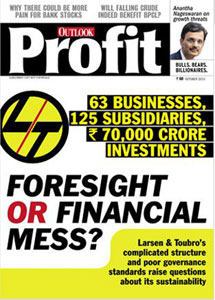
  • Outlook to merge Profit, Business titles

    By Akash Raha

    Outlook Profit is soon to merge with Outlook Business and become one magazine. The merger is planned for January 2012, and has been confirmed by Indranil Roy, President, Outlook Group.


    Mr Roy told MXM India, “We realized that it is difficult to sustain a standalone equity magazine in such volatile stock markets. At the same time we saw a great opportunity to add more of finance, markets and investing in a business magazine. Therefore after a lot of deliberation we decided to merge Outlook Profit with Outlook Business.”


    He further said that the group would aim to put the readers’ choice first in the building of the magazine. When asked what this merger will mean to Outlook Business, he said, “Outlook Business will become a more holistic business magazine. We are currently working on adding other new elements into the magazine.”

  • NDTV’s Indian of the Year awarded, in style

    By Rahul Kishore

    It’s always nice to be a part of the annual NDTV Indian of the Year event and this year was no different.

    Prannoy Roy and team ably led by Barkha Dutt were in their element and handled proceedings with aplomb. That they managed to get all the awardwinners barring Narayan Murthy was proof of their leadership position in the news domain.

    Dr Roy started by a small speech which essentially targetted his own fraternity, the media.He said that the media should not be above the law and stricter rules needed to be framed to handle defamation. These laws should be framed by the judiciary and not the government.It did not find favour with his friends in media but he would still back it.

    Now onto the awards. Dev Anand at 88 and Rahul Dravid at 35 were honoured with lifetime achievement. This was followed by the World Cup winning squad, save Harbhajan and Sachin. Dhoni spoke quite well. When Gavaskar was asked what was the essential difference between the team in 1983 and this one, he said his was better looking! Brought the house down.

    The following award was presented to Pranab Mukherjee and this was followed by one to Nandan Nilenkani.The main award was ‘Indian of the Year’ and it predictably went to Anna Hazare.  Alok Kejriwal received it on his behalf as Anna was on a maun vrat. He answered questions by scribbling on a pad. The afternoon was not without its theatrics with Kejriwal doing a ‘Bharat mata ki jai’ as well as an ‘Inquilab Zindabad’.Quite dramatic!

    What the crowd waits for is Bollywood and they were not disappointed.Shankar Ehsan Loy got an award as well as the team of Zindagi na milegi dobara. Shankar managed to sing as well.Farhan in fact was quite a sport and managed to shake a leg with Barkha Dutt.

    I enjoyed it thoroughly. What were the shortcomings? Well no mention of a jury or selection process and somewhat not as glamorous as last year, but it was a classy event as only NDTV can do.On to next year…

    Rahul Kishore is Senior Vice-President, Vivaki Exchange


    Additional reporting by MxM India correspondent:

    NDTV announced the much awaited ‘Indian of the Year Award 2011’ in a star studded ceremony held in Delhi. Anna Hazare and Arvind Kejriwal were declared as NDTV Indian of The Year 2011 for their exceptional contribution towards the society in the past year.

    Evergreen actor Dev Anand and Cricketer Rahul Dravid were honoured with Lifetime Achievement Awards. M.S. Dhoni received the Indian Heroes Award with several of his team mates.


    Dr Prannoy Roy, Chaiman, NDTV in his opening address spoke about the eventful year gone by being a transformational year for the country. “The Indian media today is the most fearless around the world. As part of the media, we are proud to be country’s fourth pillar. I feel it’s imperative now to have strong and effective defamation laws in the country.” He also added “Media cannot be above the law.”

    Arvind Kejriwal on being felicitated as the Indian of the Year 2011 said, “I would like to dedicate this award to Anna Hazare and people of this country since I believe that every Indian is truly an Indian of the Year.”

    Anna Hazare also extended his gratitude by thanking NDTV on being awarded with the title of the Indian of the Year by writing a message on a paper. He wrote, “If the Government fails to pass the bill then I will be forced to launch the agitation movement again.”(Since Anna Hazare is currently on the ‘Maun Vrat’ in his village – the channel connected with him live through a videoconferencing).

    Also, receiving the Lifetime Achievement award, Rahul Dravid said ‘I am grateful to NDTV for this honour. I would like to thank all my fans for their love and support.’

  • All the World Magazine Congress videos

    David Hill, President & CEO, International Publishing Services, IDG, USA and the new FIPP Chairman


    On becoming the new FIPP Chairman [youtube width=”400″ height=”250″]http://www.youtube.com/watch?v=DLtfwVV8jYQ[/youtube]
    On the outgoing FIPP Chairman, Aroon Purie [youtube width=”400″ height=”250″]http://www.youtube.com/watch?v=eD7YFZdY89M[/youtube]
    On the future of magazines [youtube width=”400″ height=”250″]http://www.youtube.com/watch?v=W3iQuijzoY8[/youtube]
    On the future agenda of FIPP as he takes on as Chairman [youtube width=”400″ height=”250″]http://www.youtube.com/watch?v=jQiqMJPPW_Q[/youtube]


    Tarun Rai, CEO, Wordwide Media, India and new President, Association of Indian Magazines


    On his AIM Presidency and things on top of his agenda [youtube width=”400″ height=”250″]http://www.youtube.com/watch?v=mhPNt1g3SXU[/youtube]
    On the attempt to change the mindset of advertisers and media buyers [youtube width=”400″ height=”250″]http://www.youtube.com/watch?v=ZfANp6vxVQ0[/youtube]
    On launching Good Food [youtube width=”400″ height=”250″]http://www.youtube.com/watch?v=KKPL01uKuDA[/youtube]
    On the prospects of Indian mags becoming international brands [youtube width=”400″ height=”250″]http://www.youtube.com/watch?v=-gdT17SBAtk[/youtube]
    On take aways from WMC [youtube width=”400″ height=”250″]http://www.youtube.com/watch?v=VrNFqocrqNU[/youtube]
    On the potential for mags in India [youtube width=”400″ height=”250″]http://www.youtube.com/watch?v=TLEfoXF1fjk[/youtube]


    Chris Llewellyn, President & CEO, FIPP, UK


    On the upcoming FIPP events [youtube width=”400″ height=”250″]http://www.youtube.com/watch?v=aAWNhbrXZ5o[/youtube]
    On the magazine market, Indian market [youtube width=”400″ height=”250″]http://www.youtube.com/watch?v=5rgYpWMJhjU[/youtube]
    Magazine business model might change, but the medium isn’t going anywhere [youtube width=”400″ height=”250″]http://www.youtube.com/watch?v=rCMEvZtioqc[/youtube]
    On take aways from WMC [youtube width=”400″ height=”250″]http://www.youtube.com/watch?v=Gtgers8eSAw[/youtube]
    On the feedback from delegates on the congress and the Indian experience [youtube width=”400″ height=”250″]http://www.youtube.com/watch?v=PCEmmKmPrdI[/youtube]


    Pradeep Gupta, Chairman & MD, Cybermedia and the outgoing AIM President


    On his journey as AIM President [youtube width=”400″ height=”250″]http://www.youtube.com/watch?v=4xAaeDwh0Pk[/youtube]
    Suggestions on focus points for AIM in the future [youtube width=”400″ height=”250″]http://www.youtube.com/watch?v=CTiINmiMEhQ[/youtube]
    On the PRB recommendations [youtube width=”400″ height=”250″]http://www.youtube.com/watch?v=Q0PjQmZjBqg[/youtube]
    On take aways from WMC [youtube width=”400″ height=”250″]http://www.youtube.com/watch?v=1RxZq6ShZso[/youtube]
    On the need to look at a brand approach and multiple media [youtube width=”400″ height=”250″]http://www.youtube.com/watch?v=ucck–hZd5c[/youtube]


    Vikram Sakhuja, CEO, Group M, South Asia


    On the falling share of AdEx [youtube width=”400″ height=”250″]http://www.youtube.com/watch?v=GSS2j9PQMkU[/youtube]
    On the engagement study [youtube width=”400″ height=”250″]http://www.youtube.com/watch?v=RhdD-vPnStY[/youtube]
    On the future of magazines [youtube width=”400″ height=”250″]http://www.youtube.com/watch?v=eXx1uUtjPz8[/youtube]
    Philip Thomas, CEO, Cannes Lions, UK


    On what advertisers want from magazine media [youtube width=”400″ height=”250″]http://www.youtube.com/watch?v=1i_qUImjYB8[/youtube]
    On the future of magazines [youtube width=”400″ height=”250″]http://www.youtube.com/watch?v=OoX1M6kN9SE[/youtube]


    Tomas Ernberg, Managing Director, Volvo Auto India


    On what advertisers want from magazines [youtube width=”400″ height=”250″]http://www.youtube.com/watch?v=XyYQZEWhdGM[/youtube]


     Juan Senor, UK Director, Innovation Media Consulting
    On the theme of the congress- 360 degree [youtube width=”400″ height=”250″]http://www.youtube.com/watch?v=t_s-VFGfO5E[/youtube]
    On the future of print- no medium ever dies [youtube width=”400″ height=”250″]http://www.youtube.com/watch?v=oepk4aS1uZA[/youtube]
    On the Indian magazine market and future prospects for print [youtube width=”400″ height=”250″]http://www.youtube.com/watch?v=oSYNEZB57KA[/youtube]
    On the need to focus on the content [youtube width=”400″ height=”250″]http://www.youtube.com/watch?v=qdkYu4ZAOdY[/youtube] 


    Kalli Purie, Chief Operating Officer, India Today Group Digital
    On having WMC in India [youtube width=”400″ height=”250″]http://www.youtube.com/watch?v=TOsMAe4x5i0[/youtube]
    On the theme of the congress- 360 degree [youtube width=”400″ height=”250″]http://www.youtube.com/watch?v=BpPeL1grthY[/youtube]


    James Tye, CEO, Dennis Publishing, UK
    On choosing the right app for your publication [youtube width=”400″ height=”250″]http://www.youtube.com/watch?v=wYyVQBfbk0o[/youtube]


    Voxpop@ World Magazine Congress Day 1
    On expectations from WMC and experience in India [youtube width=”400″ height=”250″]http://www.youtube.com/watch?v=KuT6DwoMFMg[/youtube]


    SRK dancing to Chhamak Chhallo [youtube width=”400″ height=”250″]http://www.youtube.com/watch?v=mTxOmOwhVjw[/youtube]


    Pre-event: Mitrajit Bhattacharya, CEO, Chitralekha
    On the upcoming WMC [youtube width=”400″ height=”250″]http://www.youtube.com/watch?v=w4wq2LulVWc[/youtube]
    On the prospects of business transactions on the sidelines of the 38th FIPP World Magazine Congress [youtube width=”400″ height=”250″]http://www.youtube.com/watch?v=VMgjob9NwfU[/youtube]


    Pre-event: Ashish Bagga, CEO, India Today Group
    On hosting World Magazine Congress & AdAsia, two broad format events in the same month [youtube width=”400″ height=”250″]http://www.youtube.com/watch?v=T7zC5_yLkbs[/youtube]
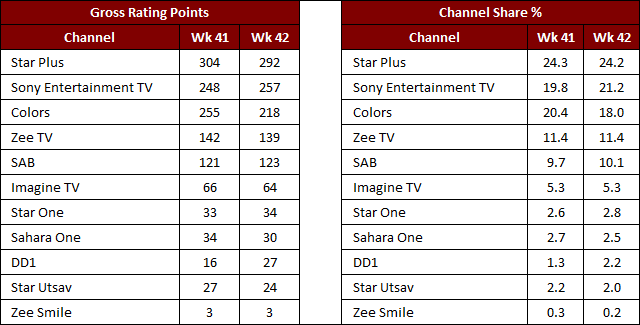
  • GRP & Channel shares of HGECs- Wk 42 2011

    Source: TAM Peoplemeter System

    TG: CS 4+ yrs

    Market: HSM

    Period: Wk 41: Oct 2 to Oct 8, 2011

    Period: Wk 42: Oct 9 to Oct 15, 2011


    About TAM Media Research

    TAM is a joint venture between Nielsen Company & Kantar Media Research. Besides measuring TV Viewership, TAM also monitors Advertising Expenditure of Television, Print & Radio through its division AdEx India. Since 2004, it extended its presence in the PR Measurement & Analysis space for Corporate/Marketing Clients by setting up a separate division Eikona PR Measurement.

    In 2007, the joint venture introduced RAM (Radio Audio Measurement) service to track Radio Listenership for the Indian Radio Broadcast Industry. In year 2009, TAM launched a division, called TAM Sports that specializes in monitoring Sports Sponsorship ROI.

    TAM Media Research’s objective is to fuel media insights that will drive the growth of the Indian Media Industry.

  • First on MxMIndia: Pioneer bags BEST tender

    By Nibha

    Pioneer Publicity has won the BEST (Brihanmumbai Electric Supply and Transport Undertaking) tender for advertising rights on single and double-decker buses. Established in 1873, BEST operates one of India’s largest fleet of buses.


    The company has won the rights for three years – 2011-14 – for about 4050 old buses in all.


    Confirming the same, Mr Sunil Vasudeva, said on the win, “We worked for BEST from 2002-2008,after that the business went to Bright Outdoors. Now, we have the business again with an account size of 85 crore.”


    Prior to this development, Bright Outdoor had owned the ad rights to the buses, but, as reported by MxMIndia, due to heavy losses it had withdrawn from the tender.

  • Must make OOH likeable: Daniela Krautsack

    Mainstream advertising is going non-traditional; print media has caught up with viral; it is a manifestation of media in which the logical conclusion seems to be 360° surveillance.

    How does the consumer cope with the futuristic outlook of a media world in which everything seems to be public and nothing is private any more? Does the media industry’s guiding light of ‘branded utility’ justify an unlimited use of hi-tech chips and codes? Who are the consumers that voluntarily jump on the ambient media bandwagon?

    Daniela Krautsack, Media Innovation Strategist, Managing Director, Cows In Jackets, talks about today’s global media trends and visions with a critical eye on their creation, their degree of popularity and their lifespan in an interview with Nibha.


    Q: When did you discover your passion for the non-traditional form of out-of-home media?

    It was about a decade ago when I moved from dreamy but advertising ‘old-school’ in Vienna to London. The company transfer within the MediaCom group offered me three simple things: to watch, listen and learn how international media strategy & co-ordination is done. Today, when I look back, I know how lucky I was. “To be at the right time, at the right place.”

    The ‘Find Your London in Yellow Pages’ campaign got me ‘in touch’ with many new forms of media when I travelled from my home in Belsize Park to work in Soho. From the moment that I walked into the station to the moment I walked into our office door, I was touched by ‘The yellow pages points’.

    The company had advertised on the backside of my ticket and even on the wallet that protected it. The entire train and its seat interior were covered in bright yellow design. Never having experienced transit media in this scope before, I felt intrigued to find out more. That was the moment when my exploration started.


    Q: Does the OOH media industry’s guiding lights of branded utility justify an unlimited use of hi-tech chips and codes?

    I would like to define that term ‘branded utility’ first: it means that brands or ideas are genuinely useful to the people they touch. So, how useful are codes and chips and do they ‘touch’? The integration of codes in OOH media in countries such as Japan where I experienced the use of QR (= quick response; a two-dimensional bar code) and other 2- and 3-dimensional codes years ago has not spread considerably across the world – yet. My experience is that the percentage of mobile phone users that have an application installed which allows reading a QR code, has not even in Japan reached the mass. The use outside of Japan is still insignificantly small in order to consider an OOH campaign that would achieve reasonable results. At present, QR codes can be rated as the best and most effective technology for mobile data capture. What I like about it so much is the thought of reducing OOH media to its core function, the visual transfer of a brand and product image with the focus on “image” rather than “text”. Including a QR code within the design of an advertising campaign that uses billboard or any other ambient OOH form allows a “pull” interaction by the recipient of the message. QR technically allows future billboard designs to use significantly less space to transfer lots of information. If interested in the message, people will connect.

    So, returning to your question: Every way that ‘helps’ the community – and this touches current trends such as “economy of time” symbolizing our aim to efficiently manage time – will be embraced and appreciated. I personally do not fear an unlimited use of this code technology. At the moment companies use codes and chips within their communications strategies predominately to play with people’s curiosity and the media’s enthusiasm and willingness to publish these ‘media-first’s’.


    Q: Who according to you are the consumers that voluntarily jump on the speed media bandwagon?

    I am always quite amused to see how small the number of people is that jump on the media bandwagon. When I visualize this ‘future train’, I only count the number of passengers with two hands. I have just been to a party with a crowd of 20- to 40-year olds, people that you could describe as pretty normal when it comes to adopting trends such as the latest technology and fashion and during a discussion, someone asked: “What is a podcast?” I looked around, astonished to experience this lack of contemporary knowledge. I had to realize that only a handful of people knew that a podcast is a word fusion of the word iPod and broadcast, that it is a digital media file and that podcasts allow you to download or stream content about any topic you care about.

    The consumers who are the clever cookies when it comes to being updated of what’s going on around the world in society, culture and technology are those who jump on. And we don’t necessarily only speak about the ‘young’ crowd. They just adapt easier to new technology because they don’t think about it as much as an older, more experienced media consumer.


    Q: According to you how does the consumer cope with the futuristic outlook of a media world in which everything seems to be public and nothing is private any more? Panopticon or individual freedom of expression?

    When I observe the mood and listen to the opinions of people who share their thoughts about the ‘media’ world we live in, I notice that they appreciate the increased opportunity to express themselves, but they are also aware of being monitored. This place can be visualized as a panopticon. We still have a choice to publically plead for a higher sensibility and reluctance to give out personal data to somebody we do not know. The careless behavior of our society to wildly publish every intimate fact bears a huge risk of violating our private sphere.


    Q: What has been your greatest challenge in ambient media?

    Convincing clients who were very sceptical towards this media form. The other one was the launching of a communications agency, ie  entirely dedicated to ambient media and non-traditional strategies and that too at  a time where taking the risk and trying out new things in communications planning wasn’t fashionable.


    Q: How do you define third place marketing and creativity in the OOH media?

    While ‘first places” represent “the home”, a place that I decorate and feel comfortable living in and ‘second places” the ambience of work, ‘third places’ are landmarks with a core attraction of such extraordinary extent that seeing them is an absolute must; thus talk-of-town organically develops. Third places can be museums, wide-open spaces but also supermarkets and shopping malls. They come to life with light, video projections and special installations. These venues feature an emotionally charged ambience and for which there is no admission fee. Without creativity, I dare to say, a third place doesn’t exist. Creativity is one of the cornerstones of the third place foundation. And OOH media logically benefits from the strength of such an eye-catching place.


    Q: What all factors do you take into account when you make a media strategy, which involves innovation in the ambient media?

    • The objectives of the campaign

    •  The demographics/psychographics, moods and opinions of the target group

    • The brand status

    • The competitors’ activity

    • The creative execution

    • The budget

    • Innovative technologies or never used before ideas, techniques or material

    • A measurement tool / method


    Q: According to you what is the approximate share of ambient media advertising in terms of ad spend when compared to the total ad spend in the OOH media?

    Considering the different definitions of ambient media (in the UK, the media industry does not even use this term anymore, they call it non-traditional OOH or brand experience or shopper marketing or stunt, etc) worldwide, I can only give a rough estimate. I just looked at the OOH share in Austria, the UK, Mexico and India and it is quite similar, roughly between 5.5 percent to 7.6 percent, Mexico showing the smallest share and India the highest OOH share.

    While ambient media is a category still not being monitored in most countries in the world, the UK reports approximately a share of 6 percent. This however does not consider guerilla, ambush and experiential marketing, sampling, promotions and events. It is clear though that this is a category that will continue to grow.


    Q: How do you see the scope of ambient media in South-East Asian countries and Africa and where does India stand among all?

    Overall speaking there is a large potential for ambient media throughout Asia and Africa. Whereas we experience a counter movement by ‘the new’ traditionalist opinion leaders in cities across Europe and the United States that plead and demonstrate for an advertising-free ambience, the outdoor category overall is growing. We are challenged to create OOH media not only in a more visually attractive way but also in one that is considered as a “useful” platform again, e.g. as an information platform that hopefully focuses on core images and incorporates technological measures (e.g. code technology) to allow information to be picked-up when needed. The important model for the future is to position OOH media as “a likeable platform” that interacts with the life of city inhabitants; media to stimulate opinions and thoughts, to inform and to entertain.

    Due to its high level of ambient media activity, Thailand has become a role model for non-traditional media in the Southeast-Asian market. Some of the award winning ambient media campaigns were developed in Bangkok and rolled out across Asia. According to my own observation in India as well as the opinion of local media experts, the potential for ambient media in India is considerable. The biggest challenge for India is not the lack of investment or funds – it is about finding clever solutions to scale ideas across India and the increase execution opportunities outside main metro-cities.