IndiaFirst Life Insurance Company Limited (IndiaFirst Life), promoted by Bank of Baroda and Union Bank of India, has launched a new social media campaign, titled ‘#BhonduJustChill – Stress Ko Karo Kill, IndiaFirst Life & Chill’. The campaign is conceptualised by WATConsult.
Commenting on the campaign, Sonia Notani, Chief Marketing Officer, IndiaFirst Life Insurance Company Limited said: “We understand the importance of a stress-free life and want to propagate the role IndiaFirst Life Insurance can play in ensuring the same for our customers. We have a suite of 40+ products tailored to suit protection and assurance needs of customers across life stages. This campaign provides an interesting take on the fact that safeguarding our family’s needs, does not have to come at the cost of our own peace of mind.”
Added Heeru Dingra, CEO, WATConsult: “Inspired by a famous comedy movie dialogue, the campaign’s catchphrase – ‘Bhondu just chill’ is a humorous way for people to bring in a little relaxed and chilled moment to their lives. We wanted to capture the hilarity and weave it with the brand’s belief that the right insurance plan can ensure peace of mind at various life-changing moments. Humour also wraps the message in a more fun package, helps in better expanding its reach and accentuates the point further. Today, as stress has become an unavoidable part of everyone’s lives, a small reminder to simply chill definitely presents itself as a welcome breather.”
Godrej Protekt has released a new TVC for Protekt Magic conceptualized by Creativeland Asia. The TVC is aimed at building awareness for the powder-to-liquid format.
Said Sunil Kataria, CEO – India & SAARC, Godrej Consumer Products Ltd (GCPL): “Godrej Protekt has always focused on providing affordable yet superior hygiene products to its consumers. Protekt Magic is one such offering which stands out and is a category game-changer. With this new TVC, our aim is to create awareness for the powder to liquid format and highlight 99.9% germ protection which is now available at an affordable price point of INR 15. We would like to further penetrate the market and increase trials of this unique product. The TVC also highlights the newly launched lime variant along with the existing neem and aloe vera variant.”
Added Anu Joseph, Chief Creative Officer, Creativeland Asia: “This is truly a revolutionary product – magical, I would add. It’s magic at so many levels – innovation, price point and germ protection. Our effort was to make a piece of communication that actually called out all the magic in the product. And we did that in Protekt’s unique way – with delight and expertise.”
Dentsu India has launched a film with its long-standing partner and jewellery brand, Jos Alukkas.
Speaking on the film, John Alukka, Managing Director, Jos Alukkas said: “We hope that we can inspire real change with this film. Of course, it’s about starting a conversation, because silence can never bring about change.”
Added Anjo Jose, Creative Head, Dentsu India: “The attempt was to tell a story every girl out there would relate to. At the same time, while we were making the film we ensured that it had certain cinematic values to it. The feedback we’ve been receiving is great. I believe, we’ve achieved what we wanted to.”
Added Vidya Sankar, VP, Dentsu India: “To me, ‘Shine on’ is not just a campaign. It is a movement that reverberates the ideology of what the brand stands for. It is a powerful way that puts the spotlight on the subdued, yet strong women in society that’s sure to start the warranted momentum,”
Tata Coffee Grand unveiled its recent campaign that aims to create a new language for coffee – Shik-Shik-Shik that evokes emotions and excitement amongst consumers. It is conceptualised by Lowe Lintas.
Speaking about the campaign, says, Puneet Das, SVP – Marketing, Beverages – India, Tata Consumer Products: “We’ve been excited about the idea of the ‘sound of coffee’ for a while now. Through this campaign, we have built the proposition of ‘The sound made by our Tata Coffee Grand pack, which has big granules and decoction crystals that make a great cup of coffee’. A simple and powerful narrative is linked to a simple action of shaking the pack, remembering that unique sound, replacing coffee with Shik-Shik-Shik when asking for it. We are hopeful that the disruptive unique sound of Shik-Shik-Shik will soon become an overarching synonymous word for coffee.”
Added Sagar Kapoor, Chief Creative Officer – Lowe Lintas: “It’s always a great opportunity when your brand has a product differentiation. Leaping to the creative idea from the differentiator lands on a disruptive idea, more often than not. With Tata Coffee Grand we had the decoction crystals. Besides delivering a superior cup of coffee, these crystals also make a unique Shik-Shik-Shik sound when one shakes the pack. So great coffee was always known by its aroma, it will now be known with its sound. That led us to the idea of ‘Great coffee will now be known as Shik-Shik-Shik. Going ahead we will engage with the consumer in many ways with the ‘Shik-Shik-Shik device,”
Omnigel has launched a series of short 20-second TVCs created by Brand David Communications to reinstate its product benefits.
Commenting on the new TV commercial, Shivam Puri, CEO, Cipla Health said: “Being true to the core of the brand, Omnigel’s latest TVC takes a refreshing route to showcase the product benefits that have been scientifically proven and intends to educate the consumer without intimidating them. We have taken the humorous route to connect with our consumers through real life scenarios, and help them make the transition towards focussing on eliminating the root cause of pain than availing surface level temporary relief measures. It is important to shift mind-set from ‘plain’ relief to pain recovery to spring back in action. Further on, we are grateful to our consumers who have bestowed their trust in Omnigel all these years making it India’s no1 pain recovery gel.”
Hindware has kickstarted the new year with its new brand campaign ‘Thoughtful is Beautiful’.
Conceptualized by MagicCircle Communications, the films redefine the category convention, treating beauty as table stakes while starting a conversation that reinforces the brand’s inherent strength of innovations through technology. Directed by Karan Shetty and produced by Fingerprint Films, the ads are centered on the playful and relatable one-upmanship of a millennial couple.
Speaking on the campaign, Sudhanshu Pokhriyal, Chief Operating Officer, Bath Products, Brilloca Limited said: “Today, Hindware has carved a niche for itself as a relevant and trusted brand, as it has proven with time its dynamic capability to evolve with changing aesthetics over the years. It understands its consumers, and in return, its patrons trust Hindware to offer the best bathware products in India. The increasing amount of consumer data, in particular, is fundamentally changing how brands operate. This is especially true with the effects of the COVID-19 pandemic, where the already complex path to purchase has evolved even further, setting the scene for long-term changes in consumer behaviour that we must be prepared to address. This is expressed in our positioning direction and it guides our business decisions.”
Today’s column is a bit different from my usual deep dive into a single topic, with some thoughts from my notepad about things that have caught my eye in the last fortnight.
2020 has been strange, to say the least, and I, like most, have been awaiting the festival season to celebrate and feel some joy. A sentiment shared by the corporate sector, which depends on this quarter for their profits, but this year, it’s depending on it for minimising losses. The initial reports are showing signs of recovery and buoying positive sentiment. According to data from Redseer Consulting, the first week of festive sales conducted in the last fortnight has seen an increase of 51% in Gross Merchandise Value (from $2.7 billion in 2019 to $4.1 billion). While this is partly also fuelled by offline consumption moving online, the economy is heaving a sigh of relief.
Micromax’s Comeback
You might have seen Micromax’s relaunch campaign helmed by the CEO, Rahul Sharma. With more than half a million people yet to go online in India, combined with the high replacement rates for smartphone for people, the smartphone categpry is and will be on fire for the coming decade at least. Every year the festive e-commerce sales also depend on smartphone sales with the category contributing upwards of 40% to the GMV. Coming back to Micromax, India’s Number 1 homegrown smartphone brand, in the relaunch video (link – https://www.youtube.com/watch?v=aRo69b1wTNg), Rahul Sharma plays all the cards which are sure to strike a chord in the average Indian’s heart – he talks about being a middle class boy who took a loan of 3 lakh from his father to launch Micromax, but with the onslaught of Chinese smartphone makers stumbled, and lost his way, vision and subsequently market share. He touches on the ‘Make in India’ call to rouse audiences to buy the new series aptly titled ‘In’
The problem of course is that the story, while compelling omits certain points Micromax built its market share on the back of great marketing. It took China-manufactured phones and branded them as Micromax devices. As a result, because of a lack of R&D, the after-sales service and support was negligible – a weak point which all the China mobile behemoths took full advantage of to wipe out market share (and rightly so, after-sales service is crucial for an essential device like a phone). He also forgets to mention his marriage to Bollywood/ Kollywood/ Tollywood star Asin, which makes his description of the middle-class boy-next-door a little hard to stomach, as these descriptors no longer hold true.
While the majority of the market is oblivious to these facts, and these points will work, I am sure it will give competition to the Chinese behemoths which control the smartphone market for a large part today.
Hooked by Nir Eyal
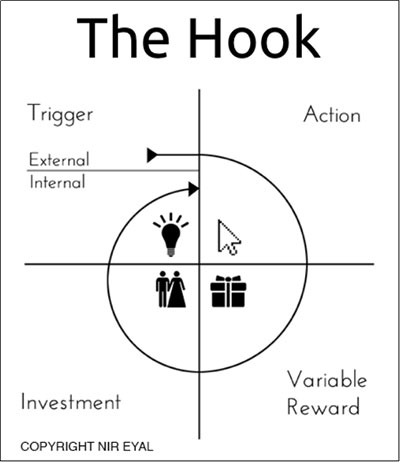
The advent of the internet has brought with it great changes in marketing in the last decade. A key differential of the digital evolution as compared to the TV evolution is how understanding consumer behaviour has become easier. This in turn has lead to building products, which fit target audiences better. The concept is beautifully explained in my latest read, ‘Hooked’ by Nir Eyal.
Eyal has explained the consumption process through a four step model – a internal trigger like a frisson of anxiety or external trigger such as an ad, which leads us to the action of logging into social media like Facebook or Twitter, which through previous interaction, we know will reward us by showing us our posts which has been liked, or content which is of interest to us, thereby assuaging our anxiety.
Such feedback loops help in establishing habits, which make these products so addictive. The fourth quadrant which focuses on ‘Investment’ explains why such habits are so hard to break – users invest time and build a community of friends and followers which feeds these feedback loops and creates stickiness to the platform.
While the book focuses on digital products like Facebook, the concepts can be applied to other industries and products. All in all a great read on understanding consumer behaviour and psychology.
That’s all from me today. Do share if you have read ‘Hooked’ or whether I have inspired you to pick up a copy.
Bhuvi Gupta is a marketer with over 10 years across industries, of which the last six have been in Media & Entertainment. She has been a part of many launch marketing campaigns – specifically at the Times of India group, Republic TV and the latest in marketing a Bollywood film. She will write on A&M (mostly marketing, but often on advertising too) every other Tuesday. Her views here are personal. She tweets at @bhuvigupta3
Barack Obama used in-game advertising hoardings in the game Burnout Paradise among others, during his 2008 Presidential campaign
By Bhuvi Gupta
This is the first time I am going on the record to admit that I have spent a lot of time playing online. Luckily though, these obsessions were recognised before they became addictions after an unhealthy time spent on Farmville, Angry Birds and lastly Candy Crush, before I admitted that I would not go down the slippery rabbit hole that can be gaming and have kept myself away since 2015.
I am definitely the exception. In the last few years, driven by increased digital penetration and bandwidths, (and this year COVID-19) mobile gaming in India has exploded. As per a report from app intelligence firm Sensor Tower, Indians installed 7.3 billion games, nearly 17% of all worldwide downloads in the first nine months of 2020, beating countries like USA and Japan to the number one position.
Basis the Google-KPMG Media Report 2020, the Indian gaming industry will cross USD 1.1 billion in 2021. With around 500 million people in India having smartphones (give or take a few million) and around 300 million+ gamers, there is no denying that this market is growing with the lockdown having helped accelerate the growth. The biggest USP of mobile gaming is the level of engagement that the audience has while playing a game. A GroupM- Mobile Marketing Association report (link – https://www.groupm.com/mobile-marketing-association-and-groupm-launch-mobile-ecosystem-report-2020/) highlighted that gamers are more than twice as likely to pay attention to advertisements placed in mobile games at 41 percent, as compared to ads placed on the internet at 17 percent, in magazines or on billboards at 15 percent each.
This implies the inherent value of digital impressions becomes much higher.
Marketing during gaming takes three forms primarily –
:: Integrations – which are well-integrated into the narrative like branded ‘Virtual Real Estate’ like banners within the game, branded items like clothes or accessories worn by avatars, and fully branded modes or levels
:: Advertisements for additional lives, etc. which can be typically purchased on ad exchanges
:: Events such as e-sporting leagues
Barack Obama used in-game advertising hoardings in the game Burnout Paradise among others, during his 2008 Presidential campaign
Barack Obama used in-game advertising hoardings in the game Burnout Paradise among others, during his 2008 Presidential campaign.
In India, Gaming in India can primarily be classified into four heads-
:: Fantasy Gaming – which already has 100 million users with companies like Dream 11, Mobile Premier League dominating.
:: Action games – such as PUBG and Fortnite. While Fortnite doesn’t have as many users in India it has been the front-runner in terms of brand integrations globally.
:: Real Money Gaming – like online Rummy, Poker, and Ludo King. This comes under the purview of gambling and hence basis Indian law is subject to laws as dictated by states. While skill-based games such as Poker and Rummy are usually permitted, games of chance are prohibited. The recent PayTM First Games ban on the Google Play Store was also related to the definition of what constitutes ‘Gambling’
:: Live Trivia apps – such as Pocket Aces owned Loco
Why Gaming?
With more people coming online there is ad fatigue that takes place due to the high number of ads users see. Many users also use ad blockers, and hence awareness and engagement with even well-targeted ads is low as the audience is just waiting to skip the ad.
This is as opposed to the active audience that plays online games, where they are tuned to engage with the gaming platform to maximise scores. By using product integrations, or branded levels, brands can also help create immersive experiences for the target audience.
Poco introduced their new launch, POCO M2 Pro via the game Tappy birds. A weeklong tournament called ‘Tappybird showdown’ was held where the mobile phones were placed inside the game, and players had to collect the phone to earn extra cookie points.
Secondly, as the market is still nascent, brand integrations remain relatively unexplored. With 5G coming into India in the next 5 years, gaming will become immersive and hence technologies such as AR/VR will help create a value-added gaming environment, which is perfect for marketing.
Poco introduced their new launch, POCO M2 Pro via the game Tappy birds. A weeklong tournament called ‘Tappybird showdown’ was held where the mobile phones were placed inside the game, and players had to collect the phone to earn extra cookie points.
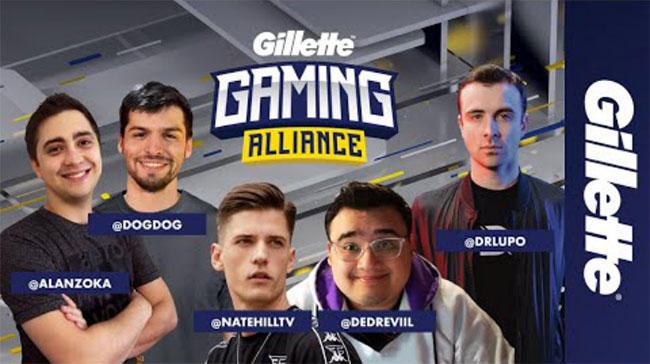
Thirdly, emergence of e-sporting leagues and tournaments and live game streaming allows brands to leverage gaming influencers, do cause marketing, sponsorships etc. for a well-defined audience. The Google-owned YouTube has a vibrant community of gaming live streamers such as Tanmay Bhat, Gagandeep Singh (Sikh Warrior), Manasvi Dalvi (Manasvivi) etc. in India. Globally such campaigns are have already become common, for e.g. P&G’s Gillette has hosted the Gillette Gaming Alliance on Amazon-owned live streaming platform Twitch in 2019 and 2020 with a team of five Twitch influencers to create content for their fans, and highlight other campaigns and causes.
Lastly, just like in digital advertising, brands can target users on the basis of demographics and geographies, which makes in game advertising all the more effective. There is also high prevalence of gamers in Tier2 and Tier 3 cities, which can be leveraged by brands.
While it may seem that Gaming is more relevant for youth-focused brands, the 35+ age group has high usage in more traditional games such as LudoKing, Online rummy and Poker. Hence, depending on the target audience, brands should choose games online to create impact.
The timing is right, the lockdown has helped accelerate user growth, and Indians brands must strike when the iron is hot to make the most of a relatively undiscovered avenue for advertising before it gets too crowded.
Bhuvi Gupta is a marketer with over 10 years across industries, of which the last six have been in Media & Entertainment. She has been a part of many launch marketing campaigns – specifically at the Times of India group, Republic TV and the latest in marketing a Bollywood film. She will write on A&M (mostly marketing, but often on advertising too) every other Tuesday. Her views here are personal. She tweets at @bhuvigupta3
As a marketer for the last decade if there is one thing that I can attest to be true is that marketing jargon comes and goes with an average lifespan of a year or two. The jargon du jour is backed by stellar logic, often introduced by a book, or a widely respected businessperson, and has wide applications in the entire gamut of business strategy.
The latest buzzword is the concept of the ‘moat’ as espoused by Warren Buffett. While he first shared this concept during a Berkshire Hathaway shareholder meet in 1995, it has seemed to catch on in pandemic. (Maybe, because being stuck at home is like a having a moat around you?). Mark my words, we are just at the beginning of the lifecycle of this jargon and you’ll see multiple applications in interviews, podcasts, CEO roundtables et al in the coming times.
What are economic moats?
The usage comes from ancient times, when a moat was a water body built around a castle so as to give the king some time to plan his defense when attacked by an invader. The concept itself is golden, as most espoused by Buffett are – An economic moat is a distinct competitive advantage a company has over its competitors, which allows it to protect its market share and profitability over the long term. Companies can build moats by strengthening their brands like Apple and Coca-Cola, achieving economies of scale like Amazon, or even lobbying for special status from the government like Patanjali.
Economic moats have existed since commerce has, but in the digital age, using data, network effects, online marketplaces, search, and social networks can help create wider and longer-lasting moats.
According to a report from CBInsights, moats can be classified into four types –
• Network Effect– those products whose value increases the more people who use it. All social media networks have network moats, which explains why a Telegram has not replaced WhatsApp despite offering some advantages
• Cost Moats– when users have a high sunk cost in the product or service (high one-time or recurring membership fee) which make them reluctant to switch
• Cultural Moats– when consumers buy into the product for the brand promise and the values it represents. For e.g. people consume Dove because it promotes ‘real beauty’, Coca-Cola due to its great emotional marketing which talks about happiness
• Resource Moats– due to patents or preferential treatment on account of a governing body. Typically why pharmaceutical companies have huge lobbying budgets
How companies have used their moats in India to remain relevant in the pandemic
The pandemic has been a death knell to the global economy – USA’s economy has contracted by a third, in its largest quarterly contraction since 1921. India is not expected to fare any better, when numbers release later this month.
Companies are being forced to be agile and leverage their business moats, and pivot to newer consumer behaviors to remain afloat. Many companies have successfully pivoted their products, launched line and brand extensions to have new health and immunity claims, which is why we even have Chyawanprakash and Haldi ice-cream now (from Amul and Dairy Day Plus). This has come easier to the behemoths like ITC and Dabur, which have both Innovation teams sitting on years of research, and vacant factories to put into use. As a result, in the last three months, ITC has launched six, and Dabur 15 new products. Such companies also have the business advantage of well-established supply chain and distribution channels.
How companies which don’t have a moat can remain relevant in the pandemic
A July 2020 McKinsey survey found that an overwhelming 91% of consumers reported trying a new shopping behavior in India due to the pandemic. Two key trends that stand out from the survey are an acceleration in the rate of digital adoption which has seen a 10+ percent growth in online customer base during the pandemic & a new DIY culture in the middle class which was reliant on household help or access to almost everything via a few taps on their mobile screens. New product categories for fruit & veggie wash, contactless dispensers, dishwashers which would have years of promotion and audience interactions have seen demand rise exponentially.
These two are the life jackets for Indian companies that can help save them in the coming months.
The pandemic has facilitated trials (often via e-commerce) as well as repeat buys in the 5+ months of its duration. This is one of the silver linings of the pandemic because categories and products, which would have taken companies years to launch and for consumers to adopt, especially in a value-conscious market like India, have launched overnight.
Restaurants, which are arguably the worst hit, have started retailing recipe and ingredient kits and sauces. Pictured above are the ready-to-cook sauces, and gravies launched by Jubilant FoodWorks (which runs Domino’s Pizza and Dunkin’ Donuts in India)
Indian companies, especially the beleaguered ones, must leverage this time to pivot, because even if some of these consumption shifts are pandemic specific, many new behaviours will stick because, getting consumer trials is one of the most difficult parts in a product’s lifecycle.
Talking from personal experience, now that I have been forced to realise that I am not a half-bad cook, I have often wondered why was I so reluctant to cook earlier and why was I so dependent on my cook or ordering food in. If the rough survey of my social circle is to be believed, I know I am speaking for scores of us in the middle class. These cooking sauces and cheaper dishwashers are only helping to cement this new-found realisation into a resolve to be more independent.
Bhuvi Gupta is a marketer with over 10 years across industries, of which the last six have been in Media & Entertainment. She has been a part of many launch marketing campaigns – specifically at the Times of India group, Republic TV and the latest in marketing a Bollywood film. She will write on A&M (mostly marketing, but often on advertising too) every other Tuesday. Her views here are personal. She tweets at @bhuvigupta3
Parle Products attempted to strike the patriotic cord with the launch of its ‘Swadeshi’ communication this Republic Day. The TVC talks about the ‘Made in India, Made by India’ concept which highlights Parle Products legacy and values while reflecting the brand’s philosophy. Conceptualised by Rediffusion, the film has been released on TV and social media platforms.
Commenting on the campaign, Mayank Shah, Senior Category Head, Parle Products, said: “Parle Products is a proud Indian brand and we believe that it is our responsibility to evoke hope and positivity among the audience. This film is a humble tribute from Parle Products recognising the importance of its loyal customers and their strong association with the brand. We have always considered ourselves to be the ‘Son of the soil’ and with each passing day, Parle Products is evolving and adapting, just like our country. Serving through generations, Parle Products has always been on the forefront and a reliable brand since its inception who everyone trusts. This film encapsulates the values of the brand along with the immersive experiences, smaller benchmarks and acts of good-well that makes us who we are.”
Glance has announced the launch of its multimedia campaign “Ye Glance Hai”. Made by DDB Mudra to communicate the exciting possibilities of content delivered on locked screen.
Said Visnhu Srivatsav, Creative Director – DDB Mudra: “We wanted to keep it pithy. We wanted to entertain. And most importantly, we wanted to leave the name ‘Glance’ in the mind of consumers. We realised that a product as rich and varied as this (Glance) needed to be experienced. So, we decided to a simple, running gag that entertains every time and just leaves enough intrigue on the table for you to check out the product,” said Visnhu Srivatsav, Creative Director – DDB Mudra Group.
Added Bikash Chowdhury, Chief of Marketing, Glance: “Just within two years of its launch, Glance has already positioned itself as the leading platform for content delivery with millions of happy users who are following favourite content almost every seconds and minutes. We wanted to further amplify this, by telling them how Glance can take them to their exciting worlds of content preferences through simple and crisp stories told by their favourable stars, truly living up to “Ye Glance Hai.”
Retail giant Big Bazaar unveiled its ‘Sabse Saste 6 Din’ campaign with an ad series titled ‘Bachat paane ki vaccine’, conceptualised and executed by Wondrlab.
Speaking about the campaign, Pawan Sarda, Group CMO, Digital, Marketing & e-commerce – Future Group said: “#O2O Online to offline is a big initiative we have taken at #BigBazaar. It cannot get bigger than this during our most iconic Sale, Sabse Saste 6 Din #SS6D. Book your shopping online (shop.bigbazaar.com) and redeem it in-store with bigger discounts. The last year has been tougher than ever for most people especially households with people facing salary cuts, with some losing jobs and businesses facing a hit by the lockdown. Something nobody was prepared for. Big Bazaar has gone an extra mile and is offering more savings if you pre-pay for the shopping.”
Added Amit Akali, Co-Founder and CCO, Wondrlab: “We are excited at having the opportunity to work on India’s biggest retail sale. Big Bazaar is one of India’s most iconic brands and ‘Sabse Saste Din’ is also a brand by itself. Consumers look forward to the sale each year, and more so in 2021, after the year they’ve had. It was important to cut through the clutter and do justice to a big annual property. More importantly, we wanted to be honest and call out the year that the consumer’s gone through, giving the sale as a solution. For instance, one lady speaks about how being locked in at home doesn’t stop kids from growing up, while you see her shopping for kids’ clothes. These are all real conversations that consumers are having and would relate to. The challenge of course was to have the conversation and land the sale in just 15 seconds. We’re pleased with the freshness and simplicity of the campaign, that brings marries the positive sentiment of the sale with that of the vaccine, seamlessly.”
 By Bhuvi Gupta
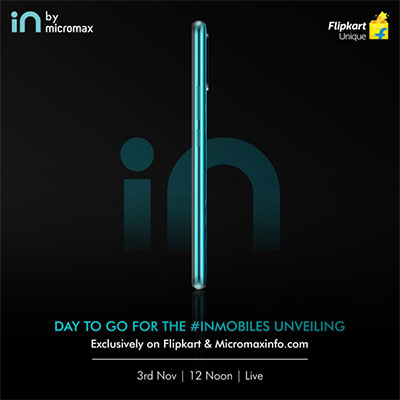 You might have seen Micromax’s relaunch campaign helmed by the CEO, Rahul Sharma. With more than half a million people yet to go online in India, combined with the high replacement rates for smartphone for people, the smartphone categpry is and will be on fire for the coming decade at least. Every year the festive e-commerce sales also depend on smartphone sales with the category contributing upwards of 40% to the GMV. Coming back to Micromax, India’s Number 1 homegrown smartphone brand, in the relaunch video (link – https://www.youtube.com/watch?v=aRo69b1wTNg), Rahul Sharma plays all the cards which are sure to strike a chord in the average Indian’s heart – he talks about being a middle class boy who took a loan of 3 lakh from his father to launch Micromax, but with the onslaught of Chinese smartphone makers stumbled, and lost his way, vision and subsequently market share. He touches on the ‘Make in India’ call to rouse audiences to buy the new series aptly titled ‘In’
 The advent of the internet has brought with it great changes in marketing in the last decade. A key differential of the digital evolution as compared to the TV evolution is how understanding consumer behaviour has become easier. This in turn has lead to building products, which fit target audiences better. The concept is beautifully explained in my latest read, ‘Hooked’ by Nir Eyal.



 Restaurants, which are arguably the worst hit, have started retailing recipe and ingredient kits and sauces. Pictured above are the ready-to-cook sauces, and gravies launched by Jubilant FoodWorks (which runs Domino’s Pizza and Dunkin’ Donuts in India)