Category: MARKETING

  • Young Track | New column on youth marketing by Samyak Chakrabarty

    What’s a 23-year-old writing a column on a site where the average age of columnists is… ? Ok, ok, we won’t reveal that number, but like it or not the youth constitute a majority of India’s population. Since the last few years, young Samyak Chakrabarty has been in and around media events and offices with his vision of how the youth can be targeted.


    In this period, he has organized a few conferences, participated in several of them in India and abroad, and works as Chief Youth Marketer with the DDB Mudra group. He’s organized a TedX youth conference in Mumbai, was invited to meet Hillary Clinton when she visited India and has co-authored a book ‘Generation Einstein 3.0 – India version’.


    Samyak’s column will appear every Wednesday and as the title suggests, it will track the young – specifically keeping in mind the advertising, media and marketing fraternity – Ed


    Measuring ROI: When it comes to spending on Marketing to Youth

    I am 23, not (academically) qualified to tell Mr Brand Manager of a 100 crore+ FMCG on how to sell his product to youngsters, but yet I decide to take the Dutch shot of courage and enter the room. Someone once told me, “As a youth engagement consultant in a country like India, you have 2 choices -“either tell your prospective client how cool his/her brand is and give some worldly gyaan with complicated numericals on how I can come on board to make it cooler OR stick to what my stand is on his brand is even if its at the risk of hurting his/her ego (which, I’ve come to realize is more of a suicidal thing to do then even going wrong in the deliverables) and loosing the business”.


    So at this meeting, I am faced with the question that I am asked at every other meeting, party or conference – “Youth is on our agenda now, now tell me how can i increase the number of likes on our Facebook page from this TG”. At best the variation is “I think youth is the future of our brand, can we sponsor some college festivals (sic: and tell youngsters that we exist for them?)”.


    Youngsters in India who are born post 1990 are at the cusp of the transformation in the way we communicate, consume, dream, think and live. Obviously, modern external influences such as social networking, information overload, evolved societal expectations and most importantly a plethora of choices in everything does play a critical role how they make their decision. However I am a believer of the theory which says that “the modern consumer is just perceived to be so, in reality – at a store, he behaves exactly as his forefathers did”. Yes it is true that they think faster, spend more and want more all the time – but that does not change the very DNA of how a consumer behaves whether young or old.


    One cannot rely on statistics alone to ascertain which way the wind will blow (predicting youth trends), it requires the brand custodian to also be instinctive, passionate and most importantly have an open mind. As prominent inhabitants of modern society, youngsters (irrespective of SEC) are more whimsical and their preferences change constantly until they touch the age of 27 since they are more exploratory / risk taking then the previous generation.


    Young Track Files #1: Redbull
     

    An example of a brand which is rich in social currency amongst Indian college students


    There has always been little or no TV advertisement of this brand and nor is there a film star endorsing it. However it always enjoys top-of-mind recall among students. The red bull vans and hot ladies stationed outside colleges giving out free samples especially after exams, college festivals and sporting events has been their only sustained marketing expense which in my opinion is giving them 100 percent ROI. They hit the G-Spot by doing this since it conveyed that the brand thinks about their TG and is present where they need it. So therefore next time during a match, hardcore party or after an intensive exam – youngsters will always desire that cold can of crispy Red Bull. Furthermore, the company has ensured that their consumer does not have to walk many meters to get hold of one when he needs it - the distribution team has ensured presence of the product at all possible touch points. Their association with Formula One has also won them many brownie points in India as well.


    You may find a slight contradiction in what I am saying now and what I’ve written above – my point is that as consumers, youngsters are almost the same as their forefathers but as people they are very different (than the previous generation) and it is this very ‘split personality’ which creates a confusion in thinking what will really influence youngsters. Before you disagree – let me guess what you are thinking “This is BS, my son is more aware of brands then I ever was and has more gadgets then I ever did”… right? Now, think again -“Is it only because your son (as a consumer) is more evolved then you or is it because the choices/influencing factors now are greater in number than in your time?” J . I hope this proves my point to an extent.


    This brings me back to talking about the holy grail, how does one then measure ROI on investments made towards marketing to youth? Truth is, numerically the method is the same as what works when you compute numbers of what is spent on the other age groups. But then there is another parallel matrix which one must also consider i.e “Social Currency”.


    As the custodian of a youth brand, being a Millionaire with this form of earning is key in not only sustaining but growing your connect with youngsters. I would base the valuation of your brand’s social currency wealth on these five things ie conversations, perception, feedback,(active) social media influence (such that it is engaging not just by number of likes / posts alone) and how inclusive is your TG in shaping your product as well as marketing strategy. I hope you noticed that this has nothing to do with how cool, colourful, cute your brand is or which film star is your brand ambassador – these are just peripheral things that may or may not be needed.

     

  • Guinness recognises Divya Bhaskar’s ‘Gandhi Jayanti’ record

    By A Correspondent


    Divya Bhaskar initiated ‘Ahimsa Dandi Yatra’ campaign in association with Spiritual Guru – Muni Tarun Sagar. The initiative was aimed at strengthening the support against ‘Animal Cruelty’ and ‘Human Tobacco Addiction’. This initiative was promoted through editorial, print campaign and school contacts. School kids were asked to register for participation, and all registered kids were provided Gandhi attire by Divya Bhaskar.

     

    On the occasion of Gandhi Jayanti, schools kids gathered at Abhay Ghat (Sabarmati Ashram) dressed as Gandhiji. The venue saw a total footfall of 7,000 citizens including dressed kids ready to participate in the yatra.


    On this initiative, State CEO Saras Sethi commented, “Gandhiji believed in Ahimsa and taking this thought forward an innovative concept was designed. The idea behind this initiative was to not only support the cause but engage our readers to support as well. Kids play a catalyst in any society and engaging them will get the entire family involved and also creates an impact.”


    State Editor Avnish Jain also commented, “The idea behind this initiative was to encourage the citizens to adopt Gandhiji’s philosophy of ahimsa and simplicity which is reflected not only in his dressing but also in his values.”


    The Guinness recognition was received for 891 kids dressed as Gandhiji. The event culminated with the Dandi Yatra along with Spirtual Guru Muni Tarun Sagar. Apart from kids few foreigners, MLA fromBelgaum, Management Guru Ujjwal Patani (Chattisgarh) also dressed like Gandhiji and participated in the march.


    The group’s other initiative ‘Junior Editor 2012’ has also been recognized by Guinness World Record as ‘The Largest Writing Competition’.


  • MTS launches mAD to break mobile ad clutter

    By A Correspondent


    Sistema Shyam TeleServices Limited (SSTL) that nationally operates its telecom services under the MTS brand with over 16 million wireless customers, has launched a service pioneered by MTS, aptly called “MTS mAd”. The service provides leading brands a clutter-breaking means to engage with customers on a one-to-one basis.

     

    MTS Smartphone customers using mAd will be able to make free local calls by just watching a video ad. The launch of this service makes MTS the first telecom operator to offer this unique service on a pan India basis.


    MTS mAd service is available on all Android devices on the MTS network including MTS MTag 3.1, MTS MTag 351, MTS MTag 352, MTS MTag 353, MTS MTag 401, MTS Pulse, Samsung Galaxy Y and Samsung Galaxy Ace Duos CDMA. The Company is working to expand the scope of this service by also launching it on Blackberry and BREW enabled entry level MTS handsets.


    According to Leonid Musatov, Chief Marketing and Sales Officer, MTS India, “Innovation is one of the core values of MTS India. The launch of mAd service is a testament of our deep rooted commitment to the same value. MTS mAd is a unique service which enables our Smartphone customers to make free calls by just watching a video ad on their device. The service also provides an opportunity to leading brands to connect with their customers in a personalised manner. I am confident that the mAd service would find its appeal amongst both our customers and the advertising fraternity”.


    A slew of leading brands including Coca-Cola, Pepsi, Mentos, Center Fresh, Fiat, Kellogg’s, Titan, Lenovo etc have associated for MTS mAd service to engage with customers.


    MTS mAd service requires no charges for activation, application download and for data transfer while watching video ads. The user will get a seamless experience with no buffering and video streaming hassle. Customers using this service will be able to make as many as 4 MTS mAd calls in a day.


  • Cisco appoints Anil Bhasin to lead services business in India

    By A Correspondent


    Cisco has appointed Anil Bhasin to lead its Services division in India and South Asian Association for Regional Cooperation (SAARC) region.


    An industry veteran with more than 25 years’ experience, Mr Bhasin began his Cisco career in 2001, as the head of its Banking and Finance (BFSI) and Commercial business for the Western region, where he doubled the revenue for both businesses. Based in Mumbai, Mr Bhasin will report to Glen Cox, vice president, Cisco Services, Asia Pacific, Japan and China.


    As part of his mandate, Mr Bhasin will oversee the build-up of momentum for Cisco Services, driving smart services adoption and helping customers and partners plan, build, and manage Cisco technologies and solutions for success.


    “Continued momentum around our collaborative partner approach and smart service capabilities remain vital to the health of our Services business and Cisco’s growth overall,” said Mr Cox. “I look forward to Anil and his team’s success as we continue to build and evolve our Services business over the next year.”


    Mr Bhasin added, “Cisco Services is a critical component of our evolution from an IT product to a technology solutions company. I look forward to leading this team and ensuring that Services continues to be a strategic asset and a competitive advantage for Cisco.”


  • Big FM and Total Oil India announce ‘total quartz safety month’

    By a Correspondent


    Big FM and Total Oil India Pvt. Ltd have announced the launch of ‘Total Quartz Safety Month’, a campaign that is spread across 21 cities, promoting safe driving habits.


    The Total Quartz Safety Month campaign will be led by the 92.7 Big FM RJs advocating and initiating change required in the mindset of people, and garnering their support as far as road safety rules are concerned. The campaign is said to have meticulously unfold in four distinct phases: Phase I – Safe Driving; Phase II – Don’t Talk While Driving; Phase III – Don’t Drink and Drive; Phase IV – will see the culmination of the campaign through the ‘Total Quartz Safety Run’ which will see the participation of the local populace in each of the cities.


    The campaign will see programming tailored to create audiences on Big FM ranging from traffic authorities, legal experts, people who have been affected by drunken driving accidents, tips to avoid getting into a situation, statistics related to accidents and more.


    A 92.7 Big FM spokesperson said, “The Total Quartz Safety Month is a unique initiative that aims at encouraging Indians to take a pledge to drive safely. With the campaign culminating into the Total Quartz Safety Run, we are inviting 92.7 Big FM listeners to actively show their support towards a cause that has taken thousands of lives already this year. We are sure that our commitment towards this cause along with Total Lubricants’ support will work collectively towards the welfare of the community at large.”


    Speaking about their association with Big FM to announce the Total Quartz Safety Month, B Vijay Kumar, Chairman and Managing Director, Total Oil India Pvt. Ltd. said, “Total considers people safety and health protection of paramount importance while carrying out its business activities in complex and diverse environments. Total through a coordinated and coherent approach is committed to improve the safety standards of individual and communities. The TOTAL Quartz Safety Run, our initiative with Big FM, is an important programme designed to promote safe driving habits thereby reducing accidents and saving precious lives.”


  • Relative Values | Brothers in Biz: Samir and Chetan Asher

    Every Friday, MxM takes you beyond our regular news and look at the people in the business of media and marketing. So on the first Thursday of every month, we have a section titled ‘RELATIVE VALUES’ featuring siblings, parents-children, cousins etc who may be working in the same or allied sectors of media, advertising and marketing.


    This first Friday, we met Samir and Chetan Asher of digital agency TonicMedia.


    By Meghna Sharma


    “Our differences have made the working relationship healthier”

    Siblings taking over or starting a venture together isn’t something out of the blue. There are numerous cases where siblings have gotten together in the world of business. While there are cases of family feuds, many have survived to carry on a legacy or to leave a mark of their own.


    One likes DJing and the other can’t stand loud music. Well, like no two fingerprints are alike, most siblings aren’t same as pods of peas. MxMIndia spoke to two such brothers who are different in many ways but pooled in their strengths to start a digital agency – TonicMedia.


    “I was already into SEO (search engine optimization) & internet marketing, helping agencies/websites in Europe increase their online presence, Chetan being the writer, used to help me with content. He used to work with Indiatimes managing short code 8888. “As it says on our website Tonic started out as a single PC for a workstation on a rainy day back in June, 2005. We knew it was time for the world to get a shot of Tonic,” says Samir Asher, COO of the company.


    The company executes idea across media, mobile and interactive. With change as a constant parameter in the digital industry, it constantly tracks global trends and adapting it to benefit their clients.


    Different work backgrounds, different likes and dislikes, so how do they manage intellectual and business differences? According to both, what has worked so far for them is the fact that most are ‘different’. “There are always differences, and that makes the working relationship healthy. Samir being the technology brain looks at a project differently from what I would perceive and in the process we have our constant debates. I always put creative / design first and he puts tech / backend first. But that ultimately leads to better execution and helps achieve client’s objectives,” explains Chetan Asher, CEO of the company.


    Samir further adds, “I would call it ‘sharing” instead of interference. We both discuss and share our ideas to archive the best outcome.”


    But how to they keep work-personal life balance? “Being entrepreneurs we need to be always connected. Also the digital media scenario is so dynamic that agencies today have to work in a 24/7 environment. We have managed to plan and organize to achieve a balance. And not just for us but for the entire team at Tonic we want a healthy work-personal life balance and it’s an ongoing process to plan, organize and better it,” says Chetan.


    As working partners, the two have grown as individuals too. “As brothers it hasn’t changed much. I’m still that brother who will ensure your PC would never work if you trouble my brother. But as partners we understand each other a lot better than we used to do before. We have both learnt from each other immensely and have grown closer running tonic together,” concludes Samir.


  • India out, advertisers still in!


    By Ananya Saha and Robin Thomas


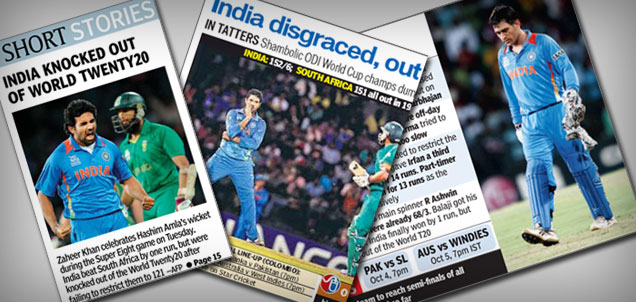
    India might not have made it to the semi-finals of the T20 Cricket World Cup, but the advertisers and sponsors of the event are still cheering. ESPN Star had sold inventories to about 34 advertisers and, according to industry estimates, the advertising revenues that the channel made for the T20 World Cup are already in the range of Rs 250 crore. Are they complaining?


    Mahesh Ranka

    Mahesh Ranka, Founder & CEO, Indus Sports and Sponsorship, feels that India’s performance would hit the advertisers. He said, “The ad deliveries in the World Cup will be lower given that India did not make it through. However, the advertisers and sponsors would have taken the factor of India not making it through before they signed up. The bigger issue is for ESPN Star, whose inventory might be affected.”


    It is no news that advertisers and agencies always plan with such contingencies, of India not winning or getting out of a tournament, in mind. And especially in the case of T20, India was going to play either five matches or seven. With just three games left, from a sheer quantity perspective, it does not seem a big loss to advertisers.


    Anwesh Bose

    Anwesh Bose, Senior Vice President, DDB MudraMax Media, said, “Advertisers and sponsors have got their value already. Cricket is a non-cancellable property, so nobody is going to withdraw the money they have put in. For the T20 World Cup, sponsors buy the inventory for the entire tournament.” He added, “The broadcaster, in this case ESPN Star, holds back about 10 percent of inventory of finals and semi-finals, which they sell at a very high premium. Now that India did not go, they might not be able to command the premium for the inventory.”


    With India losing, ESPN Star has definitely lost an opportunity that they would have capitalised on if India had made it through.


    Vivek Srivastava

    Vivek Srivastava, Joint MD, Innocean Worldwide, said, “If you are a brand that looks at tactical use of such opportunities then you might sound like prophets of doom at this eventuality. However, most strategically driven brands today have long-term sports marketing properties and a long-term perspective on leveraging them. They look at a long-term engagement via a mega sport like cricket. Our client Hyundai has a long-term vision about integrating the brand and engaging with India’s passion for cricket as well as other cricket-playing nations via a five-year official partner status with the ICC. While India missing out on a semi-final berth hurts the emotions, it is business as usual.”


    Agreeing with Mr Srivastava is Hiren Pandit, Managing Partner-Special Projects at Group M who opined, “Advertisers have got more mileage and viewership during the T20 matches, and India’s exit will be slightly disappointing for them. Most of the advertisers in cricket are long-term advertisers, all the deals have been done earlier. India’s early exit may have been a missed opportunity but it does not mean that advertisers will not continue to sponsor the sport. Viewership will be impacted by India’s exit but there will still be some viewership.”


    The industry believes that the viewership will only see a minor blip, if at all. According to Satish Menon, CEO, Sports 18, while advertisers may be slightly disappointed with the loss, it is not going to stop them from advertising or investing in cricket in the near future.


    Mr Menon asserted, “When (Team India) does not do well it does reflect on the viewership and so on. As far as the viewership is concerned there will be a marginal dip, not a huge one because cricket is a universal game and a lot of the cricket fans or viewers also follow other matches equally. So I don’t think India’s exit will have any major impact on viewership and especially because it is the T20 World Cup.”


    Sudha Natrajan

    “When India is not there in a tournament, there is between 25 percent and about 35 percent drop in the viewership as compared to when India is playing. This is the sort of trend you see in the earlier games. If the games are interesting, the viewership could even climb, despite India’s exit from the tournament. The problem however is the buzz and the interest level that the country has when India is playing as compared to when they are not playing. So more than the TVR, it is the overall interest that you see diminishing,” concluded Sudha Natrajan, founder, TMC Corporation.


    Given that it is the festive season in India, the advertisers might not mind a few losses.


    Clippings above (LtoR) from DNA, Hindustan Times and The Times of India


  • Senior management changes at SMG Delhi

    By A Correspondent


    Starcom MediaVest Group has announced that three senior executives, Tarun Nigam, Sulina Menon and Sriram Sharma, have been given new roles as part of the restructuring.


    Tarun Nigam, ED Starcom North, is moving to a role with VivaKi Exchange by Januray 2013. In the past 6 years with the organisation, Tarun has handled critical roles like Delhi head and National Director Business Impact for SMG India. He is currently in the process of transitioning from the SMG role to a full time role with the group outfit VivaKi. In his new role, Tarun will report to VivaKi Exchange CEO Mona Jain.


    Sulina Menon, Executive Director and Head of Team Samsung and Dabur will be taking charge of Tarun’s client portfolio in Delhi, in addition to overseeing the Dabur account.  Sulina has been instrumental in scaling up Starcom’s services on Samsung over the past couple of years. This year the agency won numerous awards for outstanding work on Samsung.


    Sriram Sharma, VP Starcom South is moving to Delhi to Head Team Samsung.  Sriram has played a key role in developing Starcom Bangalore and Chennai. There would be a 3 month overlap between Sulina and Sriram on Samsung before they take independent charge of their roles in Januray 2013. In their new roles both Sulina and Sriram will report to SMG India CEO Malli CR.


    Malli CR, CEO, SMG India, says, “After a good run in the past 2 years, we are gearing up for an even more action packed future. Tarun, Sulina and Sriram have done exceedingly well in their respective assignments and have been great ambassadors of SMG. Their new roles with enlarged responsibilities are a testament to their performance. We wish them the very best in their new assignments”.


  • eBay India promises best deals in its campaign

    By Tuhina Anand


    E-commerce marketplace eBay India (www.ebay.in) has unveiled its festive marketing campaign, highlighting eBay India as the best deal destination providing a guaranteed and safe online shopping experience with the widest range of brand new every-day use products. The campaign portrays savvy consumers in real life situations realising they no longer need to shop the old-fashioned way and can shop smartly for great deals on eBay India with an assurance of eBay Guarantee of 100 percent satisfaction, else a refund or a replacement. The tag line, Want it, Get It continues.

     

    Targeted at value-seeking shopping enthusiasts across the country in the age bracket of 18-40 years, eBay India’s new campaign emphasizes on eBay’s array of deals, backed by the fundamental promise of 100 percent satisfaction. The campaign is designed to encourage consumers to use eBay India for the variety of great deals available on product categories like apparel, accessories, fashion, personal care, laptops, mobile phones, cameras, TVs & fitness among many others. Conceptualized in an everyday conversational format, the TVC is designed to appeal to audiences with its tongue-in-cheek style. The campaign highlights situations in which the protagonists are able to acquire the best online shopping deals backed by eBay Guarantee on the purchase.


    Kashyap Vadapalli

    Kashyap Vadapalli, Chief Marketing Officer, eBay India says “Our new marketing campaign brings alive the fact that eBay India is the leading shopping destination for savvy online shoppers looking for great deals, offering an unmatched variety of products across categories. We foresee online shopping growing rapidly in India and as pioneers of e-commerce, our campaign aims at instilling consumer confidence, promising the consumer a completely secure & satisfaction-guaranteed experience of getting the product they selected and paid for.”


    Scheduled for a high-voltage, nationwide launch, the campaign has been developed by Law & Kenneth. The campaign will roll out nationally, with a combination of TV, digital & social mediums to drive awareness and encourage Indians to shop their heart out this festive season to get the best deals online.


    The campaign is a series of four TVCs of real life situations. In one ad, a young couple is in a discussion where the husband has his eye on a new DSLR camera and is keen for his wife’s ‘US Chacha’ to visit so he gets his hands on the latest model. His savvy wife turns around and challenges him with haven’t you heard of eBay, you don’t need to wait for a ‘US Chacha’ for deals on the latest cameras. In another ad, two friends are at a party and one of them envies the other’s new phone and says he plans to wait for the next edition to launch, so he can get the old model at a great price. His friend again challenges him and says haven’t you heard of eBay, you will get the best deals on latest phones throughout the year. The ads end with Get Deals on eBay India that you can’t get anywhere else. This is followed by “eBay Guarantee” & “Want it. Get it.”


  • Jaldi 5 with Sanjay Mehta: 1 billion users strong, Facebook can influence elections

    Sanjay Mehta

    When Facebook gently proclaimed that it now had touched the magical one billion users figure, most of us just dismissed it as a milestone. But it’s an accomplishment that cannot be ignored by not just individual users – but also marketers, sociologists, governments and all those who need to reach out to the masses.


    We asked Sanjay Mehta, Joint CEO, Social Wavelength some very fundamental questions on this achievement including whether there is any reason to fear the platform being abused of destabilizing nations.


    1 Would it be right to say that a good reason for the Facebook users reaching 1 billion would be thanks to the growth in recent years in India?

    LOL… no. We cannot take too much credit considering the Indian userbase, at this time, being a nominal 50 mn in FB’s total of 1 bn. So while the Indian user base has contributed to the overall numbers, it has been a nominal percentage.


    Would you say that Facebook is the single biggest marketing development of the 2000s?

    Well, I would say Social Media is the single-biggest marketing development. And Facebook is a key player in that social media space. Also though, I would also not claim this to be the greatest development of 2000s. That is a long period, and we have had other key developments including search engine advertising, which have been impactful. But in the last 2-3 years, it has been a clear emergence of social media as a marketing platform, and Facebook is its most significant component!


    With one billion users, Facebook users constitute the single largest community of individuals after China and India? Do you think it’s right for it to be seen like that?

    Well, yes, sure. So let’s take that analogy ahead.  What does a single group – be it citizens or China or India, or registered users of Facebook – mean?  That they do share some characteristics (citizenship in case of countries, Facebook in the latter case), but there are enough differences amongst them too. All citizens are not the same kind of people, nor are all registered users of Facebook. Likewise, there is no easy way for a marketer to reach “all Indian citizens” (wouldn’t THAT be a dream?!), and so also, there is no easy way to reach the billion Facebook users.


    Except perhaps, for the governments and for Facebook!! But the citizens and Facebook users do constitute a ‘group of sorts’ and there are opportunities built in there, for marketers.


    2 Do you think marketing in the present day can be done without a Facebook strategy in the media plan?

    All marketing plans may not need Facebook. So there IS a possibility for a few marketing campaigns to not include Facebook However, Facebook is making constant changes to become interesting for more and more brands and perhaps over time, most campaigns will have a Facebook extension! Or a Facebook core!


    But is there a lot of abuse of Facebook – fake likes, fictitious users and various strategies adopted to alter perception by marketers. Is there reason for skepticism when people refer to success thanks to ‘Facebook marketing’?

    The scepticism is with a few people only, and it is also misplaced. The number of fake accounts or fake likes is a small percentage again, and the matter has been exaggerated. There is also an extent of click fraud in Google ads. But due to good algorithms, this is controlled to a small level. Same is the case with fake profiles and fake likes. It is a small percentage. Facebook does not like these. Recently it identified about 80+ mn fake accounts and went about deleting those.


    Can Twitter be put in the same basket as Facebook for marketers?

    Well, it depends on what you’d call the basket. So yes, it is also part of the social media space, and in a sense, the marketer will reach the social media active user, via Facebook or Twitter. But within that framework, there is a difference between the two platforms. Not just that, within Facebook or Twitter usage also, there are different patterns of usage and user profiles. So marketers cannot just “go to Facebook or Twitter”. There is a further science in terms of what they want to achieve, whom they want to reach, etc., and based on which campaigns are planned and executed.


    3 Just as Orkut was a rage once upon a time and faded out eventually, do you think Facebook could see the same eventuality soon? What do you think is the next big idea?

    If I have learned something in the last 10-15 years observing the tech space, it is that, ‘nothing is permanent’ or ‘no platform / brand / service remains on the top for very long’. Facebook could be the exception to this rule, or it could also fall out of favor in sometime.


    However, at the present moment, stock price apart, Facebook is extremely well-entrenched as a powerful leader in the space.


    If something or someone can displace it from its position, I do not have the crystal ball to gaze into and tell you, what that may be! It could be a platform that is currently present and becomes larger, or it could be something that is being developed in some garage or lab in some part of Silicon Valley or Israel or even Mumbai or Bangalore!


    Let’s keep watching the space and discover when it happens!!


    4 Do you see social media like Facebook being used by politicians to influence public opinion?

    Absolutely! Politicians are also brands that need to be sold, no disrespect meant here! So like any other brand that uses the medium to influence its target market, a politician also needs to do the same, for their communication messaging.


    Whether social media will impact an election result or not, just yet, it hard to say. But it will definitely influence few votes!


    5 Can there ever be a fear of Facebook being misused to destabilize countries… just as there is a fear of various media vehicles?

    We live in interesting times. Many of us are logged into our Gmail accounts all day. There is a decent amount of our web behavior that Google knows about.


    We use applications like Whatspp or Truecaller, and we share our contact lists with these applications. And a lot of us do so, and the applications then, know a lot of our cross connections and relationships.  Likewise we use Facebook, where we share our relationships, we talk about our vacations, put our photos and videos, and let people know our political preferences or movies that we like.


    There is truly a lot of information about us, out there.  And this is with a variety of sources, whom we consciously trust, or sometimes do not realize, but end up giving our trust!  Just as data stored and flowing through electronic pipes is always susceptible to leaks like Wikileaks, so also our personal data is always susceptible to being abused.  Either by means of hackers exploiting some holes, or worse, if the sources that we trust, turn rogue!


    We live in hope that these guys don’t turn rogue, and there is no major abuse of our privacy. Each morning, along with the prayers for your health, wealth and prosperity, you must also pray that Google, Facebook, Whatsapp and other such applications do not turn rogue ever!!


  • Chitralekha presents 3rd edition of Watch World Awards

    By A Correspondent


    The Watch World Awards, 2012 hosted by the Chitralekha Group is all set to return on the 12th of October 2012 in Gurgaon. The third edition of the award will also seek attendance from eclectic brands such as Cartier, Harry Winston, Zenith, Hublot, Bulgari, TAG Heuer, Dior, Greubel & Forsey, Breitling, Corum, Parmigiani, Romain Jerome, Seiko, Citizen, Titan, Timex, HYT, Rotary, and many others.


    The event which will see well-known watch brands vying for the coveted commendation of ‘Watch of the Year’ will see intense competition across eleven categories in the Product Awards section and five categories in the Marketing & Merchandising Awards category. The jury list of the evening includes Master watchmaker with five decades of experience in watchmaking – Antoine Simonin; Leading image consultant Chhaya Momaya; Noted designer Priyadarshini Rao; Cricket Commentator Ravi Shastri along with established marketing consultants from Market Gate – Shripad Nadkarni and Sharda Agarwal.


    Mitrajit Bhattacharya, Publisher and President, Chitralekha Group said, “The third edition of the Watch World Awards is a testament of the success of the property wherein the increasing participation of international watch brands is an indication of the trust reposed by the international horology eco-system into the property. This success of the Watch World Awards has been only possible due of the whole hearted involvement of iconic watch brands along with a de-jure participation of an eclectic jury list comprising of the best from the world of horology, fashion, sports & design.”


    This edition of Awards will see the same format and award categories being followed as the past two years, “though it will be high on style quotient,” added Mr Bhattacharya.


  • Young Track by Samyak Chakrabarty | Why SEC data doesn’t reflect youth behaviour effectively

    Samyak Chakrabarty

    What’s a 23-year-old writing a column on a site where the average age of columnists is… ? Ok, ok, we won’t reveal that number, but like it or not the youth constitute a majority of India’s population. Since the last few years, young Samyak Chakrabarty has been in and around media events and offices with his vision of how the youth can be targeted.


    In this period, he has organized a few conferences, participated in several of them in India and abroad, and works as Chief Youth Marketer with the DDB Mudra group. He’s organized a TedX youth conference in Mumbai, was invited to meet Hillary Clinton when she visited India and has co-authored a book ‘Generation Einstein 3.0 – India version’.


    Samyak’s column will appear on Wednesdays and as the title suggests, it will track the young – specifically keeping in mind the advertising, media and marketing fraternity. The column started last week, and we are happy to present the second in the series  – Ed


    Very recently I read the latest India SEC report which really made me think: does any of this make sense when I look at youth consumption and purchase behaviour? After critically observing patterns of youngsters from varied backgrounds, I realized that at many points the standard classifications fail to justify much of the spending in this age group (16 to 28, urban, male and female) since the larger money outflow is coming from the most unexpected lot. Thinking aloud, here are three reasons why I think so:


    1. Parents’ income does not always necessarily trickle to the kids

    I compared the lifestyle and backgrounds of two 17-year-old males studying in the same college in South Mumbai. Paras’s father, a wealthy businessman had an annual income of Rs 75 lakh and lived in a plush apartment on Marine Drive. Whereas Amit lived in Bandra and his father earned about Rs 18 lakh a year working as a senior accountant in an MNC. Obviously, it would seem that Paras would fall under SEC A+ and Amit in SEC B. But, when I compared both their possessions (gadgets, variety of clothes and smartphone apps) and expenditures (nightclubs, restaurants and outings with the GF) – Amit’s life seemed more interesting since he had the latest iPhone, went to the best of bars and all that. Paras on the other hand only got a pocket allowance of Rs 1000 a week and travelled by local trains all that time, even though he had two luxury sedans in the garage. Typically, brands would target him vs Amit since Paras’s background made him a potential spender on premium products. The truth is otherwise, only because Amit’s dad wanted to give his son all that he could never have in his youth as compared to Paras’ dad who wanted his son to get everything the hard way. This is an everyday occurrence in many homes, but realities like these which don’t reflect in algorithms and statistical formulae can prove some very expensive brand targeting decisions wrong.


    2. Income levels fluctuate until 24

    A number of college students, in metro towns especially, are doing a number of entrepreneurial activities as one-offs (such as events, paid blogging, part-time internships etc) which for a certain period of time give them access to a lot of money. So let’s assume, in the summer break some students occupy themselves with a lucrative activity. During that period, the profit could enable them to buy pretty much any gadget, meal, excursion or extravagance that the twins in Antilla could (apart from the private jets and Maybachs ofcourse). But then due to zero knowledge about the virtues of saving up at this age, the money is over as quick as it came and there is no scope for continuing their buying spree. Hence marketing to this set could prove to be a loss-making investment. Through this example, which of course is not an everyday one, I am trying to indicate that the personal income of college students is never sustainable, hence a lot of their buying decisions are more on impulse than well thought out.


    3. Even with a lower income of first jobbers, there is more willingness to spend

    Blame the credit card for this, but many first jobbers tend to spend more than what they actually earn. This is very often seen when it comes to call centre employees or in our own advertising industry, where based on income levels the ability to buy certain products seems bleak but they always end up having it all – like a car, smartphone, Europe trips to name a few. Hence in such a case, brands while marketing should analyze their potential client base at the convergence of mindset and the income level to be able to (as much as possible) accurately identify them.


    In my opinion, the most practical method would be to classify youngsters based on “Mindsets” rather than SEC alone, since that way one could get more of an insight into factors which will trigger purchase and a better understanding of the type/brand of products they would be most likely to buy. It is also important to consider that the time difference between wanting something and acquiring it has reduced drastically for the enterprising young born post-1990, and this has nothing to do with present income since they find many innovative ways of working smart to make that quick buck.