Category: SHAILESH KAPOOR

  • Shailesh Kapoor: Modi Ads: How much is too much?

    By Shailesh Kapoor


    For the first time in about two weeks (or at least it seems like that), the front-page jacket on The Times Of India Mumbai edition did not carry a BJP ad today. The Mumbai elections being done with, the print budgets are sure to have shifted to Punjab, Gujarat and Andhra Pradesh. But national TV ads will continue to make their presence felt for at least another three weeks.


    There has been enough talk about BJP’s advertising budget and the source of that money. What interests me more, however, is the thought behind such an aggressive media plan. Surely, if Congress or BJP wanted such a plan in the past, say 2004 or 2009, they would not have issues in finding resources to put it together. Hence, it comes down more to the will and the need, than the budget.


    Narendra Modi is omnipresent on television these days, barring the kids genre. Even websites and apps, including the most unlikely ones, throw up a BJP ad with him and the lotus symbol prominently displayed. If media planners had any theories on how many exposures you need to build reach or effectiveness, you can throw those theories out of the window. Here, you may as well ask: How many exposures do you need to build a “wave”?


    Yes, it comes down to that. BJP (or Modi, used interchangeably here on) has been smart in realizing that their best chance to get an absolute majority in these elections lies increating a “wave” or a “leher” across the country. The party does not have presence in several states, such as West Bengal, Kerala and the North-East. In several others, like Tamil Nadu, it is in alliance with the weaker regional parties. In effect, if BJP-led NDA have to cross the 272-mark, they have to win 272 out of 400-odd constituencies in the heartland states, not out of 543.


    That makes it two out of every three seats! A sizeable segment of “undecided” voters, led by first-time voters, can make the difference. After all, more than 50 seats in 2009 were decided by a margin of about 15,000 votes or less.


    BJP’s campaign message has been smartly selected and phrased. It wants us to “assume” that a Modi Government is only a formality. The headlines are phrased as statements of fact, not as pleas to the voters, ranging from ‘Hum Modiji ko laane waale hain’ to ‘Abki baar Modi sarkar’ to ‘Kamal ka button dabayenge, Bhajapa ko jitayenge’.


    Over many exposures, you would tend to believe that these “facts” are indeed “facts”, and a Modi government is only a matter of formality now. That would be enough to sway both the first-time voters and those sitting on the fence in general. Anything less than a campaign of this visibility may have arguably fallen short of giving credence to the claim that a Modi government is a given this year.


    A “wave” in today’s world largely stands for “buzz”. It’s more about talk value. The decision-making takes care of itself thereafter. As a country, we are in a phase where it is becoming increasingly easy to create buzz using the media, but at the same time, it is becoming increasingly difficult to sway opinions. With more sources of influence, media campaigns are now playing a “show” role than a “tell” role.


    So, is there a Modi wave? Yes. But does that wave mean a majority of seats for NDA, we will know only on May 16. But one thing is clear. If NDA does not cross the 272-mark this year, with this campaign and such lack of options available to the voter, they never will in the next few decades at least.


    To that extent, the pressure is on Modi. Even 230-240 seats may open up possibilities that he would hate to be a part of. On one day, middle of May, it will all be known in a matter of hours!


    TV Trails is a weekly column written by Shailesh Kapoor, founder and CEO of media insights firm Ormax Media. He spent nine years in the television industry before turning entrepreneur. The views expressed here are his own. He can be reached at his Twitter handle @shaileshkapoor
     

  • Shailesh Kapoor: May 16: Mother Of All TV Battles

    By Shailesh Kapoor


    Cricket World Cup & IPL finals. Blockbuster movie premieres. Grand finales of big-ticket reality shows. Over the last decade, almost all the high-rating TV ‘events’ can be classified into these three categories. India does not have an annual showstopper like The Super Bowl. Our television highs are rather muted, very rarely attracting a pan-India audience base that cuts across demographics and viewing taste.


    The big day of election results, May 16, can be a rare exception. It has emerged as the most promoted television date by far in our television history, largely because it has become a political refrain. Across parties, “We shall talk on May 16” has been the default political response to many tough questions posed by journalists.


    Conducted over nine phases, these General Elections have been a long-drawn exercise in political theatre. And it will all climax in a matter of hours next Friday morning. News channels are set to start their live telecast from as early as 6am. The first leads will begin to come by 9am. And these days, they don’t trickle in; they come as a deluge. Before noon, the big question would have been answered: Will Modi-led NDA cross the 272-mark?


    Back in the 80s, this three-hour process would take three days. Doordarshan would entertain you with patriotic cinema (mostly Manoj Kumar films) with constant ticker updates and a news bulletin every two hours or so. EVMs have changed it all. Some from the old school may argue it’s taken the fun out of the counting process, but for me, EVMs remain one of the most significant (also one of the most under-rated) achievements of the Indian democracy.


    Coming back to May 16, the second half of the day will be more about reactions and analysis, even as the results begin to sink in. In the event of NDA falling short by a significant margin, the ‘event’ may extend itself beyond May 16, into the weekend, even the following week.


    Two factors, however, will stop May 16 from becoming a record-breaking viewership day in Indian news television history. One is the day itself. It happens to be a working Friday. I have strongly believed that all election result days should be Sundays. It will lead to higher awareness and participation in the democratic process over time. On a working day, TV viewership will take a beating, even though discussions around the results will continue to dominate offices across the nation.


    The second factor is a marketing problem. Historically, news channels have continued to market the results-day largely through on-air promotions. It should be an ideal day to get new viewers to watch, but there is a lot of promotion on the home channel, and very little outside. This time, by the sheer talk value these elections have generated, awareness about the results-day is very high. Hence, it will be a lesser concern to get the fringe, non-news viewers in. Now if only it was a Sunday!


    More than 20 news channels will fight a fierce battle on the results-day next Friday.  The results of this battle within the battle may have a long-lasting impact on our news television economy. So, fasten your seatbelts. And call in sick on May 16!


    TV Trails is a weekly column written by Shailesh Kapoor, founder and CEO of media insights firm Ormax Media. He spent nine years in the television industry before turning entrepreneur. The views expressed here are his own. He can be reached at his Twitter handle @shaileshkapoor


  • Shailesh Kapoor: News Channels on May 16: Never A Dull Moment

    Shailesh Kapoor

    Shailesh Kapoor


    Most news channels started broadcasting live on May 16 at 6am. The first results started coming in by 8am. And by 9.30am, it was all over bar the shouting. By 10am, it was certain that not only with NDA form a stable, majority government, BJP alone would cross the coveted 272-mark. By this time, some anchors were already wishing their guests ‘Good Afternoon’, well before 11am. Clearly, it happened way too fast for everyone.


    Since 1989, all General Election results have been marked by fractured verdicts in some form or the other. Hence, till leads begin to solidify, it is difficult to be sure of the verdict itself; let alone who the next Prime Minister will be. This time, it was all decided, and the focus of the coverage thereafter shifted to BJP celebrations, Modi speeches and state-wise analysis of the incredible Congress rout.


    Indeed, it was a Results Day like like no other. Here are some nuggets that caught my attention:


    :: Did Rajedeep Sardesai actually say the “Congress has f*&#ed up” on-air? The footage is not to be found anywhere on the net, but Twitter was indeed abuzz with the rather entertaining slip-of-the-tongue by the seasoned anchor.


    :: What’s with Arnab Goswami promoting 6am as the time for #May16WithArnab, but appearing on-air only at 7am, leaving it to his pupils to anchor a no-content hour? Arnab’s loyal fans, who woke up at 5.45am to watch him, want their money back!


    :: Did you notice those animated figures of Modi, Rahul and other party heads on Aaj Tak and Headlines Today? They also ran a three-minute parody called ‘Mitron main toh PM ban gaya’ (Watch here) under their well-cultivated humor brand ‘So Sorry’. Nice touch!


    :: I get the NDTV legacy of elections coverage, but it’s time to get rid of a static vinyl backdrop with hazy snapshots from across the country, variants of which they have been using in all their election results shows in the recent years!


    :: Also, did anyone toggle between NDTV and Times Now? I did, and counted number of words spoken per minute on each channel on an average. The ratio was a staggering 1:4 (which incidentally is also the ratio of their viewership in most weeks these days)!


    :: Anuradha Prasad ads in the run-up to May 16 surprised me. News 24 has never been a serious player, and here she was, promoting her May 16 show on radio and even other news channels, such as Times Now!


    :: Chanakya, the Delhi-based pollster, called their second elections right after the Delhi Assembly elections last year. News 24, coincidentally, were their on-air partners, and the channel was promoting its achievement on May 17-18 via radio ads. It was good to see Arnab Goswami congratulating Chanakya on-air, more than once, even as other exit polls, run by bigger agencies, got it all wrong, like most other times.


    :: On May 16, I learnt that there are three types of leads that can be reported – speculative leads, unofficial leads and official leads. Official leads were those available on the Election Commission website. Unofficial leads were those available on the ground via counting center information. I am still trying to figure out what speculative leads mean. At a time when most channels had information on 200-250 seats (official and unofficial), NDTV has information on 500+. Mystery still unsolved, at least for me!


    :: As someone on Twitter rightly pointed out, we heard Modi speak more words on May 16 than we have heard Manmohan Singh speak over ten years put together. Don’t know about the country, but the media must be rejoicing the election of an articulate, media-savvy Prime Minister. ‘Achhe din’ are here for TV channels!


    TV Trails is a weekly column written by Shailesh Kapoor, founder and CEO of media insights firm Ormax Media. He spent nine years in the television industry before turning entrepreneur. The views expressed here are his own. He can be reached at his Twitter handle @shaileshkapoor

  • Shailesh Kapoor: Reality Shows: Trendy No More?

    By Shailesh Kapoor


    When KBC first launched in 2000, the term “reality show” was not a part of this country’s lexicon. The long-running Sa Re Ga Ma Pa (1995) was then referred to as a singing talent show, not a reality show. But by end 2004, reality shows were emerging as a formidable force, fuelled by the launch of Indian Idol and India’s Best Cinestars Ki Khoj that year.


    The amount of activity this category saw in 2004-08 made one believe that its share of viewership would continue to rise year-on-year. But the reality shows genre in India has flattered to deceive. In 2008, 21% of viewers named a non-fiction show as their favorite GEC program. In 2014, this number remains in the 20-25% range, and that includes Comedy Nights With Kapil, which contributes to more than half the share.


    Why did the category stagnate? This summary of 2014 tells a story:


    1. Khatron Ke Khiladi Season 5 (arguably the best season of the show since season 1) ends this weekend.


    2. Dance India Dance, currently airing in the Li’l Masters variant, is into its ninth cumulative season, if you could the main show (4 seasons) and variants such as Li’l Masters, Super Mom and Doubles (5 seasons).


    3. Jhalak Dikhhla Jaa Season 7 is slated to launch this June.


    4. KBC 8 is calling for entries currently, and is slated to launch around August.


    5. As an aberration, only the second season of Zee TV’s Cinestars Ki Khoj is scheduled for a mid-year launch, coming back after a decade.


    6. Bigg Boss Season 8 should go on-air around October, like every year.


    7. Being an annual fixture, India’s Got Talent is likely to be on-air this year too, in what will be Season 6.


    You get the trend? All these properties are at least five years old.  All, barring one, are into their fifth to ninth seasons. We have fallen into a pattern. And the viewer is not exactly pleased with this turn of events.


    Except the two Zee TV formats, all other formats are imports. Four out of seven are talent show formats. Clearly, India’s ability to create original, homegrown reality show formats is highly suspect. Many attempts have been made, but have been largely unsuccessful. Imagine’s unofficial adaptation of The Bachelor got good attention, especially in the first season with Rakhi Sawant. But overall, it has been a tough ride for the industry.


    Doordarshan and Zee TV have been creating reality show formats even before the imports descended upon us. From Meri Awaz Suno in the 90s to Saanp Seedi, Antakashari, Sa Re Ga Ma Pa and DID, these channels had a lot to offer, though most of it was in the talent and games show space. When the industry showed growth and the market became ready to import foreign formats, it emerged as a low-risk option to go for. In the process, the homegrown formats began to get step treatment from most channels, in terms of attention and budgets provided to them.


    Today, the reality shows genre is facing imminent decline. The audiences who grew up watching these formats would have recently got married or are likely to get married soon. The impact of marriage on TV content preferences can never be overstated. And no young generation likes to inherit what the “oldies” liked. They want to create their own trends, their own hits.


    With a culture and heritage as rich as ours, we should be bursting at the seams with reality show ideas. The time can never be more right!


    TV Trails is a weekly column written by Shailesh Kapoor, founder and CEO of media insights firm Ormax Media. He spent nine years in the television industry before turning entrepreneur. The views expressed here are his own. He can be reached at his Twitter handle @shaileshkapoor


  • Shailesh Kapoor: A Week To Remember: Politics, IPL & More

    By Shailesh Kapoor


    Television weeks can be fairly routine, except in periods like the Elections recently, or the week of a big-ticket cricket series. An odd launch here and there, like Satyamev Jayate, can spike interest. But in most weeks, it is the staple diet that dominates.


    In contrast, the last six days have been wildly engaging. I don’t remember a week that offered so much to watch and talk about, driven by politics but certainly not restricted to it. The gossip around the shift in power at Network18 has provided the off-screen masala too. But I shall restrict myself to on-screen material only. Here are my picks of TV events that dominated the week that was:


    1. The Swearing-In Ceremony: Swearing-in ceremonies can be dreadfully boring. But the upbeat mood around the new Government ensures that anything involving them gets people interested. The Monday that went by kept the news channels busy, first with conjectures on portfolio allocation, then with the informal but actual list of portfolios, and finally with the live telecast of the actual ceremony. The entertainment was provided by an alert President, who rebuked two ministers for skipping the oath-taking protocol.


    2. What A Match: The Mumbai-Rajasthan game last Sunday provided such a big dose of entertainment, it may have over-compensated for a low-key IPL. I don’t remember seeing a match ever, where a team won despite not meeting the originally-announced target. The math of it had most commentators stumped, even though it was fairly elementary, and in fact, should have been a part of the talk even while the chase was going on. The IPL is in its last leg this week, and game last Sunday will ensure this year’s IPL ends on a high – something we were not so sure about a month ago.


    3. Ministers In Office: In a first, media has covered ministers in the new Government taking charge better than ever before. A more pro-active Prime Minister and a young, media-savvy Council of Ministers has helped. If this week is anything to go by, we seem to have found our most media-friendly Government ever.


    4. Zindagi and Indo-Pak diplomacy: It can be termed as uncanny and highly coincidental. Zee’s new channel Zindagi, which plans to air content from Pakistan, was formally launched last week. As the campaign gained momentum this week, events engineered by our new PM led to Nawaz Sharif making a much-discussed India trip. Zindagi is bound to benefit from the sentiment of hope that Indo-Pak relationships may indeed improve under Modi. The photo-op between Sharif and the Essel Group Chairman Subhash Chandra was an icing on this rather intriguing cake.


    5. The Smriti Irani controversy – Much ado about nothing: The Congress party has started the witch-hunt for chinks in the new Government’s armour. If their attempts at creating controversy around Smriti Irani are anything to go by, they will do well to take a break from these desperate measures. Smriti Irani, the youngest member of the Modi Cabinet, has all the makings of a great minister. Her rise from a TV star to a political heavyweight may just turn out to be one of the most fascinating political anecdotes of modern India.


    6. Congratulations Tulsi: Did you see the Star Plus ads congratulating “hamari Tulsi”? A class act, in both idea and execution. That’s how leader brands grab opportunities that come their way.


    What a week!


    TV Trails is a weekly column written by Shailesh Kapoor, founder and CEO of media insights firm Ormax Media. He spent nine years in the television industry before turning entrepreneur. The views expressed here are his own. He can be reached at his Twitter handle @shaileshkapoor


  • Shailesh Kapoor: Male Characters Set To Rule Hindi GECs?

    By Shailesh Kapoor


    It’s been a category dominated by female viewers and female fiction characters. Hindi General Entertainment Channels (GECs) have behaved more like Hindi Female Entertainment Channels for more than a decade now.


    The stronghold of the women on the remote continues. But the other type of female dominance – that of female fiction characters – has been challenged. As per the latest Ormax Characters India Loves report (May 2014), for the first time since we started tracking character popularity in 2009, the top 10 fiction characters list has more male characters than female characters!


    Three years ago, this would have been unthinkable. The contribution of male characters has traditionally been a token one, rarely crossing two out of ten. In the last two years, three out of ten seemed more gettable, but the female dominance remained. Last month, the balance finally tilted, with five male characters in the Top 10 and ten in the Top 20. And remember, we are talking only of fiction characters. The top 5 non-fiction ‘characters’ are all men in the same period of tracking.


    What has led to this turnaround and what could be its possible implications? A significant part of the answer lies in the list of popular characters. The five male characters who made it to the top 10 list in May are Jethalal (Taarak Mehta), Maharana Pratap, Akbar (Jodha Akbar), Krishna (Mahabharat) and Inspector Daya (CID). The list offers a good mix of history, mythology, comedy and action-thriller genres.


    Contrast this to the female characters in the top 10: Jodha (Jodha Akbar), Sandhya (Diya Aur Baati Hum), Ishita (Yeh Hai Mohabbatein), Anandi (Balika Vadhu) and Gopi (Saath Nibhaana Saathiya). Lack of genre variety is striking. Most of these characters, and others in the top 20 list, are women on a journey, facing challenges on the way. It’s a template that was created starting with Tulsi in 2000, and then redefined with Anandi in 2008. Over years, this template has been exploited to create hundreds of daily serials and characters.


    The idea of a woman’s struggle-heavy journey and her eventual victory is a powerful one for female audiences, and shall remain so in the years to come. The problem is, of course, in the same-ness of execution. It’s as if the idea is so powerful that nobody seems to care about the quality of its depiction anymore.


    The only female characters in the Top 30 who do not fit this template is Daya (Taarak Mehta) and Dadi Sa (Balika Vadhu). Everyone else is on a ‘journey’, all the time. And while the destinations may be different, the routes are strikingly similar.


    Beginning to feel disenchanted by content that is highly relevant but unimaginative, female audiences have increasingly started preferring male characters. Mahadev’s dreamboat looks, Akbar’s attitude and Krishna’s life lessons are the new cool.


    GECs would do well to act on both fronts. For one, they should capitalize on the growing interest in male characters by creating some differentiated ones. Amitabh Bachchan’s Yudh is well-timed in this regard. Two, they should consider pushing the envelope regarding female characters. We need women who take the road less travelled in their journeys, while remaining relevant to the mass audiences at large.


    Up for the challenge?


    TV Trails is a weekly column written by Shailesh Kapoor, founder and CEO of media insights firm Ormax Media. He spent nine years in the television industry before turning entrepreneur. The views expressed here are his own. He can be reached at his Twitter handle @shaileshkapoor


  • Shailesh Kapoor: FIFA World Cup: Patriotism With A Twist

    By Shailesh Kapoor


    The Football World Cup kicked off last night in Brazil. The month-long tournament is the only sporting event besides the Olympics that truly unites sports fans across the world. All other sports have their catchment areas, but soccer is the world’s favorite sport by a safe distance.


    All that being said, the craze for the FIFA World Cup in India amuses me every four years. Yes, football is the second most popular sport in India after cricket. Both television ratings and consumer research show that besides WWE-style wrestling entertainment, no other sport has the potential to challenge football’s number two position over the next decade in India.


    So my amusement is not so much about the following or viewership of the World Cup. That is logical and even expected. My amusement is about following of specific teams.


    Every four years, we see news footage and newspaper stories about fans of certain teams, often the ‘third-world’ teams such as Brazil and Argentina, gathering at public places in India to watch World Cup games. These “fans” can give local fans of the respective nations a run for their money. They wear the team colours, know their team inside out and some even carry the nation’s flag on them.


    How does an Indian, who has virtually no interest in nation-vs-nation football for four years, become an ardent fan of a soccer-playing national team? There is no rational explanation to this bizarre phenomenon. But we are not the most rational country in the world, are we?


    I have two hypotheses. The first one says that the choice to support a team is to spice up the viewing of the World Cup. So you first take the decision “I must watch the Football World Cup”. The reasons for that could range from entertainment to social expectations. You then wonder: “Now that I’m watching the World Cup, I must decide whom I am supporting”. Making a favorite team choice is critical because it would create higher engagement with the tournament, and also create volatile water cooler conversations at office.


    The second hypothesis is about the choice of the team itself. Most Indians tend to go for Brazil traditionally, for the strong third-world or brown-skin connect, I believe. Argentina has been a strong second favorite. The post-colonial effect ensures most European teams are ignored, though the ones that are not-so-British (such as Spain) have found some traction over time.


    These choices having been made, the real amusement lies in the journey over the month of the World Cup. From being a forced fan to a natural fan can be some transition. But we Indians can make that transition within days, even hours. From “I choose to support Brazil” to “I love Brazil” to “Brazil BrazilBrazil” is a quick turnaround.


    And if your chosen team indeed loses, you can behave as if the world has come crashing down. Though I suspect the hurt would last far shorter than that of India losing the final of a Cricket World Cup, a la 2003.


    So, be prepared for bleary-eyed colleagues in your office for the next one month, behave like they were born and brought up in Argentina (or Brazil), and that Maradona (or Pele) is the biggest influence on their lives. And if you spot some foreign-looking flags on the streets, just remind yourself that you are still in India!


    TV Trails is a weekly column written by Shailesh Kapoor, founder and CEO of media insights firm Ormax Media. He spent nine years in the television industry before turning entrepreneur. The views expressed here are his own. He can be reached at his Twitter handle @shaileshkapoor


  • Shailesh Kapoor: In A Politely Incorrect Industry, Can You Call A Spade A Spade?

    By Shailesh Kapoor


    Those who attend movie trial shows would relate to the predicament I’m about to share. Have you seen a movie at a trial, sat tortuously through it wondering what they were thinking when they were making it, and thenfaced with with the question you would pay anything to avoid: “How did you like it?”


    Seasoned industry folk have mastered the art of responding to such questions. They would tend to say all the good things first, and then point out the big issue as an appendage: “But I just felt that if you spend some time explaining the story, the film would work better.”


    This infectious living-in-a-bubble-at-launch-time disease has fast passed onto the television industry as well. Whenever a new show goes on air, I try and sample it for a couple of episodes, purely out of a disciplined habit inculcated over more than a decade. Seventy-eighty percent such experiences are excruciatingly boring. Mediocre writing and direction is rampant, and there’s only that odd show that stands out as being smartly made.


    Whenever I liked something new, I used to make it a point to call or message my friends at the relevant channel about how it made me feel. Silence meant ‘not liked’, not ‘haven’t watched yet’.


    But of late, this formula has stopped working. Imagine that you get a message from a channel friend, who has put his heart and soul into a new project, at 8.45pm, only 15 minutes before the new project goes on air for the first time ever. His message is brimming with excitement, requesting you to watch and give your feedback, because “it really matters”.


    This scenario forces me to reply at 9.30 or 10pm, whatever the end time is. And my option to reply with my true thoughts (which could be “your team has killed the spirit of the concept you tested with us” or “sack the director now! NOW!”) can be limiting at times.


    Hence, out of no choice, and actually with a baggage of guilt, I started behaving like the filmi guy at the trial, who would slip in the big negative as an inconsequential by-the-way. But the more I thought of this behaviour, I found it dishonest on every count, both to the client and to myself.


    What’s the big issue about criticism, especially when it comes with a constructive solution-oriented approach? Can Indians stop being less touchy and more objective about their work? Can they not get that just because they have produced or marketed something, it need not blow everybody’s mind?


    We have all been on the other side at some point or the other. Listening to appreciation about our labor of love can be a high, while criticism, especially when coming from trusted parties, can deflate you. But the ratings or the box office will deflate you anyway within a week. A bubble is never a stable place to live in.So, at some point of time in the recent past, I decided to shed the fear and the inhibition, and decide to say it like it is.


    I would urge others in the business to consider liberating themselves of the responsibility of being polite and dishonest, within and outside the organization. You will discover how it can empower you from within. Not to speak of the respect you are likely to win over time!


    TV Trails is a weekly column written by Shailesh Kapoor, founder and CEO of media insights firm Ormax Media. He spent nine years in the television industry before turning entrepreneur. The views expressed here are his own. He can be reached at his Twitter handle @shaileshkapoor


  • Shailesh Kapoor: OOH Media: Television Marketing’s Favourite Indulgence

    By Shailesh Kapoor


    Two decades of satellite television in India have seen many changes, including some watershed ones. But the more things change, the more they remain the same. Sometimes, there can be greater insight hidden in what has remained the same, than what has changed. For the television business, it is their love for the outdoor media that has stood like a rock for two decades now.


    This love started as a natural fallout of the reverence the television industry had for Bollywood in the early ’90s. Anything films would do for promotions was seen as cool and even effective. Never mind if measures existed or not, or if the target audience of the TV show in question had any connection with theatre audience profile or not. That being the context, “how many hoardings” was a very important question.


    In one of my early assignments in 2000, I was in charge of launching a new weekly fiction series. Working with frugal marketing spends, we decided to stay away from the outdoor media. Little did we know what was in store for us. About two weeks before the launch, the producers decided to hold back episode deliveries because they felt their show was not being promoted well. “We don’t see any banners”.


    An executive producer in the week before a show launch can be a bundle of raw nerves and hence a mess to deal with. “They are saying we don’t see any banners”. After decoding the terminology in my head (banners, hoardings, billboards, posters… all used interchangeably in India, I now know) I replied: “If they could see any, it won’t be short of a miracle. I don’t have a budget to take any outdoor on this launch.”


    A day later though, I was at the producer’s office, showing them outdoor creative, and taking them through the Mumbai outdoor plan, which included about five hoardings, out of which at least two were in Juhu, within a couple of miles from the producer’s home-cum-office. I had been sanctioned an additional budget the previous evening to make this happen.


    Conversations around buying strategic outdoor sites that senior management encounters on the way from or to their home are not uncommon. “It will be very visible to the MD when he goes for his morning walk,” I was once told.


    Several channels invest in an outdoor plan to create buzz amongst the trade – the advertisers and the media planners. Perhaps that principle was valid in the ’90s. But today, non-digital media being used for trade marketing in the media industry can only be seen as a wasteful expense.


    Regarding the impact of outdoor on consumer awareness or sampling of a new launch, the less said the better. We have conclusive large-sample evidence to prove that general outdoor media contributes (make that NOTHING) in a film’s marketing plan. But point-of-sales OOH, i.e., advertising in the theatre, is highly effective. For television though, ‘point-of-sale’ is at home. The closest outdoor media to it is the mode of transport that brings a person home – the local trains, the metros, the local buses, etc. Even for them, effectiveness is limited, given that many launches target an audience that hardly steps out of home. In smaller towns (<1 lac population), the medium delivers better results as 3-4 sites can cover a sizeable proportion of the city at a fairly low cost.


    But the Mumbai story is one of indulgence and prestige, than one of intelligence and prudence. Upto 10-15% of marketing budgets of some launches are spent on just the Mumbai outdoor budget. There is no measurement of the impact. But by extension of that argument, there is no measurement of the wastage either. Little knowledge can be a dangerous thing, right?


    This is a classic case of the “If I see my own campaign a lot, I feel my campaign is very visible” syndrome. The syndrome has stayed with the industry for two decades. Bollywood has nurtured it for more than five decades, though they are now questioning it more than ever before.


    Hope television follows suit!


    TV Trails is a weekly column written by Shailesh Kapoor, founder and CEO of media insights firm Ormax Media. He spent nine years in the television industry before turning entrepreneur. The views expressed here are his own. He can be reached at his Twitter handle @shaileshkapoor


  • Shailesh Kapoor: Bade Achhe Lagte Thhe: A Goodbye

    By Shailesh Kapoor


    Circa May 2011. In a stressful television primetime, where most hit shows were either about “smart” women trying to adjust in a challenging household, or about social issues dominant in small-town and rural India, came Ekta Kapoor’s Bade Achhe Lagte Hain (BALH). Last night, three years and more than 600 episodes later, the show bid goodbye to its audiences.


    BALH’s premise, of late marriage between a couple as different as chalk and cheese, was only mildly unique. But as episodes unfolded, it was the treatment of the subject that captivated millions across India. The show provided a mix of ingredients that made for an irresistible offering: Imaginative lead casting, a well-etched out ensemble, assured performances, crackling chemistry between the leads, lavish yet tasteful production and a lightness of treatment that was striking in the middle of countless other shows that were beinghandled with a heavy hand.


    The results were instant. The show jumped to being one of the top shows on television within weeks of its launch, with blockbuster performance in the metropolitan markets. Audiences who had actively sworn off primetime Hindi fiction went back to it, and Ram-Priya, or RaYa as they are called on social media, were the talk of the town.


    In my book, BALH remains the most influential TV launch in the last decade, along with Balika Vadhu. (Co-incidentally, the title ‘Bade Achhe Lagte Hain’ is derived from a song from the film ‘Balika Badhu’!) Its impact on primetime television was evident in the way the proportion of ‘mind fresh’ (read light-hearted) content increased across channels. Happy moments and fun side-characters were incorporated even in serious subjects, to deliver to what was commonly referred to the industry in 2011-12 as ‘BALH audiences’.


    The show also did well for the careers of many of its cast, especially Ram Kapoor. He started getting important roles in films, though his latest and most significant outing (Humshakals) was an embarrassment on all counts. Sakshi Tanwar (Priya) has been the most prominent brand endorser from the television industry over the last three years. Sumona, who played Ram’s sister, bagged the prestigious role of ‘Kapil ki biwi’ in Comedy Nights With Kapil.


    Like many other successful shows, BALH overstayed its welcome. The first generation leap it took, in mid-2012, was the start of the descent, though the introduction of a new child character (Pihu) postponed the inevitable for a few weeks. But eventually, the show lost its audience, as it began to lose the very lightness of touch it initially won the audience’s hearts for. The farewell, hence, was only a foregone conclusion.The show ends to make way for Amitabh Bachchan’s Yudh.


    Yet, in its golden period that lasted about a year, BALH gave us many memorable moments, including a delightful honeymoon schedule in Australia. It also gave us the first real kiss on primetime television in India, an event that took the social media by storm, even as the audiences struggled to come to terms with the shock of seeing a lip-lock in the primetime.


    I can’t say I will miss Bade Achhe Lagte Hain, because that will need going back to 2012. But I hope we see more of its ilk – shows that can shape the future of primetime television in India for the better.


    Bade Achhe Lagte Thhe!


    TV Trails is a weekly column written by Shailesh Kapoor, founder and CEO of media insights firm Ormax Media. He spent nine years in the television industry before turning entrepreneur. The views expressed here are his own. He can be reached at his Twitter handle @shaileshkapoor


  • Shailesh Kapoor: Yo Yo Honey Singh: TV’s Latest Superstar

    By Shailesh Kapoor


    Last week’s TV ratings released yesterday, saw Colors take the No 3 spot again. A quick look at the programme performance revealed that a key contributor to their small but significant growth was the Comedy Nights With Kapil episode telecast on July 6. That episode rated a cool 63% more than the average performance of the show over the last month. So who featured in this magic episode that broke all rules of momentum? Salman Khan? Shahrukh Khan?


    The answer is: Yo Yo Honey Singh.


    Yes, the singer-composer-performer, famous for his innovative (some may call them cheesy) rap numbers, and infamous for misogynistic lyrics from his past, is now a television star too. When you have 63% impact on TV ratings, you are a real mass star, someone who has the ability to influence audiences across markets and age groups.


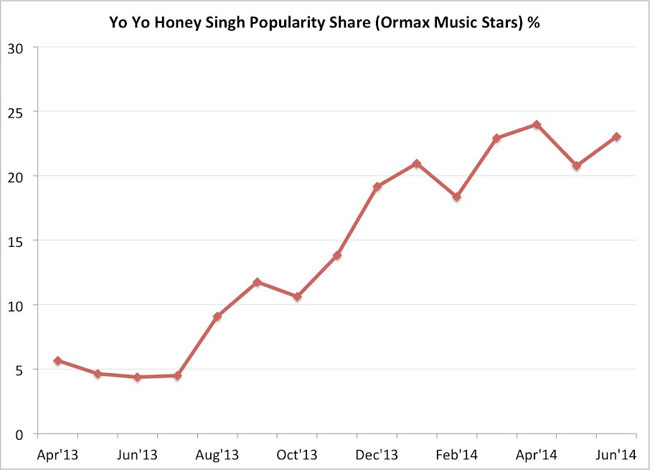
    Yo Yo Honey Singh’s popularity has grown dramatically over the last year, since the launch of Lungi Dance (Chennai Express) in end July 2013. The chart below, based on Ormax Music Stars, a popularity rating of singers, composers and lyricists, shows how his popularity share has grown from 4% before Lungi Dance to 23% today.


    The Comedy Nights episode in question (watch here) gives an insight into why the man is so popular. There is a natural ‘rockstar’ attitude he exudes, and when combined with his ability to use contemporary language in his lyrics, it makes for a heady combination.


    Often questioned about the use of ‘risqué’ lyrics in his songs, especially those involving liquor and ‘objectification’ of women, Honey Singh has been very forthcoming in his answers, be in Anupama Chopra’s show earlier this year or the Comedy Nights episode linked above. He maintains a consistent line of argument, suggesting that his lyrics are potentially no less controversial than some of the classic melodies of the past, but for their use of modern lingo making them come across as such.


    Criticism, especially from the media and the elite, has rarely affected mass stars. With his ever-growing popularity among kids, teenagers and youth, and a widening net extending to markets outside North India, Yo Yo Honey Singh probably considers the criticism an integral part of his image, and not necessarily a negative part.


    A quick visit to his Facebook page gives us a validation of his popularity. 22 million fans is no mean feat. But the mention of “business agents & contacts” on the masthead tells you that he’s still coming to terms with his stardom. Imagine Ranbir Kapoor or Alia Bhatt putting their agent details on the social media?


    But this element of ‘tackinesus’ may have worked in Honey Singh’s favor, finding him fans in the masses, even as most young stars, ranging from singers (Arijit Singh) and actors (Siddharth Malhotra) continue to be driven by the bigger cities.


    Star Plus is launching Raw Star with Honey Singh soon. Given their overall dominance, the channel’s non-fiction record in recent years has bordered on being embarrassing. But they now have solid ammunition at their disposal: The TV star who can give 63% jump in ratings of a long-running show. Ironically then, the Comedy Nights ratings would have probably led to more celebrations at Star than at Colors.


    I hope our media gives Yo Yo Honey Singh more coverage. Else, we may be missing out on some very insightful stories around the making of a superstar.


    TV Trails is a weekly column written by Shailesh Kapoor, founder and CEO of media insights firm Ormax Media. He spent nine years in the television industry before turning entrepreneur. The views expressed here are his own. He can be reached at his Twitter handle @shaileshkapoor


  • Shailesh Kapoor: Pro Kabaddi: A Giant Leap for a Dying Sport?

    By Shailesh Kapoor


    When I first learnt that Star Sports are investing in Kabaddi, I rubbed my eyes in disbelief. A wrestling league, or even a boxing league, would seem like a good idea, given the talk value around these sports in recent years, especially in the wake of India’s creditable performance at the global stage, including the 2012 London Olympics. But Kabaddi?


    India has monopolized the sport at the Asian Games, winning all seven golds since its introduction in the event in 1990. But the primarily sub-continental sport has not found many takers outside South Asia. Awareness of the sport is very low amongst young audiences, many of who confuse it with the traditional Indian (dying) sport of Kho Kho.


    Star’s decision to invest in Kabaddi, then, can be labeled as ‘high-risk’, a decision that would have to rely on exceptional execution to even find a critical audience in its first season. To their credit, having taken the decision, they have gone all guns blazing, with some good advertising and high media visibility. The simulcast on Star Sports and Star Gold will also help in widening the reach in the first year.


    But you can’t “buy” relevance and appeal for a media property. It needs to be intrinsic to the content. Hence, it was with great curiosity that I tuned into the first four games.


    My skepticism about the league has reduced considerably, say from 9/10 to 5/10, having watched the first two days of action. The last I watched Kabaddi was probably back in mid-90s. What I saw this time was strikingly different and several notches higher in entertainment than the sport I had imagined Kabaddi to be. Here’s why:


    1. Shifting from mud to mat makes the sport visually cleaner and colorful. It is far more appetizing for TV than the ‘brown sport’ I remember from the 90s.


    2. The rules have been changed to make the sport fast-moving and contemporary. There is less scope for time-wasting and the speed of action is higher than most other contact sports.


    3. Hindi and English commentary are both available. The quality of commentary is very acceptable, and there’s a lot of focus on explaining the rules in the early games, while maintaining the energy of the event.


    4. The celebrity quotient is present in good value. If it is only a function of the opening matches being in Mumbai, we will know soon. But if it sustains, the celebs would generate a lot of chatter around the league, a critical aspect in the first year.


    It’s difficult to say if these steps will be enough to make the league work. But they at least give it a chance. I believe there’s definite entertainment on offer in the league, but the ratings would tell us over the next few weeks if the young audiences across India connect with this form of entertainment.


    Even a moderately successful first year should encourage the organizers and Star to come back stronger in the second year. Other sporting leagues, including the much-hyped hockey league, have struggled to sustain themselves after a season or two. Star Sports Pro Kabaddi will hope to buck that trend.


    TV Trails is a weekly column written by Shailesh Kapoor, founder and CEO of media insights firm Ormax Media. He spent nine years in the television industry before turning entrepreneur. The views expressed here are his own. He can be reached at his Twitter handle @shaileshkapoor