Category: SHAILESH KAPOOR

  • Shailesh Kapoor: General Entertainment: A Sloppy Term We Have To Live With

    By Shailesh Kapoor

    The term ‘General Entertainment Channel’ (GEC) is unique to India. I don’t know who came up with it originally (could have been one of the ratings agencies in the ’90s), but the term has bad English written all over it. This article is a linguistic critique of this term (GEC). The viewer doesn’t even know this word and couldn’t care less. Hence, whatever you read here on has no business value. But if you care about the English language, read on.


    Let’s start with the first of the two contentious words: General. What kind of entertainment is “General”? For some reason, the word “General” was preferred over the word “Mass”, as is evident by a counterpart category being called “Niche Entertainment”, an equally odd articulation.


    If we go with “Mass Entertainment” as the meaning behind the term “General Entertainment”, we come to the next contentious word. What is “Entertainment” to the masses? Channels in the category would like to say it’s a mix of all that the mass audience want, and hence, the word “General” may have a meaning after all.


    But are the GECs delivering “a mix of everything”? If you go by a broad definition of the word “Entertainment”, it would include music, documentaries, Bollywood gossip, kids content (including animation), and some would say, even news. But the homogeneity of GEC content today is evident to all of us. They are offering only two types of content that covers more than 90% of their primetime: Serials and reality shows. Even films, earlier a GEC mainstay, have slowly moved to the movie channels.


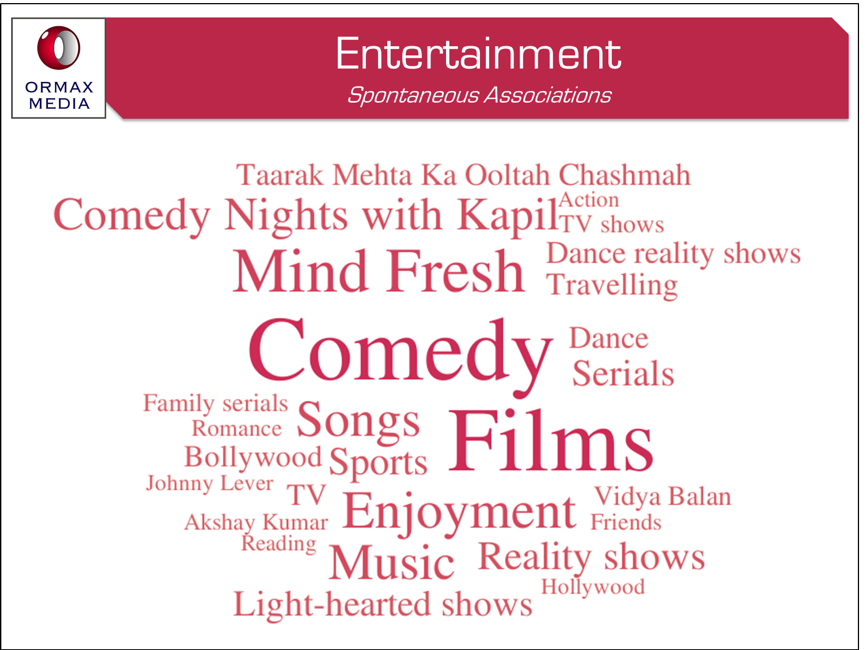
    The other definition of the word “Entertainment” is a consumer definition. The chart below is a ‘thought cloud’ made from the words that were spontaneously associated with the word “Entertainment” by a large group of consumers across the country (data collected end 2015).

    This is how India sees “Entertainment”. A large part of this thought cloud is not delivered by the GEC category (Hindi or regional). Is this consumer definition also a linguistic faux pas? Not really.


    The dictionary definition of “Entertainment” range from “the action of providing or being provided with amusement and enjoyment” to “something diverting or engaging, such as a public performance or a usually light comic or adventure novel.”


    Associations of “Entertainment” with de-stress, amusement and comedy are unmistakable across these and many other definitions available on the Internet. The thought cloud above mirrors these definitions in most part, though with an Indian contextualisation.


    Does it mean that the consumer understands English language better than those coined the term “GEC”? That would be tough to believe in a country where grammatically incorrect terms like “Mind Fresh” (also seen in the chart above; an Indian English term for relaxation and mood refresh) are rampant in their usage.


    In my understanding, when the term “GEC” was coined, it was coined with the right intention. There were no movie channels, kids’ channels or music channels then. Through the ’90s till the early 2000s, GECs used to air fiction programmes across genres, lots of films, had trailer and music slots during the day, and even animation bands in partnership with companies like Disney and Turner. Some even had news content.


    But as more and more channels launched, this “Entertainment” saw fragmentation. Each new category started getting its share of content. Film channels fought for the first right to air a big film, because ‘Why should a GEC air a film?’. Therein started the change in definition of what a GEC stands for.


    Today, almost all GECs, barring an odd exception like SAB TV, are more Drama Channels and less Entertainment Channels. Even the non-fiction content on these channels would fall under the generic definition of “Drama”: “An exciting, emotional, or unexpected event or circumstance.”


    BARC India had the opportunity to change some of this faulty nomenclature in 2015. I suspect this would have been too low on their priority list. But we have learnt to live with this mess of a term (GEC) anyway over two-and-a-half decades. Who needs a change only because the English language must be respected.


  • The Diminishing Social Impact of Television


    By Shailesh Kapoor


    That fiction content on Indian television is stuck in a rut of its own creation is no secret. In a recent attempt to familiarise myself with the content on regional GECs, most of which are in languages I do not understand, I started browsing the Hotstar, Voot and O-Zee apps and read the synopsis (headlines in case of Voot) of randomly selected episodes from the last four weeks, across their channels.


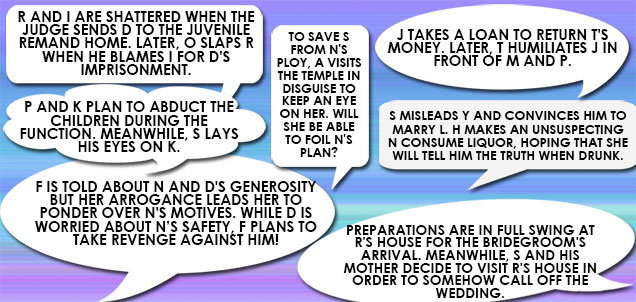
    Episode synopses of randomly-selected episodes of randomly-selected shows across seven different languages have been reproduced below. Character names have been replaced by their first letters to bring focus to the content.

    1.       F is told about N and D’s generosity but her arrogance leads her to ponder over N’s motives. While D is worried about N’s safety, F plans to take revenge against him!

    2.       R and I are shattered when the judge sends D to the juvenile remand home. Later, O slaps R when he blames I for D’s imprisonment.

    3.       P and K plan to abduct the children during the function. Meanwhile, S lays his eyes on K.

    4.       Preparations are in full swing at R’s house for the bridegroom’s arrival. Meanwhile, S and his mother decide to visit R’s house in order to somehow call off the wedding.

    5.       J takes a loan to return T’s money. Later, T humiliates J in front of M and P.

    6.       To save S from N’s ploy, A visits the temple in disguise to keep an eye on her. Will she be able to foil N’s plan?

    7.       S misleads Y and convinces him to marry L. H makes an unsuspecting N consume liquor, hoping that she will tell him the truth when drunk.


    These are all fiction shows currently on-air. What do we see here? Revenge, juvenile home, slap, imprisonment, abduction, humiliation, ploy, disguise, mislead, drunk… Barring No. 4 above to some extent (though a wedding is being called off there, which is not exactly a positive thing), everything else is in a similar space, driven by plotting and planningin circumstances that are neither relatable nor realistic. Worryingly, all the emotions expressed are negative, with little sign of positivity or hope.


    For years, I had been an advocate of our fiction television having contributed to a social change in India.It was the 2000-2013 period, in particular, when this happened. In 2012, Ormax Media had conducted a large-sample consumer research for the Indian Broadcasting Foundation on this subject, whose report, titled Posi-TV-ity, was released at FICCI Frames that year. It was about telling various stakeholders how under-rated the power to television to bring about socio-economic change is.


    Five years hence, I would be a lot less confident about the outcome if a similar research was commissioned now. The category has not been able to build on the momentum of the last decade. The last five years have seen an active shift from social exposure, awakening and personality development (three strong needs satisfied by TV, as identified in the 2012 report) to mindless entertainment, that’s not even rejuvenating anymore. And then, the Internet has started making an early impact, and taking over some of television’s roles.


    In the absence of new ideas, inertia will continue to generate some viewership. But the social significance of television is weakening considerably. Unless there’s a reversal in the near future, all the good work of the last decade may come undone.


  • #TVRising: Reviewing the Big BARC Update

    By Shailesh Kapoor


    For several months now, BARC India have been using the hashtag #TVRising in its tweets and infographics. This hashtag replaced an earlier one that said #PastCantPredictFuture. The latter played to the gallery and suggested, not intentionally perhaps, that forecasting consumer trends is a futile exercise. For an advocate of forecast sciences like me, it was a hashtag waiting to be killed.

    #TVRising came across as a more interesting thought; one that focuses on category growth and positions the industry correctly. But the real impact of this thought came into effect only this year, when BARC India announced its universe expansion, based on the Broadcast India 2016 establishment survey conducted last year.

    The big highlight, pinned currently on BARC India’s Twitter feed, is the increase in TV homes from 154 million to 183 million. The original universe was based on data from 2011 Census and IRS 2013. At that point, especially given the industry pressure to launch, this would have seemed like a good option. Now that BARC India is settled and running, a homegrown establishment survey is a welcome fixture to have.

    The 19% universe size increase is a big headline, resulting in a similar increase in volume of viewership (Impressions) as well. For years, the currency debate on absolute vs. relative has gone on ad nauseam, but the collective will of all the stakeholders to move to an absolute measure has been missing. But even in such a scenario, it is difficult to ignore a jump as sizeable as this. Can it be monetized instantly? Perhaps not. But the story will find its way through the corridors of the media agencies and the spending brands. It cannot be side-stepped altogether.

    TV’s penetration going up from 54% to 64% is an equally powerful headline. “Media-dark” areas have been a challenge for several mass FMCG brands, and this 10-points jump addresses a part of that challenge, especially because this growth primarily comes from small towns and rural India.

    Change in reporting cuts in the BMW software seem to have been thought through well. Not reporting NCCS C and DE as stand-alone cuts is a smart, not-so-obvious move. If not anything, it will save the TV industry a few thousand hours of meaningless data ‘over-analysis’ over the next 12 months.

    Similarly, not reporting 10-75L and <10L market cuts separately for low-weighted states, as well as combining MP-Chhattisgarh and Bihar-Jharkhand, are excellent steps. MP-Chhattisgarh has gone up in its contribution to the universe too, and will rightly emerge as a stronger priority market for Hindi channels once again.

    Starting with 2+ instead of 4+ is a positive step too, though the sub-segmentation of kids being sacrificed in the interest of data robustness is a mixed story. Kids are growing up faster than ever, and the 2-8 and 9-14 yrs. cuts not being accessible anymore is a compromise, even if a valid one. As the panel size expands over this year, one could see this cut coming back.

    At an overall level, the most heartening feature of this update is that it shows a sense of pro-activeness on behalf of BARC India to question the status quo and bring in new ideas. The universe update was due, but the small little things done around it show that there’s some good thinking going on.

    There will always be detractors, as change is generally unsettling. But this is TV’s biggest opportunity in a while. Which category’s consumer base jumps “overnight” by 19%, after all?


  • Shailesh Kapoor: Poll Of Polls: When Exit Polls become too many to handle

    By Shailesh Kapoor


    It’s the big election results day tomorrow (March 11), with counting and results in several states, including two that carry massive interest: UP and Punjab.


    Exit Poll predictions were released last evening across news channels. The last phase of UP elections ended on Wednesday, but since some bypolls were scheduled for Thursday, news channels had to wait that one extra day before releasing the Exit Poll findings.


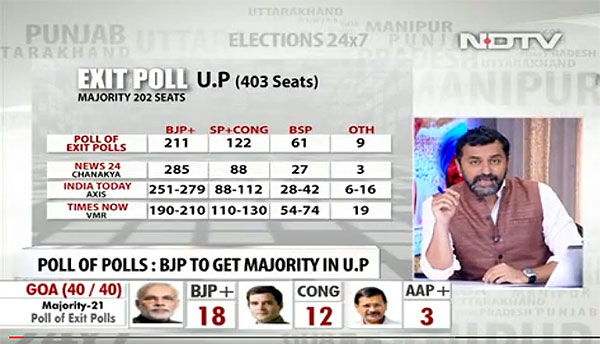
    Exit Polls have become a bit of a mathematical maze in recent years. There are 8-10 different polls, co-branded with two entities – one a media house or a media brand, and second a research or psephology firm. The results can vary significantly at times, to the extent of comfortably changing the predicted winner. Some of these polls give a “range”, while others predict an exact number of seats (error margins may be documented, but no one cares about those details, as anyone in the forecasting business will tell you).


    The new entity in recent years that adds to the maze is one called the “Poll of Polls”. It’s a simple average of all available polls, taken to find a level that’s generally seen as acceptable, because it presumably reduces the overall error margin by leveling things up. That notion (that the error margin reduces via this method) may not exactly be true, but it’s a viewer-friendly thought nevertheless, riding on simplification a a central thought.


    About a decade ago, channels and newspapers fiercely protected their work, not wanting others to share their data, and not sharing theirs in return. But in recent times, this has changed, primarily because this multi-source approach hedges their bets. Some channels have had egg on their face in the past, because they stood by some numbers their Exit Poll predicted, only to be found way off the mark on the results day.


    So now, even if a channel has its own poll, they share that as one of the data sources. It may get considerable weightage and attention, because they will have better demographic cuts and detailing available inhouse. But the larger story is still projected based on the Poll of Polls. So, it’s routine to see names of competitive channels being spoken (and on the screen) on such days. Last evening, for example, ‘Times Now’ was very visible on NDTV 24X7.


    Some channels have stopped commissioning their own polls, well knowing that there will be enough and more available to bite into. In any case, the entire exercise, such as the one last evening, is laden with confusion. For example, while it is amply clear that BJP-SAD will struggle in Punjab, and may end up with single-digit seats, the polls just could not conclude who will win the state. And while most polls suggested BJP would be comfortably the single-largest party in UP, at least one gave a very different picture, putting SP in front.


    Politicians, of course, take a stance of acceptance or denial, depending on how the results suit them. Sometimes, they can take a stance of whole-hearted acceptance on one state and a stance of complete denial on another, within seconds of each other. Very few like Yogendra Yadav actually understand how it’s all done. “Expert” comments on Exit Polls are thus largely political rhetoric, devoid of any statistical or rational view on the data.


    Do we really need these polls with only a day-and-a-half for the results? Anything for a day’s viewership. And anything for some pre-election mood build-up.


    On a lighter note, I wonder what would happen if all channels decide to stop their own Exit Polls and rely on the Poll of Polls, which would then not exist to begin with?


  • Shailesh Kapoor: RIP, Dr Mashoor Gulati? We hope not!


    This is the 200thedition of ‘TV Trail’ by Shailesh Kapoor on MxMIndia.com. We are delighted with the insights the column offers and treasure our association with Shailesh and the column.– Ed


    By Shailesh Kapoor


    Shailesh Kapoor writes about how there’s a growing perception that Sunil Grover as Dr Mashoor Gulati, is more endearing than Kapil Sharma on the show.

    The Kapil Sharma Show (TKSS) has been a runaway success thus far. When Kapil Sharma moved channels, many were sceptical about his ability to recreate the magic of Comedy Nights With Kapil (CNWK) all over again. Fatigue had already set in with the original show, and ratings were not exactly at their peak when it ended.

    But the success of TKSS has been emphatic. The show has outperformed its precedent in several weeks. Buoyed by many repeat airings of the show, Sony has moved up to the #3 rank in the Hindi GEC category.

    But there’s always the lurking danger of having a high-maintenance celebrity at the helm of a media property. Anyone who has interacted with Sharma on TV, films or ad work in the last two years will tell you how you have to tread on thin ice.Hence, what happened on a flight about a week ago, by all accounts, is not surprising.

    There were similar but not-so-public tiffs during CNWK, when Sunil Grover had left the show. At that time, he was playing a character (Gutthi) which had screen space of 5-10 minutes in an episode, and had an appeal that was largely driven by a certain talking style. The novelty was bound to wear off at some stage. The Rinku Bhabhi avatar in TKSS is in a similar space.

    But Dr Mashoor Gulati is not. He’s one of the most exciting comic characters on Indian television in recent years. There are episodes when his screen time is as high as 40 minutes, and his spoken lines outnumber Sharma’s. There’s a growing perception that Grover, in this character, is more endearing than Sharma on the show. Over time, this has also translated into a growing perception than Grover is more talented, versatile and spontaneous than Sharma as a comedian.

    Grover’s popularity share in the non-fiction category on Ormax Characters India Loves has jumped from 7% in May 2016 to 21% in February 2017. In the same period, Sharma’s popularity share has been stagnant, hovering around the 40-50% mark. The show could lose its sheen overnight and simply disintegrate over time if Grover sticks to his very-public stand and doesn’t return to the show.

    My mind is conflicted about what I would want the outcome of this crisis situation to be, if I could control it. Watching Dr Mashoor Gulati on TV is an absolute delight. But I connected instinctively with Grover’s heartfelt Twitter post. It takes a lot to put your career on the line. And unlike some of Sharma’s, it didn’t seem like a drunk tweet. So, it will be weird if Grover took a U-turn after that post.

    Sony would do well to somehow come out of this crisis in a way that the show’s intact. If not, they must consider giving Dr Mashoor Gulati his own fiction comedy show. That can be one kickass funny ride.

    Where does Kapil Sharma go from here is an equally interesting question. About a year ago, I wrote a piece here titled ‘Kapil Sharma And The Loss Of Innocence’. A year has passed and things appear to have gotten only worse. If there’s no return of innocence, we can be sure it will be an early end to the career of an immensely-talented comic star, who simply lost his way.


  • Shailesh Kapoor: IPL’s Tenth Edition: The Past, The Present, The Future

    By Shailesh Kapoor


    Come April 5, the tenth edition of the Indian Premiere League (IPL) starts. IPL has gone through its share of highs and low, both in equal measure, over the last nine years of its existence. The lows have been predominantly off-field, and in their own way, have contributed to building IPL’s imagery as a colorful, controversial and edgy brand.

    IPL’s history can be divided into three distinct phases. 2008-2010 was what one can call the ‘Novelty Phase’. This is when everyone involved was still figuring out the IPL. Its impact was grossly under-estimated when it first came in. When it became clear that IPL is a big-ticket entertainment property, with the ability to get 3+ rating on an average match and a sizeable crowd to the stadia, recalibration happened across the board.

    The ad rates were upped, the marketing push became more aggressive, the sponsor interest went up, TV channels started avoiding show launches in the IPL period, and Bollywood began to treat IPL as a graveyard period for big releases, despite May being a traditionally strong summer month.

    The 2011-15 period was the ‘Settling-In Phase’, when everyone began to come to terms with IPL’s existence, making peace with it, in a way. IPL became ‘business as usual’, as the novelty wore off yet the event value remained. This was also a period of controversies and of muck being thrown around. Ratings dropped a bit, with 2011 in particular being impacted by fatigue of the long Cricket World Cup that preceded the league.

    Last year, IPL had a fairly good season. Being the first season under the BARC India measurement system, comparing ratings would be a faulty thing to do. But the cricket was good and Kohli came into his own, boosting interest in the league. But if we go beyond specifics of what happened on the field in the individual games, IPL was slowly losing its ‘event value’ for the consumers since 2015. This phase is what one can call the ‘Stagnation Phase’.

    Stagnation does not mean loss of interest or viewership. It simply means there’s little evolution, and status quo prevails. Nine years is a long time, and once the novelty and then the event-value wore off, the league has entered in a phase when growth, or even maintaining the numbers, will be a challenge.

    In an ideal scenario, when IPL was in its Novelty Phase, the franchises should have focused a lot more on building a strong base of loyal fans, who would have ensured the event value never wears off even when the novelty does. Only two teams could do this to some extent, i.e., Chennai Super Kings and Kolkata Knight Riders. One of them is out of action for now.

    Two other teams were partially successful. Mumbai Indians relied on Sachin Tendulkar’s unparalleled equity in the early years, but in the long run, could not build a fan base that’s truly loyal. Royal Challengers Bangalore, on the other hand, had support for its star players than the idea of the team itself.

    Other teams struggled, most noticeable of them being the Delhi Daredevils. With no core fan base and a wide majority of viewers being casual and flirtatious, the league relied on its novel idea for a while. But long-term equity needs a deeper emotional connect with the viewers. In India cricket, it comes from a strong following of the national team, in what can be called ‘armchair patriotism’. IPL, however, is still driven by ‘entertainment’, which is highly ephemeral and extrinsic in the way it can create a viewer bond, if at all.

    IPL has done a lot for Indian cricket and cricket worldwide. But we live in an era where the concept of loyalty is dying in general. There are high chances that IPL’s future is that of an ‘Entertainer’, than that of a fan-driven, passion-fuelingsporting league.

    Yes, IPL is here to stay, probably for the next two decades, if not more. But can it do even more than just “stay”, is the real question.


  • Shailesh Kapoor: VOD Services: Bollywood’s Latest Saviour

    By Shailesh Kapoor


    The VOD (Video On Demand) business has been at the forefront of media discussions in India for a while now. With the launch of Amazon Prime Video (APV) and Netflix in India, VOD has gone ‘mass’, being no longer limited to catch-up television and live sports services run by broadcasters. APV, in particular, has made a significant impact, with an aggressive marketing campaign and a price point that’s affordable enough to coerce a traditional, ‘non-paying’ market like India to consider SVOD (Subscription Video On Demand).


    While original series were the talking point in the VOD space till a year ago, led by some great work done by TVF, it’s the film content available on VOD platforms that’s an interesting point of study too.


    If we go back a decade or two, the film industry got a huge shot in its arm when it discovered a new source of revenue – Satellite Rights. Film channels were mushrooming all around, and library buying was an aggressive, cut-throat thing. Films were purchased at prices that were not recoverable over their run period (typically 5 to 11 years). But high demand in the market ensured that most movies, including the ones that failed to perform at the box office, found a buyer at these exorbitant prices.


    Many films released in the 2003-2013 period became viable, even profit-making, projects for their producers purely on the strength of their satellite rights sales. It was routine for a small film lacking a starcast to make more than 60-70% of its total earnings from satellite rights alone.


    Somewhere over the last five years, this model has run out of steam. Most new films released in the five-year period before that, including the ones purchased at a hefty premium, failed to deliver ratings. When dubbed South action (purchased at as low at Rs 50 lakh to Rs 2 crore for 7-11 years) can outperform Rs100 crore Bollywood hits (purchased at prices ranging from Rs15-40 crore) comfortably, telecast after telecast, the pricing levels were bound to break down.


    The cinema almost became more urban and niche, with only about half a dozen films in the mass comedy and action genres every year. What worked in the multiplexes did not work on the telly. Single screen oriented cinema was more aligned to the small screen, but with the proportion of single screens’ box office revenue dropping year-on-year, the intersection between theatrical and television audience of films kept reducing year-on-year.


    Many films released in 2014-16 have not been able to sell their satellite rights. In most of these cases, it’s not even a case of the price point. Channels are just not interested in picking up content that’s proven dud on the small screen. In some cases, the rights are transferred within the same group that houses both the studio and the broadcasting brand. But for this advantage, the situation could have been much worse for the studios.


    But with the launch of VOD services, especially APV and Netflix, the second shot in the arm has come. Digital rights of films are being sold at aggressive prices, including certain deals that reward box office performance. Compared to similarly-attempted satellite deals in the past, there is more logic here, because of the huge intersection between the VOD audiences and the theatre-going universe.


    Many films releasing in 2017 are going to be comfortably in the green even if they are average to dull at the box office, because the digital rights will recover large part of the investment, greatly reducing the box office burden.


    Much as the film industry is welcoming this as a strong business opportunity, they need to guard against short-term greed coming in the way for long-term growth. The Bollywood box office business has been stagnant for four years now. As per the latest edition of The Ormax Bollywood Audience Report, the Bollywood theatre-goers universe (defined as those who watched three or more Hindi films in a theatre in a year) shrunk by 11% within a year, from 3.66 crore individuals in 2015 to 3.27 crore in 2016.


    This is an alarming drop in what is already a low number. If movies are easily accessible at low cost on VOD platforms, this number could go down further. If the theatre-going habit breaks and the universe continues to shrink over the next two years, there is avery real long-term threat waiting. And competition from Hollywood is not too far away.


    VOD services have emerged as Bollywood’s short-term friend. Hope they don’t turn out to be its long-term enemy.


  • Republic TV: A One-Man Movement?


    By Shailesh Kapoor


    It’s a new English news channel. It has a strange name, and is in the middle of an active, and rather peculiar, launch campaign. The launch date is not out yet, but ArnabGoswami’sRepublic TV is coming soon.


    But the campaign would rather say #ArnabWithYouSoon. Each video, PR article or promotional tweet about the channel has an unmistakable ArnabGoswami element to it. In many cases, that’s the only element.


    Three years ago, making a face synonymous with an organisation worked wonders. The face was NarendraModi and the organisation the Bhartiya Janata Party. TV channels can be slightly different though. Much as one person can pull in the audiences initially, you need to offer a strong second line to keep the 24-hour ship running.


    It could be argued that Republic TV will have a strong second line, and the one-man approach is only for the launch campaign. Goswami’s well-cultivated and well-marketed disgust towards other senior members of his community is well-known. Hence, one expects to see only younger faces on the channel, and it may take a while for the channel to go beyond that one show which Goswami will helm.


    But Goswami has shown in the past that he can be like the fearlessheroes of those awfully titled South dubs on Hindi Movie Channels – One Man Army, Yodha: Man On A Mission et al.He may not need much support by the way of his second line, at least initially. He could be on-air for 4-5 hours a day, if that’s what makes his channel topple his ex-employer and now his targeted rival.


    Oddly though, the channel’s website says prominently: “Republic is your movement”.It’s this dichotomy – of a one-man channel at one end and a people’s movement on the other – that requires some demystification. What exactly, except Goswami firing questions, which ordinary Indians want to ask but cannot, at the rich and the famous, will constitute a people’s movement? If it’s only this one thing, it’s called Newshour and we have seen it before.


    Newshour had not lost its relevance when Goswami went off air. Far from it. It was his debate show, and when it’s back, with a new name on a new channel, it will find the Newshour audiences in good measure. Is that differentiated? Yes, but only because the leading man is differentiated. Everything else about the channel seems like scenery, waiting to be chewed up by him eventually, even if the marketing campaign makes a big deal of it using phrases like “independent” and “people’s movement”.


    The other potential concern with the campaign is an overkill before the actual launch. There was certain intrigue about waiting for Goswami to come back on-air. Over the last two weeks, with all the promos, the press statements and the public appearances, that intrigue has started to dilute. It will be a fine marketing balance to achieve, where one needs to build awareness and yet keep the intrigue factor going.


    The next few weeks will tell us how things unfold. Nothing but the most outstanding results would be expected from Republic TV, given the hype, a lot of which they have consciously created. If Republic TV is not the # 1 English News Channel about 2-3 months after its launch, the ArnabGoswami brand will come under the scanner. But if it knocks the competition out in the same period, you can be sure the man will let you know the minutest detail, down to the second decimal place.


    Let the fun begin!


  • Bahubali 2: The Giant Arrives Today

    By Shailesh Kapoor


    Before the Hindi version of Bahubali: The Beginning released in 2015, not many Hindi film audiences knew about SS Rajamouli. Some may have seen Eega’s Hindi version (Makkhi) and enjoyed Hindi remakes of his Telugu films, Rowdy Rathore in particular being a big success. But the man behind these films was irrelevant.


    What Bahubali 1 achieved was rare and exceptional. To begin with, it broke a North-South divide that had existed in our cinema for eons. No South film had got theatrical traction among Hindi audiences. Robot managed some footfalls, but its lifetime Hindi collections were lower than recent films like Phillauri or Begum Jaan. To cross Robot’s 20 crore mark was easy for Bahubali 1. But the film went on to become the first dubbed film to cross the 100 crore mark, a five times improvement!


    Over these two years, Hindi film viewers have become familiar with Rajamouli and his work. His vision of Bahubali is something these newly-acquired fans have made their own. Of course, the first film left us with that one unanswered question, on ‘Why Katappa Killed Bahubali?’. But that’s just a catchphrase at best. Bahubali 2 is not about that answer alone. It’s a lot more than that.


    The film is set to open in the 35 crore range in the Hindi version alone today, which is seven times the opening of the first part. 200 crore is a foregone conclusion, and 300+ is entirely in the realm of possibility, especially given that there’s no major event film till Tubelight in June. (The first film had to face BajrangiBhaijaan within a week)


    That a dubbed film with no popular Hindi star can do this level of business puts our flawed star system in perspective. Escalating star prices make many film projects unviable at the onset, where a best-case scenario (great content and a open release window) would mean breakeven. Only a few stars today have the ability to open on their own strength, but since they cannot be doing all the films that are being made, the next lot benefits from their star power, creating economics which are fundamentally flawed and anti-growth.


    In the last three years, when footfalls have fallen and the business has stagnated, a common reason given for the industry’s stagnation is that the audiences are moving to digital. Bahubali 2 is set to prove how flawed that argument is. Of course, more audiences will embrace digital with time. But when there’s good content that deserves a visit to the big screen, they will opt for it wholeheartedly, even at escalated ticket prices.


    Bahubali 2 may not start a trend, because after all, there’s only SS Rajamouli, like there’s only one RajkumarHirani. But it definitely shows a mirror to Bollywood on how the power of original ideas can dwarf the power of stars and the packaging gloss. Bahubali 1 is already the highest grossing Indian film ever. After Bahubali 2, the Top 2 in the list will be both non-Hindi films.


    It’s a separate matter that Bahubali has been adopted by Bollywood as one of its own, and its Hindi version collections will be counted in Bollywood stats. And it is this difference of 200-300 crore that could ensure that the industry has a stronger 2017 than 2016. Now that’s an irony!


  • Two views on Week 1 of Republic


    Republic TV: Week 1 In Review 

    The stance seems so overpowering that it is beginning to overtake the content itself, writes Shailesh Kapoor
     

    By Shailesh Kapoor


    He arrived, back into our lives, on Saturday, May 6, 10 AM. There was even a hashtag to mark the occasion. It was called #May6WithArnab. Arnab Goswami’s absence from the small screen may not have changed the politics of India, but it kept us deprived of his unique brand of journalism.

    The channel has been on-air for six days now. Here’s a review of its rather eventful first week:

    The positives first. I liked that opening speech on May 6. Arnab was like he’s in real life: Candid, warm, even smiling. Wish we saw this side of him more often. Pleasantries done, he came all guns blazing at us, with what has been a regular feature on the channel in the first week: Republic Super Exclusive.

    It’s been six days and the channel has covered roughly the same number of stories. There are no headlines, side-news, IPL news, Bollywood news, feature shows etc. Talk about focus, and it’s here to see. This focus makes Republic TV is easily the most unidimensional news brand India has. It’s a differentiator alright. How many Super Exclusives can they find after the launch euphoria is over, will be the key to how well this focus sustains.

    The packaging is good, though derivative of what we have seen before. The channel is well-connected and available. The Hotstar deal, just ahead of the launch, is a huge plus. Early number on Hotstar have been very positive, giving the channel a genuine additional platform, which is far from effective than channel apps and websites.

    But all was not right in the first week. The first problem was a known, expected problem. The channel evidently lacks a strong second line of reporters. Arnab has been propping many in his team over the last six days, but none of them are seasoned names. They are clearly trying to learn from the man and grow. Which means that they will try and become like him. Which doesn’t work, as we have seen in the past on Times Now.

    The second issue for me is a bigger one. Some of these Super Exclusives being “broken” are dated, from a time when Republic TV was not even envisaged, forget being in existence. The most striking example here is the so-called exposé on what Goswami keeps calling the “Sunanda Pushkar murder”.

    The said story is based on taped conversations between journalist Prema Sridevi and Pushkar’s staff. These conversations date back to 2014, from the day before and the day of the “murder”. Sridevi was working for Times Now then. She even mentions Goswami in one of the phone calls, as being the person who asked her to meet Pushkar.

    Both Goswami and Sridevi were with Times Now for almost three years since those calls were made. He would have done at least a dozen (probably a lot more) prime-time debates on this topic on the channel in that period. But the said tapes never made their way on-air. Whatever be the reason, the material, technically, is the property of Times Now, but is being used on a platform that now’s in fierce competition with it. This one point of ethical departure is difficult to justify.

    Many of the Super Exclusives have been based on thin evidence and are more suggested “scams” than real ones. But that’s been the nature of Goswami’s attacks on politicians over years. Not surprisingly, there have been no stings exposing anyone in the BJP so far. It could be a while before that happens.

    But what bothered me the most is that there’s even more aggression in Goswami’s approach on Republic, with his stance being more confrontational, to the point of being forced confrontational at times. It’s as if a rebel has been freed of all the clutches he was being controlled by earlier.

    Goswami’s style was always abrasive, and there was no need to outdo himself. He was already on the edge, and I fear he may have gone too far this time. Being a voice of the nation and the people is good, but here, the stance seems so overpowering that it is beginning to overtake the content itself. It can easily backfire. We will have to wait and watch.

    Early numbers will be good and you can be rest assured Goswami will flash them all over his screen and make it a Super Exclusive too. The first week has been action-packed, but not necessarily rock-solid. Let’s see where this Republic is heading.


    The Republic & The Others 

    The upshot of the launch of Republic TV is that practically every news channel is following Goswami’s example, writes Ranjona Banerji

     

    By Ranjona Banerji


    The funniest thing on Twitter in the past few days is Rahul Kanwal, managing editor of India Today TV, grumbling that Arnab Goswami’s Republic TV is BJP-sponsored. There may be no doubt that there is a strong BJP link to Republic. But there has been little doubt to the average TV viewer that India Today TV, Kanwal and his fellow news anchor Gaurav Sawant, are exceptionally pro-BJP. Sawant’s investigative report into how UP chief minister Yogi Adityanath’s pet cows were so excited to meet him will go down in the annals of Indian journalism as a chamchagiri classic. Now that Karan Thapar’s shows are no longer on India Today TV, there remains RajdeepSardesai to provide a semblance of “neutrality” on that channel.

    Indeed what seems to have happened to most English news television in India – with the possible exception of NDTV – since the launch of Republic TV is a deplorable race to prove which is the most “patriotic”, that is pro-BJP, channel. The immediate focus for most is therefore Pakistan and the armed forces. The death of a soldier in Kashmir by suspected militants has whipped TV journalists into an enormous frenzy of rage and revenge. The second focus is Delhi chief minister Arvind Kejriwal, probably for his unending onslaught on the rigging of electronic voting machines. The third and frankly most idiotic “expose” was Republic TV’s launch – Lalu Yadav. Even a first year journalism student (I don’t hold my breath here) ought to know that the cattle fodder case against the Bihar leader is 20 years old and that he is banned from contesting elections after being convicted. And then there was Republic TV accusing Congress member Shashi Tharoor of murdering his wife. Words fail at the lack of journalistic sense or judgment.

    Running through news channels on Thursday night, this is what I saw:

    NDTV: Triple Talaq
    India Today TV: Kejriwal is a thief
    CNNNews18: A buffalo is under arrest in UP
    NewsX: Forget Doordarshan, we’ll tell you what Modiji inaugurated
    Mirror Now: Don’t drink water in Gurugram
    Times Now: Kashmir is burning, ZakirNaik is a traitor
    Republic TV: The Army should run the world and no one should ask questions.

    What no news channel focused on was the government itself and what it was doing or not doing. Does it bear repeating that the current government at the Centre has been in power for three years now? When Pakistan attacks India, when Kashmir is in turmoil, when there are allegations of election rigging, when there are problems with the Aadhar system, when the country faces drought, when farmers are on strike, when the effects of demonetisation continue, what journalist worth his or her salt puts the opposition under the scanner?

    The composition of panels for our nightly “debates” provides the answers. You are lucky if you can find even one government representative on them amidst the 500 screaming guests. At best, there’s a BJP spokesperson. But a party spokesperson does not speak for the government. Though as we all know, in spite of all the sucking up, this government does not speak to the media. The prime minister limits himself to platitudes on a monthly radio show and that’s the best you are going to get.

    The upshot of the launch of Republic TV is that practically every news channel is following Goswami’s example. All credit to him there. But by allowing Republic TV to set the agenda, his competitors are losing the ground they had captured after Goswami quit Times Now. Goswami’s “attack all Muslims and support the BJP” approach will necessarily have limited scope, no matter committed anyone may be to the Hindutva system. But that is Republic TV’s agenda and Goswami’s own style. It is not possible to do more than mimic him which is pointless when the original is out there. The rest of India’s news channels still have the option to go their own way without falling into Goswami’s trap.

    The next step would be to practise some real journalism.

    Breathe deep.


  • A Derailed Media: The Wheels Have Come Off


    By Shailesh Kapoor


    If you have been a follower of news media in India over the years, there’s high chance that you would see the freedom of the pressas a fairly natural outcome of our democratic machinery. In a country where taking offense has turned into a national pastime, the media has still been an independent institution, except in extreme times like the Emergency.


    Sections of the media have been guilty of catering to political interests of certain parties or politicians. But the larger media landscape has been one of an independent, though often opinionated, press. There have been propaganda papers and party mouthpieces, but those have been exceptions in a largely flourishing media environment over the years. Till recently.


    Over the last month or so in particular, the derailment of the freedom of the press idea is stark and evident for us to see. The wheels are coming off. The issue has come into focus especially since the launch of Republic TV, even though many would argue at least two mainstream Hindi news channels have been BJP mouthpieces for almost three years now.


    But with Republic TV’s launch, all efforts on being ‘seen’ a neutral media, even while having a political agenda, has been discarded. The channel is so evidently pro-Establishment that even when it covers the odd anti-BJP story (only twice in two months so far), there’s a sense of apology in the way it’s covered.


    Pro- or anti-Establishment doesn’t bother me much. It’s an editorial prerogative to take a stand on political issues, and at times, ideologies could align themselves in a way that a certain vehicle may end up supporting or opposing the establishment in what may come across as a pattern.


    What bothers me immensely, however, is the distortion of the idea of “news” itself. If you see primetime coverage in the months of May and June, you will notice that there’s been endless discussions on several channels on two topics in particular: Kashmir and the Indian Army. There’s been a nationalistic fervor to call out those who are against the Indian Government and the Indian Army’s approach in Kashmir.


    In times when the GDP has declined, the GST is ready to roll in, farmer agitations over support prices are peaking, and the impact of demonetisationis still not fully understood, the economy would logically be the most topical theme to cover. But you will struggle to find coverage and analysis on these topics on TV in particular. Because apparently, it would need fact-checking, which is hard work, and may expose the establishment, which is not everyone’s idea of how they want to run their media house today.


    To further complicate matters, the NDTV raids came in the middle of this prevailing atmosphere of a polarized and divided media. The show of strength that followed at the Press Club indicated the growing dissatisfaction that parts of the mainline Indian media have with the current Government at the center.


    The silver lining, in such times, comes from the Internet, which has the structure and the ability to present the truth in a more layered and multi-faceted way than most channels and newspapers are willing to. Of course, you need to know which sites or handles to visit for that. But at least, you have some chance of getting an objective coverage of topics that concern us today.


    We are only two years away from 2019, and I dread to think if things will get worse. But is that even possible?


  • Shailesh Kapoor: Panic Time For Hindi GECs?

    By Shailesh Kapoor


    Over the five years of existence of this column, one of the most-extensively covered topics here has been the status quo in the Hindi GEC category. Every few months, I have touched upon the concern that the category has got too inert for its own good, not recognizing the viewer dissatisfaction that’s been on a steady rise over these years.


    Over the last few weeks, the numbers are beginning to tell a story that’s harsher than ever before. In the equivalent eight-week period (May-June), 2017 saw a 11% drop in Hindi GEC ratings in Urban (HSM) India, compared to 2016. The drop is even higher at 16% at an Urban + Rural level. Since BARC’s last major market expansion in end 2015, the category has lost more than 20% viewership.


    Over-simplistically and erroneously, some may attribute this to the rise of the digital media. If that was the case, the drop would have been more significant in the Urban markets, and the Rural markets should have held steady. But that’s not the case. So, unless we attribute all of this to BARC panel settling down and the reporting getting more accurate with time, the problem is too stark to turn a blind eye to.


    There has been a 15-20% drop in weekly reach of the top channels, indicating lower sampling levels itself. Why are less people watching Hindi GECs over time? If there was an overall trend linked to panel correction, it should have reflected in similar de-growth in other genres. But that’s not happened. Kids and Hindi Movies are perhaps the two most mass genres to compare in context. Both have shown about 10% growth over the last year.


    Clearly, it’s a Hindi GEC specific problem. From an average number of actively-followed programmes of about 9-10 three years ago, an average core (heavy) Hindi GEC audience today actively follows only about 6-7 programmes. The interest to add new launches to this list continues to dwindle. Hence, with each established show going off-air or losing its sheen, the problem multiplies.


    We are in an era where digital content is grabbing the headlines. Much as its impact on television is miniscule, the GECs cannot possibly be caught napping in this period where digital is headlining content innovation. If not anything else, the advertiser can be swayed over time.


    From 300-GRP channels to 225 to now 150, the big guns in the Hindi GEC category are no longer the giants they used to be. The viewer has waited for a long while, patiently like she always does, to see a change that has not come by. There’s not been a truly blockbuster weekday show for almost four years now, since Yeh Hai Mohabbatein, which launched in December 2013.


    Innovation, when it has been attempted, has been at the cost of relevance. Genre lacunae like fiction comedy continue to remain. Serials becoming replicas of each other, both in terms of plot and treatment, is now a well-recognised consumer sentiment.


    There may not be any easy solutions around, but the “Innovation” button needs to be pressed, without losing sight of relevance. It may not be easy, but any category that has de-grown by double digits in one year needs to find hard measures to fix its issues. Another year of 10% de-growth, and GECs may not even be “mass” anymore!