Category: COLUMNS

  • Sanjeev Kotnala: Stop strangling advertising with social correctness!

    By Sanjeev Kotnala


    I know, I could get trolled for my point of view and reminded of my commitment towards society. I will be chastised for lowering expectations from brands and the advertising fraternity – including clients, media and the creative teams.

    I appreciate brands with a more significant vision. I respect their attempts to lead the society towards a better future of equality and empowerment. We do know, soon, Johnny too will have Jane walking alongside.

    We also know, most cause marketing initiative are good-feel programmes that will be written about, create positive buzz and go on to win few awards. The best of brands are known to punt on them. They know how easy it is to hoodwink the consumer with short memory is, who is always looking for the next kick.

    Simply, there is lack of serious intent to invest and sustain such initiatives.

    Much awardwinning cause marketing initiative gets buried in annual reports, framed on ego walls, repacked in videos and proudly debated in presentations. Some fortunate ones do end up with real ground activation. However, most get suffocated with lack of financial support, CXO change or the brand team losing interest.

    Tiny percentages of brands that successfully work on sustenance driven model end up making long-term impressions. No not using the word impact.

    It’s natural that they fuel expectations. They deliver organismic delight to the armchair social media activists. These bloodhounds, the set of intellectuals, social influencers, preachers of multiple causes, ill-informed brand enthusiast and advertising maestros start poking questions on creative that does not to pass their filter of social appropriateness.

    Opinions count.

    Everyone has an opinion, and we should be respected this diversity. Unfortunately, most of the loud voices hallucinate considering their verdict as final. People seem to have no patience. They reject a POV not mirroring their thinking. The majority opinion gets amplified with the support of fringe groups that sounds politically and socially right. I do not belong here.

    There has to be something wrong.

    Logically, it is easy to infer that one of two sides; the cribbers or the creators have to be wrong. The win-win is not an option. We must start re-evaluating the situation. We must address the elephant in the room. What is the prime objective of advertising?

    Is it to show a mirror to the society and provide a direction? Or to find a relevant, original insight that can be leveraged for brand impact, brand preference and decisive action in the defined TG.

    Is the communication wrong, if it fails to get a favourable echo from the arrived-in-life individuals with strong ideologies? Most probably, the message was not for them. They can’t be using the same scale to measure every creative.

    Brands have business to do.

     “The purpose of advertising is to sell. That is what the client is paying for, and if that goal does not permeate every idea you get, every word you write, every picture you take, you are a phoney and you ought to get out of the business.” — Bill Bernbach.

    Why do we repeatedly forget the business side of advertising? Advertising is targeted communication. A team has found enough logic and reason to invest in and exploit for business gains.  While we can post-rationalise and try understanding their reality, we must not mistake the map for the territory.

    “All of us who professionally use the mass media are the shapers of society. We can vulgarise that society. We can brutalise it. Or we can help lift it to a higher level.”  — Bill Bernbach

    Even I agree with it. It’s a high intent to have but not the only intent and the yardstick to evaluate.

    I share what the readers will agree with.

    “Our job is to sell our clients’ merchandise … not ourselves. Our job is to kill the cleverness that makes us shine instead of the product. Our job is to simplify, to tear away the unrelated, to pluck out the weeds that are smothering the product message.”  — Bill Bernbach

    If we don’t show, it stops to exist!

    Trust me, I am surprised at the ostrich thinking that permeates everywhere. It is going to make no difference. Nothing will change by keeping a purdah (curtain/mask/camouflage) while projecting the empowered housewives, kids, families and any community. Just because you stop showing the ugly side and keep shining the new element of positivity, the issues will not magically disappear.

    Here is the recent All-Out strong mothers film. A communication vigorously questioned for its choice of storyline and narrative.

    You all noticed the extra-patronising mother-in-law. People ask why it was not a granddaughter. The father raises his voice questioning and taunting the mother if the money that the kid stole belonged to her father?  She does not answer and silently serves. How demeaning can that be? Does she have to be so subservient? Can’t she counter argue? Can’t she take on the goons-in-the-family?

    How dare we show this side of the family and mother? Why were these frames in the narrative? Why was the lady of the house reframed for her small middle-class upbringing? Why were others silent in the conversation? How come an agency that is known for its brilliant all-empowering work even make such a film?

    How come the creative agency never objected? Was the client not interested enough? Were they blind to the situation?

    The conscience-keepers of the industry question the portrayal of the tough mother. They find it a regressive. They may feel so living in metro and mostly nuclear double-income family.  They are far removed from real India. The situation is alien to their sensibilities and the direction we should be moving. Does that make them right?

    A film is a call of creative-client-consultants-producer-director nexus. Every brand is cautious in their approach. They all want to be politically right. They also know that an unrealistic goody-goody situation will make the brand-consumer relationship a promise in fantasyland.

    All communication has a positive intent.  It has a contextual frame to address a pre-identified target group. And within the joint families, the scenario is not too different. The communication was used as a foundation for the #StandbyToughMoms idea in sync with Times Of India Sports awards. Bill Bernbach would appreciate it.

    Look at it from another side. The agency and client are not afraid. They know they are committed to their profession. May be including the repulsive behaviour is the brand’s way of waking you up.  May be it is their way to get the audience to notice and comment.

    Would you notice the obnoxious husband if he had remained silent or polite in the frame? Did you fail to miss the decisive shift with head-of-the-table getting into discussion and decision mode? You can see that along with you the rest-of-family realises something was wrong. The mother-son gameplay is powerfully purposive; it is following unsaid rules written down in the family.

    Most likely this was one of the scripts for the job.  It won in the business-need-creative-balance-political-right-budget scale.

    Advertising rarely needs to play the role of an activist. There are other organisation and leaders to do so.  It needs to remain grounded in reality. It needs to nudge not revolt against the wrong practices. The uproar shoes that this All-out communication was out-right a perfect nudge.

    Should the creative now work under a new set of guidelines that places constraints on the thinking and the creative process? What do we want or expect? Do we want every brand to be cause-centric and CSR-oriented NGO? Do we always need to be hypersensitive with an extreme opinion?  Should we start defining the boundaries of representation in advertising for everything?

    So, now onwards, the homemaker must eat with the rest, daughter-son must eat at the same table, daughters definitely should not cook, working-lady must not come home and prepare meals, Working mothers must find extra time to communicate with the child. If she gives cake in Tiffin, she must pack another suggestive nutrition rich lunchbox. She must not be shown washing alone. The wife must not serve tea when the husband has it alone. Marriage must not precede job. Women should still ask for Johnny and forget Jane. The fairness cream and the extra bounce hair gel should not make her centre of attraction and even get her a job.

    And Amitabh Bachchan can’t just keep shooting the gun without reloading the chamber.

    Or, we have a choice.

    Stop defining boundaries. Stop templatisation of behaviour. Stop cribbing. Stop expecting the same behaviour from every brand. Be sensitive.

    This does not mean that I ask you to be silent.  Don’t stop questioning. Keep raising your voice in favour of significant issues. Sexualising of communication. Women exploitation.  Racism. Fuelling unnecessary desires by projecting wrong sizes.

    #StandbyToughMoms TVC fails to have any brand connect (ALL OUT). Relating ‘silently strong’ motherhood to All-Out is taking things to far. Trust someone will have cryptic answers to these observations too.

    Let the consumers decide.

    Trust me, if brands tend to go against the consumer mindset, consumers will reject it, and the brand will be the loser. Let the consumer decide.


    Best media connect for strong moms

    http://bestmediainfo.com/2018/02/all-out-bats-for-tough-moms-in-new-spot-but-is-there-any-brand-connect/




  • Ad agencies vs Consultancies debate gets real


    By Prabhakar Mundkur


    So far, the debate on advertising versus the consultants was a theoretical one because it was not affecting the Indian market yet in any significant way. Companies like EY, KPMG, and PWC have been very active in digital marketing overseas but this capability was still not very active in India.  But with the launch of Deloitte Digital in India on January 12, the landscape is likely to change.  One will have to wait and see how the launch of Deloitte Digital willaffect  competitionlikrGroupM, Dentsu-Aegis and IPG Mediabrands.  Rakesh Barik – Technology Consulting, Deloitte India told the press, “Unlike existing creative agencies, we understand the business also.  We will help companies digitize their core”.  By implication it does mean that creative agencies don’t understand the business of their clients, something that has been troubling the advertising industry for some time now.  What’s more contrary to popular opinion ,the consultancies have been acquiring  talent in creative, designing and research, making up for their traditional lack of skills in this area.

     

    Hotstar’s Employer Branding Campaign

    Hotstar is a live streaming app that lets you watch your favourite shows, movies, sports and live news on-the-go. Most often its funny how we are able to see brands only as consumers of it.  So strong is our consumer perception of brands that often we may not even consider them as employers.  In fact, so strong is the value proposition to consumers that companies have to take a special effort to make a value proposition to its future employees and this is exactly what Hotstar has managed to do in its latest employer branding campaign.  The latest campaign from Hotstar positions it as a tech player to attract the best tech talent, which no doubt has several competitive options in the country today.

    The campaign makes you see Hotstar in a new light.  As a tech company that could offer the youth an interesting challenge.  The ‘Dare or stay there’ baseline is provocative enough for young techies to seriously consider Hotstar.


    Amazon Go 

    No wonder Amazon is being referred to as the ‘tech giant’ these days in the press. It’s no longer just the ‘online store’ or ‘e-commerce giant although its immediate competition might love to see it that way to serve their own purpose.


    With Alexa becoming the preferred personal assistant and taking giant strides forward, Alexa is not just a home assistant but is also taking control of cars (Ford has just adopted Alexa) and our other devices and possessions.


    Amazon now takes the pain out of shopping – no queues and no checkouts in their Seattle store. Just pick what you want from the store and get charged to your Amazon pay card on the way out. That’s the experience that Amazon offers at Amazon Go. The faqs on amazon.com had this to say about Amazon Go.


    What is Amazon Go?

    Amazon Go is a new kind of store with no checkout required. We created the world’s most advanced shopping technology so you never have to wait in line. With our Just Walk Out Shopping experience, simply use the Amazon Go app to enter the store, take I the products you want, and go! No lines, no checkout. (No, seriously.)

    I  liked the commercial because it made the concept of the new store really clear. It was really functional advertising which is a great way to launch a new brand.


    Indian men are not the only ones to touch their junk?

    For a long time now, there has been some public criticism of how Indian men touch their junk. A dermatologist friend of mine explains it away as tropical climate with a lot of heat and dust which could create conditions that justify this despicable Indian habit, especially amongst some classes of people.  But a new TVC from Columbia may imply that the habit is not unique to India.  The Colombian League against cancer has found a hilarious but gross way to make men aware of testicular cancer.


    This is an insight that is waiting to be used in the Indian market.  Everybody is going to identify with it.  In fact, I am wondering why no one has exploited it yet.


  • Shailesh Kapoor: The Sridevi Coverage: Where Does The Media Go From Here?

    By Shailesh Kapoor


    Less than two weeks ago, Bollywood heroine Sridevi passed away, leaving the film industry and her innumerable admirers in shock. Over the last decade or so, several film legends have passed away in India. But Sridevi’s death was different, in that she was only in her early 50s, and keeping perfectly good health too.


    If how the media handled Bollywood deaths over the last decade was any indication, expecting any sensitivity in Sridevi’s case would have been out of question. Callous headlines, poorly-researched obituaries and loose analysis are par for the course. We saw that during the passing away of Rajesh Khanna, Shammi Kapoor, Yash Chopra, Vinod Khanna and Shashi Kapoor. The deaths were treated as some sort of concoction of breaking news and film gossip. They were “news events”, not just news. But this treatment was restricted largely to Hindi news


    In Sridevi’s case, the media had a field day, once it was revealed that the death is not natural but accidental. Voyeuristic journalism came into the fore, with theories related to murder mystery and debauched celebrity lifestyles being covered with irresponsible ease. The English media, especially television, joined in with full gusto. Many channels likened the case to SunandaPushkar’s death. Theories and conjectures were floatedwithout any sense of proportions, and the flight of fantasy that some journalists took would make them worthy candidates to write a Bollywood script.


    This period of two days ran in parallel with the Dubai authorities doing their regular procedures before handing over the actress’s body to her family. When that process was completed, the media quickly realized they had gone on a chase that led to nowhere. So, the “case was closed”, and the focus quickly shifted to “breaking news” from the airport, her residence and then the funeral venue. In all this, the big financial scam of the preceding week, involving Nirav Modi, became non-news in an instant.


    Media frenzy was seen recently at the time of Jayalalithaa’s death too, as covered in an earlier column here. But Sridevi’s death took the callousness to another level altogether. Imagery associated with the coverage has done rounds of the social media, and most readers here would have seen the MautKa Bathtub graphic, the reporter in the tub moment, the ‘send white flowers to Sridevi’ viewer invitation, the collage of “drinking” images fromSridevi films, the sizing of the bathtub and more.


    Much as social media came together to criticize the tone and tenor of electronic media’s coverage of Sridevi’s death, it doesn’t count for much. The truth is that there is a wide set of audience which finds all of this watchable. And till news media will continue to be judged and bought for its viewership, not much will change. If at all, the coverage of Sridevi’s death has set a new benchmark, which is now ready to be beaten.


    Attempts have been made in the past to set editorial guidelines at an industry body level. But guidelines, by definition, are subjective in nature, and in a real-time, live scenario, they are hardly a factor. The only way out, if one was keen on finding one, has to come from the advertiser side. Most Indian news channels still rely primarily on advertising revenue, vis-à-vis subscription. And if the advertisers’ community comes together and decides to “approve” channels it will invest in, things can change overnight.


    But would they be really doing that? Eyeballs are bought like commodities. And it’s as much a business as the business of “TRPs” is. So, while the media is directly callous, the buyer is implicitly so as well.


    But if advertisers can take a wider, more responsible approach, they can fix things soon enough. Just a one-day token boycott of a news channel will send shivers down the entire industry’s spine. It can be done. But it needs the top 10 spenders to come together, which almost sounds like a flight of fantasy in itself.


  • News on TV: Future Tense?


    By Ranjona Banerji


    Do you know anyone who lives in a big city, under the age of 30, who watches TV news for three hours of an evening or reads a newspaper for an hour every morning? I don’t. I know that these young persons get news from their phones, they livestream sports and entertainment at their convenience. They are not bound by the logistics of traditional media. They have been freed by the digital experience.

     

    But what does that mean for journalism and mainstream media? As far as “content” goes, news reports and opinions can shift almost seamlessly from print to online. But how does TV transfer? Will a generation fed by Google and occasionally Facebook suddenly sit still in front of a television set for hours, watching people scream at each other once they turn 40?


    Or will some new innovation have come along by then which will produce even more changes in people’s reading and viewing habits?


    Either way, this is a bit of a seismic shift happening. The assumption so far within the media was that TV was unassailable and it was the print media and paper which was in trouble. But paper itself never should have been the issue. Paper is just trees that will now live. Online news is not so different from paper news in the way it is put together. But television faces a completely new and tough challenge. It has to realign itself with changing habits and changing demands. If I have Amazon Prime and Netflix, why do I need a cable connection or a DTH set-top box any more? And where then will I watch television news?


    In simple personal terms, I can explain it in terms of sport, which in fact I have done before. If my TV subscription does not allow me to watch the sport I want – tennis – I will look elsewhere. And as time passes, I will be more and more successful finding what I want online. I can watch it on any device, including my television, for a Rs 4000 dongle or a Rs 400 cable.


    And that brings me back to question one: How many 20-year-olds sit down and watch screaming anchors and their gusts throwing tantrums for two hours every night?


    As of now, TV news is an old man’s game in India and it is unlikely to change. There may be no immediate challenge but that doesn’t mean that the challenge is not on its way. As it had happened within the print media earlier, the warning signs were there, but no one was willing to pay attention or take them seriously. Some newspapers decided that online and paper within the same newsroom must compete. Others pretended that the online purpose was served by hiring techies. All bows, no present.


    The challenge is how to make money, how to monetise content without compromising integrity, how to pay journalists, how to negotiate a deal with Google… and it’s no small challenge. The internet is free or so cheap that it does not matter – that’s how it works for readers. How many of us actually subscribe to online content? Or cough up when we reach a paywall? And how many of those who do are under the age of 30?


    Right now, many of these conversations are happening at the subterranean level. But it’s time to bring them to the top and figure out together how the future of news is going to work. Otherwise, we sink underground together. Penniless. And someone else is laughing all the way to the bank.


  • Ranjona Banerji: When News TV finally woke up to the famers’ protest, except for…

    By Ranjona Banerji


    As some of Maharashtra’s farmers marched to Mumbai to demand their rights and that promises made by politicians be fulfilled, they were initially ignored by the intrepid television media. Print and web journalists were part of their journey as were some citizens, trying to understand why thousands of farmers were on a 180 km journey on foot, through heat and discomfort.

    https://mumbaimirror.indiatimes.com/mumbai/cover-story/join-us-on-monday/articleshow/63251180.cms

    As numbers grew and reports in newspapers and the farmers reached Mumbai, the discourse, as often happens in urban India, shifted from the march to the possible inconvenience to commuters and students. But luckily deflection was shortlived. In fact, there were numerous reports in various media about how Mumbaikars came out in large numbers to support these farmers, with water, food and even footwear.

    https://scroll.in/article/871684/feeding-those-who-feed-you-how-mumbai-residents-welcomed-farmers-marching-through-the-city

    https://www.mid-day.com/articles/maharashtra-farmers-protest-citizens-come-out-with-food-water-and-moral-support/19182194


    It was only after all this that television woke up. Well, not all television. On the morning of March 12, almost every news channel had reports on the Farmers March, except, surprise surprise, Times Now and Republic TV. Both of those channels had greater news to discuss – the death of Sunanda Pushkar, wife of Congress leader Shashi Tharoor.

    How embarrassing to be a journalist in either of these two channels. To ignore a massive peaceful uprising of anywhere between 35,000 to 50,000 people, from a community which is suffering openly in today’s India, just because it does not suit a political agenda is both shameless and shameful. Just as a journalistic exercise, it is worthwhile to follow such movements. You learn from the ground up rather than sit in a studio and spew bombastic venom.

    As the day progressed, there were enough attempts to change the narrative from brave farmers to anti-national farmers, on Twitter as well as by BJP politicians. One news agency with close BJP connections put out tweets suggesting that there were only 7000 farmers in the march and not 35,000. In one world, serious news outlets would stick to reportage and leave the opinion for another day. Or, they could call out the hypocrisy of all this when the BJP-run Maharashtra government eventually agreed to all the demands made by farmers. In any other world, there would be all day and all night screaming matches on TV, between supporters of Poonam Mahajan who said the farmers were egged on by “urban Maoists” and supporters of Devendra Fadnavis who gave into their demands. Did it happen? It would have if it was any party but the BJP being held to account by India’s farmers.

    What has really riled our patriots and their puppy news channels is that the Farmers March was initiated by Left parties. This literal red flag blinded many to what the farmers were actually saying, what they have been through and the hardship they suffered on the march itself.

    Meanwhile, amidst many other excellent articles, there is this round-up of the events around the Farmers March from The Telegraph, Kolkata:

    https://www.telegraphindia.com/india/blister-that-should-make-india-choke-on-its-coffee-215341#.WqdEK33r5Qw.twitter

    And this, from Alka Dhupkar in Mumbai Mirror, on what has been planned for the future:

    https://mumbaimirror.indiatimes.com/mumbai/other/hunger-strike-jail-bharo-andolan-next/articleshow/63276892.cms

    **

    In the other less real world, TMC MP Derek O’Brien did an interview session with senior editors of the India Today group at the recent India Today Conclave held in Mumbai. O’Brien did not hold back in his questions. He brought up tweets by India Today journalists and the company policy. Salute to India Today for allowing this. However. The reference was clearly to a couple of instances involving journalists from the India Today group. Angshukanta Chakraborty, political editor of DailyO was asked to leave because she refused to delete a tweet which asked for media owners to be culpable for sectarian hatred spread by their employees. Some of these employees are senior editors of AajTak, India Today TV and Mail Today. All of whom kept their jobs in spite of inciting hatred and openly lying. The person who pointed to it, without naming names, lost her job.

    The answers and explanations were very defensive and worth viewing. This is our future in journalism.

    https://www.indiatoday.in/india-today-conclave-2018/video/derek-o-brien-grills-editors-of-india-today-group-1186282-2018-03-10


    ​Ranjona Banerji is a senior journalist and commentator. She is also Consulting Editor, MxMIndia. The views here are her own.


  • Who should define how News is Served?


    By Sanjeev Kotnala


    Who should decide how news is served?

    In the recent times, social media has been up in arms, ranting about the pathetic insensitiveness demonstrated by the News media (TV, to be precise) while focussing on the death of an iconic actress. The decibel of protest was so high that one believed, given a free hand, these voices would lynch the anchors and news editors.

    In fact, you, the viewer, only should decide what you watch!  You do that any way with the click of the remote. But, what if all channels in a genre (in this case News) were beaming the same content! The option still exists to switch off the idiot box and shift to another medium! Just like you do so comfortably in the digital medium.

    Options always exist for people with some common sense.

    However, in the recent times so-called super intellectuals, leaders of the masses, armchair activists with high decibel voice further amplified by silent tweets and re-tweets, the politically correct spineless social media gladiators have tried to be the reflection of acceptable social behaviour and guardian to rest of the nation.

    They are convinced (once again) that news channels have overstepped the brief and were going out of their way to milk the situation. The channels have knowingly refused to be sensitive to the person the family or the circumstances.

    The truth is that the public loved it. The viewers were hungry for more.

    Everyone had theories, and everything was vague for too long. The channels played the game on the front-foot. Where was the time to think as rival channels joined the massacre of sensibilities?

    There were few creative solutions to control the situation.

    The advertisers should take the lead in stopping the ugly show on television.  Tell the channels enough is enough. They should do a collective blackout/ withdraw/ protest and not advertise for one day. And we believe channels will fall in line.

    It is an abstract thought full of impossibilities.

    I am aware of companies using such tactics in digital media and threatening a pull-out at a global level. And if for some magical reasons, if they do it with Indian news channels, the message will be driven home.

    On the other side, this will open another front. We viewers don’t want advertisers to dictate or influence what we watch.  And why should they even think of controlling or influencing the news with their purse strings?! But then, knowing advertisers, they will never join forces for such a blatant act of aggression and try the power equation.

    Advertisers do control non-news programming content by sponsorship and advertising.  As for the influence in the news, it is restricted in a very narrow corridor of selfish opportunities with possibilities of direct impact.

    The industry associations can only suggest guidelines. They cannot intervene. The I&B ministry will not interfere. There was nothing illegal or of national interest.

    They are intellectually divided on the degree of demonstrated stupidity and journalistic responsibilities.

    The rule is simple.

    What is watched is promoted and is viewed more.

    What is sponsored is promoted is watched more.

    What is watched and sponsored is produced more.

    This simplistic equation fails to recognise the power of content.  If people stop watching, no one will sponsor, advertise or produce it.

    On the other side, personally, I think, till it’s legally safe, control of news content must stay with the editorial, it’s their job to curate the content.

    Now, this is where the news organisation structure, responsibilities, roles and aspirations start recolouring the reality.

    There are unfortunately commitments, policies and internal guidelines, more constraints, few directional freedom for the editor to define the approach to a news item.

    Content is there to maximise eyeballs glued for the longest time.

    The TRP fight is a never-ending game.

    We all know, where the buck grows.

    Personally, I was frustrated with the news coverage, but then I could not find a legal angle to it.  All I did was the silent protest. I switched off the TV and went back to my video downloads.

    It was this simple. If someone is willingly continuing with a legally approved socially acceptable activity as defined by the masses, who am I to stop?!

    If tomorrow, marijuana or porn were declared legal, I could frame my point of view unless I decide to escalate the issue. Unfortunately, the armchair intellectually bright super-sensitive arrived-in-life-people just tweet and comment.

    Sridevi was no doubt a public figure and a fantasy icon for many. She died in circumstances that were mysterious and not above suspicion. There were elements of the story that allowed the channels space to manoeuvre their take. Would it been right for the news channels to give a clean chit, be biased, polarised and over-sensitive? What if things turned the other way, would the same ugly brigade of misplaced emotions and logic will not lynch the channels for being favourable to the rich and famous?

    The channel is first responsible to the audience.

    And if one was to relax the neck, stop reading between the tweeter and Facebook, you will realise the masses at the bus stops and tea shops and women at the grocery stores and kitty parties were all interested in knowing more. Their crib was not the way content was presented but the limitation of what was available and looped for eternity.

    We may call it voyeuristic journalism, but then most of us are voyeuristic bastards. We have a range of masks for every avatar. In our privacy, we remain true to our primal, basic instincts.

    Every day we want a different saucy flesh of news to bite into. No wonder people entrusted with the job of providing us with the right flavour of the day and serve us our package are pressurised. They are playing a game where winners take all.

    The news is a small section of total TV viewership. But the fight is big out there. There are no rules, and the nation will never know.

    In such a situation, it’s like the infamous streets in every town.  The seller must close the deal by pushing the wares upfront to hook you. TV News channel when everyone has the same story is such a situation.

    Trust me; I will not be surprised that after the funeral some channels brainstormed to graduate to the next level of AR/VR when someone big calls it a day.  Otherwise, it is business as usual. It will be just business as usual.

    Frankly, it is only the viewers who should/could control, swing and influence the content issue on news channels. The viewers have the power to force the channels to redefine their content strategy, guidelines and norms that it follows.

    The big question is: is the Indian viewer willing to give up his/her new audio-visual version of Satya Kahaniya and Manohar Kahaniya masquerading as legitimate news channels? Most probably not.

    The social media activists can wait for the next event.  The channels will set new records of indecency and encroach into the privacy of someone else.

    Till then: keep watching your daily dose of ugly news.


    Sanjeev Kotnala is a leading strategy consultant and trainer. The views here are his own


  • Shailesh Kapoor: The Antidote an Unhappy India Needs

    By Shailesh Kapoor


    The World Happiness Report 2018 was released yesterday. This important global study, produced by United Nations and based on worldwide data collected by Gallup, is one of the more interesting pieces of data available at a global level, but also one that’s not got adequate exposure in India.


    Before I share my thoughts on the impact of this report’s findings on the Indian entertainment business, here are some key highlights of the report from India’s perspective (the current and past reports can be downloaded from the World Happiness Report website here):

    1. India ranks a lowly 133 compared out of 156 countries. We are bunched mostly with African countries, which form the bottom of the pile.

    2. India lost 11 ranks since the last report released in 2017. These reports are based on three-year rolling averages. This year’s report is based on 2015-2017 data, vis-à-vis 2014-2016 for last year’s report. Hence, the 11-ranks drop is reflective of 2017 vs. 2014.

    3. Since the first report released in 2012, India has lost rank consistently moving down from an already-low 93 to an all-time low of 133. Its score (on a 0-10 scale) has dropped by about 15% in this period, now standing at a poor 4.19.


    The report lists the factors considered and the methodology for those interested. It’s suffice to say here that the report captures the idea of “happiness” in a multi-faceted way, with a robust methodology backing it up.


    The dichotomy of a flourishing economy but an increasingly unhappy populace is not a subtle one. And that makes the results even more interesting and, in equal measure, saddening at one level.


    But the reason why this report has fascinated me over the last few years is the correlation one can draw between the report and the entertainment trends prevalent in a country. And simply put, the India argument here is: As India gets unhappier, there preference to watch “happy” content (as against neutral or depressing content) will further increase.


    Over the last two decades, there have been several narratives about Indian entertainment built by the media and the critics community. Tags like “leave your brains home”, “mindless”, “regressive” and more such have been used to describe India’s staple entertainment, across television and films.


    The reference points of most of these critics is the West. A cursory look at the report tells you USA, UK and France, three key countries that define the “Western influence” in our entertainment, are all ranked in the top 25. If their entertainment is less “escapist” and more “cerebral”, that’s the reason. The role of entertainment in India is very different from the West. Here, it’s to actively up the happiness levels of the audience (of course, only momentarily, before the harsh reality of life strikes, one more time). There, it’s to enrich an already-happy life.


    China, ranking at no. 86, is probably a better reference point for India. To use the West as our benchmark can work as matter of personal taste, but never as a social thought.


    Happy content is not about comedies alone. It’s about a certain lightness of touch in the making of content in general. And all “happy” content need not be “mindless”. RajkumarHirani has shown that, and there are many other filmmakers and internet content creators who have managed to balance happiness with a sense of realism and meaningful messaging. The “mindless” form still exists, but in an unhappy nation, one should not be judgmental about its success.


    Television, however, is the weakest on this trend curve. Indian fiction television continues to rely on tropes that are more stress-creating than stress-reducing. It worked for some time in the name of social impact, and perhaps rightly so. But that being done and dusted, happiness becomes the primary expectation. And most mainstream TV, especially fiction, falls miserably short. No wonder then that nth repeat airing of Judwaa 2 and Golmaal Again out-rates some of the top Hindi GEC shows.


    This is not even a layered discussion. Entertainment media has to simply provide an antidote to the unhappiness that’s deep-seated and growing. That’s how simple it is. Yes, there can be variant content that serves other purposes, but the mainstream role of the entertainment media is to be this antidote. Tell any story you want, but if you want it to work with a million people or more, make it a happy experience for them.


    That will, of course, not up our happiness quotient. Because entertainment does not drive happiness. It’s supposed to cure unhappiness. And as we get unhappier, the prescribed dosage only keeps going up.


  • Ranjona Banerji: Acid Test for News TV

    ​By Ranjona Banerji​


    As the results of by-elections in Uttar Pradesh and Bihar were revealed through the day on March 14, here was an acid test for the news media, particularly television. In UP, which was a clean sweep for the BJP in the 2017 assembly elections, the constituencies of UP chief minister Yogi Adityanath and his deputy Keshav Prasad Maurya, had evidently not voted to plan the Lok Sabha bypolls.

    Instead, through the day, trends showed that the new Samajwadi Party-Bahujan Samaj Party coalition, sewn together just before the elections for these two seats, were votes ahead of the BJP. The significance is that Adityanath is five-time MP from Gorakhpur and that the BJP and rightwing have held the seat for yonkers.

    In Gorakhpur, the media were thrown out of counting centres. But apparently, the days when the BJP commanded and most of the media rolled over like tickled puppy dogs are more difficult to come by. In a discussion with Abhisar Sharma, senior news anchor of ABP News, Janta Ka Reporter editor Rifat Jawaid spoke about the actions of Gorakhpur district magistrate Rajeev Rautela.

    Social media exploded with outrage, as did other journalists.

    How Yogi’s man and Gorakhpur DM was caught ‘red-handed’

    This was unthinkable even two years ago. That journalists, especially on TV, would openly criticise the BJP in this manner! Shocking! We can all collectively name about two or three who might have been so bold.However, there is no need for any joy that TV journalists would report the news of the day without deflections. As with the Farmers’ March in Maharashtra, something had to be found to try and cover up with humiliation with the BJP was facing not just in UP but also in Bihar. Times Now immediately opened its distraction cupboard and dusted off an old favourite, Dawood Ibrahim, and brought him out to display their bravery and courage to the world.

    As we went into the evening and the best efforts of bureaucrats and yes-men and women failed, we reached the evening discussions. As Vikram Chandra on NDTV so kindly informed us, the Congress forfeited deposits in both Gorakhpur and Phulpur. True as this was, what a neat way to deflect attention from the actual loss – that the both the chief minister’s and deputy chief minister’s Lok Sabha constituencies were now with a new SP-BSP combine. Or, more importantly, the BJP lost both. Sreenivasan Jain, also on NDTV was better with his maths and news sense as he listed the number of Lok Sabha bypolls the BJP had lost since 2014.

    Conspiracy theories now began about how Narendra Modi had engineered this loss because Adityanath was becoming a threat to him. The Firstpost, in its true “His Master’s Voice” manner wrote reams on how Modi is the BJP’s only vote catcher. This way, whatever happens, they have demonstrated their loyalty.

    Perhaps it is wise for these “journalists” to wear their loyalty on their sleeves. The Wire has carried a story saying respected, veteran journalist Harish Khare has resigned from The Tribune, where he has made it, once again, one of the India’s best newspapers. Khare was apparently under extreme pressure after an expose on Aadhaar anomalies. The article also lists the number of editors who have been forced to quit for criticising this government. It’s a chilling list. I would add to that senior staff who were made to leave the Economic Times for predicting a win for Akhilesh Yadav in 2017’s UP assembly elections.

    (As an aside, after these bypoll results, is anyone asking questions about that amazing election result?)

    https://thewire.in/media/tribune-editor-harish-khare-puts-in-his-papers


    **

    Almost completely ignored for March 14 was the shocking way in which the Union Budget and its amendments were pushed through the Lok Sabha without any discussions. Today, March 16, a No Confidence Motion will be moved against the Modi government by the angry Andhra parties. The motion will almost certainly lose but what will the main deflection stories be: 1) Pakistan 2) Dawood 3) Karti Chidambaram?


    ​Ranjona Banerji is a senior journalist and commentator. She is also Consulting Editor, MxMIndia. The views here are her own​


  • Indian M&E industry at its Digital Tipping Point


    By Indrani Sen


    “All the segments of the M&E sector are showing growth, consolidation and innovation led by digital, both on consumer side and the content supply chain,”noted Uday Shankar, Chairman, FICCI Media & Entertainment Committee in the introduction of FICCI-EY Report 2018.According to the experts from EY, Farokh Balsara and Ashish Pherwani, the Indian Media & Entertainment Industry has reached its Digital Tipping Point. In other words, thereare significant changes happening all around our M&E industry to cause a larger, more important change which will see the transformation of our country to Digital India.
     

    The FICCI-EY Report 2018 has highlighted quite a few of these changes: distribution of television has become largely digitised increasing its addressability and reach, the OTT platforms for TV and video content are growing rapidly, both print and radio segments are growing continuously with more focus on their digital presence, exponential growth (though from a small base) of digital subscription and online gaming riding on falling data cost, emergence of India as the second largest smartphone market in the world giving easy access of internet to consumers, rapid growth of digital micro-payment ecosystem across urban and rural markets, etc.


    The above changes are expected to grow our digital content consumption substantially which in turn would increase the size of the total industry from INR 1.5 trillion (USD 22.7 billion) in 2017 to INR 2 trillion + (USD 31 billion+) by 2020 at a CAGR of 11.6%.

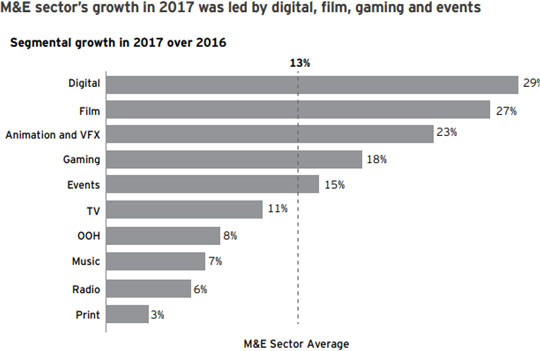
    Source: FICCI-EY Report on M&E industry 2018


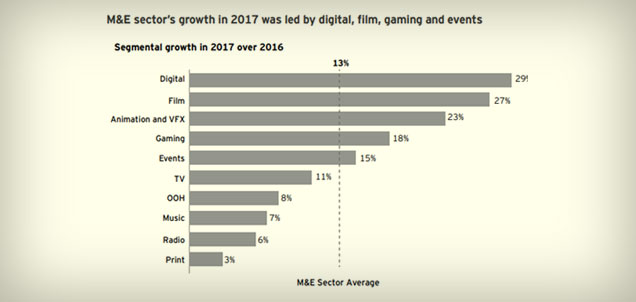
    As shown in the above chart, while the industry grew by 13% from 2016 to 2017, the growth was led by digital, film, animation & VFX, gaming and events. The same trends are expected to continue over the next three years. Another significant trend, which has been seen for the first time in the M&E sector, is outpacing of advertising growth (under10 %) by subscription growth (almost 15%) in 2017 over 2016. This trend will continue to be a major contributor to the Digital Tipping Point.


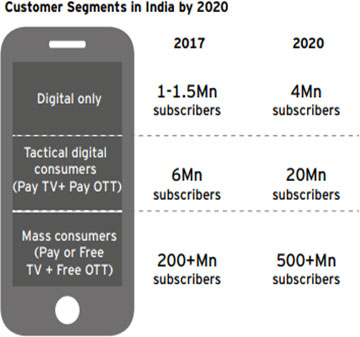
    Based on this new trend of growth in subscription,the report has made a forecast on new customer segmentation which will be an integral part of Digital India by 2020. This new consumer segmentation will be important for the A&M Industry for targeting their audience.


    Source: FICCI-EY Report on M&E industry 2018


    We can assume that there will be a process of continuous migration from the bottom tier of mass consumers to the tactical digital consumers to the only digital consumers as we go forward to the next decade. As far as deployment of resources for advertising is concerned, we will see online media campaigns slowly gaining over the combination of online and offline media campaigns at the top end of the consumer pyramid.


  • Ranjona Banerji: NDTV too?

    By Ranjona Banerji


    Parliament was not allowed to function on March 19, when notice had been given for a No Confidence Motion, moved by former allies of the ruling BJP.

    How interesting then that our brave TV “news” anchors tried very hard to justify the Speaker of the House’s stand. Sumitra Mahajan of the BJP adjourned the Lok Sabha for the whole day because members of the AIADMK, currently “friends” of the BJP, were creating a “din” over the sharing of Kaveri waters. The Speaker could not hear over the din on Monday, March 19. However, she did manage to hear over the din last week so that her government could push through the Union Budget and its amendments without discussion.

    But why should any of this be of interest to “news” anchors on television when they have to work hard to somehow absolve the BJP of all responsibility for any wrongdoing whatsoever? The severity of the bypoll results in UP and Bihar forced some of them to admit that the BJP and its allies did not do as well as they might have. For that transgression alone, one assumes they and their political masters will have to pay some heavy price unless they make amends. Hence, let us pretend that the “din” in the Lok Sabha was the fault of the Opposition. The ruling NDA (much as the alliance may be crumbling) must not

    ​be ​

    allowed to go through any harmful loss of face.

    This is how it appears on the outside. Unfortunately, even NDTV, so far much maligned by “Bhakts” for being a “Congressi” channel, seems to have succumbed to government pressure. The differences are subtle, but the signs are evident: certain anchors who will not take a strong stand are given particular shows and timings, questions are framed to let the person answering off the hook.

    Of course, one hears the cries of outrage and charges of being “unfair”. Regardless of all that, the primary responsibility is to hold government to account and this needs to be true of every government which comes to power, regardless of the consequences.

    Well, doesn’t that sound funny when you read it?

    **

    In print, however, and definitely online, the centre is holding strong for now. That is, things are not falling apart. Since the written word cannot wring the same effect from bombast and hysterics as television, the attempt at journalism is bound to be a little different. Not always better, but different. Interestingly, several columnists who were avowed Narendra Modi fans from 2013 onwards have now become critical of the Centre and/or even more stridently plaintive (if you will forgive the contradiction in my use of words) in their endless advice to the prime minister, none of which he has ever followed.

    **

    The other big story of the week is the expose on how UK firm Cambridge Analytics used Facebook data to influence elections worldwide, including India. However, given that the details of the story are in technological jargon, people’s eyes tend to glaze over. There is a serious need to decode the technology for everyone and alert people to the dangers of how their online data is being misused.

    We ignore the reach of technology into our personal lives at our own peril.

    https://thewire.in/politics/facebook-to-votes-scandal-turns-spotlight-on-cambridge-analyticas-india-inroads

    https://in.reuters.com/article/facebook-cambridge-analytica/factbox-who-is-cambridge-analytica-and-what-did-it-do-idINKBN1GW0A4?utm_medium=Social&utm_source=Twitter


    ​Ranjona Banerji is a senior journalist and commentator. She is also Consulting Editor, MxMIndia. The views here are personal​


  • Sanjeev Kotnala: Getting set for Goafest

    By Sanjeev Kotnala


    The thirteenth edition of Goafest and the 50th Abby is all set for April 5-7, 2018 at Grand Hyatt, Goa. It will be my thirteenth consecutive Goafest. I am one of the few people who has attended every edition.  Goafest delivers three days of pure fun, engagement, networking opportunities and celebration. It is, Bole toh, a Jhakaas Fest.

    The entries are all in. The shortlist is available on the site. KPMG is busy doing the final audits, and the trophy maker is waiting for the inscriptions.

    Time to compliment the AGC (Awards Governing Council) team and AGC Chairman Ajay Kakar for the promised transparent tally system, getting the ‘Master Jury’, enhanced inclusiveness with non-participant organisations representation and an apparent smoothness of the judging processes. So far so good.

    Goafest is all about delegate experience and buzz. Ashish Bhasin, Chairman, Goafest and his team are busy ensuring that Goafest 2018 sets up new standards and delivers a superlative experience to its delegates. Goafest is not just about the celebrity speakers and entertainment or the even the awards. It is a collective framework, and the delegates have every right to expect the best.

    MARKETERS STILL MISSING THE FUN. GoaFest remains a creative and media agency-centric festival. Marketing and clients are missing the fun.

    Speakers. We have a good line-up of speakers at Goafest. Baba Ramdev and Rana Kapoor Cameron Worth (SharpEnd), Dean Donaldson and Jonathan Tavss (Kaleidoko), Ramaa Mosley and Amelia Conway (Adolescent). Rosie Yakob (Genius Steals), Samuel Akesson (Forsman & Bodenfors),  Tim Castree (Wavemaker) and Wain Choi (Cheil Worldwide). I hope there are few more Indian speakers from the MAdTech world as I sincerely think that we must also celebrate Indian rise in the arena.

    ADDING A DASH OF CRICKET, SPORTS, BOLLYWOOD. Goafest is incomplete without cricket, sports and Bollywood. I don’t remember when this trend started. I hate it but have no answer to the enthusiastic crowd support to them. These are the most attended sessions.

    This year we have Sparsh Shah (child artist), Jonty Rhodes (Cricket), Siddharth Malhotra!!! (Bollywood), Sania Mirza (Tennis), and Nawazuddin Siddiqui !!! (Bollywood). It seems like we are balancing absence of Indian speakers from MAdTech with them. And are they not one-too-many in a 2-day event?

    Comments on the speakers and the content are best served uncensored post the event.

    MY CRIB.  Why should we invite a controversial person like Baba Ramdev to a festival led by AAAI and AdClub? We know Baba questions, breaks and challenges every ASCI guideline? It does not make sense to me. Where is the cause of collectivism? Will Baba share how and why not to abide by ASCI norms? He is one of the big advertisers and must answer his repeated frequent violation of the guidelines. I plan to attend his season and protest with a black armband.


    ENTERTAINMENT AND AWARDS. Surprise audience with the unpredictability of the entertainment during awards. Consider having it towards the end. It can prevent the predictable thinning of the crowd as the night progresses. No one enjoys watching awards presented in the presence of few organisers, winners and a handful of audience. May be a few subset categories need to be sandwiched between awards that make the crowd surge. Maybe do away with the entertainment show.


    TIME MANAGEMENT. We don’t start or close a session on time. It impacts networking and time management at the individual level. It is the most significant irritant (after low impact content) that scars the experience.  Make a small investment. Get a digital stopwatch mounted right in front of the speaker. Use red and green lights for the suggestion. Be rigid and consistent in behaviour.  Once we demonstrate the intent, the problem can be managed better


    GOAFEST APP. Everyone appreciates the app for collecting and managing Q&A sessions. I have heard delegates murmur about non-transparency in moderator selecting the questions and declaration of winners. Can we use the conflict of interest clause? May be we can physically show the open and close the window to enter the questions? The app should show all the questions in the order they were raised? Moderator must ensure the questions are selected on merit and in sequence.

    Here are few under-the-radar issues.
    Remember, 90% of delegates stay outside the venue hotel.


    EXTENDING THE SHUTTLE. It is not easy for the delegates to enjoy the famed after-parties with the shuttles closing by 11pm. Can shuttles be extended to 2 am?

    REST SPACE. I know no festival provides space for people to rest. However, that should not stop Goafest from thinking of doing so. What about having bunk beds or cocoons available for hiring at the venue? It can be enjoyable, and some brand could sponsor.

    KEEP IT FLOWING. Agree don’t allow beer and eatables inside the halls. However, can we have the beer counters open throughout the day without random, unannounced breaks?


    Join me at Goafest, the three days of pure fun, engagement, networking opportunities and celebration.  Bole toh, a Jhakaas Fest!


  • The Pre-Election Year of Media Alignments & Realignments


    By Shailesh Kapoor


    Unless I’m reading too much into too little, there’s definitely a subtle but significant shift developing in the news media today, across television, print and the Internet. That of a change in political stance. In summary, the shift from an unconditional, pro-BJP stance to a more balanced, issue-based stance is what I speak about here. Let’s delve deeper.


    Media stance has always existed as an idea for ages. Media houses have been aligned to individual political parties, thus making them pro-government or anti-government at a certain point of time, depending on who’s in power. Then, some media houses were always anti-establishment in their stance, which meant that they were not affiliated to any political party, but played a role of being a harsh critic of the party in power, irrespective of the party’s hue and ideology. If a media house has to have any stance, it can be argued that an anti-establishment stance is a healthy stance to have.


    Over the last four years, since the BJP came into power, we have seen media polarisation like never before. Channels, websites and newspapers aligned firmly as pro-BJP (70-80%) or anti-BJP (20-30%). The middle ground was vacated by virtually everyone. Some of the many who aligned to the ruling party at the Centre may have done it opportunistically. The word going around two-three years ago was that there was an atmosphere of fear being created in the media, whereby not aligning to the ruling party meant you could be given a tough time, which could mean anything from not getting the right interviews with senior leaders to being subject to regulatory hassles. This is hearsay, of course.


    Irrespective of why it happened, the polarisation, with a predominant pro-BJP alignment, has been evident. Till a few weeks ago.


    Since February or so, we see many unquestionably pro-BJP channels, websites and newspapers balancing their act. They have not become anti-BJP by any measure. The soft corner still exists. But it’s definitely not like earlier, when they will go out of the way to defend the indefensible. The shift may not seem evident to a casual consumer, but it’s quite apparent if you have been tracking the category over the last few years.


    The easiest sign of the shift is that red herring debates like those on Pakistan have gone off primetime television. These debates used to be the standard distraction tool of many channels, especially English, to divert attention from governance issues, such as the farmers crisis, which has been on for a while now, but getting some attention from the media only this year. The Pakistan debates also whipped up a false sense of nationalism, which is again an agenda that suits BJP.


    We see a lot more headlines and debates now on topics that the government is not necessarily at home with. Nirav Modi has been discussed in some detail, as has been the farmers crisis, and of late, the by-poll losses faced by BJP.


    There could only be two reasons for this shift. One, it could be that the issues coming up are so compelling that even the most pro-BJP media house can neither ignore them or not support them. This would be true in some part, but there have been such issues in the past too (demonetisation’s impact on the economy being one such), and they were given the cold shoulder by the pro-BJP media houses.


    The real reason, in all likelihood, is the second one. Till about 3-4 months ago, it seemed evident that BJP will be re-elected to power in 2019. But in a fairly short span of time, there seem to be at least three different reasons to believe that much as BJP is still the favourite, the momentum is definitely shifting. One, the bypoll losses across BJP strongholds have shown the chinks in BJP’s election armour. Two, several allies have withdrawn support over the last few months, leading the BJP as virtually a stand-alone party, than the pivot of a bigger group called the NDA. Three, there seems to be an active movement among the regional parties across states to set up some kind of an alternative front. This is still a nascent development, but in politics, one year is a long


    Media houses, smart enough to sense all of this, are probably just playing safe and hedging their bets. It’s not the best sign of an independent media, for it’s a validation of a new scenario where the media finds aligning to the ones in power a legitimate thought. But it’s happening alright. Like the last four years.


    2019 is getting closer. Be prepared for more alignments and re-alignments. Both on the political and the media fronts.