Category: COLUMNS

  • Shailesh Kapoor: 3 Ps of the Week: Pahlaj, Prasoon & Pehredaar Piya Ki


    By Shailesh Kapoor


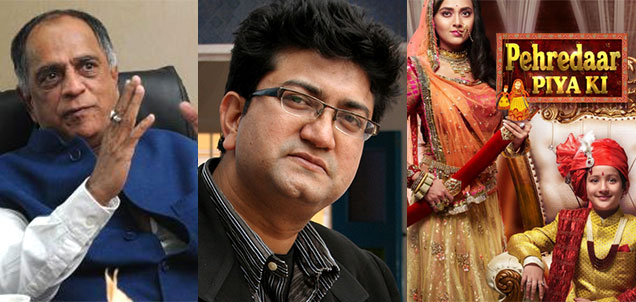
    It’s been a week the film industry was craving for. Last Friday’s film Toilet: Ek Prem Katha is a massive hit, ending a drought that started since Bahubali 2 in April this year. On the same day as the release of this film, ie, August 11, came another news that sent the industry into instant celebration mode. CBFC (Central Board of Film Certification) chief Pahlaj Nihalani was sacked, and replaced by Prasoon Joshi.


    The I&B Ministry notification was a surprise for many. The Ministry has backed Nihalani for more than two years by simply turning a blind eye to his ways. The media has been gunning for Nihalani’s head for a while now, but has never been a clear response from the Government. Till last Friday.


    It’s difficult to say the exact trigger for this notification. But it seems connected to Smriti Irani taking over as the I&B Minister in July this year. Since then, there have been two incidents the CBFC has been involved in, which are not exactly ‘women-friendly’.


    Lipstick Under My Burkha was already at the receiving end of the Board’s ire, for being ‘too lady-oriented’. Then, on August 3, the team of the film Babumoshai Bandookbaaz held a press conference to talk about how the CBFC treated them and their film. While asking for cuts on abuses and political references is nothing new for the Board under Nihalani, the details of how the proceeding went shocked many in the media and the trade. Kiran Shroff, one of the producers of the film, was asked by an Examining Committee member on how she could produce such a film “being a woman”. Before she could reply, another member of the Committee commented that “she was not a woman, as she was wearing shirt and pants.”


    Smriti Irani is not one to take this nonsense. There’s a high chance that the prevailing misogyny in the Board could have promoted her to advance her decision.


    Prasoon Joshi is known to have a liberal mindset. There’s the Shyam Benegal Committee report that’s been gathering dust for a while, and if Joshi takes that forward, we may see a structural change in the CBFC very soon. In the short run, we definitely hope to see less films going to the Revising Committee (which lost its relevance under Nihalani) and FCAT (Film Certification Appellate Tribunal).


    In sharp contrast to these progressive developments, the television industry saw the other side of ‘censorship’ this week. Sony’s new show Pehredaar Piya Ki (PPK) has been the topic of discussion since its promos went on air, with the marriage of a nine-year-old to a grown-up girl creating a stir. About two weeks ago, an online petition was floated, calling for a ban on the show. This petition got 136,000 supporters.


    Based on the petition, Smriti Irani asked BCCC (Broadcasting Content Complaints Council) to take ‘immediate action’. It seems that BCCC has directed the channel to run scrolls that the show does not support child marriage, and shift the show to post 10pm, instead of its current 8.30pm slot.


    Now, much is wrong with all this. 136,000 may seem like a high number, but it is miniscule in context of the category, i.e., Indian television. About 30 times this number watch an episode of PPK on an average. And more than 80% of these are grown-up adults, who should decide for themselves.


    Imagine if a film would have been made on this exact subject, and Nihalani would have blocked it for the exact same reasons that this online petition lists, there’s high chance the exact same section of the society that have floated and supported the ‘Ban PPK’ petition would have floated and supported one to let the film release because it’s freedom of speech, and the audiences must decide what they want. If that isn’t hypocrisy, what is?


    And how exactly does shifting a show to 10pm ‘solve’ anything anyway? If one begins to use such highly-subjective lenses to evaluate television content, almost 50% of Indian fiction shows could come under the scanner for some reason or the other. Hope we are not in for a ‘petition culture’. If the audiences can decide in the case of films, they can decide in the case of TV as well, which includes parents deciding on behalf of their (minor) children.


    Whether it’s films or TV, when will we learn to let the audiences be?


    Shailesh Kapoor is Founder and CEO, Ormax World. The views expressed here are his own
     

  • Sanjeev Kotnala: Get Lucky!

    By Sanjeev Kotnala


    Were you unlucky last time. Did you lose and pitch and crib?
    Or did you failed to close the deal or miss the promotion?
    Well, I have something to share here.
    Life is a book, and every incident in the past is just another story.
    You have no way to change the characters, sequence of events or the outcome.
    Only thing you can take from it, are the learnings.
    And in the past, there are bound to exist at least a few ( for most of us many) where we would claim that LUCK did not favour us.
    And this gives rise to ‘If Only’, ‘But’, ‘Maybe’; I wish and such equivalents in Hindi like ‘Parantu, kintu, lekin’.
    At the same time, we see messages in Whatsapp that read like ‘Luck favours the brave’.
    We all want luck to favour us. However, we also like to live in the safe confines of our own constraints.
    Even believing in ‘The Secret’, we don’t give ourselves to complete visualisation with confidence.
    Anyway, that is not even half the battle.
    Is there a formula for being lucky. Is there a process that can change your luck?
    No, I am not talking like winning the $650 million jackpot, but in general terms.
    Won’t we want to be lucky?
    Luck, the successful ( and hence Lucky) people will tell, in not an accident that happens in your life.
    And yet, luck can be made to happen.
    Don’t Doubt Yourself? Have faith and high expectation from yourself.
    Half of the battle is won, if you believe you will win, most likely you would.
    Don’t ever fail your instinct.
    No, there is no guarantee they always be right.
    However, it is worthwhile to pause, reflect and give your instinct a loud unbiased hearing.
    Your body is receiving far more information than your filters are allowing you to relate and recognise it.
    A lot more is being assimilated in your unconscious mind and even outside it. It is available to you as a sixth sense.
    Train yourself to ask your unconscious questions you may not have answers to.
    Sleep with the questions and wake up leaving your doubts.
    Help yourself in identifying opportunities. Remember most of the opportunity presents itself dressed in doubt. Inaction will never lead you anywhere but to a later regret of ‘if only’.
    To act, you will have to recognise not celebrate your fears. Get out of your comfort zone.
    Let’s put it this way; you have been unlucky, what will be the worst to happen to you?

    You will remain unlucky.

    And that if I read you right is the current situation.

    So, you lose nothing in stepping out and acting on the opportunity and your instincts.
    Be ready to fail. You will fail.
    Once that happens, do look inward and take-in your learnings.
    That’s all you can do in the story of your life. It’s done and the life must continue.
    Just do not start cribbing about the kind of luck you have.
    Your thoughts have a way of manifesting themselves.
    Strong negative thoughts anyway will not help.
    Believing in yourself and the result can help you visualise the result.
    This gives your body additional source of energy and positivity.
    You will find yourself charged toward the objective.
    Create space for luck into your life.
    Luck most likely will stay away from an over-stressed burdened being.
    You will never be in a frame of mind to interpret, recognise and accept luck.

    An inner ‘If and Buts’ will close the door, leaving you with ‘If only’ regret.
    Nothing beats willingness to make the more than desired efforts towards your goal.
    Giving more than 100% is a must.
    Once you have the best thought-out plans, understanding of the situation and your ‘ask’ in it, will the lady luck want to join you in your success journey.
    Remember luck is an after-result realisation.
    It is not something that you feel during the process.
    It is a series of incidents that have the dice rolling in your favour.
    You should realise that you control the way the dice rolls, and hence you control your luck and destiny.
    Is it not lucky enough for you to be reading this article?
    So, now just don’t sit back thinking whether what has been said above is right.
    Have the belief in your being lucky and ensure that you put in your best!
    Remember, you were one of the million sperms that fertilised the egg.
    How much lucky you will want to be!

  • Ranjona Banerji: When the usual BJP spokespersons were missing in action

    ​By Ranjona Banerji


    What a tumultuous week for the country and therefore for the media. Last Thursday, a nine-judge bench of the Supreme Court of India delivered one of the biggest and most historic judgements ever, giving Indian citizens the fundamental right to privacy. The news and the significance were both on social media and news websites from Thursday morning onwards. But news channels – a wider medium of dissemination of news despite our rising smart phone use – took time to understand the implications of what had happened. And even then, they largely failed.

    The lack of depth and intellectual heft in TV newsrooms gets severely exposed at times like this. The Supreme Court judgment could not be limited to BJP versus Congress or Hindu versus Muslim or patriots versus anti-nationals. The significance went deeper than that, to the core of Indian democracy and governmental control. And therein lay the failure – nothing to sensationalise.

    Some news channels made an effort that barely touched the surface. Some – probably misunderstanding the judgment – interviewed lawyers whose arguments had been rejected. Some gave positive publicity to Union Law Minister Ravi Shankar Prasad’s outright lie that the Government of India had always supported privacy as a fundamental right. Others just ignored the issue and tried to foment more Hindu versus Muslim tension in Bengal, in line with the BJP’s current agenda. They made a huge fuss over some notification about immersion days during Durga Puja showing little knowledge of how Bengal works, only to poison the atmosphere as they normally do.

    You had to wait for the newspapers the next morning to get a clearer understanding of how life-changing the SC judgment was. Indian Express topped the charts with its slew of articles and opinion pieces. Thewire.in and scroll.in were the champions on the internet. To be fair, all newspapers gave the right the privacy the space it deserved.

    But on Friday, TV “journalists” found the kind of story they could understand: the verdict for two rape cases for which Dera Sacha Sauda chief Gurmeet Singh Ram Rahim had been tried. Full-on coverage of the area around the courthouse in Panchkula, Haryana, the security arrangements, the various devotees gathered, assurances from the state government, the precautions at Sirsa and in Punjab where Gurmeet Singh has many supporters.

    Some 30 minutes after Singh was pronounced guilty, all hell broke loose. Dera members and supporters went on a rampage, destroyed property especially in Panchkula but the violence spread to Sirsa, Punjab, Delhi and even Rajasthan. The bulk of the mayhem was in Panchkula and the state administration appeared to be helpless and hapless. Journalists were attacked and their equipment, including OB vans, destroyed.

    The result was that for the first time since the BJP won the Centre in 2014, all news channels attacked the Haryana government for its inefficiency and inaction. TV channels ran hashtags demanding that chief minister ML Khattar must go. They referred to the earlier debacle over another “godman” with cases against him, Rampal, and also to last year’s Jat agitations which left the state burning for days.

    This concerted effort appeared to rattle the government, which is used to largely favourable coverage – even state channels like Times Now and Republic TV were furious. That night on the “debates”, the usual BJP spokespersons were missing in action. There was Rakesh Sinha of the RSS and Vikas Pandey from the BJP’s social media cell standing in and having a tough time of it. Raman Malik was the sole BJP member available for roasting through the day.

    However, being non-partisan and objective is not always easy when you have been a sycophant for three or more years. So when the Haryana and Punjab High Court asked some tough questions of the state and Centre the next day, only half the observations were pounced upon. The High Court’s acerbic comment that Narendra Modi was the ​Prime ​M​inister of India not ​P​rime ​Minister of the BJP was largely ignored. Instead the court’s equally strong indictment of the Haryana government was concentrated upon.

    It did not become any easier for the BJP’s spokespersons – the big names still invisible – through the weekend as videos and information about special treatment to Singh, about BJP ministers giving the Dera money and cutting a deal with Singh for votes all emerged.

    On Monday when the quantum of punishment was pronounced, once more the rush to be first with the news did television in. Instead of studying the sentence, reporters and anchors rushed ahead with “10 years”. They then outraged that 10 years was not enough. By the evening it turned out that the full sentence was 20 years – two 10

    ​-​

    year sentences to run one after the other. I heard some marvellous sophistry from one anchor, mid-outrage, as she realised that it was 20 years, that in legal matters, information emerges slowly and is constantly changing. However, to get the correct information three hours after the sentence has been pronounced is not the fault of the court. It is shoddy reporting and legal illiteracy.

    All in all, it was a very exciting five days for media-watchers. Meanwhile, our thoughts must be with the journalists injured in the line of duty.


    ​Ranjona Banerji is a senior journalist and commentator. She is also Consulting Editor, MxMIndia. The views here are personal​


  • Sanjeev Kotnala: Making ‘INVISIBLE’ visible

    By Sanjeev Kotnala


    ‘Honi ko anhooni karde. Unhooni ko honi. 

    Eek Jagah Jab Jamma hai Teeno Old Spice, Wieden aur Kennedy.’

    Most of the advertising in India is highly invisible. The stated reasons can be different, but they all point to one single direction; the firm belief in safety and the inability to take a risk. There are few clients who are willing to give their agencies a freedom to expand their scope. The agencies are happy keeping the relationship alive on the state bed of conformity. And it will continue. I see no reason, why it will change soon. Indian advertising has been the industry of media might. Push the invisible creative so hard that even the blind can see, and the deaf can hear it. The other side, very few have genuinely used the expression and execution as the amplifier for really visible engaging advertising.

    So, here today I share the recent work by the freaky brand ‘Old Spice’.  Work like this gives creative teams orgasm in their dreams. Most of the clients fear these stupid thoughts. It makes the creative impotency and the spinelessness apparent.

    Nevertheless, such ‘Acts not ads’ seem to shake the audience and the industry. They disrupt the complexity with their simplicity. The brand and the message are uniquely bonded that it is tough for it to be signed off with something else.

    Old Spice has an Antiperspirant Spray called ‘Invisible’. The name leads to thoughts like Mr India, the Invisible Man and many such simple ideas. The brand takes a big step forward and pushes the boundaries of self-imposed constraints.

    They created a full two-hour ‘INVISIBLE’ Movie. Yes, you got me right, an Invisible Movie. Okay. An almost-invisible movie, there are audio and video placements throughout the duration.

    Invisible movie was posted on Thursday 24th on YouTube and game-focused streaming service Twitch. ADFREAK where I came to know about it states that Invisible Movie has already got 7 million views.

    ‘Invisible World’ movie is far better than a lot of visible-invisible work we see.

    At the very start it tells you that ‘The Human eye is composed of more than 2 million working parts and can see over 7 million colours. And it starts like a normal movie. ‘Old Spice Presents – an Old Spice Invisible Spray Production’. It catches your attention with credits like any regular movie. Names like Hans Holsen, Joann Schinderle, , Lapiz Sacapuntas, Amy Miller… the game is on.

    The screen introduces a spray that fogs out everything.
    Now you are in the invisible world, you do not see anything. You can hear and read the subtitles.

    Around 180 seconds into the movie, is a little question ‘ Is every line in this movie going to have a gag about the fact the audience can’t see anything’. And an equally baffling answer ‘You tell me. You’re the one holding the time-vortex mirror. Take a look into it, dummy’.

    In the absence of visuals, the imagination is all yours in the invisible world.
    Sometime later – all you hear are voices that help you imagine what is happening in the Invisible world.

    I got the point and gave up around 7:50 minutes when the conversation was becoming interesting. Do watch the ‘Invisible World’- an Old Spice production. Do tell me what all did I miss.

    And they even have the credits rolling at the end. That has every possible role, and responsibility filled in.  At the end, they seem to be appreciative of the audience and have this simple thought.

    ‘A LOAD OF WORDS. THAT TOGETHER ALL ADD UP TO LOOK LIKE A UFO. A COOL UFO. KINDA THAT DIDN’T WORK BUT HOPING YOU CAN IMAGINE IT… THANKS TO EVERYONE WHO AUDITIONED.

    Love these guys, when at the end they share the fun fact. This movie was 2 hours 2 minutes and 57 second long. There is a whole set of things one could’ve done at this time.

    At the very last, there is a pertinent question I have many times asked. Does anyone read this stuff? I mean the credits. Do let shortneckgiraffe@gmail.com know. As you are reading this, I presume, you have read it this far, what about letting me know with a comments or SMS or whatsapp or e-mail

    Now, let me tell you the truth, ‘Invisible World’ is not worth watching.
    It makes a point of brave stupid creativity, and I love it.

    …………………………………………….

    Sanjeev Kotnala has over 30 years of corporate experience and is founder of Intradia World; a Brand, Marketing & Management Advisory. Additionally, he focusses on Ideation, Innovation and design thinking. He loves sharing the concept of Brand-i, a deliberate strategic framework to create and control your image and impressions, to be the brand. Email sanjeev@intradia.in tweet @s_kotnala web: www.intradia.inwww.sanjeevkotnala.com.

    ……………………………………


  • Ranjona Banerji: Journalists blinded by ‘bhakti’

    ​By Ranjona Banerji


    Mumbai had one of those torrential rain days coupled with a high tide this week. Citizens had no warnings and rushed to work as usual. As the morning progressed, it was clear that it was going to be one of those days.

    TV cameras rushed out to bring home the water-logging and distress in India’s financial capital to homes across the country. As usual, they went to the few spots in the city that are easy targets. If someone overturns a bucket of water while passing Milan Subway in Santa Cruz, the water will collect; because the subway runs below road level. (There is also a flyover on top of it.) This is Class V physics, also common sense: the first not taught in schools, the second missing in action in TV newsrooms looking for a sensational picture.

    Laziness of imagination apart, brave reporters were out in the rain, marking out the problems faced by people and the various misdemeanours of the municipal corporation. The horrors of July 26, 2005 hovered above everyone’s minds. International TV channels focused on Texas and the devastation caused by Hurricane Harvey.

    Was there anything in the coverage of a beleaguered, belaboured city that could have been better? More focus on the effects of over-development, of replacing all the city’s natural drainage areas with buildings, of the destruction of mangroves in the city’s coastal areas, of all the promises made about better warning systems and water draining systems after 2005.

    Still, it was quite amusing to watch Arnab Goswami of Republic TV get out of the studio and wander around Mumbai in his sopping wet suit.

    One does not necessarily want to sound like an evil commie liberal type but if only there was as much coverage of the floods in Assam and Bihar or even Gujarat, where hundreds have died…


    **


    Soon after he announced on the evening of November 8, 2016 that all Rs 1000 and Rs 500 would cease to be legal currency by midnight that day, Prime Minister Narendra Modi gave a melodramatic speech about how people could “shoot” and “burn” him if demonetisation does not a), control black money and end corruption, b), end terrorism because the funding was cut off, and, c) stop counterfeit money.

    In his Independence Speech this year, Modi assessed that Rs 1.25 lakh crore in black money had been detected by his demonetisation scheme.

    This week​,​ the Reserve Bank of India after much dithering released the official figures. Almost 99 % of the demonetised currency was deposited in banks. The amount that has not come back: Rs 16,000 crore. Even journalists blinded by bhakti and with limited arithmetic skills would know there is a vast difference between Rs 1.25 lakh crore and Rs 16,000 crore.

    In a normal world, journalists would be on to this in a jiff. Contrast the reaction in the Indian television media compared to how US President Donald Trump was pilloried for trying to fudge crowd figures at his inauguration.

    But no: Instead we give plenty of airtime to Union finance minister Arun Jaitley to now inform us that confiscation of cash was not the goal of demonetisation. Any journalists willing to openly ask on TV why the​P​rime ​Minister of India lied to the people?

    To be fair, NDTV’s Left, Right and Centre did a good show on the RBI figures, with most economists bar the ever-loyal Sunil Alagh agreeing that demonetisation was a disaster. Newspapers and websites have also excoriated the government and Modi. But the rest of national news television? I would not hold my breath for too much more on the story.

    As Bhupendra Chaubey of CNN

    ​-​

    News18 tweeted soon after the RBI released its report: “The truth of #Demonetisation May have been a contentious economic policy move but was a masterstroke on the political move front”.

    This is after Chaubey’s channel provided some reasonably good coverage of how people suffered after demonetisation.

    The goal posts on demonetisation will shift once again and our national news carriers will look away in their “new normal”. Getting wet in the rain is so much more fun.


    Ranjona Banerji​ is a senior journalist and commentator. She is also Consulting Editor, MxMIndia. The views here are her own​


  • Shailesh Kapoor: When News Rose to the Occasion. Almost.


    By Shailesh Kapoor


    It’s been a busy week for the news media. Last Friday, Gurmeet Ram Rahim Singh was convicted for rape, which triggered off violence in parts of North India, keeping the media on their toes. His sentence was announced on Monday, so the story had a life of at least five days, including a build-up day before the conviction. Five days for a story is a rarity in today’s times. Following up, Tuesday saw a shift to the coverage of the Mumbai rains, a story which continued over two days.


    The Gurmeet story was surprisingly well-handled by the media. Several media houses known for their open support to the BJP Government took a clear stand against the Haryana Government headed by Manohar Lal Khattar for the violence that erupted on Friday. That some mediapersons and their property was damaged channeled more rage into the reporting.


    A string of stories over the last few weeks have forced the clearly right-aligned mediahouses to take a stand against their grain. It happened with the Gorakhpur deaths, where the Yogi Adityanath Government was attacked, though the man himself was handled with kid gloves. It happened with more force in Khattar’s case, and now, Mumbai’s corporation (BMC) has been attacked wholeheartedly for the rains mess-up. It seems that on issues related to the ‘common man’, the rules of engagement are different vis-à-vis policy issues, such as demonetization, for which we saw some rather unflattering results being announced by the RBI two days ago, but only selective criticism.


    The Mumbai rains coverage, however, had a strong sense of déjà vu. From July 26, 2005, when the big rains story happened, there have been these smaller versions every 2-3 years, though this 2017 version would clearly rank no. 2 on that list, behind 2015. The narrative is consistently one-track every time: Attack BMC, question why the city that pays the most tax has is subjected to such poor governance, speak to citizens on the road, use shots of flooded roads and submerged vehicles on loop, flash helpline numbers, etc.


    While there’s nothing wrong in this line of coverage, there’s nothing particularly exciting about it either. The real rains story should happen in the intervening period between two such disasters. It’s the kind of topic where the media needs to keep the pressure constantly on, over an extended period of time, such as five years, to see visible change on ground. But we all know that in today’s times, the story will be forgotten within a week.


    A two-day coverage in two years does no real damage to any corrupt politician or corporator. They would be largely immune to it by now, and may even be laughing such coverage off, given that it seems driven by the media’s frustration for not being able to make any real impact in the first place. And I found it especially amusing when a journalist doing the story repeatedly called herself “a part of the ordinary middle class.”


    But with all its issues, news on Indian television was more watchable this last week than it is for most part of the year.


  • Ranjona Banerji: Is Rahul Shivshankar’s apology for real?

    ​By Ranjona Banerji​


    Regular readers of this column will know that I am usually kinder to print journalists than I am to their TV counterparts. But sometimes, print journalists decide to teach me a lesson by displaying even worse symptoms of extreme sycophancy to the Modi government than their friends in the broadcast media.

    On the day of the “Great Cabinet Reshuffle”, a few political reporters from India’s best known newspapers were over themselves with excitement on Twitter. As they got bits of information from their “sources” in the BJP, they tweeted with crazy love and joy about the ​P​rime ​Minister’s “commitment” to good governance, about his decision to induct bureaucrats into his Cabinet to ensure “delivery” and all this without a single query about where all this delivery has been for the past three odd years.

    Indeed, one political correspondent tweeting from an official account then told us how Modi was fulfilling some promise of “Four Ps” (should not someone who advises the PM stop him?), to which I can add a fifth: (anodyne) Pap. She was faster than the usual PR machinery on the day and now interestingly appears to have deleted all those breathless tweets. Like Donald Trump, it is wise to occasionally think before you tweet.

    In all the excitement, they also got it wrong when Nirmala Sitharaman was presented as India’s first ever woman defence minister. Even Wikipedia has the right answer on that so if your knowledge is suspect, why not do a little research. In fact, most Twitter journalists got phenomenally excited about the women who had been moved around the Cabinet. Because women have never held any positions of power before May 2014, didn’t you know?

    TV meanwhile also remained full of excitement and also peddled some of the same false claims but what expectation does one have there anyway?

    **

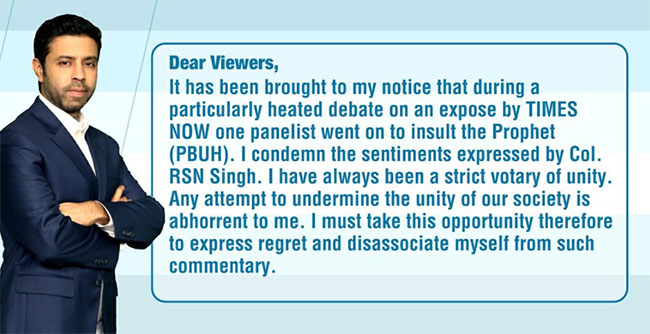
    Meanwhile, Rahul Shivshankar of Times Now has obviously managed to get himself and his channel into a bit of a sinkhole. As the apology that he issued on Twitter demonstrates:

    “Dear Viewers, It has been brought to my notice that during a particularly heated debate on an expose by Times Now one panellist went on to insult the Prophet (PBUH). I condemn the sentiments expressed by Col RSN Singh. I have always been a strict votary of unity. Any attempt to undermine the unity of our society is abhorrent to me. I must take this opportunity therefore to express regret and disassociate myself from such commentary.”

    Well, well. Of course, Col Singh has been represented to TV viewers as a “RAW agent” which he is not, having been seconded to RAW for a short duration. He is also aggressive, bellicose, offensive and unchecked. He is a media creation – how would a low-level officer of no known achievement become so famous otherwise? And he is specifically a creation of Shivshankar’s predecessor on Times Now, Arnab Goswami.

    Shivshanker, since he took over, has spent most of his tenure Muslim-baiting, on some pretext or the other. Every time the Centre and/or the BJP in the states they rule face a bit of bother, Times Now and Republic deflect attention usually by picking on something to stoke sectarian fever. This is done in the name of “nationalism”.

    It seems a bit rich therefore for Shivshanker to tell us he is a “votary of unity”. A little knowledge of television tells you that there are producers whispering in the anchor’s ears. And yet Shivshankar picked up nothing during the show so that he could correct or stop Singh? Clearly there is some legal threat at work here or else there is no need for the apology, no need to add the “PBUH” after the word “Prophet” and no need to “disassociate” himself from “commentary” that he and his fellow anchors on Times Now actively encourage.

    If Times Now means what it says, Colonel RSN Singh should no longer be invited as a guest. If that happens, you will know they mean it. Otherwise, in BJP president Amit Shah’s historic word, this is yet another “jumla”.


    ​Ranjona Banerji is a senior journalist and columnist. She is also Consulting Editor, MxMIndia. The views expressed here are her own


  • Sanjeev Kotnala: It pays to strengthen perception, because it’s more real than reality

    By Sanjeev Kotnala


    Good interviews are addictive to watch. They have an uncanny ability to capture your attention. More so, when subject, subject matter or the interviewer is of your interest. There have been a few of these in the recent past. They have the power to break or strengthen an existing perception. Many times they force you to question current thinking about an event or personality. Here are few I recommend you to watch again.

    Kangana Ranaut on Aap Ki Adalat with Rajat Sharma. It is an uncomplicated show that has been running for many decades. It has the conventional blame and argument pattern. Once in a while you get a completely bindass, bold, speaking her mind Kangana Ranaut in the show. Her every action – creating that impression that helps define her Brand-i.

    Suddenly, everyone was talking about it. There are people now taking sides. It is a demonstration of confidence and conviction that borders on what may qualify as madness. There is that slow tremor inside an emotional hurricane that is controlled to perfection. The laugh is all a wall to hold the private pain inside. I will be honest I admire her. I am a great fan of her. I do hope to meet her someday

    The Sunny Leone interview with Bhupendra Chaubey is a class in public interaction. In spite of the stupid interviewer unnecessarily plugging in the past, she answers in the best way possible. Here is another one, who has worked hard to be where she is now. There is no place for regrets as that is the past – a story where the character and results cannot be changed. And she is dedicated to write a brand new story, a new chapter as per her own liking.

    Now after the two interviews above, here I must present the others’ side, an example of how not to get interviewed! How not to be wrongly branded! Why you must prepare for such encounters? They are like the swirling currents of an untamed arena that sucks you in deeper with every wrong move. It is Rahul Gandhi interview with Arnab Goswami.

    And then there is this MAY 16th of Narendra Modi with Arnab Goswami. It demonstrates the craft from both the interviewer and interviewee side.

    And if you still have the time, please find this beautiful speech by Dr Shashi Tharoor in making a case that Britain Owes Reparations.

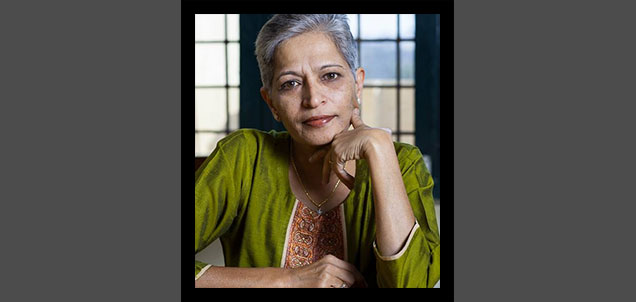
  • RIP, Gauri Lankesh


    By Ranjona Banerji


    The murder of senior journalist and activist Gauri Lankesh, 55, sent shock waves through one part of India. And open gloating and mockery through another part of India. This is the “New India” brought upon us by Hindutva forces, after the victory of the Narendra Modi-led BJP in the general elections of May 2014.

    She was shot on the doorstep of her home in Bengaluru, with seven bullets fired at her, all at close range. The similarities with the murder of writer MM Kalburgi in 2015, killed for his anti-Hindutva stance, are chilling.

    Lankesh was an outspoken critic of Hindutva and rightwing forces although she also criticised other political regimes. She lost two defamation cases filed against her by the rightwing, including one by BJP MP Prahlad Joshi and was sentenced to six months in jail in November last year. She was out on bail pending appeal.

    “The right to dissent is being threatened,” she said at the time.

    These are obvious means of harassment by a party preening itself with power, flexing its muscles. A member of the BJP’s IT cell had tweeted at the time of Lankesh’s conviction that he “hopes other journos take note”. That is a threat, whichever way you look at it and sadly, so many of our “neutral” commentators will not until something tragic like this happens.

    News channels discussed the murder last night but as usual allowed rightwing forces to run amuck with their usual whataboutery, defensiveness and the invisibility cloak of “law and order being a state subject”. Some Indian journalists have not fully comprehended the idea of “objectivity” and confuse it with a series of “false equivalences”. Therefore, we never really stand up for our own.

    Is it normal in India for writers, rationalists and journalists to be shot dead while out on their morning walks or in their homes? Is this the “New India” promised to us? Is this not a matter which needs greater study and action than primetime debates where political forces yell at each other?

    Can we continue to deny that there is a growing majoritarian militancy and a force of intolerance of free thought running through society? For how long can you keep pretending that objecting to the BJP government’s policies and to the hatred of the RSS towards religious minorities is not becoming increasingly dangerous?

    This is our country too.


    **


    What happened on social media after news of Lankesh’s murder broke is equally if not more frightening. The online rightwing trolls were out in full force, mocking, gloating and threatening.

    One gentleman on Twitter, followed by the Prime Minister of India, no less, had this to say, in Hindi: “A bitch dies a dog’s death and all the puppies start howling in one voice.” He has since deleted the tweet but it is representative of a mindset. After all, if the head of the BJP’s IT cell sends out a warning to journalists, why should the party’s online army of trolls exercise discretion, compassion or even humanity?

    A few BJP ministers did put out tweets expressing shock and dismay without any qualifications which is very welcome. But alas, other BJP followers – including several rightwing journalists – could not find it in themselves to even pretend to mimic their masters and hold their bile for once. A sad reflection on our times.


    **


    Press Clubs and associations all over India are holding meetings and candlelit vigils in Lankesh’s name. They all urge the Congress-led Karnataka government to act fast – unlike the slow pace of the Kalburgi investigation.

    I quote from the Mumbai Press Club release:

    “If this is how the Fourth Estate is going to be treated by the powers that be, while the government looks the other way, it is indeed a black hour for Indian democracy.”

    Indeed. What else is there to say?


    Ranjona Banerji is a senior journalist and columnist. She is also Consulting Editor, MxMIndia. The views expressed here are her own


  • Shailesh Kapoor: Star India’s IPL Win: A Big Deal!

    By Shailesh Kapoor


    Star India’s persistent desire to dominate sports broadcasting in the country has been one of the most important television stories in India in this decade, which has generally been an otherwise poor and unremarkable one. Earlier this week, Star’s sporting agenda got a big boost in the arm, with the company bagging the global media rights for the next five seasons of the IPL.


    There has been ample talk in the media since then on whether the Rs 16,347 crore bid is too high to make commercial sense, and how the recovery plan looks nearly impossible on paper.


    But a deeper look at some numbers would suggest that Star’s bid was reasonable after all. The average per-season price is about three times what Sony was paying over the last nine years. But that was a base set in 2008, before the league started, with an ad hoc renegotiation in 2009. And those were only the broadcasting rights. Digital was not even in discussions then, and to Star’s credits, they took that route to enter the world of IPL, even as they waited for the big rights (TV) to come up for auctioning.


    The best benchmark perhaps is the value of the title sponsorship rights, which were auctioned recently. Vivo won the rights for five years at Rs 2199 cr, which is an average of Rs 440 cr per season. This average was merely Rs 40 cr in the first five years with DLF, went up to about Rs 80 cr for Pepsi in 2013 and then to about Rs 100 cr for Vivo in 2016, when Pepsi dropped out. There are two levels of comparison here. One is the growth rate, and second, the absolute number itself.


    Title sponsorship rights have grown ten-fold since the league started, and four-fold within just a year. Even if one takes Vivo’s bid as a highly aggressive one, this growth is really what the IPL has been about. When it started in 2008, it was just an experiment. Within a year, it had acquired hit status, and over the years, a certain cult status. None of this was known when the 2008 auctions happened.


    Add to that the economic growth (at 8% annual inflation, the value should have doubled in nine years anyway), and a three-fold increase in broadcasting rights seems more than reasonable (perhaps even low), especially when you consider that digital was not a part of the Sony deal for 2008-17.


    If you look at the absolute values, Vivo’s Rs. 2199 Cr is 13% of Star’s Rs. 16347 bid. Vivo will spend additional advertising money with Star to run their commercials during the IPL. But even if one excludes that amount, which is currently not known, 13% for just title rights vis-à-vis all broadcasting rights is quite a high share. In the last deal, this share was in the 3-5% range. Even if part of the jump is attributed to Vivo’s desperation to be associated with the IPL, one cannot help wondering if the broadcasting rights could have gone for even higher.


    Star India would, of course, have its task cut out. IPL, with it its equity, has had its fair share of challenges, which Star will hope to address. But that’s the topic for another day.


  • Ranjona Banerji: Free fall of freedom

    ​By Ranjona Banerji


    India slipped three places on the Press Freedom Index to number 136 in the 2017 list compiled by Reporters Without Borders which came out earlier this year. In this column we have written consistently about threats to journalists, especially in the hinterland and in small towns. In almost instances, they have been killed or harassed because they were working on some nexus between local politicians, businesspeople and the police. On Thursday, Pankaj Mishra, a journalist working for Rashtriya Sahara in Arwal, Bihar was shot by men on a motorcycle. His condition is still critical.The murder of Gauri Lankesh is one of the rare instances where a well-known journalist was assassinated in a big city. It underlines the threat to all who dare to question the ruling dispensation and its ideology. It tries to serve as a warning that voices of disagreement will not be tolerated.
    That India has fallen down the list emphasises that this threat is real. Those who bow down to the diktats of political pressure are in fact the worst of our profession. They make life dangerous for everyone else.
    If nothing else, this murder should make us take a good, hard long look at our profession and how far it has fallen.

    **

    The murder of Gauri Lankesh has also revealed to us all sort of journalists, all sorts of journalistic practices and all sorts of theories. The evening after her murder, news channels “discovered” her brother, Indrajit Lankesh. He informed them that his sister had been getting death threats from Naxals and maybe they were behind her murder. The brother was an interesting choice.
    Through the day after the murder, articles posted on social media had informed us that Gauri Lankesh and her brother were estranged. That in 2005, they had parted ways after a bitter fight over ideology and that she had started her own newspaper Gauri Lankesh Patrike after her brother took control of their father’s original journal, Lankesh Patrike. The fight incidentally was over an article on Naxals, which Indrajit removed without editor Gauri’s permission.
    Indrajit filed a case against Gauri saying she had stolen computers and printers from the office. Gauri filed a case against Indrajit saying he had threatened her with a gun. The brother Indrajit has been flirting with the BJP and Gauri spent almost all her journalistic effort fighting Hindutva forces. All this is in the public domain. On what basis did anyone think that an estranged brother was the best source of information for the murdered journalist?
    The explanations are not pretty. The first is obvious: shoddy journalistic practices because absolutely no research was done. Everyone presumably was overjoyed that a “brother” had agreed to speak to them. The second inference is as bad. Immediately after her murder, the finger of suspicion pointed to the Hindutva forces she had been fighting. So how can a news channels deflect attention from the ruling dispensation? Easy: Find a pro-BJP person “close” to the victim and change the narrative.
    Unfortunately for these puppets of the government, the brother soon changed his tune: He had no information about Naxal threats; he really did not know about any threats; he just saw something on some local language news channel and wondered. And after these flips and flops, on Thursday, he sat silently next to his sister Kavita – who was close to the victim – as she categorically stated that Gauri had received no threats from Naxals and all the threats she received were from Hindutva agencies.
    Journalists never consider that they ever really get egg on their faces. They shrug it off and move on. But sometimes the rest of us can see the yoke of loyalty to a political master all over their visages.

    **

    An interesting fight is brewing on Twitter. JNU student-activist Shehla Rashid asked a reporter from Republic TV to leave a protest meeting over Gauri Lankesh’s murder, claiming they were trying to cover up the assassination on the orders of the BJP.
    This action creates an interesting paradox for journalists. In an ideal world, Republic TV must be defended at all and any cost. The reporter was just doing his job after all and as a journalist, he had the right to cover any event.
    However, given the complete lack of journalism evident in Republic TV, while one may feel bad for the humiliated reporter, it is hard to find any sympathy for the channel as a whole. Those who are fighting Republic TV are going after a lost cause which in fact deflects attention from the main issue of Lankesh’s murder.
    Of course, it is unlikely that Republic TV will care. It claims to be the most-watched news channel in India. Not perhaps for its journalism?


    ​Ranjona Banerji is a senior journalist and columnist. She is also Consulting Editor, MxMIndia. The views here are personal.​


  • Ranjona Banerji: Absurdity Unlimited on News Television

    By Ranjona Banerji


    The inner workings of the Dera Sacha Sauda compound at Sirsa, Haryana, has been the focus of most of television media for this week. The fact that Gurmeet Singh Ram Rahim ran what was virtually a parallel government is a subject which needs to be debated and understood. It is true that most cults the world over run like this and the truth of what is going on inside only emerges when something tragic happens.

    Of course, television must continue with its breathless excitement as if this the first time a cult has been exposed or dismantled because television is breathless and excitable by nature. Still, some questions need to be asked about how such cults function and how they are able to function autonomously purely on the basis of faith. For journalists, the collusion of politicians (of all parties), police and state administrations should be paramount. Contrast this with a situation where we have had a Censor Board for years in a democracy, snipping off offensive bits of films, where kissing on screen was banned for years and yet such private republics happily exist within India.

    **

    The battle on social media remains intense and absurd. The Prime Minister has faced local and international flak for following abusive and offensive Twitter handles. This has long been known but received far more attention after the celebrations of social media after the murder of journalist Gauri Lankesh. Some of these handles, most “proud Hindus” “blessed to be followed by the prime minister”, tweeted about how they were glad a bitch was dead and that puppies were howling and so on. Rape threats are par for the course to which one could add threats to other journalists to watch out after Lankesh’s murder.

    On Sreenivasan Jain’s Truth and Hype on NDTV, Rakesh Sinha of the RSS pointed out that the Prime Minister has no control on those who follow him. This is a neat deflection and was quickly corrected by Yogendra Yadav of the Swaraj Abhiyaan who pointed out that the debate was on who the Prime minister followed – which is a choice made by him or whoever handles his Twitter account.

    Amit Malviya, head of the BJP’s IT cell, issued a statement after all the anger on the matter. His explanation included statements like this: “(PM) follows normal people and frequently interacts with them on various issues… PM following someone is not a character certificate of a person.” A claim was also made that Narendra Modi had never unfollowed anyone. The statement went on to accuse Arvind Kejriwal and Rahul Gandhi of something and informed us that the PM also follows people who abuse him.

    On the same programme, Pratik Sinha of altnews pointed out that Modi had in fact unfollowed Dr Jwala Gurunath after she complained of being abused by Tajinder Bagga – a serial abuser on Twitter who once attacked lawyer-activist Prashant Bhushan for Bhushan’s stand on Kashmir. Bagga is spokesperson of the Delhi unit of the BJP.

    No one has explained however why the PM feels the need to follow abusive Twitter handles apart from their loyalty to him and the BJP. In fact, there is an argument to be made that being followed by the Prime Minister of India is indeed a “character certificate”. It gives your views legitimacy. Modi after all has 34 million followers on Twitter but follows only 1779 handles. Do we need to focus more on this before we get consumed by one more dramatic incident in the news cycle?

    **

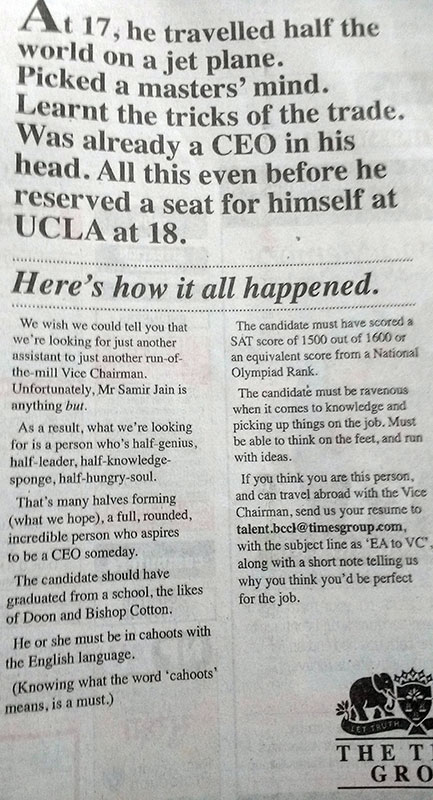
    On a lighter note, if anyone ever felt that they had Yoda-like characteristics or would get along with the sage of the Star Wars saga, they might want to get in “cahoots” and apply for the job of assistant to Samir Jain, vice-chairman of the Times of India Group. I say no more.


    Ranjona Banerji is a senior editor and columnist. She is also Consulting Editor, MxMIndia. The views here are personal.