Category: COLUMNS

  • Sanjeev Kotnala: Be Selfish: Prioritise yourself over everything else

    By Sanjeev Kotnala


    Life has always been demanding. The demands increase with time. You have been misguided if you believe that finally there will be a day when you will have more time at hand.


    It is tough to find a balance, and it is very easy to let life get out of control. Chaos, anxiety, stress are the unwelcome guests ever willing to visit your life. Nevertheless, you always have the choice to lead a life of balance. You can do so, only if bringing balance to life is a priority with you.


    If you cannot find balance in your life within the current ecosystem and environment then there is no surety if your attempts to do so will succeed in the future.


    It is not a exempalary talent to lose the whole day trying to chase your targets and objectives. We all are good at it. At the end, many a time, we feel that we have achieved nothing. The balance slips away, and you lose the control.


    It is only for you to decide if you really want balance in your life. If you do, you may want to try following strategies to make your busy life a lot more meaningful, interesting, and invigorating.


    While I share the strategies for a balanced life, I presume that you have taken time to define what “balanced life” means to you.How much of your waking hours will you willingly spend at work? How much of your time would you spend at home? How many leisure hours do you need each week? How would you spend those hours?


    Be Patient:

    If you are impatient, then it is always tough for you to analyze your life. In truth, your life is a lot more balanced than you think, and your impatience is tinting the observations. Being impatient is a sure way to agitate you. It leads to you being incapable of any action in that agitated state. Being patient helps in better managing challenging situations.


    Simplify:

    Only we are to blame for the way we have given a new meaning and definition to progress. You have been in a race to buy more things than you need and take on more responsibilities than you can manage. Remember every single little unnecessary item in life is creating imbalance. It is for you to take charge, eliminate the superfluous and bring more harmony into your life.


    Make Health a Priority: 

    Stop sacrificing for everyone and everything in your hectic life. This is one mistake that you must avoid. Without good health, there is no balance possible in life. If for any reason, you fail to give health the priority, it deserves, sooner or later bad health will make you focus on it. At that stage, it will be more complicated and create more imbalance.


    Stop Attempting to Multitask: 

    Hope you understand what is real multitasking. It is not about doing too many things simultaneously. It means in doing the right thing at the right moment, doing one thing at a time and moving to another task. When you work in such a way, you finish many things rather than leaving things partially completed. Try out.


    Plan Slot Downtime:

    ‘Saving’ is not what is left but what you take out of available funds at the start, ‘Downtime’ is not the time that is left over after responsibilities are completed? Downtime must be planned and slotted on purpose. You must plan for it. It also becomes a motivator when you know there is a planned break ahead. It funnily ends up enhancing the efficiency of your actions.


    Start Early:

    Procrastination is easier than going through the day’s work and taking decisions. Time is a valuable resource that you cannot create. You too have the same 24 hours. Once you fall behind, the entire day is out of balance. Starting your day with a clear purpose makes it easy. Once you take this step. The rest falls in place.


    Focus on what means most to You: 

    Oh, yes, your family and job are priority for you. Then what comes next? What is that is meaningful? Is it adventure sport, trekking, movies, painting, writing? Remember working never should be the ONLY priority in your life. If you are able to devote and focus on activities, you enjoy and, which mean a lot to you, you will enjoy life to its fullest.


    Give relationships the time they demand:

    When I say this, I am not necessarily and definitely not just referring to the romantic relationships. You must add friends, family and extended family to it. These relationships demand time that you must find. Analyse, if you are not wasting time on something less meaningful, for example, watching television. Hopefully, that is not your way of spending quality time with someone dear to you.


    Get enough Sleep:

    Proper sleep of minimum seven hours can help you do better. There is enough research to show that performance improves in the both physical and mental spaces when one gets seven-hour sleep. If not, it is time for you to re-examine your life and priorities.


    Be Selfish. Prioritise yourself over Everything:

    You can take better care of other, only if you have taken good care of yourself. When you are at your best; you perform at your peak. Being selfish in this case is a positive as everyone in your life benefit’s from it.


    Not everything will work for you. You will have to find the strategy that works for you. You will still have to find a balance in above strategies before you find balabce in your life. Hence here is a hort cut, the final advice and it is simple. Create a well-balanced life by choosing your priorities wisely. Please prioritize yourself over everything else.


    Sanjeev Kotnala with 28 years of corporate experience is the founder of Intradia World; a Brand, Marketing & Management Advisory. His focus area includes Ideation and Innovation; he also conducts specialized workshops like IDEAHarvest, Liberate and InNoWait. For soft skill training, he follows SHIFT (Specific High-Intensity Frequent training), a process of continuous training with frequent shorter sessions. Email sanjeev@intradia.in tweet @s_kotnala web: www.intradia.in, www.sanjeevkotnala.com.

     

  • Test Cricket Woes: Will Kohli Play Saviour?

    picture caption: Source: Twitter/@icc


    By Shailesh Kapoor


    It’s Test Cricket season again. After what seemed like a never-ending T20 fiesta, we finally have some white uniform cricket. In an unusually-designed tour, India is visiting the West Indies to play four Tests and nothing else. No ODIs, no T20s.


    Test cricket has been through its challenges in recent years. There is a loyal base of followers who consider it to be the most challenging and exciting format in the sport. But this loyal base is less than 10 million (1 crore) Indians in size. And the age profile of this segment is not exactly advertiser-friendly, with a large majority of these 10 million being 35+.


    It is not very difficult to sell India cricket in any format. ‘India in West Indies playing only Test cricket’ can be the toughest proposition to sell though. There are many reasons.


    The timings are unsustainable from a viewership perspective. 7.30pm to 2.30am is arguably worse than New Zealand Test cricket timings of 3.30-10.30am. Sleep deprivation can still be managed, but how does one get the control over the remote in the prime time of mainline GEC content that the family must watch?


    West Indies is not the most exciting team to watch in the long format. There are very few stars on the roster, and unlike India-Australia, India-South Africa or India-England, there’s no modern history to this contest.


    The telecast experience isn’t going to any better. The stadia are unlikely to be packed, if the first day last night was any indication. And the commentary ranges from functional to plain boring.


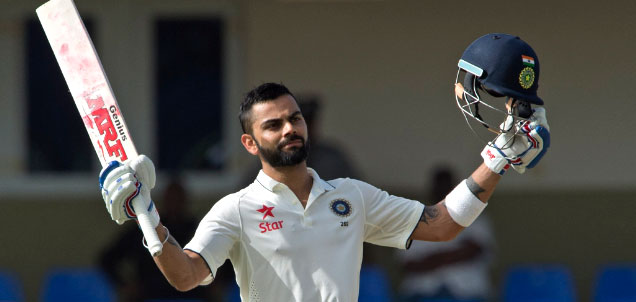
    In such a scenario, there’s just one thing that would make this Test series worth considering, even for the shrinking loyal base. Virat Kohli. This is Kohli’s first Test match since the T20 World Cup and the IPL, two tournaments where his stature as a modern great was firmly established. As I watch last night’s recording while writing this, I see that Kohli has announced his presence in the series early, scoring 143 not out in two sessions, well on his way to his first double hundred in Tests, probably more.


    How emphatically he dominates this series will decide if and how this series is remembered a few years later. Four centuries and it will be the Kohli series that will never be forgotten, especially if India win 4-0 under his leadership. But if the numbers are more modest, the series can fast lose its relevance.


    There has been a lot of talk about day-night Test cricket, and BCCI too has been championing the idea, it seems. But the larger problem with the format is that it needs a potential 30 hours of time investment from the viewer, an unreal number in today’s time, when even a 90-minute film can bore us to death.


    Test Cricket shall remain niche. The 10 million may go down to 5 million two decades from now. At some stage, Pay Per View (PPV) may be the only practical option to monetise this format in India.


    But the next decade is relatively safe. It will be the Kohli decade after all. And if he can grow the loyal base of the format purely on the strength of his charisma, he will be a media industry star too, not just a cricketing one.


  • Ranjona Banerji: Wayward Pines v/s News Television

    By Ranjona Banerji


    Channel surfing on Monday evening, I came across some extraordinary teasers scrolling at the bottom of the screen. The channel was NewsX. “Pak turns Indians against India” and “#IndiansAgainstIndia” kept scrolling, even as the news was about some Hollywood love affair gone wrong.


    So I waited. Turns out that CPM activist Kavitha Krishnan and writer Arundhati Roy had said that the killing of Kashmiri Burhan Wahi was “extrajudicial”. This made the two women traitors and presumably “agents” of Pakistan. They are of course usual targets for some of our pseudo-nationalist TV journalists because anyone with a contrary point of view has to be against the Indian State.


    I went back to watching Wayward Pines. Because, frankly, the fight between humans 2000 years out of their time zone and the humans of the future who have become “aberrations” was more interesting and realistic than what passes for journalism on some Indian news channels.


    The Indian Express for instance has a fascinating series by Praveen Swami on the covert battle between Indian security forces and the Hizbul-e-Mujahideen and the role of Burhan Wani therein. The tone is of a journalist not a hysterical news anchor waving an Indian flag to prove that he deserves the next Padma Shri. You can agree or disagree with Swami but at least he has done some work and is not just creating a Me versus You arguments for the fun of it.


    The inference that Krishnan and Roy are attacking “India” because of some Pakistani influence is extremely dangerous. As it is we have a government at the Centre that wants the discourse in India to be on a binary level only: with us or against us. We are seeing an uprising by Dalits across India, because they have been targeted by this binary mindset. Surely that is a bigger problem than the possible statements of Krishnan and Roy? Or is it now mandatory for everyone to immediately agree with the GOI? In fact, are the PDP and BJP in Kashmir even in agreement on what’s happening there?


    Even more telling is the fact that journalists seem to think that extrajudicial killings are either okay or that they do not happen. These are the same journalists by the way who will grovel at the feet of any Bollywood star regardless of his or her dodgy record.


    Is the role of a journalist to support the government of the day? Is that what the media is for? Or is the role of the media to investigate claims made by the government of the day? Is it the media’s job to start a war with Pakistan? Can the media sustain this war effort if it succeeds in its idiotic objectives? Is the media also going to start a war with China to bolster its ratings?


    If these questions sound absurd, try and watch news television in India when the issue gets close to India’s relations with its neighbours. Then you will know what absurd is!


    Like I once thought that James Bond film, Tomorrow Never Dies, where a media tycoon starts a war to increase sales, was idiotic. Now I wonder…


  • Sanjeev Kotnala: Welcoming the bride: Key to successful induction

    By Sanjeev Kotnala


    Finally, the day has come. After the organisation has gone through the time-consuming process of identifying need gap and desired competencies, filtered shortlisted candidates through references and backchecks, the selected candidate is joining to take charge of assigned responsibilities.


    The new bride walks in the family. The candidate (bride) and the organisation (family), both are unsure about many things. New equations are being redrawn in the early days. Is there something we can learn from the family structure that will help us create the best possible induction?


    Now that the bride is in, the organisation expects her to settle down, take her role within the family and start delivering results. There is the ritualistic induction, designed to ensure a smooth transition and immediate impact. In most places, it is a simple act of filling personal records and showing the candidates office building and facilities.


    Introduction to many overtly smiling faces and warm handshakes is part of the process, the productionwala chachajee (uncle), the admin dadajee (grandfather), the marketing devar (young brother-in-law), the sales jhet (groom’s elder brother), the departmental bhabhi, other surrounding family and the Patriarch (top Management) – all introduced in a speed-dating format. No one expects the bride to remember them.


    However, the candidate is left to take care of his life, find new support system, create allies and understand the omnipotent political undercurrents. From a purely male-dominated, gender distanced society. This was enough.  What else was there to do? Times have changed. There are newer expectations.  The bride is no longer just to deliver in the role of mother, wife and daughter-in-law.


    There is a demand of equality in treatment, and ambitions are being newly redefined.  For organisational growth, impact and solidarity, a lot more than fake introductions is needed. A ritualised induction process helps the bride to better grasp family values, culture, operating processes, decision making systems, and Do’s & Don’ts. It places in right perspective who’s who in the family. Net benefit: the bride finds her place and settles faster.  A happier bride leads to a happier family. It is as simple as that.


    To revamp or redesign the induction process, you need to wear two three hats. See it from the point-of-view and experience of the new bride (Candidate) , her expectations and apprehensions, demands and desire of the patriarch (management) and her husband ( HOD). Do not forget, how the rest of the support system within the family will see it.


    It is true that the family is never completely new to the bride. She has been introduced to it during the match making process. She has made her own enquiries and have accepted the alliance. Maybe some family members are known to her. Nevertheless, she brings with her a certain style of working, and upbringing. She comes with unfathomed passion, ambition, dreams and excitement. And, hopefully, she is willing to adopt a bit. The marriage most likely is a result of a long courtship. A period when the candidate and the organisation have been at their best behaviour. Once the bride joins the family, all systems become transparently naked and the reality strikes.


    If induction is to be the process that ensures homogenisation and mutual acceptance of the bride and the family, then you must answer some questions.


    What all the bride needs to know?

    What will make her comfortable and settle fast?
    What are the first impressions you want to create? Is it a warm working environment, result-oriented place or a process oriented regime?
    Who are the family members the candidate must be introduced to?
    When, where and how long the interactions will be?
    Is there a family member ( mentor, buddy) assigned to help her see through the initial period?
    How will you make her feel secure and welcomed?
    Having the direct senior (husband) available for interaction and answering her questions on the first day, give enough importance, time and attention could help the new member settle down fast.
    What are the policies and practices that must be explained in the initial months?


    Hopefully in the existing organisation, talking to the candidates who have been through the process could help redesign the rituals. Maybe some of the rituals practised when the organisation was small or in a fast-growth process or really struggling are no longer required.


    Settling in a new family is neither easy and nor a day’s work. Hence, it is better for induction to be more than a day’s process. The excitement and public rituals could be a day or a week long but the internal supervision, processes and support should be designed for a much longer period. So a clear role expectation, do’s and don’ts along with a well-designed welcome kit is helpful.


    When the candidate joins, ensure that the  designed seating place is available. It does not have the tell-tale signs and memories of past occupants. The items of daily need ( computer, visiting cards, identity card) are ready to be handed over.


    It helps when the family members are aware of the scheduled arrival. They can then instead of waiting for the ritualised introdcutions come and meet the candidate at their own pace. A person of equal status grounded in the organisation culture should be assigned as a buddy or guide. It is he who will answer the candidates FAQs.


    Like the mehndi (henna patterns) and the Chooda (thick white bangles) identifies a bride, it may be worthwhile to create a system to identify the new member. The system could be extra courteous and helpful to the candidate in the initial period.


    An effective induction programme requires deep planning and a smooth execution to ensures the new member starts taking pride in being a part of the family.


    Note: There is no gender sterotypes used in naming and assigning roles as Husband and bride –  its used in the current social norms as a point of reference.


    Sanjeev Kotnala with 28 years of corporate experience is the founder of Intradia World; a Brand, Marketing & Management Advisory. His focus area includes Ideation and Innovation; he also conducts specialized workshops like IDEAHarvest, Liberate and InNoWait. For soft skill training, he follows SHIFT (Specific High-Intensity Frequent training), a process of continuous training with frequent shorter sessions. Email sanjeev@intradia.in tweet @s_kotnala web: www.intradia.in, www.sanjeevkotnala.com. The views expressed here are personal.


  • Ranjona Banerji: Is Barkha Dutt right in damning Arnab Goswami & Newshour?

    By Ranjona Banerji


    When it comes to India-Pakistan issues, the Newshour has lost balance, objectivity, good sense and journalism.


    I am no great admirer of television news, as any regular reader of this column knows. I feel genuinely sorry for young journalists who venture into television news because their foundations will always remain weak, given what passes for news on television these days.


    I might as well put a disclaimer upfront: Yes, print and web journalists can also be obnoxious, incompetent and unbearable. However, print by its very nature and its time lapse, has some checks and balances that neither TV nor the web have. This time lapse gives it a better semblance of objectivity.


    So I watched the fight between former colleagues and both prominent TV anchors Barkha Dutt and Arnab Goswami with horror and trepidation (yeah, and some laughter and some schadenfreude). I am no fan of either and have written about that extensively. Dutt’s involvement in the Radia Tapes was inexcusable. And it was she who gushed about Narendra Modi being a “rock star” during his first Madison Square Garden performance to NRIs in New York. However, in this instance I wholeheartedly agree with Dutt — Goswami’s Newshour on Times Now, no matter how popular it is, has not been journalism for a long time.


    Forget the fact that everyone screams at each other (that’s called an “open debate”, I gather) or that the anchor launches into long diatribes in the middle of everything. The way the discussions are tilted, the choice of topics that ignores half the issues of the day, the targeting of people who do not toe the Goswami or the Government line, all points to a perversion of what the Newshour itself used to be and what journalism is.


    You only have to observe Goswami’s tone and demeanour when he interviewed Raj Thackeray and Narendra Modi compared to when he interviewed Rahul Gandhi to know where his loyalties (and his nightmares) lie.


    When it comes to India-Pakistan issues, the Newshour has lost balance, objectivity, good sense and journalism. What can only be false manipulative nationalism blares out from guests and anchors, and this style is copied by other anchors, notably of India Today TV and NewsX. The Indian Armed Forces are seen as the repository of all good and anyone who asks a question is a traitor.


    (The only time Goswami targets everyone equally is when he talks on women’s issues.)


    On his show on July 26, Goswami had this to say about his fellow journalists, “They echo the Pakistani line under the guise of backing Kashmiris. They support Pakistan sitting here in India and call themselves Indian liberals… They are not real Indian media. They are supporting Pakistan; directly or indirectly supporting ISIS and supporting Hafiz Saeed.”

    He then went on to say that such journalists should be questioned.


    If what Goswami has said was not so dangerous, it would be laughable. By what yardstick is he the arbiter of what journalists should or should not be? If the Indian Government – even this Modi one – starts talks with Pakistan, will he dub it a Traitor Government? And if he thinks Indain journalists are supporting or are supported by ISIS, no less, he better present some proof and fast.


    His own channel happily ignores burning issues in India when the Modi-run government is not shown in a kind light. The rise in attacks on Dalits is not a major issue for Times Now, nor is the attacks on minorities. The terrorist attack on the Air Force base in Pathankot which happened under Modi’s watch is not to be talked about any more. For a man who rose to fame during the 2008 Mumbai attacks and for whom patriotism is paramount, you would have thought the fact that terrorists ran around a military installation for days would still rankle.


    Many journalists criticised Goswami after his rant but it was Barkha Dutt’s comments of Facebook, later publicised, which got most traction. They have after all been former colleagues and some of Goswami’s rage appeared to be targeted at her. Dutt said “I am ashamed to be in the same industry as him. What’s striking is his brazen and cowardly hypocrisy. So he drones on and on about pro-Pakistan doves without one word on the J&K alliance agreement that commits the BJP and PDP to talks with Pakistan…”


    And she is right. Goswami does not attack the BJP for its coalition with the PDP which comes from the other end of the patriotism spectrum in its avowed intent to talk to Kashmiri separatists. In the Goswami world, the fact that the use of pellet guns in Kashmir has made matters worse as far as the public are concerned is to be discussed by traitors only. Modi’s visit to Pakistan to eat Nawaz Sharif’s birthday cake is to be forgotten. Burhan Wani is a jihadi terrorist and there can be no argument on that.


    However you feel about Dutt as a journalist, it is deplorable that there are journalists who seem to agree with Goswami – though most of them do not have the courage to put their name and face to such comments but just keep them safe on Facebook and such. If a journalist who questions the establishment is a traitor, then All Hail Traitors because what other role do we have as an instrument of democracy?


    Dutt is going to town on Goswami’s diatribe and he has not responded to calls from TV channels for an open debate. In her show on July 28, she brought up these attacks on her person, without naming Goswami, and the BJP member of her panel squirmed with embarrassment.


    Whether Goswami agrees to an “open debate” or not, it seems to be clear that Goswami has breached the barrier.

    Also, he can now drop the journalist pretence and hopefully some government will give him a Cheap Patriot Award. O, spelling mistake, did I mean Chief? Or…


  • Selfie with RK: Week #3 | Mahesh Kanchan, Marketing Director @ Carlsberg

    By Rahul Kishore


    The one thing that strikes you about Mahesh Kanchan, Director – Marketing at Carlsberg is his approachability and warmth. He thinks before he answers and pretty much sizes every googly you might throw at him. In his office in Gurugram , I began by asking him:


    What’s your biggest strength?

    Turning around ailing brands into powerful ones and ensuring that I kick the backside of the Number 1 brand.  Take on a Number 3 brand and propel it to Number 1.  Hershey’s took on Cadbury, Calsberg took on Kingfisher… stuff like that!

    Biggest weakness?
    I just cannot deal with failure. I never change for the sake of changing. If it ain’t broke don’t fix it.

    Hardwork or luck?
    99% perspiration.  Your bosses are good to you if you work hard. In Unilever most people stay for a two-year tenure, so it’s easy to have a boss who’s good to you.

    Favourite CEO?
    Ratan Tata, he has a large conglomerate in India and he was the first CEO to acquire marquee companies globally like a JLR.

    How would you like to live your life again?
    No regrets I would want to do exactly what I did this time around.

    If a movie was to be made about your life who would you want to play you?
    He instantly replies Irrfan Khan. I ask why? No façade. He doesn’t play irrfan… he gets into the character. What you see is what you get. There is no Irrfan Khan style like all the other Khans, he moulds himself into the character.

    On a  scale of 1-10, how weird are you?
    Five-ish, I’m normal. I could be weird around my friends and family though

    What didn’t you get a chance to include in your CV?
    Heading a  company at a young age and global exposure.

    Describe yourself in four words?
    Approachable, risk-taking, action… no debate, team player.

    What’s your superpower?
    Being calm in the most high pressure situations.

    How often do you destress?
    Every weekend with my kids aged 6 and 10. With them and their friends as well. The kids drive the agenda, I  follow. He plays with them, watches movies and ofcourse there is always a chilled glass of Carlsberg at hand, he says with a smile.

    Something that has never worked for you?
    Entrepreneurship. I think about it, but haven’t attempted  it as yet!

    Dream job?
    Unilever CEO in India

    Rate me as an interviewer
    Well, 8, since you managed to get so much out of me in such a short time.


  • Ranjona Banerji: So why doesn’t Arnab Goswami shout and scream at or grill those linked with the BJP?

    By Ranjona Banerji


    A friend, a real dedicated newswatcher, said to me yesterday that she cannot watch TV news nor read newspapers any more. “I just skim through the papers because they only seem to react to an agenda set by TV channels.”


    That is a strong indictment but it is also true. More and more, it is TV which is setting the agenda and therefore the scrutiny on journalism as practised on television has to be more stringent. And we are, it seems, in the middle of a TV journalism flashpoint.


    It’s been a week since one of India’s most prominent news anchors accused another prominent news anchor of being a traitor to India and being pro-Pakistani interests. And the reactions are still coming in from observers and commentators, including from this column last week. There is no doubt that television rules the news media stakes. Or that Arnab Goswami and Barkha Dutt are among TV’s most well-known faces. But how far does that power take you?


    Obviously in Goswami’s case, as far as he likes. No apology had been forthcoming from him on his appalling diatribe. One of his targets was undoubtedly Dutt. But he also targeted all journalists and everyone who does not agree with him. This also includes, as it happens, the Government of India. We are not currently fighting a war with Pakistan, no matter how much Handle Bar Generals scream and yell at their Pakistani counterparts in TV studios.


    The chief minister of Jammu and Kashmir, a state under curfew since July 11, has talked of peace and compassion for the young people of Kashmir, even those who are agitating against Indian authority. Does Mehbooba Mufti qualify as a traitor for Goswami and his studio guests or is she beyond reproach because her party is in coalition with the Bharatiya Janata Party in Jammu and Kashmir?


    Some people have called Goswami a bully, others have said he is tied down by the demands of the advertising which subsidises news, still others have informed us that he is very sweet in real life and something strange happens to him when a TV camera is turned on him. In his early days in the same news channels that Dutt worked in, he seemed to me at least a journalist who did not think it necessary to do his homework. In an interview with former Maharashtra chief minister, the late Manohar Joshi, he casually asked Joshi, “So when were you chief minister?”


    It’s not that Goswami is the only journalist who does not do his homework. But if one extrapolates that that is his foundation, then he is not really convincing when he waves papers around because we cannot see what they prove. Or when he allows the spokesperson of a party he approves of to air false videos on his channel. Or when he ignores the attack on an Air Force base in India but is very bothered about what a Booker prizewinning author has to say. Or that cow protection squads which are affiliated to the party he approves of beat up and kill people. I can understand that attacking Pakistan proves that Goswami is a good Indian. But does he then consider that Dalits are not Indians?


    I can only conclude as I did last week that while Goswami ticks his own boxes of patriotism, he does not tick any known boxes on journalism.


    **


    I did not quite believe it when people on Twitter claimed that no English news channels covered the massive Dalit rally in Ahmedabad on Sunday. But when I checked I found to my horror that this accusation seemed to be correct. All evening I waited for some report on this rally but as ever had to wait for the next day’s papers. One more downtick in my TV news dossier.


  • Sanjeev Kotnala: Lessons from marriage that can help you in job situation

    By Sanjeev Kotnala


    Like everything else in life there is no certainty on how things will shape up. However, it is for you to try reducing the uncertainties associated with it. Searching for the right candidate or searching for the right job needs a similar set of precautions. The organisation and candidate do not short-term affairs and definitely not a relationship that goes sour.


    Great family legacy, education, thinking compatibility, matching of all qualities, hobbies and interest is no guarantee of a successful happy married life. It is true for jobs too. A good resume, reference, past performance and interview are not enough. Like in case of marriage, there is a money, time and effort cost because of failed marriage, there is a huge cost of attrition that is more than money.


    People are chasing dreams fueled by their passion. Hence, they are looking at more than a list of duties. They are seeking a purpose that may come because of love or key areas of responsibility. Oversell in every sphere always leads to disaster. Over expectation and under delivery is the most common mistake. It is better to be honest and avoid any kind of misrepresentation and misinterpretation.


    Though not necessarily true for marriage, promoting candidates within the organisation instead of scouting outside should be preferred. They know the organisational culture. If the growth is within the same role expertise definition, they are faster to slip into new role and make an impact. Moreover, it gives other employees something to look forward to and acts as a motivation push.


    Many marriages in Indian context have been lost due to the magic of the 15-minute ‘love over first tea’ syndrome. It is true for jobs too. Many candidates and interviewers put a high degree of faith on these short interactions. Seriously, there are very few-trained interviewers who are probing to understand the candidates, most of them are busy validating impressions created by the resume and their initial meeting. Unfortunately, the gap is too tough to be bridged.


    However, it is wrong to consider an interview a waste. For a candidate, meeting the prospective direct senior (spouse) is important enough. Meanwhile, the interested candidate is busy saying and behaving in a manner that will help him pass the test and get the job.


    This is the reason that many recruiters are moving from interviews to skill testing. Many place candidates are asked to present their solution to existing business solutions, something like dating and a live-in relationship.


    We carry stereotypes and are biased because of our own unsaid rules and understanding. People at times treat beauty as the first filter for marriage. An arranged marriage gets biased towards known families, shared background, social class and ethnicity. Recruiters and candidates are no different and find it tough not to be influenced by such biases.


    One of the biggest common mistakes in both marriage and recruitment is hiring and marrying a person less qualified than you. It starts with protecting your own turf and the level of confidence. Marrying or hiring more qualified should work. Unfortunately, the societal structure has always pushed people to hire lessor qualified candidates. In effect, most end up rejecting an overqualified candidate.


    Many single men and women are results of their hyped expectations and waiting for the perfect match. Many candidates have wasted themselves waiting for the perfect job to maximise their potential. Positions remain vacant affecting organisational efficiencies and result, because of wait for the perfect candidate. You rarely get it. Perfection is always work in progress.


    I am in no way suggesting that one could marry or hire a wrong candidate till the right match is found. Neither am I asking to wait forever, nor am I asking you to rush. However, making an open-eyed conscious decision, altering expectation, redesigning dreams and passions, leveraging newfound qualities may be the best way forward. In job, it is possible to use a freelance, consultant or interims until you do get a candidate who satisfies your revised benchmarks. Unfortunately, marriage does not give you such an option.


    In marriage, families are known to make elaborate background checks than they do in case of jobs. References alone are not enough. In both cases, it is your life and hence, your being selfish and wanting to do more than superficial reference checks is desirable. This is true for hiring a candidate too.


    Your being cautious on these elementary issues will go a long way in finding the right candidate, the right job and maybe even the best spouse for you.


    Sanjeev Kotnala with 28 years of corporate experience is the founder of Intradia World; a Brand, Marketing & Management Advisory. His focus area includes Ideation and Innovation; he also conducts specialized workshops like IDEAHarvest, Liberate and InNoWait. For soft skill training, he follows SHIFT (Specific High-Intensity Frequent training), a process of continuous training with frequent shorter sessions. Email sanjeev@intradia.in tweet @s_kotnala web: www.intradia.inwww.sanjeevkotnala.com.


  • Selfie with RK: Week #4 | Samar Singh Sheikhawat, Senior VP – Marketing, UBL

    By Rahul Kishore


    I have known Samar Singh Sheikhawat, Senior VP – Marketing at UBL  for 44 years. On the human front, not much has changed. He continues to be as charming, friendly, warm and generous as he was then. Professionally of course he has evolved. It is not easy being surrounded by Kingfisher girls and keep your sanity. To me, he will always be the Kingfisher man. I began by asking him…


    What is your biggest strength?

    People skill. I get along famously with people, I’m great at getting them to work together and building consensus.


    What’s your biggest weakness then?

    Can’t stand lies and hypocrisy he says with a smile. I hate politicking at work and at a personal level. I let too many things bother me, I’m a bit of a control freak actually.


    Hardwork or luck?

    Definitely hard work! I am the most unlucky person around. Almost everything comes to me five years later!


    Favourite CEO?

    Jack Dorsey of Twitter. He’s a guy with his heart in the right place, is empathetic and doesn’t shy away from saying it like it is.


    How would you like to live your life again?

    Exactly the same way. Life only gets better as I get older, I’ve been a late bloomer. The 40s were brilliant and my 50s are even better. I’m like Beethoven’s symphony, slowly building up to a crescendo.


    If a movie was to be made about you, who would you like to play you?

    Samar thought for a very long time on this one. The guy who plays me would have to be as smart as me. Leonardo DiCaprio… he can play anything.


    On a scale of 1-10 how weird are you?

    About 7-9 at home and 2 at work. Normal is boring. I like meeting interesting people who have another side to them.


    What didn’t you get a chance to include in your CV?

    Game warden in Africa. I applied when I was 20 for the WWF in Africa. I was refused because I wasn’t a local.


    Describe yourself in four words.

    Altruististic, Sportsman, Philosopher,  Thinker.


    What’s your Superpower, Samar?

    Perception. I can sense anything before it happens almost!


    How often do you de-stress?

    I hit the gym everyday, I listen to a lot of music. Since I travel a hell of a  lot  it feels good to be back home always. I like to hear my family in the background somewhere and that relaxes me. SAmars famil,y consists of a wife and a daughter.


    Dream Job?

    Teaching, at any business school or university. I’d make a good teacher…


    If Bill Gates gives you 10 million US, how would you use it to improve the world?

    I would educate women. Encourage the girl child, it would have a cascading effect on the birth rate. Infant mortality would reduce. Empower women, build more toilets for them.


    Rate RK as an interviewer.

    You asked the toughest questions I’ve ever had to answer. Some of them have been quite brilliant I would therefore rate you a 9/10.


  • Ranjona Banerji: Why blame the messenger… just because it named the RSS?

    By Ranjona Banerji


    Outlook magazine has published a long investigative report on 31 young Tribal girls being taken from Assam to Gujarat and Punjab to be educated. The parents send their children off knowingly. But what they do not know is that they will not see their daughters again for years and when they return, they have forgotten their language, their culture and appear to be indoctrinated.


    The Assam State Commission for the Protection of Child Rights filed a report on July 15 that girls were being “trafficked”. The protection of child rights got an extra fillip when the Supreme Court ruled in 2010 that children from Assam and Manipur, under the age of12, were not to be sent to other states for education. This directive followed a probe that 76 children from these states had been “trafficked” mainly to schools in Tamil Nadu run by Christian missionaries.


    The reaction to the Outlook story has been strong and angry; and not for reasons that you might imagine. The problem it appears is not that the girls were taken from their homes and not allowed to see their parents for years. The anger is because they were taken to RSS-run organisations and how dare anyone criticise the RSS. One cannot recall RSS supporters standing up for the rights of Christian missionaries in 2010, however. The other point of outrage is that Outlook has used the word “trafficking”.


    Therefore the question of child rights, of parents either mislead or callous, of being taken away from your home and family, these are not issues which must move us. Our only concern is that the RSS has been mentioned in a bad light. However, if the story was about children being forcibly taken to madrasas, you can imagine how overjoyed the RSS and its supporters would be.


    Outlook has an investigative report. It has interviewed the people concerned. It has spoken to the official agencies involved. It has listed the various laws that have been broken – and they have.


    The RSS and its affiliates are within their rights to counter these by legal means. It can take on the government of Assam. It can sue the parents of the children. It can take issue with the Assam Commission for Protection of Child Rights. But it is pointless to attack the messenger. Outlook has told you what has happened. Attacking Outlook will neither solve the problem nor your reputation.


    This is the chairperson of the Assam State Commission for the Protection of Child Rights on how she is being pressured to change her report:

    http://thewire.in/55891/assam-child-rights-commission-chief-allegedly-pressurised-change-report-trafficked-minor-girls/


    And this is the writer of the article, Neha Dixit, on allegations made against her and her work by the RSS and its organisations:

    http://www.thenewsminute.com/article/operation-babylift-why-sangh-parivar-not-countering-facts-facts-asks-neha-dixit-47512


    **


    There has been much outrage on social media that the “mainstream media” has not made as much noise on Peepli Live director Mohammed Farooqui’s rape case as it did about similar allegations against Tarun Tejpal. The implication seems to be that Farooqui has friends in high places and this has helped him.


    However, there are some differences in this case. For one, Farooqui, as far as I recall, has been convicted. I have read several newspaper articles about this which puts paid to the “mainstream media has ignored Farooqui” argument. Secondly, Tejpal’s case had special interest for the media since it was about sexual assault in the workplace by an editor. Tejpal himself added dramatic content to proceedings by a bombastic letter of apology. Had he not written that letter and had supporters of the woman he assaulted not made her case public, Tejpal would probably have got away with it. As it is, he is still out on bail. He has taken back his apology and his friends in high places have continued to defend him.


    I would contend also that Tejpal was better known within and without the media than Farooqui, no matter how well known the latter was in Delhi. The real question for outragers should be perhaps: when will the Tejpal case see any justice?


  • The Games start today, but…


    By Shailesh Kapoor


    The biggest of all sporting events is here. Rio Olympics will kick off less than 24 hours from now, and over 17 days, the best in the world will compete to win something few other sporting achievements can match – an Olympic medal.


    Olympics may not be the most-watched sporting event in most parts of the world, but it is certainly the most prestigious one. From a broadcasting perspective, it is a challenging one too. Navigating schedules can be an arduous task, with more than a dozen simultaneous events at times. In the older days, we would rely on Doordarshan to give us whatever they thought was the best for us to see, on one channel. This broadcast by interrupted by long studio discussions, even as you missed the action that was unfolding at the same time.


    Star Sports has attempted to address the “problem” of variety this time, dedicating four channels (and their HD versions) to the event. It’s still not very clear how one is expected to navigate through the maze and find what one wants to watch, but at least, there will be variety on offer.


    My pet peeve related to Olympics coverage has been how incidental the India angle has been over the years. Ideally, one would expect a channel dedicated to India alone, which showcases only those events in which Indian athletes are participating. And when there’s no such event, the channel could air repeat programming or magazine content around India’s Olympic quest. I’m not aware if Star Sports has a specific plan like that, but I’m sure the India angle will be given more importance that previous years.


    Historically, there’s not been much to shout about the India angle, which explains why it has never been given the visibility it deserves today. When I started watching the Olympics back in 1984, expecting India to win even a single medal amounted to wishful thinking. We drew a hat-trick of blanks in 1984 at LA, in 1988 at Seoul, and then in 1992 at Barcelona. Leander Paes broke that dubious streak with an unlikely Tennis bronze in 1996 at Atlanta.


    Sydney 2000 was not much better. India’s sole bronze came from Karnan Malleswari in women’s Weightlifting. The hue improved in Athens 2004, with Rajyavardhan Singh Rathore (now an MoS) winning a Shooting silver. But it was the only medal we won that year.


    Beijing 2008 and London 2012 saw an improvement that many of thought we won’t see in our lifetimes. Abhinav Bindra’s gold in 2008 was backed up by Vijendra Singh and Sushil Kumar winning bronze. And the tally doubled to six in 2012, with two silvers and four bronze medals across four sports.


    If the trend is anything to go by, we should be targeting double-digit this year. To be honest, I don’t have much of a clue of how realistic that is. While there has been cursory coverage of India’s medal hopes on news channels, it has been confined to off-prime slots or the sports pages. The front-pages and primetime bulletins have largely ignored this topic. And the depth of analysis has been missing.


    The 120-strong squad, our biggest till date, will compete across 66 events. I Hope Star Sports and the rest of the Indian media covers these events prominently, even if they are not ratings-friendly. Because showcasing India’s participation with pride can have a defining influence on how our sporting culture builds over the next few years.


    Jai Ho!


  • Ranjona Banerji: When sports journalists behave like unreasonable fans

    By Ranjona Banerji


    Is it remarkable that once the BJP and the Prime Minister realised that attacking Dalits on the excuse of “cow protection” can be an electoral disaster our “patriotic” news channels have suddenly started “exposes” on cow vigilantes? I would guess, the answer is, “No, it is not remarkable, rather it is only to be expected.”


    The Una incident happened on July 11. The Prime Minister spoke on August 6 and 7. Our exposes started around the same time. It is interesting to see how our differently our patriotic news channels covered the Dadri incident last year where Mohammed Ikhlak was murdered by a mob on the suspicion that he and his family had eaten beef.


    What happens when powerful journalists take cues from government on how to cover stories or indeed what stories to cover? The Dalit anger has been simmering in Gujarat for a while. A massive Dalit rally in Ahmedabad a few days ago was completely ignored by television news, but not by news websites or newspapers. How long does it take a powerful journalist who speaks for the nation to understand this? Only when the Prime Minister speaks?


    Intriguingly, the Prime Minister spoke of most cow vigilantes as “anti-social” elements. However, many of these cow vigilantes belong to Hindutva-related organisations, most affiliated in some way with the RSS and the BJP, both of which the prime minister belongs to. Therefore, “exposes” by our patriotic news channels ought perhaps to concentrate on these organisations, not just thugs and goons.


    The other interesting fact – and this I have learnt from The Indian Express and not from television news – is that barring Himachal Pradesh, most cow vigilantes operate in states run by the BJP or BJP coalition governments. The attacks on Dalits and Muslims – who either eat beef or deal with dead cattle – have increased since the BJP came to power at the Centre. These are co-relations that our patriotic news channels may not appreciate but in a normal world, they would tickle the journalistic nose.


    **


    What is happening in Kashmir is the other issue for journalists. Times Now went over the top accusing Shah Faesal, an IAS officer from Kashmir, of something a little less than treason for a Facebook post where he asked what sort of a government shoots its own people. The patriotic news channel world is run by the George W Bush maxim: “you are either with us or against us”.


    Journalists who have a little brain may be interested to read Wajahat Habibullah, former Chief Information Commissioner, in The Hindu, on Kashmir, on Kashmiris who work for the government and on the lost youth of that state.

    http://www.thehindu.com/opinion/lead/wajahat-habibullah-on-kashmir-unrest-after-the-killing-of-burhan-wani/article8955946.ece?utm_source=MostPopular&utm_medium=Opinion&utm_campaign=WidgetPromo


    **


    Friend, former colleague and senior sports commentator Sharda Ugra had brought up some serious points in this piece for The Hoot, written in 2012, during the London Olympics:

    http://www.thehoot.org/media-watch/opinion/unfair-inaccurate-disparaging-6166


    And almost all of what she said then still stands today. There is a portion of the journalistic community whose only role seems to be to disparage any sort of sporting achievement. There is an enormous effort that takes an athlete to the world’s arena. In some ways, just being an Olympian is a massive achievement.


    Can it be that only journalists and fans want athletes to do their best, to win medals and the athletes themselves do not?


    My observation in this is that journalists too often behave like fans. And they either idolise someone to impossible heights or bring them down to despicable lows. You see this all the time with the Indian cricket team. One win and it is the best team in the world with the best and greatest caption and best and greatest players. One loss and it is the worst team in the world with third-grade players led by a fourth-grade caption. The same team, mind you. This attitude gets extrapolated to all sport.


    Sport is supposed to be a contest between two people or teams but to listen and to read most of the Indian sports media, it appears that only one team competes and the other is there to kowtow to India’s current needs.


    With the Olympics and other such sporting meets though, Indian has a very real problem. Historically, our performance has not been good barring our run in hockey. Therefore, we are without context. We are also not a very good sporting nation in the sense that we are always stuck in “win-loss”, not in the appreciation of the game, the form, the style, the method. This makes the pressure on the few athletes we have impossible. We are also largely concerned with sport as a nationalistic device.


    Sadly, journalists appear to be no different here and add to that the need for sensational headlines. Therefore, an Indian athlete who qualifies for the last 8 in a tough field where the world’s best have gathered and comes 8th  is seen as a “loser”.


    Perhaps the more appropriate reaction is that this athlete did not win a medal not that he or she “crashed out”.