
Category: COLUMNS

  • Ranjona Banerji: Pointless debates on News TV

    By Ranjona Banerji


    I have some suggestions for primetime debate topics for Indian news channels. Should the sun start rising in the West? Should women exist? Should we start to talk sense every night? Should the human species reverse its steps on the evolutionary ladder? O wait, maybe our news channels have already started that process…


    The spot-fixing scandal around the Indian Premier League may or may not have captured the public imagination – people still seem to be watching it – but it has certainly consumed our news channels. I just heard this morning on Times Now that this spot-fixing episode is cricket’s worst crisis. Far be it from me to contradict our worthies (but I’m going to do it anyway) but surely the match-fixing scandal of 2000 was the biggest in recent time, where two much revered and successful captains of international teams lost their jobs? But what do I know, eh?


    Right now, all that the investigation has shown is that Sreesanth and two other cricketers belonging to the Rajasthan Royals team took money from bookies to give away runs in particular overs which they bowled. The rest has been a whole lot of speculation and moralistic posturing. Journalists have twigged on to the fact that the Delhi and Mumbai police are at loggerheads. But instead of investigating what that means for this case, we decide to have a debate instead: “Are the Mumbai and Delhi police at loggerheads”. It’s hard to see what purpose such a debate serves. Give the viewer/reader the story and move on.


    The moralistic posturing, especially by journalists is even funnier. The issue, as far as I can see, is that three cricketers at least cheated – cheated cricket itself, cheated cricket fans and cheated their franchise owners. Whether they met escort girls or bought Blackberry phones is extraneous to the cheating allegations. The cheating is bad enough by itself. By diverting attention to the fact that bookies exist, the media is diluting the crisis.


    I would have expected a greater call for legalising betting but apparently logic and reasoning are in short supply at times like this. Instead, we have the ridiculous hysteria over a photograph of Indian captain MS Dhoni’s wife next to Vindoo Dara Singh who has been accused of knowing bookies. The connections here are tenuous – if they exist at all – and this is nothing but sensationalising.


    The police are quite happy to focus on bookies and try and point in the direction of Dawood Ibrahim which means that their job is over since there’s nothing they can do. Spot-fixing – which is extremely serious and needs to be taken seriously – has been buried under parties, bookies, escort girls, clothes from Diesel, pictures of models in email inboxes and Blackberry phones. I would conjecture that it is possible to never go to parties and still be a cheat.


    If the media did not get distracted, it could play a vital role in the unravelling of this menace – as indeed Outlook and Tehelka attempted in the past through the efforts of Annirudha Bahal and others. Instead, the media seems to have jumped on to some improbable moralistic crusade and left the real crisis behind.


    Meanwhile, preparations for the Champions League are on…


    **


    The bizarre and brutal attack on a British soldier in mufti in Woolwich by two men ostensibly in the name of Islam has badly shaken up the Western world. Glenn Greenwald asks some difficult questions and raises some interesting points about terrorism in this opinion piece in the Guardian: http://www.guardian.co.uk/commentisfree/2013/may/23/woolwich-attack-terrorism-blowback


    **


    Why have the riots in Sweden, on for five days now, not caught international media attention?


    **


    And, Roger Federer finally joins twitter: @rogerfederer.

    (I’m @ranjona by the way!)
     

  • Ranjona Banerji: The BCCI prez’s trial by media

    By Ranjona Banerji


    The fact that N Srinivasan, chairman of the Board for Control of Cricket in India, thinks that his main adversary in the IPL mess is the media shows how much news television has changed the discourse. Us journalists have always existed, but on the periphery of everyday life, an early morning or mid-afternoon fix that rarely lasted beyond an hour if that long. Now, the “media” is a 24-hour experience and whether it’s being silly or serious, it cannot be ignored.


    The BCCI chairman however is railing against the wrong enemy. The media may be annoying – to him at least in this instance – but what the BCCI has done or not done for cricket has to be scrutinised. Whether Srinivasan likes it or not, the revelations that IPL players have been caught spot-fixing, that bookies have full access to cricketers and that his son-in-law is somehow involved cannot be ignored. Srinivasan is lucky that the conflict of interest in the Board chairman owning an IPL team has not come under greater scrutiny in the past.


    Monday night on TV, our worthies who have made journalism such a contender were torn between the IPL saga and the Naxal attack in Chattisgarh. The problem here is that the Naxal problem is complex and complexity and television are natural enemies. To just start jumping and advocating “war” on Naxals is not just irresponsible, it is foolish. I did not expect to hear a sensible discussion on Salwa Judum or the civilian militia created to fight Naxals on TV and I was not proved wrong. However, Rajdeep Sardesai (CNN-IBN), Nidhi Razdan (NDTV) and Arnab Goswami (Times Now) all tried to discuss Naxalism? Does one get any marks for trying? Only in Junior KG I think.


    IPL then was a much safer bet. Except for the fact that Rahul Mehra (the man who exists to hate the BCCI) was on two channels at the same time, a trick he learnt from Ravi Shankar Prasad and both can teach that to Chris Angel. Anyway, if Srinivasan thought that the media was against him on Sunday, he couldn’t have imagined the horrors of Monday. He had handed himself over as a target and the media, quite rightly, could not look the other way. (Actually Barkha Dutt did appear to look the other way or maybe that was an old issue of that talk show she does being replayed, which was on the food security bill. Or maybe it was just bucking the trend.)


    The trial by media was on full swing and even though Sunil Gavaskar tried to defend his friend Ravi Shastri for being part of the inquiry commission and frowned upon a witch hunt, everyone else was less charitable to the BCCI. Which is only to be expected, given the brazenness of Srinivasan’s response. The fact that the BJP and the Congress – both well-represented on the cricket board – are on the same page was not missed by the media. If only they could show the same spirit of bipartisan cooperation in Parliament as well said one studio guest sarcastically. The BJP, which wants a resignation every time the wind changes, is not so sure about Srinivasan, leading to a little spat between Rahul Kanwal and Shaina NC on Headlines Today. Why does Shaina NC come on TV at all? No one is ever nice to her.


    Newspapers are no kinder and the Asian Age called Srinivasan’s attitude, “Shameful!” while The Times of India called him “combative”. The fact that Indian and Chennai captain MS Dhoni has been avoiding the media was not missed either.


    Srinivasan has made mistakes not just by changing the by-laws to own a team, giving his son-in-law free access, pretending that nothing is wrong, appointing an inquiry commission that reports to him, being caught with whole-scale cheating on his watch, annoying Sharad Pawar, but also blaming the media. Ha ha. This will not end well.


    Ranjona Banerji is a senior journalist and commentator based in Mumbai. She is also Contributing Editor, MxMIndia. She can be reached via Twitter at @ranjona. The views here are her own


  • Ranjona Banerji: Who cares about the Maoists’ attack & the PM in Japan?

    By Ranjona Banerji


    There is a feeling that the media is spending too much time on the IPL scandal and trying to sack BCCI president N Srinivasan and thus ignoring other news. The prime minister has increased ties with Japan which has economic and geopolitical implications. Maoists have launched a brutal attack against a Congress convoy and more importantly against the Indian state in Chhattisgarh. Drought and a heat wave have killed thousands and killed many. Life is not all about cricket, say some.


    That may well be true but this criticism is also only partly true. Newspapers have been carrying articles and opinions on all these other subjects – and more. The PM in Japan has been first or second lead on most front pages this week. But news TV is severely hampered by its nature. Focusing on ties with Japan will make TV news sound like those old Films Division documentaries of yore (all right, all those born after 1977, you can wake up now). Further, TV journalism is not equipped to handle geopolitics in India yet – neither the editors nor the reporters have the depth of knowledge or understanding to tackle it. Better to give it a wide berth.


    Then you reach the Maoist problem. TV journalism has crafted for itself a character where everything is seen through the nationalistic/ patriotic/ jingoistic prism. Therefore any issue with nuance is impossible for it to handle. There is a background to the issue of this insurgency against the state and without comprehension of that background you cannot provide clarity to the viewer. Many news channels did try to tackle the Maoist issue but it is too complicated for most reporters and the standard of debate on Indian news television has become so low that the importance of the subject was lost in the now expected yelling and screaming.


    It might be advisable on subjects like this to stick to interviews with experts one at a time. This gives the viewer the chance to assimilate the facts and assess varying opinions for themselves. Watching Chandan Mitra and Nandini Sundar trading charges no longer makes for entertaining television.


    That leaves the BCCI. This story is by far more exciting as far as the nature of TV goes. There is drama, intrigue and the requisite touches of sleaze. You can chase the BCCI president and his son-in-law Gurunath Meiyappan across the country. You can look for bookies and the “honey traps” they provide for susceptible cricketers. You have people surviving on the edge of the glamour industry providing a bit of cheap tinsel. You have competing police forces. You can thrown in gratuitous references to Dawood Ibrahim (if you work hard enough at this you can write a book and Anurag Kashyap may make a film about it). You have India’s cricket captain and the captain of the Chennai Super Kings MS Dhoni refusing to speak to the media (the temerity of the man!).


    Simply put: the cricket scandal was made for television. It allows TV’s best minds to work together and give you reporting, investigating abilities and editorialising all in one go. No print journalist can match it. Print can stick to ties with Japan, Maoists and all the rest of it!


    Footnote: For a perspective on the cricket crisis, here’s Ayaz Memon on The Times of India edit page: http://articles.timesofindia.indiatimes.com/2013-05-30/edit- page/39602856_1_indian-premier-league-ipl-indian-cricket


    And for the Maoist issue, here’s Ramachandra Guha in The Hindu: http://www.thehindu.com/opinion/lead/the-continuing-tragedy-of-the-adivasis/article4756954.ece


    Ranjona Banerji is a senior journalist and commentator based in Mumbai. She is also Contributing Editor, MxMIndia. She can be reached via Twitter at @ranjona. The views here are her own


  • Ranjona Banerji: When the BCCI didn’t heed advice of the channels

    By Ranjona Banerji


    Hell hath no fury like news channels scorned. The fortnight-long campaign carried out against BCCI chief N Srinivasan reached a head on Sunday afternoon, when the BCCI dared to reveal its compromise formula which went against everything news channels had been recommending. The temerity of the Board of Control for Cricket in India to allow Srinivasan to “step aside” and make his buddy Jagmohan Dalmiya the interim president!


    Srinivasan, as we all know, should have been frog-marched out by his collar, never to be allowed to darken the doorsteps of Indian cricket again.
    Alas!


    And this is why there is very little other news worth discussing in the nation or indeed the world (except for Indian children in the US consistently winning spelling competitions, truly an earth-shattering occurrence when you consider that when in India, children cannot spell at all). A poll on CNN-IBN apparently said that 90 per cent of the people were disillusioned with cricket or words to that effect. Whether that is 90 per cent of entire population of1.2 billion or 90 per cent of the six people who answered an online poll, I don’t know. But even the worst sceptic would concede that the wishes of 90 per cent of a polled people cannot be ignored.


    Arnab Goswami of Times Now was the most upset if only because he had been the most vociferous against Srinivasan together with his shrieking pet panellist Boria Majumdar. Headlines Today was determinedly resigned as they shook their heads and reminded us that Dalmiya was no crusading angel. NDTV had Sreenivasan Jain trying to look ponderous and sounding lightweight pompous. Maybe it was the outfit. Rajdeep Sardesai revealed his home decor or one lamp at any rate.


    The upshot of all this is that the BCCI meeting was a sham and the cricket-loving public (90 per cent of it anyway) had been fooled. The downturn is for the BJP because it was Arun Jaitley, beloved of all Delhi journalists (though not as much as the late Pramod Mahajan) who apparently proposed Dalmiya’s name. This made the BJP an immediate target, which now includes the fact that Narendra Modi, president of the Gujarat Cricket Association hath not said a word against Srinivasan and has extended to the usual confused statements that senior party leaders make against or for Narendra Modi.


    Indian captain MS Dhoni has been another media target because he is also the captain of the Chennai Super Kings and is a vice-president of India Cements, Srinivasan’s company. The cricket scandal overshadowed the self-righteous proclamations of outgoing CAG Vinod Rai who was all over NDTV (and one of Karan Thapar’s programmes on CNN-IBN) explaining the impossibly dull innards of accounting practices to us commoners.


    The cricket administration will continue to be a target unless, one guesses, India does well at the ongoing Champion’s Trophy series in the UK.


    **


    I absolutely adore The Week That Wasn’t, with its satirical (or farcical) view of the news as well as the take-offs on famous people or common stereotypes by Kunal Vijaykar and the others.


    However, it seems of late that the TWTW is unable to take on political satire. Or rather, the jokes reflect a schoolboy’s perspective on politics, with a sort of India Against Corruption type of self-righteousness underlining them. Maybe it’s just me…


    Having said that, Cyrus Broacha was just superb as Krishnamachari Srikkanth this week.


    **


    Small tip: Vinod Dua as a foodie is an interesting change from whatever’s going on: Zaika India Ka, NDTV.


    Ranjona Banerji is a senior journalist and commentator based in Mumbai. She is also Contributing Editor, MxMIndia. She can be reached via Twitter at @ranjona. The views here are her own


  • Ranjona Banerji: Advani resig stumps media-savvy BJP

    By Ranjona Banerji


    Is the Bharatiya Janata Party hoping for some more salacious recommendations about cricket in India? Because it is clearly uncomfortable with the media focus on the BJP, especially since its most senior leader, LK Advani, has not allowed the party to celebrate the elevation of Gujarat chief minister to the post of election campaign boss.


    If I may, in an aside, what’s with the use of the word “anoint” to replace appoint. In my lexicon or any that I have consulted, anoint has to do with rubbing various unguents on someone in a religious ritual, as an act of consecration or as a sign of divine intervention or to choose a successor (in a dynastic kind of way). Is that what has happened with Modi? Is he on his way to sainthood? Or does the choice of word have something to do with the BJP’s chosen path of Hindutva supremacy? I ask this question because Indian news TV is largely irony-free so I am forced therefore to take the use of the word “anoint” seriously. Perhaps that is what TV journalists think have happened here… Modi is about to become one with god or even become god himself. Maybe I should have used a capital ‘G’?


    At any rate, Modi is on his way to sainthood one day and no famous TV anchor is allowed an afternoon nap on a Sunday. Then Advani throws the mother of all tantrums and all the TV channels smell blood. The anointing ceremony has been somewhat sullied by a sulk. So Monday is another day altogether and one where the knives, sniggers and suspicions are out in the open. I actually felt sorry for BJP spokespersons like Nirmala Seetharaman and Meenakshi Lekhi, being forced to venture into shark-infested waters to explain what was happening in their party.


    The media is by nature fickle but this is a lesson which few politicians or media beneficiaries will ever learn because they take the spotlight so seriously. The extreme arrogance of the Congress allows them not to court the media but the BJP is usually feted for being “media savvy”. It did not work on Monday evening as Advani’s resignation letter was everywhere and every tweet put out by Modi was being sat on a couch and psycho-analysed.


    **


    The newspapers meanwhile had all written edits for Monday morning discussing the Modi appointment (should I succumb to his impending sanctification?) and what it meant for the BJP and how the BJP was changing. Tuesday morning showed that all edit writers had gone back to the drawing board to now factor in the Advani response – resignation from all party posts bar that of the convenor of the National Democratic Alliance – and what that meant for the party he had nurtured.


    However, I would have liked to have read more insights into what was happening, with some insider information on the Advani camp and who was assisting/ advising him, as well as what was happening in Modiland. The best response here was from the Indian Express, which offered a little more as well as Hindustan Times which went beyond the plain vanilla coverage provided by The Times of India.


    The better discussions were of course on Rajya Sabha TV, in both English and Hindi, where the anchors do not allow high-pitched hysteria and the guests do not seem so inclined either. It was business as usual on the other channels.


    **


    The space given to the suicide of starlet Jiah Khan has been intriguing. Sad as her suicide was, what has warranted full coverage of her funeral as well as sustained front page reports? Is this our obsession with Bollywood going too far or just some inability to distinguish between sad and significant?


    Ranjona Banerji is a senior journalist and commentator based in Mumbai. She is also Contributing Editor, MxMIndia. She can be reached via Twitter at @ranjona. The views here are her own


  • Ranjona Banerji: How everyone loves to bash journos

    By Ranjona Banerji


    The media is now one of the top topics of conversation in India. I took part yesterday in a Google Hangout organised by the website Halabol to allow Amnesty India to present their current and future projects to some of Halabol’s bloggers. The minute the floor was open to questions, the conversation veered towards the media and its real and imagined transgressions. Luckily, someone steered everyone back to the subject under discussion. But the danger was very real.


    The internet has of course made journalists out of everybody and television has made journalism enter everyone’s homes. This combination has not just smashed and toppled the ivory towers of old but it has also eroded at the basis of journalism itself. And definitely at its credibility. Wild accusations are made against journalists and the media houses they work for without any evidence. Expressions like “paid news” are flung around without most having an idea of what it means or stands for. Political polarisation means that any hint of a lack of criticism by a journalist or even too much criticism is seen as a sign as taking sides. People who were earlier oblivious now look out for signs of collusion and often even innocent mistakes are seen as part of some grand media conspiracy to destabilise someone or the other.


    How dangerous or difficult does this make life for journalists? There is no denying that there serious problems in the media and that many of those have not been effectively addressed. It is also true that unfortunately TV’s manipulations and lack of depth are both visible quite frequently. But that does not mean that every journalist is corrupt or that no media house ever does its job. But a blanket attack on credibility and integrity cannot help in the long run.


    A common refrain is that there are not enough websites or any other media tracking journalism. However, this is not true. The Hoot has been doing an excellent job for years. The Press Institute of India brings out Vidura which focuses on media issues. Shailaja Bajpai’s column in The Indian Express is a must read as was Ajit Bhattacharjee. I do remember Mihir Sharma writing regularly on the media. The Hindu has an ombudsman. I’m sorry if I have left anyone out. There are also innumerable blogs which discuss the media. And we at mxmindia.com do what we can to hold up a mirror to the media.


    However perhaps there is an argument for more mainstream effort in critiquing journalism so that the reading and viewing public are in the loop if not playing an active part. And for somehow including television news in the mix since that is where much of the public anger stems from.


    Anyone have any ideas of how it can be done?


    **


    Firstpost.com which started out so well with its platform for opinionaters is now being accused of being too kneejerk in its responses. This accusation is not without its merits. Often, opinion pieces will be written before the full facts (or even half the facts) of a case are known. And no apologies are made later. Given the seniority and experience of the people running the show, I am a bit surprised by this shoot and run policy, the possible consequences of which are that it will lose traction or become a laughing stock.


    I can understand the compulsions under which firstpost.com bought the satirical site Faking News and why Faking News sold itself, but wonder how free fake news will now be allowed to be…


    **


    Since there is evidently no stopping the Jiah Khan life and death juggernaut, I give up.


    Ranjona Banerji is a senior journalist and commentator based in Mumbai. She is also Contributing Editor, MxMIndia. She can be reached via Twitter at @ranjona. The views here are her own


  • Ranjona Banerji: No Sunday R&R for journalists

    By Ranjona Banerji


    Life has been tough for journalists looking forward to a little Sunday R&R for over a month now. Between the IPL, the BCCI, the BJP, JD(U) and the NDA (an epidemic of acronyms?), every weekend has been big breaking news time. For television especially, life has been tough. Editors have been yanked out of their weekend plans and all the stalwarts who fight through battling panellist on weeknights had to repeat the exercise on Saturday and Sunday afternoons. The other casualty has been incessant Bollywood programming.


    This Sunday’s prize has to go to Rahul Kanwal of Headlines Today for dumping his studio in Delhi and conducting discussions and monitoring news from Patna, as the Janata Dal (United) formalised its split from the National Democratic Alliance. In fact, Kanwal is a sober and sensible moderator (compared to many of his shriller compatriots on other news channels). However, when it is the armed forces that are under discussion, jingoism trumps journalism even for him.


    Newspaper editors probably had an easier time monitoring events from their drawing rooms as no one knows if they come to work on weekends or not! The Editors’ Guild can though put up a request to political parties, the police and other government, quasi-government and non-government organisations to avoid going through divorces or making revelatory announcements on the weekend!


    **


    Which reminds me: where is Markandey Katju, our intrepid chairman of the Press Council of India? We have not heard anything from him in a while.


    **


    The reshuffle in the Cabinet by the UPA/Congress possibly got less attention than it would have because of the split in the NDA. But even so, most newspapers seemed more bothered about the age of the ministers than anything else. It’s bad enough that today’s journalists think that everyone over the age of 50 is “elderly’ but to see all news through the prism of age is short-sighted and foolish.


    **


    The Twitter world saw its worst side come through this week. Former head of R&AW and security analyst B Raman died this week He was a prolific tweeter who talked about his ongoing battle with cancer, the country’s foreign policy and his disquiet about Gujarat chief minister Narendra Modi. This led to his death being celebrated by pro-Modi tweeters. That the anonymity provided by social media gives people more licence than they have in real life is not a point for debate any more. But the baser side of human nature is always distressing whenever it is revealed.


    **


    The oddly intrusive nature of today’s world and the dilemmas those pose were outlined in a newspaper story about celebrity TV cook Nigella Lawson and her husband, advertising maven Charles Saatchi. The UK newspaper Sunday People published pictures of Lawson and Saatchi involved in a fight at a London restaurant, with Saatchi gripping Lawson’s throat with one and then both hands and Lawson looking obviously distraught. The link: http://www.mirror.co.uk/news/uk-news/nigella-lawson-attacked-husband-see-1955564


    People who saw it at the restaurant evidently did nothing or little. The couple left, the story was published a week later and the police had to look into it after comments on Twitter cooked up a storm. Finally an explanation of sorts was delivered by Saatchi: http://www.guardian.co.uk/media/greenslade/2013/jun/17/nigellalawson-thepeople?CMP=twt_gu


    The upshot of all this is the “media” in all its entirety is now a constant in our lives. Journalists as we know no longer have to be around to peep and pry. The technology to do so is available to everyone. Social media may not be the voice of God but it is the voice of some of the people and cannot be ignored. And if the people are not peeking where they shouldn’t, governments are doing it. The only recourse for those interested in increased privacy is to get really thick curtains, but one doubts even that will help. Forget Big Brother, everyone’s watching.


    Ranjona Banerji is a senior journalist and commentator based in Mumbai. She is also Contributing Editor, MxMIndia. She can be reached via Twitter at @ranjona. The views here are her own


  • Ranjona Banerji: Tablets & tabloids – shape of news to come

    By Ranjona Banerji


    Having spent too long in a newsroom bossing about, I’d almost forgotten the cliquish little world that reporters live in, especially same-beat reporters. But one day of covering the Wimbledon tournament for Mid-Day and I feel that I am ready to write a thesis on the tribal customs of travelling tennis journalists.


    I had the same feeling years ago when I covered – just one, mind you – a film shooting for fun once. (Thanks actually to the founder editor of this website). All the habitual film journos hung around together and demanded entertainment from the PR guys who had organised the trip. They paid no attention to the shooting or the stars. Because it was a novel experience for me, I hung around the set – interminably boring – and interviewed one of the two main stars. The other never emerged from her room.


    In the same way, the Wimbledon press centre remained full of people watching TV and filing while I the wide-eyed rookie ran around the place. Great fun. However, more seriously, it seems that in spite of the fact that there were some women about, the media is the preserve of what NGOs call “male, pale and stale”. That is, sports journalists tend to be old white men! I tried to take aphotograph of the press enclosure on Centre Court to prove my point but apparently journalists in the press enclosure are not allowed to take photographs. Go figure.


    **


    There seems to be a lot of anger against the television media in India for its coverage of the Uttarakhand floods. It is impossible to know what went wrong from so far away but I can conjecture that as usual Indian TV went into “blame mode” rather than reporting mode and this meant that the issue became a school-playground level debate between opposing yellers and screamers. How this is of any help to anyone is a pointless question however since TV editors evidently cannot think beyond “discussion journalism”.


    But one story was intriguing and that was The Times of India report that Gujarat chief minister Narendra Modi travelled to Uttarakhand and rescued 15,000 Gujaratis. It was not made clear in the story how exactly the Gujarat state administration left behind the other people or how in extreme weather conditions they identified who was who. A petition on change.org (http://www.change.org/en-GB/petitions/chairperson-press-council-of-india-inquire-into-serious-violation-of-media-ethics-by-times-of-india?utm_campaign=share_button_action_box) has asked some questions about violation of ethics. The implication in the petition is that the story was a PR exercise for the Gujarat chief minister to show how efficient he is. But the underlying feeling is a bit of holocaust-type politics where you save only one kind of person (depending on ethnicity) and abandon the rest. Which is pretty bad PR if you think about it…


    **


    Meanwhile, here in the UK, once again you notice how news dissemination is no longer what it was. Newspaper subscription on tablet devices is winning the battle against paper. And on the tube, tabloid newspapers are common, free or otherwise. Some lessons which India will have to pick up on sooner or later. Sooner for the media industry’s own good but who knows.


    Ranjona Banerji is a senior journalist and commentator based in Mumbai. She is also Contributing Editor, MxMIndia. She can be reached via Twitter at @ranjona. The views here are her own


  • Ranjona Banerji: Inexplicable Times

    By Ranjona Banerji


    It is hard to make sense of The Times of India’s stories and comments about Narendra Modi, especially from far away. Or indeed the way the Indian media appears to have focused half their attention away from a terrible humanitarian and ecological disaster on to the chief minister of Gujarat.


    Even assuming Modi swooped into Uttarakhand with his extraordinary Gujarat Special Ops team and managed to identify 15,000 Gujaratis and whisk them off to safety, the story had to be on the people of Uttarakhand and the visitors to that state. These are the accusation against the media, from what I can gather.


    For one, there’s the Modi PR exercise which now has the piquant problem of the newspaper which publicised Modi slamming the media for publicising Modi. The Times of India can sometimes be most inexplicable. It’s one thing to be all things to all people. But it is quite another to lose all sense of coordination and contradict yourself in public.


    This is the time when the newspaper should come out with an explanation as to its conflicting policies about Modi or about news items versus columns or indeed about half-baked apparently PR-driven stories. On the off-chance that all these conjectures are untrue, this would also be a good time for this or any other news organisation to clear its name. But alas, such ivory towers sometimes are less impregnable than Saruman’s Isengard.


    The other horror from Uttarakhand that I have noticed is a TV reporter who did his report sitting on the shoulders of a flood victim who was standing in chest-deep water. I really do not know what to make of this. I read an explanation given to Newslaundry where the reporter said he was wrong but still managed to blame the cameraman for revealing that he was on the man’s shoulders! Words fail me, to be honest.


    The only thing I can give thanks for is that I am spared the nightly hysteria on Indian television as people who know nothing fight with each other in ferocious effort to obfuscate the real issue. I defy anyone on TV to read that last sentence out loud!


    **


    I am assured by a friend, tennis expert and former colleague who is covering Wimbledon for her newspaper that it is the Grand Slam tour that is particularly weighted heavily by male reporters/tennis experts, journalism stars. The rest of the tour apparently has a good proportion of women reporters, almost equal she says and quite clearly dominant especially in the noise department. Good to hear. Right now, all the white hair on display rivals mine. Which is quite an experience, given that the average age of a newsroom in India is now about nine and a half.


    One gentleman in about my age category (but he has it seems removed all evidence of grey hair on head by removing all hair) has sat next to me at Centre Court three days running. But he is barely interested in the tennis. Instead, he scans the crowd carefully for celebrities, has whispered confabulations with his colleague and then scoots off. It is thanks to his audible whispers that I learnt that British Olympic marathon star Mo Farah was in the Royal Box!


    Ranjona Banerji is a senior journalist and commentator based in Mumbai. She is also Contributing Editor, MxMIndia. She can be reached via Twitter at @ranjona. The views here are her own


  • Ranjona Banerji: Time for mainstream press to comment on media

    By Ranjona Banerji


    There are a few things we need to learn from the British media and one of them is for our newspapers to start clearly identifying their political leanings. This seems more and more necessary in the politically aware and digitally alert India, with the middle classes taking a tiny bit more interest in proceedings than before. As India develops further, it will follow a more or less established pattern of development and surely it cannot hurt the media to think ahead of the curve. I suppose one should include television news in this as well, seeing how influential television has become. There is plenty of confusion as to which side of the political spectrum various news channels and newspapers fall with ample accusations flying around.


    The current brouhaha in the Times of India stable over the article about Narendra  Modi’s daring rescue of Gujaratis from Uttarakhand, followed by a demolition of the article in an opinion piece followed by a half-baked explanation and digs at desk-bound columnists in a blog by the original writer… In any other world, the newspaper would (and should?) have offered some explanation to its readers about what was going on. In this instance, a “we cover everything” excuse sounds more like a cover up!


    For instance, the Times has every right to be pro-BJP if it wants but if its reporters are going to act like publicity agents for Gujarat chief minister Narendra Modi, then someone should please inform its senior editors and opinion writers. This will help to not confuse the reader, if nothing else. It’s bad enough that she or he has to negotiate between which bit of printed glamour gossip is PR masquerading as news without adding this political confusion to the equation. I suppose the fact that Chetan Bhagat is a best-selling writer justifies his getting edit page space in TOI, but why not stick his columns in some children’s section given the depth of his thoughts?


    **


    More Indian newspapers might also pick up on The Guardian’s idea of having a media page. Yes, Mint does it and The Hindu covers the media closely. Websites like The Hoot, Newslaundry.com and this one also track media happenings. But we need more mainstream newspapers to keep an eye and comment on media as well.


    Monday’s Guardian has a critique of the re-launch of Rupert Murdoch’s News International as News UK. It also has a very funny account of how scriptwriters are treated by the BBC as well as a feature on an internet TV service. The Reader’s Editor talked about the newspaper’s run-in with a government department. This provides a fair overall coverage to the reader about media events – all of which affect the reader, lest we forget.


    **


    I will not bother to mention that art, the performing arts and literature get space and prominence in British newspapers. Having heard variously insulting and demeaning descriptions of the average Indian for years from marketing departments in several news organisations I now accept that Indians cannot think beyond Bollywood and the rubbish it churns out week after week!


    **


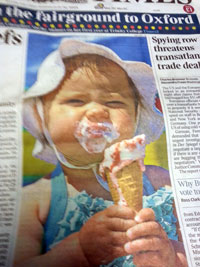
    I take back my complaints about the Indian media being obsessed with pictures of children with chocolate and ice-cream inelegantly smeared all over their faces mistakenly thinking that this is cute. Must know acknowledge that this misconception is global as this picture on the front page of The Times, London demonstrates.
     

    Ranjona Banerji is a senior journalist and commentator based in Mumbai. She is also Contributing Editor, MxMIndia. She can be reached via Twitter at @ranjona. The views here are her own


  • Ranjona Banerji: Lessons from the Murdoch saga for journalists

    By Ranjona Banerji


    Rupert Murdoch had been heard on tape supporting his journalists under investigation in Britain and raging that the allegations of corruption have been blown out of proportion. News Corp did promise to cooperate with the official investigation after the phone-hacking scandal blew up a couple of years ago, leading to the closure of News of the World. Since then, senior editorial staff members – like Rebekah Brooks – have been jailed and face various charges in the on-going case.


    On the tapes, Murdoch speaks up for his journalists and feels that the police have been incompetent in the probe. The humility which he showed during his questioning by Members of Parliament is evidently gone, replaced by the arrogance he is known for. He also, intriguingly, elliptically refers to his son Lachlan as his successor, where earlier that mantle appeared to have been handed to James.


    The Murdoch saga is far from over and even if it now flies under the radar there are implications for media houses and journalists everywhere. Like the Radia tapes revealed in India, there is some behaviour by media houses and journalists which is unacceptable. Even if such behaviour is condoned and ignored – or especially if it is condoned and ignored – serious damage is done to the institution.


    (For more on Murdoch: http://www.channel4.com/news/murdoch-rupert-tape-police-the-sun-journalists)

    In Britain, the Leveson report into press ethics and the judge’s suggestions about a regulatory have hit a stone wall. In India, the Radia tapes have been quickly forgotten. Unfortunately, this reflects very badly on the media itself given that we all pay the price by every transgression by one of ours.


    Tragically, the chairman of the Press Council of India’s early blustering has been exposed as Shakespearean sound and fury: signifying nothing. The rest of us are happy to carry on as long as that monthly pay cheque comes in.


    **


    The story behind the suicide of former journalist Charudatta Deshpande is distressing and frightening. Deshpande, who recently quit as head of Corporate Communications at Tata Steel. Deshpande had been blamed apparently for a story on Tata Steel that appeared in Forbes magazine. He has practically placed under house arrest in Jamshedpur and threatened. He told friends about a “mafia” within Tata Steel.


    The company also tried to spread the word that Deshpande had died of a heart attack to cover up his suicide, using its PR network. Deshpande’s case has been brought into the public domain and the Mumbai Press Club, for instance, has taken up the matter with the Tatas. K Ramkumar, an executive director with ICICI bank has also gone public on the appalling way Deshpande was treated.


    Along with all the other problems with such a case, there is cause here perhaps for business journalists to consider how they portray certain companies and add to their public myths. The essence of journalism has to be disbelief. But instead, we fall for some popular line and perpetuate ideas about corporations and their leaders happily ignoring their shortcomings. It’s not only about succumbing to marketing pressure either. Even worse, I think it’s about access and that glorious feeling of rubbing shoulders with the high and mighty. But whatever the reasons, the effects are disastrous.


    One only hopes that some justice can be found for Charudatta.


    **


    One of the joys of being in London is reading the Big Issue, the magazine set up in “1991 to provide homeless and vulnerably housed people with the opportunity to earn a legitimate income”. The magazine costs pounds 2.50 and the vendor gets pounds 1.25 for every copy sold. The reader gets a well-conceived magazine with the required mix of news, features and opinion. Politics, art, culture, cinema, music, popular culture, sport and human interest are all covered.


    A lesson of some sort here, not to make a big issue of it…


    Ranjona Banerji is a senior journalist and commentator based in Mumbai. She is also Contributing Editor, MxMIndia. She can be reached via Twitter at @ranjona. The views here are her own


  • Shailesh Kapoor: Lest we forget… television is a ‘service’ industry

    Shailesh Kapoor

    By Shailesh Kapoor


    The latest phase of ad cap has come into play from July 2013, limiting inventory to 20 minutes per hour for news and 16 minutes for GECs. Come October 1, 12 minutes may be a reality. Discussions and debates on ad cap over the last few weeks lead to a larger point, which we hardly give our due attention to. That television channels are not products but services. In effect, watching a television channel is closer to visiting a restaurant than using a shampoo. You may not be paying per viewing session (at least not explicitly), but the principle still holds.


    Those in the service industry, such as hospitality, retail and food, among others, will appreciate that the norms and parameters that apply to service businesses are sharply distinct from those that apply to the product businesses.


    Yet, most of the media talk about television is only about content. It boils down to programmes, their cast and crew, and the program ratings. But if we were to detach the product part of the business and look at everything else, we may stumble upon some critical parameters that can shape the way a television channel brand is perceived, consumed and advocated.


    Take for instance the breaks themselves. The break duration, length, timing of the break point and packaging (e.g. the countdown clocks) are service parameters. A long break is, in many ways, the equivalent of a restaurant taking unduly long to bring your food to your table. Yet, these are parameters we have only peripherally worried about, till TRAI stepped in.


    Similarly, we hear a lot about “picture quality” in consumer research. It is that abstract notion which can be borne out of a mix of production budgets, bandwidth and creative execution. The diagnostics of negative feedback on this aspect generally ends up being technical and theoretical in nature, and hence, un-actionable.


    Then, there is a critical service parameter that applies to practically all service businesses: On Time. Television schedules, especially on movie channels and repeats on entertainment channels, are often violated by upto 15-20 minutes. In the era of EPG, and growing viewer education on how to best use the medium, this is simply a case of poor service.


    Of course, there’s the channel packaging, particularly relevant to the news genre, where viewers may have to endure multiple tickers to watch their daily dose of news. Even on entertainment channels, screen space being covered by programme promotions is increasingly becoming an irritant for the purist viewers, and it’s a matter of time before more viewers begin to articulate the same. TRAI has tried to step in here too, but ad cap is understandably taking more attention for now.


    The list of service parameters will be longer, if one was to sit down and make it. At some stage – and that stage is not too far away – television channels will have to move towards taking a holistic brand view, than a content view. And when they do that, they will have to acknowledge that customer service (viewer service in this case, though advertiser service can also be argued to be important) cannot be an unconscious activity. Especially in genres where the product (content) is not too differentiated (and there are many such genres), service quality can create real differentiation and lead to higher subscription revenues, as we slowly but surely move into a true addressable environment where a la carte or smaller channel packages will be real options for the consumers.


    Two bad services back-to-back in tennis are called a ‘double fault’. It costs the player a point, often the game, sometimes the set and the match. Broadcasters may rather have aces up their sleeves instead.


    Shailesh Kapoor is founder and CEO of media insights firm Ormax Media. He spent nine years in the television industry before turning entrepreneur. The views expressed here are his own. He can be reached at his Twitter handle @shaileshkapoor