
Category: COLUMNS

  • Ranjona Banerji: Debates on primetime news have failed

    By Ranjona Banerji


    The ‘Modification’ of Indian TV news took a little break this week as Indian news watchers were no longer treated to sound bytes of the Gujarat chief minister ordering breakfast from his cook or singing in the shower. The news cycle did a little hop, skip and jump. TV critic Shailaja Bajpai’s Indian Express column expressed TV’s obsession with Narendra Modi perfectly: http://www.indianexpress.com/news/much-ado-about-narendra-modi/1100493/ India has 28 states but of course it is highly unlikely that even if the chief ministers of the 27 other states think they also deserve to become prime minister that the TV media will pay too much attention to them. On Twitter it seems that the pet names “Feku” for Modi and “Pappu” for Rahul Gandhi are on their way to being entrenched.


    **


    The hop, skip and jump in the news took us back to 1984 and the anti-Sikh riots unleashed in Delhi after Indira Gandhi was assassinated. Now if people like me complain that media houses have no institutional memory about the Babri Masjid demolition and its aftermath, can you imagine how far back 1984 is?


    Anyway, the Congress’s Jagdish Tytler, whose name was associated with rioters from day one, was back in the dock. The courts will relook at the witnesses but Tytler had to face the wrath of TV anchors. Twitter told me that Arnab Goswami of Times Now managed to corner Tytler better than Rajdeep Sardesai of CNN-IBN or Rahul Kanwal of Headlines Today. Later, Twitter felt that Barkha Dutt of NDTV also did a good job.


    However I saw Times Now, CNN-IBN and Headlines Today and felt that Tytler was not remotely ashamed or remorseful or abashed. He brazenly made counter-allegations against the witnesses and claimed that in fact he had been helping Sikhs during those terrible days. It is true that Tytler and Goswami got into several spats where Goswami told him sternly: “You will not patronise me”. Tytler played a game where he alternated between being aggressive and wheedling.


    The story of the riots of 1984 is of failure on almost every count – political, social, investigative and judicial. This sort of television drama does not add any dignity or indeed anything worthwhile to the proceedings. Tytler has managed to withstand all kinds of storms since then and probably relishes the chance to be on TV having his say. Our news channels took a tragedy and typically tried to turn it into a melodramatic farce.


    **


    The other news of the day was West Bengal and the attack by Trinamool Congress workers on the prestigious Presidency University (my alma mater, Asia’s first western-oriented educational institution and once India’s premier college). Times Now ran with it all day as it urged us to take our country back from goons. Newshour however turned into a most ridiculous battleground. No one from Trinamool Congress appeared on the show – Derek O’Brien had apparently already been the day before. Goswami wanted the show to be about the attack on an educational institution and political violence. Instead it turned into a slanging match between the Left and Trinamool with Swapan Dasgupta and Jayanto Ghosal of the Ananda Bazaar Patrika batting for Mamata Banerjee and her party. (If anyone wanted more proof that the BJP was trying to cosy up to Banerjee, here it was.)


    The only voice of the citizen was a young film-maker – the only female on the show – who finally had enough of Dasgupta and got into a fight with him. Goswami could not seem to control what was going on. Finally, they were all screaming so much that you had to laugh and I reminded myself once again why I’ve stopped watching primetime news.


    The debate format has failed and Indian news channels must now reinvent the evening format. It’s not even that amusing any more.

    **


    The best joke that I heard on TV yesterday came from the Left’s Sitaram Yechury who told a bemused news anchor – I forget which – “what you call violence, we call a class struggle.” Indeed.
     

  • Ranjona Banerji: Disturbing account, but a pleasure to watch

    By Ranjona Banerji


    Kudos to Headlines Today for its investigative report into the Gujarat riots of 2002, based on police wireless reports which the Gujarat government had claimed had been destroyed. Ashish Khetan, editor, investigations trawled through pages of police reports to put together a picture of what happened in those days after compartment S6 of the Sabarmati Express was attacked at Godhra station. The Gujarat government has maintained that the riots which broke out were a “spontaneous” reaction to the 59 deaths of passengers, mainly kar sevaks returned from Ayodhya, where the Vishwa Hindu Parishad was building a temple to replace the Babri Masjid demolished by various factions of the Sangh Parivar.


    The Headlines Today investigation showed message after message from the state Intelligence Bureau as well as local police stations reporting of Muslims being attacked, incendiary speeches by VHP and Bajrang Dal activists and mobs on the streets, from the afternoon of February 27, only a few hours after the train was attacked. The Ahmedabad police commissioner PC Pande – in whose possession these papers were found – on the other hand maintained to the Special Investigative Team and others that he found no reason to believe that anything untoward was about to happen.


    Headlines Today took us back to those days with careful detail and minus any overblown hype or hysteria. Rahul Kanwal as anchor was sober and serious, an attitude he carried over to the now mandatory television panel discussion whenever anything at all happens in India. He was firm and sober with his guests as well and did not allow anyone to dominate proceedings or run away with the discussion in order to push forward their own agendas.


    At periodic intervals in the discussion, Kanwal went back to Khetan to analyse and explain the findings and to the details of the investigation itself. It bears mentioning that these police wireless reports were released to Zakia Jaffrey, a riot victim who has been tireless fighting the Gujarat government, by the Special Investigative Team only after a court intervention. As Khetan pointed out, an SIT interim report in 2010 complained that the Gujarat government was being uncooperative but in its final report appeared to give the government a “clean chit”.


    In spite of the disturbing nature of the investigation, this was one TV news programme that was a pleasure to watch. http://headlinestoday.intoday.in/programme/gujarat-riots-took-place-due-to-cops-ignorance-india-today/1/262417.html


    **


    Other news channels concentrated on the supposed rift within the NDA as the BJP and ally JD (U) wrangled over the possible ascension of Narendra Modi to the prime minister’s chair. These discussions amounted as usual to nothing, with the usual suspects fighting it out. Frankly, after the work put in by Headlines Today, all other orchestrated debates became irrelevant. The IPL was a better bet if you wanted relief.


    However CNN-IBN did take a detour to the horrifying story of a woman bleeding to death on the road in Jaipur after she was involved in an accident – no one stopped to help


    Tuesday morning’s newspapers stuck to the same theme, with the BJP-JD (U) spat dominating headlines. The Headlines Today investigation was not picked up, although most papers reported that Zakia Jaffrey had filed a protest petition.


    **


    Economic Times continued with the stories coming out of Goafest and on Monday had this rather disconcerting story about allegations of plagiarism against McCann’s creatives which won it the Grand Prix. http://articles.economictimes.indiatimes.com/2013-04-15/news/38556065_1_agc-awards-governing-council-ddb-mudra


    Clearly, the advertising industry needs to do more than introspection. It needs a thorough spring cleaning.


    Ranjona Banerji is a senior journalist and commentator. She is also Contributing Editor, MxMIndia. The views expressed here are her own. Follow her via Twitter at @ranjona


  • Ranjona Banerji: Move over FBI, NIA: Indian TV news can solve both Boston and Bengaluru bombings!

    By Ranjona Banerji


    The way journalism can be practised is always up for scrutiny and rightly so. Because there’s a lot that the media does to mould or at least suggest to public opinion. Well, enough of all that. Let’s get down to it. Two bomb blasts in two cities and two completely different reactions. A bomb goes off towards the end of the famous Boston Marathon, killing three and injuring many others. A bomb goes off outside the BJP office in Bengaluru, injuring many. The US authorities and media have been careful and circumspect not to jump to conclusions and apportion blame before due investigation. One media outlet which did leap to a finding was made to quickly leap back.


    Quite another story in India of course. Within minutes of the Bengaluru blasts, our politicians, investigating agencies and our television channels knew who had done it and why they had done it. In fact, since the Boston bombings were suspected to have involved pressure cookers, the Indian media was quite willing to speculate and advise Barack Obama, the CIA, FBI, Boston Police department on who was responsible for those as well.


    A lesson for the media here ought to come from the embarrassment (actually there is no evidence that anyone was embarrassed except me, on behalf of all media!) of jumping to the wrong conclusion after the Norway bomb blasts and shootings. The BBC World Service even had experts on air within a short time telling us which Islamic group was responsible, even while the Norwegian authorities were clear it was too early to tell. A few hours later of course, Anders Breivik was seen shooting teenagers.


    **


    Thursday on Twitter was a very amusing day. It started with noted feminist and social commentator Madhu Kishwar who a while ago made a little segue from left to right. She tweeted that someone senior in the Gujarat government had told her that there was a death threat to Gujarat chief minister Narendra Modi from the Congress and social activist Teesta Setalvad. When this created an uproar, she deleted the tweet. However, nothing on the internet is lost forever so of course someone had taken a picture of the tweet which then did the rounds. Then Kishwar re-issued the same tweet with some modifications.


    It’s a difficult world out there in 140 Character Land and sometimes, discretion seems a bit more sensible than extravagant expression. This episode was still bubbling away when former Pakistan president Pervez Musharraf ran away from the court which ordered his arrest. This act of extreme bravery from the former dictator caused great hilarity on the social networking site.


    Then the Supreme Court decided to show the same “mercy” to seven other 1993 bomb blasts convicts after it showed such heart for film star Sanjay Dutt the day before. Afternoon TV anchors were very pleased with the phrase “course correction” by the Supreme Court, which they used again and again.


    **


    Increasing incidences of public apathy caught on camera caused much hand-wringing on TV debates. There have been a couple of horrific instances of a woman bleeding to death on the road and another woman being beaten up while bystanders did nothing. Police harassment was seen as the main reason for people not wanting to get involved. But there are also enough examples of people going out of their way to help so sociological assumptions made on two stories seems to be more bubblegum pop than hard rock.


    **


    Kolkata’s Presidency University made it to Sagorika Ghosh’s Face the Nation on CNN-IBN to discuss the way the recent vandalism allegedly by Trinamool Congress workers had affected the institution. As a former student of Presidency College (as it was then) I was very proud and all but I am not sure that the programme served much purpose. Why Presidency was and is so important was not properly explained and since there was no government representative on the panel of students, staff and alumnus Aparna Sen, it became something of a self-congratulatory trip. Still, it was nice to see the old college again.


    Ranjona Banerji is a senior journalist and commentator. She is also Contributing Editor, MxMIndia. The views here are her own. You can reach her via Twitter at @ranjona


  • Ranjona Banerji: Medianet mars trendsetting paper

    By Ranjona Banerji


    I was quite pleasantly surprised to see an old masthead font staring at me as I picked up The Times of India this morning. I thought it was a jacket ad actually but when I looked down the page, it was of course the beginning of a year-long celebration of the newspaper’s 175th birthday.


    This common mistake is sort of mentioned if you manage to read through the full page article by TOI editor Jaideep Bose – all of what, 4000 words? In the second fourth column (no, that is not a pun), Bose says: “We have also been accused of being “too commercial”, but how many of our readers know that several companies and governments have stopped advertising with us because we wrote something they didn’t want us to. Our refusal to bend to their will has cost us hundreds of crores.” These two sentences are in parenthesis, by the way.


    He goes on to say, “Truth is, we have no masters and no hidden agendas. Our dharma is to serve our readers.”


    Of course this is something for readers to judge and certainly, The Times of India has grown tremendously in number and geographical terms since it started as the Bombay Times in 1838. What Bose does not mention however is the one thing which his newspaper is most criticised for – the invention of Medianet where the prospect of appearing as an editorial endorsement rather than a declared paid advertisement has led many wills to bend and much credibility to be lost.


    Having said that, it is also true that under the editorship of Bose, the paper’s coverage of news has improved quite remarkably – especially the Mumbai edition. There were times when the paper would carry news items a week late since “something is not news unless it appears in The Times of India”. Editors would second guess what the owners might want and censor news unnecessarily. Rumour said that malnutrition stories were not carried until senior editorial staff threatened a pens’ down strike. And the 2002 Gujarat riots were covered cursorily (did not directly relate to Mumbai apparently) until senior editorial staff complained. That these were journalistic decisions I must make clear: I worked in the Ahmedabad edition of the Times of India during the riots and we had the full support of the management in spite of immense pressure from the state government to stop us.


    All those days are long gone. The Times of India can be a one-stop shop for the reader as it carpet bombs you with news. It employs a large number of journalists and tries not to miss out on whatever’s happening: reporting and reportage are both to be found. If it is short on anything, it would be analysis and investigative journalism.


    It is also true that within the media, it has become a trendsetter. Good or bad, if the group does it, the rest of the media houses follow suit. Medianet and its cousins therefore are now almost everywhere and paid news was not a TOI invention anyway.


    Incidentally, I covered the paper’s 150th year celebrations for Bombay magazine and it was all art and culture. Now I find it is about Ranbir Kapoor. Well. And what really describes what TOI has made of itself for me is on its centrespread walk through 175 years of the Times: what pops out is the picture of Aamir Khan as Mangal Pandey with poor Mahatma Gandhi coming a poor second on the page.


    The dumbing down of India starts here, one might say. But clearly, speaking to the lowest common denominator has made TOI a massive success. So Happy Birthday and thanks for much entertainment.


    **


    It’s not often one can say this but kudos to the television media for focusing on the rape of a five-year-old girl in Delhi. The gender discussions begin again and though they may be much of a muchness, until there is some change perhaps we have to continue. And thanks also to TV for showing us a senior Delhi police officer slapping a young female protestor. This is TV’s strength and it would be doing us a favour if it gave us more of that and less of those silly debates.


  • Ranjona Banerji: Time to junk ‘exclusive’ tag

    By Ranjona Banerji


    When television bigwigs grace us with their onscreen presence in the daytime, you know that the Supreme Vampire Council has decided that sunshine is no longer anathema to night crawlers. Okay, okay, I’m kidding. It means that this story is a biggie and the bigwigs want to be part of it.


    So how would this work in newspaper terms? Do all the senior editors run out of their cubby holes, cubicles and cabins and decide that instead of all the reporters well-versed in this biggie story, they are now going cover it? Or do they brush aside all the copy editors and take on the task of collating, investigating, interviewing, reporting and presenting the story themselves? Or do they do the job they are supposed to – plan, direct, add on, prompt, encourage, roar, explode and whip a story into shape?


    It is a measure of how TV runs that the limelight seems like the deciding factor. Senior print editors can take on some of the roles of their colleagues but they would be foolish to try and replace them – not that there are no fools in newspaper newsrooms; no dearth at some times, it seems. But this is where these two branches of journalism run on fast separating tracks. No editor-in-chief of a newspaper worth his salt would jump into a story just to get a front page byline – unless he or she (on the off chance) had played a major role in breaking the story or has some impeccable sources. They might analyse it, they may do an interview here and there and provide perspective. There is a great satisfaction in being the behind-the-scenes master of ceremonies or puppeteer or even manipulator in a newspaper.


    Anyway, back to the point. The chit fund scam broke in West Bengal and on the day that the owner of the Saradha group Sudipta Sen was arrested, all the TV bigwigs announced their presence on daytime television.


    Sen had written a letter before he ran away claiming that he was being harassed and used and was contemplating suicide. I myself first read about this letter in The Indian Express. But Times Now and Headlines Today simultaneously claimed to have exclusive rights to the letter and later the rest of TV had it as well. The next day The Times of India said it had revealed the letter first.


    Perhaps it is about time that this whole “exclusive” angle of a story is junked unless there is incontrovertible proof that it is so. Like “breaking news” which no one believes any more this “exclusive” claim has lost all its lustre.


    In the aftermath of the Boston Marathon bombings and arrest of the two brothers, the American media has done a fair bit of public hand-wringing and analyses of the way the story was covered. One conclusion that was reached is self-evident in a way – a reporter cannot be an effective news gatherer if he has to appear on TV every five minutes with an update for live television, especially when the story is still unfolding. Add the imminent threat to life and the drama and the task becomes impossible.


    Social media played its own role in the proceedings and here is some food for thought: http://socialmediatoday.com/node/1401431 which is pro Twitter and the inimitable Maureen Dowd from The New York Times: http://www.nytimes.com/2013/04/24/opinion/dowd-lost-in-space.html?smid=fb-share&_r=0


    **


    A couple of years ago, the news was owned by Anna Hazare, Arvind Kejriwal and India Against Corruption. Hazare was deemed India’s most powerful man by India Today. This year, Hazare does not even make it to the list. Veteran journalist Harish Khare analyses the phenomenon in The Hindu. The headline says “Be wary of false prophets” and that is a fair warning for the reader and viewer. But there is another message here for those who get taken in by concentrated media coverage, as Hazare and his friends were. Media attention blows hot, cold, indifferent and you believe it at your own peril.

    http://www.thehindu.com/opinion/lead/be-wary-of-false-prophets/article4647786.ece


    Ranjona Banerji is a senior journalist and commentator. She is also Contributing Editor, MxMIndia. The views here are her own. You can reach her via Twitter at @ranjona


  • Ranjona Banerji: When journalists get taken for a ride

    By Ranjona Banerji


    The collapse of the Saradha Group in West Bengal has dominated TV time and newspaper headlines. A chit fund empire with a real estate front and close connections to the ruling Trinamool Congress in the state is certainly excellent news fodder. But there is another angle to this story which directly affects the media fraternity. The Saradha Group also owned a number of newspapers and TV channels. Most of those were abruptly shut down and scores of journalists and other employees left in the lurch with no salaries and no prospects. Through their work days, journalists probe and poke into other people’s businesses, looking for transgressions. But as a fraternity, we have been unable to protect ourselves from the shenanigans of our employers.


    The Indian Post shut down suddenly and journalists fought against the management for years, to little avail. The newspaper was owned by Vijaypat Singhania – not a fly-by-night operator like Sudipta Sen of Saradha appears to be. The Ambanis bought the Sunday Observer and started the Business and Political Observer with great fanfare but as time passed realised that running a newspaper as a PR newsletter is counter-productive and shut them both down.


    Conversely, a businessman – Rajen Raheja – has apparently been almost a model owner as far as the newsmagazine Outlook is concerned, which carved out a distinctive style for itself under the editorship of Vinod Mehta.


    How is a journalist to know whether an employer is trustworthy or not? When the Bengal Post was started by the Saradha Group, I spoke to the editor about his owner. The editor assured me that the owner seemed like a straight guy – with this massive real estate business – and a leaning towards Mamata Banerjee and the Trinamool. However the newspaper was going to be allowed to carve out its own editorial line. On speaking to other journalists at Bengal Post, it soon became clear that they had no clue about who their owner was. That is, hundreds of sceptical journalists – who have gossip about everyone else at their fingertips – signed up for jobs without basic background checks, forget due diligence.


    This carelessness has cost us, not just our pockets but also our credibility. And in the old days, when we were paid a pittance, eking out a life with a Rs 75 annual increment under some government-controlled salary scheme to ensure that our employers didn’t diddle us, the shock was manageable. In most cases, we had very little to lose. The whole job was a weird adventure anyway and people picked themselves up and carried on.


    The stakes changed in the 1990s with the contract system and the advent of television pushing salaries up. Now there is a lot more to lose. Journalists are no longer “jholawallahs”, hanging about with the dregs of society. There are EMIs, expectations for children and better lifestyles. Perhaps the fraternity cannot afford to be so callous about who starts newspapers and television channels and increasingly, websites. Just about everyone who holds out the promise of a “New York Times” style paper need not be trustworthy.


    Curiously, the plight of the journalist is not much of a concern for other journalists. I don’t what that says about us really.


    But as a matter of interest, here’s Indian Express editor Shekhar Gupta on owners of media houses. For what it’s worth, I found the argument confusing and convoluted. http://www.indianexpress.com/news/national-interest-mere-paas-media-hai/1108319/0


    And here’s former colleague Seema Guha, who worked for Bengal Post on the mysterious Sudipta Sen: http://thehoot.org/web/home/story.php?storyid=6736


    **


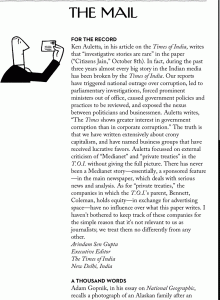
    Click to enlarge

    Ken Auletta of the New Yorker did a massive article on The Times of India and the Jains who own it. Here’s a response from the Times of India’s executive editor. Make of it what you will.


  • Ranjona Banerji: What News TV producers want India to think

    By Ranjona Banerji


    The death of an Indian prisoner from being beaten up in a Pakistani jail whipped up Indian television to quite extraordinary heights of outrage and emotion this week. The story of Sarabjit Singh was neither explored in its entirety nor presented to the general public as anything but a symbol of all that is wrong with Indo-Pak relations. Even those who wear their national pride very lightly on their sleeves must know that they are being manipulated by a quite unscrupulous strategy to use “patriotism” to feed the viewership machine. Newspapers must now fall in line with television’s tactics or be left behind – or so it seems.


    Of course, the Sarabjit story is not new and his family has maintained that he was not a spy – in spite of being found guilty by Pakistan courts. The question for the media however is that how far does it go to control national and international affairs and how much will this current hysteria help Indian prisoners in Pakistani jails.


    Sarabjit’s is only one story. Surely the case of all those fishermen who are caught sailing into Pakistani waters is more heart-rending? Or will television only pick up those cases where the families are aggressive and TV-friendly? Several accounts suggests that Sarabjit really was an Indian spy – though perhaps no one will dare to say that now for fear of being guillotined for treason. In which case, the story is complicated and murky. Which media outlet has explained to the reader how that system works? We know Agent Vinod and how he operated (or those of you who were foolish enough to see the film do) but how far does RAW go to look after its own, for instance. There are stories around Sarabjit which perhaps will not lead to war with Pakistan.


    If all these arguments sound heartless it is because the media’s first responsibility must be to be responsible and objective in the way it presents its stories. By all means use Sarabjit as an example but to make him a martyr (why doesn’t any news channel look up the dictionary meaning of martyr and explain which cause exactly Sarabjit voluntarily gave up his life for?) and to push governments into giving him state honours is stretching too many limits.


    However, if nothing else, the Sarabjit story has proved the extent to which TV news sets the national agenda and the way India thinks. It is no longer about what India wants to know. It is about producers in news television want India to think. I am unsure where we can turn if we want our own minds back.


    **


    It’s amusing to see 100 years of Indian cinema being celebrated as 100 years of Bollywood across all media outlets. The two are not the same thing at all. Bollywood refers to a particular type of film which comes out of Mumbai and the term was a derogatory invention dating to the 1970s. Indian cinema is a much larger concept and construct (see, I can use jargon too!) and deserves a larger canvas (and alliterate as well!).


    **


    The abuse on Twitter is now upsetting more people than it amuses and certainly parental upbringing manuals must include chapters on the social media as well. CNN-IBN’s Rajdeep Sardesai tweeted a few days that he’s giving up on political tweets because he can neither take the abuse nor the allegations nor the lack of reason thrown at him. Sachin Kalbag of Mid-Day wrote a charming column yesterday about he is also opting out of political tweets, citing from the seminal media film, Network. http://www.mid- day.com/columnists/2013/may/020513-mad-as-hell-and-cant-take-it-anymore.htm


    I’m reserving comment now to save it for a later date!


  • Ranjona Banerji: Why I have stopped watching primetime News TV

    By Ranjona Banerji


    The media has whipped itself into a frenzy over the unsavoury news pouring out of the government every day. It barely knows where to focus, which angle to concentrate on and how to keep up with all the delicious, spicy fare that is being offered to it. A cornucopia of scams and scandals is a rich buffet and it is hardly surprising that in all this the media – especially television – has decided to dive in headfirst to give its viewers and readers all the latest titbits. In all this, if it forgets to provide enough detail or grammar gets even more short shrift than normal, so what eh?


    The first bit of nonsense, as some have tried to point out, is to slap the suffix “gate” on to every new scam or scandal. The building where the descent of US president Richard Nixon began was called Watergate. The “gate” had no significance as far as a name for a scandal goes. Nixon was not fiddling with water to get re-elected and the gate is as relevant as any ubiquitous entry point. Instead, his plan began with a break-in into the Democratic Party’s National Committee headquarters at the Watergate Office Complex and ended with his impeachment.


    One can understand the temptation to add a “gate” only because it adds a very convincing tenor to a scam. Plus Coal-gate sounds like it refers to a well-known toothpaste, though it is highly unlikely that the manufacturer is flattered. It is however interesting to imagine what the Indian media would have done if Nixon’s people had broken into the Empire State building or a building coming up near my home called The Amazing or how about Brindaban or Madhu Kunj?


    There is the other problem that in this breathless attempt to give us a new bit of scandalous wrongdoing every day (or every minute if you’re talking about television), the details and the background of the scandals are getting lost. TV of course has complete disdain for the past, for in-depth coverage or background information but newspapers might do their readers a favour and remind them now and then.


    This edit for The Economic Times supplies some context to the question of coal allocation and the misdemeanours involved: http://economictimes.indiatimes.com/opinion/editorial/heres-how-to-properly-read-the-scam-story/articleshow/19922658.cms


    **


    On a personal note, I have stopped watching “primetime” debates on news television having decided that my primetime can be put to better use. This decision has helped significantly with my hypertension as well as allowed me to reset my stupidity tolerance meter. News television in India seems to have reached a nadir and while that implies that the only way is up it could mean that it finds itself in a pit too deep with no visible way out or a plateau too large with no end in sight.


    The first thing TV news needs to do is get rid of those now pointless debates. They serve no purpose and have stopped being amusing any more. Watching the same people yell at each other every night regardless of the subject has lost its novelty factor. Even worse, the big name anchors now appear on weekends as well – talk about overkill!
    Take a step back guys and try and assess how little you’re doing in so much time!


  • Ranjona Banerji: Same guests, diff’rent channels

    By Ranjona Banerji


    From the morning onwards on Wednesday, it was the Karnataka election results which dominated news television. This meant all the big guns were out and firing much earlier than normal because we all love a good election. Plus, there were panels of election experts, print journalists and that wonderful class that we specialise in – people who are experts in everything.


    All the experts gave us their expertise – including said one early on in the counting that the Congress was not going to make it to even 110 seats so it was time to concentrate on the other smaller parties. The Congress refused to cooperate with the gentleman and stopped at 121, a bit beyond the required majority. The experts and big guns also kept telling us dimwits that it was too early to say anything substantial (you know now that I am old; if I was young I would have said “substantive”) which begs the question: then why say anything at all?


    Of the lot, Arnab Goswami of Times Now had the most fun and as the day progressed, he pranced around like an excited puppy dog so thrilled with his new toy bone. Rahul Kanwal of Headlines Today looked and acted serious as is his new wont. And Rajdeep Sardesai of CNN-IBN searched longingly for some gravitas. I don’t get NDTV but I understand that Prannoy Roy was on air and changed his tune as the results tuned in, but this is hearsay. Incidentally, halfway through the results programming, all the channels decided that the election was about the fact that their pre-poll polls had got it right. Sweet, isn’t it?


    I fail to understand why news television insists on having politicians as guests on discussions at times like this because they are bound to say what they are bound to say. Introspection blah blah, victory yaay yaay. Endless strings of clichés – Karnataka is not Delhi, the states are not the Centre, the Earth is not the Moon and so on. Anyway, the Congress evidently decided that the man who knows more words than Samuel Johnson, Mirriam, Webster and Roget combined should do all the talking. Manish Tiwari thus came and bombasted everyone off the stage.


    As the day progressed, the focus shifted from Karnataka and the poor showing by the BJP to the Supreme Court spanking the government over the coal allocation scam and the captivity of the CBI. Some big guns changed – Sagorika Ghose replaced Sardesai on CNN-IBN – and others stayed. Goswami was sounding hoarse by the time the night ended. Of course, Karnataka did not go away either. Intriguingly, almost every TV channel had exactly the same guests on at exactly the same time – or so it seemed to me. It was like watching one of those reruns of the X Files which are currently on air: spooky and corny.


    **


    Most newspapers divided their front pages between the Supreme Court admonitions and the Karnataka elections. Editorials had stern warnings for all politicians and analysts are still figuring out whether it was caste (Lingayats versus the rest), corruption or general voter cussedness. All were agreed however that the Narendra Modi versus Rajiv Gandhi contest was not like a rerun of WWE.


    **


    The Times of India’s Mumbai edition has been what Twitter calls an “#EpicFail” when it comes to covering the ongoing strike by shopkeepers and retailers over the newly imposed local body tax. Mumbaikars are struggling with grocers shut all week and the vegetable market and transporters threatening to follow. At best, we get a meagre quarter page. This is unusual for a newspaper which believes in carpet-bombing. Mid-Day has been excellent on this and Hindustan Times had been quite good too.


    Ranjona Banerji is a senior journalist and commentator based in Mumbai. She is also Contributing Editor, MxMIndia. She can be reached via Twitter at @ranjona


  • Ranjona Banerji: Pakistan anchors – easy and more professional!

    By Ranjona Banerji


    There was some grumbling on social media that the mainstream media (there, I’ve done it, succumbed to the silliest terminology that’s become recently popular) in India spent too much time on the Pakistan elections. But let’s face, whatever happens to our western neighbour is of vital importance to us — good or bad.


    As it happened, I even thought there wasn’t enough about the Pakistan elections as TV channels veered between the fate of the two Congress ministers, the predilection of one for goats, separating the CBI from politicians, the Supreme Court, the BJP’s constant demands for resignations and the election or selection of a chief minister for Karnataka. It has to be said – as an aside – that politics in India has become the biggest public spectacle today, beating the formidable challenges posed by both cricket and Bollywood. Even the IPL cannot match the melodrama played out in the news all day, every day.


    Times Now picked up the feed from Dawn television so you got to see how Pakistani anchors dealt with the first ever democratic transition in that nation’s history. Have to admit that they seemed to be professional, easy in their skin and demonstrated a sense of humour as elections results came in. The few that I saw did not look as if they were on the verge of discovering a new planet which will change the face of human history forever.


    But as is the trend in India at least, it was evident that no one predicted that Nawaz Sharif would do as well as he did – and if it comes to that, that Imran Khan would trump Zardari and become the main opposition party. Pollsters need to re-assess their methodology.


    I became quite fond of Nawaz Sharif after I read the parody account of the life and times of the former prime minister in exile in Friday Times, so more of the same would be most enjoyable.


    **


    I digress from news analysis with a question that’s been bothering me for some time. What does one make of the trend that some major newspapers – New York Times, Times of India – has started of asking people to write blogs/ columns on their websites for free? I understand the Huffington Post model but this is a little different. These newspapers will pay for what appears in print but not for what appears on the net.


    Many journalists and columnists write unpaid I presume because it gives them a wider audience and they hope that their name in prestigious company will earn them some reputation and perhaps some bucks later. But for me they are like scabs hired by managements to break strikes. They are hitting at the very root of a professional writer’s livelihood by writing for free. Remember these are giant corporations, not tiny little start ups. They can well afford to pay. Instead, they are manipulating journalists by leveraging their vast reach. I for one find it unacceptable.


    **


    Have to give a big shout out to Rahul Sood of NDTV. He read in these columns that I do not get NDTV, tracked down my number and called to find out why. When I told him it was a problem with my cablewallah, he sent a technician to my house to sort it out. And they stuck on the job till the problem was solved. When I reminded Rahul that this meant I would now be as nasty to NDTV as I am to other news channels he took it in good humour. So thanks Rahul and remember, you have been warned!


    Ranjona Banerji is a senior journalist and commentator. She is also Contributing Editor, MxMIndia. The views expressed here are her own. You can follow her via Twitter at @ranjona


  • Ranjona Banerji: All eyes on cricket’s royal mess

    By Ranjona Banerji


    Cricket is under the scanner once more and the media is understandably all over it. Did I just say “understandably”? Ever since Anna Hazare and Arvind Kejriwal started on their anti-corruption journey a couple of years ago, politics had become India’s biggest spectator sport leaving the usual suspects – cricket and cinema – to play second-fiddle.


    Three IPL players suspended for spot-fixing, all belonging to the Rajasthan Royals team, the team captained by the upright and universally admired Rahul Dravid and the one of the three suspected cheats being the controversial Sreesanth – it’s hardly surprising that this consumed everything else including the Tehelka expose on how Varun Gandhi manipulated people and evidence to get acquitted in his hate speech case.


    The Indian Premier League has always carried controversy around like a proud badge but cheating perhaps crosses a limit that it will have to work hard to recover from. The Times of India perhaps wins the headline contest with ‘A billion betrayed for lakhs’; quite aptly summing up the effect which this latest spot-fixing mess will have on cricket. However, perhaps the paper could have done better than asking Boria Majumdar to write its edit page piece on the subject – whatever his knowledge of the game, his writing style is wanting.


    Hindustan Times since it has long replaced edit page analyses with fixed columns had an edit on the subject. Indian Express had an excellent story on how Rahul Dravid allowed his teammates to let off steam against the three Rajasthan Royals players under arrest. Mid-Day gave us an account of the thrilling chase down Bandra’s Carter Road that led to Sreesanth’s arrest.


    Have to confess that I was on an aeroplane at primetime so missed all the drama on TV. By the time I got home, I found John Abraham giving us grooming or hair tips or something and so gave up. This morning, he was still there but there was lots of cricket, some Cannes and little else.


    People on Twitter however were extremely sarcastic about the spot-fixing scandal and Sreesanth. His father’s allegations that some India captain Mahendra Singh Dhoni and spinner-slapper Harbhajan Singh were responsible for what happened to his son got scathing flak. The towel used as the signal for a spot of fixing was also the target of several jokes. Others were equally sarcastic about how Varun Gandhi had to be grateful to Sreesanth for overshadowing the Tehelka story on him.


    **


    There was other news too – film star and Bombay bomb blasts convict Sanjay Dutt finally surrendering with all the details about his breakfast, lunch and dinner menus in jail. He was roughed up by fans, he looked sad, he was accompanied by his entire extended family – a prerogative denied to other convicts – was all there.


    **


    The fact that Hindustan Times has launched its own version of Medianet called Brand Promotions has also flown under the media radar. When The Times of India introduced the despised (understandably and this time I mean it) Medianet, senior editorial worthies including Vir Sanghvi who was then editor of Hindustan Times tore shreds off TOI for destroying editorial credibility. Since then of course, many editorial mighties have fallen and now as we all know, some form of Medianet exists almost everywhere. More fool us.


  • Ranjona Banerji: Time to be less gullible, dear sports journalist?

    By Ranjona Banerji


    When the cricket match-fixing scandal broke in 2000, I was in Delhi assisting with the launch of a cricket magazine. I was therefore surrounded by eminent cricket writers and experts, established sports journalists and budding sports writers some of whom are well on their way to eminence today. Former cricketers were also a common commodity in the magazine’s offices. Not one of them had a clue about the horrors of match-fixing and how far it had contaminated the sport. This is in spite of the exposes by Anniruddha Bahal in Outlook magazine in the 1990s and the dramatic Tehelka expose with Manoj Prabhakar in 1999 (which ended dramatically with Kapil Dev weeping copious tears to Karan Thapar on live television).


    Since then, allegations of match-fixing have given way to spot-fixing. Various Pakistani players have been exposed, especially by the British media. But the general sense of disbelief in the past week is nothing short of astounding. I have read some columns this week claiming that the writers knew what was going on in the IPL but I say that’s a load of crock. Or rather, if they knew so much why on earth didn’t they write about it before? I cannot remember a single substantial story or opinion piece about the influence of bookies in the IPL and players being corrupted by betting greed. Have you read any?


    All this knowledge after the fact is not just pitiful posturing, it is shameful. The job of the journalist is to sniff out wrongdoing. But sports journalists have fallen short here. Every time, it has been general reporter who has found out exactly what’s happening in the world of sport. This shortfall is also seen with business journalists who cannot see – or report – on anything shady going on in their domain. Every CEO is the greatest and every business house is the best – this lasts even when said businessman is well-known as a dope and when some government agency reveals fraud. Of these speciality journalists, I would say the best informed are the film ones. They may not be able to tell the truth in print because their managements are so enamoured of the glamour world but they certainly know all the gossip.


    Sports journalists have maximum access and it is about time they dumped their rose-tinted spectacles for some eyewear that is a bit less gullible.


    **


    Having said all that (my favourite bumptious phrase), Indian news television was boringly predictable. There was Rajdeep Sardesai being earnest, Arnab Goswami being judge, jury, executioner, Rahul Kanwal being so serious, Jujjhar Singh trying to be reasonable and NDTV bucking the trend by talking about China. You know: that country close by that keeps wandering into our territory.


    The usual BCCI bashing is now on and it will come to nothing. TV channels cannot do more than call the same old people who say the same old things. There are some who are preserved in mothballs in TV studios and brought out when anti-BCCI comments are required. I surfed my way through them all and decided discretion is the better part of valour. Anyone else out there watching Grey’s Anatomy?


    **


    The Times of India did a nice little favour to tennis fans by having former great Boris Becker as guest sports editor which include a long Q & A with him. This was marred by the TOI’s formidable sports reporters not knowing how many Grand Slam titles Roger Federer and Rafael Nadal have won so far. And, by what is far worse, some too-clever-by-half  (my conjecture) dimwit, declaring to Becker than serve and volley as a technique was a dying practice in Becker’s day. Becker put the questioner in his place and how shameful is that?