Category: BLOGS

  • Debrief | Engaging stories from Airtel

    By Anil Thakraney


    A good product-specific campaign from Airtel. The objective is to sell digital music on their service, and instead of simply blasting out tracks in the ads, they have created neat little stories around popular movie songs.


    The theme is ‘My Song, My Story’. And each commercial features a playback singer recounting the story behind a particular song to a group of eager fans. The singers featured are well-known names from the world of music: Sonu Nigam, Shaan, Hariharan, etc. In one ad, singer Shaan tells us about the inspiration behind his hit song, ‘Tanha Dil, Tanha Safar’. About friends, who as they grow up, drift away into their own worlds and into their own busy lives. And all that remains are memories.


    It works. Songs often have stories behind them, and the singers recounting these tales makes the ads quite engaging. It’s also a good consumer insight to use because even viewers are likely to have their own personal connect with popular tracks. And so the ads become entertaining to watch even on repeat exposures.


    The only people who might not appreciate this campaign are those who are not into Hindi songs. But that’s okay. If they aren’t into music, they aren’t the target audience for this offer anyway.


    Rating: (On a scale of 1 to 5): 3.5. Focused and entertaining.


  • More Mediaah!: Indian Express, Shekhar Gupta & Co send notice to Open, Vinod Mehta. Demand Rs 500 cr as damages

    By Pradyuman Maheshwari


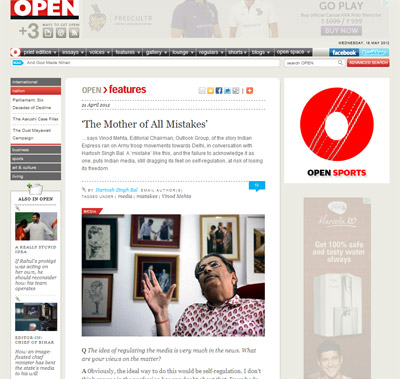
    The Indian Express group and four of its senior journalists (including editor-in-chief Shekhar Gupta) have sent a legal notice to Open magazine, its editor and other professionals. And above all to Vinod Mehta. The reason: in an interview to Open, Outlook’s Vinod Mehta rubbished the Express expose of a coup-like situation in the Capital.


    The Express is also upset with the publication of reactions that the interview elicited.


    I strongly recommend a read of the legal notice (currently posted in a blog that seems to have been created for the purpose — http://nobodyisusingthedword.wordpress.com/2012/05/15/indian-express- shekhar-gupta-threatens-to-sue-vinod-mehta-hartosh-singh-bal-open-magazine-c-repor/ .  Please don’t miss Pages 6 and 7, where the notice highlights a contradiction in Mehta’s statement on how he quit The Independent in the interview (as also made in a speech at the Press Club Bombay awards recently) and his book Lucknow Boy.


    The lawyer has asked for an apology, removal of the interview from the site and Rs 100 crore each for her clients. Note the money must be remitted even after the publication of the apology.


    Mediaah! view: I think the Express should’ve just let the interview be (link: http://www.openthemagazine.com/ article/nation/the-mother-of-all-mistakes). I don’t think the interview is damning the reputation of the Express or its editor-in-chief. And even if there is a belief that Vinod Mehta ought not to have said what he did and Open shouldn’t have published it especially since the coup story hasn’t been proven to be wrong, initiating a legal procedure is perhaps a bit much.


    Moreover, though it has established itself as an independent, gutsy publication, Open isn’t mass-circulated as, say, The Times of India. I must confess that even though I had been told about the interview, I read it only yesterday, after I heard of the notice. There is sure to be a fair bit of buzz in the social networks.


    I spoke to a senior member of the Open team who said the company lawyer was planning to respond to the notice and the magazine has no plans to pull the story off the Web.


    Final words: It’s imperative that while the media subjects everyone to criticism, it must be willing to take the heat whenever it’s subjected to it. Now, let’s hope Mediaah! doesn’t get a legal notice for writing all of this 🙂


    Buzz me if you have a story to tell. Confidentiality assured. There are various ways you can reach me:

    pradyumanm[at]mxmindia.com, BBM 23050B5D, Gtalk pradyumanm@gmail.com, Twitter @pmahesh and of course the mobile: 98338 76278.


    Disclaimer: Although he is CEO and Editor-in-Chief of this site, Pradyuman Maheshwari’s views in Mediaah! are not necessarily those of the rest of the team and MxMIndia.com.


  • The Anchor: Sevanti Ninan on 5 things she’d like to change about journalism today

    By Sevanti Ninan


    1. Its idea of what constitutes national

    Delhi and Mumbai.  At a pinch add Chennai and Kolkata, because Mamata and Jaya are there to provide copy.


    2. Its notion of public opinion

    What Twitter, Facebook and smses on TV are saying.  Get off the computer and hit the streets to find out what’s happening to those who are not on social networking sites? Na, that’s uncool. Besides being too much work.


    3. Its notion of the arts

    Movies, movies, Bollywood, Bollywood. Regional stars in the field of writing, art, music: confined to the regional press unless they know how to make the scene in Delhi or Mumbai.


    4. What makes news

    Political spats, crime, scams.  Social issues are for documentary film makers, unless Aamir Khan comes with the package.


    5. Its notion of what constitutes progress for both India and Bharat

    Sexy industries like telecom and IT. Education reporting means tracking the IITs. Health coverage means celebrity cancer. Primary health centres and anganwadis-what’s that and where would I find them?


    Sevanti Ninan is Editor, thehoot.org and Columnist, Mint


  • Anil Thakraney: Balika Vadhu: 1000! Wow!

    By Anil Thakraney


    I don’t watch many TV soaps these days, and to claim that I am too busy for such mindless entertainment will be a fashionable excuse to give. The truth is that most serials haven’t caught my attention in recent years, simply because the plots are either uninteresting or rehashed. But one soap has made the cut for me, I still watch it whenever I am at home at 8pm. And that’s Balika Vadhu.


    And I was staggered to hear that the serial has just completed 1000 episodes. That’s a lot of airtime by any stretch of imagination. While it may no longer be No 1 on the ratings chart, it’s equally true that Balika continues to hold the nation’s living rooms enthralled. The loyalists have remained with it for years.


    The story of Balika is indeed the story of Colors itself. The show provided a massive launch platform for the channel, and the latter hasn’t looked back since then. I think the main reason the soap has held its own for so long is that when it first hit the small screen, viewers had begun to tire of all those over-the-top saas-bahu dramas set in a Juhu villa. The garish make-up, the hamming, the shrieks of the women in the huge household, dead characters suddenly springing to life, etc… the nation was ready for some real freshness.


    Balika quietly came and filled the vacuum. The setting was rural, the characters very real. Simple people who acted simply and were true-to-life. The child marriage story was, of course, the novelty. It worked, and the characters instantly became household names. But what’s most important is that the makers of the show did not lose steam along the way. Even as there’s been a time jump, the characters remain grounded in reality, and we connect with their problems and their life dilemmas. In one word I would say Balika’s success is embedded in its sincerity. Sincerity of its actors and its directors.


    I am not sure how much longer the serial will continue. 1000 episodes is already a huge run. But I am certain to be there till the last ball is bowled.


    * * *


    PS: To celebrate this year’s Cannes Film Fest, some art directors have re-created posters for iconic films. Wonderful. Gives me an idea: Why don’t contemporary art directors from our ad world re-create posters for legendary ads from the bygone era?

    Should be fun. Perhaps a competition can be held to make this happen. This will also

    help art directors in ad agencies make their presence felt.


    Link: http://www.booooooom.com/2012/05/08/little-white-lies-x-colette-movie-posters/

  • Debrief: Cadbury Dairy Milk: Slice of sweetness

    By Anil Thakraney


    Cadbury Dairy Milk’s ‘sweet beginnings’ campaign introduces two more commercials.


    One involves a young girl who’s discovered she’s pregnant. And the other one features college ragging. I didn’t quite like the latter one (the chocolate is forced into the situation), so let’s just discuss the ‘pregnancy’ ad which I did like.


    The nervous girl finds out that she’s carrying. And is unsure of how to break this big news to her mate. So she rehearses the standard filmy lines in front of a mirror. But the man overhears her, and this leads to a sweet exchange between the two. And of course, Cadbury Dairy Milk happens as a natural extension.


    This ad works for me. Because the brand arrives seamlessly into the story, it isn’t forced. Also, the situation is very slice of life, many young people will identify with it.


    So this will strengthen empathy. But most importantly, the couple acts very naturally and convincingly (unlike the ‘ragging’ TVC), so full marks to the director.


    All in all, must say the ‘Shubh Aarambh’ campaign is progressing sweetly.


    Rating: (On a scale of 1 to 5): 3.5 Right situation. Good direction.


  • The Anchor: Bruno Goveas lists 5 key trends shaping the internet

    By Bruno Goveas


    1. Hyperconnectivity:

    There is an explosion of devices that are now connecting over to the Internet. We are living in an increasingly “hyperconnected” world where everyone is online 24/7. Markets are evolving and business models are being replaced. Companies are embracing hyperconnectivity as they realize it is the only way to capture new opportunity and meet the emerging needs of their customers or consumers.


    2. Security for Online Businesses:

    With the Internet now an important channel for doing business, it’s not surprising that there is a dramatic increase in the frequency, scale and sophistication of web attacks. Hence, there is a critical need for robust web security that will ensure scalable protection from data theft and downtime, and enable extension of the security perimeter outside the data-centre to deal with distributed threats and ensure adequate protection.


    3. Enterprise Applications are moving to the Cloud:

    With theEnterpriseworkforce becoming increasingly mobile, and businesses expanding into new markets, having suppliers, partners and customers distributed around the world, there is a need to securely deliverEnterpriseapplications anywhere and to anyone, in a cost effective and efficient manner. Businesses are now leveraging the Internet and enabling enterprise application access over the Internet, to effectively reach their employees, customers and partners.


    4. Interactive HD quality entertainment over the Internet is now a reality:

    Consumers are now demanding access to entertainment from any device, anywhere. Hence there is a need to engage audiences with interactive HD quality video over the Internet, solve the challenges of multi-device consumption and provide the highest quality video experience to all devices.


    5. Need for performance with Mobile sites and applications:

    With connected mobile devices now ubiquitous, growing exponentially, and their capabilities having developed and matured, there is a critical need to overcome limitations of accessing content over the mobile network and optimizing the content to ensure optimal and vastly improved user experience on any mobile device.


    Bruno Goveas is Director of Products- Asia Pacific &Japan, at Akamai Technologies


  • [MJR] TV journos prove Katju is right

    Ranjona Banerji

    By Ranjona Banerji


    Journalists have evidently signed a pact to prove Press Council of India chairman Markandey Katju right – 90 per cent of Indians are idiots. There seems to be no other reason for this enormous media reaction to the late night fracas between film star Shah Rukh Khan and a security guard at Wankhede stadium two nights ago.


    Of course, the shenanigans of film stars are exciting and when they behave badly it’s even more fun. But is there anything to justify front page headlines and TV debates for two days? What exactly is there to debate? Khan arrived last the stadium around the time Kolkata beat Mumbai, with a bunch of kids. The kids ran into the field. A security guard stopped them. Khan intervened. Words were exchanged and some apparently not very polite ones and then Khan left.


    For this, the world has come to an end. We are discussing politeness, propriety, banning, apologies, role models, respect for the uniform, high-handedness, diplomacy, official inefficiency, entitlement or the sense thereof, protection of children and the decibel level of whistles.


    If we went to war with China, I cannot imagine more being discussed on television. The journalists on TV cannot seem to distinguish between a security guard and a policeman. Rahul Kanwal almost burst a blood vessel when on Headlines Today veteran adman Prahlad Kakkar tore into the behaviour of security guards: “You have to respect the uniform”. I would really like to know how any of these TV guests react when faced with the officiousness of a security guard.


    Kakkad was a rare voice of sanity as was Rohan Gavaskar who said: “Banning Shah Rukh Khan from Wankhede is like banning Sachin Tendulkar from PVR”. Meaningless, in other words. Except for Arun Lal on Times Now, no one wanted to discuss whether officials of the Mumbai Cricket Association, who called for a ban on Khan entering Wankhede, were not over-reacting. Lal said it’s a question of contesting fiefdoms – with Khan as an IPL team owner against MCA officials with their hurt pride at being event managers rather than stakeholders.


    The levels of self-righteous on Times Now were staggering, with anchor Arnab Goswami, veteran columnist and author Shobhaa De and not-so-veteran columnist Simi Chandok leading the way. Goswami kept bringing up police action against Hollywood stars Nicholas Cage and Russell Crowe, again unable to distinguish between security guard and a policeman. (Hint: different uniform.)


    Former Mumbai police commissioner MN Singh tried to point out that criminal charges against Khan were not possible and this led to him being dragged over hot coals by Goswami. When the nation wants to know, let no man or woman try and douse the fire.


    Commentator Charu Sharma however poured cold water on Rahul Kanwal’s spectacular rage – mainly it seemed because uniforms were not being respected, apparently a prime concern in his life – by forecasting that an amicable resolution would be reached and the incident would soon be forgotten. The truth is that everyone knows that that is what will happen.


    As a matter of interest, after all the hot air expended over the fight which Saif Ali Khan had in a restaurant at the Taj a few months ago, can anyone remember the names of those self-righteously hurt complainants from South Africa? Hmmm.


    * * *


    On NDTV, I watched another somewhat circular debate over whether PA Sangma could become the next president of India. These speculative discussion with weak premises only illustrate our emptiness of thought. I greatly admire Divya Marathi editor Kumar Ketkar for his fortitude and level of tolerance as he sits through so many TV debates these days, trying to inject a little sanity into proceedings.


    It seems amazing to me that no TV people seem able to realise that all this political hoopla over the next president is just a diversionary tactic from all the political problems this country is facing.


    Goswami even wants a debate between Sangma and Vice-President Hamid Ansari, since he possibly believes that India has a presidential form of government. Contestant 1: I will plant 400 varieties of roses in the gardens. Contestant 2: I will conduct the tours of Rashtrapati Bhavan myself. Contestant 3: I will never build a large retirement home for myself. Contestant 4: I will never bore school children with my poems and ideas.


    Please, somebody, save us!


  • Anil Thakraney: The BCCI has to be controlled

    By Anil Thakraney


    Constant readers of this blog might remember my post on IPL 5 when the tamasha had just gone underway. And in that post, I had spelt out various reasons why the tournament doesn’t interest me in the least. Now, I know it isn’t very nice to boast ‘I told you so’. And yet, on this occasion, I feel no hesitation in reporting that I had mentioned at the time that I would be mighty surprised if there was no match fixing going on in this cricket ‘fest’. I also recall saying that for the tabloid media, IPL is a goldmine for sensational stories.


    Don’t know if the India TV guys read my post or not, but their sting operation has confirmed my fears. Good story. The only little grouse I have with the channel is that maybe they went out with the story a bit too soon. Perhaps if they had been more patient and had cared to dig a little harder, they may have nailed some big fish too.


    To be fair, it isn’t entirely BCCI’s fault if some youngsters decide to sell their souls for some extra moolah. Surely the board cannot keep an eye on the activities of every single player. So perhaps we can’t slam only them for this scandal. The real question is this: What will the BCCI do NOW? Their future conduct will determine if they are serious about protecting the credibility of these games. They have to not just impose a life ban on the offenders (if proved guilty), the richie rich cricket board has to draw out powerful anti-corruption mechanisms to make sure the games are run cleanly.


    And this is where the problem lies. How can an organization that’s not answerable to anyone, that has been following dodgy practices as standard operating process all these years, be trusted to run clean and transparent games? Which is why I really think the government, through the sports ministry, must clamp down on their activities. To begin with, they must bring the BCCI under the RTI regime. Of course, this is going to be tough because a whole lot of netas are involved with cricket in India, but it simply has to happen. As long as the BCCI is run like a private party, a personal fiefdom of a chosen few, rats will keep crawling under their glitzy carpet.


    If the latest shameful expose doesn’t trigger massive changes in the functioning of the BCCI, nothing will. And yes, thank god I chose to stay away from the IPL. Imagine wasting so many man hours each day watching this nautanki, only to discover later that some players have been busy cutting private deals with freelance agents. Bollocks, mate!


    * * *


    PS: An interesting billboard created by JWT, London. The National Centre for Domestic Violence, through this interactive billboard, asks people to use their cell phones to drag an abusive man away from his partner. Folks can visit a website featured on the billboard, and click on that to remove the man. Good way to directly involve people on the issue of domestic violence. Wonder when India’s hoardings will get a little imaginative!


  • The Anchor: Satish Singh lists 10 reasons why outdoor scores over other media

    By Satish Singh


    1. Free Medium – No Cost of Consumption

    Unlike any other medium, where you require a subscription or purchase, OOH is free. You need to purchase a newspaper to see an ad in it. One must have satellite TV subscription to cable/DTH to see an advertisement. For OOH, there is no need to purchase anything. It is outside, on the streets and is free for everyone to see, read, understand and there is typically a call to action – like a Short code, Toll free, and so on.


    2. Zone Domination Approach

    A particular territory could be concentrated with the communication in a limited geographic area to create a domination effect. What we call a roadblock in Radio and TV can be achieved in greater magnitude with this kind of an approach. This leads to the word of mouth and viral scenario along with creation of buzz – which is more likely to give a media multiplier effect – eventually leading to a digital platform discussions on the social platforms.


    3. Reach + Frequency

    This is the typical Catch 22 one sees in media planning. OOH allows you to circumvent the inherent challenge of the choice between the two, by helping you be there and do that. It is the only medium that will give you the best of the aspects by meeting both at a miniscule portion of what the traditional media would drain the wallet at.


    4. Large scale empty canvas

    The scale is superb and gigantic. One has the opportunity to create an imaginative thought on the larger than life canvas.


    5. Dynamic Visual impact

    3D, Motion, Lights, day/night effect, the list is nearly inexhaustive. This is something that is very exclusive to OOH. No other media offers this aspect – be it print, television, social, digital, none. The fanfare around the medium is because of the ability to push your imaginative genius to the limits and beyond. Practically anything and everything can be accommodated in the dimensions of a media unit on OOH space.


    6. 24×7

    This medium is there for an exposure 24×7. It will be present for a minimum duration of 10 days (as per the local associations in cities acrossIndia) and cannot be missed if a person is late to watch a program or read the newspaper that day.


    7. No Avoidance – Virtually No OTS

    Because of the size and scale, it is virtually impossible to miss a display in a city and, therefore, we have virtually no OTS. It is as good as MUST SEE.


    8. Key Ingredient of LMC

    As the studies have proved, the Last Mile Connectivity has most bearing in the actual purchase of the product. This is the time when the POP/POS is preceded by the OOH to ensure the curiosity pull happens to the brand/product and the retail point takes it up from there to ensure a closure of purchase/sale.


    9. Region Specific Targeting

    The only medium that works better than that of the traditional media is OOH in this area. If you want minimal geographic spillover, this gives you a ZERO spillover. The kind of brands and products that have a certain geography have chosen this medium as the lead medium. Telecom is the finest example for this – every circle has a specific tariff, VAS offering, network and bouquet of services. The best way of communicating about the same is the OOH. Traditionally, the lead medium for the industry has been OOH.


    10. Day-part capturing

    Media Scheduling is a part of every planner’s life today. Application in OOH is next to impossible. But that thought has been vapourised with the newer and advanced ways of putting up media and removing the same. This enables us to capture the morning, noon and evening parts of the communication that is possible on the same medium without breaking much of a sweat.


    All in all, the Out-Of-Home media is a really flexible and robust area of communication and advertising wherein one can expect focussed geographies to be connected, without the risk factors of a traditional print and electronic or any other media which has an OTS. Outdoors is BIG, BOLD, BEAUTIFUL and UNMISSABLE.


    Satish Singh is President, Lakshya Media


  • The Anchor: Shailesh Amonkar on 5 reasons why national advertisers can’t ignore regional media

    By Shailesh Amonkar, Chief Marketing Officer, Sakal Media Group


    1. Relevant Circulation and Readership

    Regional publications in many markets have wider circulation reach and deliver better quality mass audience.


    2.  Stronger bonding

    Regional publications have a far stronger emotional bonding with the reader. The connect that readers have gets leveraged for the advertisers and strong credibility among their readers adds to this.


    3.  Speaking to consumers in their own language

    Reaching out to consumers in their own language delivers better response since they identify with the brand strongly.


    4. Advertisers are looking at maximum reach and sales

    The objective of any communication is reaching out to maximum audiences and achieving sales so if regional publications deliver these they would not be ignored.


    5. Regional markets growing for products and services

    Today regional markets are delivering sizable sales for most products and services and FMCG, telecom, consumer durables have all been focusing on regional publications and hence they are critical in any media plan. Yes, the brand credibility is an important factor and this is where the media planner needs to go beyond figures and understand reader bonds with each brand.


    Shailesh Amonkar is Chief Marketing Officer, Sakal Media Group


  • Reviewing the Reviews: Department

    Department

    Directed by-Ram Gopal Varma

    Produced by-Siddhant Oberoi, Amit Sharma

    Written by-Nilesh Girkar

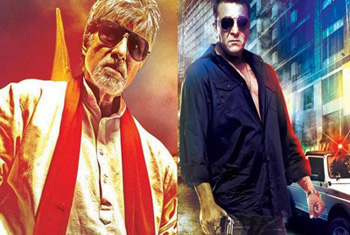
    Starring-Amitabh Bachchan, Sanjay Dutt, Rana Daggubati, Madhu Shalini, Lakshmi Manchu


    Ram Gopal Varma doesn’t care about critics (he doesn’t care about audiences either!) or he would have spent a very depressing weekend, as his latest film Department is shredded into small pieces.  The lowest rating ½ , the highest 2.


    One opinion is that this film is even worse than Ram Gopal Varma Ki Aag.  It certainly is a toss up between the two to decide which one is more crass.


    Janhavi Samant of Mid-day gave it ½ star and wrote: “It doesn’t matter what the plot is, Sawatya has an endless supply of gang members who take till the end of the film to perish. And there is some random gyaan about Bhagvad Gita. At some point Mr Bachchan enters the fray to do some spectacular hamming of his own, showing his penchant for doing ‘legal things illegally’ rather than ‘illegal things legally.’ Really Ramu, did you have to say that thrice in the film?”


    One star from rediff.com’s Raja Sen, who calls it a failed experiment: “Varma, predictably, has fun with a couple of quirky lines – especially one that blatantly introduces Nathalia Kaur’s item number, a cameltoe-y milestone for Bollywood – and a scene with the camera mounted on the striker on a carrom-board is genuinely imaginative, but Department is an utter waste. The director who showed us how to film violence is now sucking basic action scenes of their dynamism, leaving them dry and dead, but filming his movie’s carcass from multiple angles. Tragically enough, Satya and Shiva are just names of characters for the new Ramu.”


    DNA’s Aakanksha Naval-Shetye and Chhaya Unnikrishnan moved up to 1.5: “Dizzying shots, bizarre camera angles and a confusing storyline mark Ram Gopal Varma’s cop and underworld drama, Department. With Varma returning to his forte, (read underworld), one expected a gritty drama but what unfolds is a saga of gory violence and crass scenes.”


    Rajeev Masand gave it 1.5 too and wrote: “Small cameras positioned at odd places, indulges his quirk for gravity-defying angles. It works occasionally in the action scenes that appear more visceral now, but for the most part the bizarre camera movements give you a headache. Just shy of two hours and thirty minutes, ‘Department’ is tedious and boring and doesn’t have any of the originality of ‘Satya’ and ‘Company’, or even the occasional tension of ‘Sarkar’. Dutt delivers his lines like he’s reading out the phone book, and Bachchan hams it up no end as the gangster-turned-minister. It’s only Rana Dagubatti who approaches the film with any earnestness whatsoever… It’s a lazy, indulgent film that tests your threshold for pain.”


    Karan Anshuman of Mumbai Mirror went with 1.5 too: “No matter what format a film is shot on, no matter what technique – whether it’s of conventional genre or found footage or experimental Dogme 95 – the gimmick is only a means to an end (a broad view of the end being audience engagement at a story level). With RGV, now the end is simply a different visual experience that does nothing to draw you in. So many times you’re missing dialogue and performances because the camera is overwhelmingly, utterly distracting. This would be acceptable if the visuals were any good, but they are not.”


    Anupama Chopra was kinder with 2 stars: “Varma has mined this material before, from Satya to Ab Tak Chhappan, which he produced, so he decided to embellish this film with a new technique that he calls “rogue filmmaking.” Which means he chose student camera operators and high-end digital cameras over a cinematographer and film camera. Which further means that strange camera angles, a regular feature of Varma’s films, are now the main event.”


    From the Times of India, 2 stars is a massive put down. Sriranjana Mitra Das wrote: “The violence might even have clicked, considering the tale’s twists – but crazy camerawork makes you forget all that. Varma’s experimented, placing multiple cameras at different angles, treating you to close-ups of bottles pressed to mouths, lips sucking cigarettes, zooms up Dutt’s hairline. The camera even flips upside down, puncturing the tension that should’ve vibrated between Bachchan and Dutt. One line – “Chamatkaar ko namaskar” – nails it. You stagger out sensing something wasted – Nathalia Kaur’s item number’s more hideous than hot, the prettiest thing around is a translucent tea-cup, the action is mind-numbing. Losing the plot and three strong stars, Department shoots itself in the foot.”


    The Zee News critics commented: “Watch ‘Department’ if you have been missing your headaches for a long time. Watch ‘Department’ to see the way in which brilliant actors can be wrung dry and left skill-less. And above all, watch ‘Department’ if you are an ardent Ram Gopal Varma fan. And then leave the theatre cursing yourself for watching this brilliantly crafted piece of – well, by now – you know what.”


    The Business of Cinema reviewers are brutal too: “The film opens with the line ‘Absolute power corrupts absolutely’, but Ram Gopal Varma’s action film frustrates absolutely. Not only is the story old wine in cracked bottles but also it’s shot with camera angles that make you nauseous and dizzy while leaving you wondering what Varma and his cameraman were thinking.”

     

  • Anil Thakraney: On the great IPL scandals

    By Anil Thakraney


    I had been traveling all of last week, but I kept track of the IPL shenanigans as and when I could. Since the news channels and the social media folks were busy discussing two sensational incidents of last week, allow me to add my two-bits. And I’ll cut to the chase, as always.


    Firstly, on the Shah Rukh Khan versus Wankhede security personnel battle. If SRK’s kids and their pals did not have passes to enter the stadium, the security guards had every reason to demand their immediate removal. Kids will be kids, and it’s highly likely that they would run onto the pitch. There have been allegations that the kids were ‘molested’. I think that’s utter crap. Had that been the case, garam khoon Mr SRK would not have settled for maa bahen ki gaalis, he would have dispatched a few souls to the nearby Bombay Hospital. Also, guards molesting kids on an open ground when the IPL office bearers and players are still at the venue is a preposterous idea to even imagine.


    Net net: King Khan’s fat ego (and maybe his booze-influenced head) got the better of him, and he lost control. Ergo, it’s correct that the MCA has banned him. Though given the star’s super heavy connections; that would soon be lifted. But, hats off to the security men who stood up to him. It’s very, very rare in a celeb and VIP obsessed India for lowly officials to take on a heavy weight. I think these guys should be bestowed with an honour.


    Next: The incident in Delhi where a drunken IPL player allegedly molested a lady inside her hotel room. That’s a criminal case, and we will have to leave the investigation to the local cops. No one has the right to pass any moral judgments. But Mallya Jr’s tweet was beyond disgusting. It not only denigrated the woman in question, his rant exposed the dude’s sick mindset towards women in general. If Dr Vijay Mallya is a good dad, he needs to send darling beta for counseling, ASAP. And he must also insist that the brat disconnects his twitter account. Junior is not just busy bringing disrepute to his family – he’s reflecting a very poor image of the entire UB group.


    It’s Sunday evening as I write this piece. The dust is beginning to settle on both the above issues. But am sure the next scandal is just round the corner. What’s the IPL without some offline tamasha? Aisa mauka aur kahaan milega, bhaiyya?


    * * *


    PS: “If You’re Not Pissing Someone Off, You’re Probably Not Innovating.” An interesting read from the Harvard Biz Review. On what innovation really means and how marketers must do things differently in order to make a real impact.


    Link: http://blogs.hbr.org/cs/2012/05/if_youre_not_pissing_someone_o.html