Category: BLOGS

  • Media as an Ingredient

    By Premjeet Sodhi
    There was a time when the usage of media was optional. Media was an add-on which if a brand so desired or if needed would use to spur sales.
    When, I look at this from the cooking perspective (since, I love cooking a lot) I would say that media was used just as a garnish. Yes, it did make the dish seem more desirable and added some flavours but one could certainly do without it.
    Media was never appreciated. When the sales were healthy – there was no need for media and when the brand was in dire straits and there was strain on profitability – media was the first to be curtailed.
    But, those were the times of the seller; the consumer then was a deprived citizen and had no say or choice in what was being served to him. The seller prepared the product and used media just to ‘inform’ the consumer either of its existence, its merits or its price. Media was never embedded in the value creation that the product or service promised; it was so far only communicating the value. Hence, the use of media was need based.
    The world has changed. Consumer is King.
    It is not about the seller asking the consumer about what they want and then manufacturing the product or service accordingly. The matters have progressed far beyond that. The sellers are no longer in control. They have morphed from brand owners to brand custodians to just being brand moderators. Despite all the theory that existed – the brand in the yester years was still in the mind of the brand owner (with due feedback and research of the consumer). But, now the consumer is in control of the brand.
    Here, when I say consumer  it is again different from the consumer of yester years. Earlier you would imagine the consumer as an individual (or a number of individuals – not connected to one another) but today the the consumer is a group – a group of connected and communicating people. Earlier, the consumer was a multitude of individuals but now is a Collective.
    More and more products and services are being designed so that their consumption also happens or heightens when consumed as a Collective. And, these are not being designed by just the companies. The companies are a participant in this collective along with the consumers. Media runs as blood in the veins of this collective binding the consumers to each other and hence media is intrinsic to the construction of the brand.
    Media is no longer an add-on; no longer a garnish; no longer need-based.
    Media is critical and essential to the construction of the brand and the consumption of the brand.
    Media has become an ingredient for the brand.
    Brands that still treat media as an add-on have a lot of thinking to do. And, the day brands change this perspective – I am sure they will start looking differently at how they select and integrate media into their value promise. This will change the value they attribute to media in their P&L and will also impact the remuneration they pay for those who advise them on media.
    Media is no longer a garnish, but is a critical ingredient in the brand.
  • Newswatch: Covering the queer spectrum

    By Nitin Karani


    There’s little to be happy about the state of journalism today, but this piece will try to remain upbeat and offer constructive comments on coverage of LGBT (or queer issues). The focus is mainly on the English-language media. First, a pat on the back for doing by and large a good job, especially in the editorials department! A lot of the reportage is either by queer and queer-friendly journalists themselves or driven by them.

    These journalists are also the most innovative in their approach to queer issues and in touch with the pulse of queer communities despite not being on an ‘official queer beat’— another sign to management why they need diversity and inclusion in their organisation. Having people in your media house from different communities helps you understand them, reach out to the communities and broaden and strengthen your coverage. One editor deserves a special mention here. Aditya Sinha, currently with DNA, launched a weekly ‘Sexualities’ page (it was mainly about queer issues) back in April 2008 when he was with The New Indian Express. The practice continues at DNA, which has a monthly page. Quality may be ultimately important but for marginalised identities this is great exposure in the short run.

    This is not to say that there is no homophobia in the media. Of course there is sensational and sleazy reporting (TV9’s “sting” op in Hyderabad; “Central Park a Gay Paradise”: Mid-Day); insensitive, even biased writing (“A baby for gay, deaf, mute couple? It’s cruel”: Deccan Chronicle) and totally muddled, pseudo-scientific horrors as well (“Lesbian? Not quite, say psychiatrists” and “Trapped In Bad-Girl Taboo”: The Times of India). Then, there is the let’s-not-talk-about-it attitude, which is probably true of quite a few publications, but probably nowhere as ingrained as at the Reader’s Digest. However, change is inevitable and so is a debate on queer issues.

    What the media needs to do most is to go beyond the superficial, else both reader and writer will be bored! And which reader would like to start their day with a humdrum piece on a Pride parade when there are so many other colourful diversions? There are many interesting queer stories waiting to be told yet. If mainstream newspapers and channels won’t tell these, then the competition will (for instance online news magazines such as FirstPost.com). The White House has a new LGBT liaison but how many people know he is of Indian origin: Gautam Raghavan. Usually, the press goes gaga over desi achievers, even those who want to deny their Indian origins. So isn’t the Gautam Raghavan story worth an interview or at least some column inches? Let’s start with the basic issue though.

    The terminology: Admitted it can get confusing, especially with the never-ending acronyms (LGBTQI… – even The International Lesbian and Gay Association named its 2002 Mumbai regional conference ‘A-Z: The Other Asia’). However, journalists are supposed to know. Or find out! The latest NGO abbreviation is “MTH”, or men-who-have-sex-with-men, transgender and hijra. Label with care! Most people use ‘TG’ and ‘hijra’ interchangeably with eunuch. But hey, it’s all about letting people be themselves and choosing their own labels instead of imposing. Also, note that not only is the word ‘eunuch’ outmoded, but also a lot of queer people object to it as a derogatory term. Dictionaries can’t seem to keep up with these changes, so cultivate your go-to experts for advice on such matters. Ultimately, of course, people are more complex than labels.

    Pride marches: It’s been more than a decade since this annual event became a regular feature on the queer calendar in Kolkata, and every year new Indian cities are added to the list. However, in terms of visuals at least, our photographer colleagues give it the same hackneyed treatment – the usual close-ups of a hijra/transgender or of two transgenders kissing each other. The focus is always on the most garish. If they would only look more closely, and not get blinded by all the colour and pageantry, they will perhaps capture new stories of the gay couple with kid in tow, the gay bankers network, the lesbian elders who have been together longer than you have been a journalist and so on, instead of dismissing the rest of the crowd as ‘boring, normal-looking’ LGBs (lesbians, gays and bisexuals).

    TV debates/‘balance’: Twenty years of sat TV and all we have to show for it is a handful of coming-out stories and the same old discussion on every Oprah copycat show. These shows do face limitations because not many people are willing to out themselves on TV yet (even when given the honourable way out by hosts such as Simi Garewal). It’s a challenge that needs to be taken up, though, and tackled with ingenuity. Only ‘reality’ TV is pushing the boundary here, not the news channels. Although the distinction seems to be blurring!

    Meanwhile, newsroom discussions have the mandatory religious figure (to the point that it has become predictable which talking head will be on air and what they will say) even when the discussion on decriminalisation of homosexuality has nothing to do with any religion, especially Christianity. Politicians and ministers, who fight shy of the issue in public regardless of which side of the debate they are on, are never pinned down, unless they are also small-time politicians with a religious minority connection. Besides Tamil Nadu parties, which have shown some initiative on TG issues, no political organisation has been made to speak up on queer issues, although politicians are difficult to shut up on any other subject. When some of them do open their mouths to speak utter rubbish, like Ghulam Nabi Azad and Farooq Abdullah did, the media allows them to get away with it.

    On the other hand, sometimes journalists defend insensitive writing on specious grounds. In the name of religious celebration, it is common for people to dance on the streets of Mumbai to Sheela, Munni and Shakira numbers, and no one blinks an eye. What then would you say to a journalist specifically seeking out people who could have moral issues with Mumbai Pride week celebrations in suburban Bandra – just so that there is “balanced coverage” of the celebrations! That too in the midst of the Pride week, when some off-balance zealot might get provoked by irrational fears of children “getting into wrong things” expressed in the piece.

    The business of gay icons: Most stories about showbiz are created by PR people and so a new ‘gay icon’ emerges every few weeks. Often the actors too are fooled into believing their ‘iconic’ status by their producers. The rare actor does try to live up to the status with a sensible head on his shoulders and some genuine concern for gay equality. Seriously though, gay men have very diverse tastes, and rarely is an actor put on a pedestal by them. So most of the talk about someone being a gay icon, and asking every other actor what they think about being called one is, well, a con. Sure, let’s ask what actors think about playing gay on screen (though most will give you hypocritical answers as directors such as Onir will testify because they fight shy of doing such roles). But let’s also ask them the tougher questions, such as why they play the stereotypes and caricatures when they apparently root for gay equality.

    Staying with icons, how come we don’t read about lesbian icons in showbiz? Is it because it’s a male-dominated industry in a patriarchal society that still represses women’s sexuality? So the straight men will continue to enjoy the thought of girl-on-girl action but are unlikely to toast an actress as a lesbian icon anytime soon. The serious journalist would find enough genuine queer icons if they only looked.

    Reactive, not proactive: Most of what we read on the subject tends to be event-driven—a film festival, the launch of a business catering to the queer community, and so on—rather than being driven by the journalist’s imagination. With so much happening anyway (and so many press releases being dumped into the mailbox, not to mention the noise on social media), it may seem reasonable to forget about queer issues. However, bear in mind that the queer community works with limited resources (even if a certain set seems to party hard), can rarely afford to employ PR professionals and most community organisations are dealing with one crisis after another (such as suicides, threats from families, HIV-positive people falling seriously ill suddenly, hate crimes, ministers shooting their mouths off, big question marks over police permissions for public events and funders not releasing money on time). In such a scenario, the journalist needs to chase the well-networked individuals from the queer community for stories too.

    Outing, crime: Gossip is cheap but sometimes true. When it comes to a person being allegedly queer, the juice is passed around but rarely gets into print. Affairs of Bollywood stars and celebrities get written about endlessly, and not just in filmy magazines. Now even sports stars and politicians are making headlines for amorous achievements off the field. Only as long as it’s all heterosexual. Contrast this with the very polite treatment of gay rumours. Once in a while, a Shah Rukh or a Karan Johar will be asked about the enduring goss (okay, Karan, it wasn’t polite that one time). A Milind Soman will even admit that the silliest rumour he has ever heard about himself is that he had an affair with a man no less than Ratan Tata. However, even a quotable quote will remain buried, never receiving the same threadbare treatment of a hetero affair. Like Milind Soman telling Stardust years ago that had he not been in love with Madhu Sapre, he would have been in love with a man. No controversy there apparently, but great controversy about the Tuff in the buff ad!

    That is not to say that every silly rumour should be chased and every quote blown up into a headline. However, why the unequal treatment? The privacy argument should apply equally to queer and hetero individuals. Frankly, the privacy argument is bogus and just a convenient excuse to cover up. No one’s interested (okay, some may be) in who does what with whom in bed. How is privacy invaded though by just saying that you are gay, bisexual, transgender, asexual, intersexual, or whatever? In fact, unwillingness to answer that question, especially when you don’t tire speaking about every other mundane aspect of your life, can only mean one thing. If a person claims to be an environmentalist or feminist but runs a polluting industry or is a doormat wife of a bigamist, wouldn’t you point out the double standards at least? So if a closeted gay politician does anything to harm the queer community or a filmmaker produces a film with gay stereotypes or caricatures, shouldn’t such people be outed? Those are the questions that stare journalists in the face today.

    Once, in my journalism class, there was a group discussion where we students were given a hypothetical scenario. A cinema known for its gay porn gets burnt down and several male patrons lose their lives as a result. Among them are well-known, closed members of society. The newspapers have a choice to report the names of the dead, or hide them to spare the families of the dead person the stigma. Predictably, quite a few of my classmates recommended the newspapers should not publish the names. Many queer people would also agree, on the ground of ‘privacy’. However, not publishing the names, especially when that is the publication’s usual practice in case of such accidents, suggests and reinforces the sentiment that being gay is shameful. The dead person is not around to be affected by the ‘outing’, and we don’t even know what their choice would have been had they been alive: whether to come out, or not.

    As a matter of routine these days the police just hands out the names of queer murder victims whenever they think there is a ‘gay angle’ – sometimes one even wonders if they aren’t being overzealous about discovering a  sexual slant. The names get published, which is not problematic per se. What should bother us is whether any journalist even pauses for a minute and questions the police’s version of events in their minds.

    Dead people may be unaffected by the outing but it could be hell for closeted gay men abused, called names and forced to give out their names and contact details to the police simply for being at a party. If this isn’t torturous enough, they are put on display before an unquestioning, servile, insensitive media which has been ‘tipped off’ so that the pictures can be beamed to the world and played in an endless loop.

    How come no one argues for privacy when the cops ‘bust’ a private gay party? Who takes responsibility if one of the guys kills himself or gets beaten black and blue by his family? Even as the US President tells Manmohan Singh and the rest of the UN to protect their queer citizens, the Mumbai police won’t even let gay people party.


    Nitin Karani edits equity research for a living when he is not trawling the web for media reports on queer issues. He also blogs infrequently at queerindia.blogspot.com, and writes for Bombay Dost magazine.
  • When Arnab’s panelists turned argumentative

    By Ranjona Banerji


    Today is the turn of newspapers, which saved the day. That is, it gave readers a sort of clue about what was going on in the government over the 2G note about the former finance ministry from the current one. Or at least, we have been led to understand that a serious damage control exercise is going on in the government and Pranab Mukherjee has sought to clarify that his note did not target P Chidambaram. It also seemed evident that Congress president Sonia Gandhi had stepped in to stop her ministers from getting into public spats.

    Television made much of the ruckus in the J&K Assembly over a possible clemency plea for Afzal Guru, sentenced to death over the 2001 attack on Parliament. The plea started with a tweet put out by J&K chief minister Omar Abdullah after the Tamil Nadu assembly asked for clemency for some of the people facing a death sentence for their part in the assassination of former prime minister Rajiv Gandhi. A recurring problem with TV is that it does put matters into perspective or indeed explain the pernicious nature of using parochial interests to put forward such clemency pleas. Therefore, the debate should have covered all three recent incidents – Sikhs asking for clemency for Devender Pal Singh Bhullar of the Khalistan Liberation Force for a bomb attack in ’83, Tamils asking for clemency for Murugan, Santhan and Perarivalan for their role in Gandhi’s death and Kashmiri politicians asking for similar clemency for fellow Kashmiri Afzal Guru. All these people were sentenced on charges of terrorism and either the same standards apply to all or our polity will be in serious trouble.

    However, Times Now could not conduct a proper debate on this mainly because the panellists were unruly and argumentative and all Arnab Goswami’s pleas went unheard. He should have just cut the sound and continued perhaps. Most newspapers meanwhile, chose not to give this incident too much importance which may well be the more intelligent way of dealing with it.

    The Calcutta High Court verdict in favour of the West Bengal government over the Tatas in the Singur land acquisition was given prominence by most newspapers, with The Telegraph. Calcutta and most business papers giving it the front page.

    **

    Even in the dumbing down of newspapers which we are so fond of, it was interesting to read an edit page piece on the neutrinos which travel faster light at the CERN lab in Geneva. Even if not all can understand what is going on, it is important to keep track of such events.

    One would have expected more analysis on the current face-off between the US and Pakistan over the ISI’s terror links and the allegations made by US Joint chief of staff admiral Mike Mullen, since the fall out has direct implications for India. Perhaps our top analysts are sharpening their knives.

    **

    A fascinating TV-print-social media back and forth is going on over the BBC’s interview with an investment trader, Alessio Rastani, over the current economic crisis. Rastani told the BBC that traders like him waited for such moments to make money and that the markets were run by Goldman Sachs and could not be controlled by government actions. The interview went viral on Facebook and Twitter. Newspapers and magazines claimed that Rastani was a hoax and one paper quoted him as saying he was an “attention seeker”. Rastani’s finances, as investigated by the British newspapers, seemed none too healthy. The BBC however stood by its decision to call Rastani as an expert. The general consensus seemed to be that whoever Rastani is and whatever his credentials, he seemed to have spoken some very bold and harsh truths!

  • The weekend fare and is our media scared of taking on big business?

    By Ranjona Banerji


    The weekend papers…


    With the tenth anniversary of the September 11 2001 attack on the United States being top of the mind, Sunday Times carries something of a coup  a special article by US president Barack Obama, where he discusses the loss as well as US strategy to deal with terror, focusing of course on killing of Osama Bin Laden earlier this year and the targeting of the al-Qaeda. Obama reiterates that the US has never been at war with Islam.


    Other newspapers also concentrate on 9/11. The Hindustan Times carries a special section on the attacks with comment, analysis and related stories. It also does not carry its local Mumbai comments page, perhaps to accommodate this change, although the regular comments page appears at the end of the section.


    The rest of the news is a mixture of local Mumbai news the end of the Ganesh festival is prominent. The Hindustan Times in Mumbai leads with a local story on water contamination while the Delhi leads with 9/11 and the possible terror threat to the US. The opposition to the communal violence bill from the NDA and the Trimamool Congress is second lead in Delhi.


    The Times of India goes with party funding for its second lead and also highlights the communal violence bill. Half of page one is an ad, therefore limiting its options. Into this space however filmmaker Mahesh Bhatt’s son Rahul’s need for a gun to protect himself finds space. Curious.


    The Ganesh festival is played out on the inside pages of all Mumbai newspapers. Newspaper offices in the financial capital are closed on Sunday so there will be no edition on Monday.


    The Hindu leads with the communal violence bill and also gives prominence to Nalini meeting Murugan, both convicted in the Rajiv Gandhi assassination case.


    … and the news channels


    The weekend saw our television channels returning to covering whatever news they could find while international channels concentrated on the 10th anniversary of 9/11. The critical injuries to cricketer Mohammed Azharuddin’s son in a motorcycle accident in Hyderabad, an accident during the Ganesh immersion processions in Mumbai and renowned Sufi singers the Wadala brothers being caught with live bullets at Amritsar airport were the news items which got play on TV channels.


    The rest of the space was given to the back and forth between the government, the Congress and Anna Hazare’s advisers, the fight between sports minister Ajay Maken and former sports minister Mani Shankar Aiyar the dramatic essence which gives Indian television its raison detre.


    The memorial services in New York for 9/11 were sombre and the channels covered it like that, with solemnity and minus high anchor drama. Anderson Cooper of CNN is usually quite good at events like this.


    Is our media frightened to take on the rich?


    It bears comment that the CAG findings on contract violations by Reliance Industries in the KG basin have been tiptoed around by the media in general as well as by observers, commentators and opposition parties. Does it appear that we are not so concerned about corruption when our biggest industrial houses are involved, or that we are too frightened to take on the rich?


  • Paraphrasing Fareed Zakaria

    By Ranjona Banerji


    It was a joy to watch Time international editor Fareed Zakaria on CNN-IBN being interviewed by Sagarika Ghose. Zakaria talked about both the 10th anniversary of the 9/11 attacks on the US as well as India’s somewhat dismal record when it comes to pre-empting or even solving terror attacks. Zakaria was also candid about the demonisation of Muslims in India and called our policing  pathetic  and indeed, non-existent. Harsh words, but no less significant or true for that. The anchor, who is often loud and combative, only asked questions and then paraphrased Zakaria’s answers, presumably for us viewers who are short on understanding. Or perhaps cannot comprehend what is going on when sundry guests are not shouting at the same time.


    And the award goes to Arnab Goswami!

    The exploitation of every last drop of drama from a news event is practically an art form and the award has to go to Arnab Goswami and Times Now. The fact that the Supreme Court sent back a petition by riot victim Zakia Jafri on the culpability of Gujarat chief minister Narendra Modi in the Gujarat riots to a local court was presented as one woman’s lone battle and so on. Indian TV began the story with its distinct sense of speculation a day before the Supreme Court decision. No TV channel has so far taken the time to explain the context of this petition and has behaved  together with the BJP  as if this is the last legal word ever to be spoken on the riots. Nor has anyone called the BJP on its needless victory marches over nothing.

    As ever, I admire and applaud our potential for stupidity.

    RIP, Gautam Rajadhyaksha

    The death of glamour photographer Gautam Rajadhyaksha, who imparted much beauty to our stars, was given fair play. The black money stashed abroad by Indians was in focus again as German and Swiss whistle blowers talked about their findings. It’s not all about politicians though — many rich Indians are involved.


    9/11

    The anniversary of the 9/11 attacks was commemorated with sombre dignity by the United States and this was reflected in the TV coverage. The anchors and reporters did not behave as if they were part of a travelling jatra troupe re-enacting some tragic melodrama and the focus was on the victims and their families. The politicians did not try to hog the limelight either and nor did TV channels look to them for that.


    More newsgazing…

    >> Fareed Zakaria was in the newspapers as well, looking at America after the 9/11 attacks in an edit page piece for Hindustan Times. In The Times of India’s edit page, Union law minister made a reasonable plea for consensus on the Lokpal bill but sadly, the Congress has lost so much ground here is that everything is too little too late.

    >> The Telegraph, Calcutta gives the Supreme Court-Modi story a little twist by pointing out that Modi’s rise is causing maximum fear within the BJP itself and especially amongst other prime ministerial candidates.

    >> The Deccan Chronicle’s Hyderabad edition headlined its Modi story God is great, tweets Modi but then went on to discuss how the Gujarat CM was not in the clear a feat well beyond Indian television. Meanwhile, Modi has decided to go on a fast for national unity, whatever that may mean.

    >> Most newspapers also concentrated on the death at a French nuclear site, Jackie Kennedy Onassis’s observations on Indira Gandhi (prune bitter!), the critical condition of cricketer Mohammed Azharuddin’s son after a motorcycle accident, the blow up by Serena Williams at the US Open final which she then lost.

    >> Websites were full of Novak Djokovic’s US Open win over Rafael Nadal, which finished early on Tuesday morning India time. Undoubtedly, tomorrow will see more on a brewing controversy between the ICC and BCCI and an awards ceremony. Let the drama continue!


  • Premjeet Sodhi’s Nascent Media: Stop over-simplification of media

    While, the core thought of this article about ‘over-simplification’ may apply to the overall domain of marketing, but I am using the setting of media planning to construct the view.
    Lets, first see what is the task or challenge that the media agencies take up in their business.Every advertiser expects the media planning agency to deliver performance for its business metrics. That is to say that – once a media plan is executed the brand manager expects sales to happen.

    Enough has been said about the increasing complexity of the market, the increasingly unpredictable and demanding consumer and the decreasing strength of brands. In such a scenario, the factors that lead to sales success are many. The classical models of marketing have now been replaced by far more dynamic models and media is only one of the many factors that influence sales. Hence, this is not a simple or easy expectation at all.
    Even a little bit of analytics will reveal that media has only got limited leverage to drive sales and this leverage varies for different categories and brands. However, there are other interim metrics leading to sales, such as brand recall, brand perception, brand enquiry, brand interactions, etc for which media can be held accountable for. There are so many marketing models and methods that help understand what a brand needs to deliver in media. None of these methods are simple.Looking at ‘media’ in isolation and expecting it to deliver sales is a naive simplification. 

    Media Planning is an intricate science. It deals with engaging extremely incredulous and volatile consumers to convince them of the merits of one of the score of brands that are available to them and possibly get them to move closer to buying the brand. In short, it deals with the wants and desires of people which can never be a simple subject to address.

    However, somewhere along the way in the past agencies have made advertises believe that this complex task can be broken up into two simple steps – (i) design the message and (ii) deliver the message to the desired consumer segment.

    Here, I will not comment on designing the message since I have already touched upon that in my earlier post titled “Creative is killing Creativity”. Lets look at the inherent simplification that has been cultivated in delivering the message.

    The first simplification was to strip each medium of its “qualitative” values and believe that each vehicle in a medium and across mediums can be represented by the measure of only “quantity”. 

    This made it very easy to measure media and trade media. One was only bothered about the count or reach as we call it. Research agencies made a killing setting up mammoth research projects measuring this lowest common denominator across media. Yes, there was a qualitative aspect but that was left to interpretation and application by the media planners. Now, we have the media planing community largely addicted and servile to these quantitative research databases totally oblivious to the qualitative value of the media they recommend.

    The second simplification was to believe that consumer minds can be affected just by managing the volume of this media measure. 

    The GRP was conceived – which is another simplification of the arithmetic that goes into making a media schedule and this GRP became the volume measure of  voice of the brand. Due to its simplicity, clients took to GRPs easily and it soon became a strong trading currency for media. Today, everything that is done is to create, deliver, manage, buy, sell – this GRP. This GRP comes in various reach and frequency packs and is available across media. This GRP has become the magic wand with which the client and the agency attempt to deliver market shares.

    The simplification is also evident in the remuneration structure that is prevalent in the industry. Everything that is done in communication is measured in terms of the traded value of media bought and the agencies are paid as a percentage of that. Since, actually estimating the real value contributed by media is difficult – so a percentage of spends keeps it simple.

    I guess, the whole media eco-system looks at the issues too simplistically and that is why “value-creation” is reducing day by day and leading to commoditization of media, media schedules, media talent and of media agencies. The advertisers will continue to simplify, but if, the media and advertising domain wants to enhance its value they will have to do away with this over-simplification. After all, Value is in the details.

  • More Garba-Dandiya in Mumbai papers please

    By Ranjona Banerji

    The more I watch TV news (mainly thanks to this blog, my life was far less complicated before this!!!), the more sorry I feel for TV journalists in India. The constant need to fill up air time with drama, pyrotechnics and hysterics must be overwhelmingly frightening. The news in Indian TV world can never just be about events taking place. It has to be worthy of a Cecil B deMille movie with a thundering Charleton Heston, several horses, a few small divine miracles and for the grand finale at the very least, the parting of the Red Sea.

    Monday night and Tuesday morning were full of the death of a National Conference worker in Jammu & Kashmir and the alleged involvement of chief minister Omar Abdullah somehow or the other, the arrest of Gujarat cop Sanjiv Bhatt for turning against the Narendra Modi government and to some extent, the clarification by Montek Singh Ahluwalia on the Planning Commission’s poverty figures.
    **
    Tuesday morning’s newspapers found merit in Bhatt’s arrest and Ahluwalia’s statement but dismissed the J&K fight to a few paras on the nation pages. TV however continues with the story because it has drama and for many of our uber-nationalist TV journalists, J&K has a special fascination. The Indian Express Delhi edition however led with J&K. The Hindu focused on the ongoing Telengana stir which has been downplayed by Mumbai papers at least.
    In fact, the poverty issue has been given full range in our newspapers. The Times of India however has carried two intriguing opinion pieces. Arvind Panagriya, who teaches at Columbia University decided that our high child malnutrition figures are manipulated. And Swaminathan S Anklesaria Aiyer, who normally illuminates economic matters for us lesser mortals, mocked the sudden middle class interest in poverty. Contrastingly, on Sunday, The Hindustan Times carried an excellent piece by Kirit Parikh on our poverty measures. TOI on Tuesday has Parikh going further and discussing the failures of our PDS system.
    **
    Strangely, the anti-Wall Street protests going on all over the United States have not picked up traction in India. One would have thought this would be good grist to the drama mill. Also, given how Indian TV went to town when pop star Michael Jackson died, his murder trial is being largely ignored, in spite of all the dramatic revelations on a daily basis.
    **
    This is a particularly Mumbai-related complaint. The Navratri season is almost at the end and most newspapers have concentrated only on Durga Puja pandals all over the city. Where are all the pictures of garba and dandiya? I hear and see the dancing in real life but cannot find it in my newspapers? What is going on? I understand that the media is chockfull of Bengalis and people from East India, but as a hardened Mumbaikar (please ignore my name and its implications in your mind), I do expect to see Navratri represented in my newspapers.

  • Anil Thakraney’s Hard Knocks: The Bitch Boss

    This completely ridiculous reality show is now in its fifth season. Five, five, five, five… as the hosts Sallu and Sanju very irritatingly croon. Therefore how much ever many of us loathe Bigg Boss and its floozy contestants, we have to grudgingly admit the format works. It’s also worked in the western nations, where the show is called Big Brother.
     

    The serial is totally dumb in its content, and that’s by design. Because it is targeted at the low-brow viewers, and there are plenty such in every nation. People who look for cheap laughs after a hard day’s work, and particularly enjoy it when the contestants slam and abuse each other. Which is why the channel and its producer only pick people with shady backgrounds and aggressive demeanour…. even retards will do… as they are most likely to clash with each other. In fact, even to be offered a part in Bigg Boss is tantamount to a grave insult.


    It’s very tempting for me to trash Bigg Boss five, five, five, five, five. It’s a sitting duck for ridicule. Examine the fantastic star cast: Twelve dumb chicks, one transvestite and one confirmed sex pest. And two hosts, both of whom face criminal charges in assorted cases. And that’s just the start.


    But I have decided to hold my fire, grab some beers and catch the demented action whenever I can. Because the hard truth is this: There’s a big market out there for this sort of crap. And you can’t argue with business and TRPs beyond a point.


    Ganda hai par dhandha hai, as it’s often said.


    ***


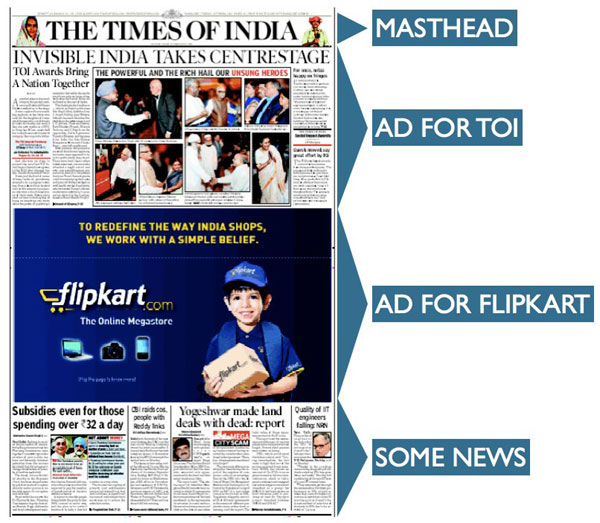
    PS: Found this image floating on the net. A good example of how valuable readers are to the publishers of the TOI. And the irony is that just a few days back the newspaper was gloating over its rising readership!


  • RIP, Vasant Sathe, grand patron of colour TVs in India

    By Pradyuman Maheshwari


    Not many amongst mediapersons and marketers may know that former minister and veteran Congress leader Vasant Purshottam Sathe, who passed away last Friday, was the man who fought with a variety of lobbies and brought colour television to India in 1982.

    I still recall the news reports on Sathe in the very early ‘80s where as information and broadcasting minister had a tough time with the black-and-white television lobby. Finally, it was the Asian Games and World Cup Hockey that did the trick. Guess the fact that Rajiv Gandhi was general secretary of the Congress then and was actively involved with the Asiad would’ve also helped.

    Sathe was also instrumental in spreading the Doordarshan network by setting up low power transmitters. This eventually led DD introducing the National Network.  He is reported to have faced opposition to introducing sponsored programmes, but later the pubcaster was receptive to the concept. And how!

    I don’t remember much about this, but I read on a bio on his website that he also helped in clearing the controversies around Richard Attenborough’s Gandhi.

    While it’s true that colour television would’ve eventually entered India even if Vasant Sathe had not intervened, but surely it wouldn’t have happened in 1982.

    1990 possibly.


    Photograph: Image of his book cover on vasantsathe.com


    **

    My Delhi trip and MxMIndia.com’s code of ethics


    Met the awardwinning CEO of an awarding winning channel at the Delhi airport while I was on my way back yesterday. I was in the Capital to meet the MxMIndia team and interview a few possible recruits as also attend a luxury magazine’s awards do. The event was at the Jaypee Greens Golf and Spa Resort which is located some 20 km from Noida in Greater Noida.

    I accepted the offer for a night’s stay because while Jaypee Greens is an excellent place, it is in the back of beyond. Plus I wanted a sneak peek at some of the facilities being created for the F1 next month.

    So how does a junket like this work with your Code of Ethics, the CEO asked me. One, our report on the event will clearly carry the disclosure in the story that we are subjected to the hospitality. And, two, while any degree of hospitality extended would amount to it being a junket, the only reason I accepted it was that I believed that attending the awards would help me understand the high-end luxury content space better as also interact with the people who matter in the business. Which I did. As a bonus, I also met a few senior mediapersons at the do.

    Had to trek back to South Delhi for my meetings and finally to the airport.

    However, having been quizzed by the CEO and realising that MxMIndia and I are going to be subjected to some scrutiny on this count, I guess there is need to be even more vigilant in ensuring that we adhere to the Code.

    Aatma chintan, as the BJP calls it.

  • Freaking News | When newspapers twisted facts to suit themselves

    By Ranjona Banerji

    This weekend was dedicated to – surprisingly, not Mahatma Gandhi – but to the poor people of India. Of course this was a matter very close to Gandhi’s heart and perhaps more important to a commemoration of his 142th birth anniversary than cursory lip service paid to his legacy, as has become our wont.

    So TV channels and newspapers discussed the Planning Commission and its inexplicably odd expenditure cut-off of Rs 32 a day being above the poverty line in cities and Rs 26 a day in villages. As TV anchors, activists and the general public fretted and fumed, some analysts – in print and on screen — tried to explain it all statistically and economically to us idiots. Little of that was fully comprehensible and regardless of the contempt for a middle class which has only recently woken up to social issues, it goes without saying that the Planning Commission’s figures seem to be absurd.

    The imminent fall of the government continued to be a matter of discussion, especially for the BJP as the UPA scrambled to convince everyone that the dissent within them was normal and all was hunky-dory. But the BJP itself appeared to be a house divided with much speculation over Gujarat chief minister Narendra Modi’s perceived snub to both the party headquarters as well as to party stalwart LK Advani.

    **

    Weekends on TV are usually news-free as news channels fill their space with car, food and Bollywood shows. We also occasionally get interviews with artists and writers. Presumably, this satisfies our need for culture, both popular and otherwise.

    International news channels however manage to slip in a bit of news as well, with the Eurozone crisis, the unrest in Libya, Syria and Yemen, the US economy and the US fight with Pakistan sharing space.

    **

    The fun quotient for the end-of-the-week as far as Indian newspapers were concerned was the release of readership figures for the quarter by the Indian Readership Survey. Every newspaper managed to twist the figures to suit themselves and this means that readers of multiple papers would have been in a state of happy confusion. In Mumbai for instance, both Hindustan Times and DNA claimed the number two spot, while the Times of India claimed number 1 for itself and number 2 for its free tabloid Mumbai Mirror. The figures support Mirror as 2 and Hindustan Times as 3, but then given that Mirror comes free with Times of India which has a huge lead over the others, this leads to a few questions. It also effectively puts DNA at either 3 (if you discount Mirror) or a distant 4. Mid-Day also saw a readership increase, bucking its own trend over the last couple of quarters.

    In Delhi, both Times and Hindustan Times claimed a rise in readership and the number 1 spot – or so it seemed to me. Across the country, this chest-thumping continued. I’m guessing readers know what they read and that advertisers will be suitably impressed – the whole point of this operation.

    **

    Am I the only one tired of every newspaper and news channels calling itself “your paper” and “your channel”? I “own” so many newspapers and channels now that am considering getting an investment consultant to cope!

  • Anil Thakraney’s Hard Knocks: Are newspaper owners in sleep mode?

    The latest IRS figures are in. And as usual, newspaper edits get busy boasting about rise in readership. Or, they’ll work out ingenious ways to interpret the findings, to keep their board of directors and advertisers in good cheer. By the way, I often wonder if everyone’s readership is healthy, who’s taking the fall? Anyway, that’s not the point of my article. And neither do I wish to discuss IRS’s methodology.


    What I want to say is this: Newspaper proprietors in India should be thrilled even if there is no growth for their brands. India is that unique nation where dailies continue to thrive even as they struggle to survive in the rest of the world. And that’s purely because, as Indian Express chief Shekhar Gupta said to me in an interview for GQ mag, and I quote: “India has more space for media than most societies. People read multiple newspapers. We may see a shakeout, but not in the near future. Simply because of the demographics. India is adding nearly three crore literate people to the market every year. That’s the size of a large European country.”


    Shekhar is right. India’s large population base and rise in education will sustain newspapers for a pretty long time. But the proprietors will do well not to get complacent and sit on their laurels. Because the global trends will sooner or later catch up with India. Soon the tech revolution will hit India hard, and many newspaper brands will be compelled to shut shop.


    And innovations and out-of-the-box thinking must start NOW before it’s too late. Sadly, I haven’t seen any signs of that so far. Almost every single news that gets ‘broken’ on the covers of our dailies, I have already been made aware of the previous night by TV and/or Twitter.


    So people, do gloat if you wish on the IRS figures. But also do take care to smell the coffee.


    ***


    PS: I badly wanted to stay inside the Bigg Boss house this time. But couldn’t think of anyone to kill, rape, molest, abuse or cheat. So I didn’t qualify. The loss is all mine.

  • Anil Thakraney’s Debrief: Dulux lacks colour

    Dulux has come out with a bad copy of the Asian Paints idea. While I understand the desperate need for a lifestyle approach to paints advertising, since the functional route won’t work in this category, there is a crying need for originality in this category. Because that’s the only way to induce brand connect for paints.


    Dulux’s new commercial says ‘Apna Rang Chhalakne Do’. It features actors Shahid Kapur and Boman Irani. Irani is finicky about the red colour he wants, and is seen giving hell to his painter on the exact shade. Suddenly, Kapur waltzes into his house, with Irani’s daughter in his arms, wearing what is called a ‘Rascal red’ tee. This follows a sequence of some very trite banter between the characters, till we are told Kapur is a doctor! Wow, we are impressed!


    Not only does the ad immediately remind you of the Asian Paints ‘Mera wala blue’ campaign, the execution is so dull, boring and well, colourless, it puts you off despite the presence of movie actors. The conversation is forced, the humour contrived. In short, the commercial is a dud any which way you look at it.


    The least Dulux ought to have done was to come up with a more interesting tribute to Asian Paints.


    Rating: (On a scale of 1 to 5): A BIG ZERO. In Rascal red.


    Anil Thakraney’s ad review column DeBrief will appear twice a week – Tuesdays and Thursdays.