Category: BLOGS

  • Ranjona Banerji: Lacklustre coverage of a lacklustre Budget

    By Ranjona Banerji


    Lacklustre. That’s how the coverage of the Union Budget 2016 looked on television. Maybe it’s that the budget itself was lacklustre. But like all Union Budgets in recent times, it was a bit of this and a bit of that. No Big Bang, no Big Ticket reforms, no economic clichés for subeditors to drool over.


    The Union Finance Minister begins his speech at 11 am. But news channels have to start salivating and hyperventilating from the time we wake up and rush bleary-eyed to our TV screens to check if a leaf fluttered in the night and we missed it. The formula was more or less the same on all channels: some pro-government economists, some anti-government economists, some cagey industrialists and some investment experts who speak a language no one else can understand.


    The one journalistic scoop of the morning on television before the Speech was that the Budget would be farmer-oriented. This great nugget of investigative journalism came from the Prime Minister himself who said that his government was going to double rural incomes by 2022. The salaried class as usual hoped that income tax would be abolished. Corporates hoped that corporate taxes would be abolished and thus it was hopes and expectations beyond reality can deliver as usual.


    Unfortunately for Budget mavens, the Oscars were also live in the morning hours and thus interspersed with “fiscal” and “deficit” and “subsidy”, were excited “oohs” and “aahs” about Bollywood and now Hollywood star Priyanka Chopra’s appearance on the red carpet and the Dolby Theatre Stage. This was in fact a welcome break from the tedium of financial jargon masquerading as prescience.


    There was also an amusing interlude when one TV anchor who hadn’t seen or read up on the Oscars even though she was giving us the highlights of what was going on, fumbled while trying to explain what The Danish Girl was all about, forgot who was transgender and why Alicia Vikander won best supporting actress in the said film.


    Of the morning lot, Rajdeep Sardesai on India Today TV was the most entertaining, Dr Prannoy Roy fans had to wait to get a darshan on NDTV and the only post-Budget programme I enjoyed was questions on personal taxes on CNN-IBN. Nowadays it is hard to tell the difference between Times Now and NewsX and as usual they decided that the Budget is best explained by party spokespersons who don’t understand economics, thus ensuring that we have the usual slanging matches one way or another.


    **


    The morning papers seem equally lacklustre. However, since they had more time to think about it, The Times of India for some reason has channelled its inner Elton John and headlined page 1, “Glowing in the wind”. I however got utterly confused because the first few pages were about a new ipad, a new MotoG and the greatness of West Bengal. By the time I reached ‘Glowing in the Wind’ I forgot all about the Budget and thought there was a fire somewhere. Basically, the Budget could mean that India is a candle in tempestuous global gales or that we could be snuffed out in one puff. I think.


    Meanwhile, in attempt to soothe the confusion in readers’ and viewers’ minds, the Times of India has explained the laws of federalism within the world of Bennett Coleman to its readers which basically says that the editors of all the newspapers, the Akond of Swat at Times Now and the tweets of owner Vineet Jain all exist in parallel universes. I will buy anyone who can cogently explain this edit page piece which appeared on Monday February 29, a drink at any press club anywhere in India.

    http://blogs.timesofindia.indiatimes.com/toi-editorials/federalism-in-structure-pluralism-of-views/


    Newspapers like the Hindu and Indian Express focused on the government’s new-found love for farmers and harped on the indication that the “suit-boot ki sarkar” had been given a reality check. To be fair, TOI also mentioned this supposed shift by the government from its core voters to the voters who have felt abandoned.


    **


    I did not make a New Year’s resolution on January 1, 2016 but I will make one now. I am not going to watch news television’s painful attempts at Budget coverage ever again.
  • Ranjona Banerji: No one for a Readers’ Editor? + Dehrudun media blues…

    By Ranjona Banerji


    Concerned citizens of Dehradun are currently involved in a struggle with the government of Uttarakhand over the “Smart City” scheme rolled out by the Centre. The state government decided to opt for the “Greenfield” provision and develop 250 acres of a partly functioning tea garden in the heart of the city into a “smart” zone. Citizens, tea garden workers, environmentalists and conservationists would rather that the city of Dehradun is improved and that a historic tea garden is not destroyed.


    I have been involved with this movement and have attended a couple of meetings. And sadly for me I have had to cringe, cower and cravenly apologise for the sort of media coverage this protest has received. First, my gratitude to the media – the protest has been generously covered in almost every newspaper which has a bureau in Dehradun and by local TV as well. But that is where the gratitude turns a little to disgruntlement.


    Because not a single newspaper has managed to get details of the protest correctly. For instance, and this I know firsthand, my father who is president of the Friends of the Doon Society, one of the NGOs involved, has been quoted on the issue. However, no journalist spoke to him and he spoke to no one. It’s not a bad quote but he didn’t give it. The Friends of the Doon has spearheaded the agitation but at the last big meeting at the tea gardens, Friends of the Doon officebearers have been identified as belonging to Citizens for Green Doon. And so in every report in every newspaper: little mistakes, carelessness and lack of attention to detail.


    I have interacted with some young reporters at one venue and they were all bright, young and enthusiastic people. And I do not know if the errors were theirs or someone at the desk or shortage of space or what. But it is not hard to guess that it is a combination of all three. The problem is that the Indian media does not take such transgressions seriously. How many newspapers in India have ombudsmen? (This is rhetorical question or perhaps you can do some homework?) A little quote missed here, a little fake attribution there, it’s all considered par for the course.


    Nor do we have researchers who check back on quotes. This is a laborious, labour-intensive and time and money consuming process. No wonder we don’t bother in India since newsrooms are run by manager-editors whose sole concern is often pleasing the management by reckless cost-cutting.


    All I can say is being on the receiving end of journalistic carelessness and having to explain their actions and find excuses without being disloyal to my profession is turning into a very difficult exercise! And this loss of trust does not help in the long run for any publication.


    **


    While on the subject of ombudsmen (ombudspersons?), The Hindu celebrates 10 years of having a readers’ editor. SA Panneerselvan writes careful, considered columns as he takes on the issues of the week and the criticism that the newspaper has faced. The letters column sometimes carries criticism of the readers’ editor which illustrates a journal which takes its readers seriously!


    Here, The Hindu traces its 10 year journey with its three readers’ editors:

    http://www.thehindu.com/specials/10-years-of-the-hindus-readers-editor/article8295971.ece


    And here Panneerselvan explains the process: http://www.thehindu.com/opinion/Readers-Editor/responsive-editorial-team-makes-selfregulation-work/article8292582.ece


    **


    The other newspaper which once had a readers’ editor at least for the Mumbai edition was The Hindustan Times, where Sumana Ramanan started the process very well but it seemed to falter after she left.


    Time for a rethink or at least a think all round?


  • Ranjona Banerji: Kanhaiya Kumar proved in TV interviews the high worth of a PhD from JNU!

    By Ranjona Banerji


    Watching interviews of Kanhaiya Kumar on TV, JNU student and president of the Students’ Union, you understand why he is popular in his little world. What you cannot understand is the frankly shoddy quality of the interviewers on TV. Either they treated Kanhaiya like he was the next messiah with all the answers in the world or they tried to bamboozle and trip him up.


    In both cases, the young Kanhaiya got the better of seasoned TV journalists. He kept calm, sounded reasonable and put forward his views without decibel fluctuation and with a smile on his face. To put it simply, he played them. A good interview has to be carefully crafted and organised. You have to create a format and a flow. It can be linear or circular. If you are very good at your craft, it can even be progressive where one answer leads to the next question. But when an interview is false, stilted and staccato, it loses its essence.


    I understand that it is more difficult to do interviews as a TV journalist than as a print journalist. On TV, you are as much on air as the interviewee and although this makes you a star it also exposes your shortcomings. Your brilliance and your stupidity are both on display. In print, you are behind the camera, you are the questions in bold and you have time and you have editing skills at your disposal.


    From what I have understood of TV journalism in India, editing skills are only used when you want to doctor videos to trap Kanhaiya! Okay, was that below the belt? If I have to be kinder, why not use those editing skills a bit more?


    What happened with the Kanhaiya TV interviews is that the agendas and egos of the interviewers showed through. And also, at the risk of being lynched, perhaps there is some advantage to getting a PhD from JNU after all?!


    **


    Although prime time TV debates in India are usually abysmally painful on the eardrums and therefore unwatchable, watching all the outrage over industrialist Vijay Mallya was quite amusing. Every news channel played over and over images of Mallya at a party with a glass of something in his hand, Mallya surrounded by models and film stars and famous people, Mallya busy having a social life.


    While our TV anchors were very angry with Mallya for not paying former Kingfisher employees and for having so much fun on money he had taken by public sector banks, industrialists and businesspeople were quite sympathetic about Mallya’s predicament. For one, possibly none of them ever had so much fun on borrowed money and two, maybe they were thinking, “There, but for the grace of god, go I”.


    Although TV anchors and commentators were worried about the terrible state of Kingfisher employees, industrialists we could see were not quite that sympathetic. Everyone agreed though that Mallya should not have lived such a lifestyle on public sector bank money. Maybe they were all hiding their Kingfisher swimsuit calendars for all I know.


    The trigger was the debt tribunal refusing to let Mallya access his bye-bye deal from Diageo. The problem however is much older than that. Hopefully we have not heard the last of this.


    Also on some channels was the controversy over HRD minister Smriti Irani. Don’t groan, this is not my fault. Her cavalcade got involved in an accident. Or maybe it didn’t. Or maybe it did. Someone died. Irani claimed on Twitter that she had helped and organised help. The victim’s family said she didn’t. Twitter said Times Now blanked out the story. Is that true


    Other channels were preoccupied with saving the Yamuna from a massive Art of Living Sri Sri Ravi Shankar event. I have a simple point to make here. Whatever damage was being done to the Yamuna was happening over months. It would have been better journalism if the Delhi-based media had focused on this programme a little earlier.


  • Ranjona Banerji: Vijay Mallya UnLtd.​

    By ​Ranjona Banerji​


    I start with an apology to The Times of India. I had put out a tweet a couple of days ago saying that the Doon edition of the newspaper had not carried any news on the current imbroglio over the Art of Living’s event on the banks of the Yamuna river in Delhi. The Art of Living has an old and long relationship with Bennett Coleman which does sometimes affect news choices. However, the paper has in fact given the subject front and inside page coverage since so perhaps the lack of may have been an oversight and not deliberate.


    News channels meanwhile gathered all their self-righteous zeal to the menu du jour. There was Sri Sri Ravi Shankar and the destruction of the Yamuna on one side and the “King of Good Times” Vijay Mallya’s exodus to the UK even as he owes banks over Rs 7000 crore on the other. What joy!


    Karan Thapar on India Today TV was very watchable, especially as he now loudly instructs the producer to lower the volume when someone misbehaves by screaming and trying to hijack the debate. This is the absolute best schoolmaster behaviour I have seen and quite frankly, TV guests usually deserve this sort of humiliation. A couple of weeks ago, the BJP’s Nalin Kohli apparently left because he was so offended but the Congress’s Sharmishtha Mukherjee did not bold when it was done to her during the Art of Living discussion.


    The BJP’s GVL Narasimha Rao was most amusing when he accused everyone opposing the Art of Living cultural event on environmental grounds of being anti Hindu, anti-national and even further, all objections being a giant plot by Congress president Sonia Gandhi to defame India’s image abroad. Thapar was so amazed and amused that he did not bother to turn down the volume. The guests, including evil environmentalists and Mukherjee also looked amused. A good journalist perhaps knows when to use the mute button and when to let someone’s grandstanding expose their quirks and beliefs. Bizarre was the word Thapar used and one cannot disagree.


    Then there’s the Mallya case. What outrage! How dare he leave! How dare he lead a lavish lifestyle! How dare he endlessly. In fact, Mallya is not the first businessperson to behave like this and he will not be the last. The same questions about how banks treat the poor and middle class compared to how they treat the rich and influential have been asked before.


    ​​TV journalists though need to do a little more bread-and-butter investigative journalism without any help to match their hysteria and they also need to read up a little history.


    For my money, the best investigation into stock market manipulation and bank and financial institution fraud was done by journalists like Sucheta Dalal and Debashis Basu into the Harshad Mehta scam of the 1990s. Neither TV nor the internet had been invented in those days. Okay, I’m kidding. But TV was mainly Doordarshan, so… Business journalists since then, sadly, have largely become press release rewriters.


    **


    The most idiotic thing for TV debates and TV anchors to do however is to allow the Mallya issue to become into a BJP versus Congress fight. Because once we get into that trap, nothing is achieved. Though of course, sometimes that is the point.


    **


    Meanwhile, to provide comic relief, a reporter for an Indian news channel stood outside Mallya’s bolthole in Tewin, Hertfordshire, United Kingdom and told us that Mallya is also famous in Tewin for his lavish lifestyle. Not only do people ride around in Lamborghinis – lavish, I grant you – but they also go to pubs! Can you imagine? Pubs? Shocking!


  • Ranjona Banerji: 25 years of BBC World Service

    By Ranjona Banerji


    In the mid-1980s, my parents lived in the factory town of Atul, near Valsad in southern Gujarat. Since Doordarshan’s reach was not “door” enough to give us “darshan”, the factory town installed a giant satellite dish. On this, we watched, yes, Doordarshan, CNN and a special broadcast for the United States Armed Forces in the Philippines.


    It wasn’t till January 1991 and the first Gulf War however that CNN became a household name in India and much of the world since it was the only 24-hour news channel. Many children dreamed of becoming journalists like Christiane Amanpour and reporting on wars from rooftops. Those of us who had access to satellite TV – soon run through the cable TV system in cities – became very familiar with scud missiles and Benjamin Netanyahu as he acted as Amanpour’s guide on various rooftops.


    Hard to imagine but newsrooms did not have televisions in those days. The editor of the magazine that I worked for at the time hired a room at a nearby hotel so that we could watch CNN and try to understand how TV journalism worked. As regular readers of this column will know, I still haven’t quite understood.


    The BBC World Service celebrated its 25th anniversary last week. In a country where independent media was limited to newspapers, the BBC’s radio service was a staple for many. In 1984, it was on the radio for instance that we learnt that Indira Gandhi had been assassinated by her Sikh bodyguards and that horrific riots had broken out in Delhi, where Sikhs were being slaughtered. Doordarshan and Akashwani only informed late in the day. The dangers of a state-run media were evident then.


    In 1992, live coverage of the demolition of the Babri Masjid was seen by many on BBC World Service. The authorities in those days were always very careful to hide everything that happened from the people. Reasons like law and order concerns, unrest or unhappiness were used as excuses given by a nanny state. The Emergency of course had demonstrated to the Indira Gandhi government that censorship was possible. The bigger lesson was that such actions can have terrible backlashes, which politicians in India have not yet fully learnt.


    From 1991 onwards, we started on the path of TV news taking over our lives. It was also television itself that invaded us or more correctly, we embraced it fully. Morning conversations were about the Australian soap Neighbours. The Bold and the Beautiful became a household regular until the stars were compelled to wish us “Happy Deewolly”. MTV deejays were discussed on trains.


    And then came Star News and all the rest which brings me to where I am today: changing channels when studio guests start yelling at each other on primetime news debates. And yet, it is important to acknowledge that too much news, annoying news, rubbish news, slanted news, incompetent news is better than no news at all and government-ruled news. We have choice and we have the ability to exercise it today. TV news has made newspaper journalists realise their worth and it has certainly changed salary structures across print newsrooms.


    And to be fair, Doordarshan and Akashwani weren’t that bad entertainment-wise either and believe it or not, some of their newsreaders became “stars” as well. Oldies will sometimes reminisce about shows like Hum Log, Buniyaad and Nukkad after the National Network started in 1984 because they were excellent.


    And before that, independent Doordarshan centres in different cities, managed to put together meaningful programming, with Bombay Doordarshan being among the best.


    My favourite newsreader remains one from Calcutta Doordarshan who once declared with great aplomb in his plummy accent, “To end the headlines, the news again”.


    Don’t you feel that that’s how it still works, sometimes?


  • Ranjona Banerji: So who in the media is now crawling when asked to bend?

    By Ranjona Banerji


    There is a demand on all Indians to declare their patriotism according to the methods deemed correct by elements of the Hindutva rightwing, which is currently the ruling dispensation at the Centre. However, these demands are also being countered from various angles of civil society. Where does the media fit in here?


    It was the BJP’s LK Advani who coined that most telling phrase about the media’s behaviour during the Emergency: when asked to bend, they crawled.


    One could well argue that parts of the media are doing exactly the same thing now – except that instead of bowing to Indira Gandhi and the Congress, they are bowing to the BJP government at the Centre and to Narendra Modi as prime minister. Even worse, some of them are bowing to the demands of those fringe elements of the Hindutva family which now seem more centre stage than fringe.


    Zee News is the channel which springs to mind here. Not only is it accused of “doctoring” the video which showed JNU students’ union president Kanhaiya Kumar shouting “anti-national” slogans, it has since accused a number of people who supported Kumar of being anti-national as well. That the Zee newsroom took the decision to change the video to make Kumar look guilty was revealed by a staffer.


    Two targets of the Zee News’s vilification campaign have been JNU professor Nivedita Menon and scientist and poet Gauhar Raza. This is unconscionable and unacceptable. In both cases, Zee News has fabricated evidence and twisted what they said to create a dangerous hate-filled atmosphere around the issue of “nationalism” as determined by the BJP and its supporters like actor Anupam Kher. Avid TV viewers, who think they know how journalism works by watching TV, put this down to “TRPs”. However, as any journalist knows, what Zee News is doing is not journalism. Although the fact that Zee owner Subhash Chandra made the surprise move of appearing on his own channel to claim that he is not a BJP supporter may prove that some criticism has stuck, that could have been a PR-driven or legal move. The only way Zee News can prove that it practices journalism is if it stops manufacturing stuff and starts reporting.


    The other two channels which are in the dock for showing the doctored video against Kumar are Times Now and NewsX. Times Now is of course India’s most nationalistic English news channel but has usually skirted on the correct side of journalistic practices if on the right side of the political spectrum. But on the JNU case, it veered straight into non-journalism territory by airing the doctored video and then pretending that it did not. NewsX on the other hand is a sort of “Mini Me” version of Times Now and follows whatever it does. If nothing else, it shows remarkable ability to wait until Times Now announces its evening debates and then putting together its own debate on the exact same subject. For the irony-free, I am being sarcastic.


    On Thursday night, I noticed that Arnab Goswami had changed tack and instead attacked the BJP for its stand on Shaktiman the horse that was injured in a political rally held by the BJP in Dehradun. It seemed that Goswami will side with horses and women against any political dispensation. That is, I suppose, good to know. The next debate, which I did not have the courage to watch, was about the arrest of students in Rajasthan over rumours that they were eating beef. This also appeared to be aimed at the BJP and its obsession with beef. Perhaps this is some rare meeting of minds in Bennett Coleman’s unique federal structure


    Ranjona Banerji is a senior journalist and commentator. She is Consulting Editor, MxMIndia. The views expressed here are personal.


  • Ranjona Banerji: The perennial war for newsroom control

    By Ranjona Banerji


    The Marathi newspaper Loksatta was apparently forced to retract an edit that was critical of Mother Teresa, after news of her imminent sainthood became public. This perhaps represents everything that is wrong with newsrooms. But it is also curious. Criticism and some of it quite vicious of Mother Teresa is not new. In Kolkata, where she did most of her work, many fulminated against her work and her methods. The Left Front government disliked her intensely as it did all Christian missionaries in Bengal.


    Many others felt that she got more attention than she deserved and that other people who did similar work were neither glorified nor given as much money and attention. The most trenchant criticism came from the writer Christopher Hitchens who called her out for her hypocrisy because she took money from all sources and applied no moral code to her donors.


    The Loksatta editorial said no more than this. It is curious why the management would force the editor to retract. Mother Teresa died in 1997. Her achieving sainthood is of interest mainly to the Catholic Church and to Catholics.


    But we have a history in India of tiptoeing around “religious sentiments” and it seems apparent that this is what happened here. It also shows the dangers of management interference in newsrooms. Let us not pretend that it has never happened before. But usually, editors had the wherewithal to fight even if they did not win every battle. But what we see in some newsrooms today is editors who have already capitulated or editors who are unable to withstand the onslaught. Both cases do journalism no favours.


    Incidentally, for those crowing that they have proof of some evil Christian plot to destabilise Loksatta and the media, let us remember that representatives of every religion in India apply as much pressure as they can on media houses to censor criticism. Is there anyone here old enough to recall the hysterics in newsrooms when India Today (the magazine) ran a story that made allegations against Sathya Sai Baba of Puttaparthi? Never have so many journalists staved off calls from so many famous people they are usually dying to speak to!


    **


    This is a call to tennis journalists. After Maria Sharapova’s dramatic announcement earlier this month that she had tested positive for a newly banned drug in January this year during the Australian Open, we saw some fulminating, reporting and so on.  But since then, the news cycle appears to have moved on to routine match reports. Indeed, it is soon to be overtaken by the gender war brewing in tennis again, after irresponsible remarks by a CEO of the Indian Wells tournament and unfortunate remarks by ATP World Number One Novak Djokovic over equal money.


    However, the issues of match-fixing and doping need to remain at the forefront if the game is to be saved. On TV now is an excellent documentary on cyclist Lance Armstrong and how he lied and manipulated his way around drug charges while winning innumerable races and setting up his cancer foundation. It is an abject lesson on how to ignore clear signs. At the time, it was France’s L’Equipe magazine which made the charges against Armstrong and was attacked for being partisan and jealous. Take a look at the defences being raised now. That should give a journalist some hints.


    **


    Tired of being accused of being constantly anti-government by BJP fans, the Hindu’s Readers’ editor delved into history and this is what he found. The pointing finger? Hmm.

    http://www.thehindu.com/opinion/Readers-Editor/charges-of-bias-how-the-upa-regimes-were-covered/article8377808.ece


  • Ranjona Banerji: Should a journalist only praise the police & ignore the problems of the people?

    By Ranjona Banerji


    At the risk of upsetting every journalist in India who thinks that their sole purpose in life is to support the government in power, one has to point out that what is happening to journalists in Chhattisgarh is very, very scary. Malini Subramaniam, who contributed to scroll.in and was threatened, was forced to leave her home in Bastar because of intimidation from various quarters connected to the government and the police.


    Journalist Prabhat Singh was arrested by the police for making an anti-police joke on Whatsapp. Bastar-based reporters Santosh Yadav and Somaru Nag have been arrested for “Naxal” links.

    It is true that Chhattisgarh is a battleground between Naxal forces and the police. It is also true that the Naxal movement began because of real and perceived persecution and the utter neglect of local people by the police, by government and by corporate interests. It is also true that Naxals and those who support them are part of India. It is also true that Naxals are dangerous and violent. It is also true that security forces have suffered terrible damage because of Naxal violence. It is also true that civil militias like Salwa Judum, encouraged and formed by the government, have added to the problem.

    What, in such a complicated case, is a journalist to do? Be patriotic and nationalistic as the government demands and toe the government line alone? Ignore the problems of the people and only praise the police? Pretend that there is no persecution and abject poverty in the region? Sing hymns exalting the state government’s policies and actions? Never try and get both sides of the story?

    These are journalists who risk their lives to do their job. It is clear that they have upset the authorities who do not want the outside world – that is us, the rest of India – to know what is happening in Chhattisgarh. And this behaviour is not new. Nor is the charge of being anti-national. After all Dr Binayak Sen, who has dedicated his life to treating the neglected and the bereft of the region, was also tagged and arrested as a seditious anti-nationalist almost a decade ago.

    The situation in Chhattisgarh is full of grey areas. And yet, anyone who does not kowtow to the government is considered an anti-national who supports anti-national activities. If you want perspective, compare how journalists who cover Bastar are treated with journalists who manage to get interviews with underworld criminals and gangsters like Dawood Ibrahim or Ravi Pujari or Chhota Rajan. Talk to a gangster/terrorist and you are a hero. Talk to a Naxalite and you are a traitor. This despicable distinction is a direct result of all those shameless journalists who scream and shout about “nationalism” day and night on television, in print and on social media, wearing their fake plastic flags on their sleeves and basking in government adoration in their spare time.

    In a sense, these are government-embedded journalists who have sold their souls for government favours or recognition.

    It is heartening to see that journalists across India have come together in support of Chhattisgarh’s journalists and reports are being prepared by organisations like the Editors Guild. Civil rights organisations are also involved in helping these journalists who have been arrested on specious grounds. Senior editors and journalists in Chhattisgarh itself have met with government officials to try and help their colleagues and sort out the situation. Journalists in Chhattisgarh share some chilling realities of working there with their friends. Says Sunil Kumar, editor of Daily Chhattisgarh, “The police is trying its best to prove that no one is a journalist in Chhattisgarh so that it can arrest whoever is a discomfort to the police.” Kumar has been scathing in his criticism of the government and also filed a complaint against the arrest of Prabhat Singh. Like many others, he is willing to put his journalism on the line to protect the rights of journalists.

    One might argue that currently, Chhattisgarh is India’s most dangerous battleground for journalists. Especially those who really care for the tenets of their profession and for this country – the opposite of our plastic patriots you might say.


    Ranjona Banerji is a senior journalist and commentator. She is Consulting Editor, MxMIndia. The views expressed here are personal.


  • Ranjona Banerji: Broadcasters’ Association bans ‘Breaking News’ usage + other

    By Ranjona Banerji


    BREAKING NEWS: The All India Broadcasters’ Association has jointly issued a declaration that the term ‘Breaking News’ will no longer be used by any television news channels in India. Ever. We may lose such gems as “Breaking News: Pigeons live in cities” or “Breaking News: Salman Khan gets bail” but hopefully we shall be able to live with this.


    CABINET MEETING: The Union Cabinet decided that from the birthday of KB Hegdewar onwards, they will uphold Indian culture and never call journalists “newstraders” and “presstitutes” any more. Sources say that former chief of army staff VK Singh was carried out weeping from the meeting.


    SOURCES TELL US: All TV journalists have sworn never to use terms like “my sources said”. This unfortunately includes scintillating TV conversations like:

    TV anchor: “Babli, your sources have told you that today is Friday, is that correct?”


    Reporter: “Yes Bunty, according to my sources, today is definitely Friday. However, we are still waiting for an official confirmation on this.”


    TV anchor: “As you heard from our reporter Babli, her sources have told her that today is Friday. We shall go back to Babli for an update as soon as she gets confirmation.”


    CLOUDS WITH CHANCES OF STUPIDITY: The BBC World Service’s weather people have sworn on copies of the film Twister that they will never say “fine and dry weather across India” when people in India are dying because of heat waves and delayed monsoons.


    SOUND CHECK: Mikes for TV debate panellists will now be fitted with decibel monitors that will automatically switch off when they go above 65 dB.


    SPEECH MODIFICATION: In bad news for fans of Indian prime minister Narendra Modi, all his speeches will no longer be broadcast live all the time. Many tantrums were observed at the India Today TV newsrooms say many unnamed sources.


    PATRIOT ACT: Super-patriotic journalists of print and TV are now required by law to have their faces painted with the Indian flag at all times. Failure to do so may lose them all privileges in Nagpur.


    GAY ABANDON: All print journalists who use the words “gay” when they mean happy, “apparel” when they mean clothes, “air-dash” when they mean “fly” will forced to spend three months in solitary confinement reading Chetan Bhagat books so that they can find new ungrammatical clichés.


    CONTINUAL PAIN: The Newspaper Association of India has decided that newspapers will no longer have seven front pages, six of which are ads for flats that no one can afford to buy.


    NEVER EVER EVER EVER NEVER EVER: will Arnab Goswami of Times Now try and save the nation again, even from himself.


    Okay, I gave myself away. Have fun and see you next week.


  • Ranjona Banerji: Panama Papers makes one feel proud to be part of the media!

    ​By Ranjona Banerji​


    Mighty congratulations to the International Consortium of Investigative Journalists and Suddeutsche Zeitung of Munich for the Panama Papers story. Congratulations to the Indian Express for being part of the consortium. It is not often enough that you feel proud to be part of the media and it is not often enough that the media works on such marvellous leaks and resulting stories! Whatever the outcome, we have seen the greed and iniquity of the powerful, the rich and the influential across the world.


    The Guardian, which is part of the ICIJ, calls the Panama Papers “history’s biggest data leak”. That is, an “unprecedented” 11.5 million files from the world’s fourth largest offshore Panama-based law firm Mossack Fonseca have been made public. The German newspaper Suddeutsche Zeitung accessed them and then shared them with the ICIJ.


    What these leaks have revealed is that the higher up the ladder you are, the greater the depths you will sink to avoid paying taxes. Politicians from across the world are indicted by these leaks. If Vladmir Putin of Russia is one of the biggest fish wiggling in mild discomfort – he wrestles bare-chested with bears after all – other smaller fish are facing political crises like in Poland. From Africa to Asia to the Middle East to Europe, tax evasion through offshore money-parking is rampant and makes real life far more exciting than a spy novel.
    The next step for the media is to ensure that this information does not get buried and forgotten. Some of India’s biggest names are superstar Amitabh Bachchan and the current prime minister’s good friends, the Adanis. Given the influence that both hold, they will pull out all stops to wriggle out unscathed. It is also true that we have enough star-struck and government-struck journalists amongst us who will help.


    The work done by Julian Assange and Wikileaks, by Edward Snowden and Chelsea Manning (earlier Brandon) demonstrate why journalists cannot take government at face value. The Panama Papers add to that another dimension – the super-rich. As if we did not know that but we often pretend as if politicians should be our only targets. They are all mixed up, as we very well know.


    ​​​​It would be a shame if the work that went into revealing the Panama Papers is wasted. The onus is on all journalists to carry on.


    **


    Back home, a three-member team of the Editors’ Guild travelled to Chhattisgarh to investigate reports of journalists being threatened by the police and the state government. The results are frightening to say the least. The two-member team found that all journalists who work in Chhattisgarh feel that they are under the government scanner. They fear doing their jobs because they are caught in the crossfire between the government and Naxal forces.
    This paragraph from the report should be an eye-opener, even to our media friends who are government toadies:


    “The fact finding team came to the conclusion that the media reports of threats to journalists are true. The media in Chhattisgarh is working under tremendous pressure. In Jagdalpur and the remote tribal areas the journalists find it even more difficult to gather and disseminate news. There is pressure from the state administration, especially the police, on journalists to write what they want or not to publish reports that the administration sees as hostile. There is pressure from Maoists as well on the journalists working in the area. There is a general perception that every single journalist is under the government scanner and all their activities are under surveillance. They hesitate to discuss anything over the phone because, as they say, “the police is listening to every word we speak”.”


    What is happening in Chhattisgarh needs to be exposed and discussed because it shows that both the state and the Naxals are pressurising and threatening the media to ensure only one point of view gets through.


    ​​The result is that we do not know what is happening in Chhattisgarh and surely that can no longer continue?


    “The President of Divisional Journalists Association of Bastar, S. Karimuddin said, “I have not visited any place outside Jagdalpur for the last six years, simply because I am not supposed to write the truth and if one cannot write what one sees then there is no point going out to gather information.” He represents UNI in Bastar for more than three decades.
    A similar claim was made by the Editor of a local newspaper Dilshad Niyazi who said that he had not visited the neighboring district Bijapur for the last eight years out of fear. Another senior local journalist, Hemant Kashyap, well travelled in the area said he knew Bastar like the back of his hand but that now journalists had stopped travelling. “All the journalists have now stopped going inside the forests because of the fear of police as well as Maoists,” he said. “Now we ask Maoist organizations to send photographs and press releases. We publish them as we receive them because we don’t want to explain every single line we are writing to them. Similarly the police expect us to publish its version so most of the journalists print their press releases as well without asking any questions,” Kashyap said.”


    The Editors’ Guild has done the homework. The rest of the media needs to wake up to the real pressures felt by our colleagues and respond accordingly. It would also help if big city newsrooms realised that there is an India beyond their coffee machines.


  • Ranjona Banerji: IPL, drought and extreme hypocrisy

    By Ranjona Banerji


    If we were not facing impending doom, the outrage of English news channels over the IPL tournament and drought in India would be nothing short of amusing. It is true that drought conditions in Maharashtra are much worse than in earlier years. It is also true that at least nine other states are suffering from drought conditions. But it is also true that this drought has nothing to do with the IPL tournament.


    The connection itself has only occurred to the television media because a public interest litigation asking for the tournament to be shifted out of Maharashtra came up for hearing in the Mumbai High Court. Long before that though water supply has been restricted, Section 144 has been imposed to prevent water riots and farmers have been complaining. How many years ago was it that Ajit Pawar of the NCP made that disgusting remark about urinating into dams of there was no water? Has the situation improved since then? Could TV journalists have ventured into the hinterland to find out what’s been happening since? The IPL after all is held every year at exactly the same time.


    At the same time as TV anchors are spitting fire at this evil IPL that is stealing water from desperate people, their channels are running long happy, inspirational ads about the IPL and how it is India’s tournament. What is this but hypocrisy and a cynical manipulation of a very real and very frightening problem? Barring NDTV, I cannot recall any other English news channel doing any stories at all on the problems of farmers, rural India, water, wild life and anything that is not some political hoopla over which you can have a panel slugfest.


    I can guarantee you that once the IPL tournament begins these same anchors will turn into simpering, fawning, skin-crawling fans if they ever come across a real-life cricketer in the IPL. They will also very easily forget about water, drought and everything else when they want to watch a match live or even when they have a shower or brush their teeth with running water. The problem though will not go away.


    I suppose though one must be grateful at least that thanks to the PIL and the courts, drought and water-scarcity has got some attention before matters became even more horrific. I have some free editorial suggestions for TV journalists, even as they continue fulminating against the IPL for perhaps one more day.


    They can speak to agricultural experts about the exchanging sugarcane for sugarbeet, which apparently will reduce water use drastically as well as allow multi-crop land use. They can question the sugar lobby on what they have done about better irrigation methods in their cooperatives. They can question the government of Maharashtra at least on what action they have taken about expected drought, given the experience of the last few years. They can ask about Maharashtra’s irrigation scam and what is going on there. They can ask people who have studied India and the world’s water problems to shed some light on what has happened so far and what can be done.


    It is not enough to have some city-bred BJP spokesperson to tell us that the government is “grippling” with the crisis and that the BCCI should be “magnamous” or that the Maharashtra government so sensibly and conscientiously advised that people not waste water while celebrating Holi. We need someone less absurd to be questioned by our fearless fire-breathing TV anchors. We need to hear from people who know a little more about the problem than former cricketers.


    The issue is not cricket and it is not the IPL. It is negligence and apathy and lack of understanding. And it is journalists showing complete lack of responsibility.


    I have no cause to be sanctimonious here. We have all been guilty of such behaviour at one time or another. It’s just that this time, it sticks in the throat.


  • Ranjona Banerji: I have written this content without either an adviser or a mentor. Weep!

    By Ranjona Banerji


    There have been changes at DNA, the last newspaper that I worked at. Since I quit in 2010, there have been several changes of editors and owners and managements. But the newest changes are intriguing. A news item put out by afaqs says that “Shreyasi Goenka who has been “mentoring the content at DNA will now take over as content advisor and will guide all functions at DNA”.


    There will also be a new “editor-in-chief”, Rohit Gandhi.

    An editor in chief, I understand. It is a job function and a lovely high-flown title.


    But what is a content advisor? Several decades at a newsroom have left me stumped. I asked a few whiskered journalist friends who are even older than me and they were equally clueless. Those younger seemed baffled as well.


    So what is a “content advisor” to do? Does it mean making a decision like which story is more important than another on a page? Like a news editor in the olden days? Or is it about how a story is written like a sub-editor or a rewrite desk? Or is about which stories make it to the front page like the editor, even, perchance, an editor-in-chief?


    Or is a content advisor just the new thing in town in newsrooms now dominated by management jargon? A meaningless designation meant to either disrupt or remain cosmetic as a newsroom goes about its business as usual?


    Are news reports, investigations, features, edits, diary items in a newspaper now to be known as “content”? I think websites use that term but for news websites, it seems likely that they also rely on the old terms.


    Having been out of a newsroom for almost six years now – yes the same DNA — I find this mildly amusing. However, when you consider the turbulent times that I saw at DNA, perhaps I am less amused. Perhaps content needs to be mentored as it tries to figure what on earth was happening around it. Can you hear the content crying, “No no, I am not a front page story. I am a simple feature. You are confusing me. I am in desperate need of mentoring.”


    The old style evil sub would have just dumped the story or cut it down ruthlessly. The new caring content mentor might take it out for coffee?


    **


    Meanwhile, the news cycle has turned and not surprisingly, the terrible fire at a temple in Kerala is dominating headlines. The water crisis and IPL have not died down completely but nightly outrage has, on television at least. Temples have taken centre stage. The saviour of India Arnab Goswami told us last night that “believe you me”, thanks to Times Now’s campaign and the support of its viewers, women of all ages will now be allowed into the Sabarimala temple, the Haji Ali dargah and so on. I would not bet against him since I don’t have the courage.


    Newspapers have shifted from anti-IPL outrage to suggesting solutions like other crops instead of sugarcane and pointing to decades of bad irrigation policies. (My father by the way wants to know why no one is considering his ideas of sugarbeet and sometimes throws newspapers around in disgust.) It is not likely that TV will take this up so we have to be satisfied with what we have.


    I must also apologise for mentioning in my last column that only NDTV bothers to cover droughts and rural issues. TS Sudhir’s Up South show on India Today TV packs a real punch into its half hour with solid journalism and yes, has been covering the problems of farmers and people who do not live in big cities.


    **


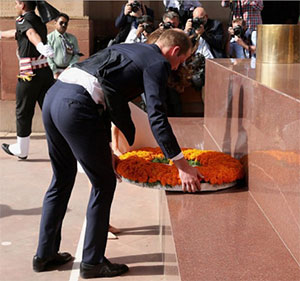
    The British Royals as in Duke and Duchess of Cambridge, as in Wills and Kate as in son and daughter-in-law of Prince Charles and the late Diana, Princess of Wales are in India. Twitter on Tuesday morning is all abuzz with skirts and suits flying in the breeze and different sorts of “Marilyn Monroe” moments (not singing Happy Birthday Mr President or wanting a diamond ring from Cartier but skirts flying in Seven Year Itch).


    So there’s this photograph of William, taken from the Twitter page of Buzzfeed’s inimitable Rega Jha, which no one talked about:


    And this, which many more talked about:

    http://www.mirror.co.uk/news/uk-news/kate-middleton-marilyn-monroe-moment-7732766


    Because maybe sometimes we all need our content to be mentored?


    Ranjona Banerji is a senior journalist and commentator. She is also Consulting Editor, MxMIndia. The views expressed here are her own.