Category: BLOGS

  • Ranjona Banerji: Goodbye to Modi rah-rah!

    By Ranjona Banerji


    The prime minister of India’s second visit to the USA in his 16-month term was a slight reality check for a breathless media. Unlike last year, it was not blanket coverage of Narendra Modi’s every waking moment, there was a small realisation that NRI hysteria does not reflect the situation at home and there was, gasp, some small criticism even from the head honchos of Silicon Valley about India’s business-friendliness.


    There were a few other problems as well. Much of the world was also in the US and the main topics of discussion were IS, Syria, Ukraine, Russia and the US. The visit by the Pope overshadowed everything else. In fact, the rah-rah over India having been done last year, this year was business as usual and the US media as it happened barely registered the Indian prime minister’s visit. C’est la vie. Running a government is not the same as running a fan club and no matter how many cheerleaders you have, the world will move on. I am of course very clearly pointing fingers at TV news here for its jaw-dropping sycophancy of last year.


    And then there’s this video of Narendra Modi and Mark Zuckerbery and Shelly Sandberg of Facebook. A few months ago, it would have been shared on social media and that would have been it. But now it has made to the mainstream media. That’s the problem with democracy you see – sooner or later even a whom-are-we-here-for media realises that it is here for the people and not for politicians and prime ministers…


    **


    Since the subject is a matter of discussion from Silicon Valley to here, it would be extremely helpful if the mainstream media paid some more attention to the topics of net neutrality, Digital India and Facebook’s idea of a controlled internet. There have been columns and interviews across some newspapers but I would hazard a guess that more is necessary. At the best of times most of us are hapless consumers blundering through websites and apps. A little more help here, guys.


    **


    I have said this before but I feel I must mention it again. It is nothing short of appalling when members of the media are so blinded by their political leanings that they forget the basics of their profession. The political divisions in the Indian media – particularly between left, right, centre and objective – were made clear when LK Advani – started his Rath Yatra to build a Ram Temple in Ayodhya at the site of the Babri Masjid. This divide has become extremely bitter and even more fractious since the BJP-led government came to power at the Centre last year.


    I must reiterate that I am not talking about members of the public here. I am talking about working journalists and former journalists and journalists who understand very well how a newsroom functions. They bombard you on social media with vicious uncorroborated rubbish which would not pass muster even with a raw intern. When you question them, they dissemble and pretend like they’ve made a mistake. I am ashamed to say that I have even worked with some of these people now that I see their understanding of journalism is so shallow.


    Many of these are journalists who are younger than me but are still experienced enough to be at the top of the pile, running newsrooms. It makes you wonder how they ever manage to sieve through the information they receive at work, if they cannot in a casual sense, separate arrant nonsense from fact.


    If people like this are the future – and I see them everywhere – I shudder for the future of journalism. I see open upper caste superiority, hatred for minority communities, complete non-application of mind when it comes to internet cons and an inherent need to support this political dispensation or that.


    Sad.
     

  • Ranjona Banerji: Is the Indian media anti-Hindu?

    By Ranjona Banerji


    Bashing the media is a wonderful pastime, isn’t it? Even I do it, you can argue, twice a week on MxM. But blaming the media when society behaves in a despicable manner or beating up the media… well, that’s another story altogether. Fashionable (if a little old and idiotic) in some circles as it is to accuse the media in India of running some agenda set by the Vatican, the media is the messenger. It may be intrusive, annoying, inconvenient, but that is what it is.


    In Dadri in Uttar Pradesh, after a man was lynched and killed by a mob ostensibly for eating beef, the media faced some of the flak. People on social media told me that the media never responds when a Hindu is attacked (never, please note) and only responded to Dadri because the victim was a Muslim. Others, some journalists even, accused the media of “never” responding in case someone’s hands are cut off (the implication being that the perpetrator would be a Muslim following Sharia law). The media (this from journalists too) also did not condemn the Charlie Hedbo killers since they were Muslim and approved of the ban on Salman Rushdie’s Satanic Verses since the book upset Muslims.


    You can see therefore that media bashing, even within the media, can take on ludicrous and nonsensical proportions. I do recall a case of a teacher’s hands being chopped off in Kerala being extensively covered and condemned. As it happens, we do not have Sharia law in India. As for Charlie Hebdo, what can one say? To my obviously biased mind, there seemed to be global shock and opprobrium. If those Indian journalists who blame the media for “appeasing Muslims” feel so strongly about this, they should carry the Charlie Hebdo cartoons in their own publications rather than bleat on about liberals in the media. So also when it comes to Salman Rushdie and the fatwa against him, although India banned Satanic Verses, there was plenty of support for him. Also, it is unclear to me why exactly the Vatican would want the media companies it owns to be nice to Muslims. Or perhaps these are those media organisations which are owned by Saudi Arabia.


    (I have a complaint here though. Where was the total condemnation of the cruel and inhuman punishment meted out by Saudi Arabia to blogger Rauf Badawi by these same sanctimonious journalists? Instead, we had breathless coverage of the prime minister’s meeting with the Saudis… I rest my case.)


    It’s easy thought to turn the tables on such brainless and frankly tainted media criticism, even when it is from within the media. What happened in Dadri? A temple priest says he was forced into announcing that Mohammed Akhlak’s family had stored beef in their house and the family was eating it. An angry mob stormed into the house, beat Akhlak to death and injured his son, who is now in hospital. The UP government in some odd wisdom sent the meat in the house to a forensic lab (it turned out not to be beef).


    Politicians of all hues descended on Dadri. First they made the right noises of sympathy, blah blah. Then they took off on their set paths of finger-pointing and defensiveness. Members of the media, which also arrived in Dadri, were beaten up and blamed for only focusing on the victims and not on those who had been falsely accused, according to their families. So are we to look for media solidarity from these genius in-media critics? Or do they perhaps toe the Central government line and approve of this sort of media bashing?


    I’m not holding my breath on this one.


  • Time for the media to wake up!


    By Ranjona Banerji


    The media in India has been getting flak from two very different quarters, heightened in the last two and a half years. One section thinks that the media is too Congress-oriented and too secular and liberal. The other section thinks that the media is too BJP-Sangh Parivar oriented and too communal.


    Am I exaggerating the case? Yes. But ever since this current BJP-led government swept into power, we have seen battle lines being more firmly drawn. Social media contributes to this division and news television “debates” are all about atmospherics and rising temperatures.
    However, two recent incidents appear to have made most the media realise that its primary role is adversarial when it comes to the government and that the excuses for brutality and assault run out of steam quite fast. The murder of Mohammed Akhlaq in Dadri, Uttar Pradesh, in September, on the basis of a rumour (false) emanating from a temple, that he had eaten beef (cow meat) did shock most of India. Most of the inhumane responses came from the RSS’s Hindutva supporters on social media, especially those who live in nations where cows are seen as no more than breakfast, lunch and dinner. So the less said about them and their cowardly hypocrisy the better.


    The media as a whole though did realise that the fear, hatred and violence instigated by a communal thought process had breached enough boundaries. The condemnation from most was swift. Commentators like Surjit Bhalla and Tavleen Singh who have been supporters of Prime Minister Narendra Modi, both in the Indian Express, wrote about their shock and horror. Even in cynical terms, incidents like this seriously affect India’s international image and the media realised it faster than the Prime Minister’s Office which is usually up and away on image-building and public relations.


    The “whatabout” arguments mainly came from the two patriotic stalwarts on India Today Television which is in some ways in deep competition with CNNIBN in the popularity-with-the-government stakes. Times Now dances to its own tune. NDTV attempts to be responsible. And NewsX gets inspired by a different competitor everyday.


    Journals and websites are a better indicator of media responsibility than TV and social media. They also have the chance to both report on news and editorialise and are able to maintain the distinction. This gives them the edge when we have a watershed event like the Dadri lynching and the murder of a man based on what he ate for dinner.


    And yet, it has to be said, that many in the media again either wilfully or mistakenly misunderstood why so many authors and writers returned their Sahitya Akademi awards and monies. As all of them stated, it was the murder of Kannada writer and scholar MM Kalburgi, killed it seems for his stand against superstition and idol worship that made them protest. The current climate where writers are threatened and murdered for holding unpopular or dissenting views has frightened them. The Dadri lynching cemented that fear. In a deep sense, what writers feel today is no different from what journalists who do not toe the majority line are made to feel. It is only that journalists are more used to abuse and threats.


    The nasty thought that occurs to one that some in the media who have themselves received government benefits and awards are the most scathing of writers who return their awards…
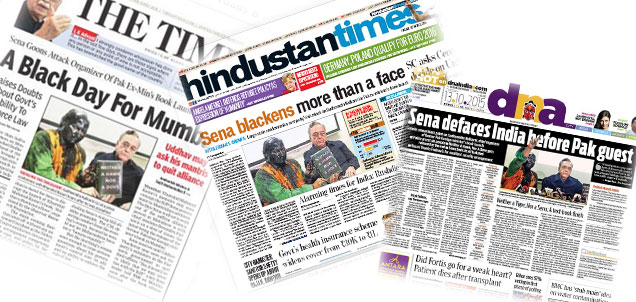
    The attack on Sudheendra Kulkarni, former speechwriter for LK Advani and member of the PMO under AB Vajpayee, has been the second event for the media to stand together. Here though the situation is more nuanced. Kulkarni was warned by the Shiv Sena not to hold an event to launch former Pakistan foreign minister Khurshid Kasuri’s book Neither a Hawk Nor a Dove at the Nehru Centre in Mumbai.


    The Shiv Sena has long had a tradition of objecting to and disrupting events which feature Pakistanis. There is nothing new in this. Only last week they got organisers to cancel a concert featuring Pakistani ghazal singer Ghulam Ali. Since Kulkarni and the Observer Research Foundation and Kulkarni decided to go ahead with the event, Shiv Sena activists acted in the way they know best: as hooligans.


    That the Shiv Sena is part of the BJP government in Maharashtra and an ally at the Centre is one more embarrassment which the media has been quick to pick up on. Condemnation however was universal, which is welcome.


    What the media may well come to realise – and I am not holding my breath here – is that its first role has to be to question the governments in power. Every time it has not done this, whether in the past or now, it has failed. The current government, it has to be understood, is no different from any other, regardless of the size of its mandate. When he became prime minister Rajiv Gandhi, who got the biggest mandate ever, soon realised that admiration can become criticism very quickly when large promises about changing the system vanish when the system hits back.


    Some of that is happening now and the media would be wise to wake up.


  • Ranjona Banerji: The reaction from the BJP to writers returning their awards has been weak and petulant

    By Ranjona Banerji


    The week on TV news in India has been nothing if not breathless and exciting. Okay. I concede. That sounds like any week on TV news in India. There is no TV news person in this wonderful nation who cannot make a simple nail found on the road into an international incident. Forget Shakespeare and Richard Whatever’s kingdom for a horse. We did it here first and we do it better.


    But this week, I am unfair. Barely had we recovered from the Shiv Sena defending our western border with Pakistan by assaulting Sudheendra Kulkarni’s face with black paint, than we jumped into the next attack of excitement. We had the prime minister express some little bits of sadness (dukkhojonok in Bengali sounds so terribly ponderous, as translated by Indian Express from an interview Narendra Modi gave to the Bengali newspaper Ananda Bazaar Patrika) about incidents like the Dadri murder and the cancellation of the Ghulam Ali concert, thanks again to the Shiv Sena’s Border Defence Force.


    These writers seem relentless in their movement against the shrinking space for dissent and keep giving away their awards. This has deeply upset the government so much that the Union Finance Minister Arun Jaitley took to Facebook to tell us that this was a dukkhojonok occurrence. However, he expressed more dukkho (sadness) for his own party and government than for what the writers are trying to convey. It is interesting that Facebook posts are now an established form of public expression, on the same level as an interview, an opinion piece or a blog. Some of us use Facebook to share cat videos with our friends and maybe “friends of friends”; others think of it as a public platform.


    On India Today TV, Karan Thapar held a compelling discussion on Jaitley’s comments on awards being returned, between writers Shashi Deshpande and Mridula Garg, actress and playwright Maya Krishna Rao, journalist Siddharth Vardarajan and journalist and BJP sympathiser Swapan Dasgupta. Deshpande and Garg have not returned their awards but are distressed by the assaults on writers and feel that dissent is being killed or squashed. Rao has returned her Sahitya Natak Award and made some powerful arguments debunking the accusation that she was politically motivated by pointing out that all art makes political statements.


    Vardarajan took issue with Dasgupta who defended the government and launched a side attack on everyone who is not in favour of the BJP’s way of majoritarian thinking. It is not a shrinking of space for dissent said Dasgupta but a truncating of an intellectual position. A fine piece of sophistry if there ever was one. Dasgupta even tried to separate writers like Nayantara Sahgal and Ashok Vajpayi from the other writers, implying that they were politically motivated and the others were just protesting. Deshpande put him right on that.


    Dasgupta then selectively quoted Deshpande’s letter of protest to the Sahitya Akademi, twisting her meaning, while she was sitting there. The purpose served by this deliberate attempt to lie which could so easily be debunked was not clear. It looked either like an attempt to demonstrate that you have reading skills or actually just like desperation.


    But it was Garg’s statement that she was disappointed in Jaitley who she had always considered one of the few intellects in the current dispensation that really upset Dasgupta. He took off on a diatribe on a class war being fought in the country and that ended the discussion. Perhaps Dasgupta was insulted that because he felt he was one of the main intellects in the BJP but apart from big words and coherent English, not much of intellect was on display. Quite tragic in fact.


    The BJP perhaps needs to find better spokespersons on TV who can put forward their position on such tricky issues. It was unfortunate that Thapar ended the show with Dasgupta.


    **


    Comic relief came from Times Now where Anand Narasimhan and guests ganged up on politicians who were defending the closing of dance bars in Mumbai. For a change, politicians were bleating weakly and everyone else was laughing or shouting at them.


  • Ranjona Banerji: Is every journalist asking probing questions anti-national?

    By Ranjona Banerji


    Ravish Kumar of NDTV, certainly one of India’s most brave and forthright television journalists, has given a visceral and honest interview to the website scroll.in on the state of the nation. He has discussed the Bihar elections, the rivers of hate running through India, the violence and the laziness of the Indian liberal. The liberal, all too often, he contends is comfortable in its fortress away from the hoi polloi, sometimes abroad, commentating from afar. Too many he feel even cosy up to the environment. Not enough speak out to stop the hatred and viciousness.


    But for this column and to my mind, it was Ravish Kumar’s comments on the media which are the most pertinent.


    This is what he says about the atmosphere today:

    “For decades, journalists have asked uncomfortable questions. They have either been answered with a smile or not at all. But it’s only recently that every journalist asking a probing question has been labelled as presstitute or anti-national. So let’s make a rule then, let journalists ask only good questions and print only nice answers – because it seems that is what the government wants.


    Many journalists who have slogged all their lives with a pittance as salary are being branded as traitors and dalals. While those who really have done such stuff are walking with their heads high. Why?”


    I would have liked to hear more of his views on the journalists who “are walking with their heads high”, as he puts it. Because these are the journalists who are giving a bad name to the rest. They are bigger opportunists than the “liberals” that he attacks, because journalists have signed a special covenant. To want to cosy up to the establishment is the death of journalism, no matter who the establishment is. This includes every award, every flat by special quota, every special invitation, every phone call that does not amount to a story. As journalists, our personal lives are precarious and everything can be fodder to the greater cause.


    It is those journalists who do not support the Hindutva cause who get the most public flak for being anti-national, “presstitutes”, “newstraders” and so on, all names used by the rightwing and sometimes important members of the Bharatiya Janata Party. Ravish Kumar reminds us that it is journalists who reported on all the scams of the UPA government, the same journalists who get called these names.


    But the problem runs deeper than that. Any media watcher (I do not mean rightwing websites like mediacrooks and so on which are clearly sponsored by an agenda) can see a disturbing shift in senior journalists, where criticism of the current dispensation is taken personally. This is not about journalists who are by inclination rightwing themselves. This is about those journalists who want to be part of the establishment to stoke their own sense of importance. The damage that they do to the media’s primary responsibility is incalculable.


    Veteran journalists who have become commentators and TV Talking Heads have limited leverage – even when (or especially when) they join a party like MJ Akbar or Minhaz Merchant. But there are many editors of publications, who are not TV regulars or columnists and therefore beyond public knowledge who wield huge powers and use them increasingly without responsibility. They also seem to carry an incredible pettiness within which reflects in their public comments.


    The situation is dire and even worse than Ravish Kumar’s interview points out. In 30 years, I have not seen journalists crawling like this when they have not even been asked to bend, to paraphrase LK Advani’s classic comment on the media during the Emergency. And I include the media division between the Rightwing and the Rest that happened during the Ramjanmabhoomi Movement in the late 1980s and early 1990s culminating in the demolition of the Babri Masjid.


    We live in bad times as far as the media in India is concerned.


    Ravish Kumar’s interview:

    http://scroll.in/article/762857/the-ravish-kumar-interview-our-lazy-liberal-class-was-always-opportunistic


    **


    Having said that, some better news. For over a year now I have criticised The Week That Wasn’t, the news satire show on CNN-IBN for going easy on the BJP and Narendra Modi. This was particularly evident in the run-up to the general elections and just after the government was sworn in.


    However, I now revise my view. The last episode of TWTW, where Kunal Vijaykar did a masterful impersonation of Modi giving an election speech in Bihar was once of the funniest I have ever seen!


    I salute you guys, too good!


    **


    And then another thought occurs to one: have the new owners of Network 18 changed their policy re: this government? Hmmm.


  • Ranjona Banerji: Did the North Indian media underplay a Hindutva activist’s death in Karnataka? (+ Winds of change @ CNN-IBN)

    By Ranjona Banerji


    There is some anguish going around in rightwing circles and among members of the media who see themselves as “true” liberals, that the murder of Bajrang Dal activist Prashant Poojary is being ignored in the mainstream media. Poojary was a flower-seller in Karnataka and an active anti-cow slaughter campaigner and activist. He was attacked, allegedly by six (or four?) men on motorcycles, as he and his uncle were setting up their flower shop on the morning of October 9. Some men have been arrested in connection with Poojary’s murder, all Muslims and action has been demanded by Hindutva rightwing organisations against an outfit called the PFI or Popular Front of India.


    I write all this but with almost no conviction of whether my facts are correct because the rightwing is, well, right: news on this murder has been thin on the ground in newspapers and television, especially papers which come out of North India. I have scraped through the internet and till last week, most references to the Poojary murder came from The Hindu and from assorted non-media websites.


    The “facts” are therefore all over the place. Was it four men or six? Have the police claimed the death was a suicide? Was the victim shot or beaten up? I was even more confused by one website which datelined the accident to one year ago: October 2014.


    Karnataka has clearly become a breeding ground for incidents of religion-based hatred of all kinds. Perhaps that in itself requires extra media scrutiny. But, apart from the media’s late arrival to this gruesome crime there is one more intriguing factor: The number of journalists who work in large mainstream organisations who took to social media to complain that the media was not covering this death and concentrating only on Mohammed Ikhlaq. The accusation, by these journalists, was that other journalists were not true liberals like them and only covered the death of Muslims but not Hindus. I repeat: these accusations were made not by members of Hindutva organisations who are legion on social media but by journalists, mainly from the print media, who hold important and responsible positions.


    There is a terrible irony at work here: most of the stories on Poojary’s death did not appear in the newspapers these journalists work for. If they felt so strongly about this murder, as they should have, what stopped them from carrying them in their own newspapers and journals? It is impossible for commentators like me, for instance, who do not work in newsrooms any more, to outrage about matters that are not given press coverage.


    Any Google search done up to a week ago showed the most consistent coverage in The Hindu. Yesterday’s print edition had a follow-up as well, even in the early edition which comes to Dehradun. But I spent some time in Gurgaon last week and saw nothing in the North Indian print editions of some major Indian newspapers.


    I would request these true liberal journalists to please provide their readers with a wider coverage of India before making accusations which only expose their own incompetence as media people.


    **


    Former chief of army staff and current Union minister of state for external affairs VK Singh once more demonstrated his remarkable knack for insensitive and insulting statements by comparing the burning of a Dalit family in his Lok Sabha constituency to persons throwing stones at dogs.


    His remark was rightly the subject of much discussion on television on Thursday night. However on many panels, several non-BJP invitees felt that the BJP spokesperson was being given more time than them. At first glance, this accusation appeared to be true. However, on closer analysis it just appeared as if the anchors were unable to control their guests.


    Of course, this is not new on Indian TV but surely even a public weaned on sensationalism is tired of trying to decipher what various screaming people are saying? I am now genuinely surprised that people with something to say actually agree to appear on these channels.


    **


    I end again with CNN-IBN where Zakka Jacob was an exception to the rule: he was tougher than most and did not allow the BJP spokesperson to run his show. There is a slight perceptible change in the way CNN-IBN presents news. Is it the elevation of Bhupendra Chaubey to executive editor or some other winds of change flowing from the new inductees to top editorial and management positions at Network 18.


  • Ranjona Banerji: Whiners gonna whine, but why the daft arguments?

    By Ranjona Banerji


    Most of my life in the media I have heard how opinion pieces are meaningless, no one reads edit pages, they are a waste of space which could be used to make money from advertising and so on. Marketing people plus journalists and editors with borderline writing skills would regularly produce data which showed that an edit page is read by two per cent of the newspaper readership. Some editors even got rid of the edit page when they were in charge of a newspaper.

    Now we have the piquant situation where the same editors and journalists have been putting their opinions out in the public domain and apparently, they love it. So the narrative changes when it suits their political perspective. Opinions, which no one reads, are now world- and life-changers and certainly influential when it comes to the Prime Minister of India, Narendra Modi.

    Apparently, Modi has not just walked into a trap set for him by evil, liberal English language journalists, all of whom live in the part of Delhi built by the British architect Edwin Lutyen, but his life is being affected by this trap. Actually I do not know if this is one trap or many or whether there is one EVIL LIBERAL ENGLISH LANGUAGE JOURNALIST IN LUTYENS DELHI who is manipulating Modi’s fortunes like Gogia Pasha did with the waters of India or whether there are many.

    Oddly though there are a large number of journalists and commentators who have been supporting Modi since he became the BJP’s prime ministerial candidate before the 2014 general elections. These worthies also write in English and many live in Delhi though I am not familiar enough with the national capital to know the architects who built their particular houses.

    Should we name some of them? Let’s see. Swapan Dasgupta and Chandan Mitra, also editor-owner of the Pioneer, have long been BJP faithfuls and are regulars on TV channels and in newspapers. They are the genuine old guard. Then there are those who jumped on to the bandwagon or joined the party later like Minhaz Merchant and MJ Akbar, both very well-respected names in Indian journalism. Veteran journalist Tavleen Singh, academic and author Meghnad Desai and economist Surjit Bhalla delight us with their ideas on who exactly is ruining Modi’s party every week in the Indian Express. Author and India’s most influential opinion-maker amongst the young, Chetan Bhagat, regularly offers advice to Modi, the BJP, women, Muslims, people in general. R Jagannathan, till recently editor of the influential English news and opinion website firstpost.com has been regularly telling Modi the five things he should do today and the ten things he must do tomorrow.

    These are just some of the brightest and biggest names in the Indian media and Indian public space who are avid supporters of Narendra Modi and/or also the BJP.

    This is from Jagannathan’s recent article in firstpost on Modi’s media strategy and the evil English media. (Disclaimer: I have worked with Jagannathan when he was editor of the business section of DNA and later when he was editor of DNA. The Daily News and Analysis was first a joint venture between Dainik Bhaskar and Zee and was later bought out by Zee.)

    “Modi’s communication strategy is simply not working. Making a rousing election speech is Bihar and speaking from the heart at a Mann ki Baat session are, of course, important, but they can achieve little when your rivals have a better strategy and, moreover, control the mainstream English media, with allies in the powerful international media, the Indian and international Left, and the Christian Right in the US.

    Let’s look at some media houses, whose flagship journals and channels are in English. Firstpost is owned by Mukesh Ambani’s Reliance and before that by Raghav Bahl’s Network 18. Dainik Bhaskar is owned by the Agarwal family of Bhopal. Zee is owned by Subhash Chandra. The Hindu is owned by the Kasturi family. Deccan Chronicle and Asian Age are owned by Ram Reddy. The Telegraph is owned by the Sarkars. The Hindustan Times is owned by the Birlas. The Times of India, by far India’s most powerful media group, is owned by the Jains.

    Which of these, I wonder, is allied with or controlled by the Kremlin, Karl Marx’s ghost and the Vatican or the Mormons.

    I have not mentioned the language media which is larger and more influential than any the entire English media regardless of whether language journalists live in homes designed by Lutyens or not. There is a fallacy that the language media is wholly in favour of the current prime minister and the BJP. Or that all journalists who write in languages other than English are cheerleaders for this dispensation. The argument of classism made by Swapan Dasgupta for instance is patronising in the extreme, implying that people who do not write in English cannot think for themselves or hold different and diverse viewpoints.

    Sadly, although I do not believe that no one reads edit pages or cares about opinions, I also do not believe that the media in India is strong or powerful enough to oust anyone from power. The people of India will decide and the people of India are intelligent enough to see through you, me and everyone. For all that Modi supporters in the media whine endlessly about how others in the media hate him and only support the Congress, remember that the Congress won only 44 seats in the 2014 general elections. The might of the Vatican and the US Bible belt and whoever else controls the Indian media was not enough.

    That might lead some of these worthies to realise how daft their arguments are but I doubt it. Like Taylor Swift could have sung, “Whiners gonna whine”.


  • Ranjona Banerji: Sad to see national biggies kill local dailies in Doon

    By Ranjona Banerji


    When my parents moved to Dehradun about 16 years ago, you got the “dak” or “first city” editions of whichever English newspapers bothered to even come here. All news therefore was about two days late and there was almost no local news to speak of. Dehradun was then still part of Uttar Pradesh, a small town below a famous hill station, filled with schools and retired people.


    There were a couple of local English newspapers. The oldest, The Himachal Times (no explanation why it has that name except according to members of the Pandhi family who own it, some family member liked the name), was in broadsheet format and barely written in English. Local news was as fascinating as “Car locked for three hours on Rajpur Road frightens residents”.


    People recommended Garhwal Post, a tabloid and certainly it had more local news, better English, opinion pieces, gardening advice, plenty of nostalgia and fascinating beauty and household tips. It also had the other thing which a newspaper needs to survive: local and retail advertising.


    Then the Times of India arrived with a local edition last year. It took time to build itself up, which surprised me as I have some small experience with increasing local coverage in more than one journal and also in a Times of India edition. The resident editor was a non-resident editor then but over time, coverage has drastically improved.


    The Tribune of Chandigarh also has an excellent Uttarakhand bureau which rarely misses a beat. The state of Uttarakhand is divided between the Garhwal and Kumaon regions and sometimes we are in a “never the twain shall meet” situation, given bad connectivity. But both TOI and Tribune cross that gap easily.

    However there is a tragic side to this. As these larger newspapers have grown and overtaken the local space, the area for local newspapers to thrive has shrunk drastically. The Garhwal Post has almost no local news now except updates of school events. It also has practically no advertising.

    There is a piquant situation here. The reader gets more news from the big papers but to have an established paper which served you over the years die as a result is sad. A bit like the corner shop versus the gigantic mall problem but in the current economy in India, the small shop is still surviving and even thriving. The small newspaper however may find it more difficult without money.

    Having said this, there are still some shortcomings in local coverage. The Times of India especially, which prides itself on its glamour quotient, has not yet got the knack of tapping into local “high society” for its Doon Times edition. And, not enough retail ads either.

    **

    As the political atmosphere heats up in the country, as it is doing, TV debates have become more hysterical. BJP spokespersons have become more strident which makes everyone else around them even louder and soon you will be able to hear them even when the TV is on mute. Still, you have to admire the talent of a political spokesperson (of any party) to keep talking very loudly while saying absolutely nothing. Do they practise?

    Having said that, TV anchors who can control their panellists reminds a fond and distant dream. On Thursday night, the anchor (not Nidhi Razdan who is sharp and firm) on Left, Right and Centre on NDTV did not even challenge a spokesperson for calling every writer, artist, filmmaker and scientist in India “juvenile”, nor did she allow anyone to defend themselves against this appalling name-calling.

  • Ranjona Banerji: Arun Shourie criticises the government on Karan Thapar’s show and the channel’s editors play it down on Twitter?

    By Ranjona Banerji


    So Arun Shourie, former editor, former minister in the AB Vajpayee government and now author and commentator, goes on Karan Thapar’s show on India Today TV again to discuss the Narendra Modi government. Shourie repeats what he said at a book launch last week and adds some extra garam masala to his criticism. The prime minister should stop acting like a section officer in the department of homeopathy and needs to be the moral leader of the country, he says. He also mentions that senior BJP leaders and ministers are frightened of writers and thinkers because they haven’t read a book in 20 years. He talks about how Nayantara Sahgal was an integral part of the movement which demanded action against those who participated in the anti-Sikh riots but her attackers have forgotten that.


    Indeed, Shourie, a former BJP member himself, criticised the government more effectively than any other commentator so far.
    http://indiatoday.intoday.in/video/pm-modi-has-failed-to-fulfill-his-moral-responsibility-arun-shourie/1/514331.html


    India Today TV has in it two of India’s most patriotic journalists. The senior one, Rahul Kanwal, is always on the lookout for evil liberal journalists who criticise the government and are not patriotic enough. On his very popular Twitter account he often puts out pithy bits of news, with no links and no evidence that his own channel or media group has covered the same news, and asks why there is no outrage about it.


    Most often, these bits of news are to do with attacks, physical, mental or emotional, on Hindus usually by Muslims or Christians or non BJP-governments.


    This is what Kanwal had to say on Twitter (at the time I wrote this at 10 am on the morning of November 3) about the Shourie interview carried on his own channel, in which he holds some important position:
    “Arun Shourie launches another attack on @PMOIndia Wonder what his responses to these questions would’ve been if he had been made a minister.”


    Perhaps Kanwal should have better briefed Thapar on the sort of interview to conduct. In fact, Thapar, a very thorough journalist and one of India’s best TV interviewers, did ask Shourie a similar question which Shourie dismissed very effectively.


    For some bizarre reason, I would have expected prominent members of the India Today TV team to have given this interview more publicity on social media, considering the channel itself was flogging it all day before the broadcast.


    India Today TV however walks the cleverest line of balance between being pro-government and critical of government of all the channels. Karan Thapar and the absolutely brilliant cartoon series So Sorry do the job of bringing down egos in government and opposition, daytime anchors like Shiv Aroor are balanced and Kanwal and Sawant operate in Uber Patriot Off With Your Head If You Criticise The Central Government mode. Rajdeep Sardesai these days dances on both side of the Line of Political Control.


    Of course, this is how a media house must be. It has to represent all points of view, even those that may make it unpopular with the ruling party rather than sucking up all the time. Perhaps some senior staff in the India Today TV newsroom need to look at journalism with a little more perspective.


    **


    Gangster Chhota Rajan, just arrested in Indonesia, was once part of Bombay’s famed Underworld. He was an important cog in Dawood Ibrahim’s gang but apparently quit after Ibrahim and Tiger Memon orchestrated the 1993 bomb blasts. However, he has been on the run from the authorities, once even jumping out of a hospital window to escape arrest.


    Sadly, today’s journalists who have no memory of the time when the underworld ran Bombay, have fallen hook line and sinker for the romanticism game played by Bollywood. Which itself sang, danced for the Underworld in real life and also acted in gangster-funded films.


    So Chhota Rajan is being treated like he is some sort of a film star by the media. Some even call him the “patriotic don” (Hindu) as if that gives him some claim on clemency.


    Distateful and frankly disgusting.


  • Ranjona Banerji: The media’s tizzy between the farce of exit polls, glorification of a gangster and a new wave of protests for a more tolerant India

    By Ranjona Banerji


    The media this week was in a tizzy over protests by creative people against intolerance, led by film star Shah Rukh Khan, the Bihar elections and the return to India of the “patriotic don” Chhota Rajan.


    Let’s take the least significant of the three first. Our “patriotic because he is Hindu and not Muslim” gangster Chhota Rajan. Make no mistake, he was an integral part of Dawood Ibrahim’s gang and also a big Mumbai gangland boss. He is not a returning hero, he is not a fine example of patriotism and he is not a fictional character from a Bollywood movie. He is a gangster. However, we have breathless reporters giving us his every move and Chhota Rajan milking every TV op in the craftiest manner possible.


    Once more I return to my old and now tired even to me theme: if only we had some journalists out there who were around when the Bombay Underworld ruled. Instead we have a bunch of ignorant editors and reporters romanticising a life of murder, extortion, smuggling, prostitution and worse. As a sign of the times, India’s newspaper with the best institutional memory, The Times of India, gave us a history of Bombay’s underworld by referencing the film industry and particularly Kamal Hasan’s Nayakan (1987) where he played Vardarajan Mudaliar, one of the city’s biggest ganglords. I would have also added Vidhu Vinod Chopra’s Parinda (1989) for its remarkable understatement and realism. The flip side is that our lack of contemporary history or our contempt for history in general (look at the reaction to the protests) means we have few other reference points especially for the internet generation.


    Then we have the Bihar elections, the run-up to which has been vicious and vitriolic. Last night on TV we had the regular and routine farce of exit polls. Whoever gets within 100 seats of being correct will claim victory. We will all agree that exit polls don’t work because people lie and then we return to them the next time round. Meanwhile, we have worked out every theory of win and loss to hedge our bets.


    Finally, there is the rising tide of creative people and academics speaking out against what they perceive as a corrosive atmosphere in the country today. Journalists have responded in interesting ways. Some have aligned with the protestors. Some have aligned with the government and played the idiotic and favourite “whataboutery” game of all politicians who are accused of something.


    And the most dangerous of all have sat on the fence, waiting it seems to see which side prevails. Almost no one, and I include myself here, has managed to be a dispassionate observer. Perhaps that will be a loss later: this is one of those clichéd wait and watch situations.


    **


    In a sweet display of intra-media love, both The Times of India and Economic Times picked up a story from Mint to carry in their editions. The credit in the websites is hard to find. The dateline just says “By Livemint” and below that the byline “By Shuchi Bansal”.


    Of course what is important is that the story itself talks about the importance of print and why even e-commerce companies have to depend on print advertising. Thus, win-win for Mint and TOI and Hindustan Times and so on.


    Mint interestingly is part of the Hindustan Times stable. And while Times of India and Hindustan Times are bitter rivals when it comes to readership surveys and circulation figures, they also share a “no-poaching pact”. This means that you cannot switch jobs from one to another without a six-month wait. But evidently, you can share stories.


    **


    I welcome the All India Bakchod (AIB) to Indian television with its political and social satire. Perhaps in some ways, this is a sign of an India growing up where some of us at least are willing and able to laugh at ourselves.


    The other good news is that Jon Stewart, recently retired from The Daily Show, will be back on air with HBO.


  • Ranjona Banerji: Results Day was #EpicFail for News Channels

    By Ranjona Banerji


    The morning of November 8, 2015 was one of the most extraordinary in the annals of television news. The event was results day for Bihar state elections. We had whipped ourselves into a frenzy during the whole month of voting. Exit polls, predictions, astrologers, the underground betting market, the Intelligence Bureau were all discussed threadbare on TV, print and social media. Pundits and journeymen all gave us their considered viewpoints or shrieked louder than the rest.


    The chatter began on November 8 just before 8 am. Most exit polls had predicted a win for the BJP, a few had gone with a close contest. By 8.30 am, all the English news channels and some language ones as well were predicting a massive win for BJP and friends. NDTV has long been the main channel for many to watch for election results, mainly because of Prannoy Roy, the man who introduced the word “psephelogy” or election forecasting to India and NDTV was clear with a BJP win.


    At 8.30 am, I went on the Election Commission website. It showed no results or trends or leads because it said that counting in Round 1 was not complete. Where were these channels getting their figures from? By now, Shekhar Gupta, one of India’s most experienced journalists, was pontificating on how the anti-incumbency factor had done Nitish Kumar, Bihar chief minister, in. Across channels, various BJP spokespersons were looking smug and happy.


    On Twitter, a completely different story was emerging. Figures from local reporters, from newspaper Twitter accounts (the Times of India was at complete odds with TimesNow here) and local news channels showed the Grand Alliance of Nitish Kumar, Lalu Yadav and the Congress well ahead and the BJP struggling to catch up. On India Today TV, political economist Surjit Bhalla, who had forecast a clear win for Nitish Kumar in his Indian Express column the week before (in spite of being a clear Narendra Modi supporter so far), told Rajdeep Sardesai to check his figures of a BJP win because social media and the Election Commission was saying something else altogether. Sardesai looked flummoxed.


    This story was repeated between 8 and 9 am on all channels. I went to the Election Commission website just after 9 am. It showed the BJP leading in 5 constituencies and the Grand Alliance or Mahagathbandhan in 12. Soon after CNN-IBN made the first course correction and changed its figures around. However, it was the same CNN-IBN which decided not to carry the exit poll it had commissioned after the last round of voting. This was because Axis had given a huge majority to the Grand Alliance and CNN-IBN felt that this result went against the journalistic work it had done on the field.


    NDTV sadly was the last English news channel to see the light and this has cost it considerable goodwill amongst its ardent followers who trusted it to be the most professional. NDTV has said that the information it got from Nielson was wrong and hence the errors.


    There are some basic journalism problems here though. The first votes that are counted are the postal ballots. These are usually not representative of voting trends on the ground. Why then did all these news channels extrapolate such massive victory margins from postal ballots? Some had given the BJP a lead of about 30 seats and had reached the 100 mark for the party when counting in Round 1 had not even been declared. When you consider that the BJP by itself ultimately got only 53 seats overall, it shows journalistic sense at its worst.


    It is also hard to understand why no one in those TV newsrooms had even opened the Election Commission website. Where were the reporters on the ground picking up information from the EC itself? It is the only counting authority. Why ask outside agencies for information that anyone with a smart phone could have accessed?


    This was about the worst display of journalism that I have seen in recent times, mainly because the basics were ignored and no checks were carried out. It is tragic how TV news makes these mistakes over and over again in its desperate race for be first at everything. People come to the media for information and opinion not Bollywood extravaganzas. Social media is now a better weathervane and predictor. Like TV threatened and wounded the print media, TV news is getting a bashing from social media. A seasoned journalist told me that he only followed the results on Twitter and got an excellent sense of what was going on.


    As they say in social media terms, TV was an “#EpicFail”.


    **


    And then we have exit polls. More often than not, they get it wrong. If one of six gets it right, that’s about the worst statistics of believability. That’s not an inexact science, that’s just wishing on the air. And then when one does get it right, the commissioning newsroom does not carry it. Go figure.


  • Ranjona Banerji: Can we be more circumspect please?

    By Ranjona Banerji


    No sooner had the terrible attack on Paris happened than the faultlines inherent in 24 hour news television exposed themselves. People barely had time to register what had happened, when the panel discussions started on the “why” and the “who”. Obviously the “who” and “why” are vital but the first focus has to be on “what”. Journalists and experts can surely hold their horses for a few hours as facts emerge before they start yelling at each other?


    There are other stories yet to be done, vital news to be covered. Like the facts on the ground, details of each site of attack, the extent of suffering and damage, the official and personal response to the attacks, the human stories are all waiting to be told. For the viewer to be faced with analysis on a dynamic situation is both confusing and unnecessary.


    Unfortunately, almost all 24 hour news channels, national and international, succumbed to the urge to try and solve the crime before the facts of the crime were fully known. Indian news channels had even less business starting with analysis than others given their thin presence in Paris but CNN and BBC World were no better.


    Sadly, it is 24 hour news television that has the edge of all forms of journalism in events like these because it is not static. Twitter can be faster with the news at it happens, but it is still static. You have to engage two steps further to get to a picture or a video and so also with newspaper or journal websites. TV is still our best way of getting news during an event like this. But if TV decides to limit itself to a studio pontificating with one or two experts and no one has a clue as to what’s actually going on, then everyone is short-changed.


    Given the debacle of the Bihar exit poll and election results just a few days ago, one expected TV news to be a bit more circumspect. But no such luck.


    **


    Of the discussions held in the evening of November 14 here in India, NDTV carried a sober, insightful and informative discussion with a range of experts on the Levant and ISIS and geopolitics, moderated by Sreenivasan Jain. Because there were no politicians present, the discussion stayed on course and the viewer came away with the feeling that he or she was better informed at the end of it. Such discussions are however extremely rare on Indian news television. The next day, we were back to the BJP and Congress yelling blue murder at each other, although neither party knew anything at all about the Paris attacks. Newspapers as even became the better bet for analysis, information, observation and expertise.


    **


    Just before these terrible attacks of course we in India were treated to quite another kind of journalism which has become all too common in India: the reporter as a cheerleader.


    There was a time when international trips by Indian prime ministers meant that he or she was accompanied by seasoned and experienced journalists. They reported on the talks held and deals struck and the strategic, national and international impact. With the Prime Minister of India, Narendra Modi, however we see young, callow and star-struck journalists who would be better suited to covering glamour and film events.


    The basis of Modi’s visit appeared to be, if you watched television, what Indian immigrants to the UK thought of him and why which singer was singing whatever song and the decorations at Wembley stadium, an extravaganza organised by Indian immigrants. Whatever other relevant and significant details there may have been about Modi’s visit to the UK were lost, ignored, deemed insignificant compared to what he ate with the queen of England.


    This included the massive protests against Modi in the United Kingdom. If it wasn’t for social media, you would have barely known that there were any.


    And when the Paris attacks happened, the rest of Modi’s trip was easily forgotten. Except for this remarkable story from PTI about where Modi’s official aeroplane was parked in Turkey. I have no further comment on this story except to say that we now need to start a new journal in India called “Parking News”.


    http://timesofindia.indiatimes.com/india/G20-Air-India-One-gets-parking-slot-near-Air-Force-One/articleshow/49791173.cms