Category: ADVERTISING

  • Takeaways from IRF 2012 (+Vdo)

    By A Correspondent


    The seventh edition of Indian Radio Forum (IRF) discussed quite a lot of issues on the strength and opportunities of radio, the road ahead for the medium, especially with FM Phase III expansion, how to maximize radio’s assets and how to gain share of market spend; the use of social media and monetizing it and much more. MxMIndia spoke to couple of industry veterans on their takeaways from the IRF 2012.


    Mr Premjeet Sodhi, COO, Lintas Media Group:

    One major takeaway with which I am going back is that while there are issues on how radio is performing commercially, there are certainly people who are passionate about the medium, and therefore, there are a lot of possibilities on how to do well on radio.


    The second major takeaway is the use of social media and radio, we had never thought of a subject as such. Radio has a lot of potential to work along with social media and be commercially successful as well.


    Third, I don’t think we are doing enough for radio, overall as an industry. There is, however, a lot of scope for improvement in this area.


    Mr B Surender, Senior Vice President, and National Sales Head, Red FM:

    I think the RAB (Radio Advertising Bureau) style of evangalising the medium is needed because UK’s RAB is so active in not only the developed markets like the UK, but it is also quite active in developing markets like South Africa.


    InIndia, probably, this kind of promotional activity is required for radio as a medium, because in India FM radio started very late and it did not get enough time before social media and the online or digital media arrived. Therefore, I believe there is a different need for a RAB kind of body which promotes radio.


    Mr Vinay Bhatia, Customer Care Associate and Senior Vice President – Marketing, Shoppers Stop:

    I think each industry within radio should develop its own tools, and this is really important in judging the input-output in efficacy because I am not chasing radio just for reach, OTS or number of impressions. Radio, as a channel, is a response medium and so it must deliver much beyond intermediary variables, it must deliver final business variables and I think radio can do that. However, it depends on how well a radio channel partners with a client, wherein the client is also willing to share some amount of data and information and a radio channel is also willing to partner it and jointly experimenting which works for all of us.


  • 63% Indian pros maintain a to-do list: LinkedIn

    By A Correspondent


    LinkedIn, the professional network with over 14 million members in India , released data about professionals and their daily to-do lists. The study examined how professionals in different industries tackle tasks planned for a given workday; the differences between men and women’s to-do list habits; and global insights on where professionals keep to-do lists and what gets in the way of completing them.


    LinkedIn surveyed more than 6,500 professionals globally and over 400 in India . The study revealed that among the countries in which the survey was conducted, India ranked sixth in maintaining to-do lists. Out of the India n professionals that were surveyed, 63 per cent reported that they frequently keep a to-do list. This matches the global average, as 63 per cent of all survey respondents reported that they frequently keep a to-do list. Globally, seventy-one per cent of women say they frequently keep to-do lists. Only 60 per cent of men say they frequently keep to-do lists.


    In India , 45 per cent of respondents said that they jot down their to-do lists by hand, while 48 per cent said they create them electronically. Globally however 50 per cent of those who jot down to-do lists do so by hand, while 45 per cent create them electronically. The remaining five per cent reported storing their lists in alternative places, like “In my mind only,” “Piles of files,” or other locations like whiteboards or chalkboards.


    The study showed that the likelihood that a professional will complete their to-do list varied by industry. Globally, professionals in agriculture claim to be the most productive, with 83 per cent of agriculture professionals stating they regularly fulfill most or all of their planned tasks. Professionals in the legal industry had the lowest completion rate on their daily plans, with 66 per cent of respondents accomplishing most or all tasks.


    Art industry professionals (40 per cent) agreed the most with this statement, “I tend to be distracted easily.” Agriculture industry professionals agreed the least with that statement; only 18 per cent of professionals in the agriculture industry are easily distracted.


    When it comes to checking the boxes on their to-do lists, only 11 per cent of professionals globally reported accomplishing all of the tasks they plan to do in a given workday. Survey respondents pointed to unplanned tasks (such as unscheduled phone calls, emails and meetings) as primary cause for not completing all items on their to-do lists. In India , 45 per cent of professionals reported splitting their workday equally between planned and unplanned tasks. At 38 per cent, India had the fourth-highest percentage of survey respondents who spent most of their day on planned tasks.


    “As professionals, we constantly attempt to plan our day at work in the most effective manner. While surprise phone calls, meetings and other unplanned tasks usually make it difficult to adhere to a to-do list, professionals can rely on the intelligence gathered on LinkedIn to work smarter,” said Hari V. Krishnan, Country Manager, LinkedIn India . “Individuals from every industry can benefit from LinkedIn’s simplified solutions to achieve work-goals while being time-efficient. Even while on the move, professionals can use LinkedIn’s mobile applications to strike off tasks from their to-do-lists.”


    Follow these “to-dos” to save time in your workday and cross more tasks off the list:


    1. Make meetings more efficient

    Check out meeting participants’ LinkedIn Profiles ahead of time to get a sense for what they bring to the table. Past experience and specific skills of your meeting cohorts could come in handy to creatively solve a problem — thereby keeping your meeting time to a minimum.


    2. Crowd source your challenge

    Use LinkedIn Answers and LinkedIn Groups to tap into the wisdom of your LinkedIn network or the rest of the 161 million LinkedIn members. By posing questions and starting discussions you’ll be able to assemble solutions in record time.


    3. Get up to speed in an instant

    Rather than visiting various news sources each morning, get your daily news fix in one place via LinkedIn Today. Customize LinkedIn Today so you get news that’s relevant to you and your clients. Access LinkedIn Today from your desk, iPad or phone by downloading LinkedIn Mobile.


  • Hippo’s ‘Indian Food League’ for cricket fans

    By A Correspondent


    The ‘Indian Food League’ is an online activity in which Hippo asks T-20 fans to support their regional teams by supporting their regional dishes. The campaign is conceptualised and implemented by Creativeland Asia.


    The campaign is a crowd-sourced activity that caters to the cricket fan’s love for snacking and eating, while they watch their teams fight it out. The IFL ultimately hopes to tap into every Indian’s latent desire to voice their humorous opinions. Talking cricket online has become engrained in every cricket lover’s match-day rituals. And by bringing food to this already heated and opinionated mix, Hippo has hit on a very successful recipe.


    Commenting on this engaging activity, Nadia Chauhan, Joint Managing Director and CMO Parle Agro said: “With so many people conversing on social sites, Hippo has created the Indian Food League as a medium to interact with and engage its consumers on the social media platform during the cricket season. Today, social media is one of the most influential and emerging channels of communication. Hippo’s previous campaign on Twitter to track inventory was a huge success. This further encouraged Parle Agro to engage interactively with its consumers on the same platform,” she added.


    Commenting on the campaign, Anu Joseph, Executive Creative Director, Creativeland Asia, said, “Hippo is constantly looking for opportunities to talk about food. He, in fact, looks at the world only in terms of hunger and food. So, a ‘Mumbai Vs Bangalore’ match for Hippo is a match between Pav Bhaji and Masala Dosa. So, whoever wins, at the end of the day, hunger loses.”


    The IFL comprises nine regional teams symbolized by the region’s most popular dishes, with Chennai being represented by ‘Idli Sambhar’, Mumbai by ‘Pav Bhaji’ and Delhi by ‘Papdi Chaat’. Other dishes include ‘Kanda Poha’, ‘Aloo Paratha’, ‘Daal Baati’, ‘Masala Dosa’, ‘Roshogolla’, ‘Dum Biryani’, representing the regions Pune, Punjab, Rajasthan, Bangalore, Kolkata and Hyderab adrespectively.


    The home of the activity is www.hippofighthunger.com/ifl, a microsite where Hippo puts up a ‘Today’s Special’ poster daily, giving his unique and quirky take on the day’s food match-up.


    Over the last 40 days, the activity has received a tremendous response. Hippo has chosen a winner for every match and most winners have been already sent their Hippo Bean Bags.


    This is not the first time Hippo and Creativeland are conducting a crowd-sourced campaign on social media. Last year’s inventory tracking campaign, Plan-T has already set a high benchmark for the brand. In fact, the launch of the activity became a trending topic on Twitter and other social networks, nationwide.


  • Lowe & Lifebuoy win India’s first Global Effie

    By A Correspondent


    Lowe Lintas and Partners India’s campaign for ‘Lifebuoy Super-Fast Handwash’ was declared the 2012 Global Effies Bronze winner at New York on Wednesday. Earlier this year, Global Effies had called for entries of globally effective campaigns across the world. Lifebuoy was shortlisted earlier in the month along with brands like Nike, Google and X- box.


    Said Saji Abraham, Global Planning Director, Lifebuoy and Virat Tandon, Global Business Director, Lifebuoy: “Lifebuoy Superfast Hand-wash is a liquid handwash formulation that kills 99.9% germs in 10 seconds. We responded to this fantastic innovation with a simple but insightful and persuasive idea – that children are in a hurry when it comes to hand-washing; and so if your handwash cannot keep pace with them, germs on their hands will just not go. This campaign won because we were bold, competitive and consumer focused at the same time.”


    Joseph George, CEO, Lowe Lintas and Partners, said: “As an agency, we take the Effies seriously. And so winning, not just the Lowe & Partners Worldwide Network’s but also India’s first ever Global Effies is hugely satisfying and encouraging.”


    See also:

    http://www.effie.org/winners/showcase/category/43 Grand Effie winners

    http://www.effie.org/winners/showcase/2012/6695 Information on Lifebuoy ad and credits

    http://www.effie.org/winners/showcase/2012/6695 The Lifebuoy presentation


  • Anil Thakraney: MMS for Prez! Puhleez!

    By Anil Thakraney


    I implore all the political parties to do at least one good deed for the nation. Please send Dr Manmohan Singh to the Rashtrapati Bhavan, with all the accompanying pomp and gaiety. The man needs to retire ASAP, and what better old age home than the grandiose Bhavan?


    No, I am not suggesting this because MMS needs to be rewarded, but because the gentleman needs to be immediately ejected from the Prime Minister’s office. Don’t think anyone, not even Ms Rabri Devi, can do worse than him. Everyone adores MMS because he’s reputed to be a ‘nice guy’ and an ‘honest man’. Is this qualification enough to run such a huge, complicated, scandal-infested country? Would you hire a CEO based only on this yardstick? Heck, would you marry your daughter to a man based on this qualification alone?


    Let’s examine Mr Nice Guy’s scintillating resume. The nuclear deal, over which he staked his job and promised truckloads of energy and dosh to the nation, is all forgotten. The proposal of FDI in multi-brand retail was quickly scuttled at the first shout from the opposition leaders in the Parliament. The PM’s allowed his retro finance mantri to come up with that hare-brained scheme called Retrospective Tax, which has made global investors become very wary of India. The mother of all scams, the famed 2G scam, happened right under the watchful eye of Dr Singh. And the man keeps getting blackmailed by his allies, and is unable to deal with them. Worse, it’s hard to imagine MMS ran the RBI once, and brought economic reforms to India. Today, he has no idea how to stop the rupee from sliding down the hill, and petrol prices have been increasing as regularly as sixes get hit in the IPL. And these are just some of Mr Nice Guy’s achievements.


    No, we simply cannot afford to have this incompetent man hang around for another two years in office. The nation can deal with only so many failures. Time to move on, Sir. Please start lobbying for the post of President. You are a nice, honest, good man, so no one will mind supporting your candidature. Not even if you later get busy collecting frequent flyer miles, a la Ms Pratibha Patil.


    Please move on! It’s been rather nice knowing you.


    * * *


    PS: Must read for all creative people. Some powerful advice on how to keep the fires burning, and not let life’s set backs (petrol prices!) come in the way of creativity. It’s applicable to creators in all walks of life.


    Link: http://www.brainpickings.org/index.php/2012/05/22/neil-gaiman-commencement-address/


  • Prateek Chandra appointed CFO @ Fever FM

    By A Correspondent


    Prateek Chandra has been appointed as CFO, Fever 104 FM. Mr Chandra has spent more than 4 years with HT Media and in his last role as Senior Financial Strategist, he has been instrumental in adding value on various strategic initiatives and successfully driving several projects including IPO of HMVL. Mr Chandra will be replacing Ritesh Handa who, after 18 months of tenure as CFO, Fever, has decided to move on to pursue other opportunities.


    Prior to joining HT, Mr Chandra had spent almost 6 years with KPMG and EXL handling different aspects of Finance function. In his new role, Mr Chandra will report to Harshad Jain, Business Head, Radio with a functional reporting to Piyush Gupta, Group CFO. He will be a part of the Leadership Team of Radio Business, and have end-to-end responsibility of finance and related operational aspects of Radio business.


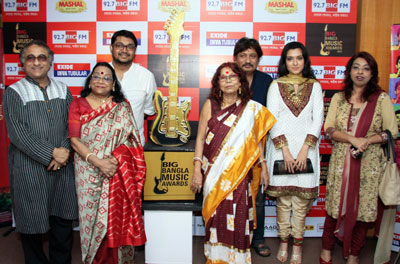
  • BIG Bangla Music Awards 2012 unveils jury and awards list

    From the MxMInfodesk


    Reliance Broadcast Network Limited’s BIG Live and its radio arm 92.7 BIG FM announced the jury for the BIG Bangla Music Awards 2012 which include veteran singers Nirmala Misra and Banasree Sengupta, music director Kalyan Sen Barat, music arranger Rocket Mondol, Programming Head of Dhoom Music Channel, Srijit Halder and acclaimed Actor Arpita Chatterjee.


    The lineup this year will have 16 Trophies and a Lifetime Achievement Award. 14 popular categories will be nominated by the jury and decided by listeners through a multi media voting campaign. The balance awards will be conferred by the jury directly.


    Apart from celebrating the resurgence of Bangla music and recognizing the best work of 2011, a key initiative will be to highlight the message of anti-piracy to music lovers and build awareness to stop the menace. This effort is being supported by the government of India recognized- Indian Performing Rights Society (IPRS) as well as leading production houses.


    A special anti piracy theme song is being composed by leading rocker and Cactus frontman Siddhartha Shankar Ray which will be sung for the live on the stage during BIG Bangla Music Awards. The resurgence of popular Bangla music and its huge impact on Tollywood is best exemplified by the works and rise of the phenomena called Jeet Gannguli. It is with this in mind that 92.7 BIG FM has chosen him to be the Face of the Award 2012. The Award is being supported by Exide Invatubular  and Mashal Mustard Oil.


    The news and content published in reports crediting MxMInfodesk are mostly unverified and based on press releases and communiques sent by organizations and/or individuals either directly or through their PR agents.

    However, not all press releases and requests are carried, and we take care to ensure that at least the source of the information recent is authentic.

    Requests for carrying communiques and intimations must be addressed to editor@mxmindia.com.


  • Chris Gayle to endorse Mallya’s Cariba Rum

    By Anshul Dhamija & Boby Kurian


    Swashbuckling cricketer Chris Gayle has extended ties with Vijay Mallya’s United Spirits as the latter tries to spin a Caribbean rum story off the cricket pitch. The big hitting Jamaican, and arguably the most valuable player in Mr Mallya’s Indian Premier League (IPL) team, has signed an endorsement deal for the company’s latest brand, Cariba Rum.


    This is the first major standalone deal for Gayle, the highest run scorer in the current IPL season, on the Indian brand endorsement pitch. The move is probably part of Mr Mallya’s multi-million dollar strategy to retain Chris Gayle, who has been eyed by rival teams. Mr Mallya’s Bangalore team bought Gayle for $560,000 just before last season and managed to retain him in the fifth edition this year.


    While Gayle’s IPL price remains the same, his overall package, including endorsement fee, may touch the maximum $2 million for an individual player in the T20 league. United Spirits, which also owns the Bengaluru team, didn’t disclose the endorsement fee but said the contract was for “more than one year”.


    Outside cricket, USL’s move to use Gayle to build a Caribbean rum brand is part of the company’s premiumization strategy aimed at checking the rapid advance of MNC rivals. Prestige and premium brands will contribute almost 60% of the company’s profits in the current fiscal, up from just under 10% in 2005.


    Mr Mallya, who had Caribbean business interests when he owned Berger Paints, is rolling out Cariba with a blend imported from the islands where rum was first distilled more than 300 years ago. Gayle, who embodies the Caribbean free spirit, may help United Spirits to develop a rum story closer to the original home. Cariba rum aims to tap the upgrading rum drinkers in a market where most brands in the flavour category (barring exceptions like Bacardi) are regular and economy priced.


    “Gayle is the best fit as brand ambassador for a rum brand. Dark, brooding, and hard-hitting – all these facets make for great rum,” said brand consultant Harish Bijoor. “However, sportsmen and alcoholic beverages have always been a question mark in the minds of people. But then, Mr Mallya knows the cricket story,” he added.


    Source:The Economic Times

    Copyright © 2012, Bennett, Coleman & Co. Ltd. All Rights Reserved


    Photograph: Fotocorp


  • Wieden+Kennedy wins Levi’s India account

    By Neha Dewan


    After staying with JWT for nine years, denim brand Levi’s is moving its India advertising account to Wieden + Kennedy (W+K), as a part of a global realignment plan to have a single creative agency. W+K will operate as a full-service creative partner, responsible for all future campaigns. JWT had been the agency on record since 2003.


    “It is important that consumers receive a singular point of view across markets,” said Vishal Bhalla, director (marketing), Levi’s. In line with its core ‘youthful’ spirit, the brand plans to reach out to its core target group of 18-34 years. “We will continue to have a significant dialogue with consumers through digital and other mediums. Our aim is to target the youth with innovation being at the heart of all our campaigns,” he added.


    Last year, for the first time, consumers experienced the first global campaign by Levi’s in India-Go Forth. The campaign by W+K appeared in 24 countries and communicated bringing about a positive change in the world. The digital engagement plan recognised people around the globe who were coming forward to transform the world.


    However, continuing its relationship with US jeans maker Levi Strauss & Co, JWT will handle work on the dENiZEN brand in India, which is a part of the same group. dENiZEN is managed globally by JWT.


    Colvyn J Harris, CEO, JWT India, said: “The parting of ways has been due to the global realignment. But our partnership of nine years has yielded some great work, including the Levi’s Stick figure campaign at Cannes and the recent Curve ID campaign for women among others.”


    Source: The Economic Times
    Copyright © 2012, Bennett, Coleman & Co. Ltd. All Rights Reserved


  • Airtel forays into m-advtg, expects 40% growth

    By A Correspondent


    Bharti Airtel recently announced its strategic foray into the mobile advertising (m-advertising) segment in India. With this, Airtel will equip advertisers to connect with their potential customers in a targeted and personalized fashion via their mobile phones. The platform is designed to meet all the essential demands of advertisers such as inventory management, campaign management, reporting and analytics. As has been reported by MxMIndia in the past, Airtel has mandated Mogae Digital, a company owned co-owned by Sandeep & Tanya Goyal, former JV partners of Dentsu in India & the Middle East, to be its sole and exclusive monetization partner.


    Commenting on the development, K Srinivas, President – Consumer Business, Bharti Airtel, said: “We are excited to launch our mobile advertising platform. Personalization, sharp segmentation and contextualization are increasingly making this platform an exciting proposition for brands. With the mobile advertising market poised to grow by more than 40 per cent over the next few years, Airtel with its technology, scale and customer intelligence is placed uniquely to leverage this growing medium. Airtel’s m-advertising platform will enable advertisers to land their message in a simple, effective manner in an increasingly complex media environment.”


    Through Airtel’s m-Advertising platform, advertisers will be able to leverage multiple communications outlets and tools such as mobile internet (WAP), Messaging services and Airtel digital TV to engage their audiences. With this platform, companies can also extend their access to the rural audience with voice solutions.


  • Tata Sky gears up for digitization with new ads

    By A Correspondent


    “Drop cable, upgrade to Tata Sky,” reads the latest ad of the direct-to-home (DTH) service provider, as the cut-throat rivalry between DTH players and cable operators intensifies in the countdown to the first phase of compulsory digitisation in the top four metros by June 30.


    “Your TV will continue to run on your inverter even during a power cut…isn’t this a reason enough to choose Tata Sky over cable,” said another advertisement, as the DTH major unleashes its third phase of print and out-of-home (OOH) ad blitzkrieg to lure millions of cable users in the top four cities to its services.


    Vikram Mehra, Chief Marketing Officer of Tata Sky, said the campaign is directed at educating consumers so that they can make an informed choice. “Our latest print campaign tells subscribers to do their homework before they buy a set-top box (STB) so that they chose Tata Sky and not just some dabba (box),” said Mehra. It’s not targeting any cable operator, he added.


    With over 9 million subscribers, Tata Sky is the second-largest DTH service provider in the country, after Dish TV.


    Last December, Lok Sabha passed the Cable Television Networks (Regulation)

    Amendment Bill, 2011, which makes it compulsory for cable companies to convert their analogue system to digital in a phased manner from June 2012.


    Consequently, in the first phase of digitisation, India’s top four metros – Delhi, Mumbai, Chennai and Kolkata – will have to replace all analog television networks with digital transmission from July 1, 2012.


    This means that all cable subscribers would need to get digital STBs in order to ensure that their TVs don’t go blank. By March next year, as many as 38 cities across the country would be brought into the digital fold.


    While phase 1 has around 10 million TV homes in the four metros, over 90 million analogue cable TV homes are estimated to convert to digital by the end of fourth phase in December 2014.


    Stakes are indeed high for DTH players who have a ready, captive base of millions of analogue cable TV customers, who just need to install a digital set top box in their homes.


    “DTH is expected to grow at a healthy CAGR of 20 per cent for the next 5-7 years,” said Abhishek Chauhan, Senior Consultant, ICT Practice, Frost & Sullivan, South Asia & Middle East. DTH contribution would increase to more than 30 per cent to overall the pay TV market, reducing the cable providers’ contribution to less than 65 per cent, he says. While the number of DTH households in the country is set to go up from 37 million in 2011 to 86 million by 2016, digital cable would see its subscriber base jump from a mere 6 million to 75 million, according to a recent FICCI-KPMG report.


    The number of cable and satellite (C&S) households is estimated to reach approximately 176 million by 2016, of which paid C&S households is estimated at 168 million, representing 89 per cent of total TV households. In 2011,146 million households in India had television sets; 119 million of which used cable or satellite services, says the report.


    While Tata Sky has been relentless in its campaign against cable, Dish TV has a different strategy. “Direct attack on cable operators is a short-lived approach,” said Salil Kapoor, Chief Operating Officer, Dish TV. Differentiated offerings and emotional connect with users is a sustainable strategy, he added. Dish TV has, in fact, tied up with neighbourhood operators to push its own set-top boxes and install connections.


    Meanwhile, Tata Sky has been running a campaign to shed its premium image and spread awareness about the impending digitisation and the value-added services that it offers.


    Perceptions on pricing in multiple television households, vacation time charges, relocation charges and prices about offerings are some of the issues that ‘Poochne mein kya jaata hain’ campaign started to address since last September. Created by O&M, the commercials urge consumers to ask while underlining the range of offerings.


    “Poochne mein kya jaata hai campaign was our way of telling customers that it’s possible to get a world-class service at an affordable price,” said Mr Mehra of Tata Sky. The latest campaign in this series informs one about the affordability of DTH services.


    Sonu & Cookie (characters from the last campaign), try to find items which are cheaper than Tata Sky. But every time they bring one to the shop, the shopkeeper surprises them by informing them that Tata Sky’s package is even cheaper.


    ‘Get the quality of DTH at the price of cable,’ says a print commercial of Den Networks, one of the largest multi-system operators having presence in a number of states, just a few months back. And a subsequent radio ad raised the pitch by mocking at DTH players – ‘DTH stands for Don’t Try at Home.’


    Tata Sky was quick to come up with a tit-for-tat print advertisement – “World-class digital box or any other dabba. What will you choose?”


    “Den has been the first cable TV MSO in India to launch a nationwide brand campaign, created by Bates,” said a Den Networks spokesperson, adding that different players will experiment with different types of messages and campaigns to attract subscribers.


    Digital cable has some inherent advantages such as weather-proof services that are not interrupted by rain, service through the local cable operator who is known to the household for years and is just a phone call away, to address any technical or service queries, the spokesperson says.


    While such kinds of advertisements may be attention-grabbing tactics, they also help consumers in making a better choice, say advertising and brand experts.


    “These are attention-grabbing tactics as consumers are in the process of making up their minds,” said Jehil Thakkar, Head, Media and Entertainment, KPMG. While now there is an opportunity for DTH players to acquire analogue subscribers from cable, the latter would obviously try its best to keep users under its fold, he added.


    Most advertising that we see around are intra-category fights, driven on the shoulders of brands such as Pepsi vs Coke, Rin vs Surf, Bajaj vs Hero. However, it’s the category versus category fight, for example GSM Vs CDMA, which is the game changer, say brand experts.


    In a fight like this, end consumers stand to gain, said Prathap Suthan, Chief Creative Officer of Bang in the Middle, an independent ad agency. “And this is exactly what is expected when it gets into a category versus category fight.”


    Tata Sky is clearly and visibly a better constructed and sustained brand among DTH players, feels Suthan. “When you stand for a category, and you represent a category (just as Tata Sky has done), other brands will look small or will be made to look small.”


    The other DTH brands, it seems, have sort of abdicated the position of category leadership to Tata Sky, he added.


    Source: The Economic Times
    Copyright © 2012, Bennett, Coleman & Co. Ltd. All Rights Reserved

     

  • Anil Thakraney: The party-pooping media

    By Anil Thakraney


    Newspapers and TV channels have been flooded with pictures of those ‘caught’ at the recent Juhu (Mumbai) ‘rave’ party bust. (We still don’t know if it really was a rave bash, but that’s not the focus of my article.) All these guys and gals desperately trying to conceal their faces in shame. Or, as I believe, because of the fear of being seen by their families and pals in such a tight situation. And each time I watch these images, I get terrified. No, I don’t get invited to many la-di-dah parties (sadly, haha!), and yet that lingering fear… that it could have been me out there.


    Imagine going out with friends to a party and being suddenly accosted by cops just because a few buggers had decided to top up their noses. And being treated brusquely all night, and made to go through unhygienic tests at municipal hospitals. It’s a nightmarish feeling. Still, when you look at it rationally, you have to quietly accept that drugs were found at the venue, and so the cops had to do their duty. So far, so bad.


    But does it surprise you how the media lands up at such busts in full force? It shouldn’t. Obviously, the cops, who want to project themselves as some sort of heroes, invite chosen reporters and cameramen to tag along. And thus more than a crime battle, this turns into a media spectacle. Leading to more stress and agony for the party goers.


    This makes me wonder. Should we in the media broadcast and publish pictures of youngsters cowering with fear and hiding their faces? Is this ethical? Is it not possible that most of them are innocent party goers? Do they deserve to be put under such harsh spotlight? One more issue for all of us in the media to introspect upon. Of course, the reporters have to join in when the cops invite them. Of course, they need to cover the bust. But because, at the time, they don’t know who’s guilty and who’s not, is it correct to put out pictures of the people trapped out there?


    My own view is such pictures must never be made public. And only after the police investigation is done, only after the culprits get booked, must we go public with images. That would be fair. Having said that, I know this practice isn’t going to stop anytime soon. Who cares if some drunk revelers are seen squirming? Who gives a rat’s ass if they are seen being treated like trapped animals? The editor wants pictures, you see. Else, he/she will say there’s no story out here. He/She will kick me out of the newsroom.


    Let’s do some self regulation, people. Before it comes in from outside.


    * * *


    PS: Brilliant ad by Prada. It’s directed by Roman Polanski and features acclaimed actor Ben Kingsley. This is the way to expand market share, I say!