Category: ADVERTISING

  • Narayana Health Kolkata launches campaign

    Narayana Health – Kolkata is celebrating over two decades of healthcare service in West Bengal and on this occasion, the hospital has launched a comprehensive 360-degree campaign titled ‘Taking Care of Bengal for Over 2 Decades’.

    Said Dr Ashish Bajaj, Chief Marketing Officer at Narayana Health: “The ‘Taking Care of Bengal for over 2 Decades’ campaign encapsulates the essence of Narayana Health’s enduring presence in the region. Through a 360-degree approach, the campaign seeks to highlight the institution’s role as more than just a healthcare provider but as a companion in the journey of life. Whether it’s nurturing the health of every book lover, supporting the aspiration of every sports lover, or managing the sweet tooth of every mishti lover with the right medical advice, Narayana Health – Kolkata has been a constant presence, offering care and support at every step.”

  • GroupM elevates Ashwin Padmanabhan

    Ashwin Padmanabhan
    Ashwin Padmanabhan

    GroupM, WPP’s media investment group, has announces the elevation of Ashwin Padmanabhan as Chief Operating Officer for South Asia. He will continue to be based out of Gurugram and report to Prasanth Kumar, CEO – GroupM South Asia.

    Padmanabhan will now oversee a streamlined structure that brings together GroupM’s extensive and diversified key practices. This includes Influencer Marketing, Content, OOH offering and Nexus. Investments, Trading, Partnerships, Motion and Entertainment will continue to be part of his portfolio. Ashwin’s strategic vision will play a pivotal role in seamlessly integrating GroupM’s diversified services, to develop and deliver a best-in-class solution that unlocks value for clients and GroupM.

    Said Prasanth Kumar, CEO – GroupM South Asia: “Ashwin’s deep understanding of client requirements and industry ecosystems and his proven track record ensures a seamless alliance across respective domains. He will continue to drive synergies across multiple practices emphasizing simplicity and consolidation to consistently deliver outstanding client work.”

  • GroupM appoints Praseed Prasad as Chief Growth Officer

    Praseed Prasad
    Praseed Prasad

    GroupM India has announced the appointment of Praseed Prasad as Chief Growth Officer. In its newly created role, Prasad will lead GroupM’s growth, marketing and communications.


    In a homecoming of sorts, Prasad has held key roles within GroupM, including heading digital trading and overseeing digital investments for all GroupM clients. , returning back to GroupM, brings a wealth of experience to this position. This is prior to joining IceCream Labs in 2015. Earlier he has had stints at Flipkart, where he ran the Ad Agency Business and led Media and Partnerships, as well as at Google, where he managed Media Operations for EMEA markets and later ran the Google APAC Agency and Partner business.


    Said Prasanth Kumar, CEO – GroupM South Asia: “It is great to have Praseed back to GroupM as Chief Growth Officer. His extensive experience in understanding client needs, strategic initiatives, industry knowledge, and cross-functional collaboration positions will help us enhance our market growth. His track record underscores his ability to navigate complex ecosystems and deliver results. We anticipate that his leadership will directly benefit our clients and the brands we work with, driving innovation and enhancing performance.”


    Added Prasad: “I am delighted to return to GroupM where I grew during the early days of my career and spent more than a decade setting up new business units and functions. I look forward to strengthening opportunities for our clients and brands that will allow me to apply my experiences to help grow the GroupM business onwards and upwards. Am excited to collaborate with all the agency teams to help drive our clients’ business impact and deliver them exceptional growth.”


    Praseed will be based out of GroupM’s Bengaluru office and report into Prasanth Kumar.

  • Can India be an MaI and AdI Powerhouse?

    Can India be an MaI and AdI Powerhouse?

    Ashoke AgarrwalThe world awaits the paradigm-shifting potential of Machine Intelligence (MI) and Advertising Intelligence (AI).

    MI and AI are foundational technologies like electricity that need to be deployed for specific purposes to generate economic and social value.

    The competition is fierce, with established corporations and countless start-ups worldwide vying for a piece of the MI and AI pie. With its unique strengths, India can make a significant mark in this arena.

    This column briefly explores India’s opportunity and potential to be a leader in applying MI and AI to marketing and advertising—a field I term as MaI and AdI.

    The first requirement for MaI and AdI is the accumulation of relevant data, including public-facing data like syndicated market, media, and consumer data compilations and research and, to the extent possible, private data on sales, consumer profiles, and research with brand owners from across the world.

    Developed on this data, MaI and AdI engines can offer a brand owner the following based on deep and evolving consumer insight:

    • Fine-tuned and dynamic marketing mix plans that maximize ROI
    • Messaging templates that turbo-charge the marketing mix
    • Product enhancement and development ideas

    Can India become a global leader in this game?

    Yes, if we move fast and move-wise.

    The first step would be to test and perfect new modes of collecting consumer data.

    The internet, the smartphone, MI, and AI promise a new age of syndicated consumer research. Currently, syndicated consumer research sits in silos. Sales numbers are compiled through retail audits. With retail worldwide increasingly dominated by e-commerce and big-box retail, retail audits largely fail as market share indicators simply because e-commerce and big-box retailers treat sales data as a valuable resource and loathe sharing it with third parties.

    Conventional media research needs to be improved. The increasingly dominant digital powerhouses like Alphabet and Meta think of audience data as the engine central to their business, and they have it at a level of granularity that no conventional research technique can match.

    As OTT platforms like Netflix and e-commerce giants like Amazon muscle into advertising, they will keep their audience data close and be equally impenetrable to conventional research.

    Media research focused on traditional mass media has a utility and funding problem. As a hangover from the halcyon days of advertising agencies when they fed at the 15% trough, brands wanted the agencies to fund media research and who, in turn, twisted the arms of media houses to share the costs. Audience research for traditional media thus came to be split into silos – press, TV and even radio, OOH and cinema – had research funded and controlled by narrowly focused bodies.

    As the percentage of marketing communication budgets allocated to traditional media continues to shrink brand, mass media owners and media agencies are finding it hard to continue funding research and the brand managers who are increasingly used to the clarity of performance marketing and pay-per-click contracts, wonder whether bland broad-brush data of who watched what is adds any edge to their marketing data.

    The third data dimension is brand lift. Marketing is going down the AIDA funnel – from awareness to consideration set to intention to purchase, with the final sale, satisfaction, brand loyalty and advocacy culminating in the process. Currently, very little syndicated consumer research is available in this area. The big brands invest in privately funded research to track this dimension, with others adopting a set-of-the-pants approach to this crucial aspect.

    The answer to the challenges above is developing a technology-led process in which the consumer is the direct and single source for all three data dimensions—brand lift, 360-degree media exposure, and purchase. The two critical issues to be resolved are compliance, incentives, and data privacy regulations. The answer lies in innovation in technology, including LLMs and contractual relationships. In the spirit of full disclosure, my partners and I are experimenting with one such system in collaboration with a UK-based company.

    A critical element differentiating successful brands is a nuanced understanding of what works and what does not in advertising and other marketing communication for a particular product category, geography and consumer segment. Ogilvy, in its heydays, used to generate multimedia Magic Lanterns for product categories of interest that laid out, with examples, the dos and donts when creating advertising for a particular category. These Magic Lanterns were assiduously produced by a cell of PhDs running factor analysis on advertising from across the world and some measure of the efficacy of each ad.

    The single source data envisaged above will produce multidimensional efficacy data for campaigns across categories, markets and segments. A state-of-the-art AdI engine could be developed that uses Deep Learning to pinpoint what works and what doesn’t.

    While MaI and AdI will be the first generation of AI in marketing, the third generation will likely result in AI avatars of brands.

    Parallelly as the Siris and the Alexas of the world will, over decades, morph into Concierge Intelligences (CI) that will become AI avatars of individuals. I have written about the idea of CIs in an earlier MxMIndia column. In the age of AI, marketing and marketing communication will evolve to primarily be an interaction between the AI avatars of brands and the AI avatars of consumers.

    In the near future, the single source would meld with the client’s private data, providing a never-before-used base for effective marketing planning.

    There is scope for more than one Indian player to make India the single-source powerhouse of the world for the following reasons:

    • India has the technology nous in the high quality, low-cost quadrant.
    • India is an evolved B2C and B2B market that can support the development of single-source-research-based MaI and AdI systems.

    Since the single-source system will be digital, India can market its fully developed MaI and AdI systems worldwide.

    Single-source data coupled with MaI and AdI are the future of marketing and advertising, and India, on its way to Viksit Bharat, can own it.

  • SoCheers wins digital mandate for Asus India

    SoCheers, the digital-first creative agency, has won the digital mandate of Taiwanese multinational electronics giant, Asus for its Indian business. The account was won following a multi-agency pitch and the account will be handled from the agency’s Mumbai office.

    Talking about their partnership with SoCheers, Paramjeet Singh Mehta, Head of Marketing, Asus India said, ”We are on the verge of making some new additions and developments to our existing portfolio & believe that a lot of value can be built through our digital touchpoints. The vision for the brand that we have & what SoCheers is envisioning syncs well and we are delighted to partner with SoCheers and embark on our digital growth journey”.

    Added Siddharth Devnani, Co-Founder & Director, SoCheers said, “As a global leader in innovative technology, Asus is at the top of their game with their cutting-edge expertise, setting them a class apart in the ever-evolving tech landscape. We are ecstatic to partner with Asus and together, we look forward to creating impactful campaigns that strike the right chords, win attention and propel the brand to the next level”.

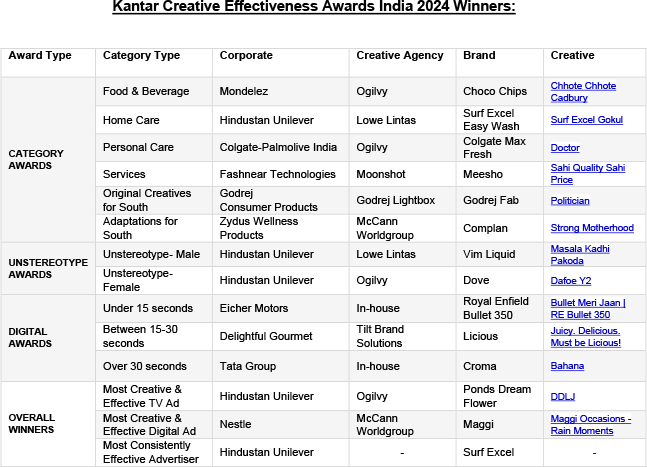
  • HUL stars in Kantar Creative Effectiveness Awards India

    HUL stars in Kantar Creative Effectiveness Awards India

    Kantar, the leading marketing data and analytics company, unveiled the ads that were most effective and creative across India in 2023.  The company tested more than 12,000 creatives for its clients around the world in 2023. Over 11% (1,400+) of those creatives were tested in India. Today,


    In the awards, consumers are the jury. The India report shortlists close to 300 ads, tested across categories, markets, TG’s and media channels.


    The winners list has doubled from last year, with Kantar awarding 10 standout performers in the television ads category and 4 in the digital ads category.


    Television categories include Food & Beverage, Home Care, Personal Care, Services and Unstereotype. New categories introduced include ‘Original Creatives for South’, ‘Adaptations for South’, Most Creative & Effective TV Ad (overall) and Most Consistently Effective Advertiser. Creatives for Digital continue to grow this year as well, with Kantar awarding standout performers in 4 categories- 3 based on ‘Ad Length’ format and one for the Most Creative & Effective Digital Ad, for bringing to life the exciting storytelling possibilities in the digital world.


    All ads exemplify essential characteristics of being creatively engaging and landing persuasive stories that enhance brand sales, notes a communique.


    Commenting on this year’s findings, Soumya Mohanty, Managing Director & Chief Client Officer- South Asia, Insights Division, Kantar said: “Earlier this year, Kantar launched the Blueprint for Brand Growth– a breakthrough understanding of how businesses build strong & profitable brands. One of the growth accelerators for building strong brands is to pre-dispose more people. Great advertising builds pre-disposition and loads the dice in favour of the brands. Creative content can and should punch above its weight”.


    Added Prasanna Kumar, Head of Creative Domain & Executive Vice President- South Asia, Insights Division, Kantar: “Truly creative ads are the ones that are effective. The journey from being just creative to being effective starts by including your key stakeholders – your target consumers, into the process by pre-testing your ads. This year we have seen some original creative ideas shine through by ensuring that they have brand and consumer at their heart.”


    Key highlights from this year’s report: 

    1. Learnings from Kantar’s Blueprint for Brand Growth indicate that great advertising is rocket-fuel for building predisposition: growing meaningfully different brands in a more effective and efficient way. Creative quality, second only to brand size, greatly influences campaign profitability, with double the impact that reach does on brand salience.


    1. Kantar research emphasizes that ads must persuade and convey messages that are novel, credible, relevant, and different to enhance short-term sales. But high-quality ads, which leave a lasting impression, generally perform well in both short-term sales and long-term brand-building (Kantar LINK database), thus reducing the need to spend money on performance marketing.


    1. Beyond brand recognition, generating a strong emotional response is key, because emotion helps build strong memory structures, and most advertising effects are not immediate. Emotion plays a critical role in effective creative- and not just in TV content. 


    Ad learnings from 2023: 

    1. Make purpose personal: 65% of Indians will buy brands that stand for something they can identify with. While purpose or value led creatives open possibilities for highly emotively engaging creatives, the effective ones execute it in a manner such that it becomes personal to the consumers.


    1. License to surprise: Consumers are open to original creative ideas- ones that are hyper creative or break existing category codes. The reward for the brand lies in the ability to integrate the persuasive and meaningful impressions into the creative idea. Pre-testing helps identify the possible risks of comprehension and resonance.


    1. Going Native: Only 28% Indians (vs Global average 75%) have watched any ‘foreign’ content. Over 25 years of Kantar Link™ ad evaluation reveal a striking truth- ad transference across Indian regions is just about a third. This challenges the assumption that a single pan-India creative approach, even with universal and validated consumer insight, will yield positive returns on objectives. Brands are now refreshingly taking on the challenge and opportunity of engaging the Southern consumers differently from Hindi-speaking markets. Investing in original creatives, by going native on multiple dimensions- insights, creative idea & treatment and execution ensures maximizing of reward for the brand.


    1. Go deep & wide: The most efficient route to optimize budgets for creating ads that effectively crossover the transference challenge across the many India’s, is to create regional adaptions by playing with backdrop, celebrity, casting, product window visualization, slogan etc. Go deep and wide is about taking a campaign pan India by starting with a pan India insight, creative idea & treatment but execute with some nativity elements to amplify the resonance with the regional markets. Pre-testing helps to identify whether the mix of insight, story & elements work together as intended and identify opportunities for improvement.


    1. Embed the Brand: The value of creativity starts with the brand. While executional elements like distinctive brand assets and consistency in advertising style are undeniable aids in ensuring that the brand takes credit for the impressions left behind by the creative, it’s potential is amplified when the brand is integral to the story.

    **In our top quartile ads compared to the bottom quartile ads, we observed more consistency (+49%), greater use of established branding devices (+14%), and the inclusion of related music (+26%).


    1. Weave in the product story: Executions that can creatively integrate the specific competitive reasons to consider the brand into the narrative tend to be impactful. The role of creativity is thus not just to entertain but also leave behind vivid impressions that make the brand more meaningful to the consumers.


    1. Specific learnings for the digital landscape: 
    1. Precision targeting is officially giving way to mass media avatar of Digital and there’s an increasing recognition of the importance of brand marketing on digital platforms. Creative Quality getting increasingly critical for ensuring ROI for digital- could unlock 35%+ incremental sales per impression.
    2. Effective content on TV does not automatically mean success in digital – Ads that perform well in TV have only a ~50% chance of performing well in digital.
    3. Emotional resonance significantly enhances digital advertising’s impact on brand building. Ads that evoke stronger emotions are 3x more likely to drive long-term brand equity and 2.75x more likely to generate impact compared to those with weaker emotional connections.


  • Fantasy cricket apps & brand-building- A lesson for advertising agencies?

    Fantasy cricket apps & brand-building- A lesson for advertising agencies?

    With apologies to none at all

    Vikas MehtaBy Vikas Mehta

    My last column titled ‘Why are we building products and not brands’ seemed to have sparked off many reactions. Some raw, I dare say. The questions ranged from differentiation to personality to digital. But one question stood out. I was asked if all new age brands are just products? Is there anyone building a brand?

    The answer was not difficult, but I will take the liberty of using this column to explain how a brand is being built by a new age product. Disclaimer first: I have nothing to do with the brand except I know the founder of the communication company which is spearheading the brand-building exercise. This is totally an outsider’s perspective.

    I am talking about Dream 11.

    Not many know that the brand was launched in 2008. The fantasy cricket app which is what they are all about today was launched in 2012 and by 2014 they had a million registered users. This figure rose to around 45 million around 2018, just when serious brand-building efforts started and today, the figure stands at around 150 million. I am deliberately starting with numbers because this is a brand which has been successful by all standards.

    The brand started advertising during the Indian Premier League (IPL) around 2018 or so. It had a simple positioning. The cricketers, who play for India, back Dream 11. It was decidedly an endorsement but an endorsement done with a positioning, personality and differentiation in mind.

    First, they aligned with the best Indian cricketers. Dhoni, Rohit, Pant, Bumrah, Hardik, Ashwin, Dhawan. Dhoni dropped out after a season or two but the core has remained the same. One of the first campaigns I remember was using Dhoni which was about khelo dimaag se. Dhoni was always an astute cricketer and the brand used his personality to show that it was a game of skill and not luck. This was required at the time because Indian laws did not allow any game which could be seen as betting or lottery. So khelo dimaag se, worked for the brand in more ways than one.

    And then the brand took off. It decided that its personality needs to be light fun, cricket humour, and showing the human face of the Indian cricketers.

    The positioning evolved into snippets of Indian street cricket as portrayed by star Indian cricketers. It was not too focused, neither too narrow. It did not get bogged down by a consistent tagline. I am not saying that consistent tagline is bad but the positioning is not just what the brand says in a tagline. Positioning is what the consumer stores in his mind. A tagline is static, positioning needs to evolve. Not change but evolve. Dream 11 did it brilliantly.

    Yeh apna game hai

    Yeh main kar leta hoon tum Dream 11 pe team banao

    Dream big. Dream 11

    Sab khelenge

    Team se bada kuch nahin.

    And each one of these taglines had a story. An emotion.

    Weaved into the game as played by Indians everyday. Using the Indian stars.

    Remember, pehle main batting karoonga kyonki bat mera hai, leaving Rohit stumped. Yeh apna game hai. Watch here

    Or the film stars like Amir challenging the cricketers who are acting in ads.  Sab khelenge. Watch here.

    Pant’s dream of becoming a singer or Bumrah acting as a romatic hero. Dream Big. Watch here.

    Or even magnifying the role of seemingly insignificant people. Ashwin’s soup wallah. Or the groundsman who prepared pitches for Rohi. Allowing them to Dream big. Watch here.

    And Sharmaji ka beta. Team se bada kuch nahin. Watch here.

    The brand owned cricket. And how.

    For IPL, it focused on team or club rivalry which overtook national rivalry. So even cricketers from other nationalities were used. Even family members. Sunil Shetty for example.

    For World Cups there was collectiveness, national pride. Ek se dikhoge toh best kheloge. The Mummyjee ad.

    This was brand building at its best.

    Dominate cricket. Own cricket. Emotionally own the category.

    And they did many other things too. If one searches for Dream 11 on YouTube there are many videos made by the brand which are not brand-building but which support brand-building. Stories of ordinary people who won big. Videos of how easy it is to play the app. Videos made by influencers on why winning is so easy. Or videos on how Dream 11 employees have grown…… Watch here

    And you know what. The competition too did all these. My circle 11. MPL. They too have such videos. They have big offers. Rs one crore prize everyday. An SUV to win everyday. They too talk about the big winners. They too have influencers in you tube videos. They have also used some Indian stars like Shubhman, Rinku, even Sourav Ganguli in the past.

    But what they don’t have is a brand.

    That is distinct.

    That differentiates. Emotionally.

    That dominates the category.

    Chances are that if you want to play fantasy cricket you will first download Dream 11.

    Because you remember it.

    Because you connect with it.

    Because it seems to dominate cricket.

    In a category where big prize matters.

    Where spends are high

    And where quantitative parameters are easy to judge by.

    So how much you spend where, gets immediate results or not can be the sole criteria to judge success.

    In such a category, Dream 11 has built a differentiating, preferred and leadership brand.

    So, should we still focus on products?

    And ignore brand-building?

    In my mind that is the role of advertising agencies.

    Build brands.

    That is the focus which the agencies have lost.

    And that is why they are struggling.

    Agencies need to start reemphasizing the need to build a brand.

    Do not tell me that clients do not want it.

    Do agencies explain it to them?

    Do the agencies explain what the brand idea is?

    How it can be differentiating and can be sustained long term.

    The agencies are trying to do what the clients want.

    Not what the brands need.

    Agencies need to create a niche.

    And they will find it is much beyond a niche.

    Do you agree?
     

  • Abhijat Bharadwaj is CCO, Isobar

    Abhijat Bharadwaj
    Abhijat Bharadwaj

    Dentsu Creative India has announced the appointment of Abhijat Bharadwaj as Chief Creative Officer (CCO) of Dentsu Creative Isobar.

    Co-reporting to Amit Wadhwa, CEO, Dentsu Creative India and Sahil Shah, President, Dentsu Creative Isobar, Bharadwaj will work very closely with the leadership team to drive the agency’s creative agenda forward. He will focus on further strengthening the creative prowess and the exceptional talent pool that Dentsu Creative Isobar has built over the years working with many iconic Indian and global brands.

    Commenting on his appointment, Wadhwa said: “Abhijat is not just an exceptional creative talent but a visionary leader for this new age. His passion for excellence in both work and team building will set new industry standards. Alongside our formidable team of creative leaders, we are confident that Abhijat will propel us to new heights of success and recognition.”

    Added Shah: “Abhijat’s entry unlocks a new level of growth for us. In today’s day and age, brands need a creative agency that solves problems, regardless of platforms or mediums, because that’s how non-linear and multi-platform the consumer is. And in this new era, I believe we have a phenomenal talent pool, with strong creative capabilities and the right culture to be in the pole position. With Abhijat leading our creative from the top, I am certain we are now a team to beat.”

  • Havas Media Network wins Muthoot FinCorp mandate

    Muthoot FinCorp, a Non-Banking Financial Services Company (NBFC), has appointed Havas Media Network India to manage its integrated media mandate. Havas Media’s Bengaluru operations will drive the media duties of the brand across OOH, digital platforms, television, print, and on-ground activations.

    Said Shaji Varghese, CEO of Muthoot FinCorp Limited: “We have partnered with Havas Media Network India due to their strategic expertise and understanding of our vision to revolutionize financial accessibility for all. Our collaboration is said expected to propel our commitment to innovate and enhance customer experiences while reinforcing our position as one of the leading players in India’s financial services sector.”

    Commenting on the win, Mohit Joshi, CEO, Havas Media Network India, added: “Havas Media Network India’s South operations has been consistently expanding, establishing it as a vibrant hub for partnering with leading brands and we are now delighted to join hands with Muthoot FinCorp – a prominent brand across India. We understand the critical role of the financial services sector in driving economic resilience and empowerment. Additionally, Muthoot Fincorp’s commitment to integrity and customer-centricity aligns seamlessly with our values designed on the philosophy of meaningful solutions in everything we do. Together, we strive to shape a future where financial empowerment and innovation go hand in hand.”

  • Ad Club Bangalore Launches ‘LogoJam’

    The Ad Club Bangalore has launched LogoJam, a logo revamp challenge event designed to crowdsource a fresh, vibrant brand identity. Designers from across India are invited to craft a new brand identity that reflects The Ad Club’s commitment to “creativity, community, and the cutting-edge future of advertising”. The contest will run from July 8 to 19, 2024 and the winner will receive a monetary reward of INR 50,000.

    “We are in the process of re-visioning the role of Advertising Club Bangalore and our aim with LogoJam is to be collaborative and inclusive in our approach to set the new identity of Ad Club Bangalore,” said Laeeq Ali, President of The Ad Club Bangalore. “The new identity should symbolize Ad Club Bangalore’s core values of innovation, collaboration, leadership, and excellence. It will capture the spirit and future-forward approach of this community-focused, non-profit organisation. From events like the Inspiration Room series to a vibrant member network, the club is committed to fostering a thriving community of advertising professionals,”

    Winners of the “LogoJam” challenge will not only receive a monetary reward of INR 50,000 but will also gain significant exposure through a publication feature in The Ad Club platforms, offering unparalleled recognition and potential future collaborations with The Ad Club and its members.

    “As Ad Club Bangalore evolves, we believe our visual identity too should evolve. I am excited to lead this initiative to find the new identity that will be a beacon of our commitment to lead the advertising industry into a new era,” added Nigel Mathew, a member of the executive committee.

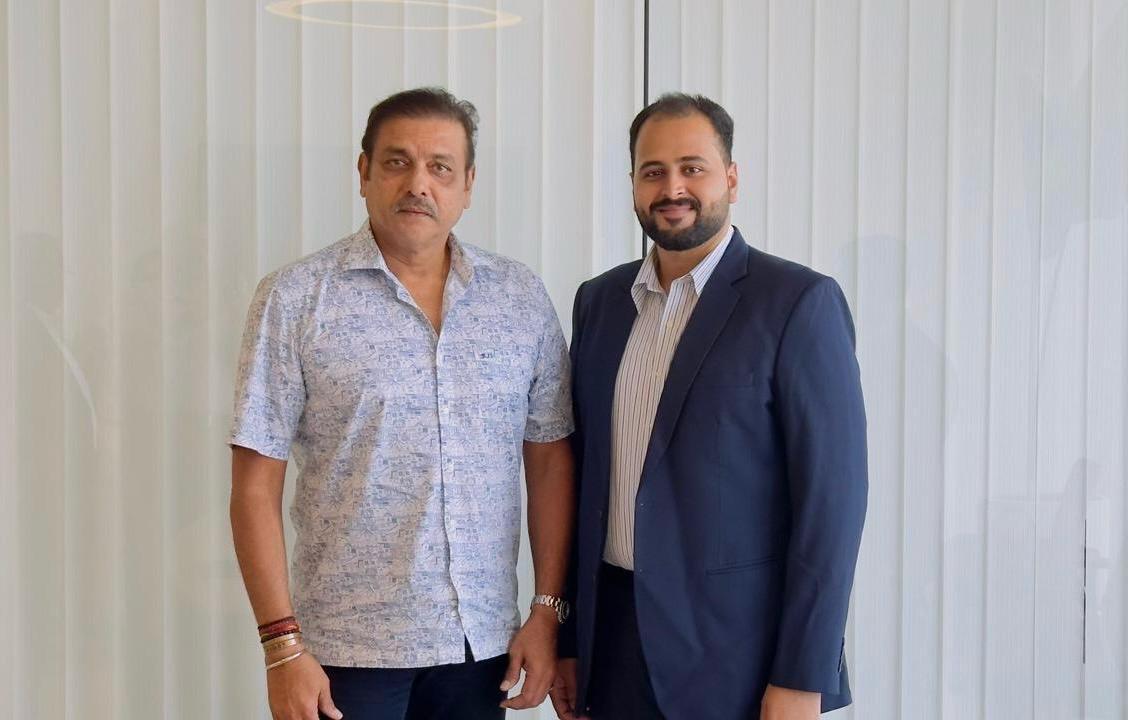
  • Ravi Shastri joins Petzzco as Principal Advisor & Brand Ambassador

    Petzzco, the pet care service provider, has named former cricketer and commentator Ravi Shastri as its principal advisor and brand ambassador.

    Commenting on the association, Raj Kantak, Founder, Petzzco, said: “Pet-lovers often have a strong bond with their pets and look for guidance and recommendations from people they admire. Since Ravi Shastri is an avid pet-lover himself, he can connect with Petzzco’s target audience on an emotional level. Having Ravi Shastri as a brand ambassador can significantly increase Petzzco’s brand awareness. His association with the company will generate positive media attention and public interest.”

  • B. Ramanathan returns to Ogilvy

    B. Ramanathan
    B. Ramanathan

    B Ramanathan is back at Ogilvy India from Ogilvy Asia Pacific. Ramanathan will be joining the agency network as Chief Client Officer.

    Over a 29-year career, Ramanathan donned many hats. His stint in Ogilvy is now in its 24th year, 16 of which have been spent in various business and office leadership roles across markets in Ogilvy India.

    Prior to his move to Ogilvy India, Ramanathan’s last role was as the Chief Marketing Officer of Ogilvy Asia and the Global Brand Leader – Mondelez, based out of Kuala Lumpur.  He had also been instrumental in driving the growth and transformation agenda for Ogilvy Indonesia as it’s Group CEO.

    Said VR Rajesh, Group CEO, Ogilvy India: “Ogilvy India’s growth has been on the back of client centricity and depth of engagement and Ram’s return adds fillip to this core strength. He will focus on our top clients in bringing to bear the best of Ogilvy’s capabilities, driving transformation and growth of the businesses. He will be an important shot in the arm as Ogilvy India continues its journey of creative excellence.”

    Added Ramanathan: “It feels great to be back at the mothership, especially at a time when it is going through a purple patch. With the repertoire of marquee clients, I look forward to partnering with our fantastic teams across markets in delivering transformative work and growth for the businesses.”