Dentsu Creative celebrates the achievement of Devansh Chaudhary, Associate Creative Director – Copy, and Rohit Sharma, Art Director, who have won the Kyoorius Young Blood Award 2024 for their work ‘Cali: The Indian Denim Thread’. The winners will be honoured with the Red Elephant – an award that recognises excellence and innovation among young professionals under 28 years of age.
The challenge, presented by brief partner Myntra, was to reimagine the timeless denim with an Indian twist and create a narrative that reflects the rich and diverse culture of India, with a contemporary appeal.Under the guidance of Manzoor Alam – Executive Creative Director, Dentsu Creative India, the duo created the winning proposition.
Amit Wadhwa
Speaking on the win, Amit Wadhwa, CEO, Dentsu Creative India said: “We are extremely proud of Devansh and Rohit, who have shown exceptional talent and originality in their work. They have not only met the challenge but also exceeded our expectations by creating a product that is both functional and meaningful. This recognition reinforces our belief in nurturing and empowering creative minds to make a lasting impact on the industry.”
Santoor, the Wipro Consumer Care and Lighting flagship brand, has unveiled a new TVC for its lime soap.
Said S Prasanna Rai, Chief Marketing Officer (CMO), Wipro Consumer Care & Lighting: “We have relaunched Santoor Lime soap with a great new fragrance. In an in-use consumer research we have found that this new Santoor Lime soap has been loved by 9 out of 10 freshness soap users due to its better bath sensorials. This TVC embodies the same essence of Santoor Lime soap which delivers a refreshing bathing experience lifting the mood.”
Wondrlab has appointed Ritika Malhotra as Head of Digital, further strengthening its leadership team. Malhotra’s last stint was at FCB Kinnect as VP – West, where she was responsible for the P&L for their largest region and leading solutioning for the brands managed from the region.
Sanju Menon
On the appointment, Sanju Menon, Chief Operating Officer, Wondrlab said: “We are thrilled to welcome Ritika to the Wondrlab Network. Her impressive track record, forward-thinking approach and leadership skills make her the perfect fit to lead our platform first thinking. Her key focus areas would be to create phenomenal value for our existing clients and shape the digital practice of Wondrlab to set new benchmarks. Her addition strengthens our team’s capabilities and reinforces our dedication to pushing boundaries in the digital landscape by unleashing and delivering full-funnel solutions for our partners.”
Omnicom Media Group has appoints Rita Verma as the organisation’s new Chief Talent Officer. She succeeds Anju Kurien – who has retired from her position after 13 years of service, during which she was instrumental in accelerating OMG’s strategic footprint in the market.
In her role, Verma is tasked with solidifying OMG India’s people-centric ethos, championing the group’s vision, and nurturing future-ready teams to advance the growth trajectory.
Speaking of the appointment, Kartik Sharma, Group CEO – Omnicom Media Group India, said: “Talent is our defining edge when it comes to propelling our collective success and that of our clients. With Rita steering our talent practice, we look forward to fortifying our commitment to our people-centric approach and driving transformations to progress further on our future-fit agenda.”
Dentsu has entered a strategic partnership with Ripplr, a leader in digital-first distribution and logistics companies, driving customised strategies that fuel client growth.
Narayan Devanathan
Under the joint leadership of Narayan Devanathan, President & Chief Strategy Officer, South Asia at Dentsu, and Abhishek Nehru and Santosh Dabke, Co-Founders of Ripplr, this collaboration will leverage the expertise of each party to deliver client-led solutions that bridge the gap between demand and supply chains.
Commenting on the alliance, Devanathan said: “Ripplr stands out as the unparalleled digital-first leader in distribution and logistics solutions, facilitating the most efficient movement of products from factory to retail. Moreover, when it comes to motivating consumers to engage with products across various channels—be it offline, online, or omnichannel—nobody does it better than dentsu. With our comprehensive suite of solutions at the intersection of marketing, technology, and consulting, this alliance will enable businesses to pinpoint the sweet spot between demand and supply, creatively and effectively bridging gaps across the entire value chain.”
Abhishek Nehru
Added Nehru: “Ripplr is one of the largest FMCG authorised distribution companies, and our platform services more than one lakh retailers across 10+ cities. We have built a robust tech-enabled playbook for all FMCG brands, along with smart data analytics, helping brands to scale up in the ever-changing omnichannel market. With dentsu as a partner, which is a powerhouse of research, analysis, and strategy, and Ripplr’s execution and reach capability, the combined synergy will enable us to launch and scale brands faster and more efficiently across multiple geographies.”
Harsha Razdan
Said Harsha Razdan, CEO South Asia, Dentsu said: “In today’s dynamic business landscape, where time is of the essence, we understand the urgency of responding swiftly to client needs. We firmly believe that complementary solutions are paramount to not only meeting these demands but also overcoming challenges and fostering sustainable growth. Our partnership with Ripplr marks a significant milestone in our journey. By joining forces, we are empowered to offer a comprehensive spectrum of distribution and customer-facing solutions that cater to the evolving needs of our clients. This collaboration enables us to provide unparalleled value and innovation, ensuring that our clients remain ahead of the curve in an ever-changing market landscape.”
FCB India, part of the FCB Group agencies, has appointed Mayuresh Dubhashi as the new Chief Creative Officer (CCO).
Mayuresh brings a wealth of experience to his new role as Chief Creative Officer, with over twenty years in the advertising industry working on some of the biggest brands in the country from The Times of India, Airtel, Pepsi Co, P&G, Oreo, Flipkart, Amazon etc. He’s been at the forefront of combining new-age technologies with classic storytelling in his work which includes designing the Indian Cricket Team’s jersey for MPL using data as well as turning an Oreo cookie into an A.I tool to express oneself.
As the new Chief Creative Officer, Mayuresh will be at the forefront of FCB India’s creative efforts, partnering closely with FCB India’s CEO Ashima Mehra. His role extends beyond FCB India, as he will also be a key member of FCB Group India’s creative leadership, collaborating with leaders across agencies to continue to elevate the work across the network.
In the marketing services arena, the outdoor media business is known to have reported questionable trade practices and governance in the past. Things may have improved much over the last decade-odd with international players and networked agencies entering the fray, but what happened in Mumbai on Monday was a shocker. Or perhaps not. Given reports of trees being poisoned trees to ensure visibility of a billboard.
It’s all over the news media: a hoarding in Mumbai has caused the death of 14 people, and there are 74 who have been rescued from the spot where the hoarding crashed. Updates on this are still coming.
We are basing our reports on what has appeared in multiple newspapers.
Here’s what Mumbai’s Free Press Journal has reported:
The death toll after a big hoarding collapsed in Maharashtra’s Ghatkopar area has risen to 14 on Tuesday. According to the National Disaster Rescue Force, 74 people have been rescued alive from the spot, while 14 have been declared dead.
The count of total victims stands at 88. National Disaster Response Force (NDRF) has been conducting rescue operation for those trapped since Monday evening, when the incident happened due to heavy rains and strong winds.
The incident is said to have happened at 5pm on Monday.
Meanwhile, another report in FPJ notes:
“… an FIR was registered at Pant Nagar police station against Bhavesh Bhinde, owner of the hoarding (Ego Media Company) under section 304 (culpable homicide not amounting to murder) among other sections of the Indian Penal Code. A case under section 304 (culpable homicide not amounting to murder), 338 (causing grievous hurt by act endangering personal safety of others), 337 (causes hurt to any person by doing any act so rashly or negligently as to endanger human life) and 34 (common intention) of the Indian Penal Code was filed against Bhavesh Bhinde by Mumbai Police.”
As per the FPJ, it had first reported about this illegal hoarding last Friday. “The Pant Nagar police, who were conducting the investigations on who poisoned the trees on the land owned by the Government Railway Police, said they have received complaint in the name of the company which owns the hoarding and now will proceed with the investigation,” a report adds. “As of now (Monday evening) we are in the rescue operation of over (expected) to be around 100 plus people, trapped under the hoarding that fell. Immediately after, along with the BMC, a new FIR will be registered in the matter and stringent action will be taken against the offenders under relevant sections,” an official said. He added, “If the company who owns the hoarding is the same as the ones who poisoned the trees, a supplementary FIR shall be registered.”
According to a report in The Times of India, the hoarding size was a problem. It was illegal. “Not only was the hoarding illegal, but it was also far bigger (120×120 sqft) than the maximum size (40×40 sq ft) allowed by the civic body.”
Now if you see a hoarding that’s illegal, why allow it to be there in the first place? Demolish it instantly. Yes, what happened on Monday — ‘Acts of God’, as they are called, happen once in a blue moon, but it’s not just enough to damn the hoarding firm. The civic authorities and all those who are responsible must also be booked.
It’s also important for the various industry associations – the Advertising Agencies Association of India and the Indian Society of Advertisers chief among them to be vigilant. The Ego Media website boasts of some discerning corporates as its clients. It’s time they also crack the whip.
Praful Akali, Managing Director and Founder, Medulla and Ashish Khazanchi, Founder and Chief Creative Officer, Enormous, have joined as Jury Chairs for Health category and Still Print category respectively, at The Abby Awards 2024.
The Abby Awards powered by One Show will be held on May 29, 30 and 31 as part of Goafest 2024 which is being held in Mumbai this year.
Inventech, the tech and content vertical of Laqshya Media Group, is presenting an animated content piece designed to commemorate ‘Loktantra ka Tyohar’ (The Festival of Democracy). Specifically tailored for Gen Z and first-time voters, this creation aims to infuse the youth with the spirit of democratic participation and celebration.
Said Sommnath Sengupta, CEO of Inventech: “The concept behind this animated content is to celebrate the essence of democracy and voting, especially for the younger generation who are experiencing this festival for the first time.”
The Ghatkopar billboard incident that killed many and injured many more has raised many ethical questions about the advertising and media business.
For many unknown reasons, the outdoor media business has always been known to be of a low moral standard and has once again brought up important questions of ethics in the advertising and media business.
It is well known that the outdoor business is often part of the intricate web of questionable transactions. Which means if you are an owner of a hoarding in Mumbai, by definition you need to be turn a blind eye to the law.
If one goes to the Ego Media website what is shocking is to see all the best brands in the country – from Godrej, Tata, Audi, Honda, Britannia, Big Bazaar, Titan and many more.
Are we saying that some of the best brand names in the country don’t care where their advertising goes and would like to in any way be associated with a company who has shown to have a complete lack of morals and ethics in the business? I know many advertisers and equally their advertising agencies think that a hoarding is something remote in their outdoor plan. Beside the top-ranking client wanting his favourite airport hoarding or a hoarding in the centre of the city because s/he lives there, not much importance is perhaps being given to where the advertising finally goes.
But shouldn’t advertisers care about where their advertising is being placed? Let me give you an example. If your cinema ad was to be tomorrow viewed in a theatre that screens porn films would you want your ad there? Or if your ad was screened in a theatre known to conduct other illegal activities, would you still want your ad placed in that theare? If yes, why don’t you care about where your outdoor creative is being placed?
If so far you have thought that “Oh that is the job of the outdoor owner” you better think again. You are not really distanced from the tragedy that has struck us on the Ghatkopar hoarding. Now that the real operation of Ego Media has been exposed in the media, I wonder how many advertisers have pulled out all their advertising from Ego Media.
Or are they waiting thinking that they are actually at arm’s length from the outdoor business?
There are many parties that are complicit in this act where many people lost their lives.
The owner of the property, which is the Government Railway Police, Ego Media who actually constructed the hoarding, the BMC for having allowed it (or for giving a stability certificate ) and, yes, the advertiser and his advertising agency are equally complicit. After all, lives have been lost.
It is time that the advertisers and their media and creative agencies feel equally guilty about the Ghatkopar billboard accident?
As a nation that is constantly boasting about now crossing Japan’s GDP, we better stop condoning our collective conscience that this is the India we know and nothing can be done about it. Make a trip to Japan to see how strict their laws on construction of any kind are in their cities.
We proudly say the medium is the message, but do we really care about what the medium is, and how the message is being placed on it.
I don’t think so!
Prabhakar Mundkur is a veteran advertising person having led advertising agencies in India and internationally. He is also a prolific writer and commentator. His views here are personal
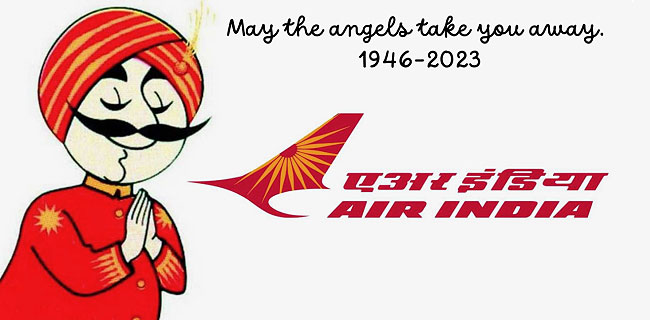
When I read the obituary of the Air-India Maharajah this morning, I couldn’t but shed a tear. After all, he was mortal like the rest of us. Ailing for the last 20 years, and in and out of hospital, many of his detractors were not able to overcome his strong will. And in spite of the many attempts on his life, he just kept coming back like the strong royal Maharajah he was. In fact he just laughed it off in his inimitable style.
While plenty has been written about him and his escapades through the decades through various lands, the end was solemn and brief. Just an unemotional announcement that his life had finally ended. There were no flowers. No prayers. No tears. No celebration of a life well-lived.
Which makes me wonder whether all mascots have a life of their own and like us mere mortals have to finally bid a goodbye.
Remember Gattu of Asian Paints? And the Murphy baby? Gattu, the mischievous Asian Paints mascot, was created by none other than the famous RK Laxman and enthralled us for a good 50 years. Murphy, another Indian favourite, was a brand born in Britain and founded in 1929 by Frank Murphy and EJ Power. The Murphy brand now belongs to the Shirodkar Group of companies but they don’t sell radios any more.
It is interesting to examine why the Maharajah was so successful. For one his commentary was on our day to day lives and the life of the nation. He became the social mirror of Indian society. He reflected our happy and unhappy moments with a touch of philosophy and wit.
Ivan Arthur, earlier National Creative Director of JWT, and now educator and author, when asked about the Air India advertising, said: “Conceived as a letterhead design, the Maharajah broke the fetters of the line drawing and became flesh with a personality and DNA of his own: the double helix of gracious exotica. That DNA did not permit him to stand in the street corners of conventional media and tout his destinations like a cheap ticket salesman. His famous romps on those hoardings were not advertising. They were non-advertising: parlour talk, one-liner points of view, camaraderie, provocation and good humour, all of which did not ask you to buy an Air India ticket. In fact, in many of the hoardings, he refused to have the Air India logo as sign-off. He was the sign-off. He was no commercial mascot. He became a national figure. Much loved and respected.
The Maharajah was always accompanied by another symbol that belonged to Air-India and that was the Centaur. Equally old, it has played an equally significant role in the branding of Air-India.
The Centaur had its own life as an alternative Air -India mascot. It flew around the world as the airline’s insignia, appeared on the inflight livery and even cutlery, was embroidered on some of its crew’s uniform, stood proudly on the top of the company’s impressive headquarters and became a brand name for its hospitality subsidiary!
Hopefully the Centaur carries on, unless the new adopted parents of Air-India have another strategy in mind.
In the meantime, let us mourn the loss of our favourite Maharajah once more. As the Byzantine Empress Theodora said “ For a King death is better than dethronement and exile”
Hand drawn toothy tiger. Designed By 千图网 from https://pngtree.com
By Prabhakar Mundkur
For some time now, the Advertising Standards Council of India (ASCI) has been the subject of criticism about its effectiveness. There is the annual rant in the media with various commentators taking potshots before or during an IPL which sees a major blip in advertising in India. ‘Watchdog’, which is often used to describe the ASCI, is perhaps not wholly descriptive of what it does. It can watch like a dog, but I am not sure it can bite. To bite you need legislation and now we have the Department of Consumer Affairs which has the teeth to bite. In the UK, for example, it is not the ASA that is considered the watchdog, but the Competition Markets Authority. The CMA has teeth. It is a non-ministerial government department to prevent anti-competitive activities. The Indian equivalent is the Competition Commission of India which was formed under the Competition Act 2002, which was formed when the erstwhile MRTP Act was repealed. But unlike the MRTP, which was very high profile, you don’t hear much about the CCI. That’s a pity!
Most critics of course miss the point that the ASCI is the advertising industry’s self- regulatory body. In many ways, it is the industry’s conscience that tells you what is misleading. And like we can always overcome our own conscience even when it is telling us not to do something, an advertiser can knowingly bend the rules. When you can overcome your conscience, you are being unscrupulous.
But coming back to the issue of misleading advertising, there are several bodies that are responsible for misleading advertising in the country. For example, the Cable Television Network Rules does not permit advertising for alcohol or tobacco products. Section 7 of the Rules on the Advertising Code has an exhaustive list of things that cannot be permitted.
(viii) promotes directly or indirectly production, sale or consumption of- (A) cigarettes, tobacco products, wine, alcohol, liquor or other intoxicants;
But rarely does anyone complain to the network channels that surrogate advertising for alcohol is being found objectionable by then. After all isn’t ASCI the favourite whipping boy for advertising that seems to cross the borders of acceptable advertising norms?
(1) The Central Authority may, after receiving any information or complaint or directions from the Central Government or of its own motion, conduct or cause to be conducted a preliminary inquiry as to whether there exists a prima facie case of violation of consumer rights or any unfair trade practice or any false or misleading advertisement, by any person, which is prejudicial to the public interest or to the interests of consumers
– The Consumer Protection Act, 2019
Equally, the Consumer Protection Act 2019 issued by the Ministry of Law and Justice protects the interests of consumers through legislation and it has a mechanism for accepting consumers complaints. It also has the authority to disburse fines for misleading products or advertising. Violation of their guidelines for endorsement can attract penalties from Rs 10 lakh to Rs 50 lakh.
So why is the ASCI the favourite pick of advertising-watchers when they find objectionable advertising in our media? If one actually looks at the number of regulatory bodies in the country there are quite a few.
1. Food Safety and Standards Authority (FSSAI)
2. Central Drugs Standard Central Organisation (CDSCO)
3. Insurance Regulatory Development Authority
4. Telecom Regulatory Authority of India
5. Securities and Exchange Board of India
6. Reserve Bank of India
7. Medical Council of India
8. Competition Council of India
9. Consumer Protection Act 2019
But perhaps what India lacks is an inter-disciplinary body or an inter-ministerial apex body that can look at the subject of misleading advertising.
For example, if we take the UK as a market, the Competition Markets Authority and the ASA form a powerful duo against misleading advertising. Also, misleading advertising can be controlled by the Consumer Protection from Unfair Trading Regulations 2008 and Business Protection from Misleading Marketing Regulations 2008. The Office of Communications (Ofcom) is the ASA’s co-regulatory partner and legal backstop for regulating TV and radio advertisements. The Financial Conduct Authority for example in UK blocks several financial services ads. In 2022, it removed 8582 consumer promotions and published over 1800 alerts to prevent consumers from losing their money to financial scams.
The House of Commons briefing paper considers the ASA ( Advertising Standards Authority ) and the regulation of advertising in the UK and therefore has the indirect consent of the government unlike the ASCI.
The ASA working hand in hand with the Competition Markets Authority gives the ASA very large teeth indeed. And the CMA will get some very extra large teeth from the Digital Markets, Competition and Consumer Bill to be introduced shortly. Also, the several legislations provide a whole bag of weapons for the ASA to conduct their business of tracking misleading advertising.
In closing, I would like to point out that in markets like the UK it is possible for the self-regulatory body the ASA in the UK to have very large teeth that can bite those that stray away from the advertising standards code. India pales in comparison.
So I leave you to decide whether the ASCI is a toothless tiger or is just being made a scapegoat for the lapses in the fight against misleading advertising in India.
Prabhakar Mundkur is a veteran advertising professional and commentator. If it’s not his views on A&M, he’s very busy with his music, and in the lockdown produced several music videos (some 100-odd). His views here are personal.












 The Ghatkopar billboard incident that killed many and injured many more has raised many ethical questions about the advertising and media business.