Category: ADVERTISING

  • Gerry D’Angelo joins MMC Advisory Board

    By Our Staff


    Media Marketing Compliance (MMC) has announced that Gerry D’Angelo, the former Vice President of Global Media at Procter & Gamble, has joined its Advisory Board.


    He joins Nick Manning, MMC chair and co-founder of Manning Gottlieb Media (now M G OMD), and other MMC directors to contribute their strategic insights and industry expertise as MMC ramps up its growth.


    Said Manning: 
“Gerry is one of the brightest minds in the industry. He remains passionate about delivering best practice across the media landscape and brings a valuable perspective to the MMC Advisory Board as it continues to define the media financial compliance industry.”


  • Rahul Gossain joins JSA as Chief Strategy & Brand Officer

    By Our Staff


    Rahul Gossain
    Rahul Gossain

    Rahul Gossain has joined JSA as Chief Strategy and Brand Officer effective from January 18, 2024. Before joining JSA, Gossain served as Head of Marketing Communications and BD at Cyril Amarchand Mangaldas since August 2018. Prior to that, he played was with Shardul Amarchand Mangaldas, Max India Group, Essel Group, and leading communications agencies.


    Said Amit Kapur and Vivek Chandy, Joint Managing Partners, JSA:  “Rahul’s extensive and varied experience will markedly enhance the Firm’s capabilities in client relationship management and contribute significantly to integrated initiatives in practice development and industry sectors. We are confident that he will strengthen the hands of the existing team at JSA.”


  • Havas gets Jaibeer Ahmad as Chief Transformation & Growth Officer

    By Our Staff


    Jaibeer Ahmad
    Jaibeer Ahmad

    Havas India has elevated Jaibeer Ahmad, formerly Managing Partner – North at Havas Worldwide India to the role of Chief Transformation & Growth Officer. He is mandated to set transformative strategies, driving business growth through integration and collaboration across all 18 Havas India agencies.


    He will report to Rana Barua, Group CEO, Havas India, South East Asia & North Asia (Japan & South Korea).


    Said Barua on the development: “The last five years have been a period of exponential growth for Havas India, having grown steadily from three to 18 agencies, both organically and inorganically delivering nine differentiated services to our clients. While this momentum will continue, and we will be adding a few more expertise, it is now critical that we consolidate and leverage the strength of our offering to enlarge the services and accelerate business growth. Jaibeer has the nuanced understanding of the One Havas ethos, the strategic knowhow to turn opportunities into tangible outcomes, and strong, people-focused leadership, and I am confident that he will make Havas India one of the top growth markets within the Havas ecosystem through integration.”


    Commenting on his elevation, Ahmad added: “At Havas India, I’ve had the incredible opportunity to collaborate across an array of functions, including, Media, CX, Experiential, PR, UI/UX, E-commerce, Programmatic, Brand Design, Health, and many more. The beauty and the strength of this model is that all these expertise are under one roof. This experience crystallized the vital need for an integrated ecosystem like our Havas Village, navigating today’s complex marketing landscape. In this new role, my mission is clear: foster convergence and collaboration among our 18 agencies and the growing ecosystem, and craft customised, integrated solutions for our clients.”


  • ASCI guidelines on environmental claims in ads

    By Our Staff


    The Advertising Standards Council of India (ASCI) has issued guidelines to prevent false pro-environment claims, also known as greenwashing, that has been seen across sectors.


    The “Guidelines for Advertisements Making Environmental/ Green Claims”, have been in the public domain for consultation since November 16, 2023, and were approved in the recent Board of Governors meeting.


    Said Manisha Kapoor, CEO and Secretary-General, ASCI : “Consumers today are exercising their preferences for green products, and in many cases, pay a premium for them. It is necessary that consumers have the correct information to make informed choices to support green products. It is also important that organizations that genuinely provide greener products are able to communicate this clearly to consumers. The Government too has expressed their concern on greenwashing or false green claims, and we believe that these guidelines are a significant step towards promoting transparency and accountability in environmental/ green claims made in advertising.”


    Notes a communique: “Effective February 15, 2024, these guidelines aim to ensure that environmental claims made by advertisers are reliable, verifiable, and transparent. Consumers are increasingly demanding products and services which minimise harm to, or have a positive effect on, the environment. As a result of a proliferation of products, services and businesses which claim to meet that demand it is imperative for such claims to be reliable and verifiable.”


    Greenwashing, as per the communique, violates Chapter I of the ASCI Code on misleading advertisements. In order not to breach Chapter I of the ASCI code, advertisements must adhere to the following guidelines.


    GUIDELINES:

    1. Absolute claims such as but not limited to “environment friendly”, “eco-friendly”, “sustainable”, “planet friendly” that imply that the entire product advertised has no impact or only a positive impact or reduces adverse impact must be capable of being substantiated by robust data and/ or well-recognised and credible accreditations. Such absolute claims cannot be diluted by means of a disclaimer or any other clarificatory mechanism such as a QR code or website link etc.

    2. Comparative claims such as “greener” or “friendlier” would need evidence that the advertised product or service provides an environmental benefit over that of the advertiser’s previous product or service or competitor products or services and the basis of such comparison is made clear.

    3. A general environmental claim must be based on the full life cycle of the advertised product or service, unless the advertisement states otherwise, and must make clear the limits of the life cycle. If a general environmental claim cannot be justified, a more limited claim about specific aspects of a product or service might be justifiable. Claims that are based on only part of an advertised product or service’s life cycle must not mislead consumers about the product or service’s total environmental impact.

    4. Unless it is clear from the context, an environmental claim should specify whether it refers to the product, the product’s packaging, a service, or just to a portion of the product, package, or service.

    5. Advertisements must not mislead consumers about the environmental benefit that a product or service offers by highlighting the absence of an environmentally damaging ingredient if that ingredient is not usually found in competing products or services. Similarly, advertisements must not claim an environmental benefit that results from a legal obligation if competing products are subject to the same requirements.

    Where such ‘free-of’ claim is necessary to equip the consumers with relevant information, an appropriate disclaimer should be added to indicate the purpose e.g. “XX-Free: (Names of regulation) prohibit the use of (name of prohibited substance/ingredient) in (category of products)”. It would be deceptive to claim that a product is “free-of” a substance if it is free of one substance but includes another that is known to pose a similar or higher environmental risk.

    6. Where the use of Certifications or Seals of Approval create the impression of an environmental claim to consumers, then the advertiser should make clear what attributes of the product or service have been evaluated by the certifier.  The advertiser should ensure that the certifying agency is nationally/internationally accredited by a certifying authority for e.g. agency accredited by the UN council/committee, BIS etc.

    7. An advertiser shall not use visual elements in an advertisement which results in the advertisement conveying a false impression that the product is less harmful or more beneficial to the environment, when seen as a whole, unless required under law. For example, logos representing a recycling process on packaging and/or in advertising material can significantly influence a consumer’s impression of the environmental impact of a product or service.

    Visual elements for the above purpose shall not include the colour scheme related to nature or environment or images of natural ingredients or natural elements used on the products / packaging / services as a part of its creative brand identity or trademark/tradename unless such elements used are connected directly to any Environmental Claim made on such products / packaging / services to influence a consumer’s impression of the environmental impact of a product, packaging or service. For example, a green coloured packaging with natural ingredients contained in the product will not be considered as contributing to a green claim unless it refers to an environmental claim

    8. Advertisers should refrain from making aspirational claims on the products/ packaging/services about future environmental objectives unless they have developed clear and actionable plans detailing how those objectives will be achieved.

    9. For carbon offset claims where the offset does not occur within the next two years, advertisers should clearly and prominently disclose the same. Advertisements should not claim directly or by implication that a carbon offset represents an emission reduction if the reduction, or the activity that caused the reduction, was required by law.

    10. For claims pertaining to the product being compostable, biodegradable, recyclable, non-toxic, free-of etc. advertisers should qualify the aspects to which such claims are being attributed, and the extent of the same. All such claims should have competent and reliable scientific evidence to show that:

    11. a) The product or the qualified component where applicable will break down within a reasonably short period of time after customary disposal.

    12. b) The product is free of elements that can lead to environmental hazards.


    Link to Guidelines for Advertisements Making Environmental/ Green Claims

     

  • Ipsos India hires Shrutika More

    By Our Staff


    Global market research company Ipsos has appointed Shrutika More as Country Service Line Leader for the Creative Excellence vertical.


    Shalini Sinha
    Shalini Sinha

    She moves from Abbott Healthcare, a leading pharma company and will report to Shalini Sinha, Group Service Line Leader, Brand Health Tracking (BHT) and Creative Excellence (CRE), Ipsos India.


    Shrutika More
    Shrutika More

    Said Sinha: “More’s remit will be on driving the next leg of growth for the Creative Excellence vertical in India; and to achieve this, she will be working closely with the account facing teams across different verticals and offices in Ipsos India; with emphasis on building thought leadership for CRE and consolidating our presence in the domain.”


  • ASCI Academy: Knowledge is not enough for Compliance


    By Sanjeev Kotnala


    Sanjeev KotnalaI welcome the news. The Advertising Standard Council of India has announced the launch of ASCI Academy. It aims to make marketers, brand custodians, agencies, and other people in the ecosystem more responsible and progressive. It talks of a greater understanding of the guidelines. Working with greater consciousness. And a higher degree of compliance. It will offer a consumer education programme. This will hopefully make consumers better aware of the guidelines, and, may be, it will push for better reporting and complaints – leading to higher compliance! As per reports and notes, it will undertake research in current and new areas that impact consumer interest!



    And I think there is a short certification course for interested people.

    The guidelines have been there on site. The site has always remained updated. The consumer and marketers are engaged in evolving guidelines. There is absolute transparency in working. However, one would like access to what are the advertisers really saying to the objections raised. There is a focus on enhanced speedy resolution of complaints. Still, some limitations prevent further tightening of the process.

    The idea of being more preventive than corrective is a welcome stance.

    The theory and wish to impact at the point of ad creation is a good thought!

    The target to train 100,000 current and future marketing professionals, advertising agency personnel, people in the field of communication and consumers is an absolute pleasure to hear.

    There is a wishful thinking of all this leading to a shift towards a deep culture of responsibility. And expecting that to be the norm is oversimplifying things.

    This is a reaction to what NS Rajan (Chairman ASCI) and Manisha Kapoor (CEO and Secretary ASCI) said in the press note.

    I love the initiative and know that the intent is right. But it is wishful thinking.

    We would have seen the difference long ago if only KNOWLEDGE was enough for the compliance.

    It is hard to believe, and I am absolutely sure that the brands that currently do not follow the guidelines or err on their judgment, behave not responsibly and progressively do not do so for the lack of understanding.

    They do this despite the knowledge.

    In fact, they work around the guidelines and knowingly flout the norms.

    Do I have a solution to offer? NOT REALLY.

    One is confident that unless flouting of the guidelines leads to some penalty affecting the revenue and brand image, the guidelines’ adherence will remain a dream.

    Unless the brands know their image is at stake if they fail in their responsibility. Nothing will happen.

    Nothing will change unless the people at the top don’t drive the change and be accountable. The surprising part is that the top knows about the guidelines, knows the expectation, and turns a blind eye – look to the other side when their department and teams knowingly test the guidelines. This the academy cannot change, so my belief in change is shaky. Offering ASCI Academy programmes online, in person, and hybrid may help numbers. But I fail to see it helping compliance.

    I am sure the industry partners will ensure compliance at their end. Their teams are well-educated and aware of the guidelines. They are big advertisers, and one can expect responsible behaviour from them.

    A lot may depend upon supporting partners like the I&B Ministry and the Department of Consumer Affairs. Maybe they could help with compliance.


    However, if knowledge and awareness could solve such problems, we won’t have crime. And knowledge is not enough for guidelines compliance or responsible and accountable behaviour.


  • The Non-secular nature of Indian Advertising


    By Sanjeev Kotnala


    Sanjeev KotnalaWe know India is a secular nation. Its regional, linguistic, cultural and religious diversity is well-acknowledged. However, if an outsider was to watch Indian advertising, s/he would not be at fault for thinking India is a non-secular Hindu nation lacking diversity and inclusivity.


    It is a flaw and the failure of Indian advertising, the brand custodian, the marketers, and the agencies. They have failed in inadequately reflecting the diversity of the nation.


    Yes, in certain AVs, brand interviews and films like ‘Mile Sur Mere Tumahara’ or the National Anthem-based films, they are forced to showcase diversity. However, these make a minuscule part of the Indian advertising universe.


    Indian advertisements tend to focus on a narrow representation, not fully capturing the essence of the diverse religious communities. If that was not enough, the advertisements continue to represent or portray the narrow religion bioscope, repeatedly showcasing the Hindu religion as backward and full of questionable and must-change rituals and practices.


    It further worries me about the underrepresentation of certain religious communities in advertisements. The minority should not be maltreated.


    Why neglect religious minorities? 

    This unintentional exclusion adds to marginalisation and alienation among the minority religions.

    The question is shouldn’t Indian advertising should not be more responsible.

    Religious diversity, whenever depicted, is superficially stereotyped.


    All this adds to misinterpretation and reinforces biases rather than promoting understanding and acceptance.


    It’s time the advertising world stood up to its responsibility and be accountable to the minority religions in helping them progress as much as it has helped the majority religion.


    Indian advertising needs a more inclusive approach that authentically represents the nation’s religious diversity. Advertising agencies and brands should prioritise diversity and inclusivity and look beyond the majority religion for progressive suggestions. Otherwise, the blame for India being seen as a non-secular nation is on its head.


    Overall, Indian advertising (and Indian cinema) has a long way to go in accurately reflecting the nation’s religious diversity. And in non-stereotypical correct ways. By actively embracing inclusivity and promoting minority religious representations, the advertising industry may create a greater understanding, and acceptance of a secular nation. But will they ever have the courage to do so…


  • Stereotyping Yamraj in Indian Advertising


    By Sanjeev Kotnala


    Sanjeev KotnalaThere are only two truths in life. Birth and death. Death creates maximum insecurity, Thus, Yamraj, the lord of death. In Hindu mythology, Yamraj presides over the cycle of death and rebirth, ensuring the proper record of karma and deciding on the soul’s destination and journey after death. Death is a sensitive subject in oyr culture and spirituality. Hence one would think that the representation of Yamraj in advertising requires a thoughtful and respectful approach. However, Indian advertising has stereotyped Yamraj, presenting him as trivial and comical. There seems to be no risk when using and depicting Yamraj in advertising. It is mostly Insurance and Public Service Advertising (PSA) which has used and abused Yamraj.

    One understands that the depiction of Yamraj needs innovative, creative representation that is contemporary and relates to the generation while respecting traditional understanding and symbolism. In fact, a few brands like Fevicol M-Seal and Max Life Insurance have used death in their communication. It is a subject I have earlier written in ‘Slice of death – advertising’.


    Yamraj and Insurance

    Life insurance and death are interlinked. The life insurance brands are forced to hint and touch on the subject of death and they do it wisely with sensitivity smoothening the fear of death. However, Yamraj, the lord of death, is not often used, and when used is a stereotypical character.

    Policy Bazar, in the past has, humorously connected death and insurance. This time Policybazar.com has used Yamraj to answer the simple truth about not delaying buying an Insurance policy to protect the family against life’s uncertainties like death and disease. It used a market and Hospital situation to make sense of the suddenness and uncertainty of death. The message is simple ‘Taalo Nahi, Le Daalo’ (Don’t delay, just buy it’ addressing the issue of procrastination in purchasing a policy.


    Edelweiss Tokio Life Insurance has used activation with the Yamraj character to drive home the road safety message in their campaign ‘Yamraj to Rescue’. It focussed on reminding the people about following traffic rules, crossing only at the Zebra crossing, driving only when the light turns green, and using helmets and seatbelts.


    Yamraj And Food

    Yamraj is comical in Namaste Desi Ghee advertising.

    In the advertisement, Yamraj comes in to take Dadima’s soul. Dadima asks him to wait, serves food, and shares that the tasty food uses Namaste Desi Ghee. However, she also informs him that she won’t be able to cook such delicious food in heaven as the brand will not be available. Yamraj takes some food for the way and extracts the promise that he will come and Dadima will serve him food made in Namaste Ghee.

    The concept of death is used playfully, making one smile even though Yamraj is more of a joker in the advertisement.


    Yamraj And Deals.

    Snapdeal.com campaign highlighted ‘irresistibility’ with deals on the site. They are good enough to entice Yamraj, the God of Death, who grants life to the person who offers him a deal. The ads about the man parachuting,  delivering the packageHospital and Runner, are simple and straight, demonstrating how Yamraj uses the deals on Snapdeal. Delivery person edits, and both are simple- straight.


    PSA Helmet And Yamraj.

    Honda has a simple Helmet On Life On campaign. Here, Yamraj monitors who is wearing a helmet and who is not. It humorously brings alive the silly excuses for not wearing the helmet and the possibilities.

    Western Indian Railways used Yamraj as an activation device to deter people from crossing or trespassing railway tracks. Chennai Traffic Police has also used Yamraj in the ‘Drink and be driven’ campaign. And the local government in Andhra Pradesh, Uttar Pradesh, Uttarakhand, Bengal and Bihar used Yamraj to drive home the caution message during Covid.


    Net-Net

    I am not sure if the comical depiction of Yamraj is acceptable, right or wrong, as I understand and appreciate creative freedom and its boundaries. The character has limitations and has been used mainly by Insurance brands and in PSA. However, brands like Everest sheets and even IPL had a Yamraj ad. Then there is the BJP ad using Yamraj against Kejriwal. Effectively, it has to be a real humorous or the direct association between the brand and message to effectively leverage Yamraj or  one ends up with an ad like Jaquar. Using death can be more straightforward.


  • Publicis WW bags Pramerica Life mandate

    By Our Staff


    Publicis Worldwide India has bagged the integrated creative mandate for Pramerica Life Insurance.

     

    Commenting on the partnership, Oindrila Roy, Managing Director at Publicis Worldwide India, said: “We are thrilled to be partnering Pramerica Life Insurance. It is a highly respected brand with a strong commitment to providing innovative and customer centric life insurance solutions. We are confident that our deep understanding of the category coupled with our creative expertise will help Pramerica exceed its business goals in India.”


    Added Amaresh Jena, Chief Marketing Officer at Pramerica Life Insurance: “This is my climb is not just a campaign; it’s a manifestation of our brand’s aspirations and goes beyond storytelling, embodying Pramerica Life Insurance’s core goals. Our objective is to imbue each life we touch with a profound sense of security and empowerment, echoing our vision. Aligned with our mission to be a trusted friend, guiding individuals to informed insurance choices, the campaign aims to provide support during life’s challenges and inspire enduring confidence.”


    Said Srijan Shukla and Pratheeb Ravi, ECDs at Publicis Worldwide India: “The campaign is conceptualised around a simple truth that there are challenges and struggles in everyone’s life. But it is these climbs and struggles beyond which lie real success. These climbs might seem very ordinary but are in fact tough on the individuals who actually face them. Pramerica Life wanted to be a partner in these extraordinary climbs of ordinary people. The films focus on the lives of ordinary people and celebrate the moment when they decide to take up the climb. We wanted to keep the stories honest and authentic so that the audience resonates with them.


  • OMG India gets Jigar Rambhia as its Sports Lead

    By Our Staff


    Omnicom Media Group (OMG) India has appointed Jigar Rambhia to lead its Sports Practice. He was until recently COO of Sporjo and in the past worked with Wavemaker, TME and Madison.

     

    Said Kartik Sharma, Group CEO of Omnicom Media Group India: “With immense first-hand experience navigating the complexities of the landscape, Jigar brings a unique perspective that aligns with our goals for innovation and advancement. With him leading the charge, we’re all geared up to deliver state-of-the-art solutions for our clients through avenues of the sporting world.”


    Speaking on his appointment, Jigar Rambhia, added: “It’s an exciting time to be in the midst of India’s transforming sports landscape. The ecosystem today is a vibrant playground offering bespoke avenues for brand engagement and enhanced fan experiences and holds great potential. I’m excited to navigate these tides, helping steer OMG India’s efforts towards valuable outcomes.”


  • McCann, Mondelez & Enormous star on Effie Night

    McCann, Mondelez & Enormous star on Effie Night

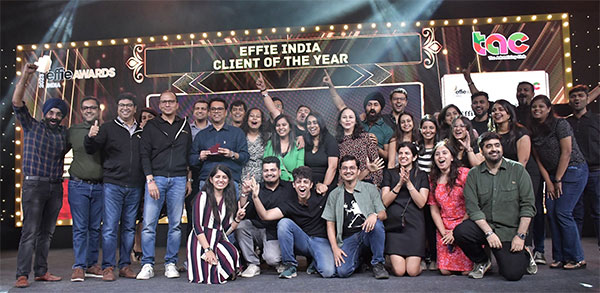
    If you were wondering why we didn’t carry this report earlier, the answer is simple: yesterday, the focus couldn’t have not been on the Zee-Sony merger. Last Friday, The Advertising Club hosted the newest edition of the ‘Effie India Awards 2023’ Mondelez India was judged the EFFIE India Client of the Year, while McCann Worldgroup India was named Effie India Agency of the Year. The coveted Grand Effie was won by Enormous for Jaquar’s campaign ‘Unimaginable Brand Extensions.’


    Grand EFFIE 2023


    EFFIE India Client of the Year
    EFFIE India Client of the Year


    Setting a new milestone, Effie India, informed the officebearers,  garnered a record-breaking 1276 entries this year, the highest in its 23-year history, with participation from 79 agencies.


    Said Prasoon Joshi, CEO & CCO at McCann Worldgroup India and Chairman, Asia Pacific: “I am extremely delighted and proud of McCann winning the Agency of the Year at the Effie India 2023 Awards. Today, In the world’s changing landscape where our industry faces extreme challenges in defining the approach to the future,  McCann India  is an organisation which holds ideas and thinking at the core of our  business and propels our business and clients forward. Effectiveness comes from this culture of belief in creative excellence driven by strong consumer insights. This is  McCann India’s hallmark supported by a robust  our McCann Global’s   culture of  strong creative and strategic leadership  What is remarkable  is the the width and the diverse set of businesses we have won awards for Ujjivan Small Finance Bank, Nestle India, MasterCard, Reckitt, Dabur, Hero and many others.”


    Speaking before the presentations started, Rana Barua, President, The Advertising Club, said: “The Effies stand as a testament to the power of impactful storytelling and strategic brilliance in our industry. My heartfelt gratitude to the advertising fraternity for their unwavering support, making these awards a celebration of creativity and effectiveness. Congratulations to all the winners for crafting campaigns that not only captivate but also leave a lasting impact on our audiences. Your creativity continues to shape the future of our industry. Here’s to another year of pushing boundaries and inspiring innovation in the world of advertising.”


    Elaborating on the awards, Mitrajit Bhattacharya, Chairperson, Effie India, said: “Effie India continues to showcase its unwavering commitment to celebrating excellence in advertising, honouring both exceptional work and the talented individuals behind it. I’d like to extend my gratitude to the esteemed judges who dedicated their time and expertise to assess a remarkable 1276 entries, setting a new record. Their commitment is truly commendable. A heartfelt thank you also goes out to our sponsors, the entire Ad Club managing committee, the Effie committee, Effie New York, and The Ad Club secretariat for their tireless efforts in making it a resounding celebration of creativity and innovation in the advertising industry.”


    Added Pradeep Dwivedi, Co-Chairperson, Effie India: “In yet another splendid year of the Effie India Awards, what stands out is how agencies and brands continue to put in their hard work. Their meticulous contributions in ideation, flawless execution, and the art of brand-building are truly commendable. Effie has always added and will continue to add a profound insight into the concept of advertising awards. A big congratulations to all the winners and the participants.”


    Celebrity Cricket League was Associate Sponsor of the event while Craving Digital was Imagination Partner, Diageo India being Celebration Partner, and Heineken Silver Beer was Beverage Sponsor.


    EFFIE INDIA 2023 CLIENT OF THE YEAR


    EFFIE INDIA 2023 AGENCY OF THE YEAR


    EFFIE INDIA 2023 RESUTLS


  • MudraMax elevates Deleise Ross to Senior VP & Business Head

    By Our Staff

    Deleise Ross
    Deleise Ross

    Integrated marketing media agency – MudraMax – has promoted Deleise Ross as Senior Vice President and Head of Business. In her new role, Ross will be reporting to Rammohan Sundaram, President – Integrated Media, DDB Mudra Group and lead business operations for West as well as the South division.


    Said Sundaram: “We are seeing tremendous growth in our media business and so structures become important which only helps teams to focus better and deliver better. It is also about leadership attention that teams require when in hockey stick growth phase. My belief has always been to groom available talent from within and we are excited to have Deleise take on larger responsibility.”