
Category: ADVERTISING

  • Arvind Sharma to be conferred with AAAI Lifetime Achievement Award 2021

    By Our Staff


    The Advertising Agencies Association of India today announced that AAAI Lifetime Achievement Award for 2021 will be conferred on advertising veteran Arvind Sharma.


    Sharma, an alumnus of IIM Ahmedabad (1975-77), led Leo Burnett for 21 years in a three decades-long association with the agency. He has led most A&M industry organisations and is now a serial investor and mentors to many entrepreneurs.


    Making the announcement, Anupriya Acharya, President, AAAI, said: “Mr Arvind Sharma has been a true pioneer. Apart from singlehandedly making Leo Burnett a top agency and a force to reckon with he has also groomed some of the finest talents in our industry. But more than that he has made a tremendous contribution to our industry across both the art and science of advertising. He is truly deserving of this honour.”


    Added Ashish Bhasin, Chairman of the AAAI Lifetime Achievement Award Selection Committee: “Arvind is a deserving winner of this prestigious honour. Not only has he been a successful advertising professional, he has also contributed significantly to the industry in various capacities, including as President of AAAI and a key driver in launching Goafest. I am pleased to say that the entire committee was unanimous in conferring this award upon Arvind.”


    Some of the past winners of this award include Subhas Ghosal, Alyque Padamsee, Mike Khanna, R K Swamy, Piyush Pandey, Sam Balsara, Prem Mehta, Roda Mehta, Ram Sehgal, Madhukar Kamath and others.


    Although AAAI hasn’t announced the date, according to information received, the award event is likely to be held in Mumbai on December 16, 2021.


  • Merkle B2B & Bloomberg Quint launch ‘The Media Guide’

    By Our Staff


    Merkle B2B, the Dentsu India agency, partnered with Bloomberg Quint to produce a study through Greyhound Research. The study was conducted with Indian CIOs and IT decision-makers to identify their concerns, issues and preferences about a brand, product or solution while making a purchase. The aim being to understand the world of evolving Indian tech buyers and the factors influencing their decisions.


    Key highlights of the report:


    :: Increasingly, CEOs/MDs are personally getting involved in the technology decision-making process. They are seeking business leaders and external parties (analysts/consultants) to gain deeper insights and better bargains from the existing and new vendors.


    :: Traditional (80%) and startup (73%) organisations prefer to use local podcasts and videos along with their global content pieces to strengthen context.


    :: 73% of respondents from traditional organisations continue to value conferences and events, while only 53% of startup organisations prefer them as part of the new technology buying decision-making process.


    :: 60% of traditional organisations and 100% of startup organisations find online technology magazines to be effective in their technology buying decision-making process.


    :: 40% of startup organisations and 23% of traditional organisations find global video content to be helpful while identifying a technology vendor.


  • So who will be the 2021 MxMIndia Mediaperson of the Year


    By A Correspondent


    This is awards season. From politics, business and films to many, many, many awards in the A&M world. Not just in A&M, in PR communications, content… everything.


    But amongst all of this, there’s the MxMIndia Mediaperson of the Year award.


    And how are we different:


    1. No jury. So no influencing, no lobbying. No accommodation of one person this year, and another the next

    2. No sponsor. No pressure from anyone on who the award should go to

    3. No event. So no pressure of having a chief guest, sponsors for the event, and hence the pulls and pressures on ensuring that the winner is a “saleable” name

    4. Planning through the year. We ensure that those who do well in the end of the year don’t have an unfair advantage as they are top-of-mind

    5. Democratic, albeit partially. We invite nominations from the world, but the decision is ours


    Our winners so far:

    2020: The Independent Journalist

    2019:  Sidharth Rao

    2018: Piyush Pandey

    2017: Arnab Goswami

    2016: Ashish Bhasin

    2015: Punit Goenka, Shashi Sinha, Partho Dasgupta for BARC India


    So who will it be this year?

    There are a few people who are in our shortlist.

    We received 26 nominations for 12 people and two organisations in response to our call for nominations on October 13.

    So, who will it be?

    Well, it’s going to happen on December 17, 2021.

    It’s a Friday.

    We’ll announce the name by 12noon that day.

    No events. No drama. No tamasha.

    An honest award for the Mediaperson of the Year.


  • Havas Prosumer Report: on future of e-commerce

    By Our Staff


    Havas Group announced the launch of its Prosumer Report, a global perspective on the future of e-commerce that captures information and insights on the sector, done through the network’s proprietary research tool. Drawing on responses from 3,000 consumers from India, Brazil, China, France, the United Kingdom, and the United States, the survey examined the upcoming trends in the e-commerce experience.


    Pritha Dasgupta
    Pritha Dasgupta

    Talking about the report, Pritha Dasgupta, CMO, Havas Group India, said: “Prosumer is Havas Group’s global report that is released 3 to 4 times every year, each one covering a specific topic. It is one of the longest-running thought leadership properties of Havas Group that has become instrumental in predicting emerging trends in consumer behaviour,” adding: “Over the last two years, digital adoption has been extremely fast and has become a way of life. If we specifically look at the e-commerce sector, it has become a breeding ground of innovation and in the last two years every leading company in this sector has grown aggressively. Our latest Prosumer Report gives a clear direction to the industry of where this e-commerce sector is headed, and also identifies trends of the sector.”


    As per a communique, the study notes that throughout the pandemic, e-commerce has clearly established itself as the new retail norm as more than eight in 10 prosumers say they prefer the online shopping experience over the traditional format of in-store purchasing. However, one out of three respondents claim that their e-commerce experiences are quite boring. Havas Group’s Prosumer report came up with a few ways to upgrade the e-commerce experience by:


    :: Focusing on new rules of eCommerce: This includes free shipping & returns, seamless & fast delivery, customer ratings, loyalty discounts and purchases recommendations.


    :: Having a purpose beyond clicks: e-commerce must be about more than just access, it is about curating products that are good for society.


    :: Being on the right side of data history: Privacy is gaining momentum so data education should be mandatory.


    :: Expanding from a place to buy to a place to socialise: As e-commerce is becoming more human and is moving to social, making the experience more community-driven will bring results.


    The report threw light on some India-specific trends:


    :: The rise in community shopping experience: Post-pandemic, the desire to replicate in-store/mall experience has led prosumers to seek community shopping experiences from the e-commerce industry. In this context, we see a spike in demand for services such as the ability to shop on social media (66%) and the ability to interact with fellow shoppers (68%).


    :: The era of Transparency: Contrary to popular euphemism, consumers are not averse to data sharing. In fact, they demand transparency regarding what data is being collected. In this context, we see 97% of the prosumers rating privacy as the key attribute and 83% ready to boycott brands that do not have a transparent data collection policy.


    :: Personalised experience: 68% of Prosumers expect their e-commerce shopping experience to be tailored through personalisation and AI.


    :: Rise in responsible e-commerce practices: 95% of prosumers demand eco-friendly packaging and 69% want to see e-commerce organisations commit to sustainable practices across the value chain.


    The Havas Group Prosumer report notes that e-commerce is no longer just about business transactions; it’s about customer empowerment and with the e-commerce market touching $84 billion in July 2021, this is a sector one just can’t ignore. Meeting the needs of consumers will ensure that the e-commerce sector moves from strength to strength. It’s where the future is.


  • MFilterIt releases ad fraud myths

    By Our Staff


    MFilterIt, a fraud detection and prevention company, has unveiled a set of myths surrounding ad fraud and brand safety. Reportedly, every year, from November 14-21, the International Fraud Awareness Week is observed to promote anti-fraud awareness and education.


    Commenting on the release of Ad Fraud Myths, Dhiraj Gupta, Co-Founder & CTO, MFilterIt said: “One of the best tools to fight Ad Fraud is “Awareness” on this subject. It’s quintessential for the brands and decision-makers to be aware of the gravity of this issue and be responsible for their financial resources. In this digital age, it is a fact that most of the Frauds are committed in the complex digital labyrinth, to mark International Fraud Awareness Week, we are releasing a set of myths that needs to be dismantled to fight this menace so that we can lead towards a safer and secure digital economy.”


    In India, the overall share of Digital advertising stands around 30% but it’s expected to grow 25% annually against a global average of 9%. This also means that ad fraud is anticipated to climb from the current average of 25-35 percent to 45-55 percent as firms shift their advertising budgets from traditional to digital. As per the MFilterIt Brand Safety Report 2021, the biggest challenges for Ad Fraud included issues like Awareness (42%), Brand Infringement (23%), Fraud (12%), Investment (12%) and placement (11 %). It is estimated that digital ad fraud will cost advertisers and brands $44 billion in fraudulent activities by 2022.


  • Brand Signature Moves… Sahi Hai?


    By Sanjeev Kotnala


    Sanjeev KotnalaAfter a long time, I am enjoying some of the advertising I see. And the buzz is not because the brands have purposefully commented on some rituals. The ideas are well-presented and powerfully pushed to the audience. Intentional communication delivers a directional message to the unconscious mind. And, if this was unintentional, maybe it is a good post-rationalisation for the idea.


    I may not have thought so, but then my friend and consultant Vermajee drew my attention to it. He elaborates over Lawson Williamson, his newly acquired taste in mid-level whiskey. I think he has been minutely observing judges empathising on signature moves of Dance India contestants. I guess it made Vermajee focus on brand signature lines, action cues of audio-visual hammering in a recent communication.


    YEH SAHI HAI

    Mutual fund communication at every possible opportunity reiterates Sahi Hai’  for investing in Mutual Funds. The regulatory warning that is part of the communication does not matter. As the statement ‘Sahi Hai’ gets repeated, it starts making sense. In fact, more sense than it should. The uninitiated investors who must rethink their options start seeing Mutual funds with coloured glasses. Their confidence gets further enhanced with every new story, exposure of Sahi Hai loaded with strong visual cues. The pause and the applause are perfectly timed. The use of cricketers – caution statement- logical explanation- push for meeting experts. Saab Sahi Hai. Only if they can get the verbal nail a visual hammer to amplify it further.


    CARBONATED THOUGHTS

    Toofan Wahi Jo Sab Palat De’ says Thums up. The character dramatically tilts the bottle upside down. It is a powerful visual cue. Drink and flip. The whole story is engaging and delivered powerfully. It again leaves you with a strong visual hammer and an audio nail. The tonality is all masculine and charged up, just like the extra string drink.


    FANTASY LEAGUE DRUMMING THE DREAM.

    The Dream stories in Dream-11 shout loudly. The brand tells you stories of realised dreams.  It wants you too to dream big. The seed is implanted subconsciously. Think Big. Dream Big. Bet Big. In most fantasy leagues, there is an additional challenge to beat the selection of superstars of cricket. They hurt the ego of an armchair critic who thinks he knows better. The challenge must then be accepted. The game is now beating the cricket superstar acumen as a team selector.


    I have been a fan of Dream-11 communications through the years and the way it is evolving. A robust strategic intent and planning is apparent. They know where they are going. From celebrating teams and gully cricket, anything for the gameDimag se Khel- eek hi Dhoni– Game hai Mahan to realising big dreams. It is different that I see a need for strong regulations for fantasy leagues because of their addictive- habit-forming nature. Any day would love to meet and interact with the Marketing teams behind it.


    CRED GAINS CREDIBILITY WITH FREQUENCY

    Cred is the joker in the House. One may question the need for high decibel advertising that the brand indulges in. But there is an established format now for the brand. It has two parts. The static, fixed part A and the tactically changing part B with celebrities like Rahul Dravid– Kapil Dev– Neeraj Chopra and more. Cred is leveraging a reverse flip. If the second statement is engaging, humorous and authentic, the earlier information must also be similar. Making that strongly uninteresting functional statement enjoyable enough. Frankly, I hate it- because even though people remember the celebrity stunts- the brand association is strong enough. Strategically, quirky Cred  is building its own unique communication signature.


    STRONG BYJU

    Byju intrigues. It uses jealousy and competitiveness along with a rational explanation. It seems to be working. I loved how Byju exploited vulnerable parents during the Parent Day #Honourtheirsacrifice with short clips of students. Vermajee rightly points out that Byju was not reminding students of the sacrifices their parents made. It was pushing parents down memory lane. There is always a better chance of them relating to the problems better them than the students.


    ALL IS NOT WELL

    There are few brand communication that confuses me. I fail to understand the primary intent and why the brand is doing what it is doing.


    MISSING UNACADEMY

    Now the last one. #TeachThemYoung by Unacademy is a cryptic one. What the hell is the brand connection? What were they selling or proposing? Even Vermajee is zapped. He tried to decipher the brand intent and gave up. Maybe the stakeholders know better.


    GOBHI AALU DISCOUNT – NETMED

    Netmeds’ discount advertising featuring Kareena and Karishma Kapoor is silly and confusing. Why should one fall ill to earn discounts on medicine? And that too for vegetables. How sick should I be to get a decent discount at Netmeds to buy even a one-time vegetable? Do I buy medicines t get a discount, or do I purchase medication at a discount? Creative license?


    The Netmeds ad on trust and ‘discount on medicine is possible’ works because it reflects customer apprehensions. I would have loved it if they had stuck to quality medicine delivered on time and at a reasonably discounted price. But, please, stop the Gobhi-Aloo discount on medicines.


    NET-NET 

    We are living in an era of information parity, easy access and social connectivity. Everyone is sharing suggestions- recommendation or their skewed point of view. The brands need to be extra cautious in developing their signature tag, a signature move supported and held by a verbal nail repeatedly hammered visually. Some brands discover it. Sometimes it is a mistake that gets post rationalised. But always better to spend that more time in developing and investing in creating communication with brands signature touch- Just like Men will be men, a powerful idea holding it together. The thought is the brand signature, but the brand association could be stronger. Maybe, (I say maybe as I can’t think how) a consistent signature visual hammering to further strengthen it.


    You may finally have a signature move or not, a verbal nail or not and a visual hammer or not- but be alive to the reality and life of your audience- be sensitive to their beliefs, region and religion




  • GroupM restructures Central Trading Group leadership

    By Our Staff


    GroupM India has announced a restructure of its media buying function- Central Trading Group (CTG).


    Sidharth Parashar
    Sidharth Parashar

    Said Sidharth Parashar, President – Investments and Pricing, GroupM India: “This restructure is a part of evolving transformation for GroupM. We constantly recognise and invest in talent across functions for our team members who have helped evolve key areas like the media buying practice. The relentless commitment to delivering value to its client’s business is what truly defines team CTG, and I am privileged to lead a multi-dimensional team of leaders who are passionate about media and our client’s business. I am delighted to see these leaders grow and take on larger responsibilities in shaping the GroupM CTG transformational journey.”


    Rahul Satoskar
    K Srinivas Rao
    Muralidhar T
    Pratik Rathod

    Pratik Rathod who has been successfully leading buying for Wavemaker will be taking on an elevated group-level role of National Broadcast Head, GroupM India.


    Muralidhar T is taking on an elevated role of leading buying function for the whole of Mindshare.


    K Srinivas Rao takes over the Wavemaker buying mandate from Rathod. Rao has been leading the Mediacom buying function for the past few years.


    Rahul Satoskar, currently the region buying lead for Mindshare west, gets elevated to lead Mediacom buying nationally.


  • Are Brands Alive to the Gen S Potential?


    By Sanjeev Kotnala


    Sanjeev KotnalaBrands have rarely targeted senior citizens, the Generation S. For some categories, they would be a perfect target and make a difference. An article in Ad Age refers to the possibility that 70+ senior audiences can be gamechangers for brands. The situation in India is not different. India is home to the second largest ageing population in the world. By 2025, India’s 50-plus population (Generation S) is estimated to be between 17.5 in 2030 and 30 crore in 2050, outnumbering the under-15 age group and almost equalling the United States population.


    This Generation S can be categorised as 50-60 pre-retirement, 60-70 after retirement and 70-plus as the extended retirement segment. In my brand and marketing consultant avatar in the last seven years, I have yet to see a purposeful objective psychographic study of this segment, which is estimated to be worth Rs 43,000 crore.


    As the Covid relaxations were announced, Mr Bhist, an ex-army person in Uttarakhand, started planning a vacation abroad. Mt Talegaonkar, staying in Pune wanting a peaceful life and pursuing his religious move, started looking for a house near Shirdi. Mrs Agarwal was planning her daughter’s wedding and scanning the jewellery brands. Mrs Chandola, a pensioner who took to digital late in her life, now consumes OTT more than television and plans to buy the new iPhone. Mr Goswami decided to celebrate his 40th wedding anniversary in style at a destination in Rajasthan and is planning to ultimately buy the diamond he promised and never gave to his wife. Mr Biswas, an ex-cricketer, has started investing in coaching young sportsperson, runs an online yoga class, and takes online education. A group of young senior bikers are planning a Manali-Leh trip. They are searching for someone who could help them with it. Mr Iyer in Bengaluru with kids abroad is in search of proper housing with senior care.


    Having lived their lives saving for the future and avoiding the EMI traps to build an after-retirement life, the senior population now wants to live their lives purposefully. And this 60-plus senior segment is willing to spend. They are the ones who have set up their life with investments and are already out of the instalment and loan trap. Their children are well-settled, and the seniors are mostly living in an empty nest. Almost 17% of these elderlies are living independently. They have time and will to define what they want for the rest of their life.


    They are adapting fast to the changes in the social structure, technology and are more active. Having saved through their working life, they not only have money but are money and time-wise. They have dedicated their lives to their children, and now their spirit of adventure is finding new avenues to express.


    As per the senior consumer market study of September 2019 by CII, the potential value of the senior consumer market in India is enormous. Home care: 1,165 crore, Diagnostic: ~5 crore, entertainment 1,086 crore, tours and travel 26,004 crore, e-commerce lifestyle products – 39,488 crore, groceries 64,826 crore and so on for health and life insurance, financial services, medical products and housing- some 2,40,000 units. The report may have been tabled in 2019, but it remains relevant with the brands not awakening to this reality.


    The brands should consider this widely ignored segment. They need a different approach than the brand communication primarily targeted at youngsters or at the 35-45 age bracket. These are adults who have seen all the possible ups and downs in their life. They are thus mature and sensitive to their bodies and future life. Their emotional needs addressing potential barriers ad fears are different.


    There is every indication that this senior consumer market will grow and is up for grabs. But, are the brands sensitive to their needs and creating products and services especially targeting them. Maybe it is time the brands wake up to address this largely untapped market.


  • Liqvd Asia wins mandate for Asian Paints wallpaper

    By Our Staff


    Digital agency Liqvd Asia has won the digital communication mandate for Nilaya by Asian Paints.


    Arnab Mitra
    Arnab Mitra

    Commenting on the win Arnab Mitra, MD Liqvd Asia said: “Nilaya is looking to redefine the wall paper category and how consumers imagine luxury and art without compromising on their personal aesthetic instincts. Launching the integrated campaign with the theme “ASpaceApart”, we want to give Nilaya the rightful space helping consumers discover the real art of wall coverings.  Our team is excited to take on the challenge of digitally re-launching the product via multiple communication mechanism across the digital universe. We hope to set a new benchmark via this partnership.”


  • Essence report for unlocking social commerce potential

    By Our Staff


    GroupM agency Essence has unveiled its first social commerce report which investigates the rapidly growing trend of consumers buying products and services directly on social platforms.


    The report illustrates the significant opportunity brands have in social commerce, with three out of four people surveyed saying they are likely or highly likely to buy through social media in the future. Social commerce is forecast to account for 13% of total ecommerce sales in China this year.


    According to the Essence survey, 41% of respondents worldwide made purchases or intend to make purchases involving social platforms. While social media platforms have always provided an environment for buyers and sellers to interact, the survey demonstrates a shift towards organised commerce on platforms. Increasingly, social commerce enables discovery, browsing and purchasing to take place on one platform without the need to interact with any external websites or applications. Ultimately, it creates a seamless experience with fewer clicks and higher potential revenue and conversion rates.


    China, unsurprisingly, is the leader in social commerce, which is forecast to account for 13% of total ecommerce sales in 2021. According to the Essence survey, almost 80% of consumers in China purchased items on social media. Singapore, India and Indonesia followed with 50%, 49% and 48%, respectively.


    France, Germany and Japan showed the lowest purchasing intent via social platforms at 22%, 27% and 24%, respectively. But despite that low percentage, interest in social commerce is growing in Germany. Almost half (44%) of Gen Z customers in Germany indicated that they purchased or intend to purchase using social platforms.


    In most countries, the average transaction value on social commerce is higher than the average transaction value on ecommerce transactions. Respondents in Japan recorded the highest average transaction value, between JPY11,001 and JPY55,000 (USD96.74 to USD483.67) for social commerce, followed by the United States, which had an average transaction value between USD101 and USD200. China, on the other hand, had a lower average transaction value between CNY201 and CNY500 (USD31.48 to USD78.30).


    The higher value transactions look to be driven primarily by men (35%) and by millennials in the 25 to 44 age segment (72%). Both the male and the 25 to 44 age segments are skewed towards the purchase of higher value categories such as hardware, home cleaning, luxury and furniture.


    Social innovations have propelled the growth of virtual shopping. Live shopping and conversational commerce experiences increase the propensity to buy on social media. Four out of five respondents are likely to buy on social media if they have watched a livestream or participated in conversational commerce. Livestreaming has emerged as a major factor in luxury social ecommerce.


    While the use of livestreaming in ecommerce was primarily centred in the Asian market, it is now commonplace worldwide. Luxury brands including Hermès, Louis Vuitton and Burberry all launched their Fall or Winter 2021 shows by livestreaming worldwide. Brands such as L’Oréal are also driving growth in the luxury beauty segment, partly because social media enables the brand to interact with consumers, influencers, beauty advisers and salespeople on the same platform. These innovations and collaborations are driving sales of luxury items both online and offline.


    The research indicates that most consumers enjoy the livestream shopping experience, with almost half (43%) of respondents claiming to have enjoyed it and 39% of respondents highly enjoyed it. These statistics held up not only in China, but also in other markets where social commerce is still in its infancy. Globally, 85% of the respondents who watched shopping livestreams report that they are more likely to purchase via social media.


    Aniket Basu

    Said Aniket Basu, Senior Director, Technology and Ecommerce, at Essence: “We expect that the future of online shopping – and not just social commerce – will be discovery-driven. Customers tend to be exposed to new and innovative products as they browse more on social media or encounter algorithmically mediated recommendations from friends and family on social platforms. Ecommerce is maturing as a field, with social media giving brands and retailers new ways to reach audiences and new growth opportunities. In this environment, social commerce serves as a key future-proofing method for the next five years and beyond.”


  • Media life back to normal globally?


    By Our Staff


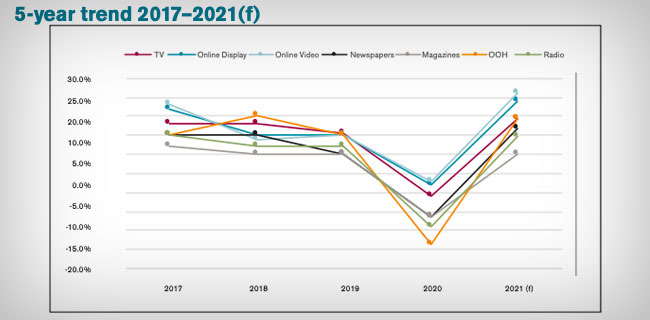
    Globally, media inflation has increased to 4 per cent this year worldwide, according to data from ECI Media Management.


    The forecast update for India is: “All media are forecast to recover from the shocks of 2020, with increasing inflationary positions. Online is expected to finalise at the highest rate of inflation, followed by TV and OOH. Magazines are forecast to have a zero inflation rate”


    Here’s the executive summary of the report:

    For many people across the world, it feels like life has returned to at least a version of normal, although the pandemic will inevitably have a long-lasting impact on the global economy and on how we live our lives.


    Lockdowns and stay-at-home restrictions are hopefully becoming a thing of the past as vaccine rollouts continue at pace, and consumers are slowly regaining the confidence to go out and spend money as economies recover.


    Media inflation in 2021 has reflected that increase in confidence. Overall media inflation is at 4.0% globally, with offline media reaching 3.5% and online 4.4%. The story is more complex and more interesting as we start to drill down into specific media types. TV has been the big success story of the year, despite the rise in CTV and speculation that the streamers would cause the decline of linear TV. TV inflation is higher than anticipated at the start of the year, and is recovering more quickly than expected as well.


    We expect it to have recovered to pre-pandemic levels by the end of this year in all regions except Latin America. Online media inflation has been less volatile than offline, and didn’t suffer the same dip at the height of the pandemic in 2020. This was in part thanks to the rise of CTV, which must also be held at least partially responsible for the significant deflation TV saw in 2020


    Online Display saw a marked decrease in 2020 in EMEA, but has recovered and inflated in all other regions.


    Meanwhile, Online Video has inflated across all regions, thanks to that shift to CTV. Interestingly, online is seeing higher levels of inflation globally than offline, but that is because Print is dragging down the overall offline figure; in fact, the offline recovery compared to 2020 is greater than online, albeit from a lower base. The story is of course different across regions and markets, depending on a swathe of factors including government responses to the pandemic, vaccine rollouts and economic health prior to the pandemic.


    The story also evolves with the changing context. That is why we at ECI Media Management release this update to our annual inflation report; with both consumer behaviour and media pricing so entwined with the prevailing economic context and, now, the recovery from the pandemic, it is crucial that marketers have up-to-date information easily available so they can make sound investment decisions, backed by data and reinforced by context.


    In this update, we explore the effect that the continued Covid-19 recovery is having on media inflation in key markets globally, how the outlook has changed over the course of 2021 and provide some initial thoughts as to what 2022 could look like. Our analysts across the world harness their deep knowledge of the advertising landscape with industry-leading forensic data analysis skills to understand how media inflation has evolved. Our information is derived from a number of sources, including our global network of experts, real client data and agencies. We cross-reference it with data from industry bodies and publications, as well as with agency traders and media vendors, meaning that it holistically reflects the expertise of those with an impact on trading variables.


    The report can be accessed at: https://www.ecimediamanagement.com/


  • Amazon, Asian Paints & Tata Tea are India’s Most Purposeful Brands: Kantar BrandZ India 2021

    By Our Staff


    India’s Most Purposeful Technology Brands Rank India’s Most Purposeful Non-FMCG Brands Rank India’s Most Purposeful FMCG Brands Rank
    Amazon 1 Asian Paints 1 Tata Tea 1
    Zomato 2 Samsung 2 Surf Excel 2
    YouTube 3 Jio Taj Mahal 3
    Google 4 MRF 3 Parachute 4
    Swiggy Tata Housing 4 Maggi
    Flipkart 5 Airtel 5 Britannia 5


    Amazon, Asian Paints and Tata Tea emerge as the most purposeful leaders in India across technology, non-FMCG and FMCG categories respectively. This emerged as insights and consulting major Kantar released the 2021 edition of its annual BrandZ India report on Thursday. This year, the report has moved gears to offer a ranking of 2021’s Most Purposeful Brands in India. According to Kantar BrandZ data, consumers believe that these brands lead with a clear sense of purpose to make their everyday lives better.


    The technology ranking has Amazon followed by Zomato, YouTube, Google and Swiggy jointly in fourth place, followed by Flipkart. The non-FMCG ranking is dominated by telecom brands, with Samsung and Jio jointly second, followed by MRF, Tata Housing and Airtel. The FMCG category ranks some of India’s biggest names: Tata Tea followed by Surf Excel, Taj Mahal, Parachute and Maggi both in fourth position and Britannia completing the list.


    Kantar conducted an analysis of 418 brands across 30 categories and found that in India especially, perceptions of a brand’s purpose, its ability to ‘make people’s lives better,’ is crucial to establishing a brand’s Meaningful quotient and thus, boosting prospects for growth.


    Said Deepender Rana, Executive Managing Director- South Asia, Insights Division, Kantar:  “Brand Purpose provides an anchor amidst constant uncertainty, both as a North Star for brands, but also as reassurance to consumers. Purpose as a contributor to brand equity is 10 times more important in India, in comparison to globally. This shows that a larger societal purpose is even more critical to success for brands in India. Of course, vague slogans and one-off ‘corporate charity’ events do not work, and it is not about jumping on the bandwagon of the latest fashionable cause either. Instead, real Purpose flows from, and builds on, a brand’s existing core values and DNA. This reinforces the need to understand and measure if a brand’s Purpose is perceived as adding real meaning to consumers lives.”


    Key Findings:

    2021 Kantar BrandZ data for India, in conjunction with other Kantar consumer sentiment tracking, has revealed several patterns in what Indian consumers deemed ‘Purposeful’ in 2021. Some of the key highlights:

    >> Amplifying or communicating purpose is critical.

    >> Tech brands show how everyday convenience contributes to brand purpose. These brands have been able to scale-up and showcase a wide range of products plus enter new categories at a time when consumers were desperate for at-home & delivery solutions. Everyday convenience in turn made lives easier and fueled saliency for brands

    >> FMCG brands are focusing on reducing their carbon footprint and taking a social stance. FMCG brands that score high on brand purpose have shown that purpose and profit can go hand-in-hand. They are working to reduce their environmental impact and promote social causes – which in turn attract customers, partners, and talent.

    >> Non-FMCG brands are now adopting marketing strategies that promote the brand in ways that look beyond the function of product or service; the key is to do more than just meeting consumers’ immediate needs, adding new and potentially differentiating associations.

    >> The Indian consumer, on a par with many of their Asian counterparts are actively engaging with sustainability; 77% are prepared to invest time and money in companies that try to do good


    Speaking about Kantar BrandZ’s report in India, Soumya Mohanty, Managing Director- Client and Quantitative, Insights Division, Kantar added: “Purpose can work as a strategy for brands, when it’s based on the right consumer insights, and executed effectively. In India, Kantar BrandZ data suggest that a brand’s Purpose ranking has a direct impact on its Meaningfulness score – which in turn is one of the cores, proven building blocks of brand value growth.”


    The Kantar BrandZ Spotlight on Brands in India 2021 Report, Rankings and extensive analysis are available online: https://www.kantar.com/campaigns/brandz/india