Category: ADVERTISING

  • Don’t poach our employees, JWT tells McCann

    By Ratna Bhushan & Rajiv Banerjee

    India’s largest ad agency, JWT, has asked its fast-growing rival, McCann Erickson, to refrain from poaching its employees. The move comes after JWT lost a dozen staff to an expanding McCann over the past few months.

    JWT has written to McCann more than once, two top executives familiar with the development told ET. McCann has not responded to this communication. Industry insiders characterise these letters as rare and unusual.

    JWT India CEO Mr Colvyn Harris said, in response to an email query, that the agency had merely cautioned its former employees. “We have a clause in our employee contracts which prevents ex-employees soliciting staff for a stipulated period, and as a process we remind them of their contractual obligation,” he said.

    Mr Prasoon Joshi, executive chairman at McCann Worldgroup and Mr Jitender Dabas, the agency’s senior VP and head of strategic planning, declined comment.

    McCann is on a hiring spree as it has bagged plum contracts, including those of telecom services provider Aircel, carmaker General Motors and paints company ICI Dulux. The agency has recruited at least 50 people over the past two months, with 30 in senior positions.

    JWT, on the other hand, has been struggling to fill 20-25 vacancies, an executive with a search firm told ET. The agency has recently lost half a dozen senior employees. “It is clear that JWT is trying its best to retain talent, particularly the people who have been working on the Airtel account,” another executive said.

    Mr Harris, however, disputed these claims. “This is the figment of someone’s imagination,” he said, “Factually, should we require people we have enough people applying to us.”

    JWT has been under pressure from some of its key clients who have entrusted independent agency Taproot with one-off plum assignments this year. These include beverage and snacks firm PepsiCo, which did not assign its biggest commercial of the year – the world cup campaign – to JWT, its creative agency for two decades. Bharti Airtel, too, turned to Taproot for a one-off campaign two months ago. Taproot is similarly working on a creative pitch for Mountain Dew, another brand handled by JWT.

    At the same time, McCann has been scouting for advertising professionals to service the two big accounts it has bagged recently – the Aircel contract, which is estimated at 200 crore, and the General Motors contract estimated at 150 crore.

    Source:The Economic Times

    Copyright © 2011, Bennett, Coleman & Co. Ltd. All Rights Reserved

  • Sushanto Biswas to lead Ford team at Mindshare

    By A Correspondent

    Mindshare, the flagship media agency of GroupM has recently appointed Mr Sushanto Biswas as Partner – Client Leadership. Based out of Delhi, Mr Biswas will be heading the Ford team at Mindshare India.

    Joining Mindshare from MPG, Mr Biswas has 13 years of rich experience in the media industry working with some of the top agencies. During this time, he has worked across a gamut of clients including HP, British Airways, Maruti, LVMH, Videocon, MTS and Reckitt Benkiser. He has also worked on the client side at LG and with Universal McCann on Gillette, Goodyear, Panasonic, MasterCard, GM and Microsoft.

    Commenting on his appointment, Mr Biswas said, “It is very exciting and at the same time very challenging to be part of the fastest growing agency in India. Auto as a category has always been a passion and I have had experience of the category, having worked on General Motors and Maruti previously. Ford has ambitious plans for the country over the next few years and I see this as a great challenge to craft media solutions in a hyper-competitive market place.”

    Welcoming Mr Biswas, Mr R Gowthaman, Leader, Mindshare South Asia, said, “Sushanto’s wealth of client and business experience makes him a vital asset to the Mindshare team. His in-depth understanding of behaviour and trends in the media industry will add incredible value to our clients.”

  • Kamal Oberoi steps down as M&C Saatchi CMD

    M&C Saatchi, the Indian arm of the UK-based global advertising agency, has announced that its India Chairman & Managing Director Mr Kamal Oberoi is leaving to pursue other professional and academic interests. Mr Oberoi founded M&C Saatchi’s India operations in October 2005. Since then, the agency grew to become one of the top 20 best advertising agencies in the country. He leaves behind a team of highly seasoned professionals capable of taking the company forward.

    On his exit, Mr Oberoi said “It has been great challenging and rewarding experience. I am grateful for support from all colleagues and for clients for reposing their faith in us. The company is poised for the next stage of growth.”

    Mr Chris Jaques, CEO, M&C Saatchi Asia said, “Kamal Oberoi is a legend in the industry, and rightly so. He has been an amazing leader of M&C Saatchi since the day he launched our company in India in 2005. Thanks to Kamal, M&C Saatchi is privileged to have a blue-chip client list and a first-class management team – one that is ready to take the company into the next phase of its exciting development.”

    M&C Saatchi Communications has offices in 22 cities across 15 countries, including Mumbai and Delhi.

  • McCann wins Agency of the Year at Mirchi Kaan

    By Shubhangi Mehta

    The 8th Mirchi Kaan Awards  were announced yesterday in Mumbai. McCann Worldgroup continued its dominance this year as well, bagging the Agency of the Year award.

    Prasoon Joshi, Executive Chairman, McCann Worldgroup, said, “We are delighted to have won this award. McCann has outshined as a strong agency over the years in this award. This is also special for us as Radio is a difficult medium to write for, unlike television, hence the team is even happier to have won this.”

    Prashant Panday, CEO,Radio Mirchi said, “The Mirchi Kaan awards are a very emotional event for us. This is a night we spend with friends and recognize and reward their brilliance. For us, the benefit is when radio becomes as creative a medium as television or print. We are happy with the way the creative quality has improved over the past eight years. The pride for us is the quality of the jury, and we owe a debt of gratitude to them.”

    The 8th Mirchi Kaan Awards received about 250 entries across 16 categories. In addition there were special awards for the best writer, best voice and the crystal award for most outstanding radio commercial of the year.

    The jury this year consisted of Agnello Dias, chairman and co-founder, TapRoot, Deepa Krishnan, president, creative, Lowe Lintas, Prathap Suthan, chief creative officer, Iyogi, Rekha Nigam, managing director, Vihaan Communications, Sunil Thoppil, vice-president, McCann Erickson, Ashish Khazanchi, national creative director, Publicis ambience, Josy Paul, chairman and chief creative officer, BBDO India, Amit Akali, senior vice-president and national creative director, Grey, Ramanuj Shastry, chief creative officer, Saatchi & Saatchi, Malvika Mehra, national creative director and senior vice-president, Grey, Prasoon Joshi, executive chairman and regional executive creative director, McCann Worldgroup, Meera Sharath Chandra, K S Chakravarthy, national creative director, Draftfcb Ulka and Manoj Shetty, senior creative director, Ogilvy India.

  • The Anchor: Satbir Singh on 7 reasons advtg is a serious business that allows much fun

    #1 Planning communication strategy requires serious thinking. Being entrusted with planning a communication strategy for a brand is no easy task and requires meticulous planning and perfect execution.

    #2 Creating campaigns requires seriously long hours and weekends in the office. Zeroing on the right idea and taking it to its final step takes time.

    #3 Executing ideas and shooting films amongst others requires travel sans any sightseeing. It might seem glamorous that one gets to travel to various exotic locations while shooting an ad, but the truth is that it’s all work and hardly any play.

    #4 On the other hand, working on different brands and different briefs on the same brands means no monotony.

    #5 It is a profession of very young people. The atmosphere is always exciting and never dull. The industry is full of youngsters who are brimming with fresh ideas and it’s always a learning experience to work with young people who often open up a new line of thinking.

    #6 For those who find it a draw, you could be working with top cricketers and Bollywood celebrities. Now that could be a perk of working with an advertising industry.

    #7 Seeing work that you’ve created on TV and around you is a massive pleasure. It is a deeply satisfying experience to see the idea that one has been working on finally taking shape and then reaching fruition.


    Satbir Singh is Managing Partner and Chief Creative Officer, EuroRSCG India

  • Proximity is digital creative agency for Nissan

    By A Correspondent

    Proximity will handle all digital initiatives including social media for Nissan X-Trail, Nissan Teana, Nissan370Z and the Nissan Brand initiatives including the Student Brand Manager program.

    Proximity India is the youngest agency of Proximity Worldwide, and is globally aligned to BBDO Worldwide. Proximity India offers talented communications experts with skills across the full range of relationship, digital and direct marketing services. The agency is focused on providing solutions and initiatives that are designed to change individual consumer behavior by creating “acts not ads”.

    Commenting on the win, Mr Ajai Jhala, CEO, BBDO / Proximity said, “Adding Nissan to our roster is a real privilege. The critical role of digital in this space will give us an opportunity to create some really impactful interactive ideas.”

    Mr Ranjeev Vij, VP & Head, Proximity India added, “Nissan is a fantastic global brand and in India they have ambitious plans. We are really excited that we can partner Nissan in challenging the market leaders and be a navigator in their journey to meet their ambitious business goals.”

    Proximity India has offices in Mumbai and Delhi and has worked on campaigns like Aviva’s “Great Wall of Education” initiative, which helped collect over one million books for the underprivileged children.

    Earlier this month, Proximity India won the digital mandate for the VISA brand in India. They also manage the digital duties for Nicorette.

  • Anchor calls for creative pitch

    By Shubhangi Mehta

    Anchor Switches, a subsidiary of Panasonic Electric Works Co Ltd, has called for agencies to handle their creative mandates.

    The account size could not be ascertained at the time of filing the report.

    In June 2010, where Anchor Electricals communicated its logo change and being a part of the Panasonic group, the company then launched the second phase of the logo revival campaign. The campaign was conceived for the end-user to understand and accept the benefits of this change and to showcase the Anchor range of products. The outdoor campaign had been conceptualized by Primetime Outdoors. The overall investment incurred for the OOH campaign was in the vicinity of Rs 7-8 crore.

    Anchor has been around for more than 47 years, constantly innovating and bringing quality products to the market. Anchor changed the way people look at switches by introducing India to the piano switch in 1976. It then went on to create offerings like Roma, the finest modular range of quality switches and accessories.

  • The anchor: Manish Bhatt on 8 things an agency does to keep the client in its pocket


    #1 Convince the client that an agency is not just an intellectual advisory but a partner in the company’s growth
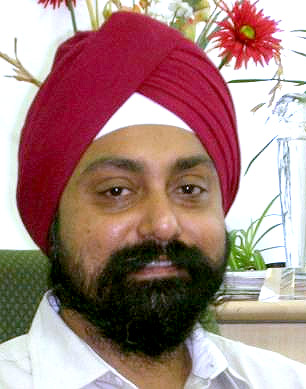
    The agency must be seen as a partner in achieving the company’s ROIs which may not necessarily be only in figures. Our role should not be restricted to that of being an advisory but should be seen as a stakeholder whose interest is in the growth of its client’s company.

    #2 Size does not matter; it’s the solution offered that matters

    An agency should not be seen as an ATL or BTL or any such term that is the stereotypical description. What matters is understanding the need of the client and offering the best solution to address his needs.

    #3 Show results on his brand

    It’s all talk unless you show results on the brand that you are working on for the client. One can start a relation like getting a business on the basis of your credentials but in the long term it’s the result that matters.

    #4 Make the client part of the process of the campaign

    While there is no denying that the client wants the aha moment or the magic factor from its agency but it’s also a fact that for greater success one needs to make client a part of the entire logical process of its communication. If the client is part of the process it will ensure that one is not still discussing briefs while making a presentation. Also this will ensure that the client is well aware of the building of the campaign and there is a common ground of discussion. Also reduces the chances of your ideas being rejected at the final stage when the client has been in the dark during the entire process and ultimately dislikes the communication presented.

    #5 Take him to Cannes!

    Make him part of a creative workshop that will help him in understanding the creative process and appreciate the nuances of what goes behind making an ad.

    #6 Show him that you eat, sleep and breathe his brand

    Any news on his brand or his category – just scan it and send it to him so that he appreciates your dedication to his brand.

    #7 Discounts are no deal

    This is a very common practice to make inroads into a client and his other brands. Give him a discount; reduce the retainer fee so that the business stays with your agency. This actually is a disservice to the industry as it reduces us to being mere traders and loses respect in the eyes of a client.

    #8 Jee Hazoori

    Agreeing to whatever the client says without applying any intellect. This clearly shows that you are more interested in keeping the business in your kitty and not in the growth of the brand.


    Manish Bhatt is Founder Director, Scarecrow Communications Ltd

  • Premjeet Sodhi’s Nascent Media: Stop over-simplification of media

    While, the core thought of this article about ‘over-simplification’ may apply to the overall domain of marketing, but I am using the setting of media planning to construct the view.

    Lets, first see what is the task or challenge that the media agencies take up in their business.Every advertiser expects the media planning agency to deliver performance for its business metrics. That is to say that – once a media plan is executed the brand manager expects sales to happen.

    Enough has been said about the increasing complexity of the market, the increasingly unpredictable and demanding consumer and the decreasing strength of brands. In such a scenario, the factors that lead to sales success are many. The classical models of marketing have now been replaced by far more dynamic models and media is only one of the many factors that influence sales. Hence, this is not a simple or easy expectation at all.
    Even a little bit of analytics will reveal that media has only got limited leverage to drive sales and this leverage varies for different categories and brands. However, there are other interim metrics leading to sales, such as brand recall, brand perception, brand enquiry, brand interactions, etc for which media can be held accountable for. There are so many marketing models and methods that help understand what a brand needs to deliver in media. None of these methods are simple.Looking at ‘media’ in isolation and expecting it to deliver sales is a naive simplification. 

    Media Planning is an intricate science. It deals with engaging extremely incredulous and volatile consumers to convince them of the merits of one of the score of brands that are available to them and possibly get them to move closer to buying the brand. In short, it deals with the wants and desires of people which can never be a simple subject to address.

    However, somewhere along the way in the past agencies have made advertises believe that this complex task can be broken up into two simple steps – (i) design the message and (ii) deliver the message to the desired consumer segment.

    Here, I will not comment on designing the message since I have already touched upon that in my earlier post titled “Creative is killing Creativity”. Lets look at the inherent simplification that has been cultivated in delivering the message.

    The first simplification was to strip each medium of its “qualitative” values and believe that each vehicle in a medium and across mediums can be represented by the measure of only “quantity”. 

    This made it very easy to measure media and trade media. One was only bothered about the count or reach as we call it. Research agencies made a killing setting up mammoth research projects measuring this lowest common denominator across media. Yes, there was a qualitative aspect but that was left to interpretation and application by the media planners. Now, we have the media planing community largely addicted and servile to these quantitative research databases totally oblivious to the qualitative value of the media they recommend.

    The second simplification was to believe that consumer minds can be affected just by managing the volume of this media measure. 

    The GRP was conceived – which is another simplification of the arithmetic that goes into making a media schedule and this GRP became the volume measure of  voice of the brand. Due to its simplicity, clients took to GRPs easily and it soon became a strong trading currency for media. Today, everything that is done is to create, deliver, manage, buy, sell – this GRP. This GRP comes in various reach and frequency packs and is available across media. This GRP has become the magic wand with which the client and the agency attempt to deliver market shares.

    The simplification is also evident in the remuneration structure that is prevalent in the industry. Everything that is done in communication is measured in terms of the traded value of media bought and the agencies are paid as a percentage of that. Since, actually estimating the real value contributed by media is difficult – so a percentage of spends keeps it simple.

    I guess, the whole media eco-system looks at the issues too simplistically and that is why “value-creation” is reducing day by day and leading to commoditization of media, media schedules, media talent and of media agencies. The advertisers will continue to simplify, but if, the media and advertising domain wants to enhance its value they will have to do away with this over-simplification. After all, Value is in the details.

  • Anil Thakraney’s Hard Knocks: The Bitch Boss

    This completely ridiculous reality show is now in its fifth season. Five, five, five, five… as the hosts Sallu and Sanju very irritatingly croon. Therefore how much ever many of us loathe Bigg Boss and its floozy contestants, we have to grudgingly admit the format works. It’s also worked in the western nations, where the show is called Big Brother.

     

    The serial is totally dumb in its content, and that’s by design. Because it is targeted at the low-brow viewers, and there are plenty such in every nation. People who look for cheap laughs after a hard day’s work, and particularly enjoy it when the contestants slam and abuse each other. Which is why the channel and its producer only pick people with shady backgrounds and aggressive demeanour…. even retards will do… as they are most likely to clash with each other. In fact, even to be offered a part in Bigg Boss is tantamount to a grave insult.


    It’s very tempting for me to trash Bigg Boss five, five, five, five, five. It’s a sitting duck for ridicule. Examine the fantastic star cast: Twelve dumb chicks, one transvestite and one confirmed sex pest. And two hosts, both of whom face criminal charges in assorted cases. And that’s just the start.


    But I have decided to hold my fire, grab some beers and catch the demented action whenever I can. Because the hard truth is this: There’s a big market out there for this sort of crap. And you can’t argue with business and TRPs beyond a point.


    Ganda hai par dhandha hai, as it’s often said.


    ***


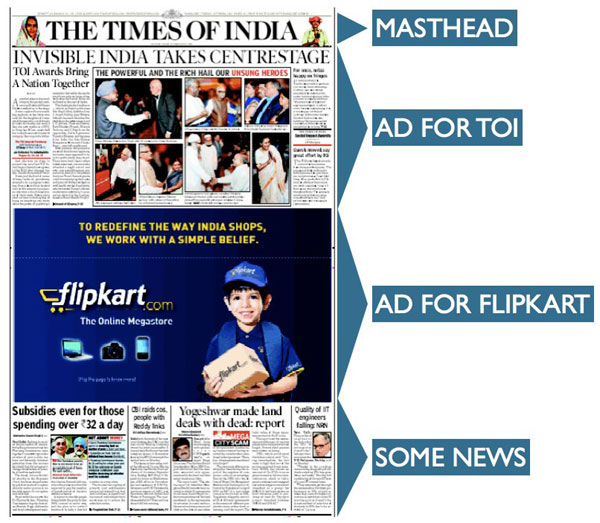
    PS: Found this image floating on the net. A good example of how valuable readers are to the publishers of the TOI. And the irony is that just a few days back the newspaper was gloating over its rising readership!


  • The Anchor: Sneha Iype recalls 8 memorable characters on Indian television


    #1 “Hein hein hein … hein hein hein…” Remember the head-bobbing rabbit from the Lijjat Papad commercial of yesteryear? That had to be the most memorable of the lot for me.
    The jingle got under one’s skin and in those days on television there was no escaping the ingratiating opening laugh of the rabbit with the papad.

    The rabbit and the jingle obviously catapulted sales and recall hugely for this amazing Shri Mahila Griha Udyog Lijjat Papad cooperative movement in its initial years, today a big marketing movement story by itself.


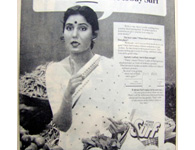
    #2 “Surf ki kharidaari mein hi samajhdaari hai…” Lalitaji is probably the most iconic symbol of Indian advertising. She stood for the discerning middle-class woman who made smart decisions for her home and boldly presented her case. Unforgettable.

     

    #3 “Doodh ki safedi Nirma se aaye…” The girl in white swaying to the ultimate melodious jingle was such a success that even after all these years the client can’t seem to let go of the tune in any of their communication. It’s obviously their trademark. Nirma was synonymous with the happy, hummable jingle.

     

    #4 “I love you Rasna…” Rasna came up with an idea of showing the mother-child relationship through their product. This gave birth to the very famous commercial featuring the Rasna Girl (Ankita Zaveri). The ad was revolutionary in more than one sense. Not only did it position Rasna as a family product, but also introduced the tagline “I Love You Rasna”, which became immensely popular among the masses. Rasna kept this tagline for many years to come.

     

    #5 “La la la la, la la la la la…” Sing it aloud. It’s truly refreshing.

    Yes, that’s what Liril did in 1985. It broke out of the sari and put model Karen Lunel in a swimsuit under a waterfall, creating history for the brand and for Indian advertising. Another case where the brand was synonymous with freshness and lime because of its pathbreaking visual and music.


    #6 “Jab main chhota ladka tha, badi sharaarat karta tha, meri chori pakdi jaati…” Roshni ki duniya ka sartaj Bajaj. A most endearing film and a truly enjoyable one too. I can still watch it and enjoy it.

     

    #7 A boy and his dog. They were an icon for the “wherever you go our network follows” line. Vodafone , in those days “Hutch”, launched with this amazingly simple campaign and showed no phone in a commercial that communicated network. A big hit.
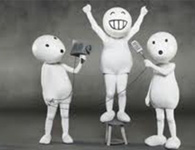
     

    #8 The Zoozoos were the IPL season 1 superstars. They stood for innovation and a great media tool with the release of one ad a day through the IPL series. They blew the minds of millions, giving Vodafone a huge edge in the advertising of their value added services. Very fresh and very cool too.


    Sneha Iype is Executive Producer, Nirvana Films