
Category: ADVERTISING

  • Newspapers Must Stop Cheating Readers


    By Sanjeev Kotnala


    Sanjeev KotnalaMy Twitter timeline tells me that newspapers are cheating their readers with what is necessarily advertisements masquerading as news. Maybe it is their necessity with dropping advertising revenue. Unfortunately, it is weaning away discerning readers.


    The Truth Remains Unchanged

    Readers buy newspapers for news/ infotainment and not for advertisements. Many readers depend on news and other content in the newspaper to take decisions in their lives. I may be exaggerating the last bit, but even in the digital age, it holds true at least in the Tier-2 and 3 towns. Print still has a role to play.

    Native advertising was earlier considered a digital news problem. Today, it finds itself in newspapers, what they claim to be advertisers-influenced behaviour.

    A reader expects their newspaper to highlight the sponsored content, disguised advertisement, advertorial, or native advertising. Not doing so is breaching the reader-newspaper trust.

    The lack of clear and well-regulated norms/rules/guidelines for such disclosure is in many ways responsible for readers’ failure in identifying native ads.


    Is the Bold Editorial Dead?

    WNP;-What’s new in publishing laments the fact that the old editorial guards are dead and buried. The kind that believed in preserving the objectivity in newspapers. They would never think of collaborating with brands to help them mask their advertisements as editorial content. From their perspective, native advertising is unethical and deceptive. It only shows disrespect for media consumers. They fear it might push journalism over the edge, to the point of no return.


    The Ugly Side

    The same article points out. Some editors don’t have anything against native advertising. On the contrary, they believe, if appropriately incorporated, sponsored content could bring significant financial benefits and help publishers protect their businesses while also bringing value to readers.

    A two-year-old estimate says that native advertising generates 18% of overall advertising revenues, and publishers expect it will reach 32% by 2020.

    Now is that not alarming as a reader.


    The Breach of Trust

    I further quote from the above report. ‘Journalists are expected to unbiasedly report, with their end goal of accurately informing the public. When sponsored content comes into the picture, the motives change as their goal becomes profit-oriented. Journalists then agree to tell stories that fit a brand’s marketing objective. They do so in exchange for money, which automatically undermines their professional role’.

    If that not a breach of trust, then nothing is.


    Secular Guidelines Should Apply to All Media

    There is a high decibel demand on social media influencers to specify if the content is sponsored and paid. Ironically, the coverage of ASCI (Advertising Standards Council of India)  guidelines for such acts in digital content on platforms, such as Facebook, Instagram is in the newspapers known not to follow the guidelines. The industry is applauding ASCI for the welcome step.

    It is beyond my understanding why should similar guidelines not apply to all news media. Why newspaper as a respectful infotainment provider not be hauled for this breach.

    ASCI is trying to control digital when it has failed to control it in newspapers.

    I found an advisory for TV advertising but failed to see one for print.

    I am sure the guidelines exist. But, how often have they been used to bring errant newspapers to the task? My tweet request to ASCI on the subject went unanswered.


    Native Advertising/Sponsore Content – Not New

    Native advertising is not a new format, as many newspapers would want us to believe. Wojdynski and Evans (2016) define native advertising as “any paid advertising that takes the specific form and appearance of editorial content from the publisher itself”. It is considered effective if the media can mimic the content produced by journalists and, through such advertising, gain the same credibility as news.

    A study across five European counties observes that news outlets do not follow a consistent way in disclosing native ads visually, negotiating the balance between transparency and deception. In this balance, news organisations do not boldly push for transparency and instead remain ambiguous. Their analyses showed that both national and organisational characteristics matter when shaping the visual boundaries of journalism.


    The Root Cause

    The problem is newspapers over-dependence on advertising revenue. And advertisers desire to see enhanced efficiency/ROI for newspaper advertising. Everyone getting on the bandwagon cannot be an excuse for other newspapers to follow it.

    Really what defines such unethical behaviour is the organisational ethos and an understanding that they can get away with it. Each newspaper is trying new means to avoid flagging such content.


    No One Will Bite The Bullet

    The newspapers must bite the bullet of upping their cover price even at the cost of losing the fringe readers. It may seem a dangerous strategy, and maybe it is when done in isolation. But, collectively executed, it is what the doctors prescribe. The business model needs an overhaul.


    Alarm Bells

    No surprise that a 2017 report by International News Media Association (INMA) and The Native Advertising Institute (NAI) found something alarming.

    • Slightly more news media companies are offering native advertising as an option, 51% this year compared to 48% last year.

    • Last year, 35% of publishers surveyed described native advertising as “very important” to their companies. This year, 50% did.

    • Last year, 26% of publishers were working with an external agency to deliver native advertising. This year, that number is half at 13%.

    • 27% of news media companies surveyed have a dedicated native advertising team, up a bit from last year’s 20%.

    You realise how alarming the issue.


    The End

    There is no denying that it is becoming more difficult for readers and regulators to identify the advertising content masquerading as news and, therefore, misleading and deceptive. It is challenging to regulate, as there is no standard format. Newspapers find new ways and captions to sidestep the issue and need to flag such content.

    It is time for ASCI to focus on it. It will help the readers and the industry.

    Why pinpoint social media influencers and expect them to flag the sponsored- paid-for content and allow newspapers to continue having a ball. Some visible practical steps will help.

    ………….

    One may further read this report; native Advertising in India: How one company set the benchmark.


    Sanjeev Kotnala is a senior business and marketing strategist and educator. He writes on MxmIndia every Wendesday. His views here are personal


  • iProspect is now a digital-first media agency

    By Our Staff

    Dentsu international launches the new iProspect as a digital-first end-to-end media agency. The iProspect teams will now collectively define a new era in media and be the first agency to offer performance-driven brand building at a global scale. iProspect has adopted the “Brands Accelerated” tagline.

    Amanda Morrissey
    Amanda Morrissey

    Said Amanda Morrissey, Global President, iProspect: “We are a new force in the industry, one that draws on decades of expertise carefully brought together to create an agile, scaled, digital first organisation built for the future and delivering today. In fact, the only thing that has stayed the same is the name, but even that looks different. With precision and at pace, the new iProspect is able to learn, flex and scale its output to transform a brands’ performance and provide effective business growth; immediately and in the future. Created from the ground up, the new agency has been collectively built by 93 local market teams working together and understanding the necessity for global consistency yet having the insight to locally adapt for their unique client, consumer and market demands. With this approach, the new iProspect is not a classic top-down ‘one size fits all’ global agency model, but more of an ‘all sizes fit within’ agency framework, with the same global vision and purpose”

    Rubeena Singh
    Rubeena Singh

    Added Rubeena Singh, CEO, iProspect India, “With the launch of iProspect’s new structure, we are extremely proud to be the first agency to offer performance-driven brand building at scale. Over the years, our mission and vision have definitely evolved and with the rapidly evolving environment, one has to change. The one thing that has stayed constant is that we continue to remain focused on driving business results for our clients. By launching as a new digital-first end-to-end agency, we at iProspect, look forward to bringing future-ready solutions, which will further accelerate brand growth for our clients. With the might and scale of Dentsu behind us, this structure is indeed set to define a new era of performance-driven brand building, not only in India but also globally.”


  • 11th IAA Olive Crown Awards postponed

    By Our Staff


    The revised Maharashtra government regulations on events have led to the postponement of IAA India’s Olive Crown Awards.

    Neeraj Roy
    Neeraj Roy

    Said Neeraj Roy, Chairperson of the Olive Crown Awards Committee and a Past President of the IA: “We have been monitoring the rising cases of Covid-19 in our state very closely, which is why we had taken a decision nearly 4 weeks ago to hold the awards with no more than 50 people in attendance and also ensure all safety of our guest and enforce strict social distancing norms. Whilst we are keen to celebrate the success and creative work in a difficult and challenging year like 2020 towards sustainability and a greener planet, nothing is more important to us than the safety and well-being of our members, our invited guests, winners and indeed all stakeholders associated with the IAA Olive Crown Awards.  Late last evening, the government of Maharashtra has issued an order, dated the 15th of March, 2021, stating that “No Social/Political/Religious gatherings to be allowed.  Respectfully we adhere to the guidelines issued by our government and in light of the same, we have taken the decision to postpone the 11th edition of the IAA Olive Crown Awards, which was scheduled to be held on the 19th of March, 2021 at the ITC Maratha Hotel in Sahar, Mumbai.”

    Megha Tata
    Megha Tata

    Added Megha Tata, President IAA, “The Olive Crown Awards ceremony are a big draw, more so since the entire process is run as a cause. We were happy that despite the extraordinary circumstances that prevailed last year, the entries, and more importantly the quality of the entries was encouraging. We will wait for the current situation to improve and then announce the winners at an appropriate event.”


  • Anugrah Madison to promote Dabur Nasal Drops

    By Our Staff


    Anugrah Madison has launched a campaign to promote Dabur Ayurvedic Nasal Drops. This is to initiate the safety of Covid-19 warriors against breathing congestion this winter. The Khul Kar Jiyo, Surakshit Raho campaign focuses on policemen, security forces, watchmen, security guards and newspaper vendors working late nights in New Delhi.

    Said Dr Durga Prasad, GM – Marketing, Ethical Portfolio, Dabur India Limited: “Dabur Nasal Drops (spray format) combines the rich experience of Dabur with the therapeutic benefits of Shadbindu Tail, Anu Tail and Badam Tail. The Shadbindu Tail is believed to have a cleansing action on nasal sinuses, Anu Tail possesses nourishing properties and is beneficial for healthy body parts above the neck level. Badam Tail has antioxidants and help soothe inflammations. It is useful in cold, headaches to cold and nasal dryness in extreme cold seasons. The brand acknowledges people’s beliefs and contributes to their faith by doing their bit towards building a healthier community. Anugrah Madison and Dabur continue to collaborate in ventures that work towards the growth of brand and community”

    Added Sunny Vohra, CEO, Madison Turnt & Anugrah Madison: “The ongoing coronavirus pandemic combined with the Delhi winters takes a lot of planning and team effort to executive an on-ground campaign of this scale with safety and precaution. We’re proud of the way the team planned and executed the Dabur Nasal Drops campaign.”


  • Madison Digital appoints Tushar Ghagwe

    By Our Staff

    Tushar Ghagwe
    Tushar Ghagwe

    Madison Digital has appointed Tushar Ghagwe as Associate Vice President. He will head the agency’s Bengaluru operations and will be reporting to Dinesh Rathod, CEO, Madison Media Omega, and Vishal Chinchankar, Chief Digital Officer, Madison Digital.

    Said Chinchankar: “Glad to have Tushar with his astute and proven experience in digital marketing in Madison Digital. Over the last two years, Madison Digital has clearly emerged as one of the leading full service digital agencies. With Tushar joining us, it only strengthens our position in digital services. We are looking at reaching even greater heights.”


  • With 11% annual growth, India will be fastest telecom adspends market: Zenith


    By Our Staff


    Zenith forecasts that India will be the fastest-growing market for telecom advertising between 2020 and 2023 by some distance, with 11% annual growth. According to eMarketer, only 31% of the population currently has a smartphone, but thanks to the launch of low-price handsets such as the JioPhone, this proportion is rising rapidly.


    Said Jai Lala, COO, Zenith India: “The telecom sector in India in 2021 is anticipating a robust growth on the basis of an increase in tariff pricing, demand for data, growing number of mobile users and hopefully the launch of 5G in the last quarter. This will lead to a substantial increase in media investments by the key players especially on Television & Digital”.


    Overall, Zenith predicts that telecoms advertising will grow at an average rate of 4.5% a year to 2023 as its recovers from an 8.7% decline in 2020. According to Zenith’s Business Intelligence – Telecommunications report, telecom adspend in the 12 key markets included in the report will rise from US$17.8bn in 2020 to US$18.7bn in 2021, and then return to its pre-pandemic level of US$19.5bn in 2022. The 12 markets included in this report are Australia, Canada, China, France, Germany, India, Italy, Russia, Spain, Switzerland, the UK and the US, which between them account for 73% of total global adspend. Telecoms is defined as services and equipment facilitating the transmission of voice calls and data by land lines and mobile networks.


    Smartphone sales will start to spring back this year once consumers feel more confident in their future. Consumers are becoming more willing to finance and purchase handsets independently from their network providers, giving manufacturers and retailers a greater incentive to advertise handsets themselves. Meanwhile, the networks will seek to recoup their investment in 5G licences and infrastructure through new services and more expensive data packages. All these trends will help fuel healthy growth in telecoms advertising over the next three years. Zenith predicts telecoms adspend will grow 4.7% in 2021, 4.4% in 2022 and 4.3% in 2023.


    Digital platforms help telecoms brands demonstrate relevance to exacting consumers

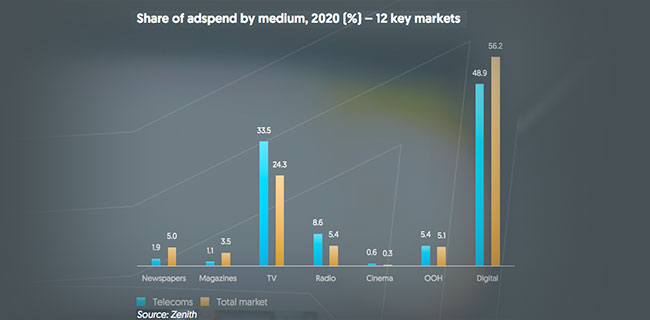
    Voice and data services are commoditised and functionally indistinguishable to consumers, who expect them to work flawlessly in the background and only pay attention to them when they go wrong. High-impact advertising in mass-audience media like television and radio allows telecoms companies to differentiate themselves from others through branding, and makes them more relevant to consumers by promoting their association with things consumers are passionate about, such as entertainment, sport and music. Telecoms brands therefore spend substantially more on television and radio advertising than the average brand – in 2020 they spent 42% of their budgets on television and radio, while the average brand spent 30%.


    But as audiences migrate online, telecoms companies are refocusing on communicating their brand narratives to mass digital audiences. Telecoms brands spend less on digital media than average (49% of their budgets went to digital channels in 2020, compared to 56% for the average advertiser), but digital advertising is also the only channel in which telecoms adspend is increasing. Zenith forecasts that telecoms brands will increase their digital adspend at an average rate of 5% a year between 2019 and 2023. By 2023, digital advertising will account for 54% of all telecoms advertising.


    “Covid-19 has demonstrated how dependent we are on good, fast and reliable internet connections. Telecoms companies have been the unsung heroes of the pandemic, shifting our lives online and keeping us connected to entertainment, work and commerce,” said Ben Lukawski, Global Chief Strategy Officer, Zenith. “Their challenge is to go from being unsung to being acknowledged and appreciated for their efforts. The spread of 5G and the reality of our new-found virtual lives give telecom brands the opportunity to move into the limelight.”


    Telecoms brands are cutting back their spending on traditional television and radio as their reach declines, but less rapidly than brands in most other categories. Zenith forecasts that between 2019 and 2023, telecoms brands will reduce their television adspend by an average of 2.0% a year, compared to a 3.5% annual reduction across all categories. They will also reduce their radio adspend by 2.8% a year, compared to 4.1% a year for the market as a whole.


    Russia as well

    Russia is another market with relatively low (57%) but fast-growing smartphone penetration, and here telecoms adspend is forecast to rise rapidly too, by 8% a year.


    Most of the other markets in this report are forecast to grow by between 3% and 6% a year to 2023. The exception will be France, not because of any inherent weakness in demand, but unlike those in most markets, French telecoms brands actually increased spending in 2020 – by 6% – in response to the extra demand for data. The basis of comparison with 2023 is therefore considerably tougher.


    “The rollout of 5G services will allow mobile operators to supply bundled voice, data and entertainment services to the home and compete directly with landline broadband,” said Jonathan Barnard, Head of Forecast, Zenith. “This will spur greater competition to put together the most attractive services at the best prices and help stimulate a sustained recovery in telecoms adspend to at least 2023.”


    .


  • Dentsu Data Sciences unveils industry position paper

    By Our Staff

    The Data Sciences Division of Dentsu international India has published a new industry position paper ‘Who Ate My Cookie’ under its specialist consumer insights wing Dentsu Marketing Cloud (DMC) Insights. The report details both the challenges and opportunities faced by marketers, publishers, consumers and data brokers as they struggle to adapt to a changing ecosystem landscape built for a privacy-first world.

    Cookies have for long a time been the cornerstone of digital marketing ever since their inception in 1994. They have been the basis of digital advertising. With a goal to deliver more relevant ads to consumers, companies have amassed troves of customer data via third-party cookies, which eroded customer trust. This industry position paper aims to describe the shift and need toward a privacy-first world by demystifying ecosystem changes and attempts to provide guidance to marketers and publishers on navigating a “privacy-first” online world devoid of third-party cookies.

    Gautam Mehra
    Gautam Mehra

    Said Gautam Mehra, Chief Data and Product Strategy Officer (Asia Pacific) and CEO Dentsu Programmatic: “The digital revolution that created so many new business and marketing opportunities is now driving the customer revolution. Developing strong customer relationships has always been fundamental to building a successful business practice. This becomes more vital in a privacy-first world. Through our position paper, we endeavour to assist the industry in navigating through the fast paced ecosystem changes and provide guidance on a few possible solutions to strengthen customer experiences with privacy at its core.”

    Nishant Malsisaria
    Nishant Malsisaria

    Added Nishant Malsisaria, Vice President– Product Strategy (Asia Pacific) Dentsu Data Sciences: “To succeed in the new customer-driven environment, organisations must be able to use consent-based information, technology and analytics to deliver relevant customer experiences across channels. A privacy-first world promotes the need to develop first-party data sets in a far more secure and privacy-focused way. Future competitive advantage will depend on the ability of brands to have more control over their audiences in a trust based world.”


  • Mind The Gap… between Expectations & Experiences


    Sanjeev KotnalaBy Sanjeev Kotnala

    It was a lovely breezy evening at Nirvana Cottage in Mukhteshwar, Uttrakhand. At 7,100 feet and some 72 Km from Haldwani, the temperature was a bone-chilling 2-degree centigrade. The bonfire and our favourite Old Monk was working overtime to keep us warm. I was facing a tricky situation in Life. The experience not even coming near the expectation. Everything was against me. Fight, Flight or Freeze! Action, reaction and Inaction! I expected everything to work against me. My friend, philosopher and guide, Vermajee; the marketing consultant was my last stop of confession and advice.

    I was not to be disappointed. After the third peg of Old Monk with Coke, ever-dependable Vermajee opened up and the shower of gyaan started. ‘Life is an experience and a journey into unchartered terrain. We may be on the same train but can have different expectation and experience. After all, we have our own filters. After the two truths of Life, the birth and the certainty; death, everything is probabilistic in nature. Everything is a transaction. There are expectations and experiences. In fact, we are living our Life all around these two dimensions. Even emptiness, meditation, self-lessness too has these two elements of expectation and experience’.

    I was impressed. It felt like Arjun with Lord Krishna. It was all about loyalty and dharma.

    Having interacted with Vermajee, I sincerely believe that there is a market for a Corporate Swami. Let me park that thought.

    Vermajee who chooses his battles well continued. ‘You must manage the E-Gap in your Life. Life is simple. Don’t complicate it’, Initially, I did not know where the discussion was going. Still, a part of me desperately agrees to what he was saying.

    ‘We all try to be responsive to changing expectations and have our expectations. For us to be happy and at peace. The experience must exceed expectation. That’s where the catch is because the expectations are telescopic in nature’.

    Vermajee took another gulp from his glass, I realised it will need a refill soon. He looked up seeking answers from the milky way that was visible in the clear sky.

    ‘We all look for engagement and involvement, try to be innovative in finding solutions, create an ecosystem of family and friends as supporting audience. We use every trick Shaam (logic), Daam (price), Dand (Penalty) and Bhed (differentiation) get our view based on our past experience and re-negotiated expectation’.

    ‘We prioritise as per our needs and situation. Life is all more about what to sacrifice than what to do. We evaluate our potential and capabilities. Challenge the ever-present possibilities. Try balancing the narrative and POV’s of the stakeholders, hoping things will follow our expectations’.

    He now looked me square in the eyes. With a smile, he said, Sanjeev, Life is two-dimensional; Expectation and Experience. The actions, reactions and inactions, strategically or otherwise, resulting from E-Gap; emotional gap between the expectations and experience. Nothing more’.

    ‘By nature, every episode in Life real or perceived, intentional or unintentional, selfish or self-less has an element of expectation attached to it. The expectation can be tangible or intangible, emotive or functional, numeric or expression-based. Even when our experience is not detailed out, expectation exists. Our rational arguments and logical inferences, along with emotive, irrational thoughts define our expectations’.

    ‘Unfortunately, we remain self-centred, lacking the empathy to view situations by getting into other party shoes. We ignore our critique and feedback. We tend to negate history, along with changing expectations and experiences. We must take them into consideration. Look at the pain and pleasure points of stakeholders in our ecosystem. They are the best indicator and directional pointers to future possibility. The pleasure points are our experience enhancers, and we tend to just become comfortable with them’.

    ‘To create likeability to satisfy our misplaced egos, which anyway results from past expectations and experience, we make Life complicated. We tend to ignore weighing the possible impact and relevance of our actions in the long term’.

    ‘We rarely voice our expectation, agreement, and prioritisation. And we expect the outer environment to understand the unsaid expectation and the experiences to follow it. The complete experience has multiple small prioritised experiences. In Life all, experiences have foreplay and follow-up. Hence, the brands must look at the complete scope of experience and expectations’.

    The marketing consultant Vermajee toyed with my confused look. ‘Hence in Life, there is a premium on consistency and authenticity. Our repeat experience re-establishes, re-strengthens or negates the experience or the resultant perceptions. We know, perceptions, the resultant summary of expectation and experiences is more real than the truth. A recent experience is benchmarked against expectations and past experiences. Hence consistency and authenticity are a critical element in all our relationships’.

    ‘To make Life simple, we must constantly re-evaluate expectations and examine the experience feedback. We should Pause, reflect on the existing E-GAP. Absorb the learnings. Tweak, redraft-recraft wherever required and move on’.

    ‘Our capability to re-align experience to expectations and vice versa should be a constant process in today’s dynamic world of interlocked ecosystems of relationships. So, go ahead, and land evaluate your actions against not only your expectation and experiences but also other’s expectations from us and the experiences we deliver’.

    I was surprised at the new avatar of Vermajee, and it was natural for me to ask, how did it happen? Where did you get these insights into Life?

    Vermajee smiled and looked disappointed with my observation. He then told me the secret. ‘I am a brand and marketing consultant. A brand is a living entity just like you and me. A social entity which must appreciate realities.  What I told you is no different than what I will tell the brand. In case you feel different, just read the above by replacing you with a brand, and it will read the same’.

    ‘The whole branding and marketing game, sales and delivery, product design and innovation, service and recovery geared to create preferences and premium works around Expectation and Experience. Everything that any brand does is manage the E-GAP, the resulting emotional gap between the Expectation and Experience. Hence, the brand must manage expectation and experience. As the expectation results from many things that may not be in total control of the brand, it’s the experience that the brand must manage’.

    I know my expectation from Vermajee was getting higher by the day and he is going to find it really tough to match it with experience. But, let’s keep it simple and leave it for the next time.


  • Dentsu X India tops RECMA’s dominant agency again

    By Our Staff

    RECMA has acknowledged Dentsu X as the most ‘dominant agency’ of India for the second consecutive time. The diagnostic report released on December 2, 2020, audited the performances and competences of 17 agencies based on 18 criteria. This in-depth report captures competitive pitches, agency momentum, resources and the client profile of each agency. The report was released in December and we are now nearing the end of March, but we just received this communique.

    Divya Karani
    Divya Karani

    Said Divya Karani, Chief Executive Officer, Dentsu X India: “It is a glorious recognition of the remarkable work that we have put in towards our ‘experience beyond exposure’ thinking and deep client partnerships that effect business outcomes. We are a team that sets itself tall goals and then does all it takes to achieves them!”


  • Madison Media exits Sri Lanka

    By Our Staff


    The directors of Media Factory have just announced that they have purchased the majority stake held by Sam and Lara Balsara of Madison World in Madison Media SriLanka Pvt. Ltd and the company will now become a fully owned subsidiary of Media Factory Pvt Ltd. The Balsaras  have exited the Sri Lanka business. Sam Balsara has also resigned as a Director of Madison Media Sri Lanka Private Ltd. and the company’s name has been changed to Midas Media Pvt Ltd.


    Both parties have agreed that Midas Media and its affiliates, associates and owners, Media Factory will immediately stop using the Madison name in any manner whatsoever nor claim ownership to the name Madison. Further, Sam and Lara Balsara and Madison in India or Sri Lanka will no longer be liable for any actions or financial liabilities or damages past, present or future of the company nor will they benefit from any financial assets or accruals to the company of the past, present or future for which they have not been compensated. Sam and Lara Balsara will also not claim any right or ownership to the name Midas Media Pvt Ltd.


    Said Sam Balsara, Chairman, Madison World: “We entered the Sri Lanka market, 12 years ago with the launch of Airtel in the country. Over the years we have built some great relationships both personally and professionally and I hope to continue those. I wish the current Directors of Media Factory and Midas Media all the very best”.


    Added Kapila Vidanagamage, Director Media Factory: “Our relationship was based on mutual trust and respect. We understood the expectations at a very early stage and were able to deliver to the complete satisfaction of our local clients, but more importantly our partners in India. I would like to thank Sam and Lara for their trust and eventual friendship and would like to wish them both the best in all their future endeavours.”


  • Paree Sanitary Pads collaborates with film Saina

    By Our Staff

    Hygiene brand Paree Sanitary Pads collaborates with Bollywood’s newest release – Saina, a biographical sports film starring Parineeti Chopra as Saina Nehwal. The brand in its endeavour to empower women associates with the film.

    Said Sahil Dharia, Founder and CEO, Paree: “We at Paree are committed to create a sense of confidence in every girl and to be a champion by prioritizing her needs. Our Paree girl is born empowered; she just needs her wings so she can shine. It is gratifying to have Saina as the voice of our brand and our philosophy. Her persona is truly inspirational, and her ambitious aura strengthens the spirit of womanhood among youth. Through this association we have taken our vision to a larger platform that we believe can encourage and motivate every girl to dream big and be a go-getter like Saina and Parineeti.”

    Added Vinod Bhanushali, President – Media, Marketing, Publishing (TV) and Music & Co-Producer (T-Series) of Saina: “Through this visual montage, Paree aims to create a platform for women to shine and encourage them to champion through every challenge. Paree has been a pioneer in the women hygiene space with innovative and progressive approach on menstruation. Saina is a story of a young girl who dreamed, fought all odds, and challenged herself to become World No. 1 badminton champion. The brand collaboration was a perfect fit for the film.”


  • Goafest: No News is Not Good News


    By Sanjeev Kotnala

    Sanjeev KotnalaIt is that time of the year. Goafest time. For the last 15 years, until 2020, Goa was my annual advertising, marketing, networking pilgrimage. I have attended every edition of Goafest.

    I have associated with Goafest in multiple capacities. I have been a delegate, a sponsor, an awardwinner and a jury member. Oh, I have rebelled by attempting to hijacking one evening with a successful standalone show. Few unfinished stories started at the Goafest and never reached a conclusion. I led cross-functional teams to publish the daily newsletter, including the first 3D issue at Goafest. Once, I objected to some Swami’s presence as a speaker. Pushed for more respect and participation to Publishers’ Abby.

    I have been an observer who regularly provided unsolicited inputs and suggestions. Some of them found the right ears and minds to impress and were implemented with no credit. But that’s par for the industry, or I think some else too had similar brilliant thoughts at the same time.

    So, it is natural that towards the end of March and the first/second weekend of April, I am full of nostalgia. My mind longs to be at Goa and enjoy the festival of advertising excellence. Thankfully, there are no withdrawal symptoms.


    GOAFEST 2020

    Goafest 2020 was rightfully postponed as the entire country was reeling under the spectre of the Covid-19. Later, Abbys were also deferred. The Red-Abby, which was to have its maiden appearance, remained silent. Later the whole show was cancelled.


    GOAFEST 2021

    One expected 2021 to be better. But, the Covid pandemic is back with a vengeance. The organising bodies AAAI and Advertising Club are silent. There is no announcement I know of.

    Don’t think there is any time left. In all probability, Goafest 2021 is dead.

    The question that stares you on the face is not so simple. Will Goafest ever be revived? There is no reason to believe it is dead! But most people do not see many reasons for it to be restored.


    FESTIVALS ADAPTING TO CHANGE

    I do not understand. When most of the awards have adapted to the new realities and have gone online or found other ways to celebrate, what stops from Goafest from doing the same?

    Is Goa the problem? Goa and virtual fun – does not sound right. What about the drinks? The tamasha? The knowledge sessions? The manpower poaching and interviews? Maybe, this is the right moment to get Goa out of Goafest. Maybe, it is time to get back to celebrating the excellence in Advertising and Marketing and be location-agnostic.


    ABBY COULD HAVE CONTINUED

    The Advertising Club says on its site: ‘ Recognition of efforts is what motivates an individual. And for an industry that thrives on motivation, the Ad Club has initiated various awards to ensure that Indian ad professionals receive the recognition they deserve. The ABBY AWARD are the Oscars of Indian ad awards to honour creative excellence in advertising.”

    So, when  Cannes changed its format and dates, it allowed a rich interaction with archives and sessions.  Adfest Pattaya went online and announced the winners of the last two years. Near home, award functions continued. Virtual webinars and exhibitions thrived. Knowledge seminars buzzed with suitable content and names… so what about Goafest? Kyoorius Award have started the entry process and were successfully conducted last year – what stops Goafest? Meanwhile, I read about the Filmfare Awards 2021, when the industry was almost shut for the last year. As I write this, I wait to watch the Mirchi Music Awards.


    EXPECTATION AND EXPERIENCE

    Goafest has evolved with time. Setting up new expectations and creating experiences to bridge the gap. So, what stops it from taking that leap of faith and get to a 2021 Goafest version going.

    Don’t the organisers have the responsibility and direct accountability to the community of agencies, clients, researchers, PR and marketers. Should the elected body at Ad Club and AAAI not go the extra mile to see it happens.

    2020 is understandable. But what about 2021.

    Why is no one asking and raising the voice?

    Or maybe Goafest does not call for such concern!

    Maybe, it is just me who is paranoid about the changes and what it could spell for Goa in Goafest.

    The industry has worked within imposing constraints. Brands and agencies innovated to find new ways to create fabulous relevant-original and impactful work.

    Should these industry warriors go unrecognised?

    Or do we plan to have a three-year award show in 2022 – subject to fair weather conditions.


    THE INDUSTRY NEEDS POSITIVITY  

    The economy, business and the advertising-marketing fraternity can definitely do with some positivity and celebration. Offline or online. WFH or lazing around in Goa. Remember, consistency is always a winner. Voids and absence give rise to many uncomfortable thoughts. Frankly, I can’t think how we will bridge the gap if Goafest is not held this year.

    Sanjeev Kotnala is a senior marketing and business strategist and educator. He writes on MxMIndia every Wednesday. His views here are personal